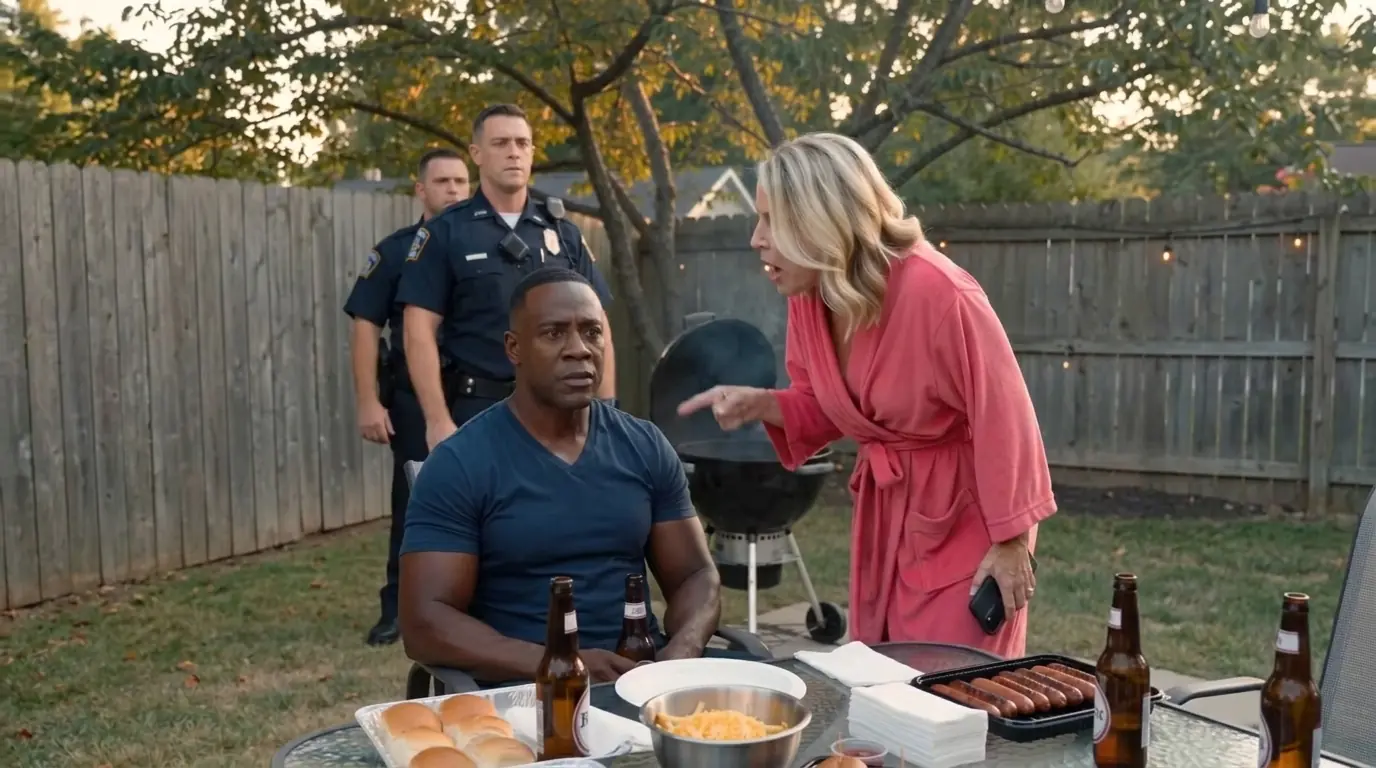
The first thing Patricia Langford told the emergency dispatcher was that four suspicious men had taken over a backyard in Stonebridge Glen. She said alcohol was involved, the men were loud, and one of them had acted aggressively when she tried to ask questions. She mentioned possible drugs twice, even though she had not seen any. What Patricia did not mention was that she was standing inside my fenced yard while making the call.
My name is Marcus Holloway, and I had owned the house at 742 Meadow Creek Drive for a little over four months. That Saturday afternoon, I was standing beside a smoker checking ribs while three of my oldest friends argued over whether Baltimore had any chance of making it through the playoffs. Terrence Cole sat at the patio table eating chips straight from the bag, Darius Bennett was fighting with a folding chair that refused to lock correctly, and Nolan Price had taken responsibility for the drinks. Until Patricia walked through the gate, the most dangerous thing happening in my yard was Terrence’s opinion about quarterbacks.
“Yes, they’re still here,” Patricia said quietly into her phone.
She stared directly at us.
“They keep looking at me.”
Nolan raised one eyebrow. “You’re standing in his backyard.”
I pointed the barbecue tongs at him. “Not one more word.”
Patricia ignored us and continued describing what she called an unstable situation. She wore tan slacks, spotless sneakers, and a turquoise polo shirt embroidered with the words Stonebridge Glen Homeowners Association. Her blond hair was pulled tightly behind her head, and she kept one hand on her hip like she was supervising employees who had disappointed her. The entire time she spoke to the dispatcher, she behaved as if the yard belonged to her.
It did not.
I bought the house because I wanted quiet. I had spent most of my adult life moving between apartments, condos, and temporary rentals where someone was always stomping above me or arguing through a wall. At forty-three, I finally had enough saved for a modest brick house with a garage, a wooden fence, and a maple tree that shaded most of the patio after three in the afternoon. It was not a mansion, but every payment came out of my account, and every inch behind that fence belonged to me.
My mother had cried when she first saw it. She walked through the kitchen opening cabinets as if I had purchased an estate instead of a three-bedroom house with outdated counters and a dishwasher that sounded like a helicopter. She knew how long I had wanted something permanent. For me, buying that house was not about status.
It was about peace.
The cookout was supposed to be my first real Saturday using the yard. Terrence brought ribs even though I had already bought ribs, then spent twenty minutes explaining why his were better. Darius arrived with macaroni salad that clearly came from a supermarket even though he swore his cousin made it that morning. Nolan carried a case of beer and announced that bringing beverages was an important form of emotional support.
There was no music playing.
Nobody was shouting.
Nobody had parked in front of another house or blocked the street.
We were simply four grown men eating in a backyard.
I first noticed Patricia about thirty minutes before she entered. Her house sat two lots behind mine across a drainage path, and from my patio I could see part of her upstairs window above the fence. The curtain moved several times. Then I saw her face briefly behind the glass.
Darius noticed too.
“Somebody’s watching us.”
Terrence turned. “Where?”
“Back house.”
Nolan lifted his bottle slightly. “Maybe she wants a rib.”
Five minutes later, I heard my side gate open.
Patricia walked straight in.
No knock.
No hello from the sidewalk.
No request for permission.
She stepped onto my patio, looked at the four of us, then looked at the cooler near Nolan’s feet.
“I knew something was going on.”
That was the first sentence Patricia Langford ever said to me.
I set the tongs on the grill.
“What exactly did you know?”
She pointed toward the cooler.
“I could hear all of you from inside my house.”
Terrence glanced toward the rear fence, then toward her house.
“You can hear us through two fences and almost an acre?”
She snapped her eyes toward him. “I wasn’t speaking to you.”
Terrence looked at me.
I shook my head.
Patricia turned back.
“Who lives here?”
“I do.”
Her expression shifted.
“You?”
“Yes.”
She looked at the house, then back at me.
“You’re the owner?”
“I’m the person paying the mortgage.”
For a second, she just stared.
At the time, I thought she was surprised because she had expected somebody else to answer. Later, after everything that happened, I understood that moment differently. Patricia was not discovering my identity.
She was confirming it.
“You recently moved in.”
“Four months ago.”
She nodded slowly.
“I thought I recognized the name.”
I missed that sentence completely at the time.
Instead, Patricia began explaining association regulations. She talked about guest limits, parking restrictions, noise rules, outside furniture, and alcohol-related nuisance complaints as though she were reading charges in court. She never asked how many people were present or whether any neighbor had actually complained. She simply announced that the gathering violated neighborhood standards.
“I read the bylaws before I bought the house,” I said.
“Then you should know parties require approval.”
“There are three guests.”
“You have alcohol.”
“Yes.”
“Visible from another property.”
“That isn’t against the rules.”
Her mouth tightened.
“You’re already being argumentative.”
Darius stood because his phone had fallen beneath the table.
Patricia immediately stepped backward.
“There.”
Darius froze.
“There what?”
“That behavior.”
He looked down at himself.
“I stood up.”
I pointed toward his chair.
“Sit back down, man.”
He sat.
I looked at Patricia.
“You need to leave.”
Her expression changed instantly.
“Excuse me?”
“This is my property.”
“I am the president of this association.”
“That does not give you permission to enter my yard.”
“I’m investigating complaints.”
“Whose?”
“I’m not required to tell you.”
“Then investigate from outside my gate.”
She stared at me.
“You clearly don’t understand how Stonebridge Glen operates.”
“I understand what private property means.”
That ended the conversation.
Patricia pulled out her phone.
“Fine.”
I knew exactly what was coming.
“You’re calling the police?”
“If that’s what I have to do.”
Nolan looked toward the sky.
“Please do.”
I pointed at him.
“Nolan.”
He raised both hands.
“I said nothing.”
Patricia called 911.
Five or six minutes later, we heard sirens.
It is difficult to explain how quickly a relaxed backyard changes when you know police are coming because somebody has described you as dangerous. The beers went onto the table. Darius put his phone down where both hands could remain visible. Nobody moved toward the gate.
Terrence looked at me.
“You handle this.”
“That was already the plan.”
Nolan’s joking expression disappeared.
“What if she says somebody threatened her?”
“Then we tell the truth once.”
Darius nodded.
“And don’t give anybody extra material.”
Exactly.
Two patrol cars stopped in front of my house.
A third arrived less than a minute later.
The first officer through the side gate looked young enough to still get carded at restaurants. His nameplate said Officer Walker. Behind him came Sergeant Victor Shaw, who had been on the department longer than most people on his shift.
Patricia hurried toward them.
“Thank God you’re here.”
Shaw raised one hand.
“Ma’am, stay right there.”
“They threatened me.”
The sergeant stopped just inside the yard.
His eyes moved across the patio.
Four men.
Food.
One cooler.
One grill.
Four folding chairs.
No broken property.
No weapons.
No screaming.
No fight.
His eyes reached me.
There was a short pause.
Recognition.
Officer Walker did not notice it.
Patricia did.
Shaw addressed me calmly.
“Sir, is this your home?”
“Yes.”
“You the legal owner?”
“Yes.”
He looked toward Patricia.
“Did you invite Ms. Langford back here?”
“No.”
Patricia interrupted.
“I am HOA president.”
Shaw looked at her.
“I understand that.”
“There was a disturbance.”
“What disturbance?”
“They were yelling.”
Terrence whispered, “Football discussion.”
I glanced at him.
He shut his mouth.
Shaw continued.
“Did anybody threaten you before you entered the yard?”
“The entire situation felt threatening.”
“That isn’t what I asked.”
Patricia folded her arms.
“They were drinking.”
“Adults can drink alcohol on private property.”
“They were using foul language.”
Shaw looked at me.
I shrugged.
“Nolan called Pittsburgh trash.”
Nolan pointed at me. “I said their secondary was trash.”
Officer Walker turned away for half a second.
I could tell he was trying not to smile.
Patricia threw up both hands.
“You see this?”
Shaw took a breath.
“Mr. Holloway, did you ask her to leave?”
“Yes.”
Patricia interrupted again.
“He doesn’t have the authority to remove an HOA representative while she’s investigating a complaint.”
Shaw looked directly at her.
“He owns the property.”
“I represent the community.”
“This yard is not community property.”
Patricia stared at him.
Then something clicked.
“You know him.”
The yard became quieter.
Shaw’s expression did not change.
“I’ve met Mr. Holloway.”
“There.”
Patricia pointed toward me.
“That explains everything.”
“What does it explain?”
“Why you’re protecting them.”
Shaw’s voice remained level.
“I am asking you to leave someone else’s fenced property.”
“You’re taking his side.”
“I am enforcing property rights.”
“They are intimidating me.”
“What threat did anybody make?”
“They stood up.”
“One man stood up.”
“He moved toward me.”
Darius shook his head.
“I was getting my phone.”
Shaw turned to Patricia again.
“Ma’am, leave the yard.”
Her face flushed.
“You people always cover for one another.”
No one responded.
She walked toward the gate.
Before stepping through it, she turned back toward me.
“This isn’t finished.”
Then she slammed the gate.
The officers stayed for almost half an hour.
They spoke with each of us individually.
Walker documented the bottles and food, probably because he wanted to be able to say he had checked the scene thoroughly. Sergeant Shaw gave me an incident number.
Before leaving, he lowered his voice.
“Save everything.”
I looked at him.
“You think she’s going to keep going?”
Shaw glanced toward the fence.
“She just told you she would.”
He was right.
That evening, I discovered that Patricia was administrator of the private Stonebridge Glen Residents Forum.
At 7:48 p.m., she posted a message titled:
URGENT COMMUNITY SAFETY WARNING — MEADOW CREEK DRIVE
She included my house number.
She described “multiple intoxicated men behaving aggressively.”
Then she mentioned possible gang activity.
Possible narcotics use.
Police favoritism.
She wrote that she had entered the property in her official capacity and had been “surrounded and intimidated.”
Her version sounded like she had escaped a hostage situation.
Comments appeared immediately.
Thank you for looking out for us, Patricia.
This neighborhood has really changed.
Why were police unwilling to act?
We should demand answers.
One woman commented that she had walked past my house earlier and seen nothing except men cooking.
Patricia responded:
You were not present during the escalation.
That sentence was technically true.
It was also completely dishonest.
I learned something about Patricia that night.
She rarely invented events from nothing.
She took pieces of reality and rearranged their meaning.
Standing became aggression.
Beer became intoxication.
Friendship became gang affiliation.
An officer recognizing me became corruption.
I took screenshots.
Every post.
Every reply.
Every timestamp.
The next morning, an envelope was taped to my front door.
NOTICE OF COMMUNITY VIOLATION
Three violations.
Unregistered social event.
Noise disturbance.
Unauthorized recreational items visible from adjacent property.
The recreational items were folding chairs, a cooler, and grilling tools.
The total fine was three hundred dollars.
Additional fines would accumulate if violations continued.
I called Darius.
He arrived an hour later with coffee and a printed copy of the HOA bylaws.
Darius loved paperwork in the deeply disturbing way some people enjoy crossword puzzles. He sat at my kitchen table and started turning pages.
“First violation is invalid.”
“Why?”
“Registration applies only when outside guests exceed ten.”
“We had three.”
“Exactly.”
He moved to another section.
“Noise enforcement requires either two resident complaints or independent verification after nine p.m.”
“It was before four.”