She thought he was just a quiet old man. The HOA president ordered his historic private bridge demolished, calling it an eyesore. What she did not know was that the bridge was federally protected, and the quiet old man was a retired federal judge.
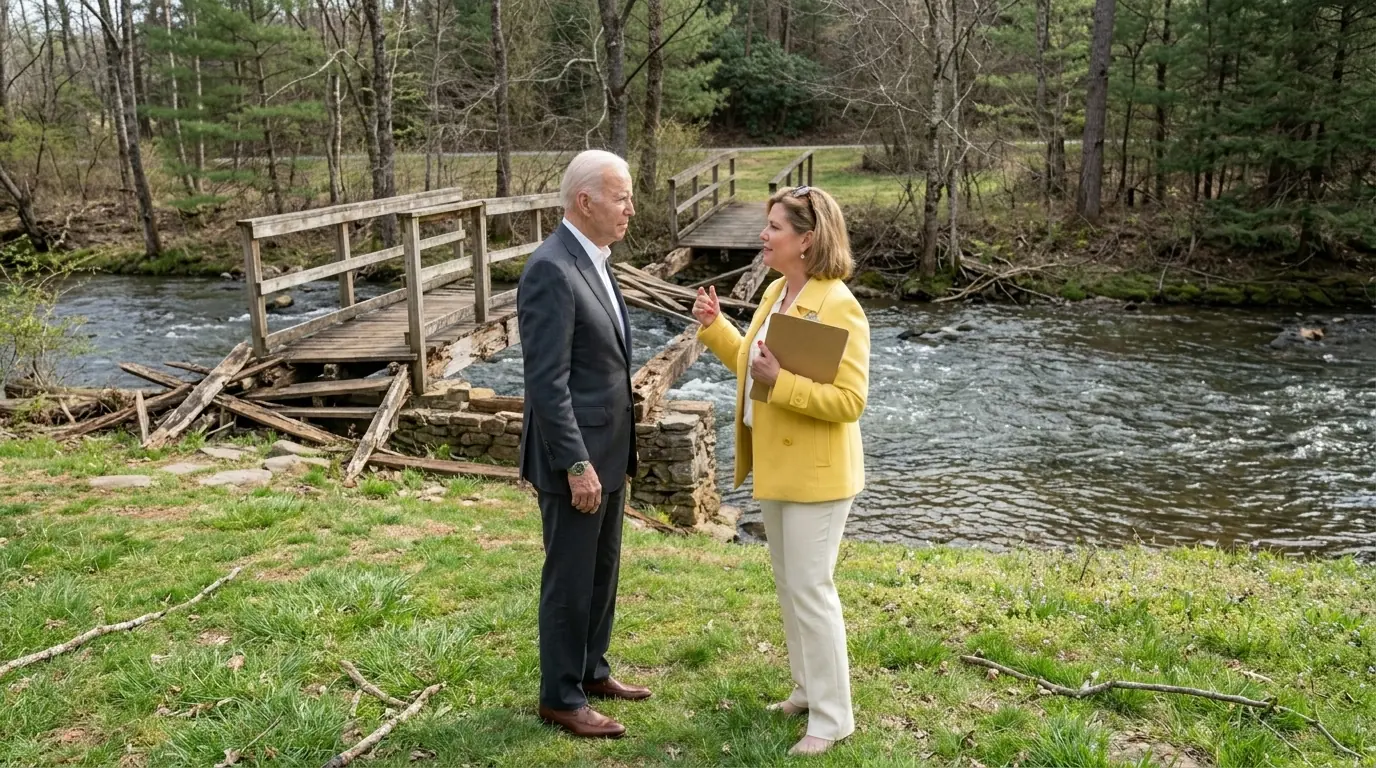
The splintering crack of century-old timber was the sound of war being declared. It echoed through the manicured lawns and identical mailboxes of the Willows at Miller's Creek, a homeowners association that valued aesthetic conformity above all else. At the source of the noise, two men with chainsaws were systematically dismantling a small, elegant wooden footbridge that arched over the creek. Directing them with the furious energy of a battlefield commander was Brenda Van Patton, president of the Willows HOA.
She was a tempest of entitlement wrapped in a canary-yellow peacoat that was offensively bright against the muted greens and browns of the landscape. Her face was flushed with righteous rage, and one finger jabbed accusingly at the wreckage.
"I don't care if it's been here since the dinosaurs," she shrieked at the small, horrified crowd of neighbors that had gathered. "It's unapproved. The wood stain is not on the pre-authorized palette. It's an eyesore and a liability. Get it down."
Standing slightly apart from the crowd, on the lawn of the handsome stone house that the bridge connected to, was a man in his late sixties. He had a full head of silver hair and wore a simple but impeccably tailored dark suit. He stood with his arms crossed, watching the destruction not with anger or panic, but with a chilling, almost academic stillness. His name was Arthur Covington, and the bridge was his.
To the residents of the Willows, he was just the quiet old man in the stone house, a retired widower who kept to himself. They were mistaken. Arthur Covington had indeed retired, but not from a career in accounting or sales. He had retired from the bench of the United States District Court for the Western District of North Carolina.
He was a federal judge, a man who had presided over complex cases involving corporate fraud, organized crime, and constitutional law. His days had been spent weighing evidence, interpreting statutes, and wielding the immense power of the federal judiciary. He was watching Brenda Van Patton and her crew not merely as a wronged homeowner, but as a judge observing what he believed to be a crime in progress.
The bridge was not just a bridge. It had been built in 1936 by his own father, a civil engineer who had used salvaged heart pine from a local textile mill. It was a perfect example of rustic WPA-era craftsmanship. More importantly, because it crossed Miller's Creek, a designated navigable waterway, albeit a small one, and because it was more than fifty years old, it had been quietly added to the National Register of Historic Places a decade earlier.
It was a federally protected structure. Destroying it was not simply a covenant dispute. In Arthur's view, it was a federal matter.
Brenda, in her quest for aesthetic purity, had declared war on the bridge a month earlier. She had sent Judge Covington a series of increasingly aggressive letters citing HOA bylaws written in 2005, nearly seventy years after the bridge had been built. The letters demanded that he submit an architectural plan for approval, repaint the bridge in an HOA-approved shade of taupe, and provide proof of a two-million-dollar liability insurance policy.
Judge Covington had replied with a single, polite registered letter. In it, he calmly explained that his property predated the HOA's existence and was not legally subject to its covenants. He further explained that the bridge was a federally protected historic structure and that any attempt to alter or remove it could violate federal historic-preservation law. He even included a copy of the official registration document.
He assumed that would be the end of it. He had underestimated the spectacular arrogance of Brenda Van Patton. She apparently saw his letter not as a legal warning, but as a challenge to her authority.
Now she stomped toward him, her face a mask of triumph. "There," she said, gesturing toward the splintered remains of the bridge. "Problem solved, Mr. Covington. Now your property is finally in compliance. You'll be receiving a bill for the demolition crew, as well as a fine for the initial violation."
Judge Covington slowly uncrossed his arms. He looked at the wreckage of the bridge his father had built, then back at her. His eyes were not angry. They were cold, the eyes he used when a lawyer tried to present a flimsy, dishonest argument in his courtroom.
"Madam," he said, his voice quiet but carrying an immense, invisible weight, "are you acting in your official capacity as president of the Willows at Miller's Creek Homeowners Association?"
She scoffed. "Of course I am. I am enforcing the rules that protect our property values."
"I see," he said, his gaze unwavering. "And you are aware that you are on private property, correct? My private property."
"It's about to be less private when the HOA puts a lien on it for the fines you owe," she shot back.
"One final question," the judge said, his voice dropping even lower. "Did you receive my registered letter explaining the bridge's federally protected status?"
"I received your little love letter, yes," she sneered. "Some nonsense about history. This is a private community, Mr. Covington, not a museum. Federal laws don't apply to our private bylaws."
It was a statement of such profound ignorance that the judge almost felt a flicker of pity for her. She had not only admitted what she had authorized, but had also made clear that she had received and disregarded his warning. To a man who had spent a lifetime listening for intent, the exchange was as clear as testimony.
He gave a single, slow nod. "Thank you, Ms. Van Patton. You've been very clear."
He turned his back on her, took out his phone, and walked toward his house. Brenda stared after him, convinced she had won, that she had finally put the quiet old man in his place.
Judge Covington did not call the local police. He sent a message to his former law clerk, Catherine, a brilliant young attorney who now worked in the U.S. Attorney's Office. He told her what had happened, asked that the matter be reviewed for possible civil and criminal violations, and asked that the regional office of the Army Corps of Engineers be notified about debris in the waterway.
He put his phone away and stood in his living room, looking out the window at the ruin of his bridge. The conflict had begun, but Brenda Van Patton had no idea what she had set in motion.
In the immediate aftermath of the demolition, Brenda was incandescent with triumph. She saw her actions not as destruction, but as a righteous cleansing. That evening, she composed a special edition of the Willows Weekly News newsletter, a document that would later become an important piece of evidence against her.
"A Victory for Compliance and Safety," the headline declared in aggressive capital letters. "Your HOA Board of Directors is pleased to announce the successful removal of the dilapidated and unapproved structure on Lot One," she wrote. "This long-neglected eyesore, which violated numerous community bylaws and posed a significant safety risk, has been professionally dismantled. This action reaffirms our board's unwavering commitment to protecting the aesthetic integrity and property values of our beautiful community. We thank you for your support."
She hit send, dispatching her self-congratulatory message to the inboxes of all two hundred homeowners. It was a digital victory lap that would later help seal her fate. She went to bed that night and slept the sound, dreamless sleep of the truly certain.
Outside, however, in the quiet tree-lined streets, a different sentiment was taking root. The residents who had witnessed the demolition had been shaken. They had seen the quiet dignity of Judge Covington and the unrestrained fury of Brenda Van Patton. They had heard the splintering of the historic timbers.
While many were too intimidated by Brenda to speak out, a small seed of rebellion had been planted. The next morning, a new sign appeared on the public easement near the judge's property. It was crudely painted on a piece of plywood, but its message was clear in wobbly, defiant letters: "Bridge Beats Karen."
The awkward lettering somehow made it more potent than a professionally printed sign. It was a small mocking flag of dissent planted in the heart of Brenda's perfectly regulated kingdom.
Meanwhile, Judge Arthur Covington sat in a leather armchair in his study. The room was dark except for a single lamp illuminating a silver-framed photograph on his desk. It was a black-and-white picture from 1937, showing his father and a team of men grinning proudly on the newly completed bridge.
Arthur was not feeling rage. Rage was an imprecise emotion, a messy and often counterproductive impulse. What he felt was deep sadness and, beneath it, the cold, familiar hum of judicial duty.
He had spent a lifetime upholding the law, a system of rules designed to protect society from chaos, impulse, and the tyranny of bullies. Brenda Van Patton was a bully of the highest order, a woman who believed the petty rules she enforced could supersede the foundational laws of the nation. She had mistaken his quiet nature for weakness and his civility for cowardice.