"You know what your creek reminds me of, Tom? A drainage ditch behind a truck stop."
"It's been on my land since 1962, Mrs. Whitfield."
"I don't care. It stinks. It breeds bugs. And it drags down every home value within a mile."
"It's my property."
"Your property is the problem. Your property, your yard, your little wife's weed patch. All of it drags this community into the gutter."
She looked Clare up and down like something stuck to her shoe. "Cute flowers, sweetheart. Very Walmart."
Clare didn't move. She held my hand a little tighter. We left for Asheville that Thursday. When we came back, the creek was gone. Every last foot of it buried, and Brenda Whitfield was standing in our driveway, smiling. She had no idea who she'd just crossed.
My grandfather bought this land in 1962: 47 acres of rolling green tucked against the Blue Ridge Foothills in Henderson County, North Carolina. The creek ran right through the middle of it, fed by a spring up in the hollow, winding down through sugar maples and old-growth oaks before it emptied into the French Broad River 6 miles south. That creek had been there longer than anyone alive could remember.
Clare and I moved onto the property in 1998 after I retired from the Army Corps of Engineers—28 years of assessing waterways, reviewing permits, and making sure nobody filled a creek or drained a wetland without following federal law. I'd seen it all: developers who buried streams under parking lots, ranchers who dammed tributaries, companies that dumped fill into marshland and called it progress. When I retired, all I wanted was quiet. This land gave it to me.
Clare fell in love with the creek before she fell in love with the house. The first spring after we moved in, she started planting wildflowers along the east bank: lavender, black-eyed susans, coneflowers, wild columbine. Year by year, the garden grew. By the time it was 12 years old, that stretch of creek bank looked like something out of a nature magazine. She'd sit there every morning with her coffee, bare feet in the cool grass, watching dragonflies skip across the water while the current murmured over smooth stone. It was her place, our place.
Then the subdivision came. Willow Creek Estates went up in 2004 on the farmland north of our property. The original developer was smart enough to keep the creek as the natural drainage channel in his engineering plans: 300 homes, all feeding stormwater runoff into a waterway that had been doing the job for free since before anyone drew property lines. For 15 years, we had no problems. Neighbors were decent. The HOA was invisible.
Then Brenda Whitfield showed up. She and Dale bought the biggest house on the hill in 2019: five bedrooms, four baths, three-car garage, and a view of the entire subdivision from their back deck like it was their personal kingdom. Brenda was 32, blonde, beautiful in the sharp and deliberate way of someone who'd made her appearance a full-time profession. She ran for HOA president that spring on a campaign platform she'd printed on glossy card stock with a mood board and a slogan: Elevate our living experience. She won because she was the only one who bothered to run.
Within 6 months, she'd rewritten half the CC&Rs. Mailboxes could only be three approved colors: charcoal, sage, or warm ivory. Grass had to fall between 2 and 3.5 inches, measured with a laser level she brought to inspections herself. Holiday decorations required pre-approval and had to match the seasonal palette she published on the HOA website every October. Children were banned from front yard play after 6:00 in the evening for disrupting what she called the "acoustic harmony" of the community. She printed business cards that read Brenda Whitfield, Community Lifestyle Director—not president, community lifestyle director.
And from day one, she hated my creek. She called it visual pollution. She called it a mosquito incubation corridor. She told me to my face that it "completely undermines the curated aesthetic brand identity we're building for this community." I told her it was my property, it predated her subdivision by 42 years, and she had no authority over it. She smiled that perfect white practiced smile, adjusted her sunglasses, and said, "We'll see."
I should have listened harder.
We were gone 4 days. Clare and I drove up to Asheville to visit our daughter Emily and the grandkids. Left Thursday morning, came back Monday afternoon. Four days. That's all Brenda Whitfield needed.
I smelled the diesel before I saw the damage. 200 feet from the driveway, the air changed: heavy, oily, mechanical. I slowed the truck, and Clare sat up in the passenger seat. "Tom," she said quietly. "Where's the water?"
She was right. The sound was gone. That low, steady murmur of water tumbling over stone that had been the background noise of our lives for 26 years—erased.
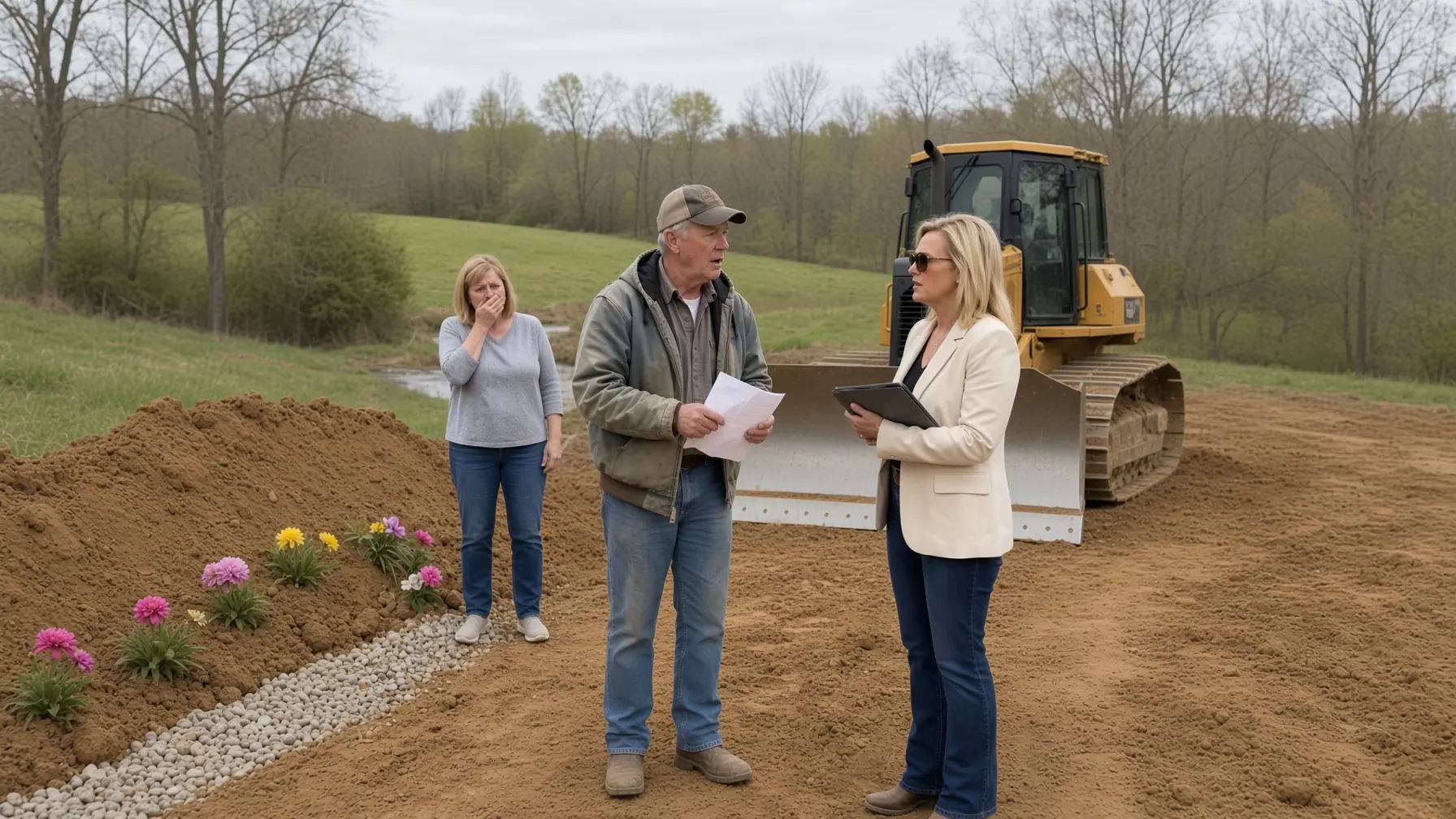
I pulled up along the back of the property and killed the engine. The creek didn't exist anymore. Where 280 feet of clear running water used to wind through sugar maples and moss-covered rocks, there was now a flat strip of packed brown earth and crushed gravel 12 feet wide, stretching across our land like a surgical scar. Bulldozer tracks cut deep ruts into the soil on both sides. Mounds of gray fill dirt sat along the edges where the crew hadn't finished grading. Tire marks from two dump trucks ran straight through what used to be Clare's wildflower garden: 12 years of lavender she'd planted from seed, black-eyed susans that came back bigger every June, wild columbine that attracted hummingbirds every April, coneflowers she'd divided and replanted three summers in a row until the bank bloomed purple and gold from one end to the other. All of it under six feet of gravel and fill dirt packed flat by a machine that weighed more than our house.
Clare got out of the truck and walked to the edge. She didn't cry. She didn't scream. She pressed both hands against her mouth and stood there staring at the dirt. Then she knelt down and touched the ground with her fingertips, and I watched her shoulders shake once before she went still. That image stays with me. It stays with me more than anything Brenda Whitfield ever said or did.
But Brenda said plenty. She pulled up 5 minutes later in the white Range Rover, heels clicking on the pavement, blazer pressed, hair blown to perfection, lipstick fresh like she was arriving at a charity gala, not the scene of a demolition. She stepped around a pile of fill dirt without getting a speck on her Louis Vuitton, and surveyed the flattened creek bed the way a homeowner admires a finished kitchen renovation.
"I'm so glad you're back to see it," she said, adjusting her Gucci sunglasses. "The board approved a community aesthetic renewal, and we prioritized your section first. That ditch was dragging everyone's property values down. Honestly, Tom, you should be sending me flowers."
"Flowers?" Clare said. "Flowers to the woman kneeling in the dirt where her garden used to be?"