The first thing Malcolm Reed smelled was gasoline.
Not smoke.
Not burning paper.
Gasoline.
He had been standing barefoot in his kitchen at 4:17 on a Thursday afternoon, rinsing a coffee mug while answering an email from one of his construction supervisors, when the sharp chemical odor drifted through the open window above the sink. For half a second, Malcolm assumed one of the landscaping crews working farther down the street had spilled fuel.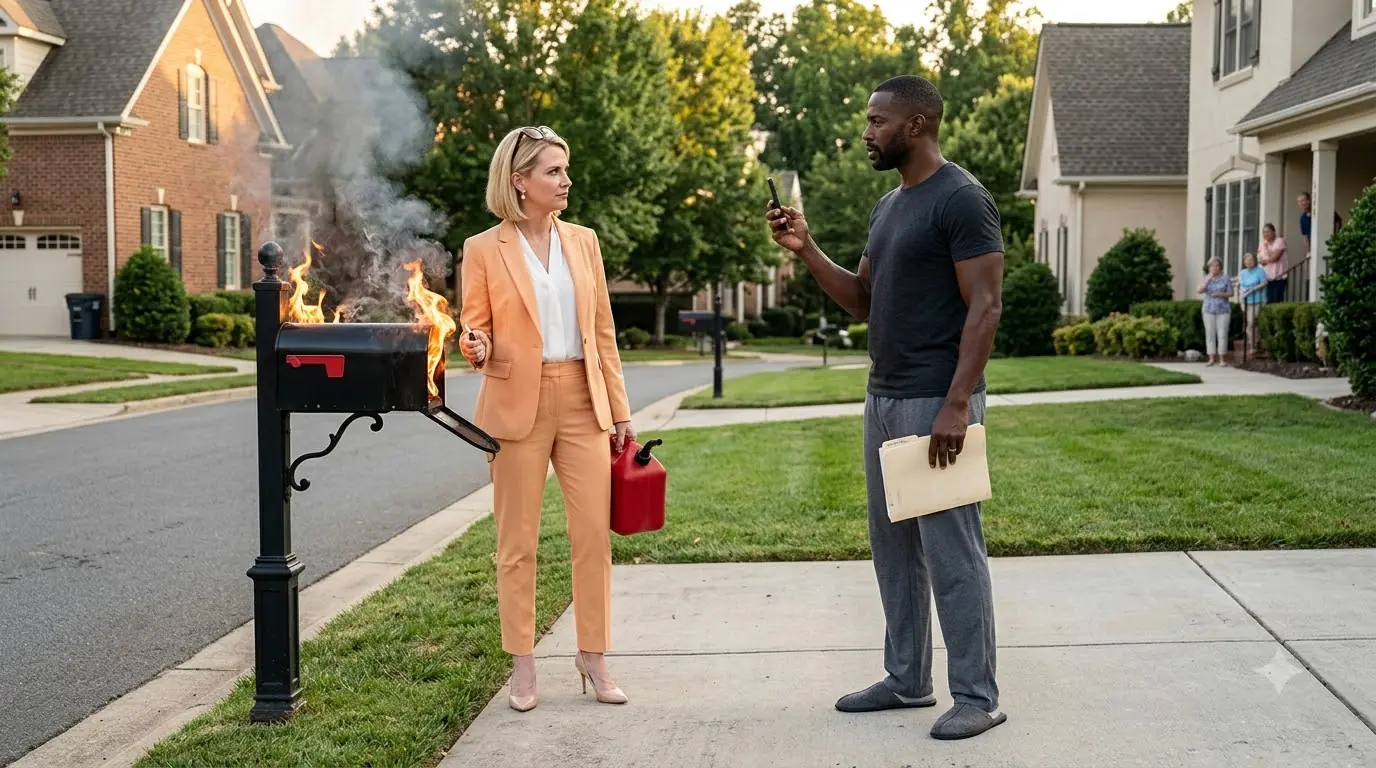
Then he heard Heather Cole shouting outside.
“Maybe now you’ll learn to stop sticking your nose into things that don’t concern you.”
Malcolm froze.
He put down the mug.
Outside, something ignited.
By the time he reached the front door, orange flames were climbing from his black curbside mailbox.
Heather stood beside it.
She wore a tailored light-orange pantsuit over a white blouse, nude heels, pearl earrings, and sunglasses pushed into her blonde bob as though she had come from a luncheon rather than an act of vandalism. A red plastic gasoline container hung from one hand, and the lighter remained in the other.
Malcolm stepped onto the porch.
He wore gray lounge pants, a fitted charcoal T-shirt, and the same house slippers he had been wearing all afternoon.
Heather looked toward him.
For perhaps one second, genuine panic appeared in her face.
Then arrogance replaced it.
“You should have answered your phone.”
Malcolm stared at the burning mailbox.
“Heather.”
“What?”
“Why is my mailbox on fire?”
She laughed.
The sound was almost absurd beside the flames.
“That depends.”
“On what?”
“Whether you finally understand that some things arriving at this house should stay unopened.”
Malcolm slowly lifted his phone.
He had already started recording before stepping outside.
Heather did not notice.
“Interesting.”
She frowned.
“What?”
Malcolm walked down the driveway.
Not toward her quickly.
Not aggressively.
He stopped roughly twelve feet away.
“You think something important was inside?”
Heather’s eyes moved toward the mailbox.
“You’ve been requesting documents you have no business requesting.”
“That didn’t answer me.”
“I don’t owe you an answer.”
“No.”
Malcolm nodded.
“But the fire marshal might enjoy one.”
Heather’s face tightened.
“Don’t threaten me.”
“I’m not.”
He raised the phone slightly.
“I’m documenting.”
She finally noticed.
Her expression changed.
“You’re recording me?”
“I’m recording my property burning.”
Heather glanced toward the road.
Across the street, curtains moved inside a neighbor’s window.
Farther down, someone had stepped onto a porch.
Heather lowered the gasoline container.
“This is being taken completely out of context.”
Malcolm looked at the flames.
“I’m struggling to imagine a context where this improves.”
“You have been harassing the board.”
“I submitted records requests.”
“You accused us of fraud.”
“I asked why the signatures on two easement amendments didn’t match.”
Heather stopped.
That was the first real mistake she made.
Not the fire.
That had already happened.
Her mistake was reacting before Malcolm finished.
He saw it immediately.
She knew exactly which documents he meant.
Malcolm continued.
“And now you’re standing beside a burning mailbox ten minutes after a certified county packet was delivered.”
Heather’s face hardened.
“You don’t know what was delivered.”
Malcolm smiled faintly.
There it was.
He had never told her what arrived.
“Actually,” he said, “I do.”
She looked at him.
Malcolm reached behind his back.
From the waistband of his lounge pants, he pulled a weathered manila folder.
Heather’s eyes widened.
“This?”
He held it up.
“The originals are already inside.”
For the first time since Malcolm came outside, Heather looked frightened.
Not embarrassed.
Not angry.
Afraid.
The mailbox collapsed inward with a metallic crack.
Heather stared at the file.
Then whispered:
“You opened it.”
Malcolm’s voice became quiet.
“Yes.”
“And now I know exactly why you didn’t want me to.”
Six weeks earlier, Malcolm had known almost nothing about Heather Cole beyond neighborhood politics.
She was forty-seven, divorced, professionally polished, and had served as president of the Oakridge Fairways Homeowners Association for seven years. She had a talent for turning ordinary community decisions into public performances and spoke about the subdivision as though she had founded it personally.
Malcolm generally avoided her.
He bought his home in Oakridge Fairways nine years earlier because the property sat on nearly one acre, unusually large for the neighborhood, with mature trees and enough space behind the garage for a small woodworking shop.
His mother liked the kitchen.
His sister liked the guest room.
Malcolm liked the fact that the rear section of his land touched a narrow wooded corridor that had once belonged to his grandfather.
That connection was why he bought the house.
His grandfather, Elijah Reed, had owned eighty-six acres in the area decades before developers transformed rolling farmland into luxury homes and an eighteen-hole golf course.
By the time Malcolm was born, most of the land had been sold.
Elijah kept twelve acres.
Then six.
Then only a narrow strip containing a creek, two old service roads, and several utility easements.
When Elijah died, those remaining interests passed through Malcolm’s mother and eventually became tangled inside development documents Malcolm never bothered studying.
Until Heather sent him a violation notice.
The notice claimed Malcolm’s backyard fence extended four feet into HOA common property.
Malcolm knew that was impossible.
He had rebuilt the fence three years earlier using a licensed surveyor.
He emailed the management company.
They responded with a map.
The map did not match his survey.
That was the beginning.
Malcolm worked in commercial construction.
He spent his career reading plans people assumed nobody would challenge.
Floor elevations.
Access agreements.
Temporary construction easements.
Utility rights.
Stormwater plans.
He understood that a line on one drawing did not become legally real merely because someone printed it in color.
So he asked Heather for the recorded instrument supporting the HOA map.
She replied:
“The board’s current property map is authoritative.”
Malcolm answered:
“Recorded where?”
No response.
He emailed again.
Heather called him.
“You’re making this unnecessarily complicated.”
“I’m asking for the document.”
“We’ve used the same map for years.”
“That isn’t a document.”
“It is the official HOA map.”
“Then tell me which county instrument created the boundary.”
Silence.
Heather finally said:
“You’re not a lawyer.”
Malcolm smiled.
“No.”
“But I hire them.”
The conversation ended badly.
Three days later, Malcolm received another violation.
Unapproved exterior workshop lighting.
The lights had existed for six years.
Then another.
Trash bin visible from the street for forty-three minutes after collection hours.
Then another.
Improper driveway vehicle placement because his truck tire touched the grass.
Malcolm recognized retaliation when he saw it.
He documented everything.
Then called attorney Rachel Kim.
Rachel had represented his construction company in contract disputes for almost a decade.
She read the HOA notices.
Then asked:
“What started this?”
“A fence line.”
“Send me your closing survey.”
He did.
Five minutes later:
“This HOA map is wrong.”
Malcolm leaned back in his office chair.
“How wrong?”
“I don’t know yet.”
“But your deed line and their map line are definitely not the same.”
“Could be an old amendment?”
“Maybe.”
“Can you find it?”
“Yes.”
“Give me a week.”
Rachel needed four days.
Then she called.
“Malcolm.”
Her tone made him sit straighter.
“What?”
“Do you still have anything from your grandfather?”
“Paperwork?”
“Yes.”
“A lot.”
“Why?”
“Because Oakridge Fairways was developed partly on land he once owned.”
“I know.”
“I think someone altered the easement history.”
That weekend Malcolm drove to his mother’s house.
Patricia Reed was seventy-two and possessed the terrifying organizational habits of a retired elementary-school principal.
When Malcolm asked about Elijah’s property files, she pointed toward a cedar cabinet in the basement.
“Bottom drawer.”
“You knew?”
“I know where everything is.”
Malcolm opened the drawer.
Inside were folders labeled in Elijah’s handwriting.
Taxes.
Timber.
Creek.
Road.
Golf company.
That last one made Malcolm stop.
He carried it upstairs.
Patricia made tea while he opened the folder across her dining table.
The first documents dated to 1988.
A development corporation named Hollis Ridge Partners wanted access across Elijah’s remaining land to connect a new golf-course maintenance road.
Elijah agreed to a limited easement.
Not ownership.
Not unrestricted development rights.
Only service access.
The agreement described a thirty-foot corridor beginning near the southern creek and ending beside what eventually became Malcolm’s property.
Then came handwritten notes.
Elijah had apparently distrusted the developer.
Never allow extension without new payment.
No residential association authority.
Access only.
Then Malcolm found a later agreement.
This one allowed temporary construction access for eighteen months while additional homes were built.
Expired 1996.
Another.
Drainage maintenance.
Still no transfer of ownership.
Then came the strange part.
A 2007 amendment purportedly converted parts of the old access corridor into permanent HOA common property.
Elijah’s signature appeared at the bottom.
Malcolm stared.
His grandfather died in 2005.
“Mom.”
Patricia looked over.
“What?”