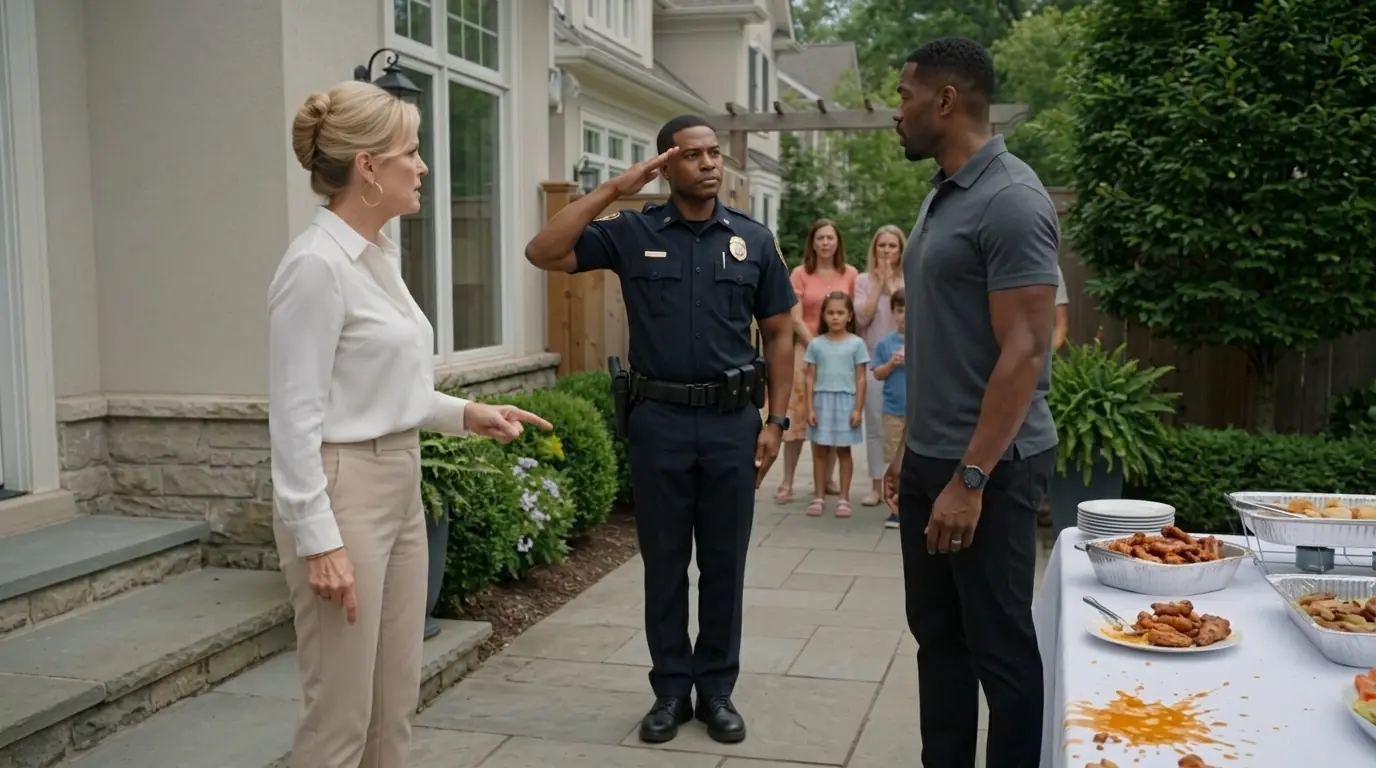
The first thing Carolyn Hayes destroyed was the blackberry cobbler. The aluminum bat came down through the center of the foil pan with a wet metallic crack, splattering purple filling across a white tablecloth that had been set less than an hour earlier for people who had not yet arrived. Nathaniel Brooks stood near the brick steps of his own backyard with both hands open at his sides, watching a sixty-two-year-old woman destroy the birthday lunch he had arranged for his dead wife. When Carolyn finally lowered the bat and called 911, she sounded almost relieved, as though the dispatcher’s voice might transform everything she had already decided about him into fact.
“There’s a man at my neighbor’s house who refuses to leave,” she said. “I don’t know who he is, he’s acting aggressive, and I’m afraid this is about to get worse.” Nathaniel could hear most of the call from where he stood, but he did not interrupt her. He looked instead at the shattered serving bowl, the hydrangeas knocked sideways across the patio, and a small handwritten card that had fallen into a tray of baked macaroni and cheese. The card had been written by his nine-year-old granddaughter and began, Things I remember about Grandma.
Twenty-five minutes earlier, the backyard had looked almost exactly the way Vivian Brooks would have liked it. Three folding tables sat beneath the broad branches of two red oaks, covered in white linen with low arrangements of blue hydrangeas and yellow roses. Framed photographs showed Vivian as a twenty-two-year-old military nurse, a young mother holding one child on each hip, a grandmother laughing on a beach, and finally a silver-haired woman standing beside Nathaniel on the porch of the house they had purchased together but never lived in together. The family lunch was supposed to mark what would have been Vivian’s seventy-first birthday, the first since her death eight months earlier.
Nathaniel had nearly canceled the gathering three times. He had spent forty years making decisions under pressure, yet grief made ordinary choices feel harder than anything he had faced in uniform. His daughter Alicia Brooks finally told him that the lunch did not require him to perform strength, and his son Michael reminded him that their mother would consider wasting perfectly good food because everybody was sad an insult to civilization. Nathaniel agreed, then ordered too much of everything because that was how Vivian always did it.
At sixty-eight, Nathaniel did not look like the man whose photograph had once appeared behind podiums at Pentagon briefings. He wore khaki trousers, a pale gray button-down with the sleeves rolled neatly to his forearms, soft brown shoes, and a navy cardigan Vivian had bought him during his final year of active duty because she said retirement should eventually teach him that shirts did not need epaulets to be respectable. His hair was silver and cut close, his posture still unusually straight, though age had softened the sharpness around his shoulders. Without a uniform, staff, security detail, or military vehicle, he looked exactly like what he wanted to be that morning: an older widower preparing lunch for his family.
Nathaniel and Vivian had bought the stone Colonial at 942 Hawthorne Crest Drive only six months earlier. The subdivision, Fairmont Hollow, sat outside Alexandria, Virginia, close enough to Alicia’s family that Vivian imagined seeing her grandchildren more often without asking permission from traffic. They signed the final paperwork one week after doctors discovered the cancer. Vivian insisted they complete the purchase because she wanted Nathaniel to own at least one home that had not been chosen by the Army, assigned by rank, or measured by distance to a base.
She never slept there. Chemotherapy became hospitalization, hospitalization became a long season of cautious hope, and hope eventually became the quiet conversation nobody wanted to have. Vivian died in March with Nathaniel sitting beside her and Alicia asleep in a chair near the window. The final promise Vivian extracted from her husband was that he would not turn grief into another military operation.
“You cannot command your way out of missing me,” she told him weakly.
Nathaniel had smiled even though it hurt. “I can attempt proper planning.”
“No.”
“Contingency planning?”
“No.”
“Logistics?”
Vivian squeezed his hand. “Nathaniel.”
He stopped. “Yes, ma’am.”
That made her laugh. It was one of the last full laughs he ever heard from her.
Nathaniel moved into the Fairmont Hollow house three months after the funeral. Most neighbors knew only that the property had transferred through the Brooks Family Trust and that contractors spent several weeks painting rooms, replacing a deck rail, repairing a bathroom, and moving furniture. Nathaniel kept to himself because introductions required explanations, and explanations inevitably produced sympathetic expressions he did not always have the strength to accept. That quiet arrival left enough empty space for other people to invent their own answers.
Carolyn Hayes lived next door. She and her husband Martin Hayes had purchased their six-bedroom brick home twenty-six years earlier, when Fairmont Hollow consisted of fewer houses, wider lawns, and residents who still treated neighborhood newsletters as serious reading. Martin spent most weeks in Manhattan overseeing commercial property investments, which left Carolyn with committees, charity lunches, landscaping projects, and the Fairmont Hollow Homeowners Association, where she had served as president for five of the previous seven years. She was organized, relentless, extremely confident, and generous whenever generosity fit her idea of how the community should work.
Several residents respected her. Others planned around her. Some learned to put trash cans away ten minutes earlier than required simply because an email from Carolyn could ruin an otherwise pleasant evening.
Carolyn first saw Nathaniel during the move. He was standing beside a rented truck carrying a box toward the garage while two Black movers worked nearby. She drove past in a white Range Rover, waved vaguely, and later mentioned at an association meeting that the new owners seemed to have hired an unusually large moving crew. Nobody corrected her because nobody else had met Nathaniel either.
That first assumption should have vanished with time. Instead, Carolyn repeatedly saw Nathaniel doing things that fit the role she had already assigned him. She watched him trimming shrubs one Saturday and assumed the homeowners had hired a groundskeeper, saw him carrying paint from his car and assumed he was a contractor, and once watched him bring packages inside while she returned from a tennis lesson. She never crossed the street to introduce herself because workers moved through Fairmont Hollow constantly and she did not consider every worker somebody the HOA president needed to know.
Their first real conversation happened five weeks after Nathaniel moved in. Carolyn found him replacing a loose fence board and walked across the side lawn carrying a clipboard because the architectural committee had been discussing exterior stain colors. She told him workers were not permitted to make visible changes without owner approval and asked which company had hired him. Nathaniel stared at her for several seconds.
“I live here.”
Carolyn laughed because she assumed he was making a joke. Nathaniel did not.
“I’m Nathaniel Brooks,” he said. “I own the house.”
Carolyn looked toward the stone Colonial. “The property belongs to a trust.”
“My family trust.”
Her smile disappeared. “Oh.”
Nathaniel waited.
Carolyn recovered quickly. She explained that Fairmont Hollow had experienced unauthorized contractors, short-term rental violations, and workers entering properties while owners were away, so board members had learned to be careful. Nathaniel told her he understood vigilance, then added that vigilance worked better when it remained open to correction. Carolyn heard only condescension.
Their relationship deteriorated through paperwork. She emailed him about the renovation dumpster even though the contractor possessed the required permit. Another message questioned a service van parked in his driveway overnight, though the rules allowed it while repairs were active. A third asked whether removing two diseased shrubs required architectural approval, even though the landscape company had already submitted documentation.
Nathaniel answered every email politely. That seemed to irritate Carolyn more than anger would have. She began telling other board members that the new homeowner challenged everything and behaved as though normal community standards did not apply to him.
One board member, retired CPA Dennis Park, reviewed the correspondence. “He isn’t challenging everything.”
Carolyn looked annoyed. “Read his tone.”
“I read his words.”
“Same thing.”
Dennis shook his head. “No, Carolyn. Sometimes somebody disagreeing with you is just somebody disagreeing with you.”
She did not speak to him for almost two weeks.
Nathaniel barely noticed. He had spent forty years in the United States Army and survived enough bureaucratic battles to consider an irritated HOA president a manageable retirement inconvenience. He paid assessments, responded to notices, attended one architectural committee meeting, and otherwise spent his time with grandchildren, veteran-support organizations, church friends, and the humiliating process of learning how to cook portions meant for one human being rather than eight.
His career rarely came up because he deliberately avoided mentioning it. Nathaniel enlisted at nineteen after graduating from high school in Macon, Georgia, served six years as an intelligence specialist, finished college through an Army commissioning program, and then spent more than three decades moving through staff and command assignments. His final position placed four silver stars on each shoulder and responsibility for one of the Army’s largest commands. He retired as General Nathaniel James Brooks.
Vivian was the person least impressed by that. She met him when he was a twenty-five-year-old staff sergeant who arrived late to a church cookout after field training and ate two pieces of sweet-potato pie without realizing Vivian had made them. She later served as an Army nurse, then as a civilian pediatric nurse practitioner, raising two children through deployments, promotions, schools in six states, holidays rearranged around operational schedules, and enough moves that she eventually labeled boxes by color rather than room.
Whenever someone called Nathaniel “General” inside their home, Vivian usually looked around dramatically and asked, “Is there another man in here?”
Her death made rank feel especially useless. Nathaniel had commanded tens of thousands of soldiers, overseen billion-dollar budgets, advised national leaders, and spent much of his life solving problems measured across countries. None of that mattered when Vivian’s oncologist explained that the treatment had stopped working.
The birthday lunch was Nathaniel’s first attempt to honor her without pretending he had accepted anything. Alicia selected the flowers. Michael arranged the photographs.
Vivian’s closest friend from nursing school, Dr. Gloria Evans, chose the menu. The grandchildren wrote short memories on blue cards that would be read during dessert.
The caterer arrived at nine-thirty. Fried chicken.
Braised greens.
Cornbread.
Macaroni and cheese.
Candied sweet potatoes.
Deviled eggs.
Blackberry cobbler.
Lemon pound cake.
Nathaniel stayed home while the family went briefly to the cemetery because he knew standing beside Vivian’s grave twice in one morning would be too much. He told everyone he needed to supervise the food.
Nobody believed him. They allowed the excuse anyway.
At ten forty-eight, Carolyn saw the catering van from her kitchen window. She watched workers carry tables through Nathaniel’s side gate and immediately opened the HOA rules on her tablet. She found restrictions involving commercial activity, large events, street parking, amplified music, and temporary structures.
None applied. No guests had arrived.
No cars blocked anything. No music played.
The small canopy did not require approval.
Carolyn went over anyway.
Nathaniel was placing one of Vivian’s photographs beside the pound cake when she entered through the open side gate. “What is going on here?”
He looked up. “Family lunch.”
She surveyed the tables. “You cannot run an event business from a residence.”
“I’m not.”
“This looks commercial.”
“It was catered.”
Carolyn frowned. “Where are the homeowners?”
Nathaniel stared at her.
“We have had this conversation.”
She looked at him blankly for half a second. Then recognition returned.
“Oh.”
Nathaniel said nothing.
“Well, the board requires notice for large gatherings.”
“No, it doesn’t.”
“Guest parking rules apply.”
“No guests have arrived.”
“You have commercial vendors.”
“They finished twenty minutes ago.”
Carolyn folded her arms. “You always have an answer.”
“I’m answering questions.”
“You argue about everything.”
Nathaniel looked toward Vivian’s photograph.
“I’m preparing my wife’s birthday lunch.”
Carolyn glanced at the framed pictures without understanding what they meant. “You could make life easier if you learned to cooperate.”
Nathaniel looked at her again. “I am asking you to leave my property.”
Her eyebrows rose. “You cannot order the HOA president away while I’m conducting association business.”
“You’re not conducting an authorized inspection.”
“This neighborhood has rules.”
“So does private property.”
Carolyn stepped closer. “I’ve lived here twenty-six years.”
Nathaniel’s voice remained quiet.
“That doesn’t make my yard yours.”
That sentence changed everything.
Carolyn later told police his tone frightened her. The cameras would show Nathaniel standing nearly ten feet away with no movement toward her. He had seen this kind of moment before, though usually around conference tables rather than patio furniture.
Pride was universal. So was the point where somebody began treating contradiction as disrespect.
Carolyn turned and left. Nathaniel assumed the encounter had ended.
He adjusted Vivian’s photograph. Replaced a napkin.
Straightened one chair. Four minutes passed.
Then Carolyn came back carrying an aluminum baseball bat.
Nathaniel looked at the bat first. Then her face.
“Please leave.”
“I called the association manager.”
“That doesn’t change anything.”
“You are not going to intimidate me.”
“I haven’t tried.”
Carolyn gripped the bat with both hands. “I told you this event isn’t approved.”
Nathaniel kept his hands at his sides. “And I told you to leave.”
She swung.
The first strike shattered a ceramic serving dish near the end of the table. Nathaniel stepped backward.
“Stop.”
Carolyn swung again.
The bat landed in the blackberry cobbler.
Foil folded inward. Purple filling exploded across the linen.
The third swing knocked two flower vases to the patio.
Nathaniel moved farther away.
His body remembered a thousand responses. Close distance.
Control the weapon.
Take the wrist.
Redirect momentum.
He could probably have taken the bat from her in seconds. The thought disappeared almost as quickly as it came.
A seventy-year-old white woman screaming that an older Black man attacked her would create a story much harder to untangle than broken dishes. Nathaniel chose distance.
“Put the bat down.”
Carolyn hit the table leg. It buckled.
Covered dishes slid into the grass.
Nathaniel reached toward his phone, then stopped when Carolyn stepped toward him with the bat raised near shoulder level.
“Do not come closer.”
She lowered it slightly. “I knew you were aggressive.”
Nathaniel stared.
“You’re holding the bat.”
“I brought protection.”
“From what?”
“You.”
He looked at the destroyed lunch.
“I haven’t touched you.”
“You threatened me.”
“With what?”
“Your attitude.”
Nathaniel went silent.
That answer told him conversation had ended.
He moved toward the brick steps and kept the outdoor kitchen island between them. Carolyn took out her phone.
She called 911.
“There is some man at my neighbor’s property,” she said. “He refuses to leave.”
Nathaniel looked toward the house that belonged to him.
“He’s acting aggressive.”
The dispatcher asked whether he was armed.
“I don’t know.”
“Who has the baseball bat?”
Carolyn paused.
“I do, but only because I’m afraid.”
The dispatcher told her to move away, place the bat down if she could safely do so, and wait for officers without further contact.
Carolyn did not put it down.
She stood near the wrecked tables, breathing hard. Nathaniel remained near the steps.
Neither moved.
Nathaniel sent Alicia a text.
Police coming. Neighbor issue. Keep everyone at your place until I call.
Alicia responded immediately.
WHAT HAPPENED?
I’m fine. Stay there.
Three dots appeared.
Then vanished.