Picture this: I roll up after two weeks on a remote job site, dusty boots and all, to find a full wedding takeover in my backyard. White tents, a champagne fountain by my grill, two hundred strangers trampling my lawn, and the bride's veil snagged in my prized tomato vines—three-time county fair champ.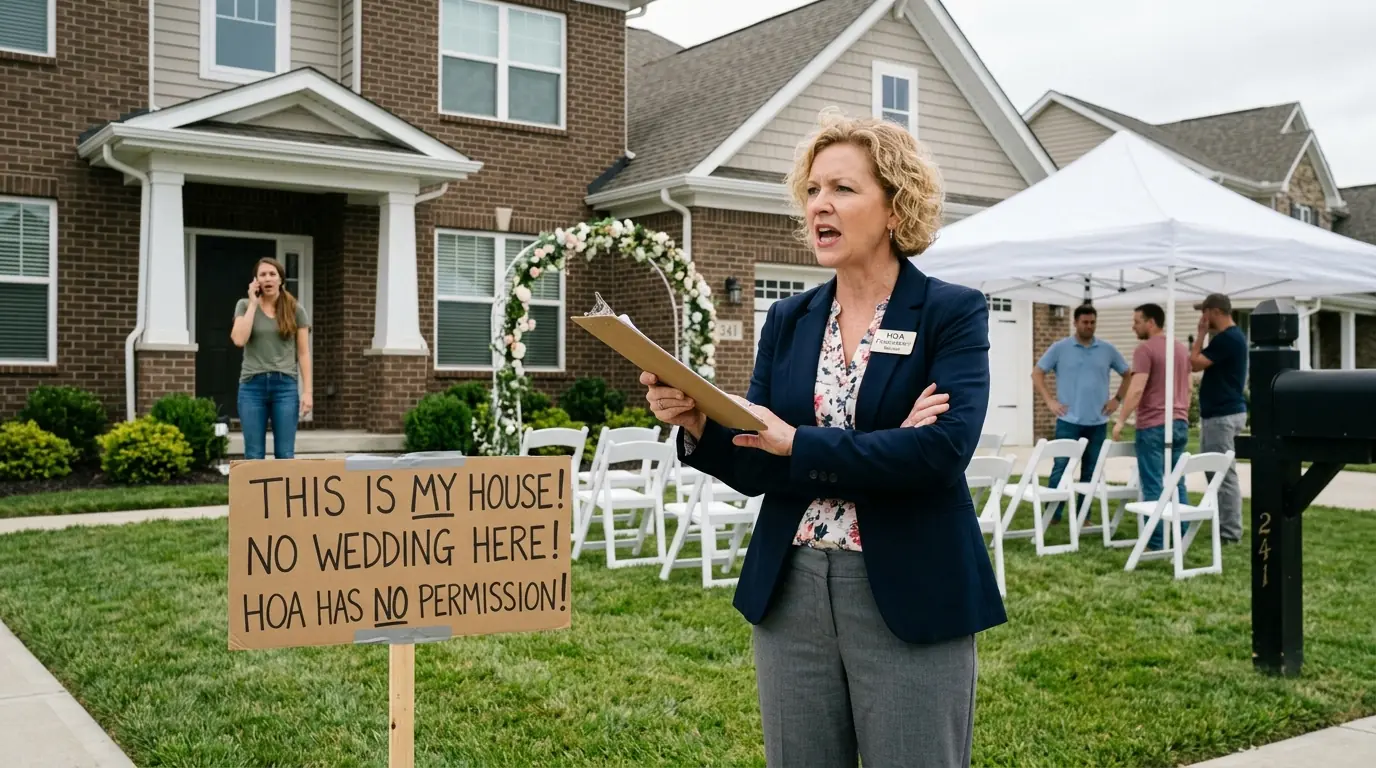
The HOA president in pearls marches over. "Sir, you're trespassing. Leave before you ruin the photos."
She told me to leave my own house. The catering guy even hands me a slider like I'm crashing the party.
What she didn't know: retired construction foreman here with a fifteen-year-old demolition permit itching for use. I smiled and dialed my old crew on speed dial. She had no idea I'd turn her perfect day into the biggest regret of her entitled life—legally, spectacularly, and without mercy. My tomatoes still standing. This gets nuclear.
Let me back up three months to when this war started.
My name's Hank Brewster, recently retired construction foreman, and I just inherited my grandmother's 1940s craftsman house in Willowbrook Estates after losing my wife, Sarah, to cancer. Moving here was supposed to be my fresh start, closer to my daughter's family, somewhere I could heal.
The house sits on 2.3 acres, the biggest, most beautiful lot in the entire subdivision. While everyone else got crammed into quarter-acre postage stamps, Grandma's property kept its original farmland boundaries: rolling green lawn perfect for hosting events, mature oak trees providing natural shade, and garden space that would make a commercial nursery jealous.
The smell of honeysuckle climbing my fence mixed with morning coffee from Grandma's old percolator. The satisfying crunch of gravel under my work boots as I walked the property line planning renovations. The sound of wind chimes hanging from the oak tree where Sarah and I got married twenty years ago. Even the feel of original hardwood floors, solid as bedrock under my feet. Everything about this place screamed peace and possibility.
Too bad my backyard screamed something else to the neighborhood vulture: dollar signs.
Enter Priscilla Blackthorne, fifty-two-year-old HOA president and self-appointed neighborhood dictator. Perfectly coiffed blonde hair that never moved in the wind. Designer clothes that cost most people's car payments. Drives a white BMW like she's personally delivering divine judgment. She's married to the subdivision developer's nephew and lives in the biggest house on the fancy cul-de-sac, where her kitchen window has a perfect view of my property. More importantly, she's a real estate agent who specializes in event planning consultation, whatever the hell that means.
The harassment began my second week. I'm replacing Grandma's rotted deck boards when I hear the sharp staccato of stilettos on concrete. Priscilla marches up my driveway like she's serving a federal warrant: clipboard clutched like a weapon, measuring tape draped around her neck like a stethoscope.
"Mr. Brewster, your property violates seventeen current subdivision standards."
Seventeen. She'd actually walked my entire lot with a ruler. The violation notice was a masterpiece of manufactured authority:
-
Mailbox wrong style: $75 weekly
-
Fence two inches too tall: $100 weekly
-
Garden shed wrong color: $50 weekly
-
Driveway exceeds width specifications: $75 weekly
Each infraction carried escalating fines until corrected to HOA standards. Total weekly damage: $450 until I surrendered to her aesthetic dictatorship.
"These features existed before your HOA was even founded," I said, holding the paper that reeked of her expensive perfume.
"Grandfather clauses require proper documentation filing within sixty days of covenant updates. Your grandmother failed to submit the paperwork in 2019." That smile could have frozen hellfire. "Pay the fines or we'll place a lien on the property."
Here's what made my blood pressure spike: I spent the next weekend walking the subdivision with my own measuring tape. Priscilla's brother-in-law had an identical fence violation—no citations. Her realtor buddy had the same mailbox style—no fines. Three newer residents had banned garden decorations covering their lawns; somehow those violations were "under review." But my seventy-five-year-old features that predated every rule in her book? Those were community cancer requiring immediate amputation.
The subdivision politics became crystal clear at monthly HOA meetings. Picture a middle school cafeteria where the mean girl holds court, except the mean girl has legal authority and a lawyer for a brother-in-law. Five original homeowners like me faced constant harassment, while forty-seven newer properties got free passes for identical violations.
"We need consistency in our community standards," Priscilla would announce from her throne at the community center, laser-focused on us original residents sitting in the back like detention students. "Some people think legacy status exempts them from progress."
That's when I realized what this really was: a systematic squeeze-out campaign designed to force original homeowners to sell their larger properties to developers—properties with enough space for hosting large events. Properties like mine, with the biggest backyard in the neighborhood and absolutely perfect sightlines from Priscilla's kitchen window. I should have connected those dots sooner.
Two weeks later, Priscilla escalated from harassment to full-scale warfare. I'm drinking my morning coffee on the back porch when her white BMW pulls up, followed by two other cars like some kind of bureaucratic convoy. Out step three women with clipboards, measuring tapes, and cameras—the HOA equivalent of Navy SEALs, if SEALs wore designer heels and carried purses.
"Good morning, Hank," Priscilla calls out, waving like we're old friends. "Time for your comprehensive property compliance assessment."