I want this cabin dismantled and the shoreline cleared before the end of the month. It will ruin Saturday's wedding.
The wedding is on my lake. Lakeside Crown has exclusive shoreline access for the ceremony.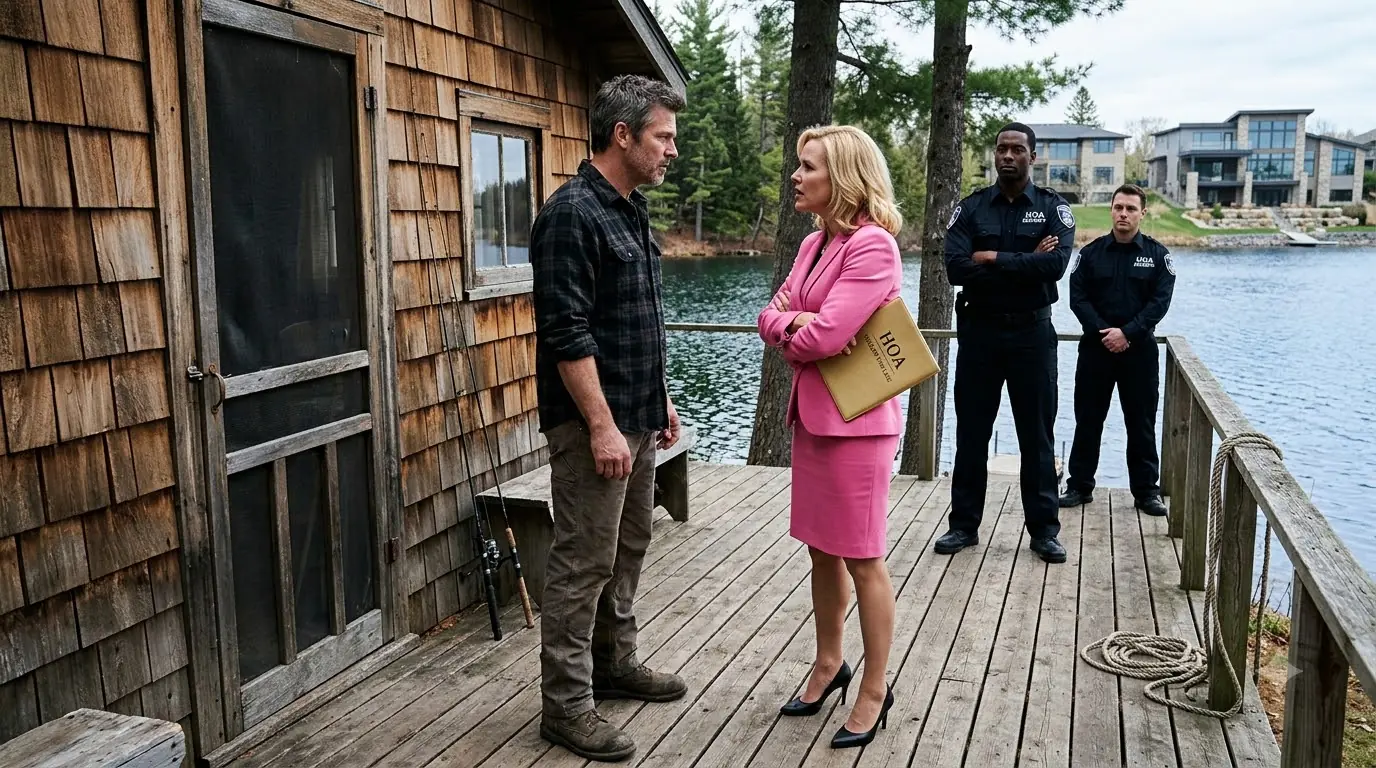
I looked at the woman in the pink suit, then at the two private security guards standing behind her on my grandfather's porch.
Ma'am, your association did not exist when this cabin was built.
Monica folded her arms. The guests have already paid.
Then perhaps you should have checked who owned the lake before selling it. Monica smiled as though the conversation was over.
She had no idea what was waiting for her wedding on Saturday.
I was 48 years old when Monica Holstead informed me that the cabin my grandfather built in 1958 had become offensive to people who arrived 61 years later.
Hollow Pine Lake sits 11 mi west of Red Haven, Minnesota, where pavement narrows into gravel beneath black spruce and white pine.
The lake is 2 mi long, cold enough in May to punish optimism, and quiet enough after sunset to hear a loon cross the water.
My grandfather, Walter Reed, bought the western shoreline in 1957 after spending most of his adult life repairing orboats on Lake Superior.
He built the cabin the following spring with tamarak beams and cedar siding. My father inherited it in 1986.
I inherited it in 2016.
Claire loved the cabin because she said the floorboard sounded honest.
Our daughter Ava loved the dock, the rowboat, and the narrow kitchen doorway where Clare marked her height every July with a carpenter's pencil.
They died on a wet Thursday in October, 2 years before I came back. A delivery truck crossed the center line on Highway 169.
The state trooper told me it had been immediate.
People say that as if immediacy is mercy. It may be for the person who dies. It is not for the person who answers the phone.
I returned to Minneapolis and spent 23 months inspecting commercial vessels, signing repair reports, and confusing exhaustion with survival.
I did not return to Hollow Pine. I did not open Clare's last box from the cabin.
I stopped answering my younger brother, Mark, often enough that he eventually stopped calling.
He called again at 6:11 that evening. Mark Reed appeared on my phone. I watched it ring until it stopped.
That was unfair to him. I knew it at the time. Grief does not become reasonable simply because the grieving person can identify it.
I had returned that morning to repair the north roof, replace the chimney flashing, and remain until the cabin felt like mine again.
Instead, I found a cream colored envelope stapled to the front door beneath a red plastic notice.
Lakeside Crown Homeowners Association final demolition directive.
The notice called the cabin structurally obsolete, visually incompatible with the premium lakefront environment, and subject to removal within 30 days.
The parcel number printed beneath my name ended in 418.
My parcel ended in 481.
Deputy Aaron Cole noticed the same thing when he arrived at 236 that afternoon carrying a second copy.
Aaron was 29, 6 years into the Red Haven County Sheriff's Office and still young enough to look embarrassed when official paperwork failed basic arithmetic.
Mr. Reed, this legal description points to a drainage lot on the Eastern Shore.
Does the drainage lot have a cabin?
No, sir.
Then Lakeside Crown may be offended by a building that does not exist.
Aaron did not smile, but one corner of his mouth considered it. He wrote the discrepancy in his notebook.
Monica arrived 11 minutes later in a white Cadillac SUV with two HOA security guards in the expression of a woman who believed timing was the same thing as jurisdiction.
She was 53 years old, blonde, polished, and dressed in a vivid pink blazer, matching skirt, and heels that sank into my grandfather's porch boards.
Across the lake stood Lakeside Crown Estates, 42 glass and stone houses, decorative gates, private roads, and enough exterior lighting to make the night sky file a complaint.
Monica pointed past me toward the cabin. This structure damages the view corridor from our premium homes.
The view existed before the homes.
Our residents paid for a certain standard.
My family paid for this shore in 1957.
She opened the gold embossed folder beneath her arm. The lake has evolved, Mr. Reed.
Lakes do not evolve because a homeowners association prints a brochure. But I let the sentence sit between us.
Before leaving, Monica informed me that Lakeside Crown would host a wedding the following Saturday aboard a charter yacht called Ever After.
The floating stage, guest dock, floral arch, and private reception area would be installed beside my shoreline because, according to Monica, the cabin and surrounding trees offered the best photographic background.
You do not have permission to use my shore.
We have community access rights. You have a narrow pedestrian ement 60 yards north of here.
We interpret it more broadly.
That sentence told me more than the demolition notice did.
After sunset, I walked down to the family dock and found 12 ft of it missing. The outer pilings had been cut cleanly. They had not been broken by winter ice.
The next morning, Ruth Barlo at the local bait shop told me Monica had locked the shoreline path her family had used for 43 years and posted it as private HOA property.
Across town, Beth Carter, the Lakeside Crown Treasurer, photographed an invoice showing HOA funds paid to Holstead Premier Events LLC and quietly slipped the copy into her purse.
I knew none of that yet. What I knew was waiting in the kitchen.
Ava's height marks were still on the door frame. 7 years old, 8, 9, 10, 11.
The final line was dated 3 weeks before the crash. Beside it, in Clare's handwriting were six words.
Still growing. Do not paint over this.
I stood there until the room went dark around me. Then I took Monica's demolition notice from the counter, folded it once, and placed it in the drawer beneath the measuring marks.