The HOA president stood on my grandmother's porch, waving eviction papers and smirking like she'd just won the lottery. What she didn't know, I owned the lake she was staring at and the only parking lot her precious neighborhood could use. My name is Ezra Thompson, and three months ago, I thought I was about to lose everything my family built. This woman, Brenda Caldwell, had decided my rustic cabin was an eyesore that didn't belong in her perfect little community.
She gave me 72 hours to pack up and leave the home my grandmother had left me, or face legal action. But here's the thing about bullies. They never do their homework. And Brenda, she picked the wrong fight with the wrong family.
Let me take you back to where this conflict began. Two years earlier, I inherited my grandmother Opal's lakefront cabin after she passed at 91. This wasn't some fancy vacation home. It was a sturdy sanctuary built in 1963 from local cedar, where three generations of my family had found peace.
Opal always chuckled and called it her worthless swamp land, winking like she was sharing the world's best inside joke. I used to think it was just her humble way. It turned out Grandmother was playing chess while everyone else was playing checkers. After my divorce imploded my corporate life, I traded my downtown consulting office for remote tech work and actual sanity.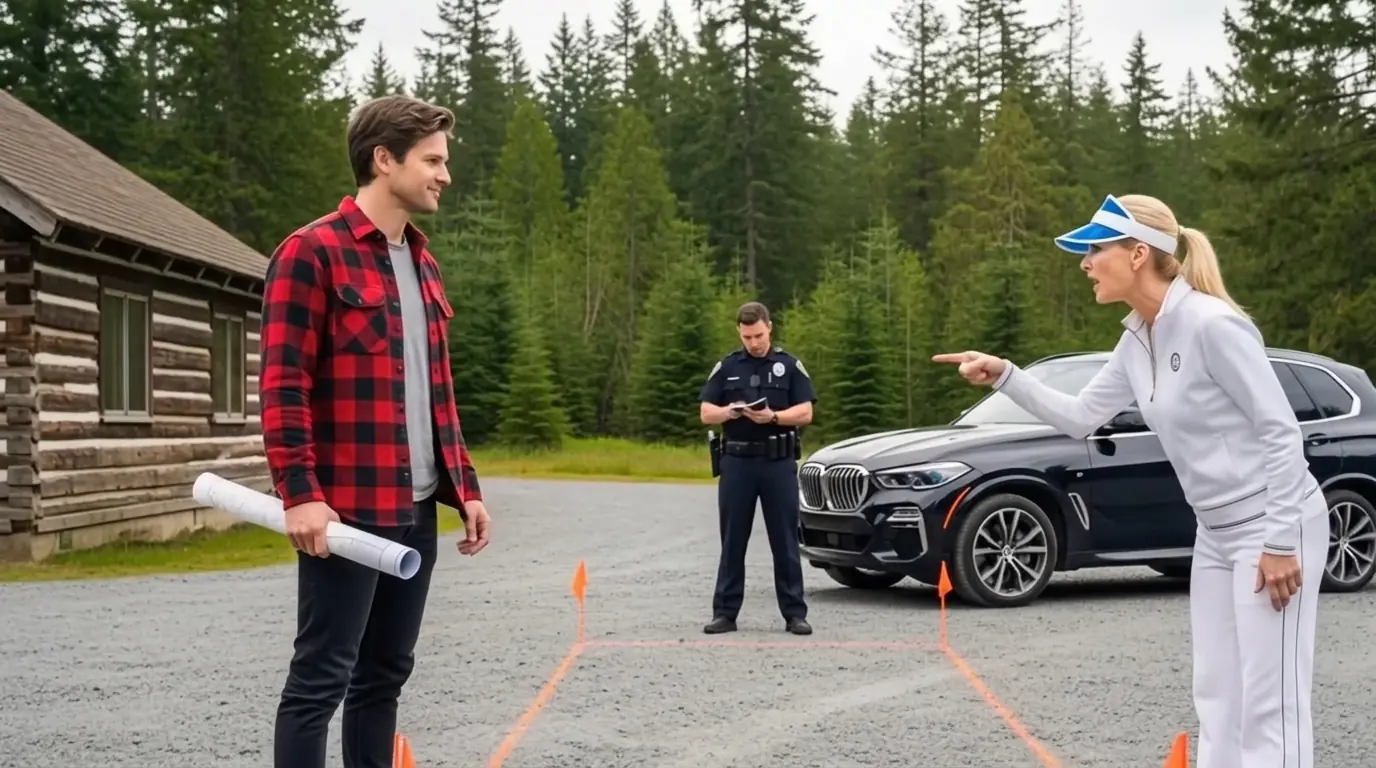
The cabin sits on what the tax records claimed was 2.3 acres of pine forest and marsh. Every dawn brought the haunting call of loons echoing across mirror-still water. I'd sip coffee watching prehistoric blue herons stalk fish in the shallows. Their movements so deliberate they seemed choreographed.
Evenings found me on the weathered dock, bare feet dangling in water so clear you could count stones 20 feet down. Those old dock planks worn silk smooth by decades of family gatherings felt like coming home to myself. But paradise always attracts parasites. Three years ago, developer Randy Morrison finished Lakeshore Estates.
Forty-seven identical McMansions had sprouted around our lake like some suburban infection. Most of the new neighbors were decent people—retirees escaping city noise and young families chasing the same peace I had found.
But every neighborhood gets its dictator, and ours came wearing designer tennis whites. Brenda Caldwell arrived from some cookie cutter suburb in her spotless BMW, looking like she'd stepped off a country club magazine cover. Within six months, she'd anointed herself queen of the Waterfront Improvement Committee. Her reign of terror started with the sweet elderly Kowalskis, who got slammed with a $300 fine for refusing to paint their charming garden shed bureaucratic beige.
Then she targeted Vietnam veteran Chuck Martinez, demanding he remove his unauthorized American flagpole or face $50 daily until compliance. The sound of her designer heels clicking across pavement became our neighborhood's air raid siren. We'd hear that sharp click, click click and know someone was about to get a lecture about maintaining property values and community standards. 18 months ago, the HOA officially formed when Morrison sold his final lots.
That's when Brenda revealed her true ambition, total control. She convinced five spineless board members to retroactively claim authority over all waterfront properties, including my grandmother's cabin that predated their plastic kingdom by forty years. I remember thinking how my uncle Morris, the retired real estate lawyer, always warned that HOAs could claim jurisdiction they didn't legally possess if nobody challenged them. The woman actually had the nerve to claim authority over land where my family had been fishing before she was born.
The harassment escalated like a bad fever. Monthly bills demanded $300 in mandatory community fees, followed by certified letters seeking $1,200 in architectural review penalties because my cabin's honest cedar siding wasn't approved suburban beige vinyl. I tossed them in my fireplace, figuring any competent lawyer would laugh these demands into next week.
My grandmother's place had been grandfathered in since the Johnson administration. Or so I thought. I'd never actually verified what legal protections inheritance properties carried. But Brenda doesn't take no for an answer.
Another eighteen residents quietly supported me, but stayed silent after watching Brenda destroy the Kowalskis and Chuck. The rest just wanted peace and couldn't understand why anyone cared if my cabin looked rustic instead of ridiculous. Then came that crisp Tuesday morning when Brenda strutted up my front steps, designer heels drumming against my grandmother's timeworn pine boards like a war march. She clutched those eviction papers like Moses carrying tablets, her expensive perfume failing to mask the stench of pure entitlement.
Standing there watching this tennis outfit tyrant lecture me about standards on land my family had claimed before she was born, I remembered grandmother's mysterious smile whenever she'd mentioned her worthless swamp land. Time to discover what she'd really left me. The next morning, I stood in my kitchen watching Brenda's BMW gleaming in what everyone assumed was the community parking lot, sipping coffee that tasted like liquid vengeance. This woman had seriously underestimated who she was messing with.
Within twelve hours of delivering her eviction ultimatum, Brenda had already escalated. She'd filed a formal complaint with county code enforcement, claiming my grandmother's old workshop was an unpermitted structure posing immediate safety hazards. The workshop had weathered fifty-seven winters, while these McMansions were already showing foundation cracks after three years. But that was just her opening move.
Saturday night at the Henderson's barbecue, I watched Brenda work the crowd like a politician at a fundraiser. The smoky scent of grilling burgers mixed with her toxic gossip as she held court near the potato salad, spinning tales about my erratic behavior and complete disregard for community safety. "We simply cannot allow one selfish individual to destroy what we have all invested in," she announced, dabbing mustard from her lips like she was cleaning blood from a blade. Her voice carried that particular tone of righteous authority that makes normal people want to throw things.
Then came her digital conflict campaign. Brenda posted a manifesto on our neighborhood Facebook group about protecting our shared values and property investments. She'd included photos of my cabin shot from deliberately unflattering angles with captions like when community cooperation breaks down and why architectural standards matter. Her post got three likes from her compliance cult members and forty-seven eye-roll emojis from everyone else.
But the poison was spreading. That's when something my uncle Morris had mentioned during last Christmas dinner clicked into focus. He had been telling stories about property law cases, mentioning how old waterfront properties often carried legal protections that most people never bothered to research. "Smart property owners always verify their rights before surrendering to bullies," he had said, raising his whiskey glass. "Knowledge is the best weapon against injustice." Monday morning found me in the county courthouse basement, surrounded by the musty perfume of decades-old files and the fluorescent hum of bureaucratic purgatory. I was hunting for something specific. Any legal protections my grandmother's property might carry that could trump Brenda's manufactured authority.
Dorothy, the filing clerk who had been sorting deeds since the Carter administration, became my archaeological guide through layers of property history. "Honey, most folks never look past their tax records," she said, pulling thick folders with the efficiency of someone who had done this dance ten thousand times. "But old waterfront properties are like vintage wine. Sometimes they get better with age."
What I discovered made my heart race like I'd struck gold. My property carried something called established riparian rights, dating back to the original 1891 homestead patent. These weren't just abstract legal concepts. They meant my family held special privileges regarding water access that couldn't be overridden by newcomer regulations or HOA demands.
Even better, every structure on my land predated current zoning by decades, protecting them under grandfather clause provisions that made them legally untouchable. But here was where Dorothy uncovered the detail that changed everything. "Sweetie, this legal description is interesting," she said, squinting at faded ink through her reading glasses. "Your property line extends much farther east than what appears on the modern tax maps."
"See this notation here? It references a 1962 boundary survey that includes an additional two hundred feet of land." My blood turned to ice water as the implications hit me. "What is two hundred feet east of my cabin?"
Dorothy smiled as if she were delivering the world's best Christmas present. "According to this, it would include that gravel parking area your neighbors use—the one everyone thinks belongs to the community." The revelation hit like a lightning bolt. Brenda had been threatening to evict me from my own property while her entire neighborhood trespassed on my land daily.
I photocopied every document with shaking hands, my mind racing through the possibilities. If these boundaries were accurate, every single car in that community parking lot was sitting on my private property, including Brenda's precious BMW. Uncle Morris's law office still smelled like leather chairs and forty years of legal victories when I burst through his door an hour later. His weathered face lit up as he spread my documents across his desk like a general planning the perfect battle. "Ezra, my boy," he said, adjusting glasses that had seen three decades of David-versus-Goliath fights. "Your grandmother was even smarter than I thought. This Brenda character just picked a fight with the wrong family." He traced the property lines with his finger, drawing on decades of experience reading legal descriptions like sheet music. "If these boundaries are accurate, your HOA problem just became their parking problem. But we need an updated survey to confirm this before we reveal anything." Driving home past that parking lot, watching Brenda's BMW sparkle in the afternoon sun on what might be my land, I couldn't stop grinning. She wanted to play legal hardball with my family's legacy.
Game on. Brenda didn't waste time licking her wounds. By Wednesday morning, she'd called an emergency HOA meeting for Friday evening, complete with official notices slapped on every mailbox like eviction warrants. The agenda read like a declaration of conflict, addressing noncompliant properties and immediate community safety concerns.
But her real master stroke came Thursday afternoon when she launched a door-to-door propaganda campaign, her designer heels clicking across driveways like a metronome of manipulation. I watched from my kitchen window as she worked the neighborhood with military precision, a clipboard clutched like a weapon, selling fear to anyone desperate enough to buy it. "We need to show unity," I heard her tell the Petersons, her voice dripping that artificial sweetness that makes your skin crawl.
"If we do not act decisively, property values will crater. Do you really want your retirement nest egg destroyed by one selfish holdout who thinks the rules do not apply to him?" By evening, she'd collected signatures from twenty-three households supporting immediate and aggressive legal action to protect our shared investment. The acrid smell of neighbor versus neighbor conflict hung over our little paradise like smoke from a house fire.
That's when I decided to stop playing defense and start hunting for ammunition. Grandmother's basement had always been forbidden territory during family visits, stuffed with what she dismissively called old paperwork and ancient history. But grief makes you brave and impending eviction makes you desperate. I descended into that cedar scented time capsule armed with nothing but a flashlight and the growing certainty that Opal had been hiding something important.
The woman had been a recordkeeping savant. Every property tax bill since Kennedy was president. Every permit application, every scrap of correspondence with county officials, all organized in chronological perfection inside boxes that smelled like vanilla extract and decades of careful storage. But it was the cedar chest tucked in the corner, locked tighter than Fort Knox, that made my pulse quicken.
Inside lay buried treasure that would change everything. The original 1962 property survey, hand-drawn with surveyor's precision and signed by someone named Harrison Pike. This wasn't just any boundary map. This was the master document used to carve my great-grandfather's sprawling homestead into smaller parcels.
And according to these measurements, my property didn't end where forty-seven families assumed it did. My heart hammered against my ribs as I traced the eastern boundary line with a shaking finger. The property extended exactly 247 feet beyond what modern tax maps showed, swallowing a kidney-shaped chunk of land that included every square inch of gravel where the entire neighborhood parked their cars. The revelation hit like cold lake water in winter.
For three solid years, I'd been watching mass trespassing every single morning without realizing it. Every BMW, every minivan, every work truck that crunched across that gravel lot was sitting on my private property. But 60-year-old surveys might not survive modern legal scrutiny without professional backup. Friday morning found me begging Dylan Pike, Harrison's son, who'd inherited the family business, to squeeze in an emergency boundary verification.
"Dad always said that homestead division created some interesting complications," Dylan told me, loading GPS equipment that looked like it belonged in a NASA mission. His weathered hands moved with the confidence of someone who'd been settling property disputes since he could hold a measuring tape. "Original surveys like yours often reveal surprises that were buried when counties went digital in the 1990s." Three hours later, Dylan's space-age equipment confirmed what grandmother's faded ink had claimed.
My eastern boundary sliced straight through the heart of the community parking area. "This is bulletproof," Dylan announced as he downloaded the coordinates. "Your property line cuts directly through that parking lot. I estimate that about fifteen prime spaces sit entirely on your land, along with the main entrance road."
The discovery exploded in my mind like a firework. Brenda had spent weeks collecting signatures demanding my eviction while her entire group of supporters committed daily trespassing on my property. But Dylan had not finished. "There is something else your grandmother left you," he said, cross-referencing measurements against historical water records he'd pulled that morning.
"This survey includes riparian boundaries that extend into the lake itself. It looks like your family owns more than just the parking lot." He pointed toward the water, where a dozen boats bobbed peacefully at their moorings. "See those dock slips everyone has been renting from the HOA? They are sitting in water that legally belongs to you." My mind reeled as the implications crashed over me like a tsunami. Not only did I own the parking lot, I owned the lake bottom where every boat in the neighborhood was anchored. The HOA had been collecting slip fees for three years on water that belonged to me.
Friday evening arrived heavy with the promise of confrontation. The community center crackled with tension as Forty-two residents squeezed into folding chairs, the air thick with nervous energy and burnt coffee. Brenda commanded the front of the room like a general addressing troops before battle, armed with her petition and delusions of authority. "Tonight we take our community back," she declared, her voice carrying the kind of righteous fury that starts crusades.
I sat in the back row, grandmother's survey burning like dynamite in my lap, watching this woman orchestrate my destruction while literally standing on land the community was using without permission. Time to teach everyone a lesson about doing homework before picking fights. The weekend after Brenda's emergency meeting brought psychological conflict that would have made dictators jealous. Saturday morning, I woke to find a Channel 7 news van parked in what I now knew was my parking lot, complete with a blonde reporter practicing her deeply concerned citizen expression in the side mirror.
Brenda had weaponized local media, spinning a masterpiece of fiction about a dangerous squatter situation threatening community safety. The reporter, a young woman named Jessica who seemed eager for a sensational story, devoured every syllable of Brenda's Oscar-worthy performance. "This individual has repeatedly violated community safety standards and shown complete contempt for his neighbors' well-being," Brenda declared to the camera, gesturing toward my cabin like she was identifying a biohazard. The morning breeze carried her voice across the water, poisoning the air with manufactured outrage.
But that theatrical performance was just her opening act. Sunday evening delivered the real psychological torture, Brenda's neighborhood safety patrol. Six clipboard-wielding volunteers began documenting my every breath like I was under federal surveillance, photographing me checking mail, recording timestamps when I left for groceries. The sharp crunch of their footsteps on my gravel driveway became the soundtrack to my personal police state.
Monday morning brought her decisive option. She filed a restraining-order petition with theatrical flair at the county courthouse. According to her sworn statement, I'd made threatening remarks about property boundaries and exhibited increasingly erratic behavior that endangers community members. The woman had apparently convinced three neighbors to submit false sworn statements for her campaign.
The Williamses, who owed her money from some bogus committee fundraiser, and Mrs. Bennett, who lived in terror of losing her perfect lawn award, had provided sworn statements about my hostile attitude threatening their quality of life and property values. That was when I stopped merely gathering evidence and began using it. During my divorce proceedings, Uncle Morris had taught me the golden rule of legal conflict. When someone builds a case against you, you better build a fortress against them.
While Brenda played neighborhood prosecutor, I was researching the one discovery that could obliterate her entire kingdom. Who actually owned the lake that gave Lakeshore Estates its multi-million dollar appeal? The state water-management department felt like the headquarters of an archaeological expedition. Endless filing cabinets stretching back generations, staffed by civil servants who'd been tracking water ownership since the ice age carved the first lake beds.
"Most folks assume all lakes belong to the state," explained Margaret, a 40-year department veteran whose gray hair had witnessed more water rights battles than the Supreme Court. "But lakes can remain privately owned if they meet specific historical criteria and were never formally transferred to public management." What those dusty files revealed made my entire body tremble like I'd grabbed a live electrical wire. Our lake, all forty-seven crystal-clear acres that every single Lakeshore Estates resident used for swimming, boating, fishing, and bragging to their suburban friends, had never been transferred from private ownership to state control.
When my great-grandfather's homestead was divided in 1962, the water rights stayed attached to the main parcel. The main parcel was mine. I didn't just own waterfront property. I owned the entire lake.
Every morning when neighbors launched their boats, they were trespassing on my water. Every summer evening when families splashed at the community beach, they were swimming in my private lake. Every boat slip fee the HOA had collected for three years, $200 monthly per slip times 23 boats times 36 months, that was $165,600 in unauthorized rental income from water that belonged to me. The revelation struck with overwhelming force.
Brenda wasn't just running a harassment campaign. She was operating an illegal commercial enterprise on my private property. But the water rights documentation revealed something even more devastating to her little empire. The HOA had been advertising boat slips to prospective residents as a premier community amenity included with membership.
They'd been using my lake as their primary selling point, inflating property values with my water while simultaneously trying to evict me for being an architectural eyesore. Tuesday afternoon, Dylan and I mapped every square inch of my underwater empire using sonar equipment that looked like it belonged on alien spacecraft. The boundaries were ironclad. I owned every foot of lake bottom, every inch of shoreline except for tiny slivers directly touching other properties.
"This is absolutely unprecedented," Dylan said, reviewing measurements that would rewrite our entire community's understanding of reality. "Your grandmother left you control over the one asset this whole neighborhood depends on for its lifestyle, property values, and entire identity." Wednesday brought Brenda's final desperate escalation. She'd scheduled an emergency community meeting for Friday night, but this time she'd invited County Sheriff Martinez to maintain order during discussions of criminal trespassing charges.
The woman was planning to have me arrested during her own one-sided community proceeding. Her flyer distributed like propaganda leaflets to every mailbox read like a terrorist alert. The notice read, "Final community meeting regarding dangerous noncompliance. Sheriff's Department will attend to ensure public safety."
Thursday evening, I sat on my dock, watching sunset paint my lake in shades of gold and crimson, surrounded by boats anchored in my water while cars rested on my land. Tomorrow night, Brenda would attempt to destroy me in front of the entire community. She had absolutely no idea I was about to reveal that I owned everything that made her neighborhood worth living in. Friday morning arrived crackling with electricity, and I knew it was time to unleash the decisive option.
Uncle Morris met me at his office at 7:00 a.m. The scent of fresh coffee mixed with decades of leather-bound legal victories as I spread my collection of documents across his battle-scarred mahogany desk. "Sweet mother of God, Ezra," he breathed, his weathered hands trembling slightly as he absorbed the magnitude of what grandmother had left me. His forty years of property law experience had never prepared him for anything this spectacular. "Your grandmother Opal was not merely smart. She was playing interdimensional chess while everyone else was playing rock-paper-scissors." We spent three hours dissecting every document like surgeons, with Morris's excitement building with each revelation. His reading glasses fogged with anticipation as he cross-referenced boundary surveys with water rights.
His calculator worked overtime to quantify the scope of my inheritance. But then he discovered something that made even his seasoned lawyer's composure shatter completely. "This is unbelievable," he whispered, pulling out receipts and financial records I hadn't even noticed in grandmother's files. "Ezra, the HOA has not merely been collecting boat slip fees. They have been running a full-scale commercial marina operation on your water." The numbers hit like a financial avalanche. Twenty-three boat slips at $200 per month for thirty-six months totaled $165,600.
Annual lake access fees of $50 from all forty-seven households, $7,050 over three years. Summer day use privileges at $25 per guest family, another $15,000 annually. Premium fishing licenses at $100 each, $4,700 more. "We are looking at more than $200,000 in unauthorized commercial exploitation of your property," Morris calculated, his pen scratching across legal pads like he was documenting a major financial case.
The musty smell of old law books seemed to intensify with each shocking revelation. "In legal terms, that is not merely trespassing. It may constitute conversion, unjust enrichment, commercial misappropriation, and potentially criminal fraud." The power dynamic shifted so violently, I could feel reality rearranging itself around me.
I wasn't some defenseless victim fighting eviction. I was a property owner who just discovered three years of systematic theft by an entire community that didn't even realize they were thieves. But Morris was only getting started. "There is something even more serious," he said, spreading the property tax records across his desk. "Look at how every single house in Lakeshore Estates has been assessed for tax purposes." His finger traced columns of numbers that revealed a remarkable pattern of community-wide error. Every property in the development had received substantial tax reductions for being classified as lakefront community residences with shared water access privileges. The county had been giving residents collective tax breaks worth hundreds of thousands of dollars based on their assumed legal right to use my water.
"Your neighbors have collectively saved roughly $300,000 in property taxes over three years because the county believed they had legitimate lake access," Morris explained, his voice rising with the thrill of discovery. "But that access was never legally granted. It was simply assumed when the development was platted." The revelation struck like lightning splitting an oak tree.
Not only had the HOA collected substantial unauthorized rental income from my property, but every single neighbor had been fraudulently receiving tax benefits based on water access they had no legal right to claim. I wasn't fighting one delusional HOA president. I was sitting on evidence that could expose an entire community's unwitting participation in tax fraud and unauthorized property use. "Here is our plan," Morris declared, his strategic mind shifting into full conflict mode.
"Tonight, we let Brenda expose her own misconduct. Then we reveal the parking-lot boundary. We reserve the lake ownership evidence unless she refuses to negotiate reasonably." He leaned forward.
Four decades of David-versus-Goliath battles gleamed in his eyes like distant lightning. "Once we reveal that you own the lake, everything changes. Every property value, tax assessment, boat slip, and summer gathering becomes subject to your permission." The crushing weight of that responsibility settled on my shoulders.
I could obliterate every property value in the neighborhood with one legal filing. Or I could use this leverage to build something better for everyone. Grandmother hadn't just left me property. She'd left me the power to reshape an entire community's destiny.
The next six hours felt like preparing for the legal equivalent of a major campaign. Uncle Morris transformed from a sleepy, semi-retired country lawyer into a focused strategist. His cluttered office became mission control for what he kept calling the most remarkable property-rights case of his 40-year career. "Listen carefully," Morris said, pulling out his ancient Rolodex. "We are not merely confronting one delusional HOA president tonight. We are establishing a new community structure. This requires precision, witnesses, and overwhelming legal documentation." The acrid smell of fresh ink and nervous excitement filled his office as our first recruit arrived.
Dylan burst through the door with surveying equipment that could measure property lines to spacecraft precision, his weathered face glowing with the anticipation of someone about to witness legal history. "I have marked your visible boundaries with bright orange flags," Dylan announced, spreading official maps across Morris's desk like a general planning the perfect siege. "Anyone driving into that parking lot tonight will see exactly where the trespassing begins. There will be no confusion and no excuses."
But Morris had recruited an even deadlier weapon. Sarah Bennett, his old environmental law colleague, arrived carrying a briefcase that probably contained enough water rights precedents to flood a courtroom. Her smile suggested she lived for exactly these kinds of complex legal cases. "Private lake ownership cases are exceptionally rare," Sarah explained. "When someone controls an entire lake in a residential community, it creates leverage that can reshape everything. You do not merely own water; you control the foundation of everyone's property values and lifestyle expectations." Then Garrett knocked on Morris's door and everything got exponentially more interesting. My quiet neighbor from three houses down had been conducting his own surveillance operation that would have impressed the CIA.
His garage workshop smelled like sawdust and righteous anger as he revealed boxes of evidence that made my discoveries look amateur. "I have been documenting Brenda's corruption for eight months," Garrett said, pulling out folders organized with military precision: financial records, recorded threats, photographs of trespassing incidents, and even phone recordings of her admitting to inflating legal costs and skimming HOA funds for personal expenses. The evidence was devastating.
Brenda had been claiming her BMW lease payments as community transportation expenses. Her country club membership was filed under professional development for HOA leadership. Last month's supposed $2,400 emergency legal consultation had actually cost the HOA $800 with Brenda pocketing the $1,600 difference. "She has been treating the HOA treasury like her personal ATM," Garrett continued, his quiet voice carrying the cold fury of someone who'd been watching injustice for too long.
"I estimate that she has taken more than $15,000 in the past year alone." My chest tightened with a mixture of rage and anticipation. Brenda wasn't just a power-hungry neighbor. She had been taking money from the community while presenting herself as the innocent victim.
Morris orchestrated our presentation strategy with the precision of someone who'd spent decades turning David into Goliath slayers. I would present the parking lot evidence first, shocking, but not yet decisive. Sarah would handle water rights law explanations in terms neighbors could understand. Dylan would provide real-time GPS demonstrations that couldn't be argued with.
Garrett would document everything while keeping the corruption evidence in reserve. "Remember the golden rule of legal disputes," Morris advised as we rehearsed. "We are not there to destroy people. We are there to establish justice and offer solutions that benefit everyone except those responsible for the misconduct."
The moment we appear vindictive, we lose the moral high ground that makes victory inevitable. During my crash course in property law that afternoon, I'd learned things that every property owner should know, but most never discover. Old properties often have boundaries that differ significantly from tax records. Always get actual surveys, not assumptions.
Water rights can be privately owned, even when everyone assumes they're public. Research before you pay fees to use water that might belong to someone else. Most importantly, when facing legal harassment, professional documentation, and evidence gathering beat emotional reactions every single time. Sarah had researched market rates that would make our settlement offer irresistible.
We'd propose parking at $25 monthly per household, below market rate. Lake access at $100 annually per family, an absolute steal. Boat slips at $75 monthly. The rates were remarkably generous compared with private-marina prices. "Your proposal needs to be so reasonable that refusing it appears completely irrational," Sarah advised, running calculations that would make everyone winners except corrupt officials. By 6:00 p.m., our legal team was fully prepared. Morris would demolish their authority with property law. Dylan would prove boundaries with GPS precision.
Sarah would explain water rights in plain English. Garrett would record everything for potential criminal proceedings. The evening air crackled with electricity as I drove toward the community center. My truck was loaded with documents that would dismantle Brenda's authority.
Tonight, forty-seven families would discover who actually owned the paradise they'd been fighting over. Brenda had wanted to destroy my family's legacy with fake legal authority. Time to show her what real legal research looked like. The weekend before our final showdown brought escalation that crossed every line of human decency.
Brenda had clearly decided that if legal intimidation wouldn't work, she'd try destroying my reputation and sanity instead. Saturday morning, I discovered she'd hired a private investigator, an unscrupulous former officer named Rick, who drove a dented Honda and smelled like cigarettes in desperation. I caught him photographing my cabin from the tree line, probably hoping to find evidence of code violations or dangerous living conditions he could report to the authorities. "Just doing my job, buddy," Rick said when I confronted him, his tobacco-stained grin revealing the moral flexibility that makes private investigators perfect weapons for people like Brenda.
"Public property, public photography rights." Except he wasn't on public property. He was standing on my land about fifty feet into the forest that belonged to me, according to Dylan's survey. I took photos of him trespassing while he took photos of my supposedly dangerous cabin, creating the kind of mutual surveillance comedy that would have been hilarious if it weren't trying to destroy my life.
But Rick's amateur detective work was just the appetizer for Brenda's main course of psychological conflict. Monday brought a visit from the city's code enforcement officer, a tired-looking bureaucrat named Pete, who clearly didn't want to be there. Brenda had filed a complaint claiming my cabin posed immediate health hazards to the surrounding community because of allegedly failing septic systems and unsafe electrical modifications. Pete spent two hours crawling around my property with testing equipment, checking every outlet, inspecting every pipe, measuring every structural beam.
The thorough inspection that Brenda hoped would condemn my cabin instead proved that it had been built to standards exceeding those of many modern homes. "Ma'am, I found no violations," Pete told Brenda over the phone while standing in my driveway. "This property is actually in better condition than many houses half its age. Please do not file any more frivolous complaints. We have genuine safety issues to address in this county." Brenda's fury at this setback manifested in her most desperate move yet.
Tuesday evening, she organized what she called an emergency community safety meeting at her house, inviting the twenty-three boat owners to discuss protecting their investments from someone she claimed threatened everyone's property values. The warm glow from her living room windows and the sound of worried voices created an atmosphere that felt like a hostile campaign meeting. Through Garrett's intelligence network, he'd befriended several reasonable neighbors who attended Brenda's meetings as double agents. I learned she was spreading rumors about my mental stability and potential for violence.
She had twisted my divorce records into a narrative about dangerous instability and claimed that my refusal to comply with HOA demands proved I was potentially unstable and capable of property destruction or worse. "She is portraying you as the neighborhood's dangerous outcast," Garrett reported Wednesday morning, his quiet voice heavy with disgust.
She told everyone, "You've been making threatening phone calls and talking about destroying property values for revenge."
The smear campaign was working. Several neighbors who'd previously been neutral, started avoiding eye contact when I checked my mail. Mrs. Patterson hurried her grandchildren inside when I walked to my dock. Even Chuck Martinez, the veteran who'd been targeted by Brenda's harassment before me, seemed hesitant to wave his usual friendly greeting.
But while Brenda was busy poisoning minds, I was quietly preparing evidence she could not possibly counter. I'd installed security cameras around my property perimeter, hidden among trees and under eaves, where they could document every trespassing incident, every threatening gesture, every moment of harassment. The high-definition footage of neighbors parking on my land, walking across my boundaries, and using my lake access created an ironclad legal record that would demolish any claims about who was violating whose rights. Dylan had spent Tuesday afternoon conducting what he called forensic surveying, using GPS coordinates to document every single car that parked on my property during peak usage hours.
The data was devastating. Forty-three vehicles regularly trespassed on my land, including Brenda's BMW, which occupied the same premium spot every single day. But my secret weapon was the quiet alliance I'd been building with reasonable neighbors who were getting tired of Brenda's increasingly unhinged behavior. Sandra Thompson, whose husband worked construction and recognized quality building when he saw it, had started asking questions about Brenda's claims.
The Kowalskis, still bitter about their own harassment, were documenting everything Brenda said and did. "People are starting to see through her act," Sandra told me during a chance encounter at the grocery store Wednesday evening. "When someone claims every problem in the neighborhood is caused by one person, reasonable people start wondering who is really causing the problems." Thursday brought Brenda's final desperate gambit before our showdown. She'd convinced the sheriff's department to attend Friday's meeting by claiming I'd made verbal threats against community members and might become violent when confronted with legal consequences for my actions. Sheriff Martinez, a no-nonsense law enforcement veteran who had probably dealt with more real criminals than Brenda had seen in movies, agreed to attend primarily to ensure nothing got out of hand.
But his presence would also legitimize whatever happened at the meeting, making it officially witnessed law enforcement business. As Thursday evening descended with the weight of approaching battle, I sat on my dock, watching boats bob peacefully in my lake, while cars rested silently on my land. Tomorrow night, forty-seven families would discover who actually owned everything they thought gave their neighborhood its value. Brenda had spent two weeks trying to destroy my reputation and mental health before having me arrested for crimes I didn't commit.
She had no idea I was about to prove she'd been committing serious violations for three years. Friday morning arrived with the ominous weight of a day of reckoning, and Brenda had clearly decided to deploy every tactic in her arsenal for maximum psychological destruction before the evening's final confrontation. At 7:00 a.m., I discovered her master stroke. She'd attempted to have me arrested before the meeting could even happen.
Sheriff Martinez stood on my front porch holding a complaint warrant, his weathered face wearing the expression of someone who'd been dragged into neighborhood drama against his better judgment. "Mr. Thompson, I have to ask you some questions about allegedly threatening phone calls made to Mrs. Caldwell," he said, his tone suggesting he'd rather be investigating actual crimes than middle-aged neighbor disputes. She claims you called her house Tuesday night making statements about destroying everything she's worked for and making her pay for what she's done. The accusation was pure fiction, but brilliant in its simplicity.
If I had actually made those calls, they could arrest me before the meeting and paint me as an unstable criminal. If I hadn't made them, which was the truth, it still planted seeds of doubt about my mental state and potential for violence. "Sheriff, I have not called that woman once since this whole mess started," I said, pulling out my phone records that I'd learned to keep meticulously documented. "You are welcome to verify that with my phone company, but I think you will find that Mrs. Caldwell has a history of making claims that do not match reality."
Martinez examined my call logs with the thoroughness of someone who'd learned to separate truth from hysteria through decades of police work. "These records show no calls to her number at any time. Ma'am," he said into his radio, "the complaint appears to be unfounded. We will proceed with the meeting as scheduled, but I will be present to ensure things remain civil."
But Brenda's fabricated emergency call was just her opening gambit. By 10:00 a.m., she'd escalated to bringing in legal muscle that looked like it had crawled out of a television commercial. Her lawyer, a sweaty man in an ill-fitting suit named Bradley Pearson, arrived at the community center early to set up what he clearly believed would be my legal defeat. Through the windows, I watched him arranging documents on a folding table like he was preparing for a court trial, complete with a briefcase that probably cost more than most people's monthly rent.
His presence was designed to intimidate me into surrender before I could present any defense. But Brenda had saved her most vicious attack for the hours leading up to our confrontation. She'd prepared a slideshow presentation that turned character assassination into an art form. Using my divorce records, employment history, and carefully edited photographs of my cabin, she'd crafted a narrative that painted me as an unstable drifter who posed a genuine threat to community safety and property values.
"This individual has a documented history of conflict with authority figures," her presentation claimed, twisting my refusal to pay bogus HOA fees into evidence of antisocial behavior and contempt for community standards. Photos of my rustic cabin were captioned with phrases like structural neglect and potential safety hazard to neighboring families. The slides even included a mock financial analysis claiming how my presence allegedly threatened everyone's property values, complete with fabricated statistics about noncompliant properties, reducing neighborhood worth by up to twenty percent. But while Brenda was busy preparing my public destruction, I was quietly assembling the evidence that would end her reign of terror permanently.
My security cameras had captured something beautiful over the past week. Clear footage of Brenda herself trespassing on my property multiple times to take photographs for her slideshow. Video timestamps showed her walking fifty feet onto my land, past Dylan's bright orange boundary markers to get the devastating cabin photos she planned to use against me. Even better, Garrett's financial investigation had uncovered the smoking gun that would destroy any sympathy she might receive.
Bank records showed she'd been depositing HOA legal fund money into her personal account, then paying lawyers a fraction of what she'd collected while keeping the rest for what she'd documented as administrative expenses. Her corruption ran deeper than embezzlement. She'd been running a pressure scheme, threatening residents with expensive compliance actions unless they paid inflated fees that went straight into her pocket. Dylan had spent the morning creating a GPS-powered presentation that would demonstrate property boundaries in real time during the meeting.
His equipment could project exact boundary lines onto the community center walls, showing everyone precisely where their cars were parked relative to my property line. But our secret weapon was the growing coalition of neighbors who'd finally seen through Brenda's manipulation tactics. Sandra Thompson had organized 12 families who were prepared to support reasonable resolution rather than continued conflict. Even some of Brenda's former allies were quietly distancing themselves from her increasingly unhinged behavior.
"She has lost credibility with anyone who thinks logically," Sandra told me.
Sandra told me during a quick phone call that afternoon, "When someone claims they need sheriff's protection from a neighbor who's never even raised his voice, reasonable people start wondering who's really the problem."
As evening shadows lengthened across my property, I watched the last cars arrive at the community center, parking on land that belonged to me while their owners prepared to vote on my eviction. Brenda had spent two weeks trying to have me arrested, discredited and expelled from the community my family had called home for sixty years. Tonight, she would discover she'd been committing serious misconduct while accusing me of minor violations. The accountability she had demanded was finally here, just not the way she'd planned it.
The community center buzzed with the electric tension of a courtroom awaiting a life-changing verdict. Fifty-two residents packed into folding chairs designed for 30, the air thick with nervous anticipation and the lingering smell of burnt coffee from a pot that had been brewing since morning. Sheriff Martinez positioned himself near the back wall, his presence adding official gravity to what everyone expected would be my public defeat. Brenda commanded the front of the room like a prosecutor delivering closing arguments in the trial of the century.
She dressed for victory in a crisp navy blazer and her most authoritative pearls, armed with her slideshow of destruction and Bradley Pearson sitting beside her like an expensive legal enforcer. "Ladies and gentlemen," she began, her voice carrying the righteous fury of someone convinced she was delivering justice. "Tonight, we take our community back from an individual who has shown complete contempt for everything we have built together." Her presentation unfolded like a masterpiece of character assassination. Photo after photo of my cabin from deliberately unflattering angles, financial projections showing how my non-compliance threatened everyone's property values, even testimony from neighbors about how my hostile attitude had created an atmosphere of fear and uncertainty.
"This person has repeatedly ignored legal notices, violated community standards, and shown complete disregard for his neighbors' safety and financial well-being," Brenda declared, clicking through slides that painted me as a serious public threat. "We are dealing with someone who believes the rules do not apply to him." The room murmured with appreciation for her thorough documentation. Several residents nodded approvingly as she detailed my supposed crimes against suburban harmony. Bradley Pearson smiled like a shark smelling blood in the water.
"Therefore," Brenda announced with the dramatic flourish of someone delivering a final judgment, "I move that this board authorize immediate legal action, including daily fines of $500 until full compliance is achieved, plus recovery of all legal costs incurred by this individual's stubborn refusal to cooperate with reasonable community standards." The motion was seconded immediately, hands raised around the room in support of ending my reign of terror once and for all. Even Sheriff Martinez seemed to be taking notes, probably preparing to discuss criminal charges after the civil matters were settled.
That was when I stood up. "Thank you, Mrs. Caldwell, for that thorough presentation," I said, my voice carrying across the suddenly quiet room with the calm confidence of someone about to reveal decisive evidence. "I have some information that might interest everyone before we vote on anything." Uncle Morris stepped forward carrying our briefcase of legal evidence while Dylan wheeled in GPS equipment that looked like it belonged at NASA mission control.
The room's energy shifted from certainty to curiosity as residents realized this would not be the one-sided proceeding they had expected. "Before we discuss my alleged violations," I continued, nodding to Dylan, who began setting up his boundary projection system. "I think everyone should know exactly whose property we are discussing." Dylan's equipment hummed to life, projecting precise GPS coordinates onto the community center wall.
The display showed an aerial view of our neighborhood with property lines marked in bright colors that couldn't be argued with or dismissed. "According to official county surveys verified this week," I announced as the display showed my property boundaries extending far beyond what anyone had assumed. "My family's land includes approximately sixty percent of the parking area that this entire community uses every day." Gasps echoed around the room as residents processed what they were seeing.
The parking lot they'd been treating as community property for three years was mostly my private land. Every single day, dozens of families had been trespassing without realizing it. "That is impossible," Brenda shouted, her composed facade cracking like thin ice. "That parking area belongs to the community. We have been maintaining it for years." Uncle Morris stepped forward with the gentle authority of someone who had been winning property disputes since before most of these people were born. "Maintaining someone else's property without permission does not establish ownership," he said. "It establishes trespassing with improvements." But I was not finished revealing facts that would reshape everyone's understanding of reality. "There is something else you should know," I continued, watching Brenda's face cycle through confusion, anger, and dawning horror. "According to state water management records, the lake that gives this community its name, property values, and identity is privately owned as well."
The room fell completely silent, except for the hum of Dylan's equipment and the sound of 47 property owners realizing their paradise might not be what they thought it was. Every boat in that water, every swimming party, and every fishing trip had taken place on property my family owned. "You have been using my family's private lake for three years while your HOA collected fees for access to water that belongs to me." Sheriff Martinez straightened up, suddenly very interested in the legal implications of what he was witnessing.
Bradley Pearson looked as though he were calculating how quickly he could distance himself from a client who had just been exposed as either incompetent or fraudulent. "Every boat-slip fee you have paid," I announced, looking directly at Brenda, whose pearls seemed to be choking her, "and every lake access charge and dollar spent for the privilege of using this water has been paid to the wrong people." The decisive moment arrived with devastating precision. "Mrs. Caldwell, you have been trying to evict me from property I own while running an unauthorized commercial operation on a lake that belongs to me." The room exploded in chaos as forty-seven families realized their property values, their lifestyle, their entire community identity depended on the cooperation of the man their HOA president had been trying to remove.
The chaos that followed my revelations was overwhelming. Forty-seven property owners suddenly realized their entire lifestyle depended on the man their HOA president had spent months trying to destroy. The irony was impossible to miss. Sheriff Martinez stepped forward as voices rose and accusations flew, his presence restoring enough order for rational discussion. "Folks, let us focus on solutions instead of blame," he said, his voice carrying the authority of someone who had mediated countless neighbor disputes. Brenda sat in stunned silence, her carefully constructed authority crumbling like a sand castle at high tide. Bradley Pearson was quietly packing his briefcase, probably calculating how to avoid malpractice charges for representing a client who'd been unknowingly operating an illegal commercial enterprise. That's when I offered the olive branch that would transform our entire community. "I know this is shocking news," I said, addressing the room with the calm confidence of someone who held all the cards but didn't want to play solitaire. "But I am not interested in revenge or destruction. I am interested in creating something better for everyone." Uncle Morris distributed copies of our proposed community agreement.
The terms were so reasonable that refusing them would make anyone look insane. Legal parking access would cost $25 per household each month. Annual lake access would cost $100 per family instead of the HOA's previous $200 charge. Boat slips would cost $75 per month instead of $200.
"These rates are significantly below market value for private lake communities," Morris explained as residents read terms that would save them money while giving them legal access to everything they had been using. "Additionally, Mr. Thompson proposes establishing a community improvement fund using surplus revenues to benefit everyone." The vote was forty-six in favor, with Brenda alone abstaining, likely aware that the investigation into her financial conduct was only beginning. Within three weeks, our new Lakeshore Community Association had replaced the corrupt HOA with something resembling actual democracy.
Brenda quietly moved away after the state attorney general's office began investigating her financial management. Her house sold at a twenty percent loss that became the neighborhood's only property value decrease. The transformation was remarkable. I used the community fund revenues to install proper lighting and drainage for the parking area, creating the kind of amenities the HOA had promised but never delivered.
We established a public beach area where families could enjoy the lake without trespassing on individual properties. Annual lake cleanup and fish stocking programs turned our water into a model of environmental stewardship. The financial benefits extended beyond my property. When the county reassessed everyone's property values based on legitimate lake access agreements, most families saw their tax burdens decrease while their actual property values increased because of the legal certainty about community amenities.
But the real victory was personal healing and community building. Neighbors who'd been afraid to speak up during Brenda's reign of terror began volunteering for improvement projects. The Kowalskis repainted their garden shed in colors that made them happy instead of bureaucratically approved beige. Chuck Martinez's flagpole became a source of pride instead of violation notices.
My cabin renovation used sustainable materials and community-friendly design that honored my grandmother's legacy while contributing to neighborhood beauty. Several neighbors volunteered their professional skills. Sandra's husband did electrical work, the Petersons landscaped the new beach area. Even some of Brenda's former supporters helped with dock repairs.
The most meaningful outcome was establishing Opal's environmental scholarship fund using surplus community fees. The program provides college assistance for local students studying conservation, environmental science, or sustainable development. Three recipients have already been selected, carrying forward my grandmother's wisdom about being good stewards of the land we temporarily inhabit. Our annual Lake Days Festival has become a regional attraction, bringing together multiple neighborhoods for a celebration of community cooperation over litigation.
Local newspapers featured our story as a model for resolving HOA disputes through research, documentation, and good faith negotiation instead of expensive legal conflict. Property values throughout Lakeshore have stabilized at their highest levels ever, proving that cooperation builds wealth better than conflict. Several similar communities have adopted our governance model after their own battles with overreaching HOA officials. As I sit on my dock watching the sunset paint the lake in shades of gold and crimson, surrounded by children playing at our community beach and neighbors sharing evening conversations, I understand what my grandmother really left me.
It was not merely property, but the opportunity to build something better than what had come before.