"You need to lift your coat," Meredith Vaughn said, arms folded like a bouncer outside a nightclub. She stood dead center on the community sidewalk, right between my sister and the gate.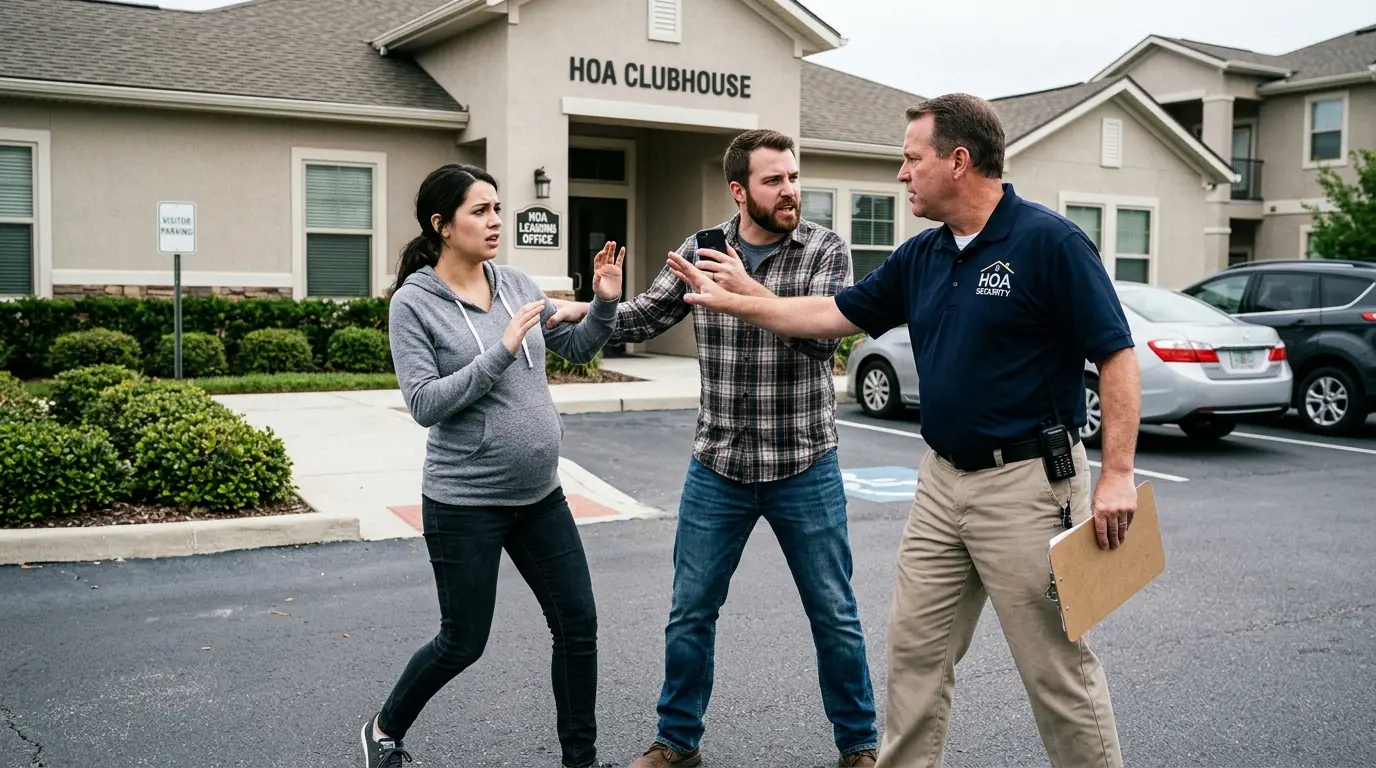
Laya, seven months pregnant, clutched the bag of groceries against her chest. "It's just apples and prenatal vitamins."
"That's not the point," Meredith sneered. "We have regulations."
I watched from 20 feet away, phone in my pocket, thumb on the record button. Then I said it: "I'm the one who wrote the camera protocol you're violating."
Her smugness cracked barely, but I wasn't bluffing. HOA guidelines, civil surveillance laws, local enforcement boundaries—I'd written them for a federal contractor.
She turned to me slowly. "Excuse me?"
I stepped forward, calm, even. "I'm Daniel Kesler. This is my sister. She has a heart murmur and was told by her OB-GYN to limit stairs, hence the heavy coat and curbside drop. Unless you're carrying a warrant or an EMT bag, I suggest you back off."
I didn't raise my voice. I didn't need to. Her power only existed when no one challenged it.
That sidewalk meant something to me. My sister moved here two months ago after a scare in her old apartment: carbon monoxide from a broken heater. I pulled every string I had to find her something safe. Pinebrook Glade advertised security, tradition, and order, but tradition meant subjugation when Meredith was involved.
Two weeks after she moved in, Laya got a warning for using non-transparent grocery bags; the HOA claimed it was a smuggling hazard. Next, they issued a violation for loitering when she sat down on the community bench for a breather. Last week, they left a note on her door about resisting wellness checks. That's what this was. Meredith called it "wellness compliance." She was trying to search a pregnant woman under the guise of health enforcement. And my sister, who'd already buried one child due to a stillbirth, was being treated like a security risk.
I didn't tell Laya I'd seen the footage from the gazebo camera the night before. The HOA thought they deactivated it, but they missed a maintenance override I wrote into the firmware years ago. What I saw made my stomach twist: Meredith demanding that Laya unzip her coat, pressuring her in front of neighbors, hinting she had something to hide. And now she was doing it again—broad daylight, no shame.
A couple of neighbors walked by. One of them slowed but didn't stop. That's how fear spreads: quiet and sticky. Meredith smiled at them and waved like nothing was happening.
"Daniel," Laya said under her breath, her voice trembling. "Let's just go."
I looked down at her belly, the way she held the grocery bag—not for weight, but for coverage. Her face was red. Not from heat, from shame.
I turned back to Meredith. "I'm filing a motion with the housing committee and the city zoning board. You'll be receiving a discovery demand within 48 hours. You'll need to preserve all video, body cam, and correspondence related to this wellness patrol nonsense."
"You think I'm scared of paperwork?" she scoffed.
"No," I said. "You should be scared of what happens when people see what's on it."
She didn't answer, just stepped aside. I guided Laya past her and toward the driveway. Her hand shook when it reached for mine. I didn't say anything, but that night, I opened the footage again.
There was a moment I'd missed the first time. Just before Meredith barked her order, just before Laya shrank inward, there was a pause, a shift in Laya's eyes. She wasn't afraid of the HOA. She was afraid I'd do nothing. That was the part that broke me.
I didn't sleep that night. Not because of the footage—I'd seen worse working in civil compliance. Not because of Meredith's smug stare, either. What kept me awake was the realization that I'd seen it before: different face, different zip code, same playbook. Abuse of power never begins with violence. It starts with paperwork.
The first warning Laya received was for her grocery bags: "All items must be transported in transparent or community-approved carriers." That's what the violation letter said, printed in bold with the HOA logo watermarked like it was a federal seal. She'd used a plain canvas tote, one I gave her after her baby shower. It had a sketch of a little fox and her name stitched under the handle.
Next came the noise complaint. Laya had opened her window on a warm evening. She was humming. No music, just her voice. Meredith claimed it disrupted the tranquility of the greenway. Two strikes within a week.
The third one arrived after Laya took a break on the gazebo bench during her walk: "Suspicious loitering," the form read. She was short of breath, carrying too much weight for her heart. But to them, she was a liability or worse, an opportunity to flex control.
I asked her if she wanted to fight it then. She shook her head. "They'll just make it worse."
I recognized that fear. I had interviewed enough victims to know the way they shrink—not from what's been done, but from what could be done next.
But that afternoon on the sidewalk changed things. Meredith had gone too far. She didn't just write a ticket or send a letter. She stood in front of neighbors and treated my sister like a shoplifter at a department store, and no one intervened. That told me everything I needed to know about Pinebrook Glade. They weren't just afraid of Meredith. They were complicit, conditioned, comfortable with her policing methods as long as the spotlight never turned their way.
So I started mapping. By morning, I'd created a timeline: each violation, the date it was issued, the exact policy cited, and the camera coverage available from those time windows. Some had gaps, likely intentional. Others, like the gazebo incident, were gold.
Laya came over with a Tupperware of oatmeal around 10:00. She didn't mention the day before. She just sat at the table, picking at the edge of her sleeve, staring out the window toward the community lot.
"I heard from Carol," she said after a while. "She got a fine last month. Her son has autism and he had a meltdown in the clubhouse. They told her it violated the decorum clause."
I looked up. "Is she willing to talk about it?"
"She won't even write a review. She's afraid they'll revoke her lease."
That tracks. Fear doesn't always wear a uniform. Sometimes it hides in the rules, in ambiguous phrases like "community wellness," "decorum," or "disruption." That's how Meredith operated, using policy as a weapon and silence as her shield.
Later that day, I walked the neighborhood—not as a resident, but as an auditor. I passed the pool gates, the dog park, the tennis courts, all perfectly maintained. But I started to notice patterns. The enforcement was selective. Two driveways had trash bins left out: no violations. One had garden gnomes: technically non-compliant, still there. But the units closest to the outer fence—the ones with renters, single moms, retirees—their doors had fresh stickers from the HOA: warnings, fines, notices.
The gazette archive confirmed it. Meredith had pushed for the "proactive compliance campaign" last year, claiming it would improve harmony. The board voted unanimously in favor. No surprise: she appointed half of them.
When I circled back toward the gazebo, I saw something that stopped me cold. A young boy, maybe nine or ten, stood by the bench, rubbing chalk on the pavement. Meredith approached from the side path. He froze. She said nothing, just stared. Then she pulled out her phone. He dropped the chalk and ran.
It wasn't what she said; it was what she didn't have to. I stood there a moment longer, then headed home. The rules weren't the problem. The rules were the excuse. And I was going to make her answer for every single one.
The next board meeting was scheduled for Thursday evening. I marked it down—not because I expected change, but because I needed eyes, patterns, reactions, the kind you can't pull from paperwork. I didn't go alone. Laya stayed home, too emotionally raw. But I brought a copy of the HOA's charter, a notepad, and a pocket-sized recorder—legal in Virginia, single-party consent. I kept it tucked under my jacket lapel, mic exposed just enough to catch the room.
Pinebrook's clubhouse looked like it had been designed by someone who thought faux marble columns and floral upholstery screamed authority. Every chair matched. Every light fixture had the same soft yellow glow: the illusion of order.