The oak gavel cracked like a gunshot, sealing Sarah Jenkins's fate. After fifteen years of marriage, her billionaire husband was about to walk away with everything while she slept in a freezing sedan. Across the aisle, Richard Preston adjusted his Rolex with the calm confidence of a man certain the law had already handed him victory. He had no idea that a dead man's secret was about to destroy everything he thought he owned.
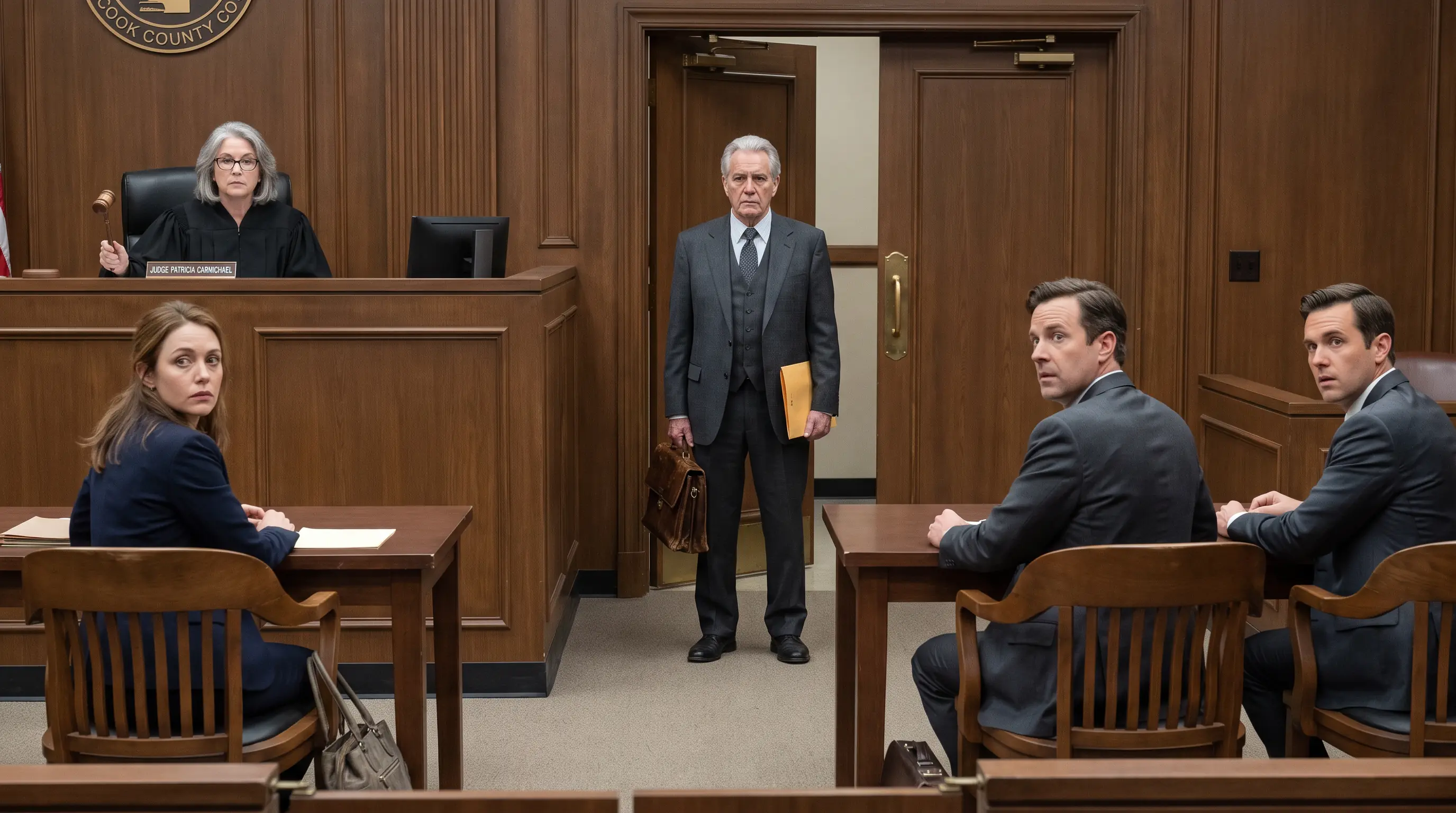
The air inside Room 302 of the Cook County Circuit Court was suffocatingly dry, carrying the smell of lemon polish and decades of broken promises. Sarah sat at the plaintiff's table with her hands trembling in her lap, wearing a modest navy blazer, the only professional clothing she had not pawned during the last six months. Richard looked as if he had stepped off the cover of Forbes, whispering a joke to his high-powered attorney, Gregory Howell, whose tailored Italian suits cost more than the car Sarah currently lived in. Richard did not even look at her.
Fifteen years earlier, everything had been different. In 2009, Richard was a desperate real estate agent in Chicago trying to flip foreclosed properties during the housing crash, while Sarah was a registered nurse pulling back-to-back twelve-hour shifts at Northwestern Memorial Hospital just to keep the lights on in their cramped one-bedroom apartment in Logan Square. She believed in him with the fierce loyalty of a woman who thought marriage was a fortress capable of surviving any storm. When he needed seed money for his first major development, Sarah drained her 401(k).
When Richard needed someone to manage the grueling administrative side of his fledgling company, Preston Holdings, Sarah left nursing and became his unpaid secretary, accountant, and sounding board. She answered phones, tracked invoices, organized contracts, handled schedules, and held the company together while Richard chased deals. He would later reduce all of that to a few dismissive words, but Sarah remembered the years when they had worked at the same kitchen table because they could not afford office space. She remembered every night she had believed they were building something together.
Her greatest sacrifice, however, had been Arthur Preston, Richard's father. Arthur was a stubborn former steelworker battling severe COPD and early-stage dementia, and Richard had little patience for him. "Put him in a state home and let the government deal with him," Richard had sneered, but Sarah could not do it. She moved Arthur into their home and cared for him herself.
For five years, Sarah bathed him, managed his oxygen equipment, handled his medications, endured his frightened outbursts, and sat beside him through long nights when breathing became difficult. Arthur could be bitter and difficult, but over time he came to trust Sarah more than anyone else. She read to him when he could no longer concentrate on television and learned how to calm him when confusion turned to fear. Arthur died two years before the divorce, slipping away quietly while Sarah sat beside him reading aloud.
Richard did not make it to the hospital in time. He was in Aspen closing a deal. By 2024, Preston Holdings had grown into a multimillion-dollar empire with lucrative commercial contracts across the Midwest. Richard had become the kind of man who appeared in business magazines, moved through private clubs, and spoke of himself as if success had been inevitable.
With the money came late nights, unexplained trips to Miami, and a gradual emotional withdrawal that became impossible to ignore. The end of the marriage did not come with a shouting match. It came when Richard slid an envelope across their custom marble kitchen island without looking up from his iPad. "I'm filing for divorce. My lawyers will be in touch. I need you out of the house by the end of the week."
Sarah stared at him. "Richard, what are you talking about? We've been together for fifteen years. I helped you build this."
Richard finally looked at her, his eyes cold. "You answered phones, Sarah. Don't flatter yourself. And as for the assets, I highly suggest you read the prenup you signed before we got married."
Sarah had signed the prenuptial agreement when she was twenty-two, deeply in love and completely naive. At the time, Richard owned almost nothing, and his lawyer had described the agreement as standard boilerplate intended to protect a small trust Richard's grandfather had left him. Buried beneath the legal language, however, was a waiver of alimony and an explicit relinquishment of claims to businesses founded during the marriage. Sarah had never imagined those clauses would one day be used to erase fifteen years of her life.
Richard's legal team, led by Gregory Howell, froze the couple's joint accounts after accusing Sarah of improperly transferring funds to pay for her ailing mother's care. The accusation was false, but it was enough to trigger a temporary financial injunction while the divorce proceeded. Sarah had no income, no savings in her own name, and an expired nursing license. Within weeks, she was sleeping in the back of her 2012 Honda Civic in the parking lot of a twenty-four-hour Walmart.
She showered at a cheap local gym and ate cold canned soup when she could not afford anything else. Meanwhile, Richard appeared in the Chicago Tribune society pages beside Khloe, a twenty-four-year-old former model. Sarah had sacrificed her career, her savings, and years of her life to a man who now treated her like a broken appliance he no longer needed. Her only legal help was Mitchell Bradley, an exhausted pro bono attorney working out of a strip-mall office.
"Your Honor, this is quite simply a waste of the court's time," Gregory Howell announced, his voice smooth and venomous. He adjusted his silk tie and gestured dismissively toward Sarah. "My client, Mr. Preston, entered into a legally binding prenuptial agreement on August 14, 2009."
"The petitioner, Ms. Jenkins, signed it of her own free will. She was an educated adult. The terms are unambiguous."
Judge Patricia Carmichael peered over her reading glasses. She was known for a strict adherence to the letter of the law. "Mr. Bradley, your client is asking me to invalidate a fifteen-year-old contract. What is your legal basis? You claim she contributed to the business, but I see no W-2s, no equity shares, and no partnership agreements."
Mitchell Bradley rose, running a hand over his thinning hair. "Your Honor, we are arguing for equitable distribution based on quantum meruit and unjust enrichment. Ms. Jenkins was the foundation of Preston Holdings. She sacrificed her nursing career to perform uncompensated labor for Mr. Preston's company for seven years."
He continued, "Furthermore, she acted as the sole full-time caregiver for Mr. Preston's late father, saving the family hundreds of thousands of dollars in medical and residential care costs. Her contribution was substantial, continuous, and directly connected to Mr. Preston's ability to build the company."
Howell gave a theatrical laugh. "Oh, please. Ms. Jenkins was a housewife. She occasionally answered the phone when the secretary was at lunch."
"As for Arthur Preston, caring for him was a familial duty, not a compensable service. There was no expectation of payment."
He spread his hands toward the courtroom. "Mr. Preston provided her with a life of extreme luxury for more than a decade. She flew on private jets. She lived in a ten-million-dollar estate. She has been more than adequately compensated for her supposed sacrifices."
Sarah felt her vision blur with humiliating tears. A life of luxury was how Howell described it, but Sarah remembered years spent trying to keep a crumbling marriage alive while Richard paraded his affairs in plain sight. She looked at Richard, who was leaning back and scrolling through his phone, detached from the reality that he was legally starving the woman who had handed him his first business cards. He acted as if she were already gone.
Judge Carmichael's expression softened slightly. "Mr. Howell makes a compelling point regarding the legal parameters of the prenuptial agreement. Ms. Jenkins, I am sympathetic to your situation, but the laws of this state regarding spousal support and property division are rigid when an intact, notarized prenuptial agreement is in place. You signed away your right to alimony, and you signed away your right to the business."
"Judge, please," Sarah said, her voice cracking. It was the first time she had spoken all morning. "I have nothing. I'm living in my car. He hid assets and transferred everything into shell LLCs before he served me. I just want enough to get an apartment and renew my nursing license."
Richard scoffed loudly enough for the court reporter to hear. "She's playing the victim, Your Honor. She has family she can leech off of."
"Mr. Preston, control yourself," Judge Carmichael snapped. She picked up her pen and looked back at Sarah.
"The court cannot rewrite a bad bargain, Ms. Jenkins. While the moral implications of Mr. Preston's actions are deeply questionable, my jurisdiction is confined to the law."
The judge took a breath. "The prenuptial agreement stands. The motion for spousal support is denied. The motion for equitable distribution of Preston Holdings is denied."
Sarah's breath caught. The room seemed to tilt, and for a moment she could barely hear Mitchell Bradley whispering an apology beside her. At thirty-seven, she was legally free but homeless and penniless. Across the aisle, Gregory Howell smiled like a man who had just watched the final obstacle disappear.
"Thank you, Your Honor," Howell said. "We ask that the divorce decree be finalized today."
Judge Carmichael reached for her oak gavel. "Unless there is any further business regarding this matter, I am prepared to enter final judgment."
"Stop."