Under the freezing Chicago rain, twin brothers Malik and Micah trudged home from school, cold, hungry, and walking back to the poor shelter, Hope Street Home. At their lowest moment, they found the wallet of a wealthy CEO with more than $3,000 inside, enough to feed every child in the shelter for an entire week. Yet, even when faced with such a huge temptation, the boys chose honesty and returned the wallet to the old woman.
What they didn’t know was that this simple act would lead them into a new life they had never dared to imagine.
The rain came down hard and cold. Malik Brown pulled his thin jacket tighter, but it didn’t help. The fabric was already soaked through, clinging to his skin like ice. Beside him, his twin brother, Micah, hunched his shoulders against the wind, his sneakers making wet, squelching sounds with every step.
“Man, I’m so hungry,” Micah muttered, his breath visible in the frigid air.
“I know,” Malik said.
Malik’s stomach had been growling for the past hour. Lunch at school had been three hours ago, a small sandwich and an apple that hadn’t come close to filling him up.
“Just got to make it back to Hope Street.”
They were walking through Chicago’s financial district, a route they usually avoided. But the bus cost money they didn’t have, and the regular way home added an extra 20 minutes. Twenty minutes in this freezing rain felt like forever.
Malik glanced at the buildings around them, glass towers that seemed to scrape the gray sky, their lobbies warm and bright. Through the windows, he could see people in expensive suits, holding coffee cups, laughing at something on their phones. A different world, one he and Micah had never been part of.
“Maybe Miss Jackson saved us some dinner,” Micah said hopefully.
“Maybe.”
Malik didn’t want to say what they both knew, that with 24 kids at Hope Street Home and a budget that barely stretched, saving dinner usually meant cold toast and whatever peanut butter was left in the jar.
His hands were numb. He shoved them deeper into his pockets, but there was a hole in the left one, and his fingers just pushed through to the cold air outside.
That’s when he saw her.
An older white woman, maybe 70 or more, stood on the corner ahead. Everything about her screamed money: the long wool coat that looked like it cost more than a year of groceries, the leather handbag, the way she held herself like the sidewalk belonged to her. She was talking on her phone, one hand gesturing sharply as she spoke, clearly agitated about something.
“Yes, I understand the market is volatile, but…”
She stepped off the curb, still talking, her attention completely absorbed. Her foot hit a slick patch of wet pavement. She stumbled, caught herself, but her purse swung wide. A brown leather wallet flew out, tumbling through the air before hitting the ground with a wet slap.
The woman didn’t notice. She kept walking, still talking into her phone, disappearing around the corner.
The wallet sat there on the sidewalk for maybe two seconds. Then the rain pushed it, slowly at first, then faster, sliding along the concrete toward the storm drain.
“Yo.”
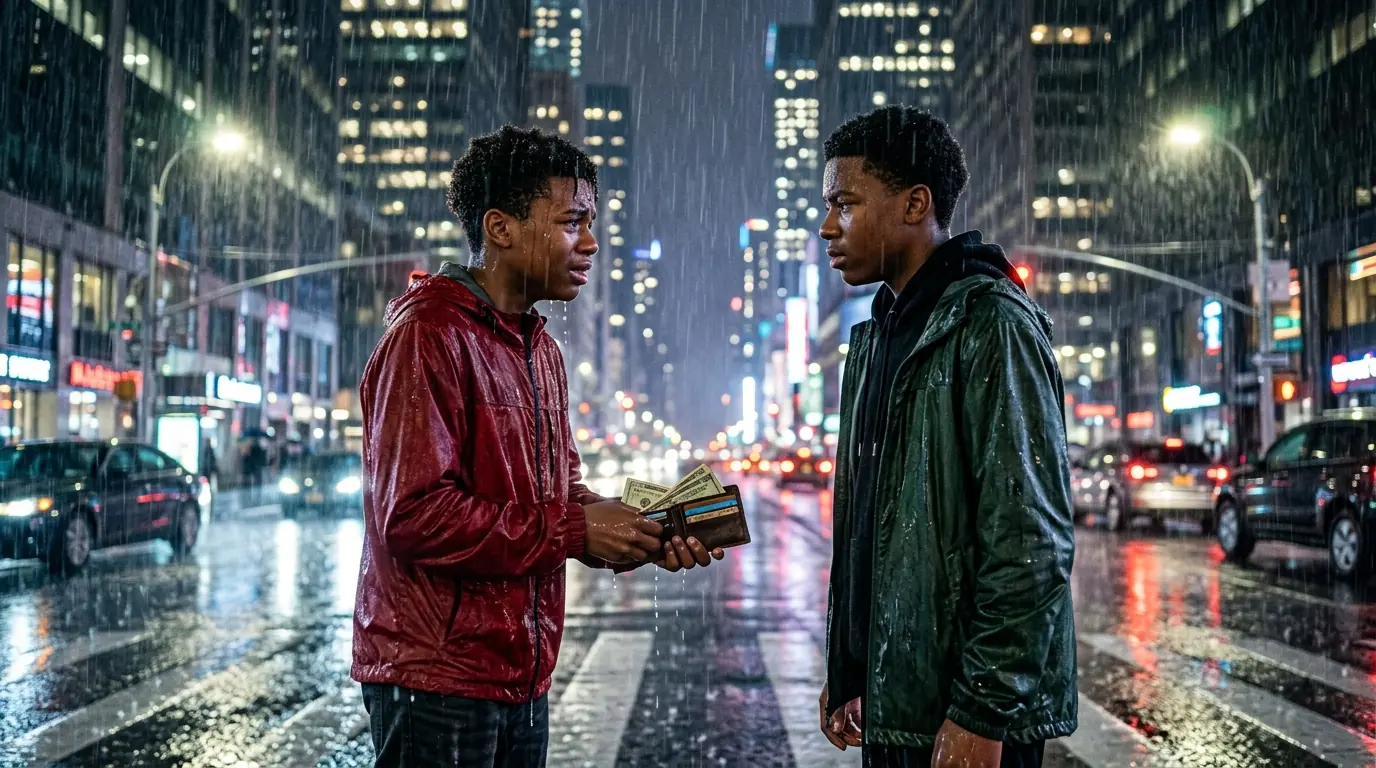
Micah grabbed Malik’s arm, but Malik was already moving. He ran, his worn sneakers slipping on the wet pavement. The wallet was six feet from the drain. Five. Four.
Malik dropped to his knees, his pants immediately soaking through, the cold concrete biting into his skin. His hand shot out, fingers scraping against wet leather just as the wallet reached the edge of the grate.
“Got it.”
He stayed there for a moment, kneeling in a puddle. His hand clutched tight around the wallet. Water ran down his face into his eyes, dripping from his chin.
“Dude, you okay?” Micah crouched beside him, breathing hard.
“Yeah.”
Malik pushed himself up, wincing as gravel stuck to his scraped knees. He looked down at the wallet in his hands.
It was heavy. Real leather, soft and expensive, the kind that got better with age instead of falling apart. He turned it over, and his breath caught.
“Micah.”
“What?”
Malik opened it. The first thing he saw was the cash. Bills, lots of them, crisp and new, stacked thick in the main compartment. His eyes flicked over the numbers. Twenties, fifties, hundreds. More money than he’d ever held in his life. More money than he’d ever seen in one place.
“Holy…”
Micah’s voice trailed off.
Malik’s hands shook, not from the cold this time. He carefully pulled out the stack, trying to count.
Thirty, forty, fifty.
He stopped. There had to be at least $3,000 here, maybe more.
$3,000.
His mind raced. That was food. Real food. Hot meals. Enough to feed everyone at Hope Street for weeks. That was new shoes that didn’t have holes. That was a winter coat that actually kept you warm.
“Malik.”
Micah’s voice was quiet, careful.
“That’s a lot of money.”
“I know.”
“Like a lot, a lot.”
Malik swallowed hard. His fingers moved through the rest of the wallet on autopilot. Credit cards, black ones, the kind he’d heard were for rich people. A driver’s license.
He pulled it out, tilting it to catch the light from a nearby street lamp.
Eleanor Price. Date of birth, March 4th, 1953. The address was in the Gold Coast, one of the richest neighborhoods in Chicago.
Behind the license, he found a business card, thick, expensive paper, embossed letters.
Eleanor Price, CEO, Price Holdings, a phone number, an email, an office address downtown.
“She’s loaded,” Micah whispered, reading over his shoulder. “Like, crazy loaded.”
Malik stared at the card. Price Holdings. He’d seen that name before on buildings around the city. Real estate development, the kind of company that owned half of Chicago.
This woman had everything, more than everything, and she wouldn’t even notice this money was gone.
“Malik.”
Micah’s voice had changed. There was something careful in it now. Something tentative.
“We could just take a little, like a hundred bucks, maybe two. She’s not going to miss it, man. Look at this. She’s a CEO. She probably spends more than that on lunch.”
Malik’s thumb brushed over the bills. They were so new they almost stuck together.
One hundred dollars would feed the little kids at Hope Street. Destiny, the six-year-old who cried every night because she was still hungry after dinner. Marcus, who was eight and had grown out of his shoes two months ago, but was still wearing them because there was no money for new ones. Tiny Carmen, who was four and sometimes didn’t get a snack because they ran out.
“Nobody would know,” Micah continued, his voice soft. “We’d be helping them. That’s not stealing. That’s just making things fair, right?”
Malik closed his eyes. His stomach cramped with hunger. His fingers were so cold they’d gone past numb into painful. His knees throbbed where he’d scraped them on the concrete. The jacket he was wearing, his only jacket, was so soaked that he’d probably be shivering all night, even under the thin blanket on his bunk.
And in his hands, he held enough money to fix all of that. Not just for him, for Micah. For all the kids who went to bed hungry, who wore clothes that didn’t fit, who walked miles in the rain because there was no money for the bus.
He could help them right now. All he had to do was take a few bills from a woman who wouldn’t even notice they were gone.
Do what’s right, even when it’s hard. Especially when it’s hard.
The voice in his head wasn’t his own. It was a memory, faded and soft, like something from a dream. He didn’t know where it came from. A teacher maybe, or a counselor, or just something he’d heard once and held on to because it felt true.
He opened his eyes and looked at Micah. His brother’s face was wet with rain. His lips were almost blue from the cold. Malik knew that look, hopeful but trying not to be, because hope hurt too much when it got crushed.
“She dropped it,” Malik said quietly. “It’s not ours.”
“But…”
“It’s not ours, Micah.”
Something flickered in his brother’s eyes. Disappointment maybe, or relief. Probably both.
Malik shoved the cash back into the wallet, making sure everything was secure. Then he closed it and held it tight in his fist.
“Come on,” he said. “Let’s find her.”
They ran back the way they’d come, their shoes splashing through puddles. The woman had turned the corner. Malik remembered which way. His lungs burned from the cold air, but he pushed harder, Micah right beside him.
There, half a block ahead, still on her phone, walking fast like the rain was personally offending her.
“Ma’am,” Malik called out.
His voice cracked. He was still only 11, and sometimes it did that.
“Ma’am, wait.”
She didn’t hear him. Or she did and ignored him. He couldn’t tell which. He ran faster.
“Ma’am, you dropped something.”
This time she stopped, turned around, her phone still pressed to her ear. Her eyes scanned the street, landed on him and Micah running toward her, and something changed in her expression.
Malik saw it. The way she automatically clutched her purse tighter, the way she took a half step back.
She thought they were going to rob her.
The realization hit him like a punch to the stomach, but he didn’t stop running. He reached her, breathing hard, holding out the wallet with both hands.
“You dropped this,” he said. “Back there on the corner. It almost went down the drain.”
The woman stared at him, then at the wallet, then back at him. Slowly, she lowered her phone from her ear.
“I… excuse me. I’ll call you back,” she said into it, her voice distracted.
She ended the call, but her eyes never left the wallet in Malik’s hands.
“That’s yours, right?” Micah asked, still catching his breath. “Eleanor Price. We saw your license.”
“You opened it?” Her voice was sharp, suspicious.
“We had to check who it belonged to,” Malik explained, “so we could find you.”
The woman reached out and took the wallet from his hands. She opened it immediately, her fingers moving quickly through the compartments, checking the cash, counting it, examining the cards. Malik and Micah stood there, dripping wet, shivering.
Finally, she looked up. Her face had gone pale under her makeup.
“This is all of it?” she asked. “Everything’s here?”
“Yes, ma’am.”
“You didn’t take anything?”
The question stung. Malik felt Micah tense beside him.
“No, ma’am,” Malik said, keeping his voice steady. “It’s not ours.”
Eleanor Price stared at them for a long moment. Really looked at them, their soaked clothes, their worn shoes, the way they were both shaking from the cold. Her eyes moved from their faces to their hands to the scrapes on Malik’s knees where he dove to catch the wallet.
Something in her expression changed. The suspicion faded, replaced by something else. Something that looked almost like shock.
“You…” She seemed to be searching for words. “You boys ran after me to return this in the rain?”
“Yes, ma’am.”
“But the money. There’s almost $3,000 in here. You saw that?”
“Yes, ma’am. We did.”
“And you didn’t take any of it?”
Malik met her eyes.
“No, ma’am. Like I said, it’s not ours.”
The woman’s hand went to her throat, touching a pearl necklace that probably cost more than a car. She looked at them like she was seeing something she couldn’t quite believe, like the math didn’t add up in her head. Two Black boys, clearly poor, soaking wet and shivering. A wallet full of cash. And they’d given it all back.
“I…”
Eleanor Price’s voice was quieter now, less sharp.
“Most people wouldn’t have done that.”
Malik didn’t know what to say to that, so he said nothing.
The rain kept falling. A car passed by, splashing water onto the sidewalk, narrowly missing them. The woman seemed to notice for the first time that they were still standing there getting drenched. She glanced down the street, then back at them, and something shifted in her face. A decision being made.
“Come with me,” she said suddenly. “There’s a cafe right there. You boys need to get out of this rain.”
“We should get home,” Micah started.
“Please.”
The word came out softer than anything else she’d said.
“I’d like to… I want to thank you properly. Just a few minutes. Get warm at least.”
Malik and Micah exchanged a glance, the kind of silent communication that only twins had. A whole conversation in a look.
She seems okay. It’s just a cafe, a public place. We’re already soaked anyway. And it’s warm inside.
“Okay,” Malik said. “Just for a minute.”
Eleanor Price nodded once, sharp and decisive, like she was closing a business deal. She turned and walked toward a small cafe with warm light spilling out onto the wet sidewalk.
Malik followed, his scraped knees stinging with every step, the wallet’s weight still somehow heavy in his memory, even though it was no longer in his hands.
He didn’t know it yet, but that weight, the choice he’d made in a split second on a wet street corner, was about to change everything.
But before the rain, before the wallet, before Eleanor Price, there had been the morning. The same morning, the one that started at 4:30 a.m., like every other morning at Hope Street Home.
The alarm didn’t make a sound. Malik had learned to wake up before it, his internal clock set by months of the same routine. He opened his eyes to darkness. Above him, the springs of the top bunk creaked.
Micah was already awake, too.
“You up?” Micah’s whisper floated down.
“Yeah.”
Malik swung his legs off the lower bunk, his feet finding the cold floor. Around them, 22 other kids slept in various states of quiet, some peaceful, some restless, a few whimpering in their dreams.
Hope Street Home, their home for the past three years.
The room was crowded. Twelve bunk beds crammed into a space meant for maybe eight. Clothes hung from every available hook and corner. The radiator in the corner clanked and hissed, putting out just enough heat to keep them from freezing.
Malik grabbed his jeans from the end of the bed, the same ones he’d worn yesterday, the same ones he wore every day because he only had two pairs.
“Destiny’s crying again,” Micah said quietly, climbing down.
Malik heard it now, soft sniffling from across the room. He made his way between the bunks, careful not to wake anyone else. The little girl was curled up in her bed, her face pressed into a pillow that had seen better days.
“Hey, Destiny.” He crouched beside her bunk. “What’s wrong?”
“I had a bad dream.” Her voice was so small. “Mommy was there, but then she wasn’t.”
Malik’s chest tightened. Destiny’s mom was in rehab. Third time. The little girl had been at Hope Street for six months.
“Want me to find Mr. Patches?” he asked.
She nodded, wiping her nose with her hand. Malik searched the tangled sheets until he found the stuffed dog missing one eye, half the stuffing gone. He tucked it into her arms.
“Better?”
“A little.”
“Try to sleep some more. Okay? We got another hour before breakfast.”
But he knew she wouldn’t. And honestly, neither would he.
Across the room, Marcus, eight years old, big for his age, was sitting up trying to tie his sneakers. The laces were so frayed they barely held together. His feet had grown since he got those shoes two months ago. Malik could see his toes pressing against the front.
“Here.” Micah knelt down. “You’re making it worse, man. Let me.”
Marcus looked down, embarrassed.
“I can do it.”
“I know you can, but I’m faster.”
Micah’s hands worked quickly, double knotting the laces to keep them from coming undone.
“There. Good to go.”
“Thanks,” Marcus mumbled.
This was their routine. Had been for a while now. Wake up early. Help the little ones find lost socks, tie shoes, calm nightmares, make sure everyone was ready before Ms. Jackson did her morning rounds.
Malik made his way to the bathroom. One bathroom shared by 24 kids. The mirror was cracked down the middle. Someone had written “Kings and Queens” on it in marker, but the words were faded now.
He splashed cold water on his face, looked at himself in the fractured glass. Eleven years old, brown eyes, hair that needed cutting, a face that adults always said looked serious or grown up, which was just a nice way of saying he’d stopped looking like a kid.
Hard to stay a kid when you were raising yourself.
“Hurry up, man,” a voice said behind him.
Jamal, 13, one of the older boys.
“Some of us got to piss.”
Malik moved aside.
By the time Miss Jackson came through at 5:30, everyone was up, getting dressed, making beds, trying to find clean clothes in the shared drawers.
Miss Jackson was a Black woman in her mid-40s with tired eyes and shoulders that carried too much weight. She’d been running Hope Street for seven years, longer than anyone else had lasted.
“Morning, babies,” she said, her voice rough from not enough sleep. “Breakfast in 20. Don’t forget, Marcus, you got that doctor’s appointment. Destiny, your social worker’s coming at 3:00. Malik, Micah…”
“We know,” Malik said. “School, straight home. No messing around.”
“That’s right.”
She gave them a look that was half warning, half affection.
“You two are my rocks. Don’t make me worry.”
Breakfast.
The kitchen was barely big enough for the folding table they’d squeezed in. Ms. Jackson and her assistant Rosa moved between stove and counter, stretching what they had. Toast. Peanut butter, if you were lucky. A banana.
Malik took his piece of toast, thin, barely browned, and sat down. Beside him, little Carmen stared at her plate, her bottom lip trembling.
“What’s wrong?” he asked.
“Mine’s too small.”
She was four, and didn’t understand yet that everyone’s portions were small.
Malik looked at his own toast. His stomach was already growling, had been since he woke up. One piece wouldn’t be enough. It never was.
He broke his toast in half and put the bigger piece on Carmen’s plate.
“There. Now it’s bigger.”
Her face lit up.
“Thank you, Malik.”
Across the table, Micah did the same thing with his piece, sliding half to Marcus.
Ms. Jackson noticed. She always did, but she didn’t say anything, just pressed her lips together and turned back to the stove.
They ate in relative quiet. Some of the kids chatted, but most were too tired or too hungry to talk much.
“Yo, Malik.”
It was Jamal again, smirking from the end of the table.
“You always playing hero. What’d you get out of it?”
“Nothing,” Malik said simply.
“Exactly. That’s dumb, man. You going to starve yourself for these little kids?”
“They’re hungrier than me.”
“How you know?”
“Your stomach growls louder than anyone’s.”
Jamal laughed, and a few of the other older kids joined in.
“Always trying to be Superman. Where’s that get you?”
Malik didn’t answer. He’d learned that arguing with Jamal was pointless. The older boy was angry at the world, and nothing Malik said would change that.
Micah, though, couldn’t help himself.
“At least he cares about someone other than himself.”
“What did you say?”
“You heard me.”
“Boys.”
Ms. Jackson’s voice cut through the tension.
“Enough. Eat your breakfast and get ready for school.”
Jamal muttered something under his breath but went back to his food. Malik caught Ms. Jackson’s eye. She gave him a small nod. Thank you for not escalating. And he nodded back.
After breakfast, the chaos began. Twenty-four kids trying to find backpacks, homework, jackets that fit. The noise was overwhelming. Ms. Jackson stood by the door, checking each one as they left.
“Coats buttoned. Homework in your bags. Straight to school. Straight home.”
When Malik and Micah reached her, she put a hand on each of their shoulders.
“You two okay?” she asked quietly. “Got lunch money?”
They shook their heads.
Her face tightened.
“I’ll see what I can do for tomorrow.”
“For today?”
She pulled two granola bars from her pocket.
“It’s not much.”
“It’s enough,” Malik said. “Thank you, Miss Jackson.”
“You’re good boys.” Her voice was thick. “Your mama would be proud.”
The words hit harder than they should have. Malik forced a smile.
“We’ll see you after school.”
Outside, the cold hit them immediately. November in Chicago was brutal. Malik zipped his jacket, thin with a broken zipper that only went halfway up. Micah’s wasn’t much better.
“Two miles,” Micah said, looking down the street, “in this.”
“We’ve done it before.”
“Doesn’t make it suck less.”
They started walking. The sky was gray, threatening rain around them. Other kids waited at bus stops, climbed into cars with parents. Normal kids, kids with homes.
“You ever wonder what it’s like?” Micah asked after a while.
“Having a real house?”
“All the time. Like, what would you want if we could have anything?”
This was their game, their way of making the walk go faster.
“A kitchen,” Malik said. “Big enough to cook in. And we’d make breakfast every morning. Eggs, bacon, pancakes.”
“Man, stop. You’re making me hungrier. Your turn.”
“A bedroom, just ours. Two beds, not bunk beds.”
“And a door that closes?”
“Yeah. And a backyard with a dog.”
“Huh. A big dog?”
They walked in silence for a moment, building the imaginary house in their minds.
“Think it’ll ever happen?” Micah asked quietly.
Malik didn’t answer right away. He wanted to say yes, wanted to believe it, but he’d learned not to hope too hard. Hope hurt when it broke.
“Maybe,” he said finally. “Someday.”
Micah looked at him, and Malik saw the same fear he felt. That maybe someday would never come. That they’d age out of the system at 18, still broke, still alone, still just trying to survive.
But they didn’t say that part out loud.
They just kept walking, shoulders hunched against the cold, counting down the blocks until school.
The school came into view after 40 minutes of walking. Lincoln Middle School, a sprawling brick building that had seen better decades. Malik’s feet hurt. His socks were damp from stepping in a puddle he hadn’t seen, and the wet fabric rubbed against his heels with every step.
“Almost there,” Micah muttered, more to himself than to Malik.
They pushed through the front doors into the warmth of the entrance hall. Around them, kids laughed, shouted, slammed lockers. The noise was different from Hope Street. Louder, sharper, full of energy that came from sleeping in your own bed and eating breakfast until you were full.
Malik and Micah made their way to their lockers, keeping their heads down.
“Hey, look who it is.”
The voice came from behind them.
“The shelter twins.”
Malik’s jaw tightened. He didn’t turn around.
Brandon Chen, eighth grader. The kind of kid who needed someone beneath him to feel important.
“Yo, I’m talking to you.”
Brandon stepped closer, his friends flanking him.
“You guys shower this morning or nah? Cuz I swear I can smell that group home funk from here.”
Micah’s hands balled into fists. Malik touched his brother’s arm. A warning.
“We’re good, Brandon,” Malik said evenly. “Just getting to class.”
“That’s what I thought. You know your place.”
Brandon laughed, turning to his friends.
“They always know their place.”
They walked away, still laughing. Micah’s breathing was hard, his face flushed.
“I hate him. I hate all of them.”
“I know.”
“One day, I swear…”
“Not worth it,” Malik said quietly. “He wants you to swing. Then you get suspended, and Ms. Jackson has to deal with it, and nothing changes except we’re in deeper trouble.”
“So we just take it?”
“We survive it. There’s a difference.”
Micah looked like he wanted to argue, but the bell rang.
First period, English with Mrs. Miller.
Mrs. Miller was in her 50s, with gray hair she wore in a bun and reading glasses on a chain. She taught at Lincoln for 23 years. And unlike most teachers, she actually remembered every student’s name.
“Good morning, class. Homework on your desks, please.”
Malik pulled out his assignment, a two-page essay on To Kill a Mockingbird. The paper was wrinkled from being stuffed in his backpack, but the words were carefully written in his neat handwriting.
Mrs. Miller walked the rows collecting papers. When she reached Malik’s desk, she paused.
“This looks good, Malik. I’m looking forward to reading it.”
“Thank you, Mrs. Miller.”
She moved on to Micah, then stopped at the desk behind them. Empty.
“Where’s your homework, Brandon?”
“Uh, I forgot it at home.”
“That’s the third time this month.”
“Yeah, well, some of us have actual houses to forget stuff at.”
A few kids snickered.
Mrs. Miller’s eyes flicked to Malik and Micah, then back to Brandon.
“Detention today, 3:00.”
“What? That’s not fair.”
“Life rarely is. But disrespect in my classroom gets consequences. Now open your books to page 47.”
At lunch, Malik and Micah sat in their usual spot, a table near the windows, away from the main crowd. Malik pulled out the granola bar Ms. Jackson had given him, split it in half, and gave one piece to Micah.
“That’s not lunch,” Micah said.
“It’s what we got.”
They ate slowly, making it last. Across the cafeteria, other kids had actual lunches. Pizza, burgers, fries. The smell made Malik’s stomach cramp.
“Hey, boys.”
Mrs. Miller appeared beside their table, holding a brown paper bag.
“Mrs. Miller…”
“I packed too much today,” she said, setting the bag down. “Turkey sandwiches, apple slices, chips. I hate to waste food. You two mind helping me out?”
Malik stared at the bag. He knew what this was. Mrs. Miller never packed too much. She did this every week, always with a different excuse.
“You sure?” he asked quietly.
“Positive. I’ll just throw it away otherwise.”
“Thank you,” Micah said, his voice thick.
“You’re welcome, sweetheart.”
She squeezed Micah’s shoulder, then walked away before they could see her eyes getting wet.
They ate the sandwiches in silence. Real food. Actual turkey, cheese, lettuce. Malik had to force himself not to eat too fast.
After school, they didn’t go straight home. Instead, they walked three blocks to the public library, a tall stone building that smelled like old paper and floor polish.
Mrs. Thompson, the head librarian, was at the front desk. She was white, in her 60s, with kind eyes behind thick glasses.
“Well, hello, boys. The usual spot?”
“Yes, ma’am.”
“Go on then. I’ll be here if you need anything.”
The usual spot was a corner table in the back, away from the computers where the loud kids played games. Malik and Micah spread out their homework, working in companionable silence.
Around 5:00, Mrs. Thompson appeared with two granola bars and a thermos.
“Hot chocolate,” she said. “It’s getting cold out there.”
“Mrs. Thompson, you don’t have to…”
“Hush. I made too much. Story of my life.” She winked. “Your folks must be real proud of you two. I see you in here every day working hard.”
The words landed like a punch. Malik forced a smile.
“Thank you, ma’am.”
After she left, Micah stared at the granola bar in his hands.
“She thinks we have parents waiting at home,” he said softly.
“Yeah.”
“Should we tell her?”
“Why? So she feels bad? She’s just being nice.”
Micah nodded, but his eyes were distant.
 Malik pulled out the one thing that mattered more than anything else. A photograph, creased and worn from being handled too many times. He kept it in a plastic sleeve, protected.
The woman in the photo was young, maybe 19 or 20, Black, with bright eyes and a smile that could light up a room. She was holding two tiny babies, one in each arm, looking at the camera like nothing else in the world existed except those two children.
Malik flipped it over. On the back, in fading ink:
Malik and Micah, Mommy loves you forever. Alicia.
“You think she’d be proud?” Micah whispered, looking at the photo.
“Yeah,” Malik said. “I think she would be.”
They sat there until the library closed at 6:00, then packed up their things. Outside, the sky was darkening. The walk back to Hope Street would take another 40 minutes.
“Ms. Jackson said something today,” Micah said as they walked. “About the home maybe closing.”
Malik’s stomach dropped.
“What?”
“I heard her on the phone. Budget cuts. The city might pull funding.”
“When?”
“I don’t know, but Malik, if they close it, where do we go?”
Malik didn’t have an answer. He’d heard the rumors, too. That older kids would get scattered to different homes across the city. That twins weren’t always kept together because it was more complicated.
“We stay together,” Malik said firmly. “No matter what happens, we find each other. Promise me.”
“I promise.” Micah’s voice cracked. “You promise, too?”
“I promise.”
They walked the rest of the way in silence, both of them carrying the weight of a fear too big for 11-year-old shoulders.
By the time they reached the financial district, the rain had started.
That’s when they saw her.
The old woman with the expensive coat, the phone pressed to her ear, completely oblivious to the wallet sliding toward the storm drain.
And Malik made a choice that would change everything.
And now here they were, dripping wet in a corner booth, watching steam rise from hot chocolate they hadn’t asked for, trying to understand why this stranger was looking at them like they’d just done something impossible.
The cafe was small and warm, the kind of place where business people grabbed coffee between meetings. Malik had walked past places like this a hundred times, but never been inside.
A waiter appeared almost instantly.
“Mrs. Price, good to see you.”
“Hello, David. Can we get two bowls of your chicken noodle soup and two hot chocolates? Actually…”
She looked at the boys.
“Are you hungry?”
Stupid question. They were always hungry.
“We’re okay,” Malik said automatically.
Eleanor’s eyes narrowed.
“When’s the last time you ate?”
“Lunch.”
“What did you have?”
Malik hesitated.
“A granola bar.”
“That’s not lunch.”
She turned back to the waiter.
“Two burgers as well, with fries, and make the hot chocolates large.”
“Right away, Mrs. Price.”
After he left, Eleanor folded her hands on the table and studied them. Really looked at them in a way that made Malik want to squirm.
“What are your names?” she asked.
“Malik Brown. This is my brother, Micah.”
“Brothers?”
“Twins,” Micah replied.
“I see.” She paused. “How old are you?”
“Eleven.”
“And you live?”
Malik glanced at Micah. There was no point lying.
“Hope Street Home. It’s a group home over on the South Side.”
Something flickered across Eleanor’s face.
“How long have you been there?”
“Three years. And before that, different homes. We’ve been in the system since we were born.”
The waiter returned with two steaming mugs of hot chocolate topped with whipped cream. Malik wrapped his hands around the mug, letting the warmth seep into his frozen fingers. He took a sip. It was the best thing he’d ever tasted.
Beside him, Micah did the same, his eyes closing for just a second.
“Your parents?” Eleanor asked quietly.
“Mom died when we were born,” Malik said.
The words came out flat, practiced. He’d said them so many times they’d lost their weight.
“Dad, we don’t know who he is. Never met him.”
“I’m sorry.”
“It’s okay. We don’t really remember her.”
But that was a lie. Not about remembering. He didn’t, not really. But it wasn’t okay. It would never be okay.
The soup arrived, followed by the burgers. Malik stared at the food in front of him. A real burger, thick and juicy, cheese melting over the sides, fries golden and hot, soup with actual chunks of chicken and vegetables.
“Go ahead,” Eleanor said. “Eat.”
Malik picked up the burger with both hands and took a bite. The flavors exploded in his mouth. Meat, cheese, pickles, special sauce. He had to stop himself from inhaling it.
Beside him, Micah was doing the same, eating slowly, methodically, like he was trying to memorize every bite.
Eleanor watched them with an expression Malik couldn’t quite read.
“You boys go to school?” she asked.
“Yes, ma’am. Lincoln Middle School.”
“You like it?”
Malik shrugged.
“It’s school.”
“What do you want to do after you graduate?”
No one had ever asked him that before. Not like they actually cared about the answer.
“College,” Malik said. “I want to go to college.”
“To study what?”
“Social work, maybe. Or teaching. Something where I can help kids like us.”
Eleanor’s eyebrows rose slightly.
“That’s very mature of you.”
“Someone’s got to do it.”
“And you?” she turned to Micah.
“Same,” Micah said around a mouthful of fries. “We’re going to stick together, go to the same college, get an apartment, help kids who don’t have anyone.”
“That’s a good dream.”
“It’s not just a dream,” Malik said quietly. “We’re going to make it happen.”
Eleanor was quiet for a moment, her fingers tracing the rim of her coffee cup.
“Can I ask you something?” she said finally.
“Sure.”
“Why didn’t you take the money? Even just a little bit?”
Malik set down his burger.
“Because it wasn’t ours.”
“But you’re, forgive me, clearly struggling. That money could have helped you.”
“Helping ourselves by stealing isn’t really helping,” Malik said. “It’s just becoming someone we don’t want to be.”
“Who taught you that?”
“I don’t know. Just feels right, I guess.”
Micah jumped in.
“Ms. Jackson. She runs our group home. She always says, ‘You can’t control what hand life deals you, but you can control how you play it.’ Taking that money would have been playing it wrong.”
Eleanor’s eyes glistened slightly. She blinked, cleared her throat.
“Do you have anything?” she asked. “From your mother?”
Malik hesitated, then reached into his backpack. The plastic sleeve was still dry. He pulled out the photograph, handed it across the table.
Eleanor took it carefully, like it was fragile. She stared at the image for a long time, longer than seemed normal. Her fingers trembled slightly.
“Her name was Alicia,” Malik said. “Alicia Brown. That’s all we know.”
“She’s beautiful,” Eleanor whispered.
Her thumb traced over the woman’s face in the photo.
“You both… you look like her, especially around the eyes.”
“People say that.”
Eleanor turned the photo over, read the inscription on the back. Her jaw tightened, and she closed her eyes briefly.
“Are you okay?” Micah asked.
“Yes, I’m sorry. I…”
She handed the photo back carefully.
“Thank you for showing me.”
They finished eating in silence. Malik watched Eleanor from the corner of his eye. Something had changed in her demeanor after seeing the photo. She seemed distracted, distant, her mind clearly somewhere else.
Finally, she reached into her purse and pulled out a white envelope, setting it on the table between them.
“I’d like to give you a reward,” she said. “For your honesty.”
Malik pushed it back.
“No, thank you.”
“It’s $500. You could…”
“We didn’t do it for money,” Malik said firmly. “We did it because it was the right thing to do. But surely if you pay us, then it wasn’t really the right thing. It was just a transaction.”
Malik met her eyes.
“We’re not for sale, Mrs. Price.”
Eleanor stared at him, and for a second, Malik thought maybe he’d offended her. Rich people didn’t like being told no.
But then her face did something unexpected. It softened. Her eyes filled with tears that she didn’t try to hide.
“You’re remarkable,” she said, her voice thick. “Both of you, truly remarkable.”
Malik didn’t know what to say to that.
Eleanor put the envelope back in her purse and pulled out a business card instead.
“This has my personal number,” she said, sliding it across to Malik. “If you ever need anything, and I mean anything, you call me. Understand?”
“Yes, ma’am.”
“I mean it. Day or night. You need help, you call.”
“Okay.”
She stood up, gathering her coat.
“I should let you get home. Your Ms. Jackson will be worried.”
They walked to the door together. Outside, the rain had stopped, leaving the streets slick and shining under the streetlights.
“Can I give you a ride?” Eleanor asked.
“We’re good. It’s not far.”
Another lie. But Malik didn’t want to explain where Hope Street Home was. Didn’t want her to see it.
“All right.”
Eleanor looked at them for a long moment.
“Thank you for everything.”
“You’re welcome, ma’am.”
She got into a car that had been waiting, a black sedan with a driver, and disappeared into the night.
Malik and Micah started walking.
“That was weird,” Micah said after a while.
“Yeah.”
“She got really intense about Mom’s picture.”
“I noticed.”
“You think we’ll ever see her again?”
Malik fingered the business card in his pocket.
“I don’t know. Probably not.”
But something in his gut told him he was wrong.
Eleanor Price stood in her penthouse, staring out at the Chicago skyline. It was past midnight. The city glittered below her. Thousands of lights, millions of lives, a kingdom she’d helped build with steel and concrete and ruthless business decisions.
But tonight, none of it mattered.
She couldn’t stop thinking about those boys, their faces, their voices, the way they’d looked at that wallet full of cash like it was a test they were determined to pass.
And that photograph.
Eleanor pressed her palm against the cold glass window. Her reflection stared back. Seventy-two years old, successful beyond measure, and completely alone.
Alicia Brown.
The name circled in her mind like a vulture.
She’d heard it before. Years ago, in a different lifetime, when she’d still had a son.
Eleanor turned away from the window, her heart pounding. She walked to her office, a sleek room with floor-to-ceiling bookshelves and a desk that cost more than most people’s cars. She picked up her phone, hesitated, then dialed.
“Miss Carter, I need you at my office now.”
“Mrs. Price, it’s almost 1:00 in the morning.”
“I know what time it is. I need you here. Bring the archived files from 2013 to 2014. Everything related to my son.”
A pause.
“Daniel?”
“Yes.”
“Mrs. Price, are you all right?”
“Just bring them, please.”
Thirty minutes later, her assistant arrived. A sharp woman in her 40s, still in pajamas under her coat, carrying three file boxes.
“Here,” Miss Carter said, setting them on the desk. “What are we looking for?”
“A name. Alicia Brown.”
Miss Carter’s face went pale.
“Oh. Oh, Mrs. Price.”
“Find it.”
They worked in silence, pulling out folders, scanning documents. Eleanor’s hands shook as she flipped through papers she’d tried to forget.
And then, Miss Carter found it.
“Here.”
She held up a certificate, her voice quiet.
“Death certificate. Alicia Marie Brown. Age 20. Cause of death: complications from childbirth.”
Eleanor took the paper. The words blurred in front of her eyes.
Date of death: November 15th, 2013.
Twelve years ago.
“There’s more,” Miss Carter said softly.
She pulled out another document.
“Birth certificates. Twins. Born November 14th, 2013, at 11:47 p.m. and 11:52 p.m.”
Eleanor’s breath caught.
“Names,” she whispered.
“Malik Daniel Brown. Micah James Brown.”
The room tilted. Eleanor sat down hard in her chair, the papers falling from her hands.
“Malik. Micah.”
Miss Carter continued, her voice gentle.
“Father listed as unknown. Mother: Alicia Marie Brown. There’s a note here that the babies were placed into state custody immediately after birth due to the mother’s death and no identifiable father.”
“No,” Eleanor whispered. “No, there was a father. There was.”
She couldn’t finish.
Miss Carter pulled out another file. This one older. The pages yellowed.
“Marriage certificate,” she said quietly. “Alicia Marie Brown and Daniel James Price Jr. Married August 3rd, 2013.”
Eleanor closed her eyes.
Daniel, her son, her only child, the boy she’d raised to take over her empire. Smart, handsome, destined for greatness. Until he’d come home one day and told her he’d fallen in love.
Eleanor remembered that conversation like it was yesterday.
“Her name is Alicia. Mom, she’s amazing. You’re going to love her.”
“Where did you meet her?”
“At the community center. She volunteers there.”
“What does her family do?”
“Does it matter?”
“Of course it matters. Daniel, who are her people?”
And then he’d shown her a picture. A beautiful young Black woman with bright eyes and a brilliant smile.
Eleanor had felt the bottom drop out of her carefully constructed world.
“No.”
“Mom…”
“Absolutely not. This is unacceptable.”
“You don’t even know her.”
“I know enough. She’s not… Daniel, think about our family, our reputation, what people will say.”
“I don’t care what people say. I love her.”
“Love isn’t enough. You’ll get over this. Find someone appropriate.”
But he hadn’t gotten over it.
Three weeks later, he’d told her he was moving out, that he’d married Alicia in a small ceremony, that he was going to be a father.
Eleanor had lost her mind. She’d screamed, threatened. Told him if he chose that girl over his family, he’d be choosing to leave everything, his inheritance, his name, his mother.
“Then I guess I’m choosing,” Daniel had said quietly. “Goodbye, Mom.”
She’d cut him off completely, changed her will, blocked his trust fund, refused every phone call. Pride, prejudice, the belief that she knew better.
And then three months later, the police had come to her door.
“Mrs. Price, there’s been an accident.”
Daniel had been driving to the hospital. Alicia had gone into early labor. Stress induced, the doctor said later. Twins premature, coming too fast. He’d been racing through a storm, trying to get her there in time.
A truck ran a red light, T-boned his car. He died instantly.
Alicia had survived long enough to deliver the babies via emergency C-section. Then she’d hemorrhaged, gone into shock, and died less than an hour after giving birth.
Eleanor had gone to the hospital, but by the time she’d arrived, it was too late. Daniel was gone. Alicia was gone. And the babies, she’d been told, the babies were in NICU fighting to survive.
She’d stood outside the nursery looking at them through the glass. Two tiny boys hooked up to machines, struggling to breathe. Her grandsons.
But when the social worker had approached, asking about custody, Eleanor had frozen.
These babies were part of the woman who’d stolen her son. They were Black in a family that had always been white, old money, carefully preserved. What would people think? What would the board say? How could she raise Black grandchildren when she’d spent her whole life in spaces that barely tolerated diversity?
So she’d said no. Told the social worker she couldn’t take them, that she was too old, too busy, that it wouldn’t be appropriate.
And she’d walked away.
Walked away from her own blood because she was a coward.
Now, sitting in her office, the truth crushed her like a physical weight.
“Mrs. Price,” Miss Carter’s voice was worried. “Should I call someone?”
Eleanor shook her head. She reached for another folder with trembling hands. Inside was a photograph. Daniel and Alicia on their wedding day. He was wearing a simple suit. She wore a white dress, holding a small bouquet. They were looking at each other like nothing else existed.
Behind them, barely visible in the background, Eleanor could see the curve of Alicia’s pregnant belly.
She’d been carrying Malik and Micah. Even then.
“They’re my grandsons,” Eleanor whispered. “Those boys who returned my wallet. They’re Daniel’s sons.”
Miss Carter sat down slowly.
“Oh my God.”
“I abandoned them. I let them grow up in the system, in poverty, while I…”
She gestured at the opulent office.
“While I sat here in my tower.”
“You didn’t know.”
“I knew.” Eleanor’s voice cracked. “I knew they existed. I knew they had no one. I just didn’t care enough to find out what happened to them.”
She stood abruptly, pacing the room.
“They’ve been in Chicago this whole time, miles away. Eleven years old, living in a group home, going to bed hungry.”
Her voice broke.
“And today, they found my wallet. $3,000. They’re starving, and they gave it all back.”
“What are you going to do?” Miss Carter asked quietly.
Eleanor looked at the photograph again, at Daniel’s smile, at Alicia’s joy, at the promise of a family she’d destroyed with her own prejudice and pride.
“I’m going to fix this,” she said. “I don’t know if they’ll forgive me. I don’t know if I deserve forgiveness, but those boys deserve to know who they are. They deserve to know they have family.”
“When?”
“Tomorrow, first thing.”
Eleanor’s hands were still shaking, but her voice was steady.
“I’m going to Hope Street Home, and I’m going to tell them the truth.”
She looked down at the birth certificates again.
Malik Daniel Brown. Micah James Brown.
Daniel.
They’d named one of the boys after their father. Alicia must have told Daniel what they’d planned to name the twins before the accident. And somehow, even dying, she’d made sure that name made it onto the certificate.
A gift. A connection. A father the boys would never meet, but who’d wanted them more than anything.
Eleanor pressed the certificate to her chest and finally let herself cry. Twelve years of grief, 12 years of shame, 12 years too late.
But maybe, just maybe, she could still make it right.
Outside, the city glittered on, indifferent to one old woman’s regrets. But inside that penthouse, something fundamental had shifted.
Eleanor Price had spent her whole life building an empire. Tomorrow, she would try to rebuild a family.
Eleanor pulled up to Hope Street Home at 9:00 a.m. She’d chosen a simple sedan from her garage, not the usual town car with a driver. This wasn’t about making an entrance. This was about facing what she’d done.
The building looked tired, with peeling paint, cracked steps, and windows that hadn’t been washed in months. A rusted playground sat in the side yard, the swings hanging crooked.
This was where her grandsons lived.
Eleanor gripped the steering wheel, her knuckles white. Every instinct screamed at her to drive away, to send a lawyer, to handle this from a distance like she handled everything else.
But she’d done that 12 years ago, and it had cost her everything.
She got out of the car.
Inside, the home smelled like industrial cleaner and overcooked food. The walls were covered in children’s drawings, bright attempts to make the space feel less institutional.
A woman appeared from a side office, Black, mid-40s, wearing scrubs, and an expression of exhausted kindness.
“Can I help you?”
“Are you Ms. Jackson?”
“I am. And you are?”
“Eleanor Price. I need to speak with you about Malik and Micah Brown. It’s… it’s a family matter.”
Ms. Jackson’s eyes narrowed.
“Family? Those boys don’t have family.”
“They do now.” Eleanor met her gaze. “I’m their grandmother.”
The words hung in the air like a grenade.
Ms. Jackson stared at her for a long moment, then stepped back.
“You better come in.”
Twenty minutes later, Malik and Micah sat across from Eleanor in a small conference room. Ms. Jackson stood near the door, arms crossed, watching like a hawk.
The boys looked confused, wary. Malik’s hand was wrapped around Micah’s wrist. Protective.
“You wanted to see us?” Malik asked.
Eleanor’s throat was tight. Up close in the daylight, she could see it even more clearly. Daniel’s nose, Alicia’s eyes, the shape of their faces, the way they held themselves.
Her grandsons.
“Yes.” She cleared her throat. “I need to tell you something about your family. Your real family.”
“We don’t have family,” Micah said flatly. “We’ve been in the system our whole lives.”
“That’s what I thought, too, until yesterday.”
Eleanor pulled out the folder she’d brought.
“When you showed me that photograph of your mother, Alicia Brown…”
Malik’s eyes widened slightly.
“You know about our mom?”
“I do.”
Eleanor’s hands trembled as she opened the folder.
“Because 12 years ago, your mother married my son.”
Silence.
“What?” Malik whispered.
Eleanor pulled out the marriage certificate, slid it across the table.
“His name was Daniel Price Jr. He was 23. Your mother was 20. They met at a community center where she volunteered. They fell in love.”
Micah grabbed the certificate, his eyes scanning the names.
Daniel James Price Jr.
“Your middle name,” Eleanor said softly, looking at Micah. “James. And yours,” she turned to Malik. “Daniel. She named you after him.”
“But our birth certificates say father unknown,” Malik said, his voice shaking.
“Because Daniel died before you were born.”
Eleanor pulled out the next document, the accident report.
“He was driving your mother to the hospital. She’d gone into early labor. A truck ran a red light. He died on impact.”
The room was so quiet, Eleanor could hear her own heartbeat.
“Your mother survived the crash,” she continued, forcing herself to keep going. “She delivered you both via emergency C-section. Malik, you were born at 11:47 p.m. Micah, you came five minutes later. But the trauma… your mother didn’t survive. She passed away less than an hour after you were born.”
Tears streamed down Malik’s face. Micah was frozen, staring at the documents.
“So our dad?” Micah’s voice cracked. “He tried to save us. He was trying to get Mom to the hospital.”
“Yes. He loved you both before you were even born. He was so excited. He’d already painted a nursery, bought two cribs, read every parenting book he could find.”
Eleanor’s own tears fell freely now.
“He would have been an amazing father.”
“Then why?” Malik looked up, his eyes red. “Why weren’t we with you? If you’re our grandmother, why did we grow up here?”
This was the moment, the question she deserved.
Eleanor took a breath.
“Because I’m a coward.”
Ms. Jackson shifted near the door.
“When Daniel told me he’d married your mother, I was… I was cruel. I told him she wasn’t good enough. That our family had a certain reputation to uphold. I said terrible things. Things I can never take back.”
Eleanor’s voice broke.
“Your mother was Black, and I let my prejudice destroy everything.”
Malik’s jaw tightened.
“I told Daniel that if he chose her, he was choosing to lose me, to lose his inheritance, his family name, everything.”
Eleanor pressed her hand to her mouth, trying to steady herself.
“And he chose her, as he should have. He walked away from me because I gave him no choice.”
“Good,” Micah said, his voice hard. “He should have.”
“You’re right. He was braver than I ever was.”
Eleanor pulled out the photograph of Daniel and Alicia on their wedding day, pushed it across the table.
Malik picked it up with shaking hands.
“That’s them,” Eleanor said. “That’s your parents. Look at how happy they were.”
The boys stared at the photo, at the young couple looking at each other with such joy. At Daniel’s face, so similar to their own. At Alicia’s smile, the same smile from the photograph they carried every day.
“After the accident,” Eleanor continued, “I went to the hospital. I saw you both in the NICU fighting to survive. And when the social worker asked if I would take custody…”
She closed her eyes.
“I said no.”
“Why?” Malik’s voice was barely a whisper.
“Because I was afraid. Afraid of what people would think. Afraid of raising Black grandchildren when I’d spent my whole life in lily-white country clubs and boardrooms. Afraid of admitting I’d been wrong about your mother.”
Eleanor looked at them directly.
“I chose my pride over my family. And you boys paid the price.”
Ms. Jackson made a soft sound, disgust mixed with pity.
“I don’t expect you to forgive me,” Eleanor said. “I don’t deserve forgiveness, but you deserve the truth. You deserve to know that your father loved you desperately, that your mother fought to bring you into this world, and that you have a grandmother who was too blind and stupid to see what mattered until it was too late.”
Malik was crying openly now, his shoulders shaking. Micah had his arm around his brother, tears running down his own face.
“We have family?” Malik asked, his voice breaking on the word. “Real family? We actually have someone?”
The question destroyed Eleanor. Eleven years old, and they’d spent their entire lives believing they were alone. That nobody wanted them, that they didn’t belong anywhere.
“Yes,” Eleanor said, her voice fierce through her tears. “You have family. You have always had family. I just… I failed you. I failed Daniel. I failed Alicia. I failed everyone who mattered.”
She reached across the table, hesitant, afraid they’d pull away.
“I can’t give you back the years I stole from you. I can’t undo the hunger, the cold, the loneliness. But if you’ll let me, if you’ll give me a chance, I want to be in your lives now. Not as someone trying to ease her guilt, but as your grandmother, if you’ll have me.”
Malik looked at Micah, that silent twin communication passing between them. Then Malik looked back at Eleanor.
“You really are our grandma?”
“Yes, I really am.”
“And our dad… he really wanted us?”
“More than anything in the world.”
Micah’s lip trembled.
“What was he like?”
Eleanor smiled through her tears.
“He was kind. Smart. He had your sense of humor, Micah, always making terrible jokes. And your seriousness, Malik. He thought deeply about everything. He loved jazz music and terrible action movies. He couldn’t cook to save his life. And he believed in doing what was right, even when it cost him everything.”
“Like us,” Malik whispered. “Like with the wallet.”
“Exactly like you. You’re so much like him, it breaks my heart.”
Eleanor pulled out one more photo.
“Daniel as a child, maybe nine or 10 years old. Look.”
The resemblance was undeniable. The same eyes, the same smile, the same way of holding their shoulders.
“That’s really him.” Micah reached for the photo with trembling fingers.
“That’s really him. Your father, Daniel James Price Jr.”
Malik stood suddenly and walked to the window. His whole body was shaking.
“Malik,” Micah called softly.
“We’re not alone,” Malik said, his voice muffled. “All this time, all these years, we thought nobody wanted us, that we were just leftovers nobody cared about.”
Eleanor stood, moved toward him carefully.
“You were never leftovers. You were always wanted, always loved. I just… I wasn’t strong enough to show it.”
Malik turned, and before Eleanor could say anything else, he was hugging her tight and desperate, like he was afraid she’d disappear.
“Grandma,” he whispered into her shoulder. “Can we… can we call you that?”
Eleanor wrapped her arms around him, around this boy who’d grown up without her, and sobbed.
“Yes. Please call me Grandma.”
Micah joined them a moment later, and the three of them stood there in that dingy conference room, crying for everything they’d lost and everything they might still have.
Ms. Jackson wiped her own eyes, turning away to give them privacy.
When they finally pulled apart, Eleanor cupped both their faces in her hands.
“I can’t fix the past,” she said. “But I promise you, I swear on your father’s memory, I will not fail you again.”
“Okay,” Malik said simply. “Okay, Grandma.”
And Eleanor Price, who’d built an empire on being unshakable, fell apart completely.
Three days later, Eleanor brought Malik and Micah to her home in the Gold Coast. The building was everything Hope Street wasn’t. Glass and steel, a doorman in uniform, marble floors that reflected the chandelier overhead.
“Whoa!” Micah breathed as they stepped into the elevator.
Eleanor pressed the button for the penthouse.
“It’s just a place,” she said quietly. “It’s never been a home. Not really.”
The elevator opened directly into her apartment. Floor-to-ceiling windows overlooked Lake Michigan. Art on the walls. Furniture that looked like it belonged in a museum.
Malik and Micah stood frozen in the entryway.
“Come in,” Eleanor said gently. “Please sit down.”
They moved carefully to the couch like they were afraid to touch anything.
Eleanor sat across from them, her hands folded.
“I asked you here because we need to talk about the future. Your future.”
“Okay,” Malik said cautiously.
“I want to be very clear about something.” Eleanor leaned forward. “This isn’t about me swooping in and fixing everything with money. This is about what you want. What would make you feel safe and happy?”
“We’ve never really thought about it,” Micah admitted. “We just… we survive.”
“Well, I’m asking you to think about it now.”
Eleanor pulled out a legal pad.
“If you could have anything, anything at all, what would it be?”
The boys exchanged glances.
“To stay together,” Malik said immediately. “No matter what. We don’t get split up.”
“Never,” Eleanor said firmly. “That’s non-negotiable. You’re brothers. You stay together. What else?”
“A place to live,” Micah said. “A real place, not just…”
“Not just a bed in a crowded room,” Malik finished. “Somewhere that’s actually ours.”
Eleanor nodded, writing.
“This penthouse has four bedrooms. Two are empty. They’re yours if you want them. Or,” she looked up, “we find a house, something with a yard, maybe. Whatever feels right to you.”
The boys stared at her.
“You mean live with you?” Malik asked. “For real?”
“If you want to. If you’re comfortable with that.”
Eleanor set down her pen.
“I know I can’t just become Grandma overnight and expect you to trust me. We’ll need time, therapy, probably help navigating this. But yes, I want you to live with me, to be a family.”
Micah’s eyes filled with tears.
“We’ve never had our own rooms.”
“Then you will now.” Eleanor smiled. “What else?”
“School,” Malik said. “We want to stay in school, good schools, and then college.”
“Done. The best schools Chicago has to offer. Tutors if you need them. College is absolutely happening. Wherever you want to go, whatever you want to study.”
Eleanor wrote it all down, then looked up.
“Now, here’s what I want to do. I want to set up a foundation in your parents’ names. The Daniel and Alicia Foundation.”
“A foundation?” Micah asked.
“To help kids like you. Kids in the foster system, kids in group homes, kids who’ve been forgotten.”
Eleanor’s voice was passionate now.
“Your father believed in helping people. Your mother volunteered at community centers. This would honor them while changing lives.”
Malik sat up straighter.
“What would it do?”
“Scholarships, housing assistance for families on the edge, mental health services, after-school programs, whatever we identify as the biggest needs.”
Eleanor looked at them both.
“And I want you two involved. Not as mascots, but as real voices. You know what kids in the system need because you’ve lived it.”
“That’s…” Malik’s voice caught. “That’s amazing.”
But Micah said suddenly, “We have conditions.”
Eleanor raised an eyebrow.
“Tell me.”
“Hope Street Home,” Malik said firmly. “If we leave, we want to make sure it’s better for the kids who stay. New beds, better food, more staff, so Ms. Jackson isn’t doing everything alone.”
“Absolutely. I’ll arrange that immediately.”
“And the people who helped us,” Micah continued, “Ms. Jackson, Mrs. Miller at school, Mrs. Thompson at the library. They all went out of their way when they didn’t have to. We want them taken care of, too.”
Eleanor smiled.
“What did you have in mind?”
“Ms. Jackson should get paid what she deserves and training so she can actually help kids instead of just keeping them alive,” Malik said, on a roll now. “Mrs. Miller buys school supplies with her own money. That’s not right. And Mrs. Thompson should have funding for programs, books, stuff that makes the library a real safe space for kids.”
“Consider it done.”
Eleanor was writing furiously.
“What else?”
The boys looked at each other, then back at her.
“We want to keep volunteering at Hope Street,” Malik said. “Even if we live here, we can’t just leave them behind.”
Eleanor’s eyes glistened.
“Of course. We’ll make it part of your routine. Weekly visits, whatever you want.”
“And one more thing,” Micah said, his voice quieter now. “Can we… can we keep our last name? Brown. We know Price is your name. But…”
“But Brown is your parents’ name,” Eleanor finished. “The name they gave you. You absolutely keep it. You’re Malik Daniel Brown and Micah James Brown. That’s who you are. That’s who you’ll always be.”
Malik exhaled, relief flooding his face.
Eleanor stood, walking to the window. The city stretched out below, vast and indifferent.
“I need to tell you something,” she said, her back to them. “I’ve spent my whole life building Price Holdings, buying buildings, making deals, accumulating wealth, and I was good at it. Ruthless even.”
She turned to face them.
“But I lost everything that mattered. My son, his wife, 12 years with you, all because I cared more about appearances than people, more about legacy than love.”
Her voice broke.
“Money can’t buy back time. It can’t undo mistakes. But maybe, maybe it can make a difference going forward.”
“You really mean all this?” Malik asked. “This isn’t just guilt?”
“It’s absolutely guilt,” Eleanor said honestly. “But it’s also love. It’s also responsibility. And it’s also knowing that if I don’t do this, if I don’t try to make things right, then I’ve learned nothing. And your father died for nothing.”
She crossed back to them and knelt down so she was at their eye level.
“I’m asking you to give me a chance. To let me be your grandmother. To let me try, probably fail sometimes, but try to give you the life Daniel and Alicia would have wanted for you.”
Micah looked at Malik. That silent conversation again.
Then Malik reached out, took Eleanor’s hand.
“Okay, Grandma Ellie,” he said softly, testing the nickname.
Eleanor’s face crumpled.
“Grandma Ellie. I like that.”
“But you have to promise,” Micah said, his voice serious. “No more secrets. No more running away when things get hard. You’re in this with us all the way.”
“I promise.”
Eleanor squeezed both their hands.
“All the way, no matter what.”
Then, “Okay,” Malik said. “Let’s be a family.”
Eleanor pulled them both into a hug, and for the first time in 12 years, the penthouse felt like a home.
Outside, the sun was setting over Lake Michigan, painting the sky in shades of gold and pink. Inside, three people who’d spent years drowning in regret and loneliness were learning how to hope again.
It wouldn’t be perfect. There would be hard days, difficult conversations, moments when the past felt too heavy to carry. But they would carry it together, and that made all the difference.
One year later, Malik stood in front of his bedroom mirror, adjusting his tie. His bedroom. His actual bedroom.
It still felt surreal sometimes. The queen-size bed with the navy comforter he’d picked out himself. The desk by the window where he did homework. The bookshelf filled with books he actually owned. The closet with clothes that fit, that were his, that nobody else had worn before him.
“You ready?”
Micah appeared in the doorway wearing a similar outfit: slacks, button-down shirt, tie.
“Yeah, just nervous, I guess.”
“It’s going to be fine. We’ve done this presentation like 50 times.”
“I know, but this time it’s real. The donors, the board, the press.”
Malik exhaled.
“What if we mess up?”
Micah walked in, fixed Malik’s tie.
“Then we mess up. Grandma Ellie always says perfect is the enemy of good.”
They finished together, smiling.
“Come on. She’s waiting.”
They headed downstairs, a staircase in their home, not a metal ladder to a bunk bed. The penthouse had become theirs over the past year, filled with photos of their parents, their artwork from school, the controlled chaos of two 12-year-old boys actually living instead of just surviving.
Eleanor waited by the door, elegant in a navy suit. But when she saw them, her face softened.
“Look at you two, so handsome.”
“Grandma Ellie, you’re going to make us late,” Micah teased.
“Let me have my moment. I’m allowed to be proud.”
She grabbed her purse.
“Besides, we have plenty of time. The car is waiting.”
School had changed for Malik and Micah, though not in the ways people might expect. They still went to Lincoln, refusing to transfer to some fancy private school.
“Our friends are here,” Malik had told Eleanor. “The kids who need to see that things can change.”
But they’d started something new.
In the cafeteria, a sign hung over one table.
Big Brother, Big Sister Program. Sign-ups today.
Malik and Micah sat there during lunch, talking to a girl who looked nervous.
“So, how does it work?” she asked.
She was in sixth grade, new to the foster system.
“It’s simple,” Malik explained. “You get paired with an older student, someone who’s been through similar stuff. They meet with you once a week, help with homework, just be there, you know. And it’s free. Completely free. Funded by the Daniel and Alicia Foundation.”
Micah smiled.
“That’s our parents. They believed in helping people.”
“I didn’t know…” The girl hesitated. “I didn’t know there were other kids like me here.”
“There are more than you think,” Malik said gently. “You’re not alone.”
By the end of lunch, they had seven new sign-ups.
Mrs. Miller watched from across the cafeteria, her eyes misty. These boys had transformed from quiet, hungry kids to leaders who lifted others up.
The van pulled up to Hope Street, and Malik barely recognized it. The exterior had been repainted bright yellow with blue trim, new windows. The playground had been completely rebuilt with safe equipment and fresh mulch.
Inside was even more dramatic.
“Malik! Micah!”
Little Destiny ran up, throwing her arms around them.
“Look, I have my own cubby now with my name on it.”
The main room had been reorganized. Cubbies for each child’s belongings. New furniture, a reading nook with bean bags and books, art supplies organized on shelves.
Ms. Jackson appeared, looking 10 years younger than she had a year ago.
“Boys, right on time.”
“We wouldn’t miss it.”
Malik hugged her.
“How’s everything?”
“Better than I ever dreamed.” Ms. Jackson gestured around. “Thanks to the foundation, we hired two more staff members. I’m not doing everything alone anymore. The kids actually have attention, structure, activities.”
“They have what they deserve,” Eleanor said, coming up behind the boys.
“Mrs. Price.” Ms. Jackson’s voice was warm. “Thank you for coming.”
“Always. This place is important to me.”
Eleanor looked around.
“To all of us.”
Malik and Micah spent the next hour with the kids, helping with homework, playing games, just being present.
Marcus, now nine, showed Malik his math test.
“I got a B+. Mrs. Miller’s been helping me.”
“That’s amazing, man. Keep it up.”
Destiny dragged Micah to see her art project, a crayon drawing of a house with flowers.
“Is this your dream house?” Micah asked.
“No, it’s yours. You and Malik and Grandma Ellie.”
She pointed to three stick figures in the window.
“Because you showed me that dreams can be real.”
Micah had to turn away so she wouldn’t see him tearing up.
The foundation launch. The event was held at a downtown hotel. The ballroom was packed: donors, board members, community leaders, and press. A banner stretched across the stage.
The Daniel and Alicia Foundation, Where Every Child Belongs.
Eleanor stood at the podium, confident but humble.
“Thank you all for coming. A year ago, I thought I knew what legacy meant. I thought it was buildings with my name on them, business deals that made headlines, wealth that would outlast me.”
She paused, looking at Malik and Micah in the front row.
“I was wrong. Real legacy isn’t what you build. It’s who you lift up. It’s not about the empire you leave behind, but the lives you change along the way.”
She gestured to the screen behind her. Photos appeared. Hope Street Home before and after. Kids smiling, new facilities, success stories.
“The Daniel and Alicia Foundation has spent this first year focused on immediate needs. We’ve renovated three group homes in Chicago. We’ve provided scholarships to 47 students. We’ve funded mental health services for over 200 children in the foster system.”
Applause rippled through the room.
“But the heart of this foundation isn’t me. It’s them.”
Eleanor nodded to Malik and Micah.
“Please welcome my grandsons, Malik and Micah Brown.”
The boys stood, walking to the stage. They’d practiced this. Rehearsed every word. But standing there looking at all those expectant faces, Malik’s prepared speech suddenly felt wrong.
He looked at Micah, who nodded.
Go off script. Tell them the truth.
“A year ago,” Malik began, his voice steady, “my brother and I were walking home in the rain. We were hungry, cold, our shoes had holes. We had nothing.”
The room was silent.
“We found a wallet with $3,000 in it. Enough money to change our lives, buy food, clothes, maybe even save some for when we aged out of the system.”
He paused.
“We gave it all back.”
Micah stepped forward.
“People asked us why. Why didn’t we take it? Why didn’t we keep even a little?”
“Because it wasn’t ours,” Malik said simply. “And because our parents, Daniel and Alicia, they raised us even though they’re gone. Through the values that somehow stuck, through the people who showed us kindness when they didn’t have to.”
“Mrs. Miller bought us lunch with her own money,” Micah continued. “Mrs. Thompson let us stay in the library after hours. Ms. Jackson made sure we had clean clothes even when the budget ran out. They didn’t have to do any of that.”
“And that wallet?” Malik smiled. “It belonged to our grandmother. We didn’t know it at the time. Didn’t know we had a grandmother, but returning it brought us together.”
Eleanor wiped her eyes from her seat.
“The Daniel and Alicia Foundation isn’t about charity,” Malik said, his voice growing stronger. “It’s about changing a system that leaves kids behind. It’s about making sure no kid goes to bed hungry or scared or thinking nobody cares if they exist.”
“Because every kid deserves what we have now,” Micah added. “A safe home, an education, someone who believes in them.”
“We can’t save everyone,” Malik acknowledged. “But we can save some. And those kids, they’ll save others. And that’s how change really happens.”
The applause started slow, then built to a standing ovation.
Malik and Micah stood there, no longer the scared, hungry boys from a year ago. They were still the same people, still kind, still humble, but now they had a platform, a voice, a chance to make the difference they’d always dreamed about.
After the event, a reporter approached.
“Can I ask you boys a question?”
“Sure,” Malik said.
“What’s next for you? What are your goals?”
Micah grinned.
“College, both of us. Then we’re coming back here to run this foundation ourselves.”
“We’re going to build something bigger than buildings,” Malik added. “We’re going to build hope.”
The reporter scribbled notes.
“And your grandmother? What’s it like working with her?”
The boys looked at Eleanor, who was talking to donors across the room.
“She made mistakes,” Malik said honestly. “Big ones. But she owned them. She’s spending the rest of her life trying to make things right. Not just for us, but for every kid in the system.”
“That takes courage,” Micah added. “More courage than just giving money. It takes actually showing up.”
Eleanor caught their eye and smiled, real, warm, proud.
“Yeah,” Malik said softly. “That’s our Grandma Ellie.”
Later that night, back at the penthouse, the three of them sat on the couch, eating ice cream straight from the containers.
“You two were incredible today,” Eleanor said.
“We learned from the best,” Micah replied.
“Your father would be so proud,” Eleanor’s voice was thick. “Both your parents would be.”
Malik leaned his head on her shoulder.
“I think they know. Somehow, I think they know.”
Outside, Chicago sparkled under the night sky. Inside, a family that had been shattered by prejudice and loss was whole again.
And tomorrow, they would get up and do it all over again, helping kids, changing lives, building a legacy that actually mattered together.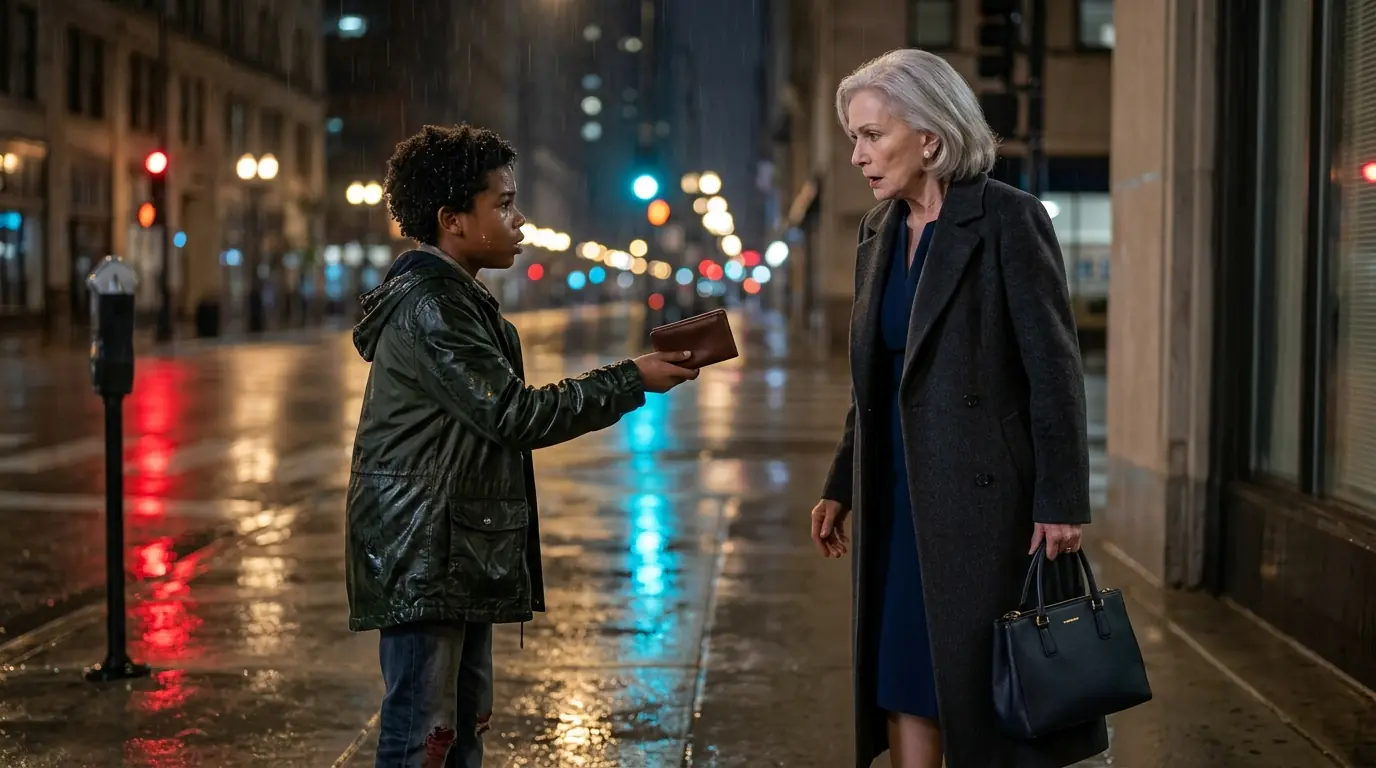
Two years after the wallet, the same corner, the same rain, the same gray Chicago sky, Malik and Micah sat in the backseat of Eleanor’s sedan, stopped at a red light.
They were 13 now, taller, their voices deeper, their faces showing the first hints of the men they’d become. But some things hadn’t changed. They still noticed everything. Still paid attention to the people others walked past.
“Grandma Ellie, look.”
Micah pointed out the window.
Across the street, near the same financial district where their lives had changed, a small girl stood alone, maybe eight years old, Black, wearing a jacket too thin for the weather. Her backpack hung open, papers and notebooks scattered on the wet sidewalk around her. She was crying.
A group of kids walked past laughing. One of them said something that made the others laugh harder. The girl’s shoulders hunched, her face turning red with shame.
“Pull over,” Malik said quietly.
Eleanor glanced at him in the rearview mirror.
“You sure?”
“Yeah. Just give us a minute.”
She pulled to the curb. But before Malik and Micah could open their doors, two boys appeared, maybe 10 years old, both wearing Daniel and Alicia Foundation hoodies.
The twins recognized them immediately.
Travis and Kevin, brothers who’d been at Hope Street Home until six months ago, when the foundation helped their aunt gain custody. Travis and Kevin had been part of the boys’ mentorship program. Malik and Micah had spent hours with them, teaching them the same lessons they’d learned.
How to survive. How to help others. How to hold on to your humanity when the world tried to strip it away.
Now, through the rain-streaked window, Malik and Micah watched their lessons come to life.
Travis knelt down and started gathering the girl’s scattered papers. Kevin pulled off his own hoodie, the warm waterproof one the foundation had given him, and draped it over the girl’s shoulders.
“Hey, it’s okay,” Travis said, his voice muffled by the rain but audible through the cracked window. “We got you.”
“They ruined my notebook,” the girl sobbed. “My homework’s all wet.”
“We can fix it,” Kevin said. “My brother and I, we used to have the same problem. You dry the pages, iron them flat, good as new.”
“Really?”
“Really. Here, let me help you pick this stuff up.”
The girl wiped her eyes.
“Why are you helping me? You don’t even know me.”
Travis smiled, that same smile Malik had given Eleanor two years ago.
“Because someone helped us once when we had nothing, and now we help others. That’s how it works.”
“Where do you go?” the girl asked. “When stuff is bad.”
“You know the Daniel and Alicia Community Center?” Kevin asked. “Three blocks that way. It’s for kids like us. They got food, tutors, a place to hang out after school. Safe, warm.”
“I don’t have money.”
“It’s free,” Travis said firmly. “Everything there is free because the people who run it remember what it’s like to have nothing.”
The girl looked at them, really looked, and something shifted in her face. Hope, fragile and new, replacing despair.
“Can… can I come with you right now?”
“Absolutely.”
Kevin offered his hand.
“Come on. Let’s get out of this rain.”
In the car, Micah let out a breath he didn’t know he’d been holding.
“They’re doing it,” he whispered. “They’re actually doing it.”
Malik felt his throat tighten.
“Yeah, they are.”
Eleanor watched through the windshield as the three children walked away together, Travis and Kevin flanking the girl, protecting her from the rain, talking to her like she mattered.
“You taught them that,” Eleanor said softly.
“No.” Malik shook his head. “We just passed it on. Someone taught us. We taught them. Now they’re teaching her.”
“The circle continues,” Eleanor murmured.
“Exactly.”
They sat there for a moment, watching until the three kids turned the corner toward the community center, the building Eleanor had purchased and renovated six months ago. The place where any child could walk in and find safety, food, help, no questions asked, no judgment.
The building had a large sign out front.
Daniel and Alicia Community Campus, Where Every Child Belongs.
“Remember when we used to walk past places like that,” Micah said quietly, “and we’d look in the windows and wonder what it was like to belong somewhere?”
“Every day,” Malik replied. “Every single day.”
“Now we built that place for kids like us.”
“For kids like her.”
Eleanor reached back, squeezing both their hands.
“Your parents would be so proud, not just of what you’ve built, but of who you’ve become.”
Malik looked at the photograph he still carried. Alicia, holding her twin babies, smiling at the camera. He’d had it professionally restored and framed, but he kept a copy in his wallet always.
“I hope so,” he said. “I really hope so.”
“I know so.” Eleanor’s voice was certain. “Because I see them in you every single day. Daniel’s compassion, Alicia’s strength, they live on in everything you do.”
The light turned green.
As they drove away, Malik looked back one more time. The corner where he’d found Eleanor’s wallet was empty now, just wet pavement and falling rain.
But two blocks away, three kids walked together toward warmth and safety.
And that made all the difference.
That night, dinner was casual, pizza on the coffee table, all three of them in comfortable clothes, a movie playing in the background that none of them were really watching.
“I’ve been thinking,” Eleanor said during a commercial break.
“Uh-oh,” Micah teased. “That’s dangerous.”
She swatted his arm playfully.
“Hush. I’m serious.”
“About what?” Malik asked.
“The foundation. We’ve done so much in two years. Renovated homes, provided scholarships, opened the community center. But I want to do more.”
“More? Grandma Ellie, we’re already stretched pretty thin.”
“I know. That’s why I want to expand the board. Bring in people who’ve lived it. Former foster kids who’ve aged out. Social workers, teachers, people who understand the system from the inside.”
Malik sat up straighter.
“That’s actually brilliant.”
“And,” Eleanor continued, “I want to start a mentorship training program, teach other kids, kids who’ve been helped, how to help others. Formalize what you two did naturally with Travis and Kevin.”
“You mean like create a whole generation of kids who pay it forward?” Micah’s eyes lit up.
“Exactly. Because that little girl today, she’s going to remember Travis and Kevin. And someday, when she’s stable and safe, she’ll help someone else.”
“And they’ll help someone else,” Malik finished. “And on and on.”
“It’s not just charity,” Eleanor said. “It’s culture change. It’s building a community where kids take care of each other because they know what it’s like to need care.”
Micah leaned back, smiling.
“Dad would have loved this. The whole thing.”
“He would have been leading it,” Eleanor said, her voice catching. “He was always the one who saw people, really saw them, not their circumstances, but their potential.”
“Like you do now,” Malik said softly.
Eleanor’s eyes filled.
“I learned finally, after wasting so many years being blind.”
“You’re not blind anymore,” Micah said.
“You see everything.”
“Because you two taught me how to look.”
They sat in comfortable silence for a moment, the weight of the past two years settling around them. The grief, the healing, the growth.
“Grandma Ellie,” Malik said finally.
“Yes, sweetheart?”
“Thank you for not giving up. For finding us. For choosing us, even though you were scared.”
Eleanor pulled both boys close.
“Thank you for giving me a second chance. For letting me be your grandmother when I didn’t deserve it.”
“You deserved it,” Micah said. “You just didn’t know it yet.”
Outside, the rain continued to fall on Chicago. Somewhere out there, kids were going to bed hungry, scared, alone. But tonight, in this penthouse, three people who’d once been strangers were a family.
And tomorrow, they’d wake up and keep fighting to make sure fewer kids had to feel that hunger, that fear, that loneliness. Not because it was easy, not because they’d save everyone, but because once upon a time, two 11-year-old boys had returned a wallet in the rain.
And that single act of integrity had changed everything.
“Movie’s back on,” Micah said, grabbing another slice of pizza.
“Who’s even watching this?” Malik laughed.
“I am,” Eleanor protested. “I want to see if they find the treasure.”
“Grandma Ellie, we’ve seen this movie five times. They find the treasure.”
“Spoilers.”
She threw a napkin at him, and they all dissolved into laughter.
Just a normal night. A normal family.
Proof that sometimes the best treasures aren’t found in buried chests or bank vaults. They’re found in the people who choose to stay, to help, to love, even when it’s hard, especially when it’s hard.
Three years after the wallet, the rain had stopped. The sky was clearing, streaks of gold breaking through the gray clouds as the sun set over Chicago.
Malik and Micah stood on the rooftop terrace of the Daniel and Alicia Community Campus, looking out over the neighborhood they’d transformed. Fourteen years old now, no longer the scared, hungry boys who’d walked miles in the cold, but still the same people, still kind, still humble, still determined to make a difference.
Below them, the community center buzzed with life. Through the windows, they could see kids doing homework with tutors, families picking up groceries from the food pantry, teenagers in the music studio learning to produce beats.
“We did that,” Micah said softly.
“We started it,” Malik corrected. “They’re doing it, all of them.”
Eleanor joined them, wrapping a shawl around her shoulders against the evening chill. At 75, she moved a little slower, but her eyes were sharper than ever.
“Beautiful sunset,” she said.
“Yeah.” Malik put his arm around her. “It is.”
“I’ve been thinking about the speech for tomorrow,” Eleanor said. “The foundation’s three-year anniversary event. What should I say?”
“Tell them the truth,” Micah said simply.
“Tell them about the wallet.”
The next evening, the ballroom was packed. Donors, volunteers, families who’d been helped by the foundation. News cameras lined the back wall. Eleanor stood at the podium, Malik and Micah flanking her on either side.
“Three years ago,” she began, her voice clear and strong, “two 11-year-old boys found my wallet on a rainy street corner. Inside was $3,000. They were homeless, hungry, wearing shoes with holes. They had every reason to take that money.”
The room was silent, hanging on every word.
“But they didn’t. They ran after me in the rain, returned every penny, and refused a reward. When I asked them why, one of them said something I’ll never forget. It’s not ours.”
Eleanor paused, letting the words sink in.
“Those boys were my grandsons. I just didn’t know it yet.”
A ripple of emotion moved through the crowd.
“I’d abandoned them at birth because of my own prejudice and pride. I let them grow up in the foster system while I lived in luxury because I was too much of a coward to face what I’d done.”
Her voice didn’t waver.
“But they saved me anyway, not because I deserved it, but because that’s who they are.”
She gestured to Malik and Micah.
“In three years, the Daniel and Alicia Foundation has helped over 800 children. We’ve renovated 12 group homes. We’ve provided scholarships to 134 students. We’ve opened three community centers across Chicago.”
Applause began, but Eleanor held up her hand.
“But numbers don’t tell the real story. The real story is Travis and Kevin helping a little girl in the rain. It’s Ms. Jackson finally getting the support she needs to truly care for kids. It’s Mrs. Miller and Mrs. Thompson getting resources to help students they’ve always supported out of their own pockets.”
She looked directly at the camera.
“The real story is that kindness multiplies. One act of integrity led to a reunion. That reunion led to a foundation. That foundation created opportunities. And those opportunities created a generation of kids who know how to help each other.”
Eleanor stepped back, nodding to Malik and Micah.
Malik moved to the microphone.
“Three years ago, we had a choice. Take what we needed or do what was right. We chose right, even though it was hard.”
“But here’s what we learned,” Micah continued. “That choice wasn’t just about a wallet. It was about who we wanted to be. And every day, we all face that same choice.”
Malik’s voice grew passionate.
“Maybe your wallet isn’t money. Maybe it’s time. Do you give it to someone who needs help or keep scrolling on your phone?”
“Maybe it’s privilege,” Micah added. “Do you use it to lift others up or just protect what you have?”
“Maybe it’s knowledge. Do you share it or hoard it?”
“Maybe it’s just noticing. Really seeing the kids sitting alone at lunch, the person struggling with groceries, the neighbor who seems off.”
They spoke in tandem now, their voices blending the way only twins could.
“Everyone has a wallet, something they could give that would cost them but would change someone else’s life. The question isn’t whether you have something to give. The question is, will you give it?”
Malik looked out at the audience.
“We were two kids with nothing, but we had integrity. We had each other, and when we needed it most, people gave us their wallets. Mrs. Miller gave time, Mrs. Thompson gave safety, Ms. Jackson gave care, and our grandmother gave us a family.”
“Now it’s your turn,” Micah said. “What’s your wallet, and who are you going to return it to?”
The room erupted in applause, but Malik and Micah weren’t done.
“Today, we’re announcing something new,” Malik said. “The Pass It Forward initiative. Anyone who’s been helped by the foundation can sign up to help someone else. Tutor a kid, mentor a teen, donate time at a community center, whatever you can give.”
“Because we can’t save everyone,” Micah acknowledged. “But we can create a culture where everyone tries to save someone.”
“And that,” Malik smiled, “changes everything.”
Eleanor drove them back to the spot where it all began. They sat in the car for a moment, engine idling, rain starting to fall again, gentle this time, not the punishing storm of three years ago.
“You think we’ve done enough?” Micah asked quietly.
“We’ve barely started,” Malik replied. “But we’re doing something. That’s what matters.”
Eleanor turned around from the front seat.
“Your father used to say, ‘You can’t change the whole world, but you can be someone’s whole world.’ You two have been that for so many kids.”
“So have you, Grandma Ellie.”
She smiled, tears in her eyes.
“We make a pretty good team.”
“The best.”
They got out of the car and stood on the same corner where a wallet had fallen, where a choice had been made, where lives had collided and changed forever.
“Do you ever regret it?” Eleanor asked. “Giving the wallet back? Think about what you could have done with that money.”
Malik and Micah exchanged glances.
“Never,” they said in unison.
“Because that money would have run out,” Malik explained. “But what we have now, family, purpose, the ability to help others, that’s forever.”
“Plus,” Micah grinned, “we got something way better than $3,000.”
“What’s that?”
“We got you.”
Eleanor pulled them both into a hug right there on the street corner, rain falling softly around them. A car passed, splashing water onto the curb. A woman hurried by with an umbrella. Life continued, ordinary and chaotic and beautiful.
But for these three people, this spot would always be sacred.
The place where everything changed, where a small act of kindness created ripples that were still spreading, still touching lives, still proving that doing the right thing mattered.
“Ready to go home?” Eleanor asked.
“Yeah,” Malik said. “Let’s go home.”
They got back in the car, but before Eleanor started the engine, Micah pointed across the street.
A teenage boy was helping an elderly man pick up groceries that had spilled from a torn bag. No one had asked him to. He just saw someone who needed help and stepped in.
Simple, quiet, easy to miss if you weren’t looking.
But Malik and Micah saw it.
And they smiled.
“It’s working,” Micah whispered.
“Yeah,” Malik agreed. “It really is.”
Eleanor pulled away from the curb, heading toward the penthouse, toward home, toward family, toward a future they were building one kind act at a time.
Behind them, the street corner remained, waiting for the next person who would face a choice between taking what they needed and doing what was right.
And somewhere in Chicago, a child would make that choice.
And the circle would continue.
Three years ago, two boys who had nothing gave back everything. Not because they were heroes, because they were human. One wallet, one choice, one rainy afternoon. That’s all it took to change hundreds of lives.
The question isn’t whether you have something to give. The question is, what’s your wallet?
And when you find it, when that moment comes where you can take what you need or do what’s right, who will you choose to be?
Because somewhere, right now, someone needs you to make the choice that Malik and Micah made. To see them, to help them, to prove that kindness isn’t dead. It’s just waiting for people brave enough to practice it.
Your move.
The camera pulls back from the street corner, rising up over the Chicago skyline. Lights twinkle in windows. Thousands of lives. Thousands of stories. Thousands of choices being made every moment.
The rain stops, the clouds part, the moon breaks through, casting silver light on the city below. And somewhere in that city, a child goes to bed safe, fed, and loved because someone chose to give instead of take, because someone returned the wallet.