Ten-year-old Noah Bennett knew which grocery stores threw away bread on Tuesdays.
He knew which church steps stayed dry when it rained.
He knew which bus stop had a bench long enough for his mother to rest her back for ten minutes before anyone asked them to move.
And he knew that if he smiled politely, kept his hands visible, and said “Yes, ma’am” or “No, sir,” most adults would look away faster.
That was how life worked when you were homeless.
People did not always hate you.
Most of the time, they simply did not want to see you.
Noah had not always lived that way.
There had once been a small apartment above a barber shop in Dayton, Ohio, with a crooked kitchen table, a blue couch, and a window that looked out over a parking lot. His mother, Grace Bennett, used to place a plastic cup of wildflowers on the windowsill every spring, even though the flowers came from cracks in the sidewalk.
“We can make anywhere feel like home,” she used to say.
Then the barber shop closed.
Then the landlord sold the building.
Then Grace lost her job at the bakery because she missed too many shifts caring for Noah when he had pneumonia.
After that, everything disappeared slowly.
The couch went first.
Then the table.
Then the apartment.
Now home was wherever they could stay for the night.
Sometimes it was the family shelter on Morgan Street, if there were beds open.
Sometimes it was the back room of a church basement.
Sometimes it was Grace’s old sedan, which no longer started but still sat behind a closed laundromat where the owner looked the other way.
Noah hated sleeping in the car most.
Not because it was cold, though it was.
Not because the seats hurt his back, though they did.
He hated it because his mother always stayed awake, watching through the windshield as if danger might walk out of the darkness at any moment.
She thought Noah did not notice.
He noticed everything.
He noticed when she rubbed her hands together because her gloves had holes.
He noticed when she gave him the bigger half of a sandwich.
He noticed when she said she was not hungry, even though her face looked pale and tired.
Noah wanted to help her.
But he was ten.
He had no money, no house, no power, and only one pair of sneakers with cardboard tucked inside to cover the holes.
Still, he had hands.
And his hands were good at fixing small things.
His father had taught him that before leaving two years earlier.
“Machines talk,” his father used to say while repairing bicycles behind the apartment building. “You just have to listen.”
Noah listened.
He could tighten a loose chain.
He could straighten bent spokes.
He could unjam a sticky zipper.
He could fix a shopping cart wheel if he had the right coin, a small rock, and enough patience.
That was why he noticed the old man outside Miller’s Market.
It was a cold Friday afternoon in November, the kind of day when the sky looked flat and gray and the wind pushed trash along the sidewalk like it was in a hurry to escape. Noah and his mother had just left the church kitchen with two cups of soup and a paper bag containing day-old rolls.
Grace was walking slowly.
Her cough had returned that morning.
Noah kept glancing at her, worried.
“I’m fine,” she said, before he even asked.
“You always say that.”
“Because I am always fine.”
“You coughed all night.”
Grace gave him a tired smile. “Then I am fine with a cough.”
Noah did not smile back.
They were passing Miller’s Market when a loud metallic crash snapped both their heads toward the entrance.
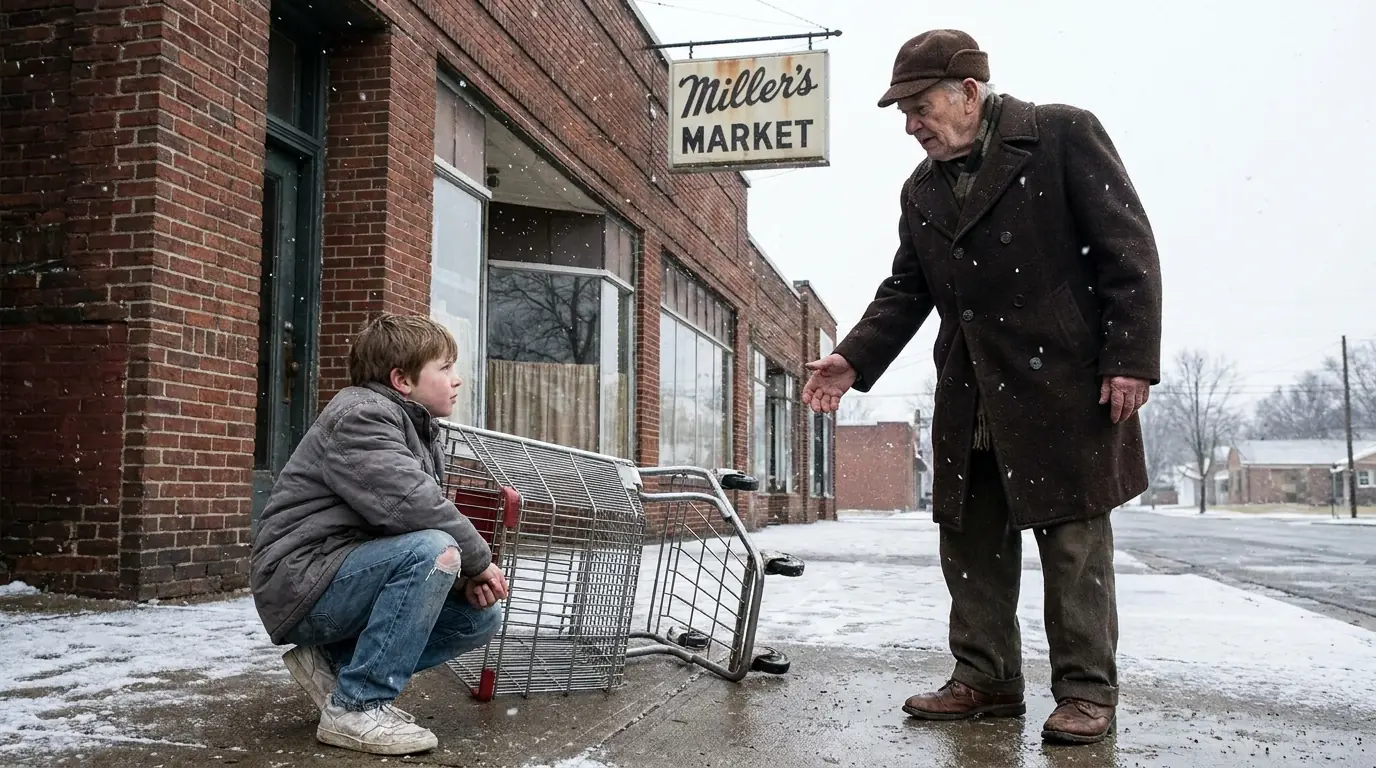
An elderly man stood beside a grocery cart that had tipped sideways near the curb. Apples rolled across the pavement. A carton of milk lay leaking white across the ground. A loaf of bread had fallen into a dirty puddle.
The man gripped the cart handle with both hands.
He looked around seventy-five, maybe older. He was tall but bent slightly at the shoulders, with thinning white hair under a brown wool cap and a deeply lined face that looked tired rather than angry. His coat was buttoned wrong, one side higher than the other, and his shoes were polished but worn at the soles.
The front wheel of the grocery cart had twisted sideways and jammed against the frame.
People walked around him.
One woman stepped over an apple without slowing.
A man in a black jacket muttered, “Watch where you’re going,” even though the old man had not touched him.
The elderly man tried to lift the cart upright, but his hands shook. The cart scraped loudly against the pavement and fell again.
Noah stopped.
“Noah,” she said softly.
“I know,” he replied.
He knew what she meant.
They had soup getting cold.
They needed to reach the shelter before the beds filled.
His mother was sick.
They did not have extra time.
But the old man was standing alone in the cold, staring at his spilled groceries like one more small disaster had finally become too much.
Noah handed his soup cup to his mother.
“I’ll be quick.”
Before she could answer, he ran toward the curb.
“Sir?” Noah said. “Are you hurt?”
The old man looked down at him in surprise.
For a second, he seemed confused that a child had spoken.
“No,” he said slowly. “No, I don’t think so. The blasted wheel caught, and I—”
His voice faded as he looked at the milk spilling into the gutter.
Noah crouched beside the cart.
The front wheel was bent inward, stuck against a metal bracket. A small piece of gravel had wedged deep in the hinge, and the wheel could not turn.
“I can fix that,” Noah said.
The old man blinked. “You can?”
“I think so.”
Noah pulled a nickel from his pocket.
It was one of only three coins he had.
He used the edge of it to scrape mud and gravel from the wheel joint. Then he found a flat stone near the curb and tapped the bent bracket, gently at first, then harder. The cart shifted. The wheel loosened but still dragged.
Noah lay on his side on the cold pavement to see underneath.
His jacket sleeve soaked up dirty water from the curb.
Grace came closer, worry tightening her face. “Noah, careful.”
“I’m okay.”
He pushed the wheel outward, twisted the frame, and tapped again with the rock.
The wheel snapped free.
Noah spun it once.
It turned.
He stood up, wiping his wet hands on his jeans.
“There,” he said. “It should roll now.”
The old man stared at the cart as if Noah had repaired something much larger than a wheel.
Then Noah began picking up the groceries.
He gathered apples, wiped them on his sleeve, and placed them back into the cart. The bread was ruined. The milk was nearly empty. A small box of tea had split open, scattering packets across the sidewalk.
“I’m sorry about your milk,” Noah said.
The old man bent slowly to help, but Noah shook his head.
“I got it.”
Grace stepped in and picked up the tea packets. Her cough caught her halfway through, and she turned away, covering her mouth.
The old man noticed.
His eyes moved from Grace’s pale face to Noah’s worn sneakers, then to the paper bag of rolls tucked under Grace’s arm.
Something in his expression changed.
Not pity.
Recognition.
“You’re a helpful young man,” he said.
Noah shrugged. “My mom says if you can help, you should.”
The old man looked at Grace. “Your mother is right.”
Grace gave a small, polite nod. “We should get going. Come on, Noah.”
Noah turned to follow her, but the old man reached into his coat pocket.
“Wait,” he said. “Please. Let me give you something.”
Noah stiffened.
Grace did too.
They had learned to be careful with gifts. Some people gave with kindness. Others gave with strings attached.
The old man pulled out a folded twenty-dollar bill.
Noah’s eyes widened.
That was more money than he had held in months.
But Grace shook her head immediately.
“That’s very kind, sir, but he didn’t help for money.”
“I know he didn’t,” the old man said.
“Then thank you, but no.”
The old man looked at her for a long moment. He seemed to understand something in her voice, something proud and wounded.
Slowly, he folded the bill again and put it away.
“What is your name, young man?” he asked.
“Noah Bennett.”
“And yours, ma’am?”
Grace hesitated. “Grace.”
The old man nodded. “I’m Arthur Whitmore.”
Noah had never heard the name.
Arthur reached into his cart and lifted a small paper bag that had survived the fall. Inside were two oranges and a package of crackers.
“Then at least take this,” Arthur said. “Not payment. Trade. You fixed my cart. I have more groceries than I can carry.”
Grace looked ready to refuse again.
Then she coughed.
Noah looked up at her.
“Mom,” he whispered.
Her eyes closed briefly.
At last, she accepted the bag.
“Thank you,” she said.
Arthur smiled faintly. “No. Thank you.”
Grace and Noah walked away before the moment could become too heavy.
At the corner, Noah looked back.
Arthur Whitmore was still watching them.
Not staring.
Seeing.
That night, the shelter was full.
Grace and Noah arrived nine minutes too late.
The woman at the desk looked genuinely sorry, which somehow made it worse.
“I can give you a blanket,” she said. “But we don’t have beds.”
Grace thanked her.
They returned to the old sedan behind the laundromat. The wind had grown sharper. Noah’s sleeve was still damp from fixing the cart, and his fingers ached.
Grace spread the shelter blanket across him in the back seat.
“You should have kept it,” Noah said.
“I’m not the one who lay in a puddle today.”
“You’re the one coughing.”
“I’m the mother. I win.”
Noah hated when she joked like that because it meant she was trying not to cry.
He reached into the paper bag Arthur had given them and took out one orange.
He peeled it carefully, separating the pieces.
He handed half to his mother.
This time, she did not refuse.
They ate in silence while frost gathered on the windshield.
“Was it stupid?” Noah asked after a while.
Grace turned her head. “Was what stupid?”
“Stopping to help him. Maybe if we came faster, we’d have gotten beds.”
His mother’s face softened.
“No, baby.”
“But we’re sleeping here.”
“We might have slept here anyway.”
Noah stared at the orange peel in his hands.
Grace reached back and touched his knee.
“Listen to me,” she said. “Hardship can take your comfort. It can take your address. It can take the little things you thought were safe. But don’t let it take your heart.”
Noah swallowed.
“What good is a heart if you’re cold?”
Grace smiled sadly.
“It keeps you human.”
Noah did not fully understand.
But he remembered.
The next morning, Grace’s cough was worse.
By Monday, she had a fever.
By Wednesday, she could barely stand in line at the church kitchen.
Noah begged her to go to the free clinic.
Grace said she would.
But first they had to find a place to stay.
First they had to eat.
First they had to get through one more day.
There was always a first.
And somehow, her health kept coming last.
On Thursday afternoon, Noah returned alone to Miller’s Market.
Grace was resting in the car under two blankets, too tired to walk. Noah had gone to ask the store manager if there were any broken boxes or food they planned to throw away.
The manager said no before Noah finished his sentence.
So Noah stepped outside, blinking against the cold.
That was when he saw Arthur Whitmore again.
The old man stood near the entrance with his repaired cart, placing groceries inside a cloth bag.
He looked up.
“Noah Bennett,” he said.
Noah froze.
Adults rarely remembered his name.
“You remembered.”
Arthur smiled. “A boy fixes a man’s cart in the cold and refuses money. That is not easy to forget.”
Noah looked at the sidewalk.
“My mom refused. Not me.”
“Would you have taken it?”
Noah thought about lying.
Then he shook his head. “Maybe. But I would’ve felt bad.”
Arthur’s smile deepened.
“Where is your mother today?”
Noah’s stomach tightened. “Resting.”
“Is she ill?”
“She’s fine.”
Arthur studied him.
Noah looked away because the old man’s eyes were too kind, and kindness was dangerous when you were trying not to fall apart.
“Noah,” Arthur said gently, “where are you staying?”
The question landed like a stone.
Noah stepped back. “We’re okay.”
“I did not ask because I wished to judge you.”
“We’re okay,” Noah repeated.
Arthur did not push.
Instead, he reached into his bag and removed a loaf of bread, a jar of peanut butter, and two cans of soup.
“Would your mother accept these as another trade?”
Noah frowned. “I didn’t fix anything today.”
Arthur glanced toward the cart. “This wheel still works because of you. I consider the repair ongoing.”
Despite himself, Noah smiled.
“That’s not really how repairs work.”
“At my age, young man, I reserve the right to define repairs creatively.”
Noah almost laughed.
Almost.
Then Arthur added, “There is a community clinic on Wayne Avenue. I know the director. If your mother needs care, I can make a call.”
Noah’s smile disappeared.
“We don’t need charity.”
Arthur nodded slowly. “Neither did I, once.”
That made Noah look up.
Arthur’s gaze had moved beyond him, past the street, past the market, into some old place in his memory.
“When I was eleven,” Arthur said, “my mother and I slept in the back room of a closed tailor shop for three months. My father had died. We had nothing but a suitcase and her sewing kit.”
Noah stared at him.
Arthur Whitmore, with his polished shoes and careful coat, had once slept in a back room?
“She repaired clothes for people who barely paid her,” Arthur continued. “One winter morning, an old mechanic let me sweep his garage in exchange for breakfast. Then he taught me to fix engines. That one kindness changed the direction of my life.”
“What happened?” Noah asked.
“I became a mechanic first. Then I opened a garage. Then another. Eventually, I owned several repair shops across the state.”
Noah blinked. “You’re rich?”
Arthur gave a soft laugh. “I have been fortunate. But money is not the interesting part.”
“What is?”
Arthur looked directly at him.
“The interesting part is that someone stopped to help me before I looked like I deserved helping.”
Noah did not know what to say.
Arthur placed the food into Noah’s arms.
“Take this to your mother,” he said. “And if she needs the clinic, tell her an old man with a stubborn grocery cart asked her to go.”
Noah carried the food back to the laundromat.
Grace was asleep in the car, her face flushed with fever.
For the first time, Noah felt truly afraid.
He woke her gently.
“Mom,” he said. “We’re going to the clinic.”
She tried to argue.
He cried before she could finish.
That stopped her.
Grace Bennett could refuse help.
She could endure hunger.
She could sleep sitting up in a freezing car.
But she could not bear her son’s tears.
They went to the clinic.
Arthur had called ahead.
The nurse at the desk seemed to know their names already. No one asked for insurance before seeing Grace. No one sighed when she could not fill out the form quickly. No one looked at Noah’s shoes.
Grace had bronchitis, bordering on pneumonia.
The doctor gave her medicine, arranged a follow-up visit, and called the family shelter personally.
That night, Grace and Noah had beds.
Not because space had magically appeared, but because Arthur Whitmore had made more calls than Noah knew.
A church volunteer brought them dinner.
A social worker came the next morning.
Grace cried in the hallway where she thought Noah could not see.
Noah saw.
Over the next month, life did not become easy.
Stories like Noah’s did not change overnight.
His mother still needed work.
They still had no apartment.
Noah still carried most of his belongings in a backpack with one broken zipper.
But something had shifted.
They had a caseworker now.
Grace got treatment.
They slept inside more often than outside.
And every Friday afternoon, Arthur Whitmore appeared at the shelter’s common room with a bag of groceries and a new broken thing for Noah to examine.
A toaster with a loose lever.
A flashlight with corroded batteries.
A wooden chair with a cracked rung.
A bicycle bell that would not ring.
“I thought you were rich,” Noah said one day, turning the broken bell in his hand.
“I am,” Arthur replied.
“Then why do you have so much broken stuff?”
Arthur’s eyes twinkled. “Because I know a repairman.”
Noah grinned.
He fixed the bell in twelve minutes.
Arthur clapped once, delighted.
“Excellent.”
“It was easy.”
“Easy because you understand it.”
Noah shrugged, but he felt warm inside.
Arthur began teaching him properly.
Not in a formal classroom.
Arthur taught in shelter corners, church basements, and the back table of Miller’s Market café.
He taught Noah how screws differed.
How gears transferred motion.
How to clean rust.
How to listen for the tiny click that meant a piece had returned to place.
Grace watched the lessons with guarded gratitude. She liked Arthur, but life had taught her not to trust good fortune too quickly.
One evening, after Arthur left, she said, “You know he doesn’t owe us this.”
Noah looked up from a flashlight he was rebuilding.
“I know.”
“And we don’t owe him anything either.”
“I know.”
Grace sat beside him.
“I just don’t want you to feel like someone helping us means they own part of us.”
Noah thought about that.
“Mr. Whitmore doesn’t make me feel owned,” he said. “He makes me feel useful.”
Grace’s expression changed.
For a moment, sadness and relief crossed her face together.
“Then maybe he’s a good man,” she said.
Arthur was a good man.
But he was also a lonely one.
Noah learned that slowly.
Arthur lived in a large brick house on Ashland Avenue, but he rarely spoke of family. His wife had died ten years earlier. His daughter, Margaret, lived in Chicago and called when she could, which was not often. His old friends had moved away, passed away, or become names in Christmas cards.
The grocery store was part of his routine because routine kept silence from swallowing his days.
The broken cart had been an accident.
Meeting Noah had not.
At least, that was what Arthur said later.
By spring, Grace found part-time work at a school cafeteria.
By summer, with help from the shelter program, she and Noah moved into a small apartment above a hardware store.
It had one bedroom, a narrow kitchen, and a living room barely large enough for their donated couch.
To Noah, it felt like a palace.
On the first night, Grace placed a plastic cup of wildflowers on the windowsill.
Noah stared at them for a long time.
“We can make anywhere feel like home,” she said.
This time, he believed her.
Arthur came the next day carrying a toolbox.
Not a toy toolbox.
A real one.
It was old, metal, and heavy, with scratches along the sides and a handle wrapped in black tape.
Noah opened it slowly.
Inside were screwdrivers, pliers, a small wrench set, measuring tape, oil, a flashlight, and a notebook.
The first page of the notebook said:
For Noah Bennett, who listens before he fixes.
Noah touched the words.
“I can’t take this.”
Arthur laughed softly. “People keep saying that to me.”
“It’s too much.”
“It is not too much. It is a beginning.”
Grace stood in the kitchen doorway.
Her eyes were wet, but she nodded.
So Noah accepted the toolbox.
He used it constantly.
He fixed their cabinet door.
He repaired Mrs. Alvarez’s fan downstairs.
He adjusted Mr. Kim’s squeaky shop stool in the hardware store.
He fixed three bicycles for kids in the neighborhood and earned eight dollars, two granola bars, and a baseball card.
Arthur visited every Friday.
Sometimes he brought something broken.
Sometimes he brought groceries.
Sometimes he brought nothing but stories.
He told Noah about his first garage, Whitmore Auto Repair, where he had painted the sign himself and slept on a cot in the office because he could not afford both rent and business costs. He told him about customers who became friends, employees who became family, and mistakes that had cost him money but taught him wisdom.
“Never be ashamed of beginning small,” Arthur said. “Most strong things begin in small rooms.”
Noah wrote that in the notebook.
By the time Noah turned eleven, he had filled twenty pages with Arthur’s lessons.
By twelve, he knew how to repair lawn mowers.
By thirteen, he spent weekends helping at one of Arthur’s old garages, now run by a manager named Luis who treated Noah like an apprentice instead of a charity case.
By fourteen, Noah could diagnose engine sounds better than some adults.
Arthur grew older.
His walk slowed.
His hands shook more.
But his mind stayed sharp when he was near machines, and his face brightened whenever Noah entered the room.
“You’re late,” Arthur would say, even when Noah was exactly on time.
“You’re impatient,” Noah would reply.
“That is because I’m old. I have less time to waste.”
Noah would laugh, not knowing how much those words would hurt later.
When Noah was fifteen, Arthur invited him and Grace to his brick house for Thanksgiving.
The dining room table was too large for three people, but Arthur insisted on using it.
“My wife loved this table,” he said. “She said a table should always be ready to grow.”
Grace brought sweet potatoes.
Noah brought a wooden napkin holder he had made in shop class.
Arthur placed it in the center of the table as if it were silver.
During dinner, Arthur’s daughter Margaret called.
Arthur put her on speaker.
She sounded polite, busy, and far away.
“Happy Thanksgiving, Dad,” she said. “I’m sorry we couldn’t come.”
“I know,” Arthur replied.
“We’ll try for Christmas.”
“You said that last year.”
There was a pause.
Noah looked down at his plate.
Margaret sighed. “Dad, please don’t start.”
“I’m not starting. I’m finishing the sentence truthfully.”
After the call ended, Arthur sat quietly for a while.
Grace began clearing plates, but he stopped her.
“Leave them,” he said. “A messy table proves people were here.”
Noah looked at him across the table.
For the first time, he understood that Arthur had not only rescued them.
They had rescued him too.
Years moved forward.
Grace eventually became full-time kitchen manager at the school. She saved money carefully. She smiled more. She slept without fear.
Noah grew into a tall, quiet young man with steady hands and eyes that noticed everything.
At seventeen, he was accepted into a technical program for automotive repair and mechanical design.
Arthur was prouder than anyone.
He attended the ceremony in a navy suit, leaning on a cane, clapping so hard that Grace worried he might hurt his hands.
Afterward, he pulled Noah aside.
“I have something for you.”
Noah smiled. “If it’s another broken toaster, I’m leaving.”
Arthur chuckled. “Not this time.”
He handed Noah a small brass key.
Noah frowned. “What’s this?”
“A key to my first garage.”
Noah went still.
“Whitmore Auto?”
Arthur nodded. “The original building. It has been closed for years. I kept it because I could never bring myself to sell it. Too much of my life began there.”
“Why are you giving me the key?”
“Because too much of your life may begin there too.”
Noah shook his head slowly. “Mr. Whitmore—”
Arthur raised one finger. “Do not refuse before listening.”
Noah closed his mouth.
“I am not giving you the building today,” Arthur said. “You are young. You need training, experience, mistakes, and time. But I want you to see it. I want you to know what is possible.”
The next Saturday, Arthur took Noah and Grace to the old garage.
It stood on the corner of Bell Avenue and Third Street, a low brick building with faded white doors and a rusted sign that still read WHITMORE AUTO REPAIR. Weeds grew through cracks in the pavement. Dust coated the windows. The air inside smelled of old oil, rubber, and memories.
Noah stepped through the door and felt something open in his chest.
There were two service bays, an office with a cracked leather chair, shelves of old manuals, and sunlight falling through high windows in pale squares.
Arthur stood beside him quietly.
“This place looks rough,” Noah said.
Arthur smiled. “So did you, the day I met you.”
Noah looked at him.
Arthur’s smile softened.
“Rough is not ruined.”
Noah walked through the garage slowly, touching the workbench, the lift, the old metal cabinets.
In his mind, he saw it clean.
He saw lights working.
He saw tools organized.
He saw kids from shelters learning to fix bicycles in one corner.
He saw single mothers getting cars repaired at fair prices.
He saw a place where people who had been overlooked could walk in and feel useful.
Arthur watched him.
“You see it, don’t you?” he asked.
Noah nodded.
“I see it.”
“Good,” Arthur said. “Hold on to that.”
When Noah was nineteen, Arthur’s health declined sharply.
He moved into assisted living after a fall in his kitchen. He hated it at first. He called it “a waiting room with curtains.” But Noah visited three times a week, bringing small engines, carburetor parts, and repair manuals they could argue over.
Arthur’s daughter Margaret came more often too.
Maybe guilt brought her at first.
Maybe love found its way through guilt later.
Noah never judged her.
He had learned that people sometimes needed time to become brave enough for love.
One rainy evening, Arthur asked Noah to wheel him outside beneath the covered patio.
Rain tapped gently on the roof.
Arthur looked thinner than he used to, his skin pale, his hands folded over a blanket.
“Noah,” he said.
“Yeah?”
“Do you remember the grocery cart?”
Noah laughed softly. “Of course.”
“You ruined your jacket sleeve.”
“It was already ruined.”
“You gave me dignity that day.”
Noah looked at him sharply. “I fixed a wheel.”
“No,” Arthur said. “You stopped when everyone else walked around me. There is a difference.”
Noah swallowed.
Arthur turned his head toward him.
“Never underestimate the power of stopping.”
Noah looked out at the rain.
“I won’t.”
Arthur passed away that winter.
He was eighty-two.
The funeral was larger than Noah expected.
Former employees came.
Old customers came.
Men in work jackets stood beside women in business suits. People told stories about Arthur giving them jobs, forgiving debts, teaching them skills, fixing cars for free when they had no way to pay.
Margaret cried through most of it.
Grace held her hand.
Noah stood near the front, wearing a black suit that felt too tight around his shoulders. In his pocket, he carried the brass key to the old garage.
After the funeral, Margaret approached him.
“Noah,” she said softly, “Dad’s attorney asked us to meet tomorrow.”
Noah nodded.
He assumed Arthur had left him a tool or a book.
Something meaningful.
Something small.
The next day, they gathered in an attorney’s office downtown: Margaret, Grace, Noah, and a gray-haired lawyer named Mr. Ellison.
The room smelled like paper and coffee.
Mr. Ellison opened a folder.
“Arthur Whitmore made several specific bequests,” he said.
Noah listened quietly as Margaret received the house, family belongings, and primary assets. That felt right. She was his daughter.
Then Mr. Ellison turned to Noah.
“And to Noah Bennett, Arthur left the following letter.”
He handed Noah an envelope.
The handwriting was shaky but familiar.
Noah opened it with trembling fingers.
Dear Noah,
If you are reading this, I have finally stopped giving advice in person.
Do not look too relieved.
I have left you something, but before you argue, remember that I am dead and therefore harder to interrupt.
The original Whitmore Auto Repair building on Bell Avenue is yours now.
So are the tools, manuals, remaining equipment, and the repair account I created to help restore it.
You may sell it if you choose. I hope you do not.
I hope you make it what we both saw when we stood inside it.
A garage, yes.
But also a place for second chances.
You once fixed a grocery cart for an old man on a cold afternoon. You thought it was a small repair. It was not. It reminded me who I used to be. It gave me a family again when I had forgotten how to ask for one.
People will tell you success means rising above where you came from.
Do not believe them completely.
Sometimes success means going back with stronger hands and opening a door for someone else.
Build well.
Stop often.
Listen before you fix.
With gratitude and great pride,
Arthur Whitmore
Noah lowered the letter.
The room had gone blurry.
Grace covered her mouth with one hand.
Margaret was crying too, but she smiled through it.
“He loved you,” she said.
Noah could barely speak.
“I loved him too.”
The garage took two years to restore.
Noah worked days at a repair shop and evenings at Bell Avenue. Grace painted the office. Margaret handled legal details and donated Arthur’s old photographs. Luis helped inspect equipment. Former Whitmore employees came by on weekends, some too old to lift much but willing to teach.
Kids from the shelter helped sweep floors for pizza.
Noah paid them anyway.
“Trade,” he told them when they tried to refuse. “You helped build this place.”
The sign was remade, but Noah kept the old name.
WHITMORE & BENNETT REPAIR
Underneath, he added smaller words:
Second Chances Built Here.
On opening day, the garage was filled with people.
Grace stood near the office door, proud and tearful.
Margaret brought flowers.
Luis brought coffee.
Mrs. Keller from the shelter brought six children who wanted to see the lifts.
Noah unlocked the front door with Arthur’s brass key.
For a moment, he stood still, remembering the grocery cart, the spilled apples, the cold pavement against his cheek, the old man’s surprised eyes, and his mother’s words in the frozen car.
Don’t let hardship take your heart.
Then he opened the door.
The first customer arrived before lunch.
An elderly woman with a dented blue sedan and nervous hands stepped inside.
“My car makes a terrible noise,” she said. “I don’t have much money until next week.”
Noah smiled.
He heard Arthur’s voice in his memory.
The interesting part is that someone stopped to help me before I looked like I deserved helping.
“That’s all right,” Noah said. “Let’s listen to it first.”
The woman looked relieved.
Noah walked outside with her, opened the hood, and listened.
Machines still talked.
So did people.
You just had to care enough to hear them.
Years later, people in Dayton would talk about Whitmore & Bennett Repair as if it had always been there.
They would say it was the garage where no one was laughed at for being broke.
The garage where teenagers learned skills after school.
The garage where single parents could pay in installments.
The garage where old men sat in the office drinking coffee and telling stories no one rushed.
The garage where a wall near the entrance held a framed letter from Arthur Whitmore and, beside it, an old grocery cart wheel mounted on a piece of polished wood.
Most customers asked about the wheel.
Noah always told them the truth.
“That,” he would say, “is where everything started.”
And when winter came, he kept a shelf near the office stocked with bread, peanut butter, oranges, soup cans, gloves, and socks.
No sign explained it.
No camera recorded it.
Anyone who needed something could take it.
One snowy Friday afternoon, Noah stepped outside and saw a boy no older than ten standing near the curb, staring at a bicycle with a broken chain.
The boy’s coat was too thin.
His shoes were wet.
His face held the careful blankness Noah remembered wearing himself, the expression of a child trying not to look scared in public.
People passed around him.
Noah wiped his hands on a rag and walked over.
“Need help?” he asked.
The boy looked up quickly.
“I don’t have money.”
Noah crouched beside the bicycle.
The chain had slipped and jammed near the gear.
“That’s okay,” he said. “You can help me fix it. That’s payment enough.”
The boy hesitated.
Then he nodded.
Noah showed him how to loosen the chain, how to guide it back into place, how to turn the pedal slowly and listen.
The wheel spun.
The boy’s eyes widened.
“I fixed it?”
“You helped.”
The boy smiled for the first time.
Noah stood and looked down the street. Snow fell softly over Bell Avenue, covering the old sidewalks, the repaired garage doors, and the sign Arthur had left behind in spirit if not in wood.
For a moment, Noah could almost see him there—an old man in a brown wool cap, watching with kind eyes, holding a grocery cart that no longer needed fixing.
Noah smiled.
He had once thought kindness was something people gave when they had extra.
Arthur had taught him better.
Kindness was not extra.
It was structure.
It was a beam inside the house of a life.
It held things up when everything else tried to fall.
Noah turned back to the boy.
“Come inside,” he said. “It’s cold. We have soup.”
The boy’s smile faded into surprise.
“Really?”
“Really.”
Together, they rolled the bicycle into the garage.
Behind them, the door closed against the snow.
Inside, the lights were bright, the tools were ready, and the air smelled of oil, coffee, and warm food.
Noah placed the broken chain tool back on the bench and glanced at Arthur’s framed letter on the wall.
Build well.
Stop often.
Listen before you fix.
Noah had spent his whole life trying to keep that promise.
And every time he opened the door for someone who thought they had been forgotten, he knew the old man had not really left.
He was there in every repaired engine.
Every shared meal.
Every child taught to use their hands.
Every person who walked in ashamed and walked out standing taller.
A bent grocery cart wheel had led to a garage.
A garage had become a shelter of another kind.
And a hungry homeless boy who once owned almost nothing had grown into a man who understood the greatest inheritance Arthur Whitmore had given him.
Not the building.
Not the tools.
Not even the key.
The greatest gift was the belief that broken things were not worthless.
They were waiting for someone patient enough to help them move again.