“She didn’t ask for anything,” Bear said, his voice barely above a whisper.
“Not a single damn thing."
"She just left it there for me.” Nobody at the table said a word because none of them knew what to do with that.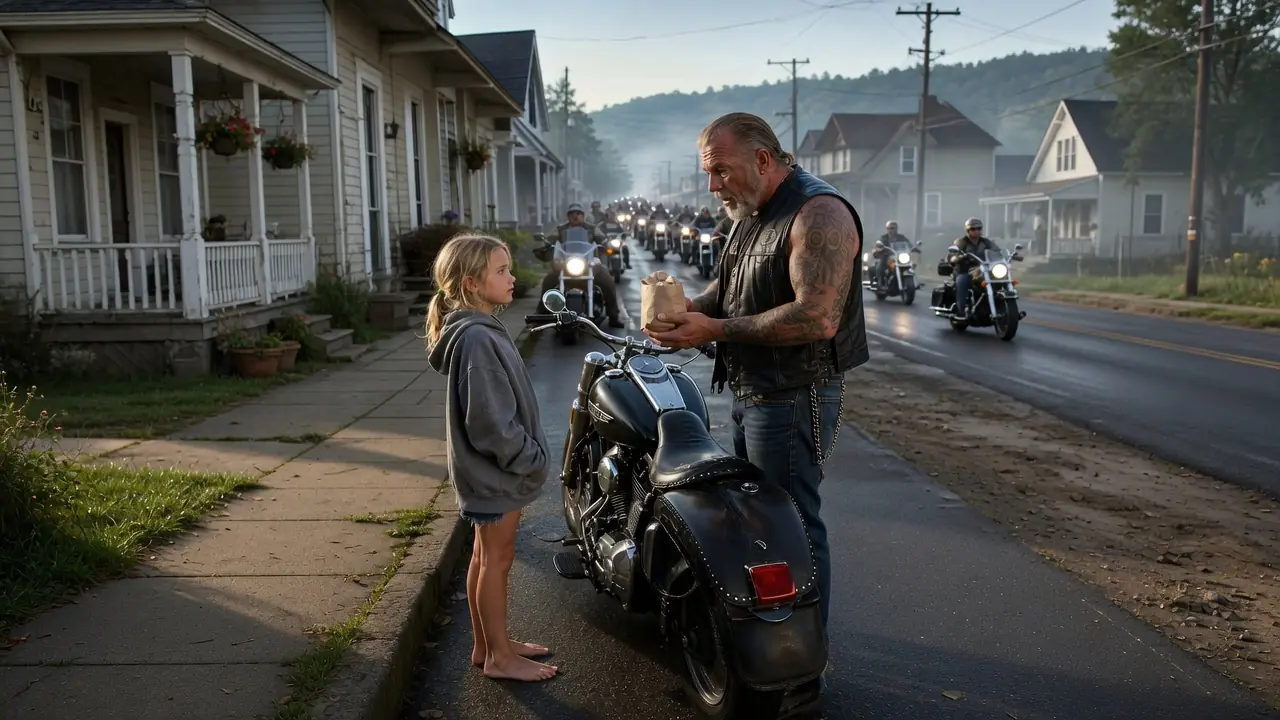
A man who had buried his heart years ago sitting in a roadside diner trying to explain why a homeless child he’d never spoken to had just broken something open inside his chest that he thought was sealed forever. He couldn’t explain it, but every single person in that room felt it. The town of Millhaven, Kentucky didn’t appear on any tourist map and nobody who passed through it on the way to somewhere else ever thought to stop.
It existed the way a lot of small American towns exist in the years after everything has changed. The factory's gone, the storefronts half empty, the young people scattered to cities that promised more and sometimes delivered. What remained was a particular kind of quiet, not peaceful quiet, the other kind.
The kind that settles in after noise has given up.
Jack “Bear” Malone had chosen it for exactly that reason.
He was sixty-one years old broad through the shoulders with a gut that had arrived sometime in his 50s and decided to stay. His beard had gone fully gray 3 years ago and he kept it trimmed close, not out of vanity, but out of habit. The same habit that had him up every morning before 6:00 regardless of what the night before had looked like.
His hair, still thick, was combed back and held with the kind of product his ex-wife used to buy him and he still bought for himself without thinking about why. His arms from the wrist to the sleeves of whatever he was wearing were covered in ink that had blurred with age the way tattoos do. The stories written into his skin no longer sharp, but still readable if you knew how to look.
He had a 2003 Harley-Davidson Road King that he kept in better condition than he kept himself and he parked it every night in the small gravel lot beside the house he rented on Caldwell Street, which was a real street with a real name but felt like the kind of place that had been left off the town's mental map the same way Millhaven had been left off every other kind of map. His mornings had a shape to them. That was the right word, not routine, not discipline, just shape.
A shape that held him without requiring him to think too hard about why he needed holding. He woke at 5:40. He made coffee in a machine that was older than some of the prospects he’d once known.
He drank the first cup standing at the kitchen counter looking out the window at nothing in particular. Then he got dressed, jeans, boots, whatever shirt was on top of the pile and he walked outside. He always checked the bike first.
He didn’t know why he’d started doing it. Maybe because the bike was the only thing he’d kept from the life before, not the chapter, not the brothers, not the woman he’d loved and failed and lost, just the bike. So he checked it the way you check on something that matters, running his hand along the tank, glancing at the tires, making sure everything was the way he’d left it.
Then he walked to Peg’s Diner on Main Street and he had his second cup of coffee at the counter alone and he watched the town wake up at the speed of something that had almost forgotten how. He had been doing this for two years and four months. He did not count the days.
He knew the number anyway. It was a Tuesday in early October when he walked out to the bike and stopped. There was something on the seat.
A paper bag. Brown folded at the top, the kind you get from a grocery store or a bakery. It was sitting square in the center of his seat, which meant someone had placed it there deliberately, not dropped it or left it by accident.
Deliberately. On his bike, on a seat that was at chest height and would have required intention to reach. Bear stood four feet away from it for a long moment.
He was not a man who startled easily. He had spent years in situations where startling easily got you hurt or got someone else hurt, and the reflex had been trained out of him so completely that it sometimes worried the people around him. But this stopped him.
This small brown paper bag on his motorcycle seat at 6:00 in the morning on a Tuesday in October stopped him the way almost nothing had stopped him in years. He looked up and down Caldwell Street. Nothing moving.
A dog somewhere barking at its own schedule. The sky the color of old pewter. He walked to the bike slowly the gravel shifting under his boots, and he looked at the bag without touching it for another few seconds.
Then he picked it up. It was warm. That was the first thing.
It was warm which meant it hadn’t been sitting there long, which meant whoever left it had been here recently. Recently enough that the warmth was still in it. He unfolded the top of the bag carefully.
Inside a biscuit wrapped in wax paper, the kind that came from a real oven and not a can. A boiled egg already peeled sitting in a small square of paper towel, and a folded napkin white clean like the kind Peg kept in the metal dispensers at the diner. Bear stood there holding a warm paper bag in both hands at 6:00 in the morning, and he had absolutely no idea what to do with it.
He looked up and down the street again. That was when he saw her. She was across the street half behind the blue metal dumpster that sat at the corner of the alley between the old hardware store and the building that used to be a pharmacy.
She was small, not just child small but genuinely small. The kind of thin that takes a while to register as alarming because your brain keeps waiting for it to resolve into something normal. Her hair was blonde darker at the roots, and it hung loose around her face in the way hair looks when it hasn't been brushed in a while but hasn't been entirely given up on either.
She was wearing a gray hoodie that was too big for her, and jeans that were too short, and she had no shoes. No shoes in October on pavement that was already carrying the first real cold of fall. She was watching him, not hiding exactly.
She was partly behind the dumpster, but she wasn’t pressing herself against it or trying to disappear. She was just there, watching him hold the bag, watching to see what he would do with it. Their eyes met.
Bear felt something move in his chest that had no name he was ready to give it. The girl didn’t flinch. She didn’t run.
She looked at him with eyes that were older than eleven years old had any right to be calm and steady and carrying something behind them that he recognized without being able to say where from. And then she nodded. One small deliberate nod like a confirmation.
Like she was checking something off a list. And then she stepped back behind the dumpster and by the time Bear had taken two steps toward the street, she was gone. No sound, no movement he could track, just gone.
He stood on the edge of the gravel lot looking at the mouth of the alley for a full minute. Then he looked back down at the bag in his hands. The biscuit was still warm.
He ate it at the counter at Peg’s, which was unusual because Bear almost never ate breakfast.
Peg herself, who had the particular gift of noticing things without appearing to look directly at anything, glanced at the wax paper he was folding up and said, “You bring that from home?” “No,” Bear said.
“Where’d it come from?” Bear thought about the answer to that question for a moment.
“I don’t know,” he said.
Peg refilled his coffee without being asked, which was her way of communicating that she had more to say and was deciding whether to say it. She was sixty-four, had owned the diner for twenty-two years, and had been serving Bear his morning coffee for two of them. She had learned to read him the way you learn to read weather, not perfectly, but well enough.
“You look like somebody walked over your grave,” she said.
“I’m fine,” Bear said.
“Uh-huh,” Peg said and moved down the counter to somebody else.
Bear ate the biscuit slowly. It was good. Better than good.
It was the kind of biscuit that someone had put actual care into the layers coming apart properly, the inside soft and still faintly warm. He ate the egg. He drank his coffee.
He kept seeing the girl's eyes, that nod. He didn’t understand what had just happened. He understood the mechanics of it.
Someone had left food on his bike. He’d seen who she’d confirmed it in some silent way and then disappeared. He understood that part.
What he didn’t understand was the why of it or the feeling it had left sitting in the middle of his chest like a stone that was somehow also warm. He left Peg’s at 7:15 and walked back to the bike and rode out to the edge of town the way he did most mornings when he needed to think without being looked at. The cold air hit him the way it always did at that speed in October, sharp enough to push everything else back and he let it.
He rode for forty minutes on empty back roads and then he came back and he sat in the house on Caldwell Street and tried to read a book and couldn’t. He kept thinking about her feet on the cold pavement. Wednesday morning he was out front at 5:30.
He told himself he was just up early. He made his coffee and stood at the window and watched the gravel lot and at 5:fifty-three he saw movement near the bike. Just a shape quick and low appearing from the direction of the alley and then gone again in less than 30 seconds.
He walked outside. Same bag, same position on the seat, still warm. He looked toward the alley immediately this time and she was there less hidden than yesterday standing at the edge of the dumpster watching him with those same steady eyes.
Bear raised a hand, not a wave exactly, just an acknowledgement. He was not sure what he was acknowledging. She looked at his raised hand.
Then she nodded again the same single deliberate nod and she was gone. Bear stood there a moment longer this time. He looked down the alley.
He could hear faintly the sound of something feet on pavement maybe or just wind. He didn’t follow. He opened the bag, biscuit, egg, folded napkin.
He sat on the front step of the house and ate it there in the cold looking out at the empty street. He was aware that something was happening that he did not have the right vocabulary for yet. He had a feeling not an emotion exactly more like a pressure like the feeling before weather changes that whatever this was it mattered that some part of him he had stopped listening to a long time ago was trying to say something.
He was not sure he was ready to hear it but he ate the biscuit and the egg and he folded the napkin carefully and put it in his jacket pocket instead of throwing it away. He didn’t know why he did that either. By Friday it had become something.
He didn’t have a word for what but it had weight. It had the weight of a thing that repeats and repetition gives things weight whether you wanted it to or not. Every morning the bag, every morning the girl, every morning that nod.
She was a little less hidden each day still not close still not speaking still vanishing before he could do more than acknowledge her. But the distance between the dumpster and the alley mouth was shrinking by small degrees and Bear noticed it the way you notice small degrees of change in something you are paying close attention to. He started thinking about her during the day not obsessively not the way you think about a problem you’re trying to solve more the way you think about something that doesn't fit any of your existing categories and so keep surfacing keeps asking to be figured out.
He thought about where she was sleeping whether she had a coat what she was eating because she wasn’t keeping any of what he left for her he’d figured that out by Thursday. Whatever he left on the bike the night before a $5 bill Thursday night a pair of socks he’d bought at the dollar store on the way home it was gone by morning taken, but it wasn’t being kept. He knew that somehow, without being able to explain how he knew it.
He thought about the biscuit, how warm it was every morning, which meant she was making it somewhere close or buying it somewhere close at 5:00 in the morning, which meant she was spending money she clearly didn’t have much of on food she was giving away. That thought sat on him like a weight.
Friday evening, he drove to the gas station on Route 11 that had a small hot food section, and he bought a biscuit and a styrofoam cup of soup, and he put them in a bag and he left it on the bike with a note that said, “Only this is yours.” Saturday morning, the bag was gone, replaced with the usual breakfast.
Same bag, same folded napkin, same warm biscuit and peeled egg. Bear stared at it for a long time.
“Okay, sir,” he said to no one.
“Okay.” It was Tank who noticed first, the way Tank always noticed things that Bear would have preferred not to be noticed.
Calvin Tank Reams had been Bear’s closest friend for nineteen years, which was long enough that the friendship had stopped requiring much maintenance, and had instead become something structural, like a wall you don’t think about until you need to lean on it. Tank was fifty-seven, built like his name, and had a garage on the south side of Millhaven, where he did good work on bikes and better work on people, which was a thing about Tank that surprised everyone who didn’t know him, and no one who did. He came by the house on Saturday afternoon with a case of beer, and no particular reason, which was also structural.
Bear told him about the girl. Tank listened the whole way through without interrupting, which was notable because Tank had a lot of opinions, and usually deployed them freely. When Bear finished, Tank was quiet for a moment.
"How old?" Tank said.
"I don’t know.
Young, maybe 10 11?" "Blonde?" "Yeah." "Bearfoot?" Bear looked at him.
"You've seen her." "Twice." Tank said.
Once outside my garage last week, once at the corner by the old pharmacy. I thought she was somebody's kid just playing around. He paused.
She wasn’t playing. No, Bear said, she wasn’t. Tank set down his beer.
She's giving you breakfast every morning. Yes. And you’re leaving stuff for her.
Yes. And she takes it, but keeps leaving breakfast. Yes.
Tank was quiet again for a moment. He had a way of being quiet that wasn’t empty. It was the kind of quiet that was full of processing visible in the slight movement of his jaw, the way his eyes went somewhere interior.
Bear, Tank said finally. I know, Bear said. She's spending her own money on you.
I know. A homeless child. I know, Tank.
Spending money she doesn't have? I said I know. Bear’s voice was quieter than the words needed to be.
I know. Tank picked up his beer over again. He turned it in his hand.
He looked at the floor. What are you going to do? Tank said.
I don’t know yet. You’re going to have to do something. I know that, too.
Because she's a child, Tank said, and she's alone, and she's feeding you. Bear didn’t answer. He’d been sitting with that exact sentence for three days.
Sitting with the weight of it. Sitting with what it did to the part of him that had learned over the years and losses and wrong turns that added up to his life to keep the door mostly closed on things that could get in and rearrange everything. The last time something got to me like this, Bear said after a while, I wasn’t ready for it.
Are you ready for it now? Tank said. Bear looked at him.
No, he said, but I don’t think that’s the point anymore. Sunday morning he was out at 5:15. He didn’t try to intercept her.
He’d learned enough by now to know that direct approach made her vanish, and vanishing was the one thing he needed her not to do. So, he positioned himself differently, not at the bike, but on the front step of the house, visible, non-threatening with two cups of coffee and a space beside him that was obviously a space someone could fill. He watched the bag appear on the bike seat at 5:54.
He watched the shape move back toward the alley.
“I’ve got coffee,” he said.
He didn’t raise his voice. He said it at conversational volume in the general direction of the alley, the way you'd say something to someone you knew was close enough to hear. The movement stopped.
Silence. 10 seconds? 20?
Bear looked straight ahead, not at the alley. He wrapped both hands around his own cup.
“I don’t know if you take it any particular way,” he said.
“I’ve got sugar in the house if you need it.
Cream, too.” A pause.
“I don’t use either.
Never could stand it.” Nothing.
He waited.
“I’m going to leave this cup here,” he said, “on the step.
I’m going to go inside.
If you want it, it’s yours.” He set the second cup on the step beside him.
He looked at it for a moment. Then he stood up, went inside, and shut the door. He stood at the window where he could see the step.
3 minutes passed, 4. Then a small shape appeared at the edge of the gravel lot. She came forward in stages, stopping, listening, moving again.
She reached the step. She picked up the cup. She looked at it.
She looked at the door. Bear stepped back from the window. When he looked again, she was gone.
The cup was gone with her. He stood in the middle of his kitchen with one hand pressed flat on the counter, and he breathed slowly through his nose, the way he had learned to breathe when things moved through him that needed room. He had been alone in this house for two years and four months.
He had been alone in every way that mattered for longer than that. He was not a man who talked about that or made claims about it, but in this moment, in this kitchen, at 6:00 in the morning on a Sunday in October. Something in him that had been very still for a very long time shifted just slightly.
Just enough. Monday she left the breakfast. He left coffee on the step.
Tuesday same. Wednesday she came to the step and picked up the coffee while he was still sitting there. He didn’t look at her directly.
He looked out at the street. She stood at the corner of the step not sitting holding the cup in both hands the way you hold something warm when you are cold and he heard her drink and he heard her breathe and he did not look at her because he understood without being told that looking directly would be the wrong move.
“Cold this morning,” he said.
Silence.
“Going to get colder,” he said.
“Another week, two weeks.” He heard her shift her weight slightly.
Boot on gravel. No, not a boot. Bear feet on the cold ground.
He kept his face forward.
“You need shoes,” he said not as an accusation just as a fact the way you'd state any fact.
"I’ve got a size seven and a half women's work boots I bought last week.
They're on the step inside the door.
If they don’t fit, I’ll get a different size.” He stood up, went inside, left the door slightly ajar.
He heard her on the step. He heard the door push open. He stayed in the kitchen his back to the hallway making noise with the coffee machine so she could hear that he was occupied and not watching.
He paused the sound of something being picked up. The door closed. He turned around.
The boots were gone. He sat down at the kitchen table and he didn’t move for a while. It was Tank who said it out loud first which was how it usually worked between them.
Bear would carry a thing until Tank named it and naming it was what allowed Bear to decide what to do about it. They were at the garage Thursday evening Tank working on a Sportster that needed new primary chains while Bear sat on an overturned milk crate and held a beer he wasn’t really drinking.
"You've been looking for a her," Tank said, not a question, "trying to understand the situation better." Bear said, "You want to know if she's safe." "I want to know if she has anywhere to be." Tank set down his wrench.
He stopped. He turned around and leaned against the workbench and looked at Bear with a directness that Bear sometimes found irritating and always ultimately needed.
"She's a child who’s living on the street," Tank said, "alone in October." "I’m aware.
And every morning she's taking whatever she can scrape together and she's making you breakfast." "I know that." "Why do you think she's doing that?" Bear turned his beer in his hands.
He’d thought about that question, turned it over, held it up to different kinds of light. He’d come at it from different angles and always arrived at the same answer, which was the one he was least comfortable with.
"Because she wanted to do something for someone," Bear said, "without being asked, without getting anything for it." He paused.
"Because she needed to." Tank was quiet.
"She's been surviving," Bear said, "and surviving isn't the same as living.
And she figured out that the way to feel like you’re living even when you’ve got nothing is to give something away." He stopped.
"I know how that sounds." "It sounds true," Tank said.
Bear looked at the floor.
"She's eleven years old and she figured that out," he said.
"11 is I mean He let that sit.
And I’m sixty-one and I’ve been surviving for 2 years and not doing the other part." Tank said nothing.
He didn’t have to.
"Something has to change," Bear said.
"Yeah," Tank said, "something does." By Friday morning, Bear didn’t just sit on the step.
He put a second chair out, a folding chair, the kind he kept in the back of the garage, nothing special. He set it at a reasonable distance from his own chair, angled slightly outward, the way you'd set up furniture for someone who might be more comfortable not being looked at directly. He had coffee on the step.
He had a second biscuit he’d bought at the gas station wrapped up in a paper bag sitting beside the coffee. She arrived. She picked up the coffee.
She sat down. Not all the way, perched at the edge, weight forward, ready to be gone in 1 second. But she sat.
They didn’t speak for four minutes. Bear could count time without a watch when he needed to, a skill from years of situations where phones didn’t come out. four minutes of coffee and cold air and the sound of Millhaven beginning its morning.
Then she said, “It’s good.” Her voice was small but not weak.
Clear. A child's voice with something behind it that was not quite a child's quality.
“The coffee?” Bear said.
“The biscuit,” she said.
“Gas station,” he said.
She was quiet.
“Then mine are better.” “Yes,” Bear said.
“They are.” A pause.
"How do you make them that good?" Bear said.
She didn’t answer right away. He heard her shift in the chair.
“Practice,” she said.
The word landed with a weight neither of them commented on. Bear drank his coffee. The morning light was coming in gray and flat over the buildings across the street.
And somewhere on the next block, a truck was backing up with its warning sound going, and it was a perfectly ordinary morning in a town that most people had stopped paying attention to. He felt more awake than he had in years. Saturday she came back.
Sunday she came back. Monday morning she sat in the chair for forty minutes. Her name, Bear had decided, she would tell him when she was ready.
He didn’t ask. He understood that asking would be the wrong move, in the same way looking directly had been the wrong move. Some things you have to wait for, and waiting is its own kind of offering.
But on Tuesday morning, when she arrived and sat down, and they had been quiet for a few minutes with their coffee, she said, “How come you’re always alone?” Bear considered the question.
“How come you are?” he said.
A pause.
“I asked first,” she said.
He almost smiled.
“I lost some things,” he said.
“People.
Got quiet after.” “People died?” she said.
Not with discomfort, with directness, the way children can sometimes ask the questions adults circle for hours.
“Some,” Bear said.
“Some just went.” “Which is worse?” she said.
Bear thought about that honestly.
“The going,” he said.
She was quiet for a moment.
“Yeah,” she said eventually.
“Yeah, it is.” Bear turned that over.
He looked at the street.
"What’s your name?" he said.
A pause. A long one. Long enough that he thought she might not answer.
“Sadie,” she said.
He nodded.
“Bear,” he said.
“I know,” she said.
“Tank told me.” Bear looked at her then directly for the first time.
She was looking back at him with those steady, too-old eyes, and there was something in her face that was almost not quite a smile.
“You talked to Tank,” Bear said.
“He gave me soup,” she said.
“Last Thursday.” Bear stared at her.
“And he said you were grumpy, but not mean,” Sadie said.
“He said the difference matters.” Bear turned back to the street.
“Tank talks too much,” he said.
“He said you’d say that,” Sadie said.
And that was the first time Bear laughed. Not a big laugh, not the kind that takes over, but real. The kind that surprises you when it comes.
Sadie watched him. She didn’t smile, but something shifted in her face. Some small degree of something loosening.
It was barely visible. Bear, who had been watching for it for 2 weeks, caught it. He looked back at the street before she could see him catch it.
The morning moved around them indifferent and ordinary. And on Caldwell Street, on two folding chairs in front of a house that had been quiet for too long, something that had no name yet was becoming something that would The morning after Sadie said her name, Bear woke up at 5:10 and lay in the dark for a few minutes before he had understood why he’d woken early. It wasn’t noise.
It wasn’t pain. It was anticipation, which was something he hadn’t felt in the morning in so long. He’d almost forgotten what it felt like in the body, that slight forward pull, like something in you is already moving towards the day before you’ve decided to.
He got up, made coffee, stood at the window. At 5:51, the bag appeared on the seat of the bike. He was outside at 5:52 with two cups and the folding chairs already set up from the day before.
She came around the edge of the lot a minute later, slower than usual, and she stopped when she saw the chairs already out. She looked at them. Looked at him.
"Figured you'd come back," Bear said.
"I wasn’t sure I would," she said.
"But you did." A pause.
"But I did," she said.
She sat down. She took the coffee he held out. She wrapped both hands around it and looked out at the street, and they were quiet for a while, the way they'd gotten used to being quiet, not because there was nothing to say, but because the quiet had become part of the thing between them, and neither of them was in a hurry to fill it with noise that didn’t need to be there.
Then she said, "You didn’t ask me anything yesterday about where I’m staying." "No," Bear said.
"Why not?" He thought about how to answer that honestly.
"Because I figured you'd tell me when you were ready," he said.
"And if you weren’t ready, asking would just make you go." She was quiet for a moment.
"Most people ask right away," she said.
"Most people are trying to feel useful," Bear said.
"I’m just trying to sit with you." She looked at him.
He felt it on the side of his face, but didn’t turn.
"That's a weird thing for a biker to say." She said.
"I’m a weird biker." Bear said.
She made a sound that was not quite a laugh and not quite nothing. Somewhere in between. He filed it away.
"I sleep in the old fabric warehouse." She said.
"On Depot Road, the one with the broken east window." Bear knew the building.
A former textile plant closed for 11 years, chain link on three sides and a collapsed section of fence on the fourth. He’d ridden past it a hundred times.
"Alone?" He said.
"Yes." He kept his voice level.
"How long?" "Since June." She said.
"Since June." "Five months." Five months in an abandoned warehouse alone, eleven years old in a town that hadn’t noticed her enough to act.
Bear held that information without letting it show on his face, which required more effort than almost anything he’d done recently.
"You’re not from Millhaven." He said.
"No." She said.
"Lexington originally." "What happened?" A long pause.
She drank her coffee.
"My mom got sick." She said.
"Then she got sicker." "Then she stopped being able to take care of things.
And then it was just she stopped." Started again.
"We moved around for a while, different places.
She had a boyfriend for a while who had a house, but that didn’t work out." "And then one day I was in Millhaven and she wasn’t." She said it flat and direct, no dramatics the way you'd describe something you’ve already processed until it’s just facts.
"She didn’t leave me on purpose.
I want to be clear about that." "She just lost track." Bear didn’t say anything.
He understood from where he sat in his own life what it meant to lose track. To let go of things, not because you wanted to, but because holding on had gotten past what you could manage.
"How old are you?" He said.
"11." She said.
"twelve in February." He nodded slowly.
"I know what you’re thinking." Sadie said.
"What am I thinking?" That someone should call someone." She said, "Child services or police or whatever." "That did cross my mind." Bear said.
"I’ve been in the system before." She said flat, "in Lexington.
When my mom got sick the first time, it wasn’t" She stopped.
"I’m not going back into that." "Okay." Bear said.
She turned and looked at him directly.
"Okay, just like that." "I’m not going to call anyone without talking to you first." Bear said.
"That's all I mean." She studied him for a moment with those eyes that had no business being that steady in an eleven-year-old's face.
"Tank said you keep your word." She said.
"Tank talks too much." Bear said.
"But he's not wrong." She turned back to the street, drank her coffee.
After a moment, she said, "The biscuits.
I make them at the gas station on Route 11. There's a lady there, Lorraine. She lets me use the back kitchen in the early morning before her manager comes in.
I buy the mix myself." A pause.
"It’s the cheapest thing that’s good." Bear closed his eyes briefly behind the rim of his cup.
She was buying biscuit mix at 5:00 in the morning to make breakfast for a man she’d never spoken to.
"Why me?" he said.
Silence. A long one.
"I don’t know exactly." She said.
"I saw you the first morning.
You came out and you checked the bike and you looked at it like" She paused.
"Like it was the only thing.
The only thing that was still yours." Another pause.
"I know what that looks like from the inside." She said.
"I thought maybe you needed something." Bear didn’t trust himself to speak for a moment.
"You were right." He said finally.
She nodded once looking straight ahead.
"I know." She said.
Not with arrogance, with the simple accuracy of someone who had gotten very good at reading people from a distance. He told Tank that evening. Tank was at the garage, but he wasn’t working on anything.
He was sitting in his office chair, busted thing with one arm duct tape, drinking bad coffee, and watching nothing in particular, which meant he’d been waiting.
"She told you," Tank said.
"She told me she She," Bear said.
"The warehouse on Depot Road." Tank’s jaw tightened visibly.
"Since June." "June." "five months." "Yes." "In that building." Tank set his cup down with more force than he intended.
"Bear." "I know." "She's a child." "I know, Tank." "We have to" "I gave her my word I wouldn’t call anyone without telling her first," Bear said.
"So, we're not doing that, not yet." Tank stared at him.
"Then what are we doing?" Bear had been thinking about exactly that since 6:00 in the morning.
He’d turned it over all day, writing, sitting, not reading the book he’d picked up three times and put down three times. What do you do when you found something that matters and you can’t fix it in any of the ways you know how to fix things?
"We make it better where we can," Bear said.
"Right now, while we figure out the rest." Tank was quiet for a moment, then he said, "What does she need?" "Everything," Bear said, "but she’ll only take some of it." "How do you know that?" "Because she takes the coffee," Bear said, "and the boots, but she keeps leaving breakfast and she keeps not asking for anything else.
She needs things, but she needs to feel like that she's giving something, too.
You take that away from her and she disappears." He paused.
"She's got her pride.
It’s one of the only things she's got that nobody can take if she doesn't let them.
I’m not taking it." Tank was looking at him with an expression Bear didn’t see on Tank’s face very often.
Something between respect and the particular sorrow of understanding something you wish you didn’t.
"You know what you just described?" Tank said.
"Don't," Bear said.
"I’m just saying." "I said, don’t, Tank." Tank picked up his coffee.
He drank it. He looked at the wall.
"There are kids winter coats at the Goodwill on Franklin," he said.
"I drove past it today.
Big window display, girls section.
I’ll check it tomorrow," Bear said.
"I’ll check it with you," Tank said.
Wednesday morning the chair situation changed again. Bear had moved the chairs to the edge of the small covered area by the front door out of the wind that had picked up overnight. When Sadie came around the corner and saw them, she stopped.
She looked at where they'd been before. She looked at where they were now.
"Out of the wind," Bear said.
She came over, sat down, took the coffee. They were quiet.
Then Bear said, "I’ve got something in the house if you want it." She looked at him.
"Coat," he said, "winter one.
Found it yesterday, figured it was worth asking." She said nothing for a moment.
He watched her work through it, the thing he’d noticed in her, where she had to run an offer through a whole internal negotiation before she could accept anything, checking it from all angles, making sure it wasn’t attached to something that would cost her.
"What kind?" she said.
"Dark green," he said, "heavy, the kind that actually works." "What size?" "I brought the tag," he said.
He pulled a small slip of paper from his jacket pocket and read, "Girls large, which runs 12 to 14." She thought about this.
"That might be too big," she said.
"Too big keeps the wind out the same as right-sized," Bear said.
Another pause.
"Okay," she said.
He got up, went inside, came back with the coat. He held it out. She took it without looking at him and she put it on over the hoodie and it was slightly too big, the way he’d said it might be, but the moment it settled around her, he saw something happen in her shoulders.
A small releasing. The particular physical language of warmth reaching someone who hasn't been warm in a while. She didn’t say thank you.
He didn’t expect her to. That wasn’t how it had worked between them. What she did instead was settle deeper into the chair just slightly, the way you settle when you’re less cold than you were a minute ago.
He sat back down. They drank their coffee.
"It’s good." she said after a while.
"Yeah." Bear said.
"The coat." she said.
"Not the coffee.
The coffee is only okay." "I’ve been making it the same way for 30 years." Bear said.
"That's the problem." she said.
He turned his head slightly and she was looking straight ahead, but the corner of her mouth had a shape to it that hadn’t been there a week ago. He turned back to the street.
"I’ll take that under consideration." he said.
By the third week the dynamic had shifted in ways Bear tracked carefully without commenting on. Sadie came earlier, not drastically, 10 minutes, 15, but earlier. She stayed longer.
The 40-minute mornings became hour mornings, became on the weekend 2 hours during which they talked, actually talked in ways that build on each other, the way real conversation builds rather than circling the same safe territory. She was sharp. That was the thing that kept catching Bear off guard, not because he’d underestimated her, but because her sharpness arrived in unexpected directions.
She had opinions about things, strong, specific, argued opinions, and she held them without aggression, but also without any particular interest in backing down from them. And she asked questions that went sideways from where you expected them to go. She asked him one sitting on the step in the third week why people got tattoos of things that hurt them.
Bear looked at his arms.
"What makes you think they're of things that hurt them?" "Um yours are." she said.
He was quiet for a moment.
"How do you know?" "Because you look at them sometimes when you think nobody's watching." she said.
"And you don’t look happy when you do." He turned his coffee cup in his hands.
"Some of them are people." he said, "that aren't here anymore." "So you carry them." she said.
Yeah. Does it help? He thought about that honestly.
Some days, he said, some days it just reminds you what you lost. Sadie was looking at his arms with a seriousness that wasn’t morbid. It was more like she was reading something.
I don’t have anything like that, she said. I don’t have anything from before. Bear understood what she meant.
Not photographs, not objects, not anything that held a life that used to exist. She was carrying her losses without any place to put them. You've got the biscuit recipe, he said.
She looked at him. Your mother teach you that? He said.
A pause. A long one. Her mother taught her, Sadie said, and she taught me.
Then you’ve got that, Bear said. That's something real. She looked back at the street.
Something moved across her face that she didn’t try to control. Just felt it and let it move through. Yeah, she said quietly.
I guess I do. Tank started leaving things at the garage. Not in a way that required acknowledgement.
Not in a way that made it a thing that had to be received formally or gratefully or at all. He started leaving a small bag of groceries just inside the back gate of the lot on Depot Road tucked against the fence post on the side closest to the building's broken east window. He told Bear what he was doing and Bear nodded and neither of them discussed it further.
On the second day the bag appeared, the items inside were rearranged but not taken. On the third day half of them were gone. On the fourth day a folded napkin was left in the empty bag.
Tank brought the napkin to Bear that evening without comment. Bear looked at it for a long time. She's leaving a receipt, Tank said.
She's saying she received it, Bear said. There's a difference. Tank turned the napkin over in his hands.
It was clean, precisely folded into quarters, left deliberately. A signature without words. She's remarkable, Tank said.
Not with sentimentality. With the plain recognition of someone who didn’t use the word lightly.
"Yes." Bear said.
"What are we going to do, Bear?" "I told you.
Long-term, Tank. Think it out. Not this week, not the bags at the fence.
Long-term.
She's eleven years old and winter is coming and that building isn't safe and we both know it." Bear set down his beer.
He looked at his hands. He had been thinking about long-term every day for the past week and arriving at the same wall every time, which was the wall of what Sadie would and wouldn’t accept and what the law would do if it got involved and how those two things pointed in directions that might not go the same way.
"She's scared of the system." Bear said.
"I know.
And she has reason to be." Bear said.
"The system put her somewhere before that was worse than where she was.
I don’t doubt that." "So, we work around the system." Tank said.
"For how long?" "For as long as we have to." Tank said.
"While we find a better answer." Bear looked at him.
"You got a better answer." Tank leaned forward, elbows on his knees.
"I’ve been making calls." He said.
"Quietly.
I know a woman in Harlan who does independent advocacy work for kids in exactly this situation. Not CPS, not police.
Someone who can look at Sadie’s specific case and tell us what the options actually are without triggering anything that takes the choice away from her." Bear was quiet for a moment.
"Does she know you’re making calls?" "No." Tank said.
"I’m not going to do anything with the information until you and I agree it’s right.
And until Sadie knows." "She has to know." Bear said immediately.
"Whatever happens, she has to know every step." "Agreed." Tank said.
"But Bear, we have to move.
The temperature dropped to 31 last night.
31 degrees in that building." The weight of that number landed the way Tank had intended it to.
Bear felt it in the center of his chest like a closed fist.
"Give me until Friday." Bear said.
"You've got until Friday." Tank said.
"Then we figure out the next step together.
All three of us." Thursday morning Sadie arrived at the step and sat down and something was different.
Bear clocked it immediately, the way she held herself, the set of her jaw, the slight tension around her eyes that wasn’t there on the good mornings. He said nothing. He poured the coffee.
He waited. She drank for a few minutes in silence.
Then she said, "Someone went through the building last night." Bear went still.
"Two men." she said.
"I heard them on the other side.
I don’t think they saw me.
I stayed I stayed very quiet and they left after maybe 20 minutes." She paused.
"But I didn’t sleep after." Bear looked at her.
She was holding the cup with both hands and her knuckles were pale.
"Did they see you at all?" he said.
"I don’t think so." "Did they come near your side of the building?" "No." she said.
"But she stopped." She set the cup down on her knee and looked at it.
"I’m not scared a lot." she said.
"I want to be clear about that.
I’ve been doing this since June and I’ve managed.
But last night" she exhaled "last night I was scared." Bear was aware of the exact temperature of the thing he was about to say and how important it was to say it right.
"I’ve got a spare room." he said.
She looked at him.
"It’s got a door that locks from the inside." he said.
"I don’t have a key to it.
I’ve never had one.
You'd be the only one with access to it." He kept his voice level, informational, not pleading, not pressuring, just facts laid out in a row for someone to pick up or not.
"It’s got a bed and it’s warm and it’s on the second floor with a window that faces the street so you can see what’s coming." She was looking at him the way she had that very first morning, measuring, calculating, running everything through the internal mechanism that had kept her alive and intact and herself for five months alone.
"This isn't a trade." Bear said.
"You don’t owe me anything for it.
Not breakfast, not conversation, not anything. You can take the room and we never speak again if that’s what you want.
I just" He stopped.
He chose his next words carefully.
"I don’t want you scared in that building alone at night." Silence.
A long one. Longer than any they'd had.
"The lock works," she said.
"I’ll show you before you decide anything." "And the window faces the street." "Yes." "Can I see it before I say yes or no?" "Yes," Bear said.
He took her inside for the first time. He showed her the room. He showed her the lock, a sliding bolt on the inside, no keyhole on the outside, and he showed her the window, and he stood in the doorway while she went in alone and tested the bolt and looked out the window and turned around in the small space the way you do when you’re trying to figure out if something fits.
She came back to the doorway.
"I’m not staying forever," she said.
"Nobody's asking you to," Bear said.
"This is just for right now," she said.
"Right now is all we're talking about," Bear said.
She looked at the room one more time, then she looked at him.
"Okay," she said.
"Okay," he said.
He went downstairs. He heard the bolt slide home on the other side of the door. He stood at the bottom of the stairs for a moment with his hand on the newel post, then he went to the kitchen and sat down, and he pressed both palms flat on the table and breathed until his chest unclenched, which took longer than he would have admitted to anyone.
Tank called at 8:30.
"Well," Tank said, "she's upstairs," Bear said.
Silence on Tank’s end for a few seconds.
"In the house?" "In the house," Bear said.
"Bear." Tank’s voice had something in it that it didn’t usually have, something close to cracking around the edges, which was not a Tank sound.
"Bear, that’s" "Don't" Bear said, "I’m not saying anything." "You were about to say something." "I was about to say that’s the right thing." Tank said.
"That's all I was going to say." Bear looked at the ceiling.
He could hear faintly the sound of movement above him. Small footsteps, the creak of a floorboard.
"She's walking around up there." He said.
"She's checking the space." Tank said.
"Making sure it’s real." "Yeah." Bear said.
"Is it real?" Tank said.
Bear listened to the footsteps above him. A child walking in his house in the spare room that had been empty since he moved in.
"Real as anything God." "Yeah." He said.
"It’s real." So, in the morning he was in the kitchen at 5:40 with the coffee going when he heard her door open.
Footsteps on the stairs. She appeared in the kitchen doorway in the green coat over her pajamas. He’d gotten her pajamas along with the coat, a simple set.
She’d accepted them without comment and she looked at him and he looked at her and neither of them said anything for a second.
Then she walked to the counter, pulled out the bowl she’d apparently already located and said, "Do you have flour cabinet above the stove?" He said, "Butter.
Fridge left side.
Salt next to the stove." She started moving around the kitchen with the efficiency of someone who has learned to work in spaces that aren't theirs.
Opening things carefully, taking only what she needed, leaving each door and drawer the way she found it. Bear poured himself coffee and sat at the table and watched her without appearing to watch her. She made biscuits, real ones, from scratch without a recipe by hand, the way you do it when someone showed you and you learned it in your body and not your head.
She worked the dough with her knuckles folded. It worked it again, cut the rounds with a glass, she used his glass, the one from the cabinet turned upside down and put them in the oven on a sheet pan she found without asking at an oven temperature she set without hesitation. 22 minutes later she took them out.
She put two on a plate and set it on the table in front of Bear. She took one herself and stood at the counter eating it looking out the window over the sink. Bear ate one of the biscuits.
He set his fork down. He picked up his coffee. He looked at the table.
"Sadie," he said.
"Yeah," she said not turning from the window.
"This is the best biscuit I have ever eaten." A pause.
"I know," she said.
He heard it in her voice then, not arrogance, not performance. Something smaller and much more real. Pride.
The real kind, the kind that lives deep and doesn't need anyone to confirm it, but expands slightly when someone does. He didn’t make a bigger deal of it. He ate the second biscuit.
She finished hers at the counter. She put her plate in the sink and rinsed it.
Then she said, "I’ll make them tomorrow, too, if that’s okay." "That's more than okay," Bear said.
She nodded. She went back upstairs. Bear sat at the kitchen table with his coffee and the smell of biscuits still in the air.
And he thought about all the mornings he’d sat at the same table with nothing coming from upstairs. No footsteps, no sound, no smell of anything cooking. Just the silent specific weight of a house that holds one person who has stopped expecting more.
He thought, I should have opened that door years ago. Not this door. He knew what he meant, the other kind, the one he’d bolted from the inside and told himself was protection.
He sat there for a long time. Then he got up, rinsed his cup, and started thinking about what else the spare room needed. She’d been in the house four days when Tank came by and she didn’t hide.
That was the thing Bear noticed, she didn’t leave the room, didn’t go upstairs, didn’t position herself to be invisible.
She was sitting at the kitchen table working on something in a notebook she’d produced from somewhere when Tank came through the door and she looked up when he came in and said, "Hi, Tank." The way you greet someone you’ve already decided is safe.
Tank froze in the doorway for approximately 1 second.
Then he recovered himself and said, "Hey Sadie." Like he’d been greeting her in Bear’s kitchen his entire life.
He sat down, Bear poured coffee, Sadie kept working in her notebook.
"What are you doing?" Tank asked her.
"Math." She said, "I’m behind." "From school?" "From not going." She said without any shame about it, just a fact.
"I taught myself what I could, but I’m behind in math." Tank glanced at Bear.
Bear gave a fractional head shake that meant not yet.
"I was good at math." Tank said.
Sadie looked up at him with a measuring expression.
"Were you?" "Still am, actually." Tank said.
"What are you working on?" She slid the notebook across the table.
Tank looked at it. He looked at Bear. He looked back at the notebook.
"Pull your chair over." He said to Sadie, "I’ll show you." She pulled her chair over.
Bear stood at the counter with his coffee and watched Tank, fifty-seven-year-old motorcycle mechanic with hands the size of bear paws, lean over a notebook explaining fractions to an eleven-year-old girl who was nodding at everything he said with her pencil ready, and something about that specific image put a pressure behind Bear’s eyes that he hadn’t felt in a long time and hadn’t been prepared for this morning. He turned to the window, looked out at the street, breathed.
He heard Tank say something wrong about a step in the problem, and he heard Sadie say, "That's not right." And he heard Tank say, "Yes, it is." And Sadie say, "No, here, look." And the sound of pencil on paper and Tank going quiet for a second and then saying, "Huh, she's right." Bear smiled at the window.
He didn’t turn around so nobody could see it, but it was there, real as anything, wide enough to reach places in his face that hadn’t been asked to do that in longer than he could honestly say. And on Caldwell Street in the house that had been empty in all the ways that mattered something was building that none of them had the right words for yet. Something made of biscuits and bad coffee and a child's notebook in a broken man’s spare room and a mechanic who knew fractions and left grocery bags at fence posts.
Something that in a few weeks would be tested in ways none of them saw coming. Something that would not break. She had been in the house 11 days when she stopped coming down for breakfast.
Bear noticed it at 5:50 when the kitchen stayed quiet past the time her feet usually hit the floor above him. He waited. 6:00.
6:15. He stood at the bottom of the stairs and listened and heard nothing from behind the door at the top. He went back to the kitchen, made her coffee anyway.
Set it on the counter where she always picked it up. At 6:40 he heard a movement upstairs. Slow.
Not her usual movement which was purposeful and light and had a rhythm to it he’d learned without meaning to. This was different. Heavier.
Unsteady. She came down the stairs holding the railing. Bear looked at her and kept his face level through an act of will.
She was pale in a way that was visible even in the kitchen light. There were shadows under her eyes that hadn’t been there the night before and she was holding her left side slightly, not dramatically, the way you hold something that hurts when you’re trying not to show that it hurts.
"Sit down." Bear said.
"I’m fine." She said.
"Sadie, sit down." She sat.
She pulled the coffee toward her and wrapped her hands around it and Bear set a biscuit in front of her. He’d started making them himself on her bad mornings. Following the method he’d watched her use until he could approximate it, not as good as hers, but close enough.
And she looked at it and didn’t eat it.
"What happened?" he said.
"Nothing." she said.
"You’re holding your side." "I fell." she said.
He looked at her. She looked at the coffee.
"Where?" he said.
"On the stairs.
Last night.
I got up for water and I slipped." Bear sat down across from her.
He put both hands flat on the table and looked at her with the particular attention he usually reserved for things he needed to understand completely before he acted on them.
"Show me." he said.
"It’s fine, Sadie.
Show me." She lifted the edge of her shirt slightly just enough.
Bear looked at the bruising along her lower left ribs, deep purple already yellowing at the edges, which meant it wasn’t from last night. It was older than last night.
"That didn’t happen on my stairs." Bear said.
She pulled the shirt down. She looked at the coffee.
"When?" Bear said.
His voice was quiet. Carefully, deliberately quiet. Silence.
"Sadie." "Three nights ago." she said.
"When I went back to the warehouse to get the rest of my things." Bear went very still.
"I told you I was going back for my bag." she said.
"You said okay." "I said okay." Bear said.
"I didn’t know." He stopped.
He breathed.
"What happened?" It wasn’t a question exactly.
It was the kind of statement that creates a space that has to be filled. She drank her coffee, set it down, looked at the table.
"There were two men." she said.
"Different ones from before.
They saw me coming out of the building and they thought" she paused "they thought I had money." People who sleep in buildings sometimes have money hidden somewhere.
"They thought that." A breath.
"I didn’t have anything.
I told them that." "They didn’t believe me at first." Bear’s hands pressed flatter on the table.
"At first." he said.
"They left." she said.
"When they saw I really didn’t have anything." "They left." She looked up at him.
"I’m okay.
I got out. I’ve been okay the whole time.
I just It hurt to breathe deep for a couple days and I didn’t want to worry you." Bear looked at her face. eleven years old at them.
Sitting in his kitchen telling him she hadn’t wanted to worry him three days after two grown men had put their hands on her in an alley because they thought she was worth robbing. Something moved through him that he hadn’t felt in years. He had a name for it, but he set that name aside, set it down carefully the way you set down something dangerous because acting on it was not what this moment needed.
What this moment needed was her.
"You should have told me." He said.
"I know." She said.
"That same night." He said.
"You should have come and knocked on my door." She looked at him.
"I didn’t want to." "Sadie." His voice had something in it that stopped her.
"You live here." "You don’t have to earn the right to knock on a door in your own house when something happens to you." He let that sit for a second.
"This is your house, too.
You understand me?" She stared at him.
"I need you to say you understand me." Bear said.
A pause.
A long one, but an um "I understand." She said.
"Good." He said.
He stood up. He walked to the window and stood there for a moment with his back to her. He needed a moment where she couldn’t see his face.
"Eat the biscuit." He said.
He heard her pick it up.
"" He called Tank from the back of the house.
Tank answered on the second ring, which meant he was already up, which meant Tank had been getting up early in the way people do when they're worried about something they can’t fix from where they're standing.
"She was hurt." Bear said.
"three days ago, two men at the warehouse.
She didn’t tell me." A silence on Tank’s end that Bear knew the texture of.
"How bad?" Tank said.
"Ribs.
Bruised, maybe cracked. I can’t tell.
Nothing worse than that physically." Bear paused.
"She was scared, Tank.
She hid it and she was scared and she's been carrying it alone for three days in my house and she did not knock on my door because she didn’t want to be a burden." "God." Tank said quietly.
"I know." "We need to get her looked at." "She won’t go to a hospital." Bear said.
"I know she won’t, but I know a guy Reyes over in Harlan.
He was a medic. He does off-the-books stuff for the club sometimes.
You think he’d come out?" "Call him." Tank said.
"I’ll pay whatever." "I’ll call him." Bear said.
"Bear." Tank’s voice dropped.
"Those two men." "I know." Bear said.
"She give you anything description where they went?" "I didn’t push." Bear said.
"It’s not the priority right now.
Isn't them." "It’s not." Tank agreed, "But it gets to be later." "Later?" Bear said.
"Yeah." He hung up.
He stood in the back of the house for a moment with the phone in his hand. He was aware of very clear and specific feeling. Not rage, not yet or not only rage, but something underneath it.
Something older and simpler, which was the feeling of responsibility. Of having been close enough to prevent something and not having been in the right place at the right time to do it. He knew rationally that he couldn’t have known.
She had gone in the afternoon while he thought she was doing her usual errand. He’d said okay because she’d asked and he trusted her to handle her own movements, which she was entitled to. He knew all of that.
It didn’t move the feeling. Reyes came that afternoon. He was fifty-three, compact and precise, and he examined Sadie’s ribs with the professionalism of someone who had done this in worse conditions than a kitchen table, and said two of them were bruised, one might have a hairline crack, and she needed to take it easy for 2 weeks and take the ibuprofen he left and not do anything that involved twisting hard at the waist.
Sadie submitted to the examination with the stillness of someone who had learned that staying still made things go faster. She answered his questions directly. She did not wince more than once, which Reyes noticed and which seemed to earn her a slight shift in his expression.
Not quite a smile, but close. When he was done, he looked at Bear.
"She's going to be fine." he said.
"She's tough." "I know she is," Bear said.
After Reyes left, Sadie sat at the kitchen table and looked at the bottle of ibuprofen. She turned it in her hands.
"You didn’t have to do that," she said.
"You needed to be checked," Bear said.
"It costs money." "Sadie, I’m aware that everything costs money," she said not sharply, just directly with the particular weight of someone for whom that equation had been real and present for a very long time.
"I’m aware that I cost money.
I’m not" She stopped.
She set the bottle down.
"I’m going to pay you back, all of it.
I’m going to keep track." Bear sat down across from her.
"I don’t want you to," he said.
"I know you don’t," she said, "but I need to.
It’s not about you, it’s about me." He looked at her.
She looked back.
"Okay," he said.
"Okay," she said.
She picked up the ibuprofen. She took two with the glass of water he put in front of her. She set the glass down carefully and looked at the table.
"I’m sorry I didn’t tell you," she said.
"I know," Bear said.
"I’m used to handling things," she said, "by myself.
It’s" She paused.
"It’s hard to stop doing the thing that kept you alive." Bear was quiet for a moment.
"Yeah," he said, "it is." They looked at each other across the table.
"We're working on it," Bear said, "both of us." Something moved across her face, not quite a smile, not quite relief, something in between.
"Yeah," she said, "we are." Two mornings later she was back to her full routine.
She came down at 5:40, made biscuits, corrected Bear’s coffee technique. She developed a running commentary on his coffee that was one part genuine critique and two parts something she enjoyed and sat at the table with her notebook while he ate. Tank came by at 7:00, which had become his pattern, and the three of them had the particular rhythm now of people who have shared a morning enough times that it doesn't require arrangement.
It looked from the outside like something remarkably close to ordinary, but Bear knew what was underneath it. Not fragile, exactly, but provisional. Built on something that hadn’t been fully resolved.
Sadie had no documentation, no school enrollment, no official existence in Millhaven. The woman in Harlan that Tank had contacted, her name was Ruth Calloway, and Tank had spoken to her twice now, had said the options were navigable, but narrow. And the narrowest part was the timeline.
Winter, Ruth had told Tank, you get to February without a resolution, and the circumstances become harder to manage discreetly. Tank had relayed this to Bear. Bear had turned it over for several days before bringing it to Sadie.
He did it on a Sunday morning when the house was quiet and there was no particular urgency to the morning, and she was in a good mood. She’d beaten him at rummy the night before for the third time in a row, which she had not been gracious about in the way that Bear found completely unreasonable and secretly delightful.
"I need to talk to you about something," he said.
She looked up from her notebook. She read his face.
"Is it about me?" she said.
"Yes," he said.
"Is it bad?" "It’s complicated," he said, "but it’s not bad.
I’m not doing anything without you knowing and agreeing.
You understand that first." She closed the notebook.
"Okay," she said.
He explained Ruth. He explained what Tank had been doing. He explained carefully without minimizing and without alarming what Ruth had said about the timeline.
Sadie listened the entire way through without interrupting. Which was how she listened to things that mattered. Her face was still.
Her hands were flat on the table. When he finished, she was quiet for a moment.
"You've been doing this for how long?" she said.
"Tank started talking to Ruth about 2 weeks ago," Bear said.
"Before I moved in," she said.
"Yes." She thought about that.
"Were you going to tell me?
Yes, Bear said. I was waiting until I knew enough to tell you something useful instead of just worrying you. That's the same reason I didn’t tell you about the ribs, she said.
Bear absorbed that. Fair, he said. We're both bad at this, she said.
Working on it, he said. She almost smiled. She looked back at the table.
What does Ruth need from me? To talk to you on the phone first. No obligations, no reports filed, nothing that starts any process until you say it’s okay.
Sadie’s jaw tightened slightly. She's not going to try to put me somewhere. She's an advocate, Bear said.
Her entire job is to stop that from happening if you don’t want it to. What do I want? Sadie said.
Not rhetorically, genuinely looking at him. Bear thought about how to answer that carefully. I think you want what most people want, he said.
You want to be somewhere safe and known and not have to keep proving you deserve to be there. She looked at him for a long moment. Do you have a grandmother?
Bear said. Carefully. They hadn’t gone here before.
Something shifted in her face. Yes, she said. Are you close?
A pause. We were before. She's in Danville.
I don’t know.” She stopped.
I don’t know if she knows where I am. Would you want her to? She looked at the table.
She turned her pen over and over in her fingers. I don’t know if she’d want me, she said. So quietly it almost wasn’t there.
Bear felt that in a specific place he didn’t name. That's something Ruth could help figure out, he said. Safely, without putting you at risk either way.
Sadie was quiet for a long time. Okay, she said finally. I’ll talk to Ruth.
Bear nodded. He picked up his coffee, drank it. It’s still bad, Sadie said.
The coffee, Bear said. The coffee, she said. I’ve been making it for 30 years, he said.
The problem, she said, has not improved with age. Bear looked at her. She was looking back at him with that corner of the mouth thing that was as close to wide open as she got.
He shook his head and looked back at his cup, and the morning held. The phone call with Ruth happened on a Wednesday. Bear handed Sadie’s his phone and went outside and sat on the step for 45 minutes, and he did not listen at the door, and he did not check his watch more than four times.
When Sadie came outside and handed the phone back, her face was composed, but her eyes were doing something careful.
"She's nice," Sadie said.
"Tank said she was.
She didn’t push," Sadie said.
"She just asked and listened." She paused.
"She's going to look into my grandmother, quietly.
She said it might take a week." "Okay," Bear said.
"She also said" Sadie stopped.
She looked at the street.
"She said that whatever happens with my grandmother, I have options.
Real ones. She said Bear and Tank could potentially petition for temporary guardianship while longer-term arrangements are figured out. She said the words carefully, like she’d rehearsed how to transmit them accurately.
She said it’s not simple, but it’s possible." Bear looked at the street.
He had known this was one of the possibilities. He’d known it since Tank first mentioned Ruth. He’d let himself think about it in the early mornings when he was awake and the house was quiet and there was a child sleeping upstairs who made biscuits and corrected his grammar and beat him at rummy.
"What do you think?" Sadie said.
"What do you think?" Bear said.
"I asked you first," she said.
He looked at her.
"I think," he said carefully, "that you deserve something permanent.
And I think you deserve to have a say in what that looks like." "That's not an answer," she said.
"No," he said.
"It’s not." He looked at the street for a moment, then back at her.
"I think if your grandmother wants you and you want her, that’s the right thing.
And I think if that’s not how it goes, I think you’ve already got people who aren't going to let you disappear." Sadie looked at him.
Something crossed her face, not the corner of the mouth thing this time. Something bigger and less guarded just for a second before she pulled it back.
"Okay," she said.
"Okay," he said.
She went inside. Bear sat on the step for another few minutes looking at nothing, letting himself feel exactly what he was feeling without trying to organize it into something manageable. It was a lot.
It was fine. The morning everything broke open started like every other morning. Sadie came down at 5:40.
She made biscuits. Bear made the coffee. She had given up correcting the coffee and had instead started making her own cup separately, which Bear chose to interpret as a compliment, and they sat at the table and she worked in her notebook and he read the newspaper that Peg saved for him every morning.
It was fine. It was a Tuesday in November. The sky outside the window, the flat white of clouds that hadn’t decided yet whether they were going to do anything about it.
It was completely ordinary. Until Bear’s phone rang. He looked at it, a number he didn’t know.
He almost didn’t answer. He answered.
"Is this Jack Malone?" The voice was a woman’s, formal but not cold.
"Who’s calling?" Bear said.
"My name is Carol Simmons.
I’m a case worker with the Garrard County Department of Social Services." A pause.
"We've received a report regarding a minor believed to be in your residence.
A girl approximately eleven years old." Bear looked at Sadie.
She was looking at him already having heard the change in his voice. He stood up and walked to the back of the house.
"Who filed the report?" he said.
"I’m not able to share that information," the woman said.
"What I can tell you is that we're required by law to follow up.
We'd like to schedule a a visit to your home.
We have an obligation to assess the situation and the welfare of "I understand your obligation." Bear said.
"What I want to know is whether we're talking about a scheduled visit or whether someone is coming to my door today." A brief pause.
"We're reaching out to schedule." "Good." Bear said.
"Then I’ll need until tomorrow morning.
I need to make a call." "Mr. Malone, I want to be clear." "I understand what you need to be clear about." Bear said.
"And I’m telling you I’ll cooperate, but I need until tomorrow morning." He hung up.
He stood in the back of the house for 3 seconds. Then he walked back to the kitchen. Sadie was sitting very still.
Her notebook was closed. Her hands were flat on the table.
"Someone reported me." She said, not a question.
"Yes." "Who?" "I don’t know yet." She was quiet.
Her face had gone to the still managed place he hadn’t seen in several weeks. The face she wore when she was processing something that required all available resources just to stay level.
"Are they coming?" She said.
"Not today." Bear said.
"I bought us until tomorrow morning." She looked at him.
"What does that mean?" "What happens tomorrow?" Bear sat down.
He looked at her directly.
"I’m going to call Ruth right now and Tank and we're going to figure out the best possible version of tomorrow before tomorrow comes.
And I’m going to tell you everything we decide.
Every step." He paused.
"But Sadie, I need you to hear me." She was looking at him.
"I am not going to let anything happen to you." Bear said.
"That is not a promise I make lightly.
You know that about me by now." She looked at him for a long moment.
Her jaw was tight. Her eyes were doing the thing where they went somewhere interior. That self-sufficient calculating look.
And then they came back and she said "I know that about you." "Good." Bear said.
"Call Ruth." She said.
He called Ruth. Ruth, to her credit did not panic.
She listened to everything Bear said in the precise order he said it asked two clarifying questions and said, "Okay, here's what we do." What they did was this.
Ruth contacted a family law attorney in Lexington who owed her a favor. The attorney, a woman named Diane Park, agreed to accompany Bear to the DSS visit and to have on record by the time it happened a formal petition for temporary guardianship filed under Bear’s name. It wasn’t a guaranteed shield, but it was documentation.
It was something official that said this child is known and accounted for and there are adults pursuing her welfare through proper channels. It changes the conversation, Ruth said. It means they're not walking into an unknown situation.
They're walking into a situation that’s already being managed legally.
"Will it work?" Bear said.
"It gives us the best chance," Ruth said, "which is all anyone can promise." He relayed everything to Sadie at the kitchen table.
She listened. She asked three questions, all practical, specific, the questions of someone who needed to understand the mechanics before she could assess the risk. Ruth answered them directly on the phone which Bear had on speaker.
When Ruth was done, Sadie said, "Okay." "Okay," Ruth said.
"Okay," Sadie said, "I trust you." Bear watched Ruth on the other end of the phone absorb that.
He heard the slight shift in her breathing.
"I’m going to do everything I can to earn that," Ruth said.
"I know," Sadie said.
Tank arrived that evening. He came in the way he always did. No knock door opening, the particular sound of his boots, a case of something under one arm.
He set the case on the counter without comment and looked at Bear and then at Sadie and then at Bear again.
"I heard," he said.
"I figured you did," Bear said.
Tank sat down. He looked at Sadie.
"How are you doing?" "I’ve been better," she said, "but I’ve been worse." "Yeah," Tank said, "that’s fair." Sadie was doing her notebook again, or appearing to.
Bear could tell she wasn’t actually processing whatever was on the page, just needed the familiar thing in her hands. He understood that.
"Tank," she said without looking up.
"Yeah," Tank said.
"You know a lot of people," she said.
Tank glanced at Bear.
"Some," he said.
"Bear does, too," she said.
"He does," Tank said.
She looked up.
"I’m not asking you to do anything illegal." She said with a precision that told Bear she’d been thinking this out.
"I’m not asking for anything that makes tomorrow harder, but I want to know." She stopped.
She looked at Tank directly.
"If it goes wrong tomorrow, if they try to take me somewhere before Ruth and the lawyer can stop it." She paused.
"Is there anything" Tank was quiet for a moment.
"There's always something," he said.
"That's what I know." She nodded.
She looked back at her notebook. Bear looked at Tank across the table.
Tank was looking back at him with an expression that said, "Whatever it takes." Bear gave the smallest nod.
"Whatever it takes." He checked on her at 9:00.
He knocked on the door, always knocked.
She knew he always knocked, and she said, "Come in." And he opened it a crack without going in.
She was sitting on the bed with her notebook on her knees and the lamp on, and she looked at him, and he looked at her.
"You should sleep," he said.
"I know," she said.
"You’re going to be okay tomorrow," he said.
She looked at him.
"You don’t know that," she said.
"No," he said, "but I know that whatever happens, you won’t be facing it alone.
And for right now, that’s the part I can promise." She was quiet.
"That's different from being alone," she said.
"Very different," Bear said.
She looked at him for another moment.
Then she said, "Good night, Bear." "Good night, Sadie," he said.
He pulled the door until it was almost closed. He heard the bolt slide home on the other side. He stood in the hallway and listened to the quiet of the house around him.
The ordinary inhabited quiet of a house that held more than one person. And he breathed through the feeling that was in his chest, which was equal parts fear and something he hadn’t felt in so long. He was almost surprised it still knew where to live in him.
He went downstairs. He sat at the kitchen table. He called Tank.
"She's scared." Bear said.
"So are you." Tank said.
"Yeah." Bear said.
"Bear." Tank’s voice was level.
"I made some calls tonight, quiet ones." Bear said nothing, waiting.
"If it goes wrong tomorrow." Tank said, "it’s not going to go wrong quietly." "What does that mean?" Bear said.
"It means I called Diesel." Bear closed his eyes.
Diesel, Marcus Diesel Webb, current president of the Louisville chapter of the Hells Angels, a man who had known Bear for twenty-three years and owed him something that had never been repaid, and both of them had always known it.
"You called Diesel?" Bear said.
"I told him the situation." Tank said.
"Just the situation.
I didn’t ask for anything.
I just told him." Bear was quiet.
"What did he say?" Bear said.
Tank paused just a beat.
"He said, 'Give me an address.'" Tank said.
Bear sat at the kitchen table in the quiet kitchen with his phone in his hand and something moved through him that was larger than himself, larger than the house, larger than Millhaven. Something that had the weight of all the years and all the roads and all the things he thought he’d lost when he thought he’d lost everything.
"Tell him he doesn't have to." Bear started.
"He already knows that." Tank said.
"That's why he's going to." Bear pressed his free hand flat on the table.
He breathed.
"Okay." he said.
"Okay." Tank said.
"Get some sleep.
Tomorrow we do this right." Bear sat at the table for a long time after he hung up.
The house was quiet. Upstairs behind a bolted door, twelve-year-old girl was not sleeping. Probably the same way he was not sleeping.
Both of them running tomorrow through their heads, turning it over, looking for the edges. He thought about what she’d said. Is there anything He thought about what Tank had said.
There's always something.
He thought about Diesel saying, “Give me an address.” He looked at his hands, the tattoos that had blurred with age, the faces and names he carried that couldn’t be carried any other way.
He had thought for two years and more that those years were gone. That the road and the brothers and the particular way to belonging to something had passed out of his life along with everything else. He had been wrong about that.
Not wrong about losing it. He had lost it, but he’d been wrong about it being gone. Some things go quiet.
They don’t go away. He looked at the ceiling, listened to the house, thought, “Hold on, Sadie. Just hold on one more night.
And in the morning everything would change." Bear didn’t sleep.
He sat at the kitchen table until 2:00 in the morning, then moved to the couch, then gave up entirely at 4:00, and made coffee, and stood at the window watching the street the way he used to watch Rhodes. He wasn’t sure about looking for the thing that was going to come from a direction he hadn’t anticipated. At 5:30 he heard her door open.
Her footsteps on the stairs were slower than usual. Deliberate. She came into the kitchen already dressed, not in her usual morning clothes, but in the cleanest thing she had, her jeans without the fraying at the left knee, the dark blue sweater Tank had added to the pile at the fence 3 weeks ago.
Her hair was brushed and pulled back. She had done all of this on purpose, and Bear understood what it meant. She was presenting herself.
Making herself as visible, incredible, and normal as she knew how to be for people who were going to look at her and make decisions. eleven years old, and she already knew how that worked. He didn’t say anything about the clothes. He poured her coffee and put it on the counter, and started pulling out the flour.
"You don’t have to make them," she said.
"I know," he said.
"I can make them," she said.
"I know that, too," he said.
"Sit down.
Let me do it." She sat.
She wrapped both hands around the coffee and watched him work. He could feel her watching, feel the particular quality of attention she gave things when she was trying to hold herself together, taking inventory, cataloging the ordinary, using the familiar as ballast. He made the biscuits.
They weren’t as good as hers. They never were, but she ate two of them without being asked, which told him everything he needed to know about where her nerves were landing.
"What time?" she said.
"Diane is here at 8:30," Bear said.
"The visit is scheduled for 10:00." "And Ruth?" "On the phone the whole time," Bear said.
"She'll be available every minute." Sadie nodded.
She looked at her coffee.
"What if they decide" she started.
"They're not taking you anywhere today," Bear said, not softly, directly the way she needed things said.
"Diane is filing documentation this morning.
Ruth has already been in contact with the case worker. There's a legal process that has to be followed, and that process takes longer than one morning.
You understand?" "I understand the process," she said.
"I also know that processes can be overridden." "Not when there's a lawyer present," Bear said.
"Not cleanly, not in a way that holds up." She looked at him.
"You sound sure." "I’m sure," he said.
"About this part." She held his eyes for a moment.
Then she looked back at the coffee.
"Okay," she said.
Tank arrived at 7:15, which was earlier than usual and required no explanation. He sat at the table and drank coffee and talked about nothing in particular, a customer's bike he’d been working on, a story about a dog that had adopted his garage over the summer, and Bear understood what he was doing and was grateful for it. Sadie half-listened, and the half-listening was its own kind of anchor.
At 8:20 a silver sedan parked in front of the house. Diane Park was forty-seven, small, precise, with a particular quality of stillness that came from spending years in rooms where everything said mattered and nothing said accidentally could be unsaid. She came in, shook Bear’s hand, shook Tank’s, and then looked at Sadie.
"Hi Sadie," she said.
"I’m Diane." "I know who you are," Sadie said.
"Ruth told me." "Good," Diane said.
"Then you know my job today is to make sure your interests are represented and that nothing happens without your knowledge and consent.
That's it.
That's all I’m here for." Sadie studied her with the measuring look.
"Okay," she said.
Diane sat at the table, opened a slim folder, and walked both Bear and Sadie through exactly what had been filed that morning, what the case worker was legally permitted to do during the visit, and what would happen if the visit produced concerns that required follow-up. She was clear and specific, and she did not soften anything, which was exactly right. And Bear could see Sadie tracking every word with the precision of someone who had learned that vague reassurance was the thing that hurt you when reality arrived.
At 9:50 Bear’s phone buzzed, a text from Tank who was now outside.
"They're here.
Two of them." At 10:00 exactly Carol Simmons knocked on the door.
She was younger than Bear had expected from the phone voice, mid-30s, professional, with a second person beside her, a man who introduced himself as her supervisor, which told Bear that whoever had made the report had made it with enough weight to bring a supervisor out on a Tuesday morning. They came in. They saw Diane.
The supervisor's expression shifted fractionally, just enough.
"Ms. Park," he said.
"Mr. Hensley," Diane said.
Which meant she knew him, which meant Ruth had done her homework.
"Shall we sit down?" They sat.
Carol Simmons was professional and thorough. She asked Bear questions about the living arrangement, the timeline, the nature of his relationship to Sadie. She asked Sadie questions directly in a tone that was careful and not unkind.
And Sadie answered every single one of them with a clarity and composure that Bear was certain cost her more than it appeared to.
"Sadie," Carol said, "can you tell me in your own words how you came to be living here?" Sadie looked at her.
"Bear left coffee for me," she said, "when I had nowhere to go, and then he left the door open, and I came in." Carol wrote something down.
"And you feel safe here?" "Yes," Sadie said.
"Is there anything you want or need that you don’t currently have?" Sadie thought about this with the seriousness she gave every real question.
"I need to be enrolled in school," she said.
"I’ve been behind and I need to catch up.
And I need" she paused.
"I need this not to be temporary.
I need to know where I’m going to be." She paused again.
"I’m tired of not knowing where I’m going to be." The room was very quiet for a moment.
Carol looked at Diane. Diane looked at Hensley. Hensley was looking at Sadie with an expression that had moved past professional into something more like human.
"That's a very reasonable thing to want," Carol said.
"I know it is," Sadie said.
The visit lasted 90 minutes. When Carol and Hensley left, they took notes and said they would be in touch with Diane within 48 hours. What they did not do was take Sadie.
What they did not do was issue any immediate action. What they did, and Bear watched this in the slight exchange between Hensley and Diane at the door, was signal without saying it directly that the situation as presented was one they were prepared to let the legal process handle. When the door closed, Sadie sat at the kitchen table and put both hands over her face.
Not crying, just covering, holding herself together from the outside for a moment. Bear sat down across from her. He didn’t say anything.
He put his hand on the table palm up not demanding just available. After a moment she put one hand down on top of his. He closed his hand around hers.
They sat like that for a while. Tank from the doorway said nothing. Diane from the hallway found somewhere else to look.
Then Sadie took her hand back and sat up straight and said, "I want to go to school." "We'll start that process this week." Diane said.
"I’m behind in math." Sadie said.
"Except for fractions.
Tank helped me with fractions." "Fractions are the hard part." Diane said.
"I know." Sadie said.
"That's why I started there." "Diane." Ruth called at 2:00 that afternoon with news that hit the kitchen like weather coming through a window left open.
"I found her grandmother." Ruth said.
Bear was sitting at the table. Sadie was upstairs.
He looked at the ceiling and said, "And?" "Her name is Eleanor Cooper.
She lives in Danville. She's seventy-one.
She's been looking for Sadie for 4 months." Ruth paused.
"She didn’t know where Sadie was." "Her daughter Sadie’s mother lost contact with Eleanor before she lost contact with Sadie." "Eleanor filed a missing person's report in September." "She's been calling county offices all over the state." Bear closed his eyes.
"She's been looking." he said.
"The whole time." Ruth said.
He sat with her mother that is seventy-one year old woman in Danville calling county offices all over Kentucky while her granddaughter made biscuits in an abandoned warehouse in Mill Haven and left them on a biker's motorcycle seat every morning.
"Does she know we found her?" Bear said.
"I told her Sadie is safe and well and being cared for." Ruth said.
"She cried for about four minutes.
Then she asked when she could come." "What did you tell her?" "I told her I needed to talk to Sadie first." Ruth said.
"And to you." Bear looked at the ceiling again.
"I’ll talk to Sadie," he said.
He went upstairs. He knocked.
He heard her say, "Come in," and he opened the door.
She was at the window looking out at the street, which was what she did when she was thinking about something she hadn’t resolved yet. She turned when he came in. She read his face.
"It’s my grandmother," she said, not a question.
"Yes," he said.
Something moved across her face, fast, complex, not readable in any single direction.
"She's been looking for me," Bear said.
"4 months.
She filed a missing person's report." Sadie turned back to the window.
Bear waited.
"She wanted to find me," Sadie said.
"Yes," Bear said.
"I thought" She stopped.
She pressed her lips together.
"I thought maybe she didn’t know I was gone.
Or that she knew and decided it was easier." "She didn’t decide that," Bear said.
Sadie was quiet. Her shoulders moved slightly, not a shudder, something smaller, an internal shift.
"Does she know about" Sadie gestured vaguely.
"All of it." "She knows you’re safe," Bear said.
"Ruth told her that.
The rest is yours to tell or not tell." Another silence.
"I want to talk to her," Sadie said.
"I know I uh" Bear said.
"Not yet," she said.
"I need" She stopped again.
"I need a day." "You've got a day," Bear said.
She nodded. She looked at the street.
"Bear," she said.
"Yeah," he said.
"If I go to her" She stopped.
Started again.
"If it works out with my grandmother, you’re not" Her voice had something in it that she was working to keep level.
"You’re not going to just disappear, are you?" Bear looked at her profile, this child who had been alone for so long that her first instinct, even in a good moment, was to calculate the exit.
"No," he said.
"I’m not going to disappear." “Promise?” she said, not childishly, with the full weight of someone who knew exactly what they were asking and why.
“I promise,” he said.
“You’re stuck with me.
Tank, too.
That’s not negotiable.” She was quiet for a moment, then very quietly, "Good." He went back downstairs.
He sat at the kitchen table. He called Tank.
"Her grandmother’s been looking for her," Bear said.
Tank was silent for a full 3 seconds.
"The whole time." "The whole time." "God," Tank said.
"God, Bear." "Yeah," Bear said.
"She How is she taking it?" "Processing," Bear said.
"She needs a day." "She can have a day," Tank said.
A pause.
"Bear," Tank said, "I have to tell you something." Bear heard the shift in Tank’s voice, the thing that came into it when Tank was carrying something he’d been holding back.
"Tell me," Bear said.
"After the visit this morning," Tank said, "after the case workers left, I called Diesel again." Bear said nothing.
"I told him how the visit went," Tank said.
"I told him about the grandmother.
I told him the whole picture." Another pause.
And he said, "Bear," he said the chapter wants to be there for the hearing, whenever the formal custody hearing is scheduled, however it goes, wherever it is." Tank’s voice had the careful quality of someone presenting something they're not sure how it'll land.
He said word had already spread from his call last night.
"Not just Louisville.
He's been getting calls all morning.
Other chapters, Independents." Bear was very still.
"How many?" Bear said.
"He doesn't have a final count," Tank said.
"But Bear, he said to plan for a lot." "How much is a lot, Tank?" A pause.
"He said, 'Don't worry about a number,'" Tank said.
"He said, 'Just give him the date and the address.'" Bear sat at the kitchen table in the house on Caldwell Street and looked at the wall.
He thought about Diesel, who was not a sentimental man and did not make gestures he didn’t mean. He thought about the calls spreading through the network chapter to chapter rider to rider the particular speed of news that travels between people who share a language that most of the world doesn't speak. He thought about a girl who had spent her last dollar on biscuit mix to feed a man she’d never spoken to because she needed to give something to someone.
"Okay." Bear said.
"“Okay,” Tank said, tell Diesel okay." Bear said.
"Tell him we’ll have a day." the hearing was scheduled for the second week of December.
The three weeks between the phone call and the hearing had a particular quality to them. Not suspended, not slow, but layered the way time gets when a lot of things are happening at different depths simultaneously. Ruth and Diane worked the legal architecture.
Eleanor Cooper drove to Millhaven the Friday after Sadie said she was ready and Bear opened the door and stepped back and let the two of them see each other in the front hallway. And what happened in that hallway was not something he narrated or described to anyone afterward because it was not his. He went to the kitchen and made coffee and heard the sounds from the hallway.
Not words, something underneath words, and he stood at the counter and looked out the window and pressed his lips together and breathed until his chest settled. Eleanor Cooper was seventy-one small with white hair and Sadie’s eyes Bear recognized them immediately and the recognition was its own kind of shock. She sat at the kitchen table for two hours and she talked to Sadie and she talked to Bear and she cried twice quietly in the way of someone who had been holding it together for months and was finally in a room where putting it down was allowed.
Before she left she found Bear in the kitchen while Sadie was upstairs.
"She told me about the motorcycle." Eleanor said, "and the breakfast." "Yes." Bear said.
"She said she saw you checking the bike and she thought." Eleanor stopped.
She looked at him with Sadie’s eyes in a seventy-one-year-old face. She said she thought you looked like someone who needed something and that helping you made her feel less like she was just surviving. Bear looked at the counter.
She was right, he said. Eleanor was quiet for a moment. Thank you, she said, for seeing her, for not She stopped again.
She pressed her lips together. For not walking past. Bear looked at her.
She's hard to walk past, he said. Eleanor smiled small real. She always has been, she said.
Sigh. Diesel arrived the night before the hearing. Just Diesel.
Just one man in his riding gear on his bike pulling up to the house on Caldwell Street at 9:00 in the evening. Bear heard the engine and went outside and they stood in the gravel lot and looked at each other across twenty-three years. Diesel was 5 taller than Bear remembered or maybe just held differently with the kind of face that had been through enough weather to have stopped performing anything it didn’t mean.
He put his hand out and Bear took it and they held the grip for a moment before letting go.
“How many?” Bear said.
Diesel looked at him.
“I told you not to worry about a number.” “I’m asking anyway,” Bear said.
Diesel looked at the street for a moment.
“Last count I had was 3,100,” he said.
“But that was yesterday.” Bear didn’t say anything.
“Mongols are sending a contingent,” Diesel said.
“Outlaws, too.
Independents from four states.” He paused.
When the story went out, what she did, what she is, Bear people just called. I wasn’t organizing it after the first day. It was organizing itself.
Bear looked at the ground, the gravel, his boots on the gravel. She's going to ask why, Bear said. Sadie is.
She's going to want to know why that many people would come for her.
“What are you going to tell her?” Diesel said.
Bear thought about it.
“The truth,” he said, that she did something that reminded a lot of people of the thing they're supposed to be about.
Diesel was quiet for a moment.
"“That’s right,” he said.
“That’s exactly right.” They went inside.
Bear introduced Diesel to Sadie, who was at the kitchen table with her notebook. She’d been doing homework. Real homework now, from the school she’d been enrolled in for 2 weeks.
And she looked at Diesel with the measuring look, and Diesel looked back at her without flinching. Which was the right move.
"You’re Bear’s friend," she said.
"twenty-three years," Diesel said.
"He doesn't have many friends," she said.
"No," Diesel said.
"He doesn't.
He's picky." Sadie looked at Bear.
"That's the nicest way anyone's ever sh- that that," she said.
Bear said nothing. Diesel sat down. Bear put coffee in front of him, and they talked until 11:00.
The three of them, and it was the most people the kitchen table had held since Bear moved into the house, and the kitchen held it fine. The morning of the hearing, Bear was up at 4:30. He heard Sadie at 5:00.
He heard her in the kitchen at 5:15, and he came down, and she was making biscuits again. Not for any practical reason. Just because it was what her hands knew how to do when her mind needed somewhere to be.
He sat at the table and let her make them. At 5:40, she put a plate in front of him and sat down across from him. They ate in silence.
Then she said, "Bear." "Yeah," he said.
"After today," she said, "whatever happens, I go with my grandmother, right?
That's what we decided." "That's what you decided," Bear said.
"Yes," she nodded slowly.
"Danville is 2 hours from here," she said.
"About that," Bear said.
"That's not very far," she said.
"No," Bear said.
"It’s not." She looked at her biscuit.
"And Tank’s garage is still here." "Hasn't moved," Bear said.
"And Sunday mornings," she stopped.
"Sundays, I’m always here," Bear said.
"Or I come there, whichever." She looked up at him.
"This isn't an ending," he said.
"You know that." "I know," she said.
"I know it up here." She touched her temple.
"I’m working on knowing it the other place." "Give it time," he said.
She nodded. She picked up her biscuit.
"These are really good," she said.
"They are," he said.
"Better than yours," she said.
"Significantly," he said.
She made the corner of the mouth thing, looked at the table, looked back up.
"“Let’s go do this,” she said.
What happened on the road to the Garrard County Courthouse was something none of them were prepared for despite being told to expect it. They heard it first. Bear was driving Sadie beside him in the truck.
She’d asked to ride with him, not in Eleanor’s car, and Eleanor had understood that and said yes without hesitation, which told Bear everything he needed to know about Eleanor Cooper. They were on Route 127, 20 minutes out, when they heard the sound. A low building rumble from the direction they'd come from.
Not thunder, the wrong texture for thunder. Something more deliberate, more human. Sadie turned and looked behind them through the rear window.
"Bear," she said.
"I know," he said.
The first bikes appeared over the hill behind them. Then more, then more behind those, filling the road in a column that stretched back as far as they could see. Leather and chrome and exhaust smoke and the particular vibration of hundreds of engines running together, a sound that got into your chest and stayed there.
Sadie was turned all the way around in her seat, on her seat, both hands on the back of the seat, staring.
"How many?" she whispered.
"A lot," Bear said.
"Bear, that’s" She turned around and looked at him with an expression he had never seen on her face before.
Not the composed managing look, not the corner of the mouth restraint, something wide open.
"That's for me." "Yes," Bear said.
"Why?" she said.
And she wasn’t asking rhetorically. She genuinely didn’t know. She was eleven years old and she genuinely could not understand why this many people would come to a county courthouse for her specifically.
Bear kept his eye on the road. He thought about what he’d said to Diesel the night before.
"Because you did something," he said.
"Something that reminded people of who they want to be." "I just made breakfast," she said.
"You made breakfast for someone who had nothing left," Bear said.
"With the last thing you had and you didn’t ask for anything back." He paused.
"People don’t forget that.
The real ones don’t." She was quiet.
She turned and looked behind them again. The column had grown more bikes joining from side roads, from parking lots. They passed from every direction, merging into the procession the way tributaries find a river.
She watched it for a longer time. Then she turned back around and sat forward in the seat and looked at the road ahead. Her hands were in her lap.
She looked at them.
"I’m not going to cry," she said.
"Okay," Bear said.
"I’m really not," she said.
"I know," Bear said.
A pause.
"Okay," she said in a completely different voice.
"Maybe a little." He didn’t say anything.
He drove and beside him Sadie Cooper, who had been alone for longer than any child should be alone, let herself cry for just a few minutes in the cab of a truck surrounded by the sound of 3,000 engines coming with her to make sure she was never alone again. The courthouse square was full by the time they arrived, but so calm. Not chaotic, not loud in the way you'd expect 3,000 motorcycles to produce.
They were parked in rows that stretched around the block and beyond and the riders were standing beside their bikes quiet in the particular discipline of people who have shown up for something serious and understand that their presence is the statement and no other statement is required. News vans were already positioned. Two local stations, a regional affiliate, a reporter Bear recognized from the Lexington news doing a live stand-up at the corner.
Her face carrying the expression of someone trying to describe something that didn’t fit any of her available categories. Sadie got out of the truck and stood on the sidewalk and looked. Diesel appeared from somewhere and stood beside her.
He was holding something. Bear saw it a second before Sadie did. A small leather vest, child-size black with the patches fitted small and on the back in the white background lettering that anyone who knew the world would recognize one word, family.
Diesel crouched down to her eye level. He held the vest out. Sadie looked at it.
She looked at Diesel.
"This isn't about the club," Diesel said.
"This is about you.
This is 3,000 people who heard your story and drove through the night to be standing here when you walk into that building." He paused.
"You don’t have to take it.
It’s not a membership or an obligation.
It’s just we wanted you to know you’re not going in there alone." Sadie looked at the vest for a long moment.
Then she took it. She put it on over her good sweater. It fit nearly perfectly.
Someone had measured well or guessed well or both. She turned around and 3,100 people, bikers, riders, men and women who had driven from five states and crossed every line of affiliation that normally kept them separate went to one knee at the same time, one motion, silence. Sadie stood in front of the courthouse in a small leather vest and looked at 3,000 people kneeling in the cold November air for her specifically, and her face did the thing that Bear had been watching her face try not to do since the morning she first said her name on the front step.
It broke open all the way. No restraint, no management, no composure. Just her eleven years old finally understanding that this was real.
Bear stood behind her. He put his hand on shoulder. She reached up and put her hand over his and held on.
Diesel rose first, then in a wave everyone else. A reporter was saying something into a camera nearby. Bear didn’t hear the words.
He heard the sound of the engines ticking as they cooled and the sound of 3,100 people standing up from cold pavement, and he heard Sadie breathe slow, deliberate, the kind of breath you take before you walk into something that matters.
"Ready?" he said.
She straightened. She adjusted the vest with both hands. She looked at the courthouse doors.
"Yes," she said.
The hearing took 4 hours. Bear and Tank and Eleanor and Diane and Ruth, who had driven 3 hours to be there in person. The case worker Carol Simmons was there and her supervisor Hensley and a family court judge named Patricia Odum who had been doing this work for twenty-two years and whose face when she looked at Sadie had the quality of someone who had seen a lot and was prepared to act on what she saw.
Sadie spoke twice when asked. Both times she was clear, direct, and entirely herself, which was what Bear had told her to be.
The first time Judge Odum asked her what she wanted, Sadie said, "“I want to live with my grandmother, and I want to stay connected to the people here, and I want to go to school without worrying that someone is going to move me before I finish the year.”" The second time Judge Odum asked if there was anything else she wanted the court to understand.
Sadie thought about it for a moment.
"“I want the court to understand,” she said, “that Bear didn’t find me.
I found him, and I chose this.
I chose to trust these people, and I’m asking the court to trust my choice.” The room was quiet.
Judge Odum looked at her for a long moment.
Then she wrote something down and said, “I’ve heard enough.” Primary guardianship was granted to Eleanor Cooper.
Bear and Tank were granted formal status as secondary guardians, a designation Ruth had spent 3 weeks building the legal structure for and which Diane had argued for in language that Judge Odum had ultimately accepted without significant objection. Sadie would live in Danville with her grandmother. She would spend alternating weekends in Millhaven.
Sunday mornings were by informal but iron agreement non-negotiable. When they came out of the courthouse, the crowd was still there. Still quiet.
Still present. Diesel was at the bottom of the steps and he looked at Bear’s face and he nodded once and Bear nodded back. Sadie walked out beside Eleanor, the small leather vest over her sweater and she looked at the crowd and the crowd looked at her.
And someone started an engine, just one somewhere in the back and then another and then the sound built the way it does when it starts with one and ends with everything rolling through the square and up into the gray November sky. Sadie stood at the top of the courthouse steps and listened to it. She put her hand in Bear’s hand on one side and Eleanor’s on the other.
She stood there until the sound filled everything and she didn’t let go. The drive to Danville took 1 hour and fifty-three minutes. Bear knew because he drove it himself that first Sunday three days after the hearing following Eleanor’s car the entire way without being asked to.
He didn’t plan it ahead of time. He was standing in the kitchen on Caldwell Street at 7:00 in the morning watching Eleanor’s car load up one bag for Sadie which was everything she owned and still wasn’t heavy and something in him just walked to the truck and got in. Sadie saw him pull out from the curb.
She turned around in the passenger seat of Eleanor’s car and looked through the rear window at him and he raised one hand off the steering wheel. She raised one hand back. He followed them all the way to Danville to a small house on a quiet street with a front porch that had a swing on it and flower boxes under the windows that were empty for winter but had clearly held things in warmer months.
Eleanor pulled into the driveway. Bear parked at the curb. He got out.
He carried Sadie’s bag to the porch. Sadie stood at the bottom of the porch steps and looked at the house. He stood beside her and looked at it with her.
"It’s smaller than I remembered." She said.
"How long since you’ve been here?" Bear said.
"3 years." She said.
"Maybe 3 and 1/2." "Does it feel right?" Bear said.
She was quiet for a moment. He watched her look at the porch swing, the empty flower boxes, the front door with its brass knocker that had a small dent in the lower left corner.
"Yes." She said, quietly but without uncertainty.
"It feels right." He handed her the bag.
She took it. She looked at him.
"Sunday." He said.
"Sunday." She said.
"I’ll be here at 9:00." He said.
"Or you come to me, whichever." "I’ll probably come to you." She said.
"Eleanor’s church runs until 11:00 on Sundays." "Then I’ll be on the step at 9:00." He said.
She nodded. She started up the porch steps, stopped on the second one and turned around. She was eye level with him from the step, which almost never happened, and she looked at him with those eyes that had not gotten younger in all the weeks he’d known her, the ones that had been old since the beginning.
"Thank you." She said.
"Not for any one thing." He understood that.
For all of it. The coffee on the step, the boots, the spare room, the bolt on the inside of the door, the biscuits he’d tried to make and failed at the chair beside his, the four hours in a courtroom, the hand on her shoulder at the top of the courthouse steps.
"You already said that." He said.
"When you left the first breakfast." She looked at him.
“I didn’t say anything that morning,” she said.
“I just nodded.” “I know,” he said.
“I heard it anyway.” She held his eyes for one more second, then she went up the steps and through the door, and Eleanor held it open for her, and it closed behind them both.
Bear stood on the sidewalk for a moment. Then he walked back to the truck and drove 1 hour and fifty-three minutes home, and the road was empty and cold and completely fine because there was somewhere on the other end of it now, and there was somewhere at this end of it, and neither of them is going anywhere. January arrived the way Kentucky January’s do, committed gray with a cold that didn’t apologize for itself.
Tank opened the back of his garage to kids 2 weeks after the hearing. Not formally, not with signage or announcement. He just stopped locking the side door, started keeping the space heater running, and let the word move through whatever channel word moves through in a town where the young people who have nowhere warm to go know each other without needing to explain why.
By the third week, there were six of them most afternoons, ranging from 13 to 17 various degrees of lost, all of them in the particular situation of needing a place that wasn’t home because home wasn’t a place they could be right now. Tank gave them space and basic structure, and occasionally when someone sat on an overturned bucket staring at nothing long enough a conversation. He didn’t make the conversations into projects.
He didn’t try to fix things he couldn’t fix. He just talked to them the way he talked to Bear, directly without condescension, like they were people who already knew most of what they needed to know, and occasionally needed someone to ask the right question. Bear came by on a Thursday and found three teenagers he didn’t know sitting in the garage watching Tank work on a carburetor while Tank narrated every step.
One of them was holding a wrench and looking at it with the kind of focus that meant something had clicked. Bear leaned against the doorframe and watched. Tank glanced up.
“Don’t hover,” he said.
“I’m not hovering,” Bear said.
“I’m observing.” “That’s hovering with better vocabulary,” Tank said.
The kid with the wrench looked up at Bear.
"You’re Bear," he said.
"Tank talks about you." "Tank talks too much," Bear said.
"He said you'd say that," the kid said.
Bear looked at Tank. Tank working on the carburetor. There was something in the set of his shoulders, not quite a smile, but the physical equivalent.
Bear came in and sat down on the milk crate that had become specifically his milk crate through repetition and territorial rights.
"What are we working on?" he said.
"Carburetor rebuild." Tank said.
"Kyle here is going to put it back together when I’m done showing him how it comes apart." Kyle, the kid with the wrench, looked at the carburetor with the expression of someone who had just been given a responsibility they didn’t expect and weren’t sure they deserved.
"You'll be fine." Bear said to him.
Kyle looked at him.
"You don’t know that." "I know what Tank’s teaching you." Bear said.
"You'll be fine." Kyle looked back at the carburetor.
Then he tightened his grip on the wrench. And that, Bear thought, was exactly how it worked. Not fixed, not solved, just one afternoon at a time, one wrench at a time, one question asked and answered in a warm garage in January.
He came back Thursday the week after. And the week after that. He didn’t plan to.
He just kept ending up there. Yeah. The first Sunday Sadie came back to Millhaven, she arrived at 8:forty-seven.
Bear was on the step with the coffee. He heard Eleanor’s car before he saw it, and he made himself stay seated instead of standing up because standing up would make it a thing, and he wanted it to be just a morning. Eleanor pulled up.
Sadie got out. Bear handed her the coffee she was already reaching for, and they sat in the chairs that had been outside since October because Bear had never put them away. The air was cold enough to see their breath.
"How's Danville?" Bear said.
"Cold." she said.
"Same as here." he said.
"Eleanor makes oatmeal for breakfast." she said.
"Every morning with brown sugar." "That sounds good." he said.
"It’s fine." she said.
"It’s not biscuits." He looked at her.
She was looking at the street, but the corner of her mouth had the shape.
"There's a diner in Danville," she said, "three blocks from Eleanor’s.
I walked past it twice.
I was thinking" She stopped.
"What?" Bear said.
"I was thinking maybe I could ask if they need help on Saturdays bussing tables or whatever they'd give me." Bear looked at the street.
"You’re 12," he said.
"Almost 12," she said.
"My birthday is in 3 weeks." "That's still 12," he said.
"Some diners hire 12," she said, "for light work." "That's true," he said.
"So I was thinking about asking," she said.
He turned the coffee cup in his hands.
"Is it because you want the work or because you want to pay people back?" She was quiet for a moment.
"Both," she said, "but mostly the first one." "Then ask," he said.
"Worst they say is no." "That's what I thought," she said.
They drank their coffee. A car went past on Caldwell Street, someone going somewhere at 9:00 in the morning, and the town was doing its usual quiet version of waking up, and the two chairs were occupied the way they'd become occupied over months of mornings, and nothing about this was remarkable from the outside. Nothing about it looked like what it was.
"I’ve been thinking about something," Sadie said.
"Tell me," Bear said.
"The kids at Tank’s garage," she said.
"What about them?" "He's got six right now," she said.
"You told me that." "About six, yeah," Bear said.
"Does he have enough space?" Bear looked at her.
She was looking at the street.
"He's got what he's got," Bear said.
"There's the building on Depot Road, too," she said, "the old warehouse." Bear went very still.
"I know it sounds" she started.
"Keep going," he said.
"It’s the right size," she said, "for something real, not just a garage, somewhere with heat that’s actually meant to be there, and maybe some furniture, and someone to help kids figure out" She paused.
"I I know.
What I needed, someone to help them figure out what I needed. Bear looked at her. She turned and looked at him.
"Diesel said the chapter wanted to do something," she said, "after the hearing." "He said they wanted to that there was money from different chapters that was meant for something." She paused.
"Ruth told me.
She said it hadn’t been allocated yet." "I know about the money," Bear said.
"So," she said.
He held her eyes for a moment. 12 years old sitting on a folding chair in the cold with a coffee she’d been evaluating critically since October, proposing to redirect a Hells Angels charitable fund toward renovating a building she’d slept in alone for five months because she’d looked at her own worst experience and thought about how to turn it into someone else's better one.
"You've been thinking about this for a while," he said.
"Since December," she said.
"Why didn’t you say anything?" "I wanted to make sure it wasn’t a bad idea first," she said.
"Is it a bad idea?" he said.
She looked at the street.
"No," she said.
"I don’t think it is." "Neither do I," Bear said.
She looked at him.
"I’ll call Diesel today," he said.
She turned back to the street. She drank her coffee. He saw her shoulders release by a fraction that only someone who had been watching them for months would catch.
"It’s still bad," she said.
"The coffee," Bear said.
"The coffee," she said.
"twelve-year-olds don’t get to have opinions about coffee," he said.
"I’ve had opinions about your coffee since the first cup," she said.
"That hasn't changed." "No," he said, "it hasn't, Jim." He called Diesel that afternoon.
Diesel listened to the whole thing. When Bear finished, Diesel was quiet for a moment.
Then he said, "She came up with this herself?" "Yes," Bear said.
"She's 12," Diesel said.
"Almost," Bear said.
Another pause.
"Tell her it’s done," Diesel said.
"I’ll tell her you said yes," Bear said.
"Tell her it’s done," Diesel said again.
"The money has been sitting there waiting for something worth doing with it.
This is worth doing." He paused.
"Bear, tell her from me she did good." "I’ll tell her," Bear said.
He called Tank next. Tank answered on the first ring, which meant he’d been waiting for something, and this was it.
"How do you feel about a bigger space?" Bear said.
Tank was quiet for 1 second.
"Two." "Tell me," he said.
Bear told him. When he was done, Tank didn’t say anything for a moment. Bear heard him in the garage, the particular ambient sound of the space tools and heat and the faint radio.
"She designed this," Tank said.
"Out of the building she was alone in." "Yes," Bear said.
"Bear," Tank said.
"I know." "Bear said, 'I’ll talk to contractors Monday,' Tank said. 'I know two guys who'll do right by it.'" "“Good plan,”," Bear said.
"Bear," Tank said again.
"What?" Bear said.
"I’m glad you checked the bike that morning," Tank said.
"I’m glad you didn’t just go inside." Bear looked at the wall, at his hands, at the tattoos that had blurred with age.
"Yeah," he said.
"Me, too." February came Sadie’s birthday.
She turned 12 on a Saturday, which meant the Sunday after was the first Sunday of her being 12, which she announced when she arrived on the step and with the particular ceremony of someone who has decided a number matters.
"“I’m twelve,”" she said sitting down.
"“I know,” Bear said.
“I was at your party.” “You stood in the corner at my party,” she said.
“I participated from a distance,” he said.
"Eleanor made a cake," she said.
"It was a good cake," he said.
"And it was an excellent cake," she said.
"She's been making that cake since my mother was little." She paused.
"She told me that while we were making it." Another pause, smaller.
"She told me a lot of things about my mother when she was young, before she stopped.
She looked at the street.
"She was funny.
I didn’t know that. She was funny and she liked to draw and she wasn’t always she stopped again. Bear waited.
She wasn’t always the way I knew her. Sadie said. Bear looked at the street with her.
“People aren’t always the way we know them,” he said.
“Sometimes we only get a part.” Sadie was quiet for a moment.
“Do you think she knows I’m okay?” she said.
Bear thought about the right answer to that. He thought about what was true and what was kind and whether those were different things in this particular moment. I think he said that wherever she is the thing she was most afraid of was you being alone and you’re not alone.
He paused. So yeah, I think she knows. Sadie looked at the street.
Okay, she said. Okay, he said. They drank their coffee.
The morning was gray and cold and completely ordinary and Bear thought this is it. This is the thing people mean when they say the word home. Not a building, not a location.
This specific ordinary thing, this cold morning, this chair, this coffee, this child who corrects everything he does wrong and is right every time. This was it. The building on Depot Road opened in April.
It took 11 weeks from the first contractor conversation to the day Tank unlocked the front door. Proper front door now with a proper frame, not the broken East window and let the first round of kids in. Diesel had sent three people from the Louisville chapter who had construction backgrounds and they'd worked alongside Tank’s guys and what came out of it was something that looked intentional.
Warm. The kind of space that says you are expected here. They called it the exchange.
Sadie named it. She said it without explaining it and nobody asked her to explain it because everyone in the room when she said it understood exactly what she meant. The thing that had started on a motorcycle seat with a paper bag, one act of giving without asking had become this.
An exchange. What you give comes back in a form you couldn’t have predicted. The opening wasn’t a ceremony.
Tank specifically refused a ceremony.
He said, "If you make it a ceremony, it becomes about the ceremony, and it’s supposed to be about the kids." So, they just opened the door and let people in and served coffee and Bear made biscuits that were by April substantially better than they'd been in October, although still not as good as Sadie’s.
Sadie was there. Eleanor drove here. She walked through the space the way she’d walked through Bear’s spare room that first time checking it, measuring it, making sure it was real.
Then she found Tank.
"“It’s good,” she said.
“Yeah,” he said.
"“The heaters work,” she said.
“Two of them,” he said, "plus the one in the back room in case." "“You need a kitchen,” she said, "even a small one, a hot plate and a sink." Tank looked at her.
"“We’ve got a budget meeting next month,” he said.
“You want to come?” She looked at him.
"“I’m twelve,”" she said.
"I know how old you are," he said.
"You want to come or not?" She considered it.
"Yes," she said.
"Good," he said.
"Bring ideas.
Diesel’s going to be on the call." “I have ideas,” she said.
“I know you do,” he said.
She looked around the space one more time.
Then she said, "Oh, Tank." "Yeah," he said.
"Thank you for the soup," she said.
"Last October, outside the fence." Tank looked at her.
He had the expression he got when something hit him directly that particular stillness.
"You knew it was me," he said.
"From the second week," she said.
"I thought I was being subtle," he said.
"You left a napkin in the bag," she said.
"A clean one folded the same way you fold the ones in your garage." Tank was quiet for a moment.
"You didn’t say anything," he said.
"I wasn’t ready to," she said.
"But I wanted you to know I knew." She paused.
It mattered. It mattered a lot. Tank pressed his lips together.
He looked at the floor.
"Okay," he said.
"Okay," she said.
She walked back toward the group. Tank stood where he was for a moment and looked at the ceiling in the way Bear had learned meant he needed a second that wasn’t being watched. Bear from across the room looked away and gave it to him.
The first year passed. Not easily. Nothing real passes easily.
There were hard Sundays and good Sundays and one Sunday in June where Sadie arrived on the step and didn’t say anything for forty minutes.
And Bear didn’t ask and eventually she said, "I had a dream about my mother." And Bear said, "What was she doing in it?" And Sadie said laughing, "She was just laughing at something." And Bear said, "That's a good dream." And Sadie said, "Yeah, it was." And they drank their coffee and that was enough.
There was a Sunday in August where she came and she’d started high school. She tested ahead, pushed by the tutoring sessions that had become part of her weekly routine, helped by the particular stubbornness of someone who had taught herself fractions in an abandoned building and was not prepared to be behind. And she had things to say about high school that required significant time to say and Bear let her say all of them.
There was a Sunday in October one year since the paper bag on the motorcycle seat where neither of them mentioned the anniversary out loud, but both of them knew it was there sitting between them in the cold morning air like a thing that had been carried a long way and could finally be set down. And then there was the Sunday that mattered most. It was March of the second year.
Sadie was thirteen, almost fourteen, tall in a way she hadn’t been when Bear first saw her behind the dumpster. She arrived at 9:00 with Eleanor’s car idling at the curb and she had something in her hands that Bear saw from the step before she reached him. A paper bag.
Brown folded at the top. She walked up and set it on the seat of the motorcycle. Then she sat down in her chair.
Bear looked at the bag on the bike seat. He looked at her. She looked straight ahead.
He got up. He walked to the bike. He picked up the bag.
It was warm. He opened it. A biscuit wrapped in wax paper.
A boiled egg already peeled. A folded napkin white and clean. Bear stood at the motorcycle holding the bag in both hands and he looked at Sadie and she was looking at the street.
The corner of her mouth carrying the shape that had started as barely anything and had over a year and a half become the thing he recognized her by from any distance. He walked back and sat down. He opened the biscuit.
He took a bite. He set it on his knee and looked at the street.
“Still the best I’ve ever had,” he said.
“I know,” she said.
They were quiet for a moment.
"Sadie." he said.
"Yeah." she said.
"This is the part where I’m supposed to have something wise to say." he said.
"About the full circle and what it means." She glanced at him.
"Do you have something wise to say?" he was saying.
He thought about it honestly.
"No." he said.
She looked back at the street.
"Good." she said.
"I’ve heard enough wise things.
I just wanted to bring you breakfast." Bear looked at the biscuit on his knee.
He thought about the first morning, the bag on the seat, the girl behind the dumpster, the nod. He thought about everything that had been built from that one small act of giving without asking. The spare room.
The lawyer. 3,000 bikers on a courthouse lawn. A building on Depot Road that had warm heaters and a small kitchen now because a thirteen-year-old had sat in a budget meeting and made her case to a Hells Angels chapter president with the same directness she’d used to tell Tank his fraction answer was wrong.
He thought about what he’d told her on the courthouse steps when she asked why they all came.
"Because you did something that reminded people of who they want to be." He thought about who he had been before October.
The man who checked the bike and went to Peg’s and came home and repeated it because repetition was the only thing that didn’t require him to feel anything. The man who had learned to survive and forgotten everything that survived for. He thought about the nod.
One small nod from behind a dumpster and here they were.
"Tanks got two new kids at the garage this week." he said.
"I heard." she said.
"He texted me." "He texts you now." Bear said.
"He sends me updates." she said.
"On the kids, on the exchange." She paused.
"Sometimes he sends me videos of engines." "Why?" "He says I should know how they work." she said.
"In case I ever need to." Bear looked at her.
"Do you watch them?" "Every one." she said.
"Don't tell him." Bear looked at the street.
"It would destroy him if you told him you didn’t." "I know." she said.
"That's why I watch them." Bear ate the biscuit slowly.
The morning was cold and clear. The kind of March morning that couldn’t decide whether it was still winter or not and had settled on both at once. Somewhere on the block someone was starting a car and from the direction of Main Street there was the distant sound of Peg’s opening up metal on metal, the particular sound of that door.
Sadie reached into her jacket pocket. She took something out and held it. He looked over.
A small notebook, not her current one, something older, the cover worn at the corner from being carried.
"What’s that?" he said.
"My list." she said.
"What list?" She opened it.
He could see columns of numbers, small handwriting, dates.
"Everything." she said.
"The boots, the coat, the medical visit, the room, the lawyer." She paused.
"I told you I was keeping track." He looked at the notebook.
At the careful accounting of everything he and Tank had given her, tracked in a child's handwriting, getting slightly less childlike as the pages went on.
"Sadie." he said, "I’m not done." She said, "I know I can’t pay it all back now, but I’m going to." She looked at him.
"It’s still about me, not about you.
I need you to understand that." He looked at her.
"I understand that," he said.
She closed the notebook, held it in her lap, looked at the street.
"Tank says debt between family doesn't work the same way," she said.
"Tank’s right," Bear said.
"I know he's right," she said.
"I’m still keeping the list." "Okay," he said.
"Okay," she said.
He finished the biscuit. She finished her coffee. Eleanor’s car was still at the curb.
Eleanor stayed inside, giving them the morning the way she had learned to give them the morning, understanding what it was without needing it explained.
After a while, Sadie said, "I want to learn to ride." Bear looked at her.
"The motorcycle," she said.
"When I’m old enough, I want to learn." He looked at the Road King in the gravel lot, the bike he’d kept in better condition than he kept himself, the one thing from before that he’d carried through everything.
"When you’re sixteen," he said, "that’s 2 and 1/2 years," she said.
"Yes," he said.
"Will you teach me?" she said.
He looked at the bike, then at her. She was looking at him with a direct, steady look that had not changed in all the months he’d known her, the one that was old at 11 and was something else entirely at 13, something that was growing into its own shape.
"Yes," he said.
She nodded.
"Satisfied?" She looked at the street.
"Good, then," she said.
"I’ve been thinking about it since October." "October of when?" he said.
"The first October," she said.
"When I saw you ride out and I thought" She paused.
"I thought it looked like freedom, the way you rode, like nothing behind you and nothing ahead of you, and just the road." Bear was quiet.
"It’s not like that all the time," he said.
"But sometimes," he said, "yeah, it’s like that." She nodded again.
"Two and a half years," she said.
"It'll go fast," he said.
"Everything does," she said, "eventually." They sat with that for a moment.
The morning sat with them. Then Sadie stood up and picked up the coffee cups and took them inside the way she did when the morning was winding down and Bear heard her moving through the kitchen, heard the cups go in the sink, heard the water run and stop. He stayed on the step and looked at the motorcycle in the gravel lot and the street.
He thought about all the mornings that had happened in this exact spot. The first one when he came out and found a paper bag on the seat and looked up and saw her. The morning she said her name.
The morning she sat in the chair. The morning he showed her the spare room. The morning after the visit when she put her hand on top of his on the table.
He thought about what Tank had said, "I’m glad you didn’t just go inside." He thought about what Diesel had said crouched down to her eye level on the courthouse steps.
"You’re not going in there alone." He thought about what Eleanor had told him in the kitchen while Sadie was upstairs.
She said you look like someone who needed something.
He thought about what Sadie had said to him on the second step of the porch in Danville, "Thank you for seeing her, for not walking past." He thought about all the things that had come from one paper bag left by one girl who had almost nothing and chose to give it anyway.
Sadie came back out. She picked up her jacket from the arm of the chair. She zipped it up.
She looked at Bear on the step.
“Same time next Sunday,” she said.
“Same time,” he said.
She went down to Eleanor’s car. She got in. She buckled her seatbelt and looked up through the window and raised one hand off her knee.
Bear raised one hand. The car pulled away from the curb. He watched it go down Caldwell Street and take the right at the corner and then it was gone and the street was quiet and he was alone on the step in the March morning, the way he had been alone on the step in the October morning a year and a half ago when none of this existed yet.
But nothing about this felt the same as that. He looked at the motorcycle, at the empty seat, at the gravel lot in the street in the town of Millhaven, which was still forgotten on most maps, and still quiet in the way that towns get quiet when the easy things leave. But it had the exchange now with its heaters and its small kitchen and its unlocked door.
And it had Tank’s Garage with whatever number of kids needed it on any given Thursday. And it had a house on Caldwell Street with a spare room where the bolt still worked and the window still faced the street. And every Sunday at 9:00 it had two chairs on the step and two cups of coffee and a girl who was not done becoming what she was going to be and a man who had been surviving for two years and four months before she taught him the difference between that and living.
Bear looked at the empty motorcycle seat where it had all started. Sometimes the smallest act of kindness is not small at all. Sometimes a paper bag left by a child with nothing is the thing that breaks open a closed heart.
Life moves 3,000 people to their knees, builds a shelter from the walls of a wound, and stitches a family together from the broken pieces of people who had stopped believing they deserved one. Sadie Cooper had known all of that before anyone else did. She’d known it standing behind a dumpster at 5:00 in the morning watching a man check his motorcycle the way you check the only thing left that belongs to you.
She’d known it was worth something. She’d known he was worth something, and she’d been right. She had always, from the very beginning, been exactly right.