The first thing Amara Cole noticed when Richard Blake closed the service-room door was not fear. It was the click. A tiny metallic sound, almost nothing against the distant rumble of industrial washing machines and the rolling wheels of housekeeping carts, yet it changed the room immediately. Five minutes earlier she had been arranging clean glasses on a banquet cart behind the Grand Wellington Hotel’s main ballroom. Now she stood alone with the operations manager in a narrow fluorescent-lit storage corridor where guests never walked, cameras were easy to forget, and employees had learned to lower their voices whenever Richard appeared. He pointed toward a tray Amara had moved away from a red emergency-exit sign and asked, “Did I tell you to touch that?” Amara looked at the tray, then back at him. “No. It was blocking the fire exit.”
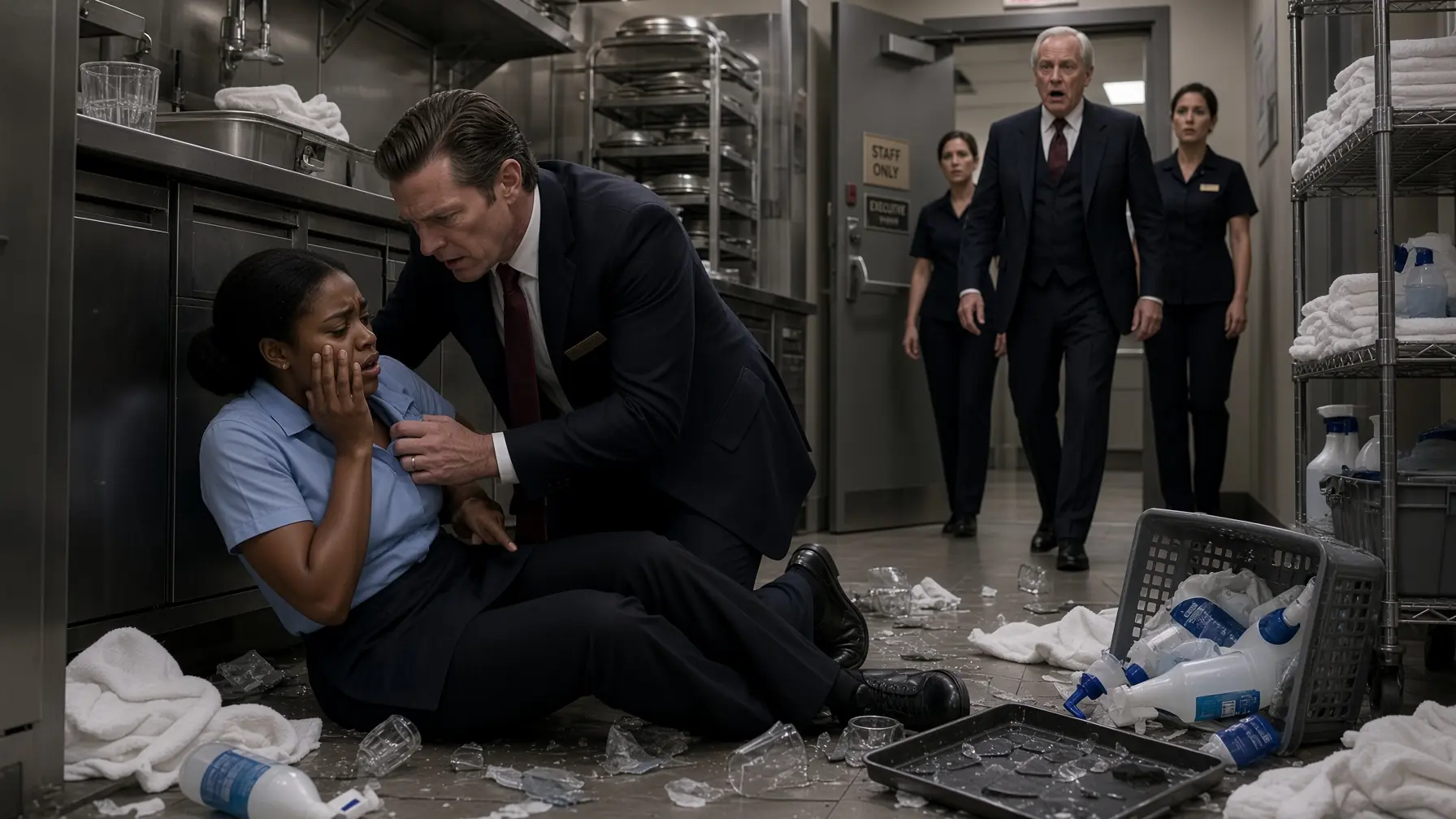
Richard stared at her as though the answer itself were insubordination. He was forty-six, white, impeccably groomed, and had spent eleven years turning himself into exactly the kind of hotel manager executives trusted at first glance. His suits were tailored, his guest reviews were exceptional, and he could remember the preferences of wealthy repeat customers after meeting them once. In the lobby he smiled at housekeepers, opened doors for elderly guests, and spoke about “our hotel family” during staff meetings. Back here, where polished marble became gray tile and chandeliers became buzzing fluorescent strips, his face looked different. “That,” he said, pointing at Amara, “is the problem with people like you. Three days in the building and suddenly you think seeing something gives you authority to change it.”
Amara did not move. She was twenty-seven, Black, with dark curls tied into a neat bun and a cream-colored service uniform that made her indistinguishable from dozens of other employees working the afternoon shift. Her name badge read only AMARA — SERVICE STAFF. No executive title. No corporate designation. No indication that she had spent the previous four years studying hotel operations from boardrooms, management rotations, and graduate-school case studies. Nothing on her uniform suggested that the man whose portrait hung in the executive conference room was her father. That was exactly how she wanted it. “It wasn’t a matter of authority,” she said. “The tray was blocking an emergency exit. I moved it two feet.”
Richard laughed softly and looked toward the closed door. “You still don’t understand.” He walked to the service cart and shoved it hard enough that glasses rattled against one another. “This is a luxury property. Things happen because somebody responsible decides they happen. Not because a waitress sees something and decides she knows better.” Amara watched him carefully. She had seen smaller versions of this behavior over the previous three days, but never this openly. In public, Richard wrapped contempt in professionalism. In the back corridors, he seemed to believe hierarchy itself was permission. “If the responsible person leaves a fire exit blocked,” she said, “someone should still move the tray.”
Richard’s expression hardened. “Stop saying fire exit.” He stepped closer. “This isn’t about the tray anymore.” Amara almost answered that it obviously was not, but she stopped herself. She had promised her father that she would observe, document, and avoid provoking confrontations just to test people. What she was doing at the Grand Wellington was not a prank or a billionaire’s daughter playing poor for three days. Corporate headquarters had received eleven formal complaints from lower-level employees in twenty-two months, plus unusual turnover among servers, housekeepers, banquet attendants, and bell staff. Most complaints described humiliation rather than clear policy violations. Richard denied retaliation, and property-level investigations repeatedly concluded that witnesses could not corroborate enough detail. Amara wanted to know why so many people were leaving a hotel guests consistently rated among the best in the group.
The idea had been hers. Her father, Charles Cole, had initially refused. He founded Cole Hospitality Group thirty-two years earlier with one airport hotel and had grown it into fifteen high-end properties across the eastern United States. Charles understood numbers, contracts, and buildings. Amara believed he understood employees less well than he thought. “Everybody behaves differently when the chairman walks through the lobby,” she had told him. “If we announce another inspection, we’ll see another inspection.” Charles disliked the risk, but the board’s employee-relations committee agreed that a short, carefully structured placement could reveal things formal reviews had missed. Human resources created legitimate temporary transfer records, legal approved the process, and only four people knew Amara’s identity at the property level. Richard Blake was not one of them.
During her first shift, Richard had corrected a Filipino housekeeper named Teresa for speaking Tagalog with another employee while folding linens. “English in guest-facing operations,” he told them, although they were twenty yards inside a service hallway with no guests present. On her second day, he stopped Malik Johnson, a Black bell attendant, before the morning rush and told him his short twists looked “a little too expressive for the front entrance.” Malik quietly pointed out that his hairstyle complied with the written grooming policy. Richard smiled and said, “Policies describe minimum standards. I decide presentation.” Later that afternoon, Amara watched him give a white valet with shoulder-length hair a friendly pat on the back and compliment his “California look.” None of it alone proved a sweeping theory. Together, it made the complaints feel less abstract.
What concerned Amara most was how quickly employees changed when Richard entered a space. Conversations stopped. People who had been laughing became busy. A banquet server named Elena warned Amara on her first morning, “If he tells you to do something stupid, just do it. If you explain, he thinks you’re challenging him.” Amara asked whether employees could report him. Elena laughed once and said, “To who? His managers?” That line stayed with Amara. The hotel had a corporate hotline, but several employees believed complaints eventually returned to property management, where desirable shifts, overtime, banquet assignments, and promotion recommendations could quietly disappear without anyone explicitly calling it retaliation.
Now Richard stood less than three feet away and said, “Do you know why I brought you back here?” Amara answered, “You said you wanted to discuss the tray.” He smiled. “No. I brought you here because you need to learn something before you become one of those employees who thinks every instruction deserves a debate.” He reached behind him and pushed the door fully closed. Amara heard the latch catch again. There was no lock, but the gesture was deliberate. Richard leaned one shoulder against the stainless-steel shelving and lowered his voice. “There are two kinds of employees who survive in places like this. People who understand structure, and people who eventually get replaced.”
Amara folded her arms loosely. “What does structure mean to you?” Richard’s eyes narrowed. “It means when your manager tells you not to move something, you don’t move it.” She nodded toward the emergency sign. “Even if it creates a safety issue?” His jaw tightened. “You are still arguing.” Amara said, “I’m trying to understand the rule.” Richard stepped closer. “No. You are trying to decide whether my instruction deserves your respect.” She looked at him evenly. “Those are different things.” For a moment she saw genuine disbelief in his face, as if nobody in a service uniform had ever spoken to him with that much calm.
“Get on your knees,” Richard said.
Amara thought she had misheard him. “What?”
He pointed toward several towels that had fallen when he shoved the cart. “Pick those up.”
“I can pick them up.”
“Then kneel.”
Amara looked at the towels, then back at him. “I’m not kneeling because you’re angry.”
Richard smiled, but there was no humor in it. “You keep thinking this is a negotiation.”
“No. I think picking up towels is work. Ordering somebody onto their knees to prove they obey you is something else.”
His smile disappeared.
Richard stepped forward and caught her right wrist. Amara reacted instinctively, pulling backward. His fingers tightened. “Let go of me,” she said. Instead he twisted her arm behind her and pushed her shoulder against the metal shelving. The rack clanged loudly, and a stack of folded hand towels slid onto the floor. Pain shot through Amara’s wrist. She sucked in a breath and said, “You’re hurting me.” Richard leaned closer. “Good. Maybe tomorrow you’ll remember that when a manager gives you an instruction, your job isn’t to explain why you’re smarter.”
For several seconds Amara did not speak. She was not thinking about her father. She was not thinking about corporate headquarters. She was thinking about Elena telling her to do whatever Richard said, Malik suddenly looking busy whenever Richard approached, and Teresa apologizing for speaking to a coworker in the wrong language twenty yards from any guest. Amara realized something she had not understood from the complaints. Richard did not merely lose his temper. He seemed to believe fear was a legitimate management tool. When he finally released her wrist, she turned slowly and asked, “Is this how you teach everyone back here?”
The question changed him.
Richard’s face reddened. “What did you say?”
“You heard me.”
He stepped toward her. “You think because you’ve been here three days you know anything about how this hotel works?”
Amara said nothing.
Richard continued, “You people come in with this attitude, acting like every correction is some personal attack. Then management is supposed to bend over backward because somebody might complain about tone.”
Amara stared at him. “You people?”
He caught himself. “New hires.”
“Then say new hires.”
“Do not tell me what to say.”
“I’m not.”
“Yes, you are. Every sentence out of your mouth is a challenge.”
Amara tilted her head slightly. “Maybe you hear questions as challenges because you don’t expect people in this uniform to ask them.”
Richard laughed once. “You really think you’ve figured me out.”
“I think you behave differently when guests are around.”
That struck him harder than she expected.
Richard glanced toward the door, then back at her. “Careful.”
Amara looked around the empty service corridor. “Why? There’s nobody important back here?”
His eyes changed.
Then his hand moved.
The slap landed across Amara’s left cheek with enough force to turn her head sideways. She stumbled into the service cart, catching herself against the metal edge while several spoons and folded napkins slid onto the floor. The room went silent except for the distant washing machines. Amara remained bent over the cart for a moment, one hand gripping its frame. Heat spread across her cheek. She tasted a small amount of blood where her lip had caught against a tooth. Behind her, Richard breathed heavily.
When Amara straightened, she did not cry. That almost seemed to anger him more. Richard pointed toward her and said, “That was for disrespect.” She touched her cheek with two fingers and looked at the faint red smear that came away. “You just hit an employee.” He scoffed. “Don’t start acting dramatic. You pushed and pushed until somebody finally taught you there are consequences.” Amara studied him. “Consequences for what?” He pointed toward the towels scattered across the floor. “For refusing instruction. For talking back. For acting like rules don’t apply to you.”
Amara’s voice became quieter. “I moved a tray away from a fire exit.”
Richard shook his head. “Still doing it.”
“Doing what?”
“Trying to be right.”
Amara almost smiled. “That bothers you?”
“What bothers me is people who think being technically right gives them permission to undermine management.”
“So this isn’t about whether I did anything wrong.”
Richard folded his arms. “It is about obedience.”
There it was.
No ambiguity.
No coded language.
No guest-service explanation.
Amara looked toward the corner of the ceiling where a small black dome protruded between two light fixtures. She had noticed it on her first day while mapping service routes. Richard apparently had not.
She looked back at him.
“Say that again.”
Richard frowned. “What?”
“That this is about obedience.”
He laughed. “You think you’re going to report me?”
“I asked you to repeat it.”
He stepped closer. “Here’s something you can report. Employees who refuse direction don’t last here. I can cut your banquet shifts, move you to overnight service, put you on laundry support until you quit, or terminate your probation before lunch tomorrow. And nobody at corporate is going to lose sleep over one temporary waitress who couldn’t follow instructions.”
Amara felt something colder than anger settle inside her.
“Do you tell everybody that?”
Richard’s mouth tightened.
“People who need to hear it.”
“Only back here?”
“What is that supposed to mean?”
“You don’t talk like this in the lobby.”
“Because the lobby is for guests.”
“And this place?”
“For work.”
Amara nodded. “No witnesses.”
Richard looked toward the door again. “Stop playing games.”
“I’m not.”
He grabbed the front of her uniform near the shoulder and pushed her back against the wall. “Listen carefully. You are temporary. You are replaceable. Nobody knows you. Nobody cares what you think you saw. If you want to survive here, you learn to take correction without turning everything into a fight.”
Amara looked down at his fist twisted into her uniform.
Then back at him.
“You really believe that.”
“Believe what?”
“That the uniform makes me disposable.”
Richard pushed her once more, not hard enough to knock her down but hard enough to make the wall vibrate behind her. “The job makes you replaceable. That’s reality.”
A voice came from the far end of the corridor.
“Take your hand off her.”
Richard froze.
The service door stood open.
Charles Cole was at the threshold.
Beside him were Susan Patel, Cole Hospitality Group’s chief human resources officer, Regional Managing Director Thomas Avery, and two members of corporate security. They had arrived nearly forty minutes earlier than scheduled because Charles’s flight from Chicago had landed ahead of time and traffic from the airport had been unusually light. The executive team entered through a private loading-side access corridor specifically to avoid disrupting guests before their scheduled management review.
Charles had heard enough.
He was sixty-three, Black, silver-haired, and dressed in a charcoal suit he wore with the ease of someone who had spent decades in boardrooms. In photographs he often looked warm. At that moment there was nothing warm in his face. His eyes were fixed on Richard’s hand clutching Amara’s uniform.
Richard released her immediately.
“Mr. Cole.”
Charles did not answer.
Richard took one step backward.
“Sir, this is not what it looks like.”
Charles walked past him.
“Amara.”
Richard looked from Charles to the waitress against the wall.
Then back.
Amara adjusted the shoulder of her uniform and touched her swollen cheek.
“Hi, Dad.”
Richard’s face emptied.
He seemed unable to process the word.
“Dad?”
Charles stopped in front of Amara and examined the side of her face. His first instinct was visible in the way his hands flexed, but he kept them at his sides. “Did he hit you?” he asked.