The first thing Richard Blake knocked from Amara Cole’s arms was a bottle of sparkling water. It hit the marble floor of the Grand Wellington Hotel, bounced once, and rolled beneath the shoes of a businessman waiting near the elevators. The second thing was a folded bath towel, which Richard deliberately pulled from the top of the stack she was carrying even after Amara told him the tray was unstable. Then came a crystal glass. It struck the floor with a sharp crack that cut through the soft piano music drifting across the lobby, and every head within thirty feet turned toward them. Richard did not look at the glass he had caused to fall. He looked at Amara and shouted, “Do you have any idea what that costs?”
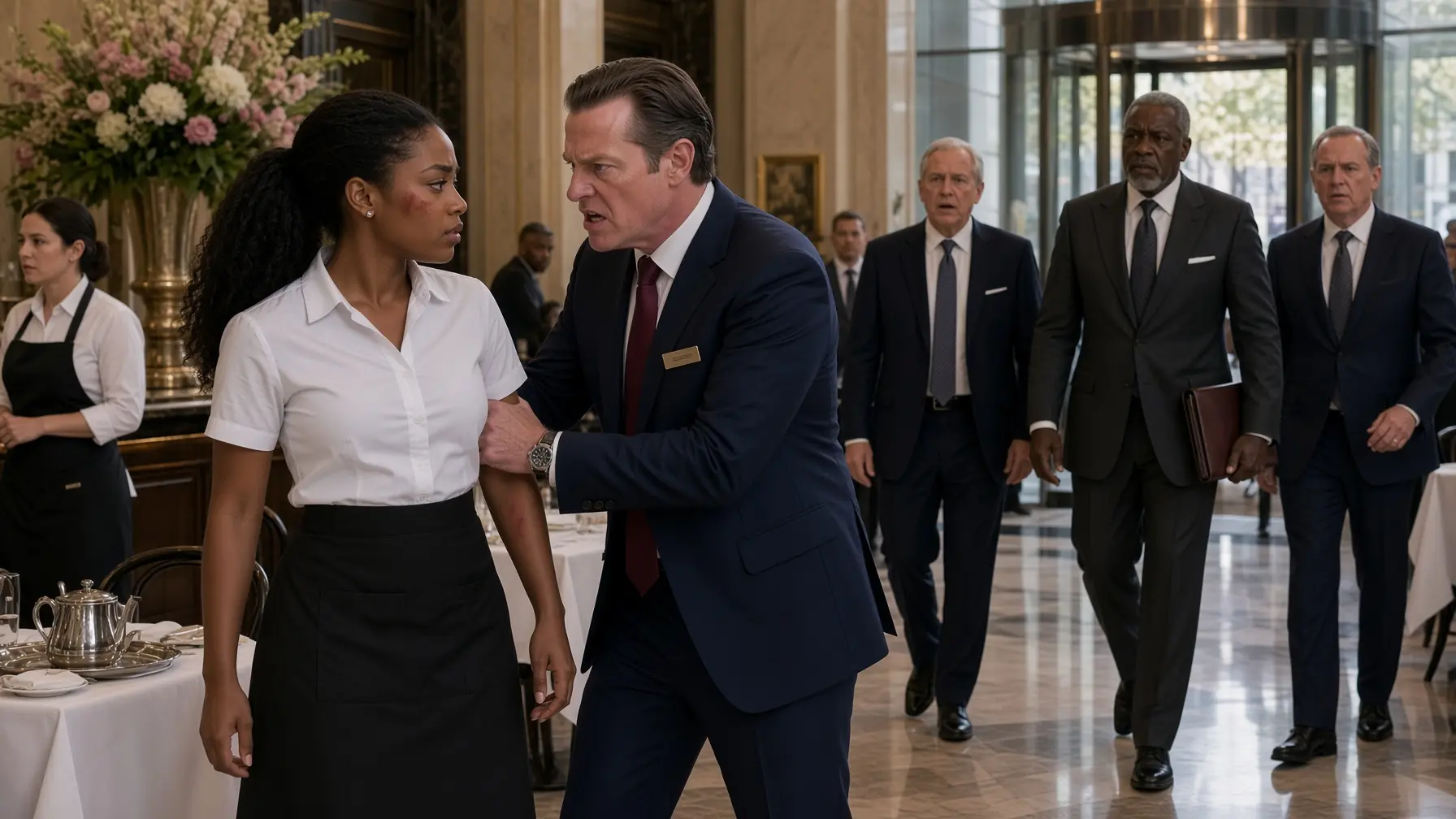
Amara stood beneath the enormous chandelier with both arms still full of towels, bottled water, and toiletries for the Presidential Suite. She was twenty-seven, Black, with dark curls tied neatly behind her head and a cream service uniform that had been issued to her three days earlier. She had been on her feet since six that morning, and the thin shoes required by the hotel were already beginning to hurt. Nothing about her clothing suggested wealth, authority, or influence. To anyone passing through the lobby, she looked exactly like what the name tag on her chest said she was: AMARA — SERVICE STAFF.
“I didn’t drop it because I was careless,” she said quietly. “You pulled the towel from underneath it.” Richard’s face tightened because several guests had heard her. He was forty-six, white, impeccably groomed, and dressed in a dark navy suit tailored closely enough to communicate that he considered presentation a moral virtue. For eleven years he had worked his way through the Grand Wellington’s management structure, and for the last three he had controlled day-to-day operations in the lobby, front office, guest services, and executive floors. Customer satisfaction scores under him were excellent. Employee turnover was not.
Richard stepped closer until Amara could smell the peppermint gum he chewed before donor events and VIP arrivals. “Are you correcting me?” he asked. Amara shifted the stack in her arms and answered, “I’m explaining what happened.” He smiled without warmth and glanced toward the guests watching from the lounge. “Third day here and you already think explanations are part of your job. Your job is to carry what you’re given, go where you’re told, and make sure people who pay fifteen hundred dollars a night never have to notice you struggling.”
At the front desk, receptionist Lily Grant stopped typing. She had been working at the Grand Wellington for fourteen months and had learned to recognize the small changes in Richard’s voice that preceded trouble. “Mr. Blake,” she said carefully, “I saw what happened. The tray was balanced before—” Richard lifted one hand without even looking toward her. “Nobody asked you, Lily.” She fell silent, but her face changed. Amara noticed. During three days at the hotel, she had already seen several employees do exactly the same thing when Richard entered a room: shoulders stiffened, voices became softer, eyes dropped toward computers or cleaning carts.
That was one of the reasons Amara had come.
Nobody in the lobby knew that.
Three days earlier, she had entered the hotel through the employee entrance at 5:40 in the morning wearing inexpensive black trousers, a plain coat, and shoes she had deliberately purchased at a discount store. Human resources had introduced her as a temporary service employee transferred from another property. The paperwork was real enough to survive ordinary checking. Her background record listed a previous hospitality job in Baltimore, a community-college certificate, and no management experience. Only four people inside Cole Hospitality Group knew the complete truth: the chairman, the chief human resources officer, the general counsel, and the chair of the board’s employee-relations committee.
Amara’s last name appeared nowhere on the schedule.
At the Grand Wellington, she was simply Amara.
The experiment had been her idea.
For nearly eighteen months, corporate headquarters had received inconsistent reports from the property. Guest ratings were among the best in the group. Revenue per available room was up. Corporate events had increased. Yet service-staff turnover was nearly three times the company average, and exit interviews repeatedly contained phrases like humiliated in public, threatened with termination, different rules for certain people, and management cares more about appearances than staff safety. Formal investigations had produced little because employees often softened their statements once managers became involved.
Richard dismissed the complaints as resentment from people who could not meet luxury-hotel standards.
Amara wanted to see the difference between what appeared on a quarterly report and what happened when management believed nobody important was watching.
She had seen enough by her second day to understand why the numbers looked strange. Richard had corrected a housekeeper’s English in front of guests despite understanding her perfectly. He told a Black bellman named Malik that his hair was “a little too expressive for the entrance” even though it complied with policy. He made Lily redo an entire seating chart because one corner of a printed guest list was slightly bent. None of those moments alone looked dramatic enough to survive a corporate investigation, but together they created an environment where employees spent more energy predicting Richard than serving guests.
Amara had also seen another Richard.
The Richard who greeted wealthy families by name.
The Richard who crouched to speak gently with children.
The Richard who personally carried luggage for a retired senator and remembered the preferred bourbon of a real-estate developer who stayed twice a year.
He was capable of patience.
He was capable of kindness.
He simply rationed both according to status.
That interested Amara more than a manager who screamed at everyone.
Now, beneath the chandelier, Richard pointed toward the broken glass. “Pick it up,” he said. Amara looked down at the shards. “Housekeeping should bring a broom. Someone could cut themselves.” Richard’s eyebrows rose. “I did not ask for a safety lecture.” She answered, “I’m holding six bottles and two trays.” His eyes moved toward the guests again. “Then put them down and clean your mess.”
“My mess?” Amara repeated.
Richard smiled.
“Do you want to keep your job?”
The question was louder than necessary.
Several guests looked away.
That was another thing Amara had noticed: people became deeply interested in phones when someone was being humiliated nearby. She slowly lowered the stack onto an empty side table, then crouched to retrieve the towels and toiletries that had fallen. Before she could reach one folded towel near Richard’s shoe, he nudged it farther across the marble with the toe of his polished loafer. “That one too,” he said.
Amara looked at the towel.
Then at him.
For the first time, something colder entered her expression.
“You can tell me to work,” she said. “You don’t need to make me crawl.”
Richard’s smile disappeared.
“I’m sorry?”
“You heard me.”
Lily stopped breathing for a second.
Malik, standing near the revolving doors, looked toward them.
Richard leaned closer. “You need to understand something very quickly if you expect to last here. This is not a neighborhood restaurant. This hotel survives because guests expect a certain environment. They do not want attitude from staff, they do not want arguments in the lobby, and they certainly do not want employees acting as if every instruction is negotiable.”
Amara stood slowly.
“What does that have to do with kicking a towel away from me?”
His cheeks flushed.
“You are dangerously close to insubordination.”
“I asked a question.”
“There. That.” Richard pointed at her as if she had demonstrated his entire case. “People like you arrive here and immediately think questioning everything makes you strong.”
The lobby seemed to become quieter.
Amara’s eyes held his.
“People like me?”
Richard realized the phrase had traveled farther than he intended. His expression changed slightly, but instead of apologizing, he adjusted it. “Probationary employees,” he said. “People who have not earned the right to challenge management.”
Amara nodded slowly.
“Then say probationary employee.”
Richard stared at her.
“Excuse me?”
“Say what you mean.”
A woman sitting near the lounge lowered her champagne glass.
Richard looked around again.
This was no longer a workplace disagreement to him.
It was an audience.
And Richard hated losing control in front of an audience.
He bent down, grabbed one of the bottled waters from the table, and shoved it back into Amara’s arms harder than necessary. “Take these upstairs. Now.” Amara caught the bottle against her chest and said, “I was already doing that before you stopped me.” His jaw tightened. “You stopped because you wanted attention.” Amara almost laughed. “I stopped because a guest dropped her handkerchief.”
Richard looked toward the elderly woman Amara had helped several minutes earlier. She was still standing near the concierge desk. “She did,” the woman said. “The girl was being helpful.” Richard forced a smile toward the guest. “Of course, ma’am. We appreciate your patience.” Then, the instant he turned back toward Amara, the smile vanished.
“Go,” he said.
Amara reached for the remaining towels.
Richard grabbed her wrist.
Not hard enough to injure.
Hard enough to make the point.
Amara looked down at his hand.
“Let go.”
Richard’s eyes narrowed.
“I said go upstairs.”
“You’re holding me.”
“Then stop pulling away.”
“I am not pulling.”
Lily came around the desk. “Mr. Blake.”
Richard turned toward her. “Back behind the desk.”
“Please let her go.”
His grip tightened.
Amara’s voice remained calm. “Richard.”
Something about hearing his first name from a service employee triggered whatever self-control he still had.
“Do not call me that.”
“It is your name.”
“You call me Mr. Blake.”
“Then take your hand off me, Mr. Blake.”
The next few seconds happened so quickly that people later disagreed about which movement came first. Richard released Amara’s wrist, but as she turned toward the tray he grabbed the stack of towels from her arms and jerked it sideways. Bottles shifted. One rolled off. Amara instinctively reached to stop it. Richard interpreted the movement as another refusal to obey, stepped into her path, and said, “I am done with your attitude.”
Amara answered, “Then control yours.”
His hand struck her face.
The sound cracked across the lobby.
Amara’s head snapped sideways.
The tray flew from her hands.
Towels, bottled water, wrapped toiletries, two glasses, and a silver ice bucket scattered across the marble. A bottle burst when it struck the base of a column. Water sprayed across the floor. Amara lost her footing and fell hard onto one hip, catching herself with her left hand.
For one second, nobody moved.
Then Lily screamed.
Malik rushed forward.
The pianist stopped playing.
Richard stood above Amara breathing heavily, staring at his own hand as if even he had not expected it to move. That might have been the moment he could have stepped backward, called medical assistance, admitted what he had done, and let the consequences begin honestly.
Instead he looked at the guests.
And chose pride.
“That,” he said, pointing down at Amara, “is what happens when you push people too far.”
Malik stopped.
“What did you just say?”
Richard looked toward him. “Stay out of this.”
“You hit her.”
“She became physically confrontational.”
Amara slowly pushed herself upright.
“No, I didn’t.”
Richard turned. “Do not speak.”
She wiped the corner of her mouth with one finger.
A faint line of blood appeared.
The sight seemed to sober several guests more than the slap itself.
The elderly woman who had dropped the handkerchief said, “I saw the whole thing. She never touched you.”
Richard looked toward her.
“Ma’am, please allow us to handle an internal matter.”
“It stopped being internal when you hit a woman in front of thirty people.”
Another guest raised his phone.
Then another.
Richard noticed.
His face changed again.
“Everyone needs to stop recording,” he said.
Nobody listened.
Amara got fully to her feet.
Her left cheek was already reddening.
Richard pointed toward the employee corridor. “You’re done. Go downstairs, clear out your locker, and leave through the staff exit.”
Amara looked at him.
“You’re firing me?”
“Immediately.”