The wind did not just blow across the high plains of the Wyoming territory in the late 1870s. It hunted. It scoured the earth with a predatory hiss, stripping the topsoil from the hardpan and driving grit into the deepest creases of the skin. It was a living, malevolent thing that knew neither pity nor pause.
Mara walked with her head bowed against this gale, her body angled forward as if she were pushing against a solid wall. She had lost track of how many days she had been walking. Three, perhaps four. The timeline had blurred into a gray smear of pain and cold.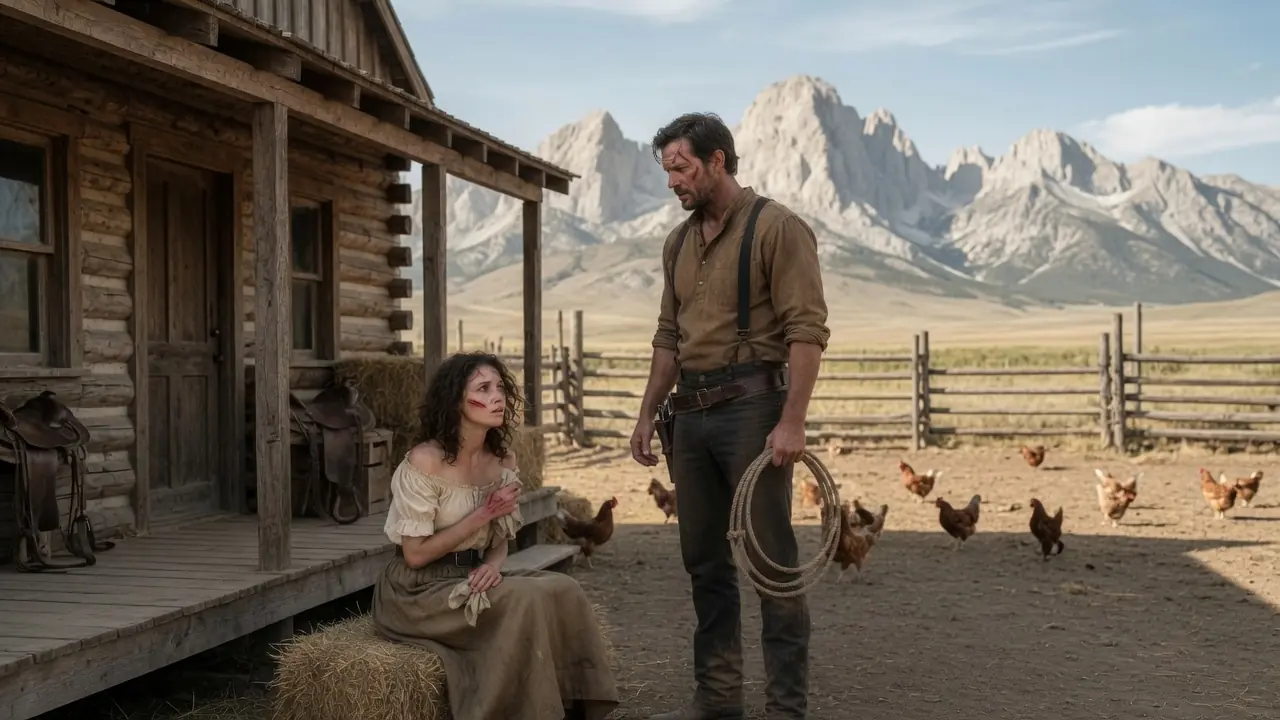
Her boots, cheap leather things meant for standing on saloon floorboards and not for traversing the jagged geography of the frontier, had given up miles ago. The soles were thin as paper, and she could feel every sharp rock and frozen rut through them. Her left heel was raw, the blister having burst yesterday, leaving her sock stiff with dried blood. She clutched a small bundle of clothes to her chest, wrapped in a rough shawl that smelled of lye soap and stale tobacco.
It was all she owned in the world. The landscape around her was a study in desolation. To the west, the mountains rose up like the jagged teeth of a wolf. Their peaks already dusted white with snow that promised a winter few would survive without shelter.
Above the sky was a flat, bruised purple, pressing down low and heavy. There was no sun, only a diffused, watery light that offered no warmth. She stumbled, her knee hitting the hard earth. A cry caught in her throat, but she swallowed it down.
Crying took moisture, and she had none to spare. She pushed herself up, her hands trembling uncontrollably. You cannot stop, she told herself. If you stop, the frost takes you.
The memory of the town she had left behind was still sharp, cutting through the haze of her exhaustion. It was a muddy collection of shacks and ambition called Silver Creek, a place where men went to lose their money and women went to lose their souls. She had been staying at a boarding house near the edge of town, a place that turned a blind eye to how a woman paid her rent, provided she was quiet about it. But the new proprietor, a thin-lipped woman with a Bible in one hand and a ledger in the other, had decided to clean house.
"You are bad for business," the woman had said, standing on the porch with her arms crossed. "You are not respectable enough for the clientele I aim to attract. Respectable." The word tasted like ash. Mara had not been respectable since she was 16 years old, and she had long ago learned that respectability was a luxury, like silk ribbons or sugar and tea.
It was something other people could afford. She had pleaded, offering to scrub floors, to empty chamber pots, to stay out of sight. The woman had simply closed the door. So Mara had walked.
She walked because standing still meant death, and she possessed a stubborn, illogical desire to keep breathing. Now, as the afternoon light began to fail, draining away into a murky twilight, she saw it, a thin gray ribbon rising against the darker gray of the sky. Smoke. It was faint, whipped almost instantly into nothingness by the wind.
But it was there, hope, sharp and terrifying, spiked in her chest. Where there was smoke, there was a fire. Where there was fire, there was a roof. She forced her legs to move faster, her frozen feet stumbling over sagebrush roots.
The cabin emerged slowly from the gloom. A low, squat structure built of rough-hewn logs that had weathered to the color of iron. A corral stood nearby, the fence rails gray and splintered, holding two horses that stood with their rumps to the wind, tails whipping. It was an isolated place, miles from the nearest neighbor, perched on a rise that overlooked the endless empty prairie.
It looked lonely. It looked hard. Mara approached the door. There was no porch, just a flat stone dragged from a creek bed to serve as a step.
She hesitated, her hand hovering over the wood. She knew what she looked like. She knew what men thought when they saw a woman alone on the plains with no horse and no escort. She was debris.
She was something broken to be used or discarded. But the cold was seeping into her marrow, making her bones ache with a deep, throbbing rhythm. She had no choice. She knocked.
It was a weak sound, barely audible over the howling wind. She waited, shivering violently. Her teeth chattelering so hard her jaw ached. Nothing happened.
She knocked again, harder this time, desperation lending her strength. "Please," she whispered to the wood. The latch clicked. The door did not swing open.
It was pulled inward with a deliberate slowness. A man stood in the frame. He was tall, filling the doorway, blocking the warmth that spilled out from behind him. He wore a heavy wool coat and a battered hat pulled low.
In his right hand, resting easy but ready, was a Winchester rifle. He did not speak. He just looked at her. His face was a map of hard living.
He was in his 30s, perhaps, but the sun and wind had etched deep lines around his eyes and mouth. A scar ran from his temple down into his beard. A jagged white line that spoke of violence. His eyes were dark, guarded, and devoid of welcome.
Mara tried to speak, but her throat was too dry. She swayed, the world tilting sideways. The heat from the cabin washed over her, smelling of wood smoke and coffee, and the contrast with the freezing air nearly sent her to her knees. “Help me,” she managed to rasp.
The man looked past her, scanning the horizon. He was checking for others. A husband, a pimp, a posse. He saw only the blowing dust in the empty distance, emphasizing how alone they both were on this god-forsaken stretch of earth.
He looked back at her, his gaze dropping to her torn shoes and the blue tint of her lips. A flicker of something crossed his face. Not pity exactly, annoyance perhaps, or resignation. He stepped back, lowering the rifle barrel just an inch.
"Come in before you let all the heat out," he said. His voice was like the grinding of gravel under a boot heel. Mara stumbled across the threshold. Her legs finally gave out and she pitched forward.
He did not catch her, but he reached out a hand to steady her against the doorframe, his grip firm and impersonal. "Sit," he ordered, nodding toward a rough-hewn table near the center of the room. The cabin was small, consisting of a single room. A cast iron stove sat in the corner, radiating a blessed, intense heat.
A narrow bed was pushed against the far wall, covered in heavy quilts. Saddles and tack hung from pegs, and the floor was swept clean but bare. Mara sank onto the bench, her body trembling so violently she had to clamp her hands between her knees. The man pushed the door shut and dropped the heavy wooden bar into place.
The sound of the wind was instantly muffled, reduced to a dull roar that battered impotently against the logs. He moved with a hitch in his stride, a stiffness in his left leg that he tried to hide but could not. He went to the stove, took a tin cup, and dipped it into a bucket of water. He set it on the table in front of her.
"Drink slow," he said. She grabbed the cup with both hands, the metal cool against her feverish skin, and drank. The water was sweet and shockingly cold. She choked, coughed, and drank again.
The man watched her. He had leaned the rifle against the wall, but stayed within reach of it. He went back to the stove and ladled a thick brown stew from a pot into a chipped ceramic bowl. He placed this before her along with a spoon.
Beans. He said, "It is not much. Tomorrow, it looked like a feast fit for a railroad baron. She ate with a hunger that shamed her, shoveling the beans into her mouth, barely chewing.
The heat of the food bloomed in her stomach, sending pain and pleasure radiating through her chest. He watched her eat. He did not sit. He leaned against the counter, his arms crossed over his chest.
He was studying her, reading the clues written on her body. He saw the way her wrists were thin and marced with faint yellowing bruises. He saw the way she kept her eyes down, a habit born of survival. He saw the flinch that rippled through her shoulders when he shifted his weight and his boots scraped the floor.
She was a run-to-ground animal. He knew the look. He had seen it on horses that had been whipped too often, and he had seen it on men in the war camps down south. When the bowl was empty, she pushed it away and finally looked up at him.
Her eyes were large and dark, rimmed with red from the wind. "Thank you," she said. He nodded once, a sharp jerk of his chin. "Where did you come from?" he asked.
"Town," she said. "Silver." "That is 3 days walking." He said, "Maybe four in this weather," she nodded. "You walk all that way alone?" "Yes." "Why?" The question hung in the air. Mara looked at her hands which were cracked and bleeding at the knuckles.
She could not tell him the truth. She could not say she was a woman of no virtue who had been discarded like refuse. Men like this, solitary men who lived by the gun and the plow, they valued order. They valued decency.
“I got put out,” she said softly. “Put out?” he repeated. “I ran out of money.” The landlord, he needed the room. It was a lie, but it was close enough to the truth that she hoped it would pass.
He looked at her for a long moment, his eyes narrowing. He did not believe her. She could see it in the set of his jaw, but he did not press her. “I am Eli Turner,” he said.
Mara, she replied, "Well, Mara, you are miles from anywhere. The next town is Casper, and that is a weak ride south. You are lucky the snow held off or you would be a frozen lump out there by now. “I know,” she said.
Eli ran a hand over his face. The sound of his palm against his stubble was loud in the quiet room. He looked tired. It was a deep, bone-weary exhaustion that went beyond physical labor.
"I live alone here," he said. "I have got cattle to tend and fences to fix before the deep freeze sets in. I barely have enough supplies to see myself through the winter, let alone a guest. Mara felt a cold knot tighten in her stomach.
“I can work,” she said quickly. I can cook, I can wash, he held up a hand to stop her. “I cannot afford trouble,” he said flatly. And a woman walking alone from Silver Creek with bruises on her wrists brings trouble.
I do not know who you are running from, and I do not aim to find out. He walked to the window and peered out into the gathering darkness. You can sleep here tonight, he said his back to her. By the stove.
Tomorrow morning, I will give you some salt pork and a canteen. I will point you toward the stage road. If you leave at first light, you might catch a wagon. The dismissal was final.
Mara stared at his broad back. The stage road was two days away across open country. Without a horse, without proper boots, she would never make it. The wind outside rattled the door in its frame, a reminder of the beast waiting to devour her.
She looked around the cabin. It was dry. It was warm. There was food.
Panic began to rise in her throat, tasting of bile. She could not go back out there. She would die. The certainty of it settled on her shoulders like a lead weight.
She had to stay. She had to convince him. But she had no money. She had no skills that a rancher would value.
She could not rope a steer or brand a calf. She had nothing except one thing. It was the only currency she had known for 5 years. It was the only thing men had ever wanted from her.
It was the only thing that had kept a roof over her head in Silver Creek and in Cheyenne before that and in Abilene before that. She looked at Eli. He was a man. He was alone.
He might be hard, but he was made of flesh and blood. The shame was a familiar companion. It rose up hot and suffocating, but she pushed it down. Survival was more important than dignity.
Dignity did not keep the frost from turning her blood to ice. She stood up. Her legs were shaky, but she locked her knees. "Mr. Turner," she said.
He turned to face her. The lamp on the table cast deep shadows across his face, making a scar look like a canyon. She took a breath. It rattled in her lungs.
“I cannot leave,” she said. I will die out there. He sighed, his expression hardening. I am not running a charity.
He said, I told you I have nothing to spare. She stepped closer to him. The heat from the stove was intense, but she felt cold inside. She looked him in the eye, her own eyes glossy with the tears she refused to shed.
"I am not worth much," she said, her voice trembling just a little. She paused, forcing the words past the tightness in her throat. She had said them before, or versions of them. She knew the script.
"I am not worth much," she repeated. "But I will spread my legs for a roof over my head." The silence that followed was absolute. The wind seemed to hold its breath. The pop of a log shifting in the stove sounded like a gunshot.
Eli went rigid. His whole body stiffened as if he had been struck. He did not move toward her. He did not smile the way men usually smiled when she made that offer.
That hungry, predatory grin that stripped her naked before she even undid a button. Instead, a flush of dark color rose up his neck. His hands hanging by his sides, curled into fists. He looked at her, and for a second, Mara thought he might strike her.
The anger in his eyes was sudden and fierce. He turned away sharply, gripping the edge of the table with both hands. His knuckles turned white. "No!" he growled.
Was she too ugly, too dirty from the road? I can clean up, she stammered. I can stop it, he snapped. He spun back around, and the fury on his face made her take a step back.
But as she looked at him, she realized with a jolt that the anger was not directed at her. He was not looking at her with disgust. He was looking at her with a terrible, aching sorrow that looked almost like rage. He ran a hand through his hair, knocking his hat back.
"Is that what you think this is?" he asked, his voice shaking. "You think you buy your life with your body?" "It is all I have," she whispered. Eli let out a harsh breath through his nose. He looked at the ceiling, then back at her.
"Who made you believe that?" he asked quietly. She did not answer. "The list was too long." He shook his head, looking down at the floor. I am done paying for bodies, he said.
The words carried a weight of history. They hinted at border towns in Mexico, at army camps where women followed the regiments, at a life that had seen too much transaction and not enough humanity. I have seen enough of that to last two lifetimes, he said. And I will be damned if I am going to make a woman do that just so she does not freeze to death on my doorstep.
He looked her in the eye again. The hardness was back, but it was different now. It was a protective hardness. You put that thought out of your head, he commanded.
You hear me? You are a guest in this house. Or you are nothing. But you are not a whore here.
Mara stood there, stunned. Her hands hung uselessly at her sides. She felt unmed. The transaction had been rejected.
She did not know what to do. The script had run out. So, you are throwing me out?" she asked, her voice breaking. Eli looked at the window again.
The snow had started. He could hear the hiss of it against the glass. "No," he said. "I am not sending anyone out in that." He walked over to the stove and poured himself a cup of coffee.
He took a long sip, grimacing at the heat. "Here is the deal," he said, not looking at her. "You want to stay? You work, and I do not mean on your back.
He turned to face her. I need help with the stock. I need help hauling water. I need someone to cook a meal that does not taste like burnt grease.
You pull your weight, you get a bed and food. Equal trade. Labor for board. Mara stared at him.
Equal trade. The concept was foreign. “You mean like a hired hand?” she asked. “Like a partner,” he corrected.
For as long as you are here, he set the cup down. But I am telling you now, Mara, the work is hard. It will break your back and blister your hands. I do not carry dead weight.
“I can work,” she said again, and this time her voice was stronger. He studied her for a moment longer, then nodded. All right, then. He walked to a wooden chest at the foot of the bed and rummaged through it.
He pulled out a worn flannel shirt and a pair of canvas trousers. He tossed them to her. Those will be too big, but they are clean, he said. You can sleep in them.
He pointed to the bed. You take the bunk. Mara blinked. But it is your bed.
I have slept on harder ground than this floor, he said. And I do not sleep much anyway. He grabbed a couple of blankets from the bed and a pillow, tossing them onto the rug near the stove. Go change behind the blanket over there, he said, gesturing to a sheet hung up in the corner to separate the dry goods from the living space.
Mara went behind the curtain. Her fingers were shaking as she unbuttoned her dress. It was stained and torn. A relic of a life she was suddenly violently hoping to leave behind.
She pulled on the flannel shirt. It smelled of sage and man. It swallowed her small frame, the cuffs hanging past her fingertips. She rolled them up.
When she came out, Eli was already lying on the floor, wrapped in a blanket, his back to the room. He had turned the lamp down low, leaving the cabin in a soft amber gloom. "Get some sleep," he said from the floor. "Dawn comes early." Mara climbed into the narrow bed.
The sheets were rough cotton, but they were clean. The pillow was soft. She pulled the heavy quilt up to her chin. She lay there staring at the log beams of the ceiling.
Outside, the storm had fully arrived. The wind shrieked around the corners of the cabin, sounding like a chorus of lost souls. The snow pelted the window pane with a steady, rhythmic ticking. She was warm.
She was safe. She turned her head slightly to look at the dark shape of Eli on the floor. He was breathing steadily, but she sensed he was not asleep. He was listening to the wind just as she was.
She felt a strange tightness in her chest. Fear, yes, confusion, certainly. She had offered him the only thing she had, and he had looked at it with anger. Not because he wanted it and could not have it, but because he hated that she felt she had to offer it.
He could have taken her. She would not have fought. She would have let him do whatever he wanted, and she would have been grateful for the warmth. But he had given her the bed.
He had given her dignity, even when she had tried to throw it away. Tears prickled her eyes again, hot and stinging. She let them fall this time, sliding silently into the pillow. She listened to the storm raging against the walls, a violence that wanted to consume her.
And she thought of the man lying on the hard floor, keeping the watch. He was a stranger. He was scarred and grim. But tonight, he was the only thing standing between her and the grave.
The cabin creaked under the force of the wind, but it held, and for the first time in years, Mara closed her eyes and slept without one hand gripping a knife under her pillow. Dawn arrived not with the warmth of the sun, but with a pale, unforgiving light that washed the color from the world. It crept through the frosted window pane of the cabin, illuminating the dust motes dancing in the cold air. Mara woke with a start, her heart hammering against her ribs.
For a split second, she did not know where she was. The heavy quilt, the smell of pine pitch and old wood, the silence, none of it belonged to the life she had known. Then the memory of the previous night rushed back. The wind, the desperate bargain offered, the rejection that had felt like a slap, and the unexpected mercy of a bed.
She sat up, pulling the quilt tight around her shoulders. The air in the cabin was frigid, bitter enough to see her breath huffing out in white clouds. Across the room, the cast iron stove was already popping with heat and the scent of strong coffee cut through the stale air. Eli was gone.
She scrambled out of the warm nest of blankets, her bare feet hitting the cold floorboards. She dressed hurriedly in the oversized shirt and trousers he had given her, fumbling with the buttons because her fingers were stiff with cold, she found her worn boots by the door, stiff as boards, and forced her feet into them. When she opened the heavy wooden door, the wind assaulted her instantly. It sliced through the valley, carrying with it the bite of snow that lay in patchy drifts across the hard ground.
Eli was by the corral, breaking ice in the water trough with a heavy iron bar. He looked up as she stepped onto the flat stone stoop. He did not smile. He did not say good morning.
He simply watched her for a moment, his breath steaming before driving the bar down into the ice again with a grunt of effort. It was as if the vulnerability of the night before, her tears, his quiet anger, had never happened. The slate had been wiped clean by the frost. Mara walked over to him, wrapping her arms around herself.
"What do you want me to do?" she asked. Eli rested the iron bar against the fence post. He looked her over, noting the way the oversized clothes hung on her frame. But he made no comment.
"There is coffee on the stove," he said, his voice flat. "Drink some. Then there is work." He pointed a gloved hand toward the creek that ran a hundred yards behind the cabin. Water needs hauling for the house.
Two buckets. Then the wood box needs filling. The chickens in the coop out back need scratch. And you will find eggs if the cold has not stopped them laying.
He paused, looking at the distant fence line. I will be out checking the south perimeter. The wind likely took down a rail or two. I will be back for the midday meal.
There is salt pork in the cellar and beans in the sack. He swung himself up into the saddle of the bay horse, standing patiently nearby. He adjusted his hat, looking down at her one last time. "Do not let the fire go out," he added.
"It takes too much wood to get it going again." With that, he turned the horse and rode off toward the ridge, a dark silhouette against the gray, looming sky. Mara stood alone in the wind. She felt small. She felt exposed.
But beneath the fear, there was a tiny hard kernel of resolve. He had given her a list. He had given her a role. She was not a charity case, and she was not a whore.
She was a worker. She turned and went back inside, drank the scalding coffee black, and set to work. The reality of the frontier was not romantic. It was a brutal physical assault.
The buckets were heavy oak, bound with iron, and when filled with water from the icy creek. They weighed enough to strain the muscles in her shoulders until they screamed. The handle bit into her palms, reopening the blisters from her long walk. She slipped on the mud of the creek bank, soaking the hem of her trousers in freezing water.
But she scrambled up, terrified that spilling the water would mean she had failed. She hauled the wood, splintering her fingernails on the rough bark. She found three brown eggs in the coop, clutching them like gold bullion as she navigated the frozen yard back to the cabin. By the time Eli returned at noon, the cabin was warm, the floor was swept, and the smell of frying pork filled the room.
He ate quickly with the efficiency of a man who viewed food as fuel. They barely spoke. He asked if she had found eggs. She said yes.
He nodded. That was all. The days began to bleed into one another, marced only by the changing gray of the sky and the ache in Mara's body. The laundry was the worst of it.
Once a week, she took their clothes down to the creek. She had to break the ice at the edge of the water, then kneel on the freezing stones to scrub the heavy denim and wool with a bar of harsh lye soap. The water was so cold it burned like fire. Her hands turned raw and red.
The skin cracking across the knuckles. Blood would sometimes seep from the cracks, staining the soapy water pink. But she scrubbed until her arm shook. She scrubbed until the stains of grease and sweat were gone.
One afternoon, a week into her stay, she was drying dishes after the evening meal. Her hands were numb and clumsy. A ceramic plate slick with soapy water slipped from her fingers. It hit the floor and shattered into three large pieces.
The sound was shockingly loud in the quiet cabin. Mara froze, her breath hitched in her throat. The instinct was immediate and overwhelming. She flinched, her shoulders hunching up to protect her ears, her eyes squeezing shut.
She waited for the shout. She waited for the backhand. In the houses she had lived in before, a broken plate meant a bruise. It meant she was clumsy, stupid, worthless.
Silence stretched out. Slowly, she opened her eyes. Eli was sitting at the table, mending a bridle by the light of the kerosene lamp. He had stopped working.
He was watching her. His face was unreadable, but his eyes were focused on the way she was cowering. "I am sorry," she whispered, her voice trembling. "I will pay for it.
I will work extra. Eli set the bridle down. “It is a plate, Mara,” he said quietly. I know.
I just I was clumsy. It will not happen again. He stood up. Mara took a step back, her back hitting the stove.
She braced herself. Eli stopped. He looked at her flinch and a shadow passed over his face. It was a look of deep, unsettling recognition.
He saw the expectation of violence in her posture. He saw how she had already punished herself in her mind far worse than he ever could. He walked over, not to her, but to the broom in the corner. He picked it up and held it out.
"Handle first. Sweep it up before you step on a shard," he said. Mara stared at the broom. "You, you are not angry." Eli looked at the shattered ceramic on the floor.
"I have broken more things in this life than I can count," he said. "Men break things. The world breaks things. A plate is the least of it, he went back to the table and sat down.
Watch your fingers, he added, his voice gruff. You need those for the milking tomorrow. Mara swept up the pieces, her heart pounding a slow, confused rhythm. She did not understand him.
He was hard. Yes, he worked her until she was exhausted, but he did not hurt her. He did not touch her. Slowly, the tension in the cabin began to change.
It was not gone, but it shifted like the wind changing direction. One evening, Mara was sitting by the fire trying to sew a button onto her shirt. The fire light was dim and she was squinting. Eli watched her for a moment, then stood up and moved the lamp closer to her side of the table.
"Thank you," she murmured. He grunted in response. A few nights later, he came in from the barn carrying her boots. He had taken them out earlier without asking.
She saw that the worn soles had been reinforced with fresh, thick leather, tacked on with neat, sturdy nails. He had greased the uppers to waterproof them. He set them down by the door. Snow is getting deeper.
He said, "Thin soles will kill you." Mara looked at the boots, then at him. He was already turning away, unbuckling his gun belt. "Thank you, Eli," she said, using his name. He paused, his hand on the buckle.
He looked at her and for the first time the corner of his mouth twitched almost a smile. “Just keeping my help on her feet,” he said. The dynamic shifted further during meals. They began to speak.
It started with the weather. Always the weather, the tyrant of the plains. Then it moved to the cattle, the price of feed, the behavior of the horses. Mara learned that Eli had come west after the war, seeking silence.
She learned he hated the cold but loved the mountains. She told him in small guarded fragments about growing up in Missouri, about how she liked the smell of sage after a rain. They were two solitary creatures circling the same fire, wary but drawn to the warmth. Then the flour ran out.
"We need supplies," Eli announced one morning, staring into the empty bin. We have put it off long enough. Mara felt a cold dread settle in her stomach. Going to town meant leaving the sanctuary of the ranch.
It meant eyes. It meant whispers. “Do I have to go?” she asked. Eli looked at her.
I need help loading the buckboard. It is heavy work and you need a coat. That flannel shirt will not hold up against a blizzard. So they rode.
The journey to the nearest settlement, a dusty cluster of buildings called Two Creeks, took half the day. Mara sat on the bench of the buckboard wagon beside Eli, wrapped in her thin shawl, her head down. She tried to make herself small to disappear into the gray wood of the wagon. Two Creeks was not much, but it had a saloon, a blacksmith, and a general store.
As they rolled down the main street, Mara felt the weight of stares. Men leaning against the saloon porch stopped talking to watch them pass. A curtain twitched in a window. She kept her eyes on her hands which were clasped white knuckled in her lap.
She felt dirty. She felt marced. Eli pulled the team to a halt in front of the general store. He set the brake and hopped down, favoring his bad leg.
He walked around and offered a hand to help her down. She hesitated, then took it. His grip was firm, calloused, and warm. For a second, just a second, she felt safe.
Then they walked inside. The store smelled of coffee beans, spices, and sawdust. It was warm. A bell jingled above the door.
There were two women at the counter, inspecting a bolt of calico fabric. They were respectable women, wearing bonnets and clean dresses with high collars. They turned as the door opened. Their eyes landed on Eli, and they nodded politely.
Then their gaze shifted to Mara. The change was instantaneous. Their faces stiffened, their eyes narrowed, sweeping over her worn trousers, the man's shirt, the shawl that had seen better days. They looked at her face, reading the history written there in the faint lines of hardship, and the way she refused to meet their gaze.
They leaned in close to one another. One of the women, a matron with a sharp nose, whispered loud enough to be heard. Well, look at that. Seems Eli Turner decided to do some shopping.
The other woman tittered behind her hand. I suppose it gets lonely out there, she murmured, though I would have thought he had more pride than to trade up from the saloon girls. The words hung in the air, toxic and sharp. Mara felt the blood drain from her face.
She felt naked. The shame was a physical blow, hot and sickening. She hunched her shoulders, wishing the floor would open up and swallow her whole. She wanted to run.
She wanted to apologize for existing. She took a step back toward the door. Eli stopped moving. He had been reaching for a sack of flour.
His hand froze in midair. The silence in the store was sudden and absolute. Even the shopkeeper behind the counter stopped wiping his hands on his apron. Eli turned slowly.
He did not look at Mara. He looked at the two women. He seemed to grow taller, his presence filling the cramped aisle. His face was like granite, cold and immovable.
He walked over to them. His limp was pronounced, the heavy thud of his boot heel echoing on the floorboards. He stopped 2 feet from them. They shrank back, suddenly realizing that the solitary rancher was not a man to be trifled with.
"Mrs. Gable," Eli said. His voice was low, steady, and utterly terrifying. The woman with the sharp nose swallowed. Mr. Turner, we were just You were just flapping your tongue about things you know nothing about.
Eli cut in. He gestured toward Mara, not with shame, but with an open, deliberate hand. This lady is Mara, he said. She is my hired help, and she is a guest in my home.
He let the words hang there. hired help, guest lady. If I hear another word of disrespect spoken about her inside this store or out on the street, I will take it as a personal insult to me. And you know, I do not take insults lightly.
The women were pale. They nodded, mute with shock. Eli held their gaze for a moment longer, ensuring the message had landed. Then he turned his back on them.
"Mara," he said, his voice softening just a fraction. Pick out a coat, a wool one, and get some gloves. Mara stood frozen. She had never been defended.
Not once. Men fought over her. Yes, fought over who got to use her, who got to take her earnings, but no one had ever stood between her and the world's judgment. No one had ever called her a guest.
She moved mechanically, grabbing a dark gray wool coat from the rack without looking at the price or the fit. She just wanted to leave. The ride back to the ranch was silent. The sky had darkened, purple clouds bruising the horizon.
The wind was picking up, smelling of ozone and rain. Mara sat wrapped in the new coat. It was warm, heavy, and smelled of lanolin. But inside, she was vibrating with a chaotic mix of shame and confusion.
When they reached the cabin and unloaded the supplies, the tension finally snapped. Eli was putting the flour away. Mara stood by the table, her hands gripping the back of a chair. "You did not have to do that," she said.
Her voice was brittle. Eli did not turn around. "Do what?" "Pretend," she said. "You did not have to pretend I am some some lady.
You did not have to lie to them." Eli turned then, slamming the flour bin shut. Dust rose in a small cloud. "I did not lie," he said. "You call me a guest," she said.
Her voice rising. You know what they think. You know what I am. Everyone knows what I am.
I am the girl who gets thrown out of boarding houses. I am the girl men use when they cannot afford a wife. She let out a harsh, jagged laugh. It sounded painful.
Do not dress me up in a new coat and pretend I am respectable. Eli, it makes it worse. It makes the joke meaner. Eli crossed the room in three long strides.
He grabbed her shoulders. His grip was hard, not hurting, but anchoring. Stop it," he barced. He shook her once, gently.
"I am tired of this, Mara. I am tired of you talking about yourself like you are trash. I am what I am," she cried, tears finally spilling over. "You are what you survived," he shouted back.
The sheer volume of his voice stunned her into silence. "They stood chest to chest, breathing hard." Eli's eyes were blazing. "I have seen the world, Mara. I have seen men in silk suits who are rotten to the core.
I have seen generals who send boys to die without blinking. And I have seen women who sell themselves to feed their children or just to keep breath in their bodies. His hands tightened on her shoulders. Those men in town, the ones who whisper, they are the ones who buy.
They are the ones who use and then they go home to their wives and pretend they are righteous. I will not have you standing here believing their lies about your worth. Mara was shaking. The truth of it, the raw honesty of his anger, cut through her defenses.
"You do not know," she whispered. "You do not know what I have done." "Tell me," he challenged. "“There was a man,” she choked out. Jonas, he he kept me in a house.
He said I owed him. I always owed him. If I tried to leave, he hurt me. She touched her ribs unconsciously.
And the men, strangers, hundreds of them. They looked at me like I was meat. And I let them. I let them because I wanted to eat.
I let them because I was scared. She looked up at him, her eyes drowning in shame. I am hollow. Eli.
There is nothing left inside but the parts they used. Eli looked at her. He did not look away. He did not recoil.
His eyes were dark. But the anger in them was not for her. It was a cold, dangerous fury directed at a man named Jonas and at every faceless man who had ever touched her. He released her shoulders and stepped back, running a hand over his face.
He looked like he wanted to punch the wall. "You are not hollow," he said roughly. "You are standing here. You are working this land.
You are fighting." Outside, the sky split open. A crack of thunder shook the cabin loud enough to rattle the jars on the shelf. The storm had arrived. Rain began to hammer the roof.
A sudden, violent deluge. The wind howled, slamming against the logs. Suddenly, a massive crash sounded from above. A dead branch from the cottonwood tree outside, sheared off by the wind, smashed into the roof shingles.
The impact was deafening. Mara screamed. She jumped back, tripping over her own feet. She began to fall.
Eli moved with the reflexes of a soldier. He lunged forward, catching her by the arms before she hit the floor. He pulled her up, hauling her against him to steady her. For a moment, the world stopped.
They were standing inches apart. Mara's hands were clutching the front of his shirt. Eli's hands were on her waist, holding her upright. She looked up.
He was looking down. The air between them was suddenly charged, thicker than the storm outside. She could feel the heat of his body through her clothes. She could smell the scent of him, rain, leather, and soap.
She could feel the rapid beat of his heart against her chest, matching the frantic rhythm of her own. His eyes dropped to her lips. Mara felt a pull, a magnetic, terrifying urge. She wanted to lean in.
She wanted to close the gap. It was not the transactional desire she was used to faking. It was real. It was a hunger for comfort, for connection, for him.
She saw his pupils dilate. She saw his head lower just a fraction of an inch. Then he froze. He took a sharp breath through his nose.
His hands on her waist tightened for a split second, then released. He stepped back. He put two ft of distance between them. The loss of his warmth was physically painful.
Mara stood there swaying slightly. Her lips parted. Eli cleared his throat. He looked at the door.
Anywhere but at her. “The roof held,” he said, his voice strained. He walked over to the stove and checked the fire, though it did not need checking. I will I will sleep by the door tonight, he said, keeping his back to her in case the storm gets worse.
So you feel safer. Mara looked at his broad back. She understood what he had done. He had felt it too.
He had wanted it to. But he had stopped. He had refused to take advantage of her fear or her gratitude or the charged moment. He was giving her the choice.
Always the choice. "Thank you," she whispered. That night, Mara lay in the bunk listening to the thunder roll across the plains. She pressed her fingers to her lips.
They tingled. She imagined what it would have felt like. Not a rough stealing kiss, but something else, something given. She fell asleep with the image of his eyes, fierce, protective, and gentle, burned into her mind.
Over the next few weeks, the winter deepened, but the cabin felt different. The silence was no longer empty. It was companionable. They fell into a routine that wove their lives together.
They woke before the sun, sharing coffee in the gray light of dawn. They rode out to mend fences under the vast, pitiless sky. When Eli held a fence post steady for her to hammer, their gloved fingers would brush. Neither of them pulled away immediately.
When he passed her the canteen, their eyes would meet and a faint, awkward smile would touch his lips. It was a dangerous warmth growing in the heart of a frozen land. It was the terrifying, exhilarating realization that she was no longer just working for a roof over her head. She was working for a home.
And the man across the fire was no longer just a boss or a savior. He was becoming the center of her world. Winter did not merely arrive. It conquered.
By January, the high plains were buried under 3 ft of snow that had drifted against the cabin walls until the windows were half covered in white. The world outside ceased to exist, reduced to the howling wind and the blinding glare of the sun on ice. The cabin, once a place of awkward silence and separate corners, was forced to become a sanctuary. There was nowhere to go.
The cattle were huddled in the lee of the ridge, and the horses were stall bound. The days shrank, the light failing by mid-afternoon, leaving Mara and Eli trapped together in the amber glow of the kerosene lamp. The forced proximity chipped away at the walls between them. Silence, which had been a shield, became a bridge.
One evening, the wind was particularly vicious, shaking the roof shingles with the sound of rattling bones. Mara sat by the stove, mending a tear in one of Eli's heavy canvas coats. Eli was oiling his rifle at the table, the metallic click of the lever the only sound in the room. Mara paused, the needle hovering over the fabric.
The isolation had loosened something in her chest, a pressure that had been building for years. My stepfather was not a cruel man when he was sober, she said. She did not look up. She spoke to the coat in her lap, but he was rarely sober, and when the whiskey took him, he forgot I was a person.
He only saw a mouth to feed. Eli stopped wiping the gun barrel. He did not speak, but his stillness was an invitation. I was 16 when he sold me, she continued, her voice flat and devoid of inflection.
He owed a debt at a card table in St. Louis. The man who held the debt ran a boarding house. That is what they called it, a boarding house for gentlemen. She pushed the needle through the tough canvas.
My stepfather got $50 in a clear slate. I got a room with a lock on the outside of the door. Eli looked at her. His face was in shadow, but his hands were tight on the rifle stock.
How long? He asked, his voice was rough gravel. 5 years, she said. First in St. Louis, then he sold me to a man in Kansas City.
Then I ran and ended up in Silver Creek. She finally looked up, meeting his gaze. Her eyes were dry, but they held a terrifying emptiness. "You learn to leave," she whispered.
When they touch you, when they use you, you learn to step out of your own skin. You float up to the ceiling and look down. You watch it happen to a stranger. That is the only way to survive.
If you stay in your body, you die. The fire popped, a log settling into the ash. Eli set the rifle down on the table with a heavy thud. He looked at his hands, scarred and calloused.
I was in the cavalry, he said, down in New Mexico territory. He spoke slowly, dragging the words up from a deep well. We were chasing Apaches, but mostly we were burning villages, killing men who were just trying to hold on to their dirt. I followed orders.
I shot when I was told to shoot. He rubbed the thumb of his right hand over the scar on his left knuckle. I had a girl back home in Ohio. Her name was Sarah.
She wrote to me every week. She talked about the garden she was planting, the house we would build when I mustered out. He swallowed hard. I stayed on after the war.
Wanted to make some money driving cattle so I could buy us a good start. I was on a drive to Abilene. Gone for 4 months. While I was gone, the fever swept through her town.
He looked at Mara, his eyes dark with a grief that had never healed. She died calling for me. her mother told me in a letter. She died alone in a fever sweat while I was drinking bad whiskey in a cow camp, celebrating a pay packet.
The silence that followed was different from the silences before. It was heavy, but it was shared. It was the weight of two lives that had been ground down by the uncaring machinery of the world. Mara set the coat down.
She moved from the chair to the bench near the fire, sitting just a few feet from him. She reached for the coffee pot on the stove at the same moment he did, their elbows brushed, neither of them pulled away. They sat there, knees nearly touching, surrounded by the ghosts they had just summoned. The emotional nakedness was terrifying.
To be seen, truly seen, without the armor of pride or the mask of transaction, felt more dangerous than any blizzard. After that night, the air in the cabin changed. It softened. Mara began to notice things she had missed before.
She noticed that when they sat down to eat. Eli always possetioned the bench so she was closest to the stove, keeping the draft from the door off her back. She noticed that when they rode out to check the herd on the rare, clear days. He kept his big gelding reined into a walk, matching the pace of her smaller mare, so she never had to struggle to keep up.
She caught him watching her sometimes. One evening she was kneading dough for biscuits. Her face flushed from the heat of the oven. She looked up and found him staring at her from across the room.
His expression was not the hungry look she was used to from men. It was a look of profound quiet concern mixed with something that looked frighteningly like hope. He looked away quickly, pretending to check the wick on the lantern, but Mara felt the warmth of that look linger on her skin. Then came the storm in late February.
It hit with a violence that shook the ground. The wind screamed like a banshee, driving snow horizontally so thick it was impossible to see the barn from the house. They had been holed up for 2 days when the wind finally died down to a dull roar. Eli went out to check the stock.
He came back 20 minutes later, his face gray with cold. We are missing a calf, he said, grabbing a coil of heavy rope. The spotted one. The mother is bawling by the south ridge.
Mara grabbed her coat and gloves without a word. The world outside was a blinding expanse of white. The wind was still vicious, biting through Mara's wool coat as if it were paper. They fought their way through the drifts, trudging up the rise toward the south ridge.
They found the cow standing at the edge of a ravine, her breath steaming in the frigid air below, on a narrow ledge 20 ft down the steep, icy slope. The calf was huddled against the rock wall, bleeding pitifully. "It is stuck!" Eli shouted over the wind. "It cannot climb back up, and if it slips, it goes all the way to the creek bed.
That is a 50-ft drop." He looked at the slope. It was sheer ice, treacherous and deadly. "I have to go down," he said. He tied one end of the rope around his waist and handed the other end to Mara.
"Loop this around that scrub oak," he yelled, pointing to a gnarled tree trunk jutting out of the snow. "Brace yourself. You are the anchor, Mara. If I slip, you have to hold me." Mara looked at the rope, then at the drop.
Fear seized her throat. "I am not strong enough," she shouted back. You are, he said. He looked her in the eyes, his gaze fierce and absolute.
I trust you. He turned and went over the edge. Mara wrapped the rope around the tree trunk and gripped it with both hands, digging her heels into the frozen earth. She felt the weight of him hit the line, jerking her forward.
She gritted her teeth, leaning back, using her entire body as a counterweight. The rope bit into her palms through her leather gloves. Her shoulders screamed in protest. She could not see him, only the taut line disappearing over the lip of the ravine.
"Got him!" Eli's voice drifted up, faint and distorted by the wind. "Pull, Mara! Pull!" she pulled. She hauled on the rope, gasping for air, her boots slipping on the ice.
She imagined Eli hanging in the void, the calf in his arms. She thought of the soldiers who had burned villages, the men who had used her, the life that had told her she was weak. "No," she grunted, heaving back. "Not this time," she pulled until black spots danced in her vision.
Slowly, agonizingly, Eli's head appeared over the rim. He was clawing at the ice with one hand, the calf tucked securely under his other arm. With one final desperate heave, she dragged them onto solid ground. Eli collapsed into the snow, gasping, the calf scrambling away toward its mother.
Mara fell to her knees beside him, her chest heaving. They lay there for a moment, the wind howling over them, alive only by the grace of stubbornness and a length of hemp rope. Eli rolled over and sat up. He looked at Mara, his face was raw from the cold, his eyebrows frosted with ice.
“You held me,” he rasped. “I held you,” she whispered. Suddenly, the distance between them vanished. It was not a conscious decision.
It was the adrenaline, the relief, the sheer defiance of death. They reached for each other at the same time. Eli grabbed her, pulling her against his chest, and Mara wrapped her arms around his neck. It was a fierce, crushing embrace.
It was the hug of two soldiers who had survived a mortar blast. Mara buried her face in the rough wool of his coat. She could hear the steady thundering beat of his heart against her cheek. She felt the heat of his body radiating through the layers of clothes.
A living furnace in the center of the frozen world. His arms tightened around her, one hand tangling in her hair, pressing her closer. His breath was warm against her ear. She felt a rush of desire so potent it made her knees weak, a longing to stay right there, to burrow into him and never leave.
For a long moment, they held on. The wind ceased to matter. The cold ceased to exist. There was only the solid reality of him.
Then she felt him stiffen. The embrace changed. The desperation faded, replaced by a sudden, rigid awareness. Eli's hand stopped stroking her hair.
He pulled back. His hands gripping her upper arms to steady her. He looked down at her. His eyes were dark, dilated, and burning with a hunger that terrified her.
He wanted her. She knew the look. She had seen it a thousand times. But then he blinked, and the look changed.
It became pained. He released her arms and stepped back, putting a foot of cold air between them. "We need to get inside," he said. His voice was thick.
"You are shivering." He turned away, grabbing the rope, acting as if his body was not screaming the same things hers was. He was being honorable. He was refusing to take what she would have given freely in that moment because he respected her too much to let it be an accident of adrenaline. Mara stood there for a second, feeling the loss of his heat like a phantom limb.
Then she nodded, wiping the snow from her face, and followed him back to the cabin. That evening, the cabin was stifling. They dried off by the fire, laughing nervously about the calf, about the mud on Eli's face. But the laughter died quickly, leaving a heavy, charged silence in its wake.
They moved around each other carefully, like two magnets fighting the pole. When their eyes met, they lingered too long. Lips parted on words that neither dared to speak. The air was thick with the question, "What are we?" Spring arrived not with flowers, but with mud.
The great thaw turned the plains into a slurry of brown slush. The creek swelled, roaring against its banks. The road to town became passable again. Eli began to ride into two creeks more frequently.
He had cattle to sell, supplies to buy, and business to attend to. Sometimes he was gone for a full day. Mara would stand on the porch, watching his figure shrink into the shimmering distance until he was just a speck against the horizon. The loneliness that hit her then was sharp and new.
It was not the loneliness of isolation. It was the specific ache of missing a specific person in town. The whispers had not died down. They had festered.
The story of the rancher and his fallen woman had become the favorite topic in the saloon and the sewing circles. Men joked that Eli Turner must be getting his money's worth. Women speculated on how long it would take for him to come to his senses and throw the trash out. But words have a way of traveling.
And these words traveled far. They reached the ears of a man who considered himself a collector of debts. It was a Tuesday in April. The sky was a brilliant hard blue.
Eli had ridden out at dawn to negotiate a price for a bull with a rancher on the other side of the valley. He was not expected back until sundown. Mara was in the yard feeding the chickens when she heard the sound of hooves. She looked up, shading her eyes.
A single rider was coming up the track. He sat his horse with a lazy, arrogant ease. He wore a fine black coat, dusty from the road, and a flat-brimmed hat. Mara's blood ran cold.
She knew that silhouette. She knew the tilt of that head. She dropped the bucket of feed, the grain scattered in the dirt. Jonas Hail rode into the yard.
He looked older than she remembered, his face a little heavier, his eyes a little colder, but the smile was the same, that smooth reptilian curling of the lips that had haunted her nightmares for 3 years. He pulled his horse up and looked around the ranch. He looked at the cabin, the repaired fences, the fat chickens. "Well, well," he said, his voice like oil sliding over gravel.
"You have done all right for yourself, Mara." Mara could not speak. Her throat had closed up. Her hands began to shake uncontrollably. Jonas dismounted.
He walked toward her, slapping his riding gloves against his thigh. I heard rumors. He said, "A girl matching your description, living in sin with a whore out in the Badlands." I thought to myself, "Surely not my Mara. Surely she knows she still has a contract to fulfill." He stopped in front of her.
He smelled of expensive bay rum and stale cigar smoke. "Go away," Mara whispered. Jonas laughed. It was a soft, cruel sound.
"Go away! Is that how you greet an old friend? After all I did for you, after I took you in when you were nothing but a starving stray, he reached out and grabbed her arm. His fingers dug into the flesh above her elbow.
Finding the soft spot between the muscles. It was a grip she remembered. It was designed to bruise without breaking the bone. “You owe me, Mara,” he hissed, the smile vanishing.
You owe me $300 for room and board. You owe me for the loss of earnings when you ran off in the middle of the night. “I do not have money,” she gasped, trying to pull away. He yanked her closer.
Then you work it off. You belong to me until the ledger is clear. That was the deal. He looked at the cabin.
Does he know? Does your cowboy know he is sleeping with stolen property? “He does not own me,” Mara cried. And neither do you.
Jonas slapped her. It was a quick stinging backhand that snapped her head to the side. Do not raise your voice to me," he said calmly. Mara tasted blood.
The old fear, the conditioning of 5 years of abuse washed over her. Her knees buckled. She felt small. She felt dirty.
Jonas leaned in close. "Here is what is going to happen. You are going to pack your things. You are coming back to town with me.
We are going to settle this debt." If you do not, he whispered, I will burn this shack to the ground. And if your cowboy tries to stop me, I have three men waiting just over that ridge who would love to use him for target practice. Mara looked at the ridge. She saw nothing, but she believed him.
Jonas never bluffed. She thought of Eli. She thought of his bad leg. She thought of the way he had held her in the snow.
She could not let him die for her. She was not worth a good man's life. “Okay,” she sobbed. Okay, just do not hurt him.
“I will wait in town,” Jonas said, releasing her arm. His fingerprints were already blooming red on her skin. You come to the hotel by sundown. If you are not there, I come back and I will not be alone.
He mounted his horse and tipped his hat. Do not keep me waiting, darling. He rode off, leaving a cloud of dust and a shattered world behind him. Mara stood there for a long time, shaking.
Then she wiped the blood from her lip and ran into the cabin. She grabbed her old bundle, the one she had arrived with. She began shoving her few belongings into it. Her hands were flying, driven by panic.
She had to go. She had to lead the danger away from Eli. She heard hoofbeats again. Heavy galloping hoofbeats.
Panic spiked in her chest. Had Jonas come back? The door burst open. Eli stood there.
He was breathless, his face flushed. He looked at Mara, then at the bundle on the table. He looked out the window with the dust settling on the road. I passed a rider.
He said, "Black coat, fancy horse. Who was that?" Mara turned away, clutching the bundle to her chest. "Nobody," she said. "Just a man asking for directions." Eli stepped into the room.
He saw the red mark on her cheek. He saw the way she was holding herself. He crossed the room in two strides and grabbed her wrist gently but firmly. He pulled her hand away from the bundle.
He saw the fresh bruises on her arm darkening against the pale skin. His face went terrifyingly still. "Who hit you?" he asked. His voice was a whisper, but it carried the threat of a landslide.
"I have to go, "Eli," she pleaded, trying to pull away. "I cannot stay here. Mara, look at me. Who was that man?
“It is Jonas,” she screamed, the truth tearing out of her. It is Jonas Hail. He found me. He says I owe him.
He says I belong to him. Eli did not let go of her wrist. He says he will hurt you. She sobbed.
He has men. I have to go. Eli, I have to go back. I am not worth you getting killed.
I am just I am just a whore who ran away. Eli's grip tightened. “Stop it,” he commanded. He pulled her closer, forcing her to look at him.
His eyes were blazing with a fury she had never seen before. But it was a clean fury. It was a protective fire. "You think you are leaving?" he asked.
"You think I am going to let you walk out that door and go back to a man who beats you?" "You do not have a choice," she cried. "He will kill you. Let him try." Eli snarled. He took the bundle from her hands and threw it across the room.
It hit the wall and fell open, scattering her few meager possessions. "You are not going anywhere." "Mara, you hear me? You are not his property. You are not a debt to be paid.
I am nothing," she yelled, pushing against his chest. "I am poison. Eli, everyone I touch gets hurt." "You are everything!" he shouted back. The words rang in the small cabin.
Mara froze. Her hands were pressed against his chest, right over his heart. It was hammering against her palms. Eli was breathing hard.
He looked at her, his expression raw and open. "All the walls were down. "You are not poison," he said, his voice dropping to a rough murmur. "You are the reason I wake up in the morning.
You are the reason I rebuilt the fence. You are the reason I remember who I am." He stepped closer, invading her space, surrounding her with his presence. I have lived a long time in the dark. Mara, do not ask me to go back to it.
You mean more to me than you understand. You mean everything. It was almost a confession of love. It was as close as a man like Eli could get without breaking apart.
They stood inches apart, the air between them vibrating with the force of his admission. Mara looked up at him. She saw the scar on his face, the gray in his beard, the terrifying vulnerability in his eyes. She realized with a sudden blinding clarity that he was not saving her out of pity.
He was saving her because she was his and he was hers. The fear of Jonas, the shame of her past, the conditioning of 5 years. It all shattered under the weight of his gaze. She did not think.
She did not calculate. She stood on her tiptoes and pressed her mouth to his. It was not a practiced kiss. It was not the smooth, seductive kiss of a saloon girl.
It was shaky. It was hesitant. It was a collision of lips and teeth and desperate need. It was the kiss of a woman who had never truly kissed a man in her life.
Not until this moment. Eli froze for a heartbeat. Then a low sound tore from his throat, a groan of surrender. He brought his hands up and cupped her face, his thumbs tracing the line of her jaw.
He deepened the kiss, tilting her head back. The hunger he had kept chained in the cellar of his soul broke free. He kissed her with a fierce, possessive intensity that made her knees buckle. For a few seconds, the world outside vanished.
There was no Jonas. There was no debt. There was only the heat of Eli's mouth, the roughness of his hands, and the taste of coffee and hope. When he finally pulled back, they were both gasping for air.
His forehead rested against hers. His eyes were closed. "We are not running," he whispered against her skin. He opened his eyes.
They were clear and hard as flint. "We will face him. We will go to town, and we will face him. But we will do it together, and we will do it on our terms." Mara looked at him.
She felt the bruise on her arm throbbing. But the fear was gone. In its place was something new, something dangerous and powerful. "Okay," she said.
Together, they rode into two creeks shortly afternoon. The sun was high and pale, a white disc behind a veil of thin, high clouds that promised rain before nightfall. The wind had not let up. It drove dust down the main street in choking brown clouds, rattling the loose boards of the boardwalks and snapping the canvas awnings of the shops.
Eli wrote his big bay gelding. His posture stiff and upright. He wore his good coat, the one with the collar brushed clean of horsehair, and his hat was pulled low on his hip. His revolver sat heavy and visible.
He did not look like a man coming to trade. He looked like a man riding to war. Mara rode beside him on her mare. She had scrubbed her face until it shone, braiding her hair back tight to keep it from whipping in the wind.
She wore the gray wool coat Eli had bought her, buttoned to the chin. She held her head high, mimicking Eli's posture. Though inside her stomach was a knot of cold vipers, the town felt different today. It was no longer just a collection of buildings.
It was a gauntlet. As they passed the livery stable, the smith stopped his hammering, wiping soot from his forehead to watch them pass. A group of men loitering in front of the barber shop fell silent, their eyes tracking Mara with a mixture of curiosity and open lewdness. They know, Mara thought, the skin on the back of her neck prickling.
They all know why we are here. The saloon was the largest building in town, a two-story structure with a false front painted appealing yellow. Jonas Hail's horse was tied at the rail, sleek and black, looking out of place among the rough cow ponies and mules. Eli reined in.
He swung down from the saddle, ignoring the twinge in his bad leg and tied the reins. He stepped around to Mara's horse, offering his hand. She looked at his gloved palm. It was steady.
"Ready?" he asked quietly. "No," she said. He nodded. "“Neither am I.
Let us go.”" She took his hand and slid to the ground. They walked through the swinging doors together. The interior of the saloon was dim and smelled of stale beer, sawdust, and unwashed bodies. It was crowded for a midday.
Men stood at the long polished bar or sat at the round tables nursing whiskeys. When Eli and Mara entered, the conversation died. It did not taper off. It was cut.
The silence that followed was heavy, filled with the scratching of a chair leg against the floorboards and the clinking of a glass being set down. Jonas Hail was holding court at a table near the back. He was drinking brandy from a crystal glass, looking entirely too clean for two creeks. He saw them and a slow reptilian smile spread across his face.
"Ah," he said, his voice carrying easily across the quiet room. "The happy couple arrives." He stood up, buttoning his frock coat. He looked at the men around him, men who had likely paid for the company of women like Mara in the past, men who now looked at her with a mix of familiarity and judgment. I was just telling the boys about our little misunderstanding.
Mr. Turner, Jonas said, walking toward them. Eli stepped in front of Mara, shielding her slightly with his shoulder. There is no misunderstanding. Jonas, Eli said, his voice was like grinding stone.
You threatened a woman on my land. You laid hands on her. Jonas tutted, shaking his head as if dealing with a slow child. I attempted to retrieve my property.
Eli, there is a difference. He reached into his inner pocket and withdrew a folded piece of paper. It looked official, covered in dense, spidery handwriting and stamped with a seal. You see, Mara seems to have forgotten her obligations.
This is a contract signed by her mark 3 years ago in Kansas City. He held the paper up for the room to see. It states clearly that she is indentured to my employment until her debt of room board and medical expenses is paid in full. By my ledger, she still owes $350.
A murmur went through the room. $350 was a fortune. It was more than a cowboy made in a year. “It is a forgery,” Eli said flatly.
Is it? Jonas raised an eyebrow. The marshal can decide that. Marshal Cobb.
A heavy set man pushed himself away from the bar. Marshal Cobb had a face like a bulldog and eyes that had seen too much trouble to care about fairness. He wore a tin star pinned to a greasy vest. He walked over, taking the paper from Jonas.
He squinted at it, his lips moving as he read the legal jargon. “Looks legal enough to me,” Cobb grunted. He looked at Mara, his gaze sliding over her with zero sympathy. Did you sign this girl?
Mara stepped out from behind Eli. Her legs felt like water. She looked at the paper. She could not read well, but she recognized the shape of the document.
Jonas had made all the girls sign things when they were drunk or scared or hungry. Papers that promised safety but delivered chains. I I do not know," she whispered. He made me sign so many things.
Jonas smiled triumphantly. "There you have it, Marshal. She admits it. She is in breach of contract.
She is a runaway. And by the laws of the territory, she comes back with me until the debt is worked off." The men in the saloon nodded. It made sense to them. A debt was a debt.
And a woman like Mara, well, she was a commodity. You did not just steal a man's horse and you did not steal his whore. Eli's hand drifted toward his holster. She is not going anywhere with you, Jonas.
Marshal Cobb stepped between them, his hand resting on his own gun. Now settle down, Turner, Cobb warned. I will not have a shooting war in my town over a skirt. If the paper says she owes, she owes.
You cannot just keep her because you have taken a shine to the merchandise. The insult landed like a physical blow. Mara felt the shame wash over her. Hot and suffocating.
She wanted to shrink. She wanted to disappear. The old reflex kicked in. The survival instinct that told her to go limp, to go quiet, to let men do what they wanted so it would be over faster.
She felt herself fading, the room graying out. Then she felt a hand on the small of her back. It was Eli. His hand was warm, heavy, and steady.
It was not pushing her forward, and it was not holding her back. It was just there, an anchor. She remembered the way he had looked at her in the cabin. You are everything.
She took a breath. It was a shaky, jagged breath, but it filled her lungs. “He is lying,” she said. She Her voice was quiet, trembling.
“Speak up, girl,” the marshal snapped. Mara looked up. She looked at Jonas who was smirking. She looked at the marshal.
She looked at the faces of the men in the crowd. Some of them men she recognized from dark rooms in other towns. She squared her shoulders. “He is lying,” she said louder this time.
The room went silent again. “There is no debt,” Mara said, her voice gaining a hard, brittle edge. He took 60% of everything I earned. He charged me $5 a day for a room with no heat.
He charged me for the dresses he made me wear. She took a step toward Jonas. He stopped smiling. He fined me if I cried, she said, the words spilling out now.
Unstoppable. He fined me if I refused a man who was too drunk or too violent. And when I tried to leave Abilene, he had his men hold me down and beat the soles of my feet so I could not walk for a week. She turned to the crowd.
She looked them in the eye one by one. "You call him a businessman," she said, her voice shaking with a rage she had suppressed for years. "He is a slaver. He sells women and then beats them when they try to save themselves.
That paper is not a contract. It is a leash." For a moment, no one moved. The raw, ugly truth of her words hung in the smoke-filled air. "It was one thing to visit a brothel.
It was another to hear the mechanics of its cruelty spoken aloud in daylight. Some of the men looked down, studying their boots. Others scoffed, uncomfortable with being confronted by the humanity of the creature they used. "She is lying," Jonas said, though his voice had lost its smooth polish.
"She is hysterical. She is trying to get out of paying what she owes." Marshal Cobb looked from Mara to Jonas. He looked at the paper again. He looked at Eli, who was standing like a coiled spring, ready to kill.
“This is a mess,” Cobb grunted. He handed the paper back to Jonas. I cannot verify this signature, and I am not going to drag a woman kicking and screaming out of here on your say so. Hail.
Not when there are accusations of assault. Jonas's eyes narrowed to slits. You are refusing to uphold the law, Marshal. I am refusing to start a blood feud in my saloon, Cobb retorted.
He hitched up his belt. The circuit judge is due through here in 3 weeks. Judge Holloway, he can look at your paper. He can hear her story.
He can decide who owes who. He looked at Eli. Until then, she stays where she pleases. But you keep her close.
Turner, if she runs, I will hold you responsible for the debt. Jonas stepped forward, his face twisted with cold fury. This is unacceptable. She is my property.
“She is a human being,” Eli roared. The shout was so sudden, so violent that Jonas actually took a step back. Eli stepped into Jonas's space, invading it. You come near my ranch again.
Jonas, you or any of your hired thugs, and I will not wait for the marshal. I will bury you where you fall. He grabbed Mara's arm. Gentle but firm.
We are leaving. He turned his back on Jonas. A dangerous move, but one that showed supreme contempt. He led Mara out of the saloon.
The crowd parted for them. The men murmuring, eyes darting between the angry pimp and the limping rancher. Jonas shouted after them, "You have 3 weeks, Turner. Enjoy her while you can.
When the judge sees this contract, she comes back to the house, and I will make sure she works off every penny." The door swung shut, cutting off his voice. Outside, the wind had turned colder. The sky was a deep, bruised purple, heavy with the approaching storm. Mara leaned against the hitching rail, her legs finally giving out.
She was shaking so hard her teeth clicked together. Eli was there instantly, his hands on her arms. "Breathe," he said. "Just breathe.
I did it." She gasped, looking up at him. “I said it.” “You did,” Eli said. And you were brave. Braver than any man in that room.
He helped her onto her horse. She felt exposed, stripped raw by the public confession. But she also felt strangely lighter. The secret was out.
The shame had been dragged into the light, and she was still standing. They rode out of town without looking back. As they hit the open trail, the first drops of rain began to fall. Heavy, cold drops that slapped against the dust.
Eli reached out across the gap between their horses. He found her hand on the reins. He covered it with his gloved hand. He gave it a squeeze.
He did not say anything. He did not have to. The touch said, "I am here. I saw you.
I am not leaving." The ride back was a race against the weather. By the time they reached the ranch, the storm had broken. Rain battered the earth, turning the track to mud. Lightning arced across the sky, illuminating the isolated cabin in harsh, flashing white.
They stabled the horses quickly, working in the rhythm they had developed over the winter. When they finally burst into the cabin, they were soaked to the bone and shivering. Eli bolted the door against the wind. The cabin was cold.
The fire having died down to embers. Mara stood in the center of the room, water dripping from her coat onto the floorboards. She felt brittle, the adrenaline of the confrontation was fading, leaving behind a hollow, aching fear. 3 weeks, she whispered.
Eli was kneeling by the stove, shoving kindling into the firebox. He paused. “We will be ready,” he said. “Will we?” Mara asked.
Her voice cracked. It is a judge, Eli, a man of the law. He will look at that paper and he will look at me and he will see a whore who signed a contract. She began to pace, tearing off her wet gloves.
They never side with us. Never. Jonas has money. He has influence.
I have I have nothing. Eli got the fire catching. The orange glow began to spread into the room. He stood up and took off his wet coat, hanging it on a peg.
“You have me,” he said. Mara stopped pacing. She looked at him. The lamplight cast long shadows across his face, highlighting the scar and the exhaustion in his eyes.
"Is that enough?" she asked. She did not mean it to be cruel, but the fear made her cruel. "You heard them in the saloon. You heard what they think." "I do not care what they think," Eli said.
"I do," Mara shouted. She grabbed the back of the chair, her knuckles white. I care because they are right. Eli, part of me is still that girl in the room.
Part of me still believes I am only worth what someone pays for me. She hit her chest with her fist. I feel dirty. I feel like no matter how much I scrub, no matter how many cows I hurt or fences I fix, I will always be the woman who spread her legs for a roof.
The confession tore out of her, sobbing and ugly. It was the core of her darkness, the thing she had been hiding even from him. "How can you look at me?" she wept. "How can you look at me and not see the hundreds of men who were there before you?
How can you want this?" Eli crossed the room. He did not rush. He moved with a heavy, deliberate purpose. He stopped in front of her.
He reached out and took her hands, pulling them away from the chair. His grip was rough, his palms calloused, but his touch was incredibly gentle. "Look at me," he commanded. Mara shook her head, staring at his boots.
"Mara, look at me." She slowly lifted her head. Her eyes were swimming with tears. He looked at her with an intensity that burned. "I see you," he said.
His voice was rough, choked with emotion. "I do not see a list of men. I do not see a contract. I see the woman who walked through a blizzard to find a life.
I see the woman who held a rope on an icy cliff to save a calf. I see the woman who stood up to a monster in a room full of cowards. He brought her hands up to his chest, pressing them against the wet wool of his shirt. “You ask how I can want this?” he whispered.
He leaned closer, his forehead touching hers. I have not slept a full night since you got here without listening for your breathing. When Jonas rode into the yard, when I thought he might take you, it felt like the lights going out. It felt like falling back into a hole I spent 10 years climbing out of.
He released her hands and cupped her face. You are more than the worst things that have happened to you, Mara. And you are more than the worst things you have done to survive. You are clean to me.
You are the only clean thing in this whole damned world. The words washed over her. Hot and healing. clean.
He thought she was clean. The dam inside her broke. The self-loathing, the defenses, the walls she had built to keep herself safe from transaction, they all crumbled. She let out a small broken sound and surged against him.
Eli caught her. His arms went around her, crushing her to him. And then he kissed her. This was not the kiss from the morning.
Fueled by adrenaline and defiance, this was a kiss of desperate need. It was a claiming. Mara responded with everything she had. She tangled her fingers in his wet hair, pulling him closer.
She opened to him, not because she had to, not because it was the price of admission, but because she was starving for him. He lifted her, his strength surprising her, and carried her the few steps to the bed. He laid her down on the quilt, not like a purchase, but like something precious. The storm battered the roof, rain hammering against the shingles, but inside the cabin, the world narrowed down to the two of them.
When he undressed her, his hands were shaking. He touched her with a reverence that made her want to weep. He traced the scars on her ribs with his fingertips, whispering soft words against her skin, words of praise, words of worship. Mara lay there trembling.
For years, her body had been a tool, a thing to be used, detached from herself. Now, with Eli hovering over her, looking at her with such raw, unguarded love, she felt herself slamming back into her body. She felt the texture of the quilt under her back. She felt the heat of the fire.
She felt the weight of him settling over her. Eli," she whispered. "I am here," he murmured against her neck. "I am right here." When they finally joined, it was slow.
It was terrifyingly intimate. There was no rush to finish, no brutality. It was a conversation without words. Mara cried out, not in pain, but in the overwhelming shock of feeling pleasure that was hers.
Pleasure that was shared, not stolen. She wrapped her legs around him, pulling him deeper, wanting to erase the space between them completely. For the first time in her life, she was not performing. She was not enduring.
She was loving and she was being loved. Later, much later, the storm began to quiet. The rain slowed to a steady rhythmic drumming. The fire had burned down to glowing coals, casting a deep red light across the room.
Mara lay with her head on Eli's chest. His arm was draped over her. Heavy and protective. She could hear his heart beating, slow, steady, strong.
She traced the line of the scar on his shoulder with her finger. He shifted, tightening his hold on her. "You awake?" he rumbled, his voice deep with sleep. "Yes," she said.
She closed her eyes. She felt safe. It was a strange foreign sensation. She felt cherished.
Eli kissed the top of her head. “No one takes you,” he whispered into the darkness. I swear it. Mara, I will stand between you and hell itself.
“I know,” she said, and she did. She finally believed him. The next few days passed in a blur of activity. The looming court date hung over them like a thunderhead.
But instead of paralyzing them, it drove them to work harder. They needed money. If the judge ruled against them, they would need to hire a real lawyer, maybe even bribe an official. Eli had a stash of coin hidden under the floorboards.
But it was not enough to fight a man like Jonas. So they worked. They rounded up every steer that was ready for market, driving them into the holding pen. They repaired the damage from the storm, replacing shingles and bracing the fence line.
The intimacy of the night in the cabin had changed everything. There was no more awkwardness. They moved around each other with the easy familiarity of a couple who had been together for years. When they passed in the barn, Eli would reach out and squeeze her shoulder or brush a stray hair from her face when they sat down to eat.
Their knees touched under the table. They shared private smiles, small secret things that belonged only to them. But the world outside did not vanish. Every evening at dusk, Mara would see them.
Riders, two or three of them, silhouetted on the ridge line that marced the edge of Eli's property. They never came close. They just sat there on their horses, black shapes against the fading purple sky, watching Jonas's men. It was a form of siege, a reminder that the clock was ticking.
And when Eli went into town for supplies, taking his rifle this time and never staying longer than an hour, he brought back news that the town was split. Some people, mostly the ones who had been shamed by Mara's speech or who held a grudge against Jonas, were quietly supportive. The blacksmith had given Eli a bag of nails for free. The widow at the bakery had slipped an extra loaf of bread into his sack, but others were hostile.
The respectable folk were scandalized. They whispered that Eli was a fool, that he was bewitched. They repeated the old hateful saying, "A whore cannot change her stripes." One evening, 4 days before the judge was due to arrive, they stood on the porch. The sun was setting in a blaze of orange and blood red.
Mara looked up at the ridge. The riders were there. "They are waiting," she said softly. "Let them wait," Eli said.
He was cleaning his rifle. the rag moving rhythmically over the metal. He looked at Mara. We are ready for them.
We have the truth and we have this place. He gestured to the land, the rolling plains, the mountains, the small, sturdy cabin that had weathered so many storms. “I am scared, Eli,” she admitted. “I know,” he said.
“I am too.” He set the rifle down and pulled her into his arms. They stood there as the light died. Two small figures against the vast indifferent landscape. "But being scared does not mean we are wrong," he said into her hair.
"And it does not mean we lose," Mara held on to him tightly. She looked at the darkening sky, and for the first time, she allowed herself to imagine a future where the riders on the ridge were gone. A future where she could wake up in this man's arms without fear. It was a fragile hope, thin as spun glass.
But it was there. And as the night settled in, cold and starless, that hope was the only light they had. The day before the circuit judge was scheduled to arrive in two creeks, the world felt suspended in a breathless, terrifying silence. The sky was a hard, brilliant blue, stretching tight over the plains like a canvas tent.
But the air carried a static charge that made the hair on Mara's arms stand up. It was the feeling of a storm gathering, not in the clouds, but in the unseen fabric of their lives. Eli and Mara spent the morning checking the tack in the barn, preparing the horses for the ride into town at first light. They moved with a quiet, synchronized efficiency, but their eyes were shadowed with worry.
Every creek of the barn door, every sudden gust of wind made them both look toward the ridge line. We will leave before the sun is up, Eli said, running a soft cloth over the leather of his saddle. We will get to the town hall early. We will be the first ones the judge sees.
Mara stood by the grain bin, letting a handful of oats trickle through her fingers. "What if he does not listen?" she asked. Her voice was low, swallowed by the vastness of the barn. What if he looks at that paper Jonas has and then looks at me and decides the law is on the side of the debt.
Eli stopped polishing. He walked over to her, his boots crunching softly on the straw-covered floor. "Then we appeal," he said firmly. "We fight it, and if the law fails, we leave.
We pack the wagon, and we go north or west, somewhere Jonas cannot find us." He reached out and tucked a loose strand of hair behind her ear. But it will not come to that. Judge Holloway is a hard man, but they say he is fair. He will see the truth.
They spent the evening in the cabin. The lamp turned low to save oil. They rehearsed what they would say over and over until the words felt like stones in their mouths. They sat side by side on the bench.
Eli's hand covering Mara's anchoring her against the rising tide of her panic. Go to sleep," Eli said finally when the clock on the mantle chimed 10. "You need your strength for tomorrow." Mara climbed into the bed, pulling the heavy quilt up to her chin. Eli lay on his pallet by the door, his rifle within arms reach.
The cabin was quiet, save for the settling of the logs and the distant, lonely cry of a coyote. Sleep did not come easily. It was a shallow, restless drift filled with fragmented dreams of running through deep mud, of doors that would not lock, of Jonas's laugh echoing in empty rooms. She woke to a sound that was not part of a dream.
It was a crackling sound like dry leaves being crushed in a giant fist. And then came the smell. It was the acrid choking scent of burning pine and tar. Mara sat up, her heart slamming against her ribs.
The room was not dark. A strange flickering orange light was dancing against the window panes, casting long twisting shadows across the cabin walls. "Eli," she screamed. Eli was already moving.
He scrambled up from the floor, grabbing his trousers and his boots. "Fire!" he shouted, his voice rough with sleep and adrenaline. "The barn!" they rushed to the window. The sight that met them stopped the breath in Mara's throat.
The barn was not just burning, it was being consumed. Flames licked up the side of the structure, bright and hungry against the black backdrop of the night. The roof was already smoking heavily, and sparks were fountaining into the sky, carried by the wind toward the dry grass of the pasture and toward the cabin. "The horses," Mara cried, they jammed their feet into their boots and threw on their coats.
Not bothering with buttons, they burst out of the cabin door into the bitter night air. The heat hit them instantly, a physical wall that pushed against the freezing wind. The roar of the fire was deafening, a rushing, consuming sound that drowned out the terrified winnies of the animals trapped inside. "Get the buckets!" Eli yelled, pointing toward the well.
"Wet the cabin roof. If a spark lands on those shingles, we lose everything." He ran toward the barn, limping heavily but moving with a desperate speed. I am getting the horses," he shouted over his shoulder. Mara did not argue.
She grabbed the two heavy oak buckets from the porch and ran to the well. Her hands shook so badly she nearly dropped the rope. She cranked the handle, the rusty gears screaming, and hauled up water. She ran to the cabin, splashing it against the lower logs, then ran back.
She watched Eli disappear into the smoke-filled maw of the barn doors. "Eli," she screamed. terror clutching her heart. A moment later, he emerged, leading the bay gelding by its halter.
The horse was wild with fear, rearing and striking out, eyes rolling white. Eli fought the animal, dragging it clear of the heat and slapping its flank to send it galloping into the darkness of the open field. He turned and ran back inside. Mara abandoned the buckets.
She could not just water logs while he walked into fire. She ran toward the corral, grabbing a shovel to beat out the sparks that were landing in the dry bedding straw. Eli came out with her mare, coughing violently, his coat smoldering at the sleeve. He released the mare and bent over, hands on his knees, retching from the smoke.
We have to let it go, he shouted, grabbing Mara's arm as she tried to move closer to the structure. It is too far gone. We just saved the cabin. The roof of the barn groaned, a timber snapping with a sound of a cannon shot.
A shower of sparks exploded outward, drifting dangerously close to the house. It was then, in the chaotic light of the destruction, that the first shot rang out. It was a sharp, high crack that cut through the roar of the flames. Dirt exploded near Eli's boot.
He spun around, reaching for the revolver at his hip, but he was too slow. A second shot echoed from the darkness beyond the light of the fire. Eli jerked violently as if an invisible hammer had struck his right shoulder. He spun halfway around and collapsed to the ground.
"Eli," Mara screamed. She did not think. She did not hesitate. The instinct for self-preservation that had ruled her life for years vanished, replaced by a singular, blinding need to get to him.
She ran across the open ground, the fire light illuminating her like a beacon. Another shot whined past her ear, close enough to hear the angry buzz of the lead. She threw herself into the dirt beside Eli. He was groaning, clutching his shoulder.
Blood was already welling up between his fingers, dark and slick in the orange light. "They are shooting," he gasped, his face pale and twisted with pain. "Get down, Mara. Get up, she cried, grabbing his good arm.
We have to move. We are sitting ducks. She hauled him up. He stumbled, his legs not working right, the shock of the impact robbing him of his balance.
Mara wedged her shoulder under his arm. Taking his weight. She was small, but terror gave her a strength she did not know she possessed. Toward the wall, Eli gritted out the stone wall.
There was a low wall of piled field stones about 20 yards away. The remnants of an old pig pen from the homestead's previous owner. It was the only cover in the yard. They stumbled toward it.
A three-legged race against death. A bullet struck the ground inches behind Mara's heel, kicking up a spray of frozen mud. They threw themselves behind the stones just as another volley of shots chipped the rock above their heads. Eli slumped against the cold earth, breathing in shallow, ragged gasps.
Mara pressed her hands over the wound on his shoulder, trying to staunch the flow. The blood was hot and sticky. “It is a graze,” Eli wheezed, clenching his teeth. It hit the bone, but it went through.
From the darkness beyond the circle of firelight, a voice called out. It was a smooth, mocking voice. A voice that belonged to nightmares. "Fire is a hungry thing, is not it, Mr. Turner?" Jonas Hail shouted.
"It eats everything it touches, just like pride." Mara froze. The sound of his voice stopped her heart. "Come on out, Mara!" Jonas called. His voice seemed to come from everywhere and nowhere.
You come walk to me now and I will let the whore live maybe. Or you can stay there and I will burn the cabin next. Then I will shoot him while he crawls out of the ashes. Mara looked at Eli.
He was trying to draw his revolver with his left hand, but his fingers were clumsy and the pain was making him shake. I am going to kill him. Eli whispered. He tried to lift himself up to fire over the wall, but his arm gave out and he slid back down.
Cursing. He has men, Eli gasped. I saw two muzzle flashes to the left. Jonas is in the center behind the wagon.
Mara looked at the rifle Eli had dropped when he fell. It was lying in the dirt a few feet away. She looked at the burning barn. The heat was intense, singing her eyebrows even from this distance.
The cabin was 50 yard away. If Jonas reached the porch with a torch, it would be over. They would freeze to death or burn or be shot down like dogs. She looked at Eli bleeding in the dirt.
This man who had given her a bed. This man who had saved a calf in a blizzard. This man who had looked at her scars and called her clean. Something inside Mara broke.
But it did not break into pieces. It broke open. She scrambled over and grabbed the rifle. It was heavy, the wood stock warm from the radiant heat of the fire.
“Mara, no,” Eli groaned. It kicks hard. Mara did not listen. She crawled back to the wall.
She rested the barrel in a notch between two stones. She had never fired a gun in her life, but she had watched Eli. She had watched him clean it. She had watched him shoulder it to shoot a coyote.
She pulled the hammer back. The click was loud and final. She peered into the darkness. The fire was behind her and to the right, casting a blinding glare that made the shadows deeper.
But the flames were also illuminating the yard. “Come on, Mara,” Jonas taunted. I am losing patience. And when I lose patience, things get broken.
She saw movement behind the old buckboard wagon that sat rotting near the shed. A shadow detached itself. It was a man in a long coat and a flat-brimmed hat. He stepped out, arrogant and sure of his victory.
He held a pistol in one hand and a lit torch in the other. He was walking toward the cabin. Mara sighted down the barrel. Her hands were shaking violently.
The front sight danced around the dark shape of the man. She closed her eyes for a second. She saw the room in Kansas City. She saw the bruises on her arms.
She saw the line of men waiting outside her door. She saw Jonas counting money while she sat in the corner bleeding. She opened her eyes. The shaking stopped.
She was not a victim. She was not a whore. She was a woman protecting her home. She aimed for the center of the dark mass.
Jonas took another step, raising the torch. The fire light caught his face. That sneering, handsome, cruel face. Mara squeezed the trigger.
The rifle roared. The stock slammed into her shoulder with the force of a mule kick, snapping her head back and bruising her collarbone. The smell of gunpowder filled her nose, sharp and bitter. Through the ringing in her ears, she heard a sound.
It was not a scream. It was a grunt. A wet, heavy thud. Jonas staggered.
The torch fell from his hand, sputtering in the dirt. He took a step back, clutching his chest. He looked down as if surprised. Then he collapsed.
He did not fall gracefully. He crumpled, hitting the ground like a sack of grain. Silence stretched out, tighter than a bowstring. "Boss!" a voice called from the darkness to the left.
There was no answer. "He is down!" another voice shouted, panicked. "Hail is down. They have got a sharpshooter." The sound of running feet echoed on the hard ground.
Then the sound of horses galloping away, fading into the night. They were hired guns. They fought for coin, not loyalty. Without the man holding the purse strings, they had no fight left in them.
Mara stayed behind the wall. The rifle still pressed to her shoulder. She was breathing in short, shallow gasps. "Is he?" Eli whispered.
Mara lowered the rifle. She stood up slowly. Her legs felt disconnected from her body. She walked out from behind the wall.
"Mara," Eli called, trying to get up. Wait, she did not wait. She walked across the yard, past the burning barn, which was now collapsing in on itself, a skeletal frame of blackened timber. She walked to the shape lying in the dirt.
Jonas Hail was on his back. His coat was open. His shirt was soaked in red. His breathing was wet and bubbling.
He looked up at her. His eyes were glassy, reflecting the dying flames of the barn. you," he rasped. Blood trickled from the corner of his mouth.
Mara stood over him. She held the rifle by her side, the barrel pointing at the ground. "You stupid whore!" Jonas wheezed. "You think this makes you clean?
You are still mine." He tried to lift his hand. Perhaps to grab her ankle, perhaps to strike her one last time. His fingers twitched, staining the dust. Mara looked down at him.
She looked at the man who had defined her worth for 5 years. The man who had convinced her she was nothing but a body to be rented. He was just a dying man in the dirt. He was small.
He was pathetic. She did not curse him. She did not spit on him. She did not tell him he was wrong.
She simply turned her back. She walked away. The choice to not even respond was the loudest sound in the night. It was the final severing of the chain.
He was not worth her breath. She walked back to the stone wall where Eli had managed to pull himself to a sitting possetion. She dropped the rifle and fell to her knees beside him. "He is gone," she said.
Her voice was hollow. Eli looked at her face. He saw the shock, but he also saw the steel. He reached out with his good hand and gripped the back of her neck, pulling her forehead against his.
"You are all right," he whispered. "We are all right." The dawn brought the marshal. Marshal Cobb rode into the yard just as the sun was cresting the horizon, painting the sky in shades of bruised purple and gold. He was followed by four men from town who had seen the smoke rising from the ranch and ridden out to investigate.
What they found was a scene of devastation. The barn was a smoldering ruin of black ash and charred beams. The corral fence was cut. The ground was churned up by hooves.
And near the old wagon, a body lay covered by a horse blanket. Eli was sitting on the porch steps, his shoulder bandaged with strips of a clean sheet. His face was gray with pain, but he was upright. Mara sat beside him, still wearing her soot stained coat, her hand resting on his knee.
The marshal swung down from his horse. He walked over to the body and lifted the corner of the blanket. He stared at Jonas Hail's face for a long moment, then let the blanket drop. He walked over to the porch.
He looked at the burned barn. He looked at the bullet holes in the logs of the cabin, three of them, dangerously close to the window. He looked at Eli's bloodied shoulder. "What happened here, Turner?" Cobb asked heavily.
"They came in the night," Eli said. His voice was weak but steady. They set the fire. When we came out to save the stock, they opened fire.
It was an ambush. Cobb looked at Mara. In hail? He stepped out to burn the cabin.
Mara said her voice was raspy from the smoke. He had a torch. He said he was going to burn us out and kill Eli. She pointed to the rifle leaning against the porch rail.
“I shot him.” The men behind the marshal murmured. A woman shooting a man, a prominent man, was not something that happened every day. Cobb looked at her. He looked at her bruised cheek.
The soot on her forehead, the way her hands were clasped tight to stop them from shaking. He walked over to where Jonas had fallen. He found the unlit torch lying in the dirt, smelling of kerosene. He found the spent shell casings near the wagon where the hired men had been possetioned.
He walked back to the porch. “Some in town might say you lured him out here,” Cobb said, playing devil's advocate. They might say you killed him to get out of that dead. Eli tried to stand, wincing.
Look at the barn, Marshal. Look at my shoulder. You think I let him burn my livelihood and shoot me just to set a trap? Cobb held up a hand.
I am just telling you what folks will say. He hooked his thumbs in his belt, but the evidence tells a different story. arson, assault with a deadly weapon, attempted murder, he looked at Mara. And self-defense, he sighed, tipping his hat back.
I am not arresting you, girl. Not today. It is clear enough what happened, but the circuit judge is coming tomorrow. He will have to review the shooting.
It is a formality mostly given the circumstances, but you will have to stand before him. I will stand, Mara said. We need to get you to a doctor. Eli, Cobb said.
That shoulder looks bad. They loaded Eli into the back of one of the townsmen's wagons. Mara climbed in beside him, cradling his head in her lap. The ride to town was a blur of pain and exhaustion.
When they arrived, word had already spread. People came out of their houses to watch the wagon pass. They stared at the soot stained woman and the wounded rancher. They stared at the body of Jonas Hail draped over the back of a horse following behind.
The gossip began before the dust had even settled. She killed him in cold blood. Some whispered, "She is a black widow. He got what was coming to him." Others muttered, "Did you see the barn?" He burned a man's livelihood.
The town was divided, split down the middle by the violence of the night. The doctor, a brusk man named Doc Miller, cleaned and stitched Eli's wound in a spare room above the general store. The bullet had passed through the muscle, missing the artery in the joint. It would heal, but it would leave a scar to match the others.
Eli was given laudanum for the pain and fell into a heavy drugged sleep. Mara sat by the bed. The room was small and smelled of camphor and dust. The sounds of the town drifted up through the floorboards, boots on wood, muffled voices, the ring of the blacksmith's hammer.
She looked at her hands. They were scrubbed clean, but she felt the phantom weight of the rifle. She felt the kick against her shoulder. She had killed a man.
The realization sat in her stomach like a stone. Yes, he was a monster. Yes, he would have killed them. But she had taken a life.
She had crossed a line that could never be uncrossed. The guilt gnawed at her, not for Jonas, but for what the act said about her. Was she broken now? Was she tainted?
Would Eli look at her differently when he woke up? Would he see a killer? The afternoon dragged on. Sunlight moved across the floor and faded into twilight.
Eli stirred. He groaned, shifting on the narrow bed. Mara leaned forward. Eli.
He opened his eyes. They were hazy at first, then focused on her face. “Mara,” he croaked. I am here, she said, taking his hand.
He squeezed her fingers. His grip was weak, but it was there. You saved us. He whispered.
“I killed him,” she said, her voice trembling. Eli shook his head slightly on the pillow. You saved my life. You saved the ranch.
He swallowed, trying to find moisture in his dry throat. Do not let them do not let them tell you it was wrong. Do not let them make you feel small for surviving. He pulled her hand up to his lips and kissed her knuckles.
I will stand beside you, he vowed, his voice slurring with the medicine. Before the judge, before God, before anyone. You are mine and I am yours. He drifted back to sleep, but he did not let go of her hand.
Mara sat there as the room grew dark. His faith in her was a physical weight. It was a comfort, yes, but it was also terrifying. He saw her as a hero.
She felt like a ruin. Late that night, when the town was asleep, Mara slipped her hand out of Eli's grip. She needed air. The room was too small, too full of the smell of sickness and blood.
She walked down the stares and out onto the main street. The wind had died down. The air was cold and still. The street was empty, lit only by the sliver of a moon.
She walked past the saloon. It was dark now, the noise and music gone. She walked past the spot where Jonas had confronted them just yesterday. She looked at the church steeple, rising sharp and white against the stars.
She looked at the dusty windows of the houses where the respectable women slept. Women who would never have to hold a rifle. Women who would never have to sell themselves for bread. She knew there would be no clean justice.
The judge might clear her name, but the town would never forget. She would always be the woman who killed her lover. She would always be the outsider. But as she stood there alone in the center of the town that had rejected her, she realized something.
She was not afraid. The fear that had ruled her life, the fear of men, the fear of hunger, the fear of judgment was gone. It had burned up in the fire. She was not the frightened girl who had stumbled down the street with blistered feet 3 months ago.
She was a woman who had faced death and chosen life. She was a woman who was loved by a good man. She wrapped her coat tighter around her shoulders. She looked at the dark horizon to the west where the ranch lay waiting to be rebuilt.
Let them talk," she whispered to the empty street. She turned and walked back toward the general store, her steps echoing firmly on the boardwalk. She had a hearing to attend in the morning, and she would stand tall. Judge Holloway arrived in Two Creeks 2 days later, riding in a mud spattered buggy that had seen better years.
He was a man carved from the same hard oak as the frontier itself. Gray-haired, stern-faced, with eyes that had looked upon every variety of human sin and folly the territory could produce. He carried his authority not in a gavel, but in the weary set of his shoulders and the thick leatherbound law book he tucked under his arm as he walked up the steps of the town hall. The hearing was not held in a courthouse, for Two Creeks had none.
It was held in the meeting hall, a drafty building that usually hosted Sunday services and town dances. Today, however, it was a theater of judgment. The room was packed. It seemed the entire population of the valley had squeezed onto the rough wooden benches.
They were there for the spectacle, drawn by the salacious mix of sex, violence, and fire. They whispered behind their hands, their eyes darting to the front of the room where the accused sat. Mara sat on a stiff backed chair, her hands folded tightly in her lap. She wore her grey wool coat, buttoned to the chin, attempting to hide the tremors that occasionally shuddered through her frame.
Beside her sat Eli. His right arm was in a sling, bound tight against his chest, and his face was pale from blood loss and the lingering effects of the laudanum. But he was there. He sat close enough that his good shoulder pressed against hers in a room full of people who saw them as a scandal.
He made sure there was no daylight between them. He was a wall, solid and immovable. Judge Holloway took his seat at a simple table at the front of the room. He took a pair of spectacles from his pocket, wiped them on his vest, and placed them on his nose.
He looked over the rim of them, scanning the crowd until the whispering died down into a suffocating silence. This is a preliminary hearing regarding the death of Jonas Hail, the judge announced, his voice dry as dust. We are here to determine if a crime was committed or if the actions taken were justified under the laws of this territory. He nodded to the marshal.
Marshal Cobb, state the facts. Cobb stood up, uncomfortable in his Sunday suit. He recounted the events with a dry policeman's efficiency. He spoke of the fire, the burned down barn, the cut fences.
He described finding Eli wounded and Jonas dead with a single gunshot wound to the chest. He paused, looking at the crowd. We found torches, your honor, unlit, soaked in kerosene, and we found spent casings from a repeater rifle behind the wagon where Hail's men were possetioned. It was an ambush, plain and simple.
The judge made a note in his ledger and the deceased. What was his business here? He claimed he was collecting a debt. Cobb said he produced a contract which he claimed the woman Mara had signed, but he also brought three hired guns and tried to burn the ranch to the ground to collect it.
A murmur went through the room. The reality of the violence was hard to ignore when presented so starkly. The judge called several townsmen who had ridden out with the marshal. One by one, they testified.
Some were reluctant, trying to paint Jonas as a legitimate businessman who had simply been pushed too far. But under the judge's sharp questioning, their stories fell apart. They admitted Jonas was known for his temper. They admitted he had bragged in the saloon about teaching the girl a lesson.
Then it was Mara's turn. Call Mara to the stand," the judge said. Mara stood up. Her legs felt heavy, as if she were walking through deep water.
She felt the weight of a hundred pairs of eyes on her back, judging, assessing, stripping her down. She walked to the front of the room and sat in the witness chair. She looked small against the dark wood of the wall behind her. "State your name," the judge said.
"Mara," she said. Her voice was a whisper. Speak up, the judge commanded, not unkindly. Mara.
And your relation to the rancher, Elias Turner? Mara hesitated. What were they? Employer and employee?
Lovers? Partners? “He gave me shelter when I had none,” she said clearly. The judge leaned back.
Tell me what happened that night. Mara took a breath. She looked at Eli. He gave her a barely perceptible nod.
She began to speak. At first, her voice shook, but as the memory of the fire took hold, her words grew stronger. She described the smell of the smoke, the panic of the horses, the sound of the gunshot that struck Eli. She described dragging him behind the stone wall.
She described Jonas's voice taunting them from the darkness, promising to burn the cabin next. He said he would kill Eli, she said, her hands gripping the arms of the chair. He said he would take me back. “Take you back where?” the judge asked.
“To his house,” she said. To the brothel. The word hung in the air. The women in the front row stiffened.
The men looked at the floor. "Why did you think you had to go?" the judge asked. "Because he made me believe I belonged to him," she said. She looked out at the crowd.
She saw the faces of the women who had snubbed her in the store. She saw the men who had left in the saloon. For 5 years, Jonas Hail kept me in a room with a lock on the outside, she said, her voice ringing with a sudden fierce clarity. He took the money men paid to use me.
He told me I had a debt that could never be paid. He told me that if I left, he would hunt me down. She paused, swallowing the lump in her throat. When I came to Mr. Turner's ranch, I was starving.
I had walked for 4 days. I knocked on his door and I told him. She stopped. This was the hardest part.
This was the shame she had carried like a stone. I told him I was not worth much. But I would spread my legs for a roof over my head. A collective gasp went through the room.
It was raw. It was ugly. It was the truth. Mara did not look down.
She looked straight at the judge. That was the only value I thought I had. Your honor, that was what men like Jonas had taught me. But Mr. Turner, he said no.
He gave me a bed and he gave me work. He treated me like a person. Tears welled in her eyes, hot and stinging, but she did not let them fall. I shot Jonas Hail because he was going to kill the only man who ever saw me as something other than a thing to be bought.
I shot him because I am tired of being treated as if my life belongs to any man with a coin in his pocket. Silence descended on the room. It was a heavy, stunned silence. The sheer honesty of her confession had stripped away the gossip and left only the human tragedy underneath.
"You may step down," the judge said softly. Eli was called next. He stood up, wincing as he moved his shoulder. He walked to the chair with a limp, his face gray with pain.
He did not waste words. "I served in the cavalry for 6 years," Eli said. I know what a war looks like. What Jonas Hail brought to my land was an act of war.
He looked at the judge. He fired on us without warning. He burned my barn. He threatened to murder me and kidnap Mara.
You say kidnap, the judge noted. Hail claimed she was a runaway servant. She is a free woman, Eli said, his voice hard as iron. She works on my ranch.
She earns her keep. She has worked herself nearly to death mending my fences and hurting my cattle. He looked at Mara. His eyes fierce with pride.
She dragged me 40 yards under fire. She saved my life. There is not a braver person in this valley. And if protecting her from a man like Hail is a crime, then you had better hang me because I would do it again.
The judge studied Eli for a long moment. He looked at the scars on Eli's face, the calloused hands, the undeniable integrity of the man. He closed his ledger. He took off his spectacles and rubbed the bridge of his nose.
“The court has heard enough,” the judge stated. He stood up. The room held its breath. “The evidence is clear,” the judge began.
Jonas Hail, accompanied by armed accomplices, trespassed onto the property of Elias Turner with the intent to commit arson and assault, the burning of the barn, and the wounding of Mr. Turner constitute a deadly threat. He looked at Mara, the actions taken by the defendant. Mara were taken in the immediate defense of her own life and the life of Mr. Turner. Under the laws of this territory, a person has the right to meet deadly force with deadly force.
He paused, letting his gaze sweep over the townspeople. Furthermore, let it be known that a person's past does not make them fair game for violence. A debt, real or imagined, does not give a man the right to treat a woman as chattel. He slammed his hand down on the table.
I rule the death of Jonas Hail to be justifiable homicide in the act of self-defense. No charges will be filed. This court is adjourned. The gavel did not bang, for there was no gavel, but the finality of the words rang just as loud.
A wave of noise broke over the room. People stood up talking excitedly. Mara sat frozen in her chair. It was over.
The nightmare that had chased her for 3 years was legally dead. Eli stood up and offered her his good hand. "Come on," he said gently. "Let us go home." They walked out of the town hall together.
The crowd parted for them, but the reaction was mixed. Some people still glared, their faces pinched with disapproval. To them, Mara would always be the woman who admitted to selling herself, the woman who brought violence to their quiet valley. They muttered about morals and the decline of decency, but others offered wary nods.
The blacksmith tipped his hat as they passed. A woman who ran the bakery stepped forward and thrust a parcel wrapped in brown paper into Eli's hand. "For the ride," she mumbled before retreating quickly. "It was not total acceptance.
It was not a fairy tale ending where the town embraced the outcast, but it was a start. It was a crack in the wall of prejudice. They retrieved their horses from the livery stable and rode out of town. They stopped at the edge of the ridge that overlooked the valley, looking back at the cluster of buildings.
"It is done," Mara said, the wind whipping her hair across her face. "It is done," Eli agreed. He looked at her. "They will still talk." "You know, gossip never truly dies in a place like this." "Let them talk," Mara said.
"I am done listening. They turned their horses toward the open plains. The sun was high and brutal, baking the earth. But the vastness of the landscape felt different now.
It was no longer a terrifying void. It was a blank page. The ride home was slow, dictated by the throbbing in Eli's shoulder, but the silence between them was easy, filled with the unspoken relief of survival. As the miles fell away, they began to talk.
Not about the trial or Jonas or the past. They talked about the future. We will need to rebuild the barn before winter comes again, Eli said, shifting in his saddle. I can cut the timber from the upper grove, but I cannot raise the beams alone with this shoulder.
“We can hire help,” Mara suggested. Honest help this time. Eli nodded. I saw a boy in town, he said thoughtfully, hanging around the livery.
looked to be about 14, skinny as a rail, eyes like a hunted rabbit. Reminded me of Well, he looked hungry. I saw him, too. Mara said he was sleeping in the straw.
“Maybe we offer him a job,” Eli said. Room and board and a wage. Give him a place to be. Mara looked at him, her heart swelling.
He would need new boots, she said pragmatically. And he eats a lot. I bet we have plenty of beans. Eli smiled.
They talked about practical things. Expanding the garden to grow potatoes, buying a new bull in the spring, fixing the roof of the cabin. Small, mundane dreams that anchored them to the earth and to each other. When they crested the final hill, the ranch lay spread out before them.
The sight was stark. The blackened skeleton of the barn rose like a scar against the blue sky, a pile of charred timber and ash. The smell of burning still lingered faintly in the air, but the cabin stood. The chimney was straight.
The fences were holding. "It is a mess," Mara said. "It is ours." Eli replied. They spent the rest of the afternoon working.
Despite his injury, Eli refused to sit still. He used his one good arm to drag the smaller debris into a pile. Mara worked beside him, her face smudged with soot, hauling the charred planks that were light enough for her to carry. They worked in a rhythm, sweat mixing with the ash on their skin.
It was backbreaking labor, but it felt like a ritual. With every piece of burnt wood they cleared, they were removing the stain of Jonas from their land. They were clearing the ground for something new. That night, the sky was a deep velvet black, thick with stars that looked close enough to touch.
The wind had died down to a gentle breeze, carrying the scent of sage and cooling earth. They sat on the flat stone step of the cabin, too tired to move, watching the moon rise over the plains. Eli had taken his arm out of the sling to rest it, his shoulder stiff and aching. Mara sat next to him, leaning her head against his good shoulder.
He wrapped his arm around her, pulling her close. She fit there perfectly, as if the space under his arm had been carved specifically for her. "You are quiet," Eli said softly. Mara looked up at the stars.
"I am just thinking," she said. "About what? About how strange it is," she whispered. "To be here.
To be safe." She turned her head to look at him. "Sometimes I still hear his voice. Eli in the quiet moments telling me I am worthless, telling me I am dirty. It is like an echo that will not fade.
Eli tightened his hold on her. I know, he said. I still hear the guns from the war. I still see the faces of the men I killed.
He looked down at her, his eyes catching the starlight. Those ghosts do not just go away. Mara, we carry them, but we do not have to carry them alone. Not anymore.
He reached up and touched her cheek, his thumb brushing over the skin. “I choose you,” he said. Every morning when I wake up and every night before I sleep, I choose you and I will keep choosing you day after day until the ghosts get tired of haunting us. Mara felt a tear slide down her nose.
It was not a tear of sadness, but of gratitude so profound it hurt. I choose you too," she whispered. She leaned up and kissed him. It was a slow, lingering kiss.
There was no desperation in it, no frantic need to prove anything. It was a kiss of deep, steady desire. It tasted of salt and ash and promise. It was the kiss of two people who had seen the worst of the world and decided to build their own world in spite of it.
They pulled apart but stayed close, their foreheads resting together. We have a lot of work to do tomorrow, Eli murmured against her lips. Then we had better get some rest, Mara replied. They stood up together and went into the cabin, closing the door firmly against the night.
6 months later, the autumn sun was golden and warm, bathing the valley in a soft, hazy light. The air smelled of dry grass and sawdust. On the hill where the old barn had burned, a new structure was rising. It was bigger than the old one, built of fresh blonde pine that gleamed in the sunlight.
The frame was up, strong and straight, smelling of resin and hope. A boy was perched on a ladder, hammering a crossbeam into place. He was lanky with hair the color of straw and a pair of boots that looked new, though already scuffed with honest work. "Higher, Leo," Mara called out from the ground.
She was holding a basket of tools, shielding her eyes from the sun. You need to hit it like you mean it. The boy grinned down at her, wiping sweat from his forehead. I am hitting it, Miss Mara.
This wood is just stubborn. It is good wood. Eli's voice came from the interior of the frame. It will hold against the wind.
Eli walked out from between the beams. His limp was still there, a permanent part of his stride, but he moved with strength. His shoulder had healed into a jagged scar. Just one more map on his body.
He stopped beside Mara. He looked at the boy working on the ladder. He looked at the cattle grazing in the distance, fat and ready for market. He looked at the new fence line they had finished last week.
Then he looked at Mara. Her hair was loose, blowing in the wind, catching the light like spun copper. Her face was flushed with work and laughter. She looked nothing like the frightened, hollow-eyed girl who had stumbled onto his porch in the dead of winter.
She looked solid. She looked real. She caught him watching her. She lowered the basket and smiled.
It was a smile that reached her eyes, open, affectionate, and completely free of fear. "What?" she asked. Eli reached out and took her hand, his calloused fingers interlaced with hers. “Nothing,” he said, squeezing her hand, just admiring the view.
Mara squeezed back. “It is a good view,” she said. They stood there for a moment, hand in hand, watching the boy hammer the final nail into the beam. In that look between them was everything they had fought for.
It was a love forged in the darkness of a blizzard and the heat of a fire. It was a love that had survived judgment and violence and the ghosts of the past. It proved that even here on this harsh unforgiving frontier where the wind tried to strip the skin from your bones, two broken souls could find each other. They could plant their feet in the hard earth and build a home that no one, not a pimp, not a judge, not a town full of hypocrites could ever take away.
They had built a roof over their heads, but more importantly, they had built a life underneath it.