I banned the HOA from my sturgeon pond. They never knew my water held a listed species. Why would banning an HOA from a private sturgeon pond matter so much? And what changes when the water holds a listed species they never knew was there?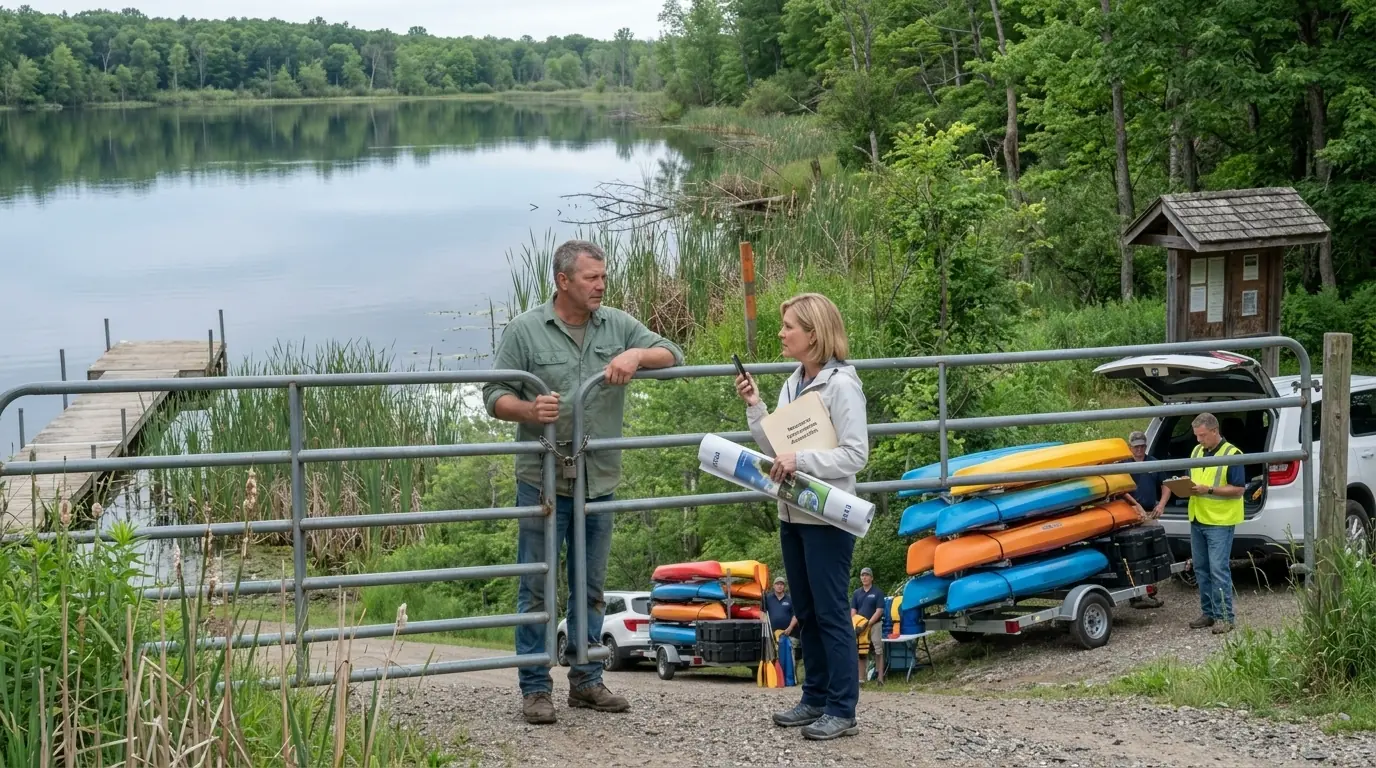
"Turn that trailer around."
The metal latch on my gate clicked shut hard enough to make Cynthia Mallory stop halfway through unrolling a Westmere Shores banner. It was 6:20 on a Saturday morning in late June, and six bright kayaks were strapped to a trailer behind her white sport utility vehicle.
Portable dock sections sat stacked beside the road. Two maintenance workers were unloading paddles while morning mist still hovered above my pond.
Cynthia stared at me across the gate. "Excuse me?"
"Nobody from Westmere launches anything into this pond today."
Her expression shifted from surprise to the polished little smile she used whenever she thought someone was confused about who had authority. "Look, this is a community recreation event."
"Not on my water."
She glanced toward the pond behind me. Seven acres of spring-fed water lay quiet beneath the early light, edged with reeds, cattails, fallen branches, and the kind of shoreline Westmere residents like to call messy. A faint smell of wet mud and cool vegetation drifted through the gate. Somewhere near the north bank, water ticked softly through an old culvert.
Cynthia folded her arms. "You cannot privatize nature because your deed happens to touch the shoreline."
"My deed does more than touch it."
She lifted her phone. "Then I will call our attorney."
I looked past her toward a small orange marker standing between the reeds about 40 ft down shore. "Call whoever you want. Just do it before somebody puts a boat in that water."
She followed my eyes, but saw nothing important. That was Cynthia's problem from the beginning: she only noticed things once somebody attached a price tag to them.
My name is Luke Barrett. I am 48 years old, and I own 31 acres bordering Westmere Shores in northern Michigan. I have spent most of my working life restoring ponds, stabilizing shorelines, improving fish habitat, and fixing water systems people damaged because they thought shallow meant useless.
The pond came with the property 13 years earlier. The previous owner called it Sturgeon Pond, though he never explained the name beyond saying his grandfather had used it first.
It was not a manicured subdivision lake. There was no fountain, no concrete seawall, no trimmed grass running to the water. Cold springs entered along the western edge. Reeds crowded the shallows. A gravel shelf stretched beneath clear water near the eastern bank, and during high water months, an old culvert connected the northern end to a seasonal tributary beyond the trees.
Most people saw mud, weeds, and mosquitoes. I saw a healthy system.
Seven years earlier, three state fisheries biologists had spent an entire morning standing knee-deep exactly where Cynthia now wanted to install her portable dock. They measured water temperature, photographed the gravel shelf, marked shoreline reference points, and left one orange survey marker near the reeds. I never removed it.
Cynthia had walked past that marker at least five times during our arguments about access, and never once asked what it meant. She thought the pond mattered because Westmere's newest homes had expensive views of it. She was about to learn the water had a history that started long before her marketing brochures did.
The first time Cynthia ever asked about the pond, she did not ask who owned it, where the water came from, or why the north end stayed 10° cooler than the shallows near the road. She asked whether I would let Westmere trim the reeds so buyers could get a better view. That told me almost everything I needed to know.
I had spent 13 years learning that pond season by season. In April, snowmelt pushed cold water through the north culvert and opened the seasonal connection to the tributary beyond my tree line. By June, the western springs kept the deeper pockets cool while the shallow eastern shelf warmed under the sun. In October, fallen maple leaves gathered along the edges and sank slowly beneath the surface.
None of it looked organized, but every piece had a job. The reeds broke wind. The cattails held shoreline soil. Submerged logs gave small fish cover. The gravel shelf stayed surprisingly clean because groundwater moved through it from below.
When I first bought the property, I almost made the same mistake Cynthia did. I saw overgrown banks and assumed I should clean them up. Then I spent a season watching the water. That cured me fast. Healthy habitat rarely looks like a golf course.
The orange fisheries marker near the east bank had faded over seven Michigan winters, but I kept the grass clear around it. About 30 ft beyond it, the gravel shelf ran beneath 2 to 3 ft of water depending on the season. You could see the stones clearly on calm mornings, pale gray and brown beneath the surface.
The old north culvert looked even less impressive: corrugated steel, dark with age, half framed by alder roots. Most of the year it carried only a trickle. During spring high water, it connected the pond to the tributary long enough for the system to behave very differently.
I learned that 7 years earlier when the state fisheries team came out. They arrived in a pickup before sunrise wearing chest waders and carrying temperature probes, measuring boards, notebooks, and orange marker stakes. They spent hours checking depth, substrate, flow, and the seasonal connection.
One biologist stood over the gravel shelf so long I finally asked what she was seeing. She smiled and said, "More than most people would."
That sentence stuck with me. I did not press her. I was there to help move equipment and provide access, not turn the survey into conversation about every fish in the county. The final habitat file went into my property records and life moved on.
Westmere Shores expanded 2 years later. First came the new homes on the ridge, then the walking path along their side of the tree line. Then Cynthia started using phrases like "water lifestyle" and "natural amenity" in real estate advertisements.
From my dock, I could sometimes hear agents telling buyers that Westmere offered beautiful pond views. Views were true. Access was not.
One afternoon Cynthia met me near the property fence holding a glossy sales brochure. My pond was on the cover behind a row of new houses.
"You used my water in your marketing," I said.
She smiled. "We used the view. There is a difference. Buyers love water."
"Then sell them the view."
Her smile tightened. "Look, nobody benefits from keeping a pond locked away."
I looked past her toward the reeds moving in the breeze. "Depends who you are trying to benefit."
She thought I meant myself. I did not. And the orange marker standing quietly near the shoreline was still waiting for someone at Westmere to ask the right question.
Three days after that conversation, Cynthia stopped asking politely.
I came home from a shoreline stabilization job around 4:00 in the afternoon and found a white Westmere golf cart parked near my eastern fence. Cynthia stood beside it with a rolled site plan under one arm and two members of the homeowners association board behind her.
The summer air smelled like warm pine needles and lake water. Somewhere in the reeds, frogs clicked back and forth.
She waited until I reached the fence, then unrolled the plan across the hood of the cart. "We are proposing a reasonable recreational easement," she said.
A blue line ran from Westmere's walking path through a narrow strip of my property and ended at the eastern shoreline, almost directly above the gravel shelf. The drawing showed a small dock, a launch lane, trimmed vegetation, and a gravel footpath.
"You are proposing it," I said. "That does not make it reasonable."
She tapped the dock symbol with one manicured finger. "Residents would have controlled access. Kayaks only. Limited fishing. No motors. It would improve property values without disturbing anything important."
I looked at the blue line again. "Who decided nothing important is there?"
Cynthia smiled. "Look, it is shallow water and reeds."
One of the board members nodded like that settled the science.
I rolled the plan back toward her. "No."
Her expression changed. "You have not even reviewed the terms."