After sixteen hours in the hospital, I stopped by my fiancée’s apartment with dinner in my hand and a stupid little hope in my chest.
That was the part I hated remembering most.
Not the man at the door.
Not the look on her face.
Not even the ring on her finger catching the hallway light while he stood barefoot behind her.
It was the hope.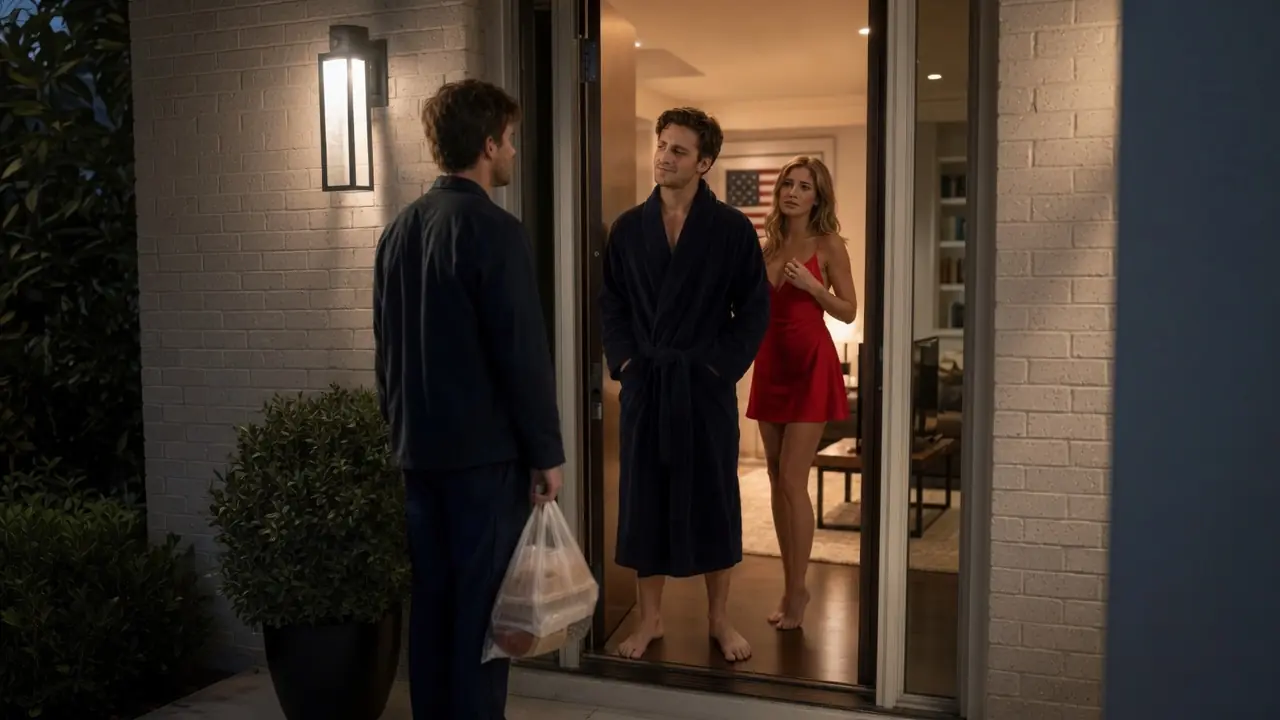
The ordinary, tired, loyal hope of a man who had spent all day holding other people’s lives together and wanted one quiet hour with the woman he planned to marry.
My name is Marcus Reed. At the time, I was thirty-four years old, an emergency room physician at Bellhaven Medical Center in a cold little city called Ashford Mills. It was the kind of place where the river split downtown in two, where old brick factories had been turned into apartments, and where everyone complained about winter as if winter had personally betrayed them.
That night, my shift had started before sunrise.
By the time it ended, my hands smelled like sanitizer, my back ached from leaning over stretchers, and my brain felt like it had been scraped hollow. I had treated a construction worker with a crushed ankle, a college kid who fainted after mixing energy drinks and panic, a grandmother who kept apologizing for needing help, and a man whose heart stopped twice before we got him stable.
When I finally stepped outside, the air hit my face cold and clean.
I should have gone home.
I knew that.
I should have driven to my apartment, eaten toast over the sink, and fallen asleep with my shoes still on. Instead, I turned left at the hospital exit and drove toward Laurel Street, where my fiancée lived above a bookstore that smelled like dust, coffee, and old paper.
Her name was Celia Warren.
She was thirty-one, a corporate attorney, sharp enough to make powerful people nervous and charming enough to make them thank her afterward. She remembered waiters’ names. She remembered birthdays. She remembered the exact way I liked my coffee, even though she herself drank tea and claimed coffee tasted like burnt ambition.
I stopped at a small Italian place called Nona Bell’s because Celia loved their roasted garlic pasta.
She said it tasted like a rainy Sunday in somebody else’s childhood.
I bought two orders, a salad neither of us would really want, a slice of orange olive-oil cake, and a bottle of sparkling water because she always said she did not drink soda and then stole mine when she thought I was not looking.
I remember smiling when the girl at the register tied the paper bag handles in a neat little knot.
That smile embarrasses me now.
Not because love made me foolish.
Because trust made me unprepared.
Celia and I had been engaged for five months. I proposed in her kitchen on a Tuesday night while she was wearing sweatpants and reading a contract aloud to me as if I understood any of it. She had burned grilled cheese in a cast-iron pan and insisted the smoke alarm was being dramatic.
I pulled out the ring while she was waving a dish towel beneath the ceiling.
She cried before I finished the sentence.
“Yes,” she said, laughing and crying at the same time. “Yes, Marcus, obviously yes.”
For five months, I believed obviously meant forever.
That night, I drove to her building through freezing rain with the food bag buckled into the passenger seat. My phone sat in the cup holder, silent. Celia had not texted all evening, but that was not strange. She had a major filing due and had warned me she might disappear into work.
I wanted to surprise her.
That was all.
Nothing dramatic.
Nothing suspicious.
Just dinner, warmth, maybe an hour on her couch with my head in her lap while she pretended not to read emails over my shoulder.
I parked behind the building because the front spaces were full. The rain had softened into mist, and the alley smelled like wet brick and old leaves. A small American flag hung from the balcony across the street, moving weakly under a porch light.
I remember thinking about our wedding invitations.
The venue.
The song she wanted for the first dance.
The way my mother had cried when Celia asked if she would help choose flowers.
I climbed the back stairs slowly, holding the food in one hand and reaching into my coat pocket for my key with the other.
Before I could unlock the door, it opened from the inside.
A man stood there barefoot.
He was about my age, maybe a little older, with dark blond hair, a white T-shirt, and the calm expression of someone who had not expected to be interrupted but did not feel guilty enough to panic. Behind him, warm light spilled from Celia’s living room.
I saw two wineglasses on the coffee table.
One of her cardigans was thrown over the arm of the couch.
Soft music was playing.
Not loud.
Not romantic enough to accuse.
Just enough to make the room feel occupied by people who had not been working.
The man looked at me, then at the paper bag in my hand.
“Do you want me to tell her you stopped by?” he asked.
He said it politely.
That made it worse.
Not defensive.
Not startled.
Polite.
As if I were a neighbor delivering mail.
For one second, my mind tried to save me.
Maybe he was a cousin.
Maybe he was a client.
Maybe he was someone from the building.
But clients do not answer the door barefoot.
Cousins do not look so comfortable in another man’s future.
And strangers do not ask if they should pass along your presence to the woman wearing your ring.
Then Celia appeared behind him.
She was in black leggings and an oversized cream sweater I had bought her on a weekend trip to Harbor Point. Her hair was down, loose around her shoulders. Her engagement ring flashed on her left hand when she reached for the doorframe.
Her eyes found mine.
Then the bag.
Then his bare feet.
“Marcus,” she whispered. “Please. It’s not what you think.”
I looked at her ring.
Then at him.
Then at the two wineglasses.
There are moments when asking questions only gives someone time to become creative.
I had spent sixteen hours reading bodies.
Pain, shock, fear, lies, grief.
People can make their mouths say almost anything, but their bodies usually speak first.
Celia’s body had already spoken.
She stood behind him.
Not beside me.
That was enough.
I held out the food bag.
The man did not take it.
Celia took one step forward.
“Marcus, wait.”
I set the bag on the hallway floor.
“Dinner,” I said.
My voice sounded so calm that I did not recognize it.
Then I turned and walked down the stairs.
Behind me, I heard Celia say my name. I heard the man say hers, quieter, almost warning. Her footsteps stopped.
Mine did not.
I walked into the mist, unlocked my car, got in, and sat there with both hands on the steering wheel.
For several minutes, I did not start the engine.
My hospital badge was still clipped to my jacket. My own face looked up from the plastic card, tired and official. Marcus Reed, MD. A man trusted to make decisions under pressure. A man trusted with trauma, overdose, chest pain, blood loss, and parents begging for miracles.
A man who had no idea what to do with a paper bag left outside his fiancée’s door.
My phone rang before I left the parking lot.
Celia.
I watched her name glow until the screen went dark.
Then it rang again.
And again.
By the fourth call, I turned the phone off.
The drive home should have taken twenty minutes.
I remember only pieces.
A red light reflecting on wet pavement.
A woman walking a dog under a yellow umbrella.
The smell of garlic pasta still trapped in my car.
My own breath sounding too loud.
At home, I sat in my kitchen without turning on the lights. On the table was a stack of wedding envelopes Celia had brought over the week before. She had insisted we address them by hand because printed labels looked cold.
Her handwriting curved across every envelope.
Aunt Denise.
Calvin and Mara Brooks.
Dr. Elaine Reed.
My mother’s envelope had a tiny heart after the zip code.
I stared at it until the lines blurred.
At 2:09 a.m., I turned my phone back on.
Twenty-three missed calls.
Nine voicemails.
Sixteen texts.
I did not open them at first.
Then I saw one from Celia’s best friend, Morgan.
Please call Celia. She says you misunderstood something and she is falling apart.
That told me Celia had already begun building a version of the night.
People do that when caught.
They do not first ask what they broke.
They ask who already knows.
I opened Celia’s texts.
Marcus please answer.
You walked away before I could explain.
He is not what you think.
Nothing happened.
Please don’t throw us away over a misunderstanding.
I stopped at nothing happened.
Those words should come with a warning label.
They almost never mean nothing happened.
They mean something happened that someone hopes cannot be proven.
The first voicemail was all tears.
“Marcus, please call me. His name is Evan. He’s an old friend from law school. He came over because he’s been dealing with something really bad and he needed someone to talk to. I know what it looked like, but nothing happened. Please, please don’t do this.”
I deleted it.
The second voicemail sounded calmer.
Too calm.
The third had anger in it.
The fourth began with, “You owe me a conversation.”
That one I saved.
Not because I wanted to hear it again.
Because some part of me recognized future evidence when it arrived wearing emotion.
I did not sleep.
At 5:30, I showered, shaved, put on clean clothes, and went back to the hospital because pain made more sense there.
Blood pressure had numbers.
Wounds had edges.
Sepsis had protocols.
Betrayal had nothing but echoes.
My colleague, Dr. Lena Park, found me in the staff lounge staring at a banana I had no memory of buying. Lena was an orthopedic surgeon with the emotional softness of a locked toolbox and the loyalty of a guard dog.
She looked at my face once and said, “Who did what?”
I almost laughed.
“No one died.”
“That’s not what I asked.”
I should have lied.
I usually did.
Instead, I told her enough.
The shift.
The dinner.
The door.
The barefoot man.
Celia behind him.
Lena listened without interrupting, which was how I knew she was taking it seriously.
When I finished, she leaned back.
“Did you ask who he was?”
“No.”
“Good.”
I looked at her.
She shrugged.
“People think answers heal things. Sometimes answers just give liars more furniture to move around.”
That sentence stayed with me all day.
So did Celia’s face.
The shift was brutal in the normal way. A car accident on the interstate. A toddler with a high fever. A man with a fishing hook in his thumb who kept apologizing to the hook like it was the injured party. An elderly woman who held my hand and asked if she was going to die.
I knew what to say to everyone.
Except myself.
At 7:15 p.m., Celia came to the hospital.