The elevator doors opened on the twenty-seventh floor, and my wife was in another man’s arms.
Not just any man.
Her boss.
His hand was at the back of her neck, her fingers were twisted in his tie, and for one stupid second, my brain tried to turn the scene into something else. A fall. A panic attack. A strange emergency where two adults looked guilty because I had arrived at the wrong angle.
Then Dana saw me.
Her face did not show fear first.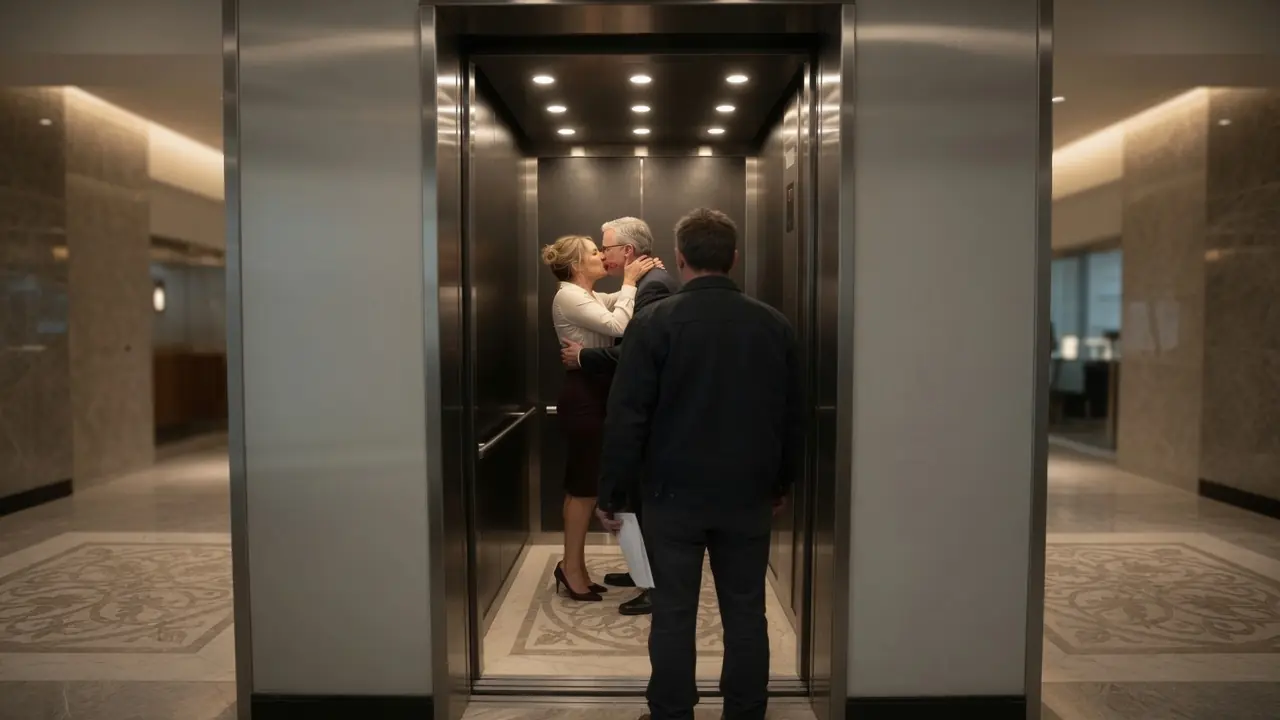
It showed irritation.
That is what I remember most clearly, even now.
Not the elevator. Not the polished brass doors. Not the ridiculous silence after the little chime announced the floor. Her irritation, sharp and quick, as if I had interrupted a meeting instead of finding my wife pressed against the man who signed her paychecks.
My name is Colin Whitaker.
I was forty-four years old, a husband of fifteen years, a father of one, and the owner of Whitaker Lift & Control, a small elevator maintenance company in a fictional city called Lakebridge. My father started the business with one van, two toolboxes, and the belief that the scariest machine in any building is the one people trust without thinking about it.
He used to say, “Nobody notices an elevator until it stops doing its job.”
That turned out to be true of marriages too.
Dana and I met before either of us had anything worth bragging about. She was twenty-four, working the front desk at a dental office while studying communications at night. I was twenty-nine, crawling through elevator shafts, replacing relays, eating gas-station sandwiches, and trying to keep my father’s company alive after his second heart attack.
She loved my hands back then.
She used to take them in hers and run her thumb over the cuts, burns, and grease stains like they were proof of something honorable.
“You build real things,” she would say.
I believed her.
For years, I believed she meant it.
We built a life in a quiet neighborhood called Briar Hollow, twenty minutes outside downtown Lakebridge. A three-bedroom house with a maple tree out front, a detached garage, a kitchen we renovated ourselves, and a daughter named Claire who arrived after three years of trying and made us both cry harder than either of us expected.
Claire was twelve when everything happened.
Old enough to notice silences.
Too young to be responsible for them.
Dana’s career changed faster than mine. She was smart, polished, beautiful in a clean, camera-ready way, with dark blond hair, blue eyes, and a voice that made people trust a press release even when it was saying almost nothing. She moved from office work to branding, from branding to corporate communications, and eventually became director of public relations for Arden Vale Holdings.
Arden Vale owned office towers, hotels, luxury apartments, and half the skyline of Lakebridge.
The company’s headquarters sat inside Arden Crest Tower, a forty-two-story glass building downtown with a rooftop restaurant, private security, underground parking, and elevators so smooth most passengers forgot they were moving. My company did not maintain those elevators. Not at first.
Arden Vale used a national contractor with shiny trucks and terrible response times.
Dana complained about them often.
“Preston hates them,” she would say.
Preston.
Preston Vale.
The founder’s son.
The CEO.
Dana’s boss.
He was fifty-two, tall, silver-haired, and expensive-looking in the way certain men become when they have never wondered whether a bill would clear. He wore dark suits, narrow ties, and glasses he did not need except to look thoughtful in photographs. His smile was the kind that made donors write checks and employees forgive insults.
I met him three times before I caught him with my wife.
The first was at a company holiday party.
He shook my hand, looked at my shirt, then at my watch, then at Dana with a smile that made my stomach tighten.
“So you’re the elevator man,” he said.
Not elevator contractor.
Not business owner.
Elevator man.
Dana laughed too quickly.
“He owns the company,” she said.
Preston smiled wider.
“Of course. That’s what I meant.”
No, it wasn’t.
Men like Preston always mean exactly what they accidentally reveal.
The second time I met him was at a charity luncheon for the Lakebridge Children’s Fund. Dana had helped organize it. I went because she asked, though I hated those rooms: white tablecloths, silent auctions, men pretending generosity was not a networking tool.
Preston gave a speech about community responsibility.
Afterward, he put his hand lightly at Dana’s lower back while introducing her to a councilwoman.
It stayed there too long.
I saw it.
Dana saw me see it.
On the drive home, I mentioned it.
She stared out the window and said, “Please don’t make this weird.”
That sentence became a little door in my mind.
I closed it because I wanted peace.
The third time was at Arden Crest Tower, two months before the elevator opened.
A minor power surge had trapped three attorneys between floors during a storm, and the national elevator contractor took forty-seven minutes to arrive. Preston was furious enough to let Dana call me. My team got there in twenty-two.
We reset the controller, inspected the brake circuit, and had the elevator cleared before the national crew parked.
Preston watched from the lobby, arms crossed.
When it was over, he said, “Maybe we should have hired the local guy after all.”
Dana smiled at me then.
Not proudly.
Nervously.
I should have understood that too.
Two weeks later, Arden Vale requested a maintenance proposal from my company.
It would have been the biggest contract Whitaker Lift & Control had ever landed. Arden Crest Tower had twelve passenger elevators, four freight elevators, and two private executive lifts that ran from the underground garage to the top three floors. A contract like that could double our yearly revenue.
I was excited.
Dana was not.
“That building is complicated,” she said over dinner.
“So are most buildings worth working in.”
“I just don’t want business and marriage tangled up.”
I laughed because I thought she meant stress.
“Dana, we have been tangled since 2009.”
She did not smile.
“I am serious.”
“So am I.”
She pushed salad around her plate.
“I work there. If something goes wrong, it reflects on me.”
“Something already went wrong. That’s why they called me.”
Her fork stopped.
Then she said, “Preston does not like feeling dependent.”
That sentence sat between us longer than it should have.
I should have asked why she cared so much how Preston felt.
Instead, I said, “No CEO does.”
Life gives you chances to ask the right question.
Most heartbreak begins with the questions you do not ask because you are trying to be fair.
The weeks before discovery were full of small changes.
Dana started coming home later. Not always dramatically late. Just late enough. Twenty minutes. Forty. One hour. Always with a reason. Crisis meeting. Client call. Investor deck. Preston needed language for a statement. Preston wanted her in the room for strategy.
Preston needed.
Preston wanted.
Preston asked.
The man became a third person in our kitchen without ever sitting down.
Claire noticed first, though she did not know what she noticed.
“Mom’s always tired now,” she said one night while helping me load the dishwasher.
“Work is busy.”
“Is work always Preston?”
I looked at her.
She shrugged, placing a cereal bowl on the bottom rack.
“She says his name a lot.”
Kids do not need evidence.
They feel weather.
That Thursday started with Claire forgetting her science fair permission form.
Not dramatic.
Not meaningful.
Just a school paper Dana had signed and left in her leather work bag by mistake.
Claire called me from the school office at 10:18 in the morning, whispering as if she had committed a crime.
“Dad, Mom has the form.”
“What form?”
“The science fair bus thing. It’s due today.”
I closed my eyes.
“Can you ask for one more day?”
“No. Mrs. Renner said the office needs it before lunch, or I can’t go.”
I looked at the clock in my shop office.
I had a maintenance call across town at noon, but Arden Crest was on the way. Dana had an investor communications meeting that morning, according to the calendar she still shared with me out of habit, or arrogance, or laziness.
“I’ll get it from Mom,” I said. “Don’t worry.”
“Thank you.”
Her voice softened.
“Dad?”
“Yeah?”
“Is Mom mad at you?”
That question landed harder than it should have.
“No, sweetheart.”
“Okay.”
But she did not sound convinced.
I drove downtown in my work truck, wearing a navy jacket with the Whitaker Lift & Control patch over the chest. My hands smelled faintly of machine oil because I had been rebuilding an old door operator that morning. I remember rubbing them on a rag before entering Arden Crest because I did not want Dana to feel embarrassed.
That is how far gone I was.
Standing outside the building where my wife was betraying me, worried that my hands might shame her.
The lobby of Arden Crest Tower looked like money trying to become architecture. White stone floors, glass walls, a reception desk curved like a yacht, and two security guards wearing earpieces. A sculpture made of bronze ribbons rose three stories in the atrium, twisting upward like someone had frozen a very expensive mistake.
The front desk guard recognized me from the storm repair.
“Mr. Whitaker,” he said. “You here for Facilities?”
“No. Personal errand. Need to drop something with Dana Whitaker on twenty-seven.”
He checked his tablet.
“She’s in executive conference.”
“I can wait.”
He hesitated.
Then looked down.
“Actually, her badge is showing in the executive lift bank.”
I frowned.
“What does that mean?”
He turned the screen slightly without meaning to.
Dana Whitaker — Exec Lift 2 — In Transit.
Preston Vale — Exec Lift 2 — In Transit.
The executive lifts served only garage level, twenty-seven, thirty-nine, forty, and forty-two. They required keycard access. They were also slow compared to the main elevators because they were designed for privacy, not efficiency.
Something moved in my stomach.
“Is there a restroom down that hall?” I asked.
He pointed.
“Past the marble wall.”
I walked that way, then turned left before the restroom and entered the side corridor that led toward the executive elevator lobby.
I did not plan it.
Not fully.
But my body knew what my mind was still too polite to admit.
The corridor was quieter than the main lobby. No tourists. No interns. No delivery carts. Just gray carpet, soft lighting, and two polished brass elevator doors with a small screen above each one.
Executive Lift 2 was climbing.
Twenty-one.
Twenty-two.
Twenty-three.
I pressed the call button for Executive Lift 1 with the temporary contractor access card Facilities had issued me during the storm repair. I had never returned it. Not intentionally. It was in my wallet with old receipts and the loyalty card for a sandwich shop I did not even like.
The doors opened.
I stepped in.
Instead of pressing twenty-seven, I used the service override and selected the same destination as Lift 2.
That is the thing about elevators most people do not know.
They feel private because the doors close.
But a closed box still belongs to the building.
And the building remembers more than people think.
My elevator reached twenty-seven first.
The doors opened into the private executive lobby outside Arden Vale’s boardrooms. No receptionist. No foot traffic. Just a wide hallway, frosted glass, and the distant sound of voices from a conference room.
I stepped out.
The screen above Lift 2 showed twenty-six.
Then twenty-seven.
The elevator chimed.
The doors opened.
And there they were.
Dana and Preston.
He had her against the back wall of the elevator, one hand at her waist, the other in her hair. Her blouse was half untucked from her skirt. His tie was loose. Her lipstick was on his mouth.
The world did not explode.
It narrowed.
Everything became painfully detailed.
The brass rail behind them.
The soft amber light inside the elevator.
The faint smell of Preston’s cologne.
Dana’s wedding ring catching light as her fingers released his tie.
Preston stepped back first.
“Colin.”
He said my name like a man greeting an unexpected subcontractor.
Dana straightened her blouse.
Her face flushed, but not with shame.
With anger.
“What are you doing here?”
I looked at her.
I had imagined this moment before, the way betrayed people imagine betrayal long before proof arrives. In my imagination, I yelled. I cursed. I threw a punch. I said something sharp enough to cut them both open.
In reality, I held up Claire’s unsigned permission form.
“Our daughter needed this.”
Dana’s face changed then.
Just for a second.
Not guilt over the affair.
Guilt over Claire.
That was somehow worse.
Preston cleared his throat.
“This is not the place.”
I turned toward him slowly.
“Then where is the right place to find my wife with her boss?”
His jaw tightened.
Dana stepped out of the elevator.
“Colin, don’t make a scene.”
I looked at the empty hallway.
“There is no scene. Just the truth arriving with bad timing.”
Preston stepped out too, fixing his tie.
“We should all calm down.”
I laughed once.
It sounded strange.
Not human.
“Calm down?”
Dana lowered her voice.
“Please. People are in the boardroom.”
“Good,” I said. “Maybe they should meet the real executive team.”
Her eyes widened.
“Don’t.”
That word told me everything.
She was not worried about our marriage.
Not first.
She was worried about Preston’s room.
His company.
His image.
His investors behind the frosted glass.
Preston moved closer.
“You need to leave the building.”
I looked down at the Arden Vale logo beneath his polished shoes.
“I was invited into this building when your elevators failed.”
“That does not give you the right to trespass in a private executive area.”
Dana whispered, “Preston, stop.”
I looked at her.
So she did understand danger.
Only not mine.
The boardroom door opened.
A woman in a gray suit stepped out holding a tablet. Behind her, I saw people seated at a long table, some turning toward the hallway. Investors. Lawyers. Executives. The kind of audience Preston Vale would never choose for humiliation.
“Mr. Vale?” the woman asked.
Preston’s face rearranged itself instantly.
“Everything is fine, Maren.”
Maren looked at Dana.
Then at me.
Then at the elevator.
Nothing about her expression suggested she believed him.
I handed Dana the form.
She took it automatically.
“Sign it,” I said.
Her mouth opened.
Nothing came out.
“Sign the form for our daughter.”
Her hands shook as she took a pen from Maren, signed Claire’s permission slip against the wall, and handed it back to me.
The signature looked messy.
Good.
At least one thing that morning looked honest.
I folded the paper and placed it inside my jacket.
Then I turned toward the elevator.
Dana followed me two steps.
“Colin.”
I stopped but did not turn.
“I’ll call you,” she said.
“No,” I answered. “My lawyer will.”
Behind me, Preston exhaled sharply.
That was the first sound he made that resembled fear.
The elevator doors closed between us.
For twenty-seven floors, I stood alone in a brass box that still smelled faintly of my wife’s perfume and another man’s cologne.
By the time I reached the lobby, I understood one thing with total clarity.
I was not going to beg.
I drove the permission form to Claire’s school.
I parked badly, walked into the front office, and handed it to the secretary. She smiled kindly and said Claire would be excited. I nodded, stepped outside, made it to my truck, and then broke apart.
Not loudly.
Not dramatically.
Just sitting behind the wheel, both hands gripping it, forehead pressed against my knuckles, trying to breathe around a pain so clean and humiliating it felt surgical.
I had seen them.
My wife and her boss.
In an elevator.
A machine I understood better than either of them understood me.
The irony was so ugly I almost laughed.
Then I called my attorney.
Her name was Rebecca Sloan. She handled business contracts for my company and had once helped me collect $18,000 from a property manager who thought small contractors were easier to ignore than pay. She was sixty-one, sharp as a razor, and allergic to emotional waste.
“Rebecca,” I said when she answered.
“One second,” she replied. “I’m hearing something in your voice I don’t like. Are you hurt?”
“Yes.”
“Physically?”
“No.”
“Then talk.”
I told her.
Not everything.
Enough.
She was silent for a moment.
Then said, “Do not confront further. Do not move money. Do not threaten anyone. Do not send messages you don’t want read aloud in court. And Colin?”
“Yeah?”
“Do not underestimate the boss. Men with money panic through other people.”
I did not understand that sentence fully until the next morning.
Dana did not come home that night.
She texted me at 8:43.
I’m staying at the Harbor West Hotel. We need space.
We.
That word enraged me more than the hotel.
I did not reply.
Claire asked where her mother was.
I told her Mom had a work emergency and would call tomorrow.
Claire looked at me for a long time.
“Is it because of Preston?”
I stood in the kitchen with a glass of water in my hand and felt something inside me cave in.
“What do you mean?”
She shrugged, but tears had already gathered in her eyes.
“I saw messages once. On Mom’s tablet. He called her beautiful.”
I put the glass down.
“When?”
“A month ago.”
“Why didn’t you tell me?”
Her mouth trembled.
“Because I thought maybe I was wrong. And if I told you and I was wrong, I would hurt everybody.”
I crossed the kitchen and pulled my daughter into my arms.
She held herself stiff for one second.
Then she collapsed against me.
Children should not have to carry adult secrets because adults are too cowardly to hide them better.
That was the first thing Preston and Dana had stolen from Claire.
The divorce filing began three days later.
Dana was shocked.
That sounds impossible, but it was true. She admitted the affair in one careful conversation at our dining table, but she seemed to believe confession would become a doorway to negotiation. She cried, apologized, blamed loneliness, blamed my work hours, blamed the way I never wanted to attend her company events, blamed the distance she said had grown between us after my father died.
I listened.
Then asked one question.
“Would you have confessed if I had not seen you?”
She looked down.
That answer ended any chance she thought she had.
“I want a divorce,” I said.
Her tears stopped quickly.
“You are angry.”
“Yes.”
“You are making a permanent decision from pain.”
“No,” I said. “You made permanent decisions from desire. I am only naming the result.”
She left the house that night with two suitcases.
Claire watched from the top of the stairs.
Dana saw her.
“Baby,” she whispered.
Claire stepped backward.
Not dramatically.
Just one step.
Dana’s face crumpled.
I did not comfort her.
Some consequences should be felt without cushioning.
A week later, Preston struck first.
Arden Vale canceled our pending maintenance proposal.
That did not surprise me.
Then two other property managers postponed contracts, citing “concerns over professional discretion.” One forwarded me an anonymous email claiming I had entered a private executive floor without authorization, behaved aggressively, and threatened Arden Vale leadership after a “personal domestic dispute.”
That did surprise me.
Rebecca had warned me, but I still felt the insult like a slap.
Preston was not only sleeping with my wife.
He was trying to make me look unstable before I could make him look guilty.
The email went further. It implied that Whitaker Lift & Control had misused temporary access credentials and might not be trustworthy inside secure commercial buildings. For a small elevator company, that kind of rumor is poison. Buildings trust you with machines that carry people. If owners believe you misuse access, you are finished.
I forwarded everything to Rebecca.
She called me within three minutes.
“Did you threaten Preston Vale?”
“No.”
“Did you touch him?”
“No.”
“Did you record anything?”
“No.”
“Damn.”
That was not comforting.
Then I remembered the elevator.
Not the hallway.
Not the lobby.
The elevator.
I drove to the shop, pulled up the service notes from the storm repair, and searched the equipment logs. Arden Crest Tower’s executive elevators had been modernized eight years earlier. The national contractor installed new cab panels, new dispatch logic, and new access controls.
But the emergency monitoring system was older.
Much older.
My father had installed it twenty-one years before, back when Arden Crest belonged to a different developer. The system did not record video continuously. It captured brief snapshots and audio bursts only during irregular door holds, emergency stops, overloads, or unauthorized key overrides.
I had used a temporary service override.
Executive Lift 2 had been held between floors for four minutes before reaching twenty-seven.
That meant the elevator might have logged data.
Not in the shiny front-end system Preston’s IT people used.
In the old building safety archive.
The forgotten machine memory.
The place nobody noticed until something stopped doing its job.
I called the only person who could help me access it legally.
His name was Harold Finch, the retired building engineer who had worked Arden Crest before corporate management outsourced everything with a pulse. Harold was seventy, cranky, and loyal to my father, who once repaired his wife’s stairlift for free after her surgery.
We met at a diner called June’s Table at 6:30 the next morning.
Harold listened while cutting his pancakes into perfect squares.
Then he said, “You didn’t hear this from me.”
“I already don’t like where this is going.”
“The old archive is not controlled by Arden Vale executives. It feeds into the building safety server, which is technically under the tower ownership trust, not the tenant. Arden Vale leases the top floors. They don’t own the backbone.”
I sat back.
“Who owns the trust?”
He pointed his fork at me.
“You remember Meridian Brick?”
The name was familiar.
A development firm my father had done work for years ago.
“Sure.”
“They still own forty percent of the building systems trust. And their chairwoman is Anita Caldwell.”
I knew Anita.
Everyone in Lakebridge contracting knew Anita Caldwell. She was seventy-four, Black, brilliant, terrifying, and had built half the commercial district after banks told her women like her should stay in residential property. My father called her “the only developer in town who reads invoices before pretending not to understand them.”
Harold sipped his coffee.
“Anita hated Preston’s father. Hates Preston worse.”
“Why?”
“Because men like Preston confuse inheriting buildings with understanding them.”
That afternoon, I sat in Anita Caldwell’s office on the thirty-first floor of a different building across town.
She wore a red suit, silver earrings, and the expression of someone who had already decided whether I was wasting her time before I sat down.
“Your father was honest,” she said.
“Thank you.”
“That was not a compliment to you. It was context.”
I nodded.
“Yes, ma’am.”
She liked that.
Barely.
I told her what happened.
The elevator.
The affair.
The canceled proposal.
The smear emails.
The possible safety archive.
She listened without blinking.
When I finished, she pressed a button on her phone.
“Clara, get Paul from legal and send a preservation notice to Arden Crest systems trust. Full archive hold for Executive Lift 2, last Thursday, 9:45 to 11:00 a.m.”
Then she looked at me.
“If the data exists, it will be preserved. If it does not, we will know who deleted it.”
“Why help me?”
She leaned back.
“Because your father once rode an elevator with me during an inspection while three bankers stood in the lobby laughing because they thought I was the cleaning staff. He handed me his clipboard in front of them and said, ‘Ms. Caldwell owns the building you gentlemen are hoping to finance, so you may want to stop giggling before you become tenants somewhere else.’”
I had never heard that story.
Anita’s face softened by one degree.
“Men like your father make enemies. Good ones.”
Two days later, the archive came back.
There was no continuous video.
But there was enough.
A timestamped access log showing Dana and Preston entered Executive Lift 2 from the private garage level at 10:03. A door-hold alert at 10:05 because someone had pressed the close button and emergency stop in a repeated pattern, a trick used to pause older elevators briefly between floors. Three still images: Dana and Preston embracing; Preston reaching toward the panel; Dana laughing with her hand on his tie.
Then the audio burst.
Not everything.
Enough.
Preston’s voice: “Once Colin is out of the contract pool, we can push the national renewal through before Caldwell’s people notice.”
Dana’s voice: “He’ll be furious.”
Preston: “Your husband fixes elevators. He does not fight people like me.”
Dana laughed.
Not nervously.
Fondly.
That laugh did more damage than the kiss.
There is a special kind of grief in hearing the person you love agree with someone who underestimates you.
Rebecca listened to the audio twice.
Then smiled in a way that made me glad she was my attorney.
“This is no longer just divorce,” she said.
“What is it?”
“Tortious interference, defamation, possible procurement manipulation, and a CEO stupid enough to discuss contract steering while committing adultery in a monitored elevator.”
She paused.
“Colin, this is the best bad news I’ve heard all month.”
The next week moved fast.
Anita Caldwell’s legal team filed a preservation demand and notified the building systems trust that Arden Vale may have attempted to manipulate maintenance contracting. Rebecca sent letters to every property manager who received the anonymous smear email, attaching enough proof to make ignoring it legally dangerous.
Then came the board meeting.
Not a public one.
Not at first.
Arden Vale Holdings held an emergency investor meeting on the thirty-ninth floor of Arden Crest Tower. Preston arrived expecting to control the room. Dana arrived with him, according to the receptionist who later told Harold everything because Harold still knew every person in every mechanical room downtown.
I was invited by Anita Caldwell.
So was Rebecca.
So was Harold.
Preston’s face when I walked in was worth remembering.
He looked at me the way a man looks at a locked door that should not have opened.
Dana was seated near the wall in a gray dress, pale, eyes swollen, hands folded in her lap. For the first time, she looked afraid of more than embarrassment.
Preston stood.
“This is inappropriate.”
Anita Caldwell, sitting at the far end of the boardroom table, looked up from her folder.
“Mr. Vale, inappropriate was using my elevator system to hold private romantic meetings while discussing contract manipulation. This is documentation.”
The room went still.
Dana closed her eyes.
Preston’s attorney whispered something urgently.
Rebecca opened her laptop.
No drama.
No shouting.
Just records.
Access logs.
Smear emails.
Bid documents.
Audio transcript.
A procurement timeline showing Arden Vale intended to award a five-year elevator maintenance renewal to the national contractor at a higher price after excluding Whitaker Lift & Control through reputational damage.
One investor, a woman named Maren Cross, the same woman who had stepped out of the boardroom the day I caught them, asked Preston one question.
“Did you interfere with the bid process to protect a vendor relationship connected to personal misconduct?”
Preston said, “Absolutely not.”
Then Rebecca played the audio.
Your husband fixes elevators. He does not fight people like me.
Nobody moved.
In legal terms, it was not everything.
In human terms, it was more than enough.
Dana began crying silently.
Preston stared at the table as if it had betrayed him.
Within forty-eight hours, Preston Vale stepped down pending investigation. Within two weeks, Arden Vale’s board canceled the national elevator contract renewal and opened an independent bidding process under outside supervision. Whitaker Lift & Control did not automatically get the contract.
Anita insisted on that.
“Justice is not a gift basket,” she told me. “Submit the best bid.”
So I did.
And we won.
Not because I was cheated on.
Not because Preston was exposed.
Because my company was better, faster, cheaper, and honest.
That mattered to me.
The divorce was uglier than I wanted and cleaner than Dana deserved.
She tried apology first.
Then nostalgia.
Then blame again.
Then fear.
When she realized Preston would not leave his wife for her, would not protect her job, would not protect her reputation, and would not even answer her calls once the board opened its investigation, she came to our house one night in April and stood on the porch with rain in her hair.
Claire was asleep upstairs.
I opened the door but did not invite her in.
She looked past me toward the living room.
“Our home looks the same,” she whispered.
“No,” I said. “It doesn’t.”
She started crying.
“I was stupid.”
“Yes.”
“I was lonely.”
“Maybe.”
“I was manipulated.”
That one made me tired.
“You were flattered.”
She flinched.
That was better than tears.
“I loved the way he looked at me,” she admitted.
I said nothing.
“He made me feel important.”
“You were important.”
She looked at me then.
Really looked.
Maybe for the first time in years.
“I know,” she whispered. “That’s the worst part.”
No, I thought.
The worst part was Claire asking if her mother was mad at me because she had already seen messages no child should see.
The worst part was Dana laughing in an elevator while Preston called me too small to fight him.
The worst part was standing in the same machine my father taught me to understand and realizing my marriage had been failing between floors long before the doors opened.
But I did not say any of that.
Some truths do not need to be handed to the person who created them.
They already live there.
“We are done,” I said.
Dana nodded.
“I know.”
She left without asking to come inside.
That restraint was the kindest thing she had done in months.
A year later, Whitaker Lift & Control had twenty-one employees instead of nine.
We maintained Arden Crest Tower, three hotels, two hospitals, and a residential high-rise near Lakebridge Harbor. I hired a dispatcher, two apprentices, and a safety manager who scared my younger techs more than any inspection ever could.
Claire spent half the week with me and half with Dana.
It was not easy.
Nothing about divorce with a child is easy. People who say children are resilient often mean children are forced to adapt because adults broke something and still need to feel forgiven. Claire adapted. That did not mean she was untouched.
She went to therapy.
So did I.
Dana did too, eventually.
Preston disappeared from Lakebridge business circles for a while, then resurfaced at a private equity firm in another city with a new title and the same smile. Men like him rarely vanish. They rebrand.
I no longer cared.
Not much.
The strangest part happened on a Saturday in October.
Claire and I were downtown because she wanted new art markers from a little store near the river. On the way back to the parking garage, she asked if we could go inside Arden Crest Tower. I hesitated. She saw that and looked embarrassed.
“I just want to see the elevator.”
I knew which one.
We entered the lobby.
The security guard recognized me and nodded.
“Mr. Whitaker.”
Claire looked at me sideways.
“People say that differently now.”
I smiled faintly.
“They should have said it correctly before.”
We took the main elevator up to twenty-seven, not the executive one. The doors opened to the same private lobby where I had stood a year earlier with a permission slip in my hand and my life split open in front of me.
Claire stepped out.
Looked around.
Then turned to me.
“This is where?”
“Yes.”
She nodded slowly.
For a moment, I regretted bringing her.
Then she walked to the brass elevator doors, touched the edge of the frame, and said, “It’s smaller than I imagined.”
I almost laughed.
Most monsters are.
She looked at me.
“Do you hate Mom?”
“No.”
“Do you hate him?”
“I did.”
“Not now?”
I thought about Preston.
Dana.
The boardroom.
The audio.
The contract.
The divorce.
The nights Claire cried without making noise because she did not want to make me sadder.
“No,” I said. “Hate takes maintenance. I already have enough elevators.”
Claire stared at me.
Then laughed.
A real laugh.
The kind I had not heard in too long.
We rode down together.
Somewhere between floor twenty-seven and the lobby, she leaned against my side. I put one arm around her shoulders. The elevator hummed smoothly around us, cables moving, brakes ready, doors waiting for their command.
A machine doing its job.
A father doing his best.
A life descending from pain but not staying there.
When people ask how I found out my wife was cheating, I usually say, “Bad timing.”
That is easier.
Cleaner.
Funny enough to end the conversation.
But the real answer is more complicated.
I found out because my daughter forgot a permission slip. Because a security guard looked at a screen. Because I still had a temporary access card in my wallet. Because my father had installed an emergency archive twenty-one years earlier that everyone forgot existed. Because men like Preston believe small people stay small forever.
And because elevators, unlike people, keep records of where they have been.
My marriage ended on the twenty-seventh floor of Arden Crest Tower.
But my life did not.
That is the part I wish I had known while standing inside that brass box, breathing in my wife’s perfume and another man’s cologne, feeling like the walls had closed around me for good.
Elevators feel trapped only while they are between floors.
Eventually, the doors open.
And when they do, you decide whether to step out carrying shame that was never yours, or leave it behind with the people who earned it.
I stepped out.
I kept my company.
I kept my daughter’s trust as best I could.
I kept my father’s name clean.
And somewhere along the way, I learned that being underestimated by cruel people is not always a curse.
Sometimes it is a hiding place.
Sometimes it gives you time to gather proof.
Sometimes it lets a man who fixes elevators become the one person in the room who understands exactly how far everyone else is about to fall.