My name is Tonya. I was 32 years old when I drove 4 hours home from my aunt's house a day early, walked through my own front door, and heard wedding music coming from my backyard. My backyard. My string lights. My rose bushes.
And my best friend of 12 years in a white dress holding my boyfriend's hands. Neither of them heard me come in. I had maybe 10 seconds before anyone saw me standing in that kitchen doorway. 10 seconds of knowing something they didn't. That I was there.
That I had seen everything. That I was already thinking. Devon thought he knew exactly who I was. A steady woman. A safe woman.
A woman who would fall apart. He had no idea what I was about to find in that house. Let me tell you how I got here. The last day before spring break, I bought my kids chips. Not because the school had a budget for it.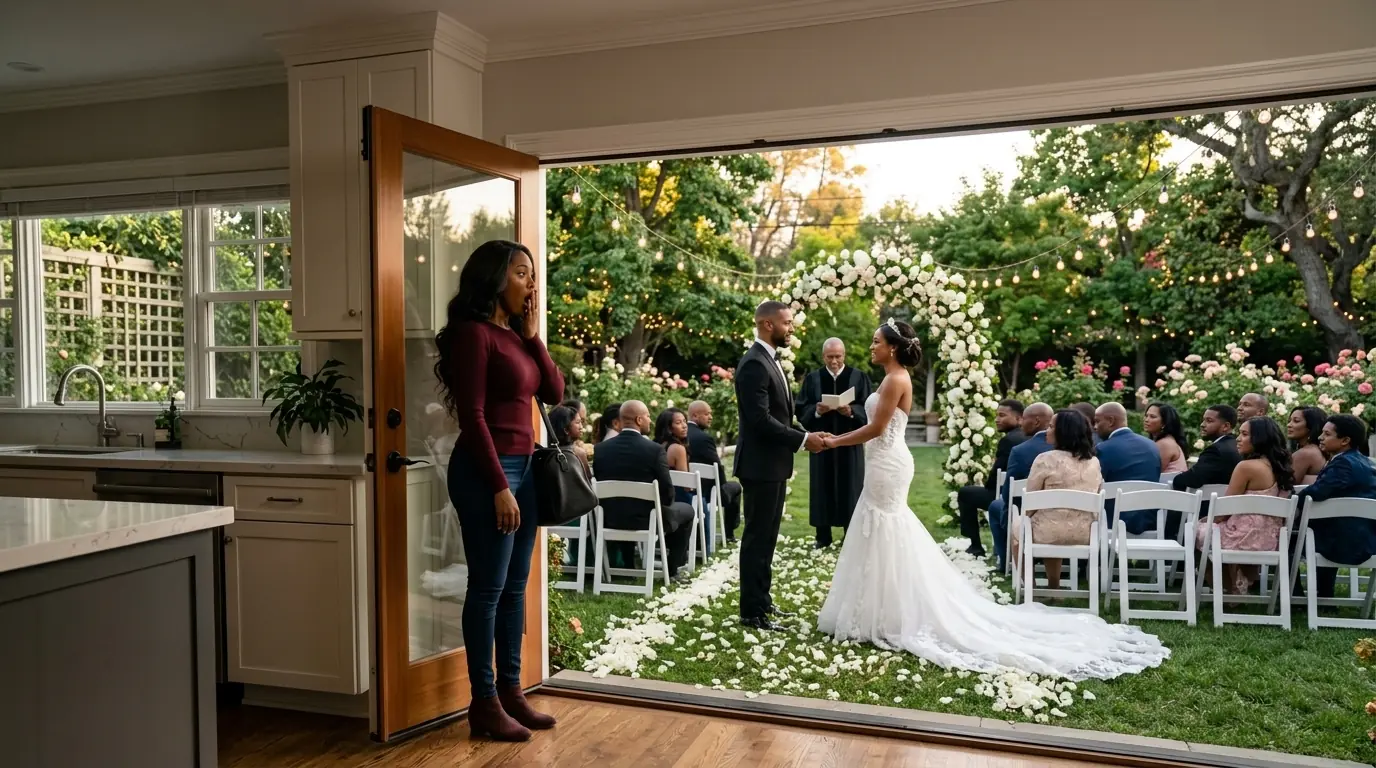
Not because anybody asked me to. I stopped at the gas station on Campbellton Road on my way in. Spent $11 on three bags of Flamin' Hot and watched 22 fifth graders act like I'd handed them the moon. That's the kind of teacher I was. That's the kind of woman I was, if I'm being honest with you.
The kind who fills the gaps before anyone notices they're there. By 2:30, the kids were gone and I was alone in my classroom, boxing up the reading sets, wiping the whiteboard down to nothing. I had a dying pothos on the windowsill that I kept forgetting to water. A stack of permission slips on my desk. Three of them signed in my own handwriting because those particular parents weren't going to sign them and I wasn't going to let their kids miss the science museum over it.
Little things. The kind of little things nobody counts or notices or says thank you for. I didn't mind. That's what I told myself. I didn't mind.
I called Devon from the parking lot, my tote bag over one shoulder and my grade book tucked under my arm. He picked up on the fourth ring. "Hey, baby." His voice had that warm, slightly distracted quality. The voice of a man who was doing something else but wanted credit for answering.
"You done?" "Just locked up. Heading home to finish packing." I shifted the bag on my shoulder. "You remember I'm leaving for Dorothy's in the morning?" "Of course I remember." He laughed a little. "Drive safe, okay? I'll miss you." I believed him.
I want you to know that. I believed every word of it. I swung by Rochelle's apartment on my way home. Rochelle Banks, my best friend of 12 years. The woman who called me when her car got towed and when her heart got broken and every complicated moment in between.
Her car wasn't in the lot. I knocked anyway, twice. Nothing. I texted her, "Heading to Dorothy's tomorrow morning. Call me when you surface." She didn't reply. I told myself she was probably out. Rochelle was always out, always somewhere, always moving, always in the center of whatever was happening. That was her way.
She took up space in the loud, bright way that men fell over themselves for. I'd watched it happen at every party, every cookout, every Sunday dinner we'd ever been to together. She'd walk in and the room would tilt toward her like sunflowers. I'd learned not to stand too close when I was feeling fragile. I filed her silence away as nothing and kept driving.
That night Devon made pasta. Candles on the table, real ones, not the fake flickering kind. He'd even put on music, something low and unhurried. And when I walked in, he looked up from the stove and smiled the particular smile he kept for moments when he wanted me soft. I stood in the doorway of my own kitchen and felt the specific warmth of being loved, or what I understood love to look like.
I remember the first night I ever spent in that house. No furniture, just an air mattress and my grandmother's old quilt wrapped around my shoulders. Lying on the floor of the empty living room thinking, I did this. Nobody gave me this. I built this.
The down payment had come from my grandmother's inheritance. Not much, but enough in the way that love converted into money always manages to be exactly enough. Devon set a bowl in front of me and sat down, and we talked the way couples do when everything seems fine. Easy, ordinary talk about nothing much. Then, almost as an aside, he mentioned that some of his friends might stop by the house over the weekend. "Just the guys," he said, twirling his fork. "You know how it is. Figured I'd have some people over since the house is mine for a few days." Mine for a few days. My house.
But I smiled and said, "Of course. Have fun." I almost brought up the $3,800 that night. Almost. It had been eight months since I'd handed it to him in cash. "A loan," he called it, a gap between paychecks, temporary. And it had simply never come back up. I'd been waiting for him to bring it up first, the way you wait for someone to return something they borrowed without making it awkward. I let it go again. I was good at letting things go.
After dinner, I finished packing, and somewhere in the folding and zipping, I thought about the white box. Six weeks ago, in the back of Devon's car, ribbon-tied, the kind of bright white that means something formal, the size of a garment box. I'd asked about it. He'd said it was a gift for his sister and moved the conversation along before I could get another look. I'd believed that, too.
I walked through her front door on Saturday afternoon and felt my shoulders drop 2 in without deciding to. That's what Aunt Dorothy did. She created conditions for rest without announcing she was doing it. She hugged me the way she always had, one firm arm around my back, her hand patting twice, no lingering. Dorothy, the woman who raised me after my mother died, wasn't sentimental about hugs.
She was sentimental about making sure you ate. Within 20 minutes I was at her kitchen table with a bowl of butter beans and a square of cornbread, and she was across from me asking practical questions. How were my kids doing? Had the school fixed the broken AC unit in the hallway? Was I sleeping enough?
Not once did she ask about Devon. Dorothy had a habit of leaving certain doors unopened, and I had learned to notice which ones she chose. I slept that night like I hadn't slept in weeks, deep and dreamless, the old quilt pulled up to my chin in Dorothy's guest room, the ceiling fan clicking softly overhead. Sunday was slow, the way Sundays at Dorothy's always were. Church in the morning, a long lunch, the afternoon dissolving into nothing in particular.
I sat on her back porch while she napped, watching the neighbor's cat pick its way across the fence, and felt, for the first time in longer than I could name, genuinely still. You know how it is when you've been tightly wound for so long that you've forgotten what it feels like to uncoil? That's what those two days were. I didn't reach for my phone much. I didn't solve anything.
I just let myself be Dorothy's girl for a little while, which was the one role in my life that didn't require me to hold anything up. It was nearly 3:00 in the morning when I heard her. Not loud. Dorothy didn't do loud. But the sound of her moving through the hallway with that particular careful step, the one that meant something was wrong, but she was trying not to make a fuss about it.
I was up before she reached my door. Her hand was pressed flat against her chest. Her face was composed in the specific way of a woman who is frightened and refuses to show it completely. "It's probably nothing." She said.
We were in the car in 4 minutes. The ER was quiet at that hour, the particular quiet of a hospital at 3:00 a.m., fluorescent and hushed. They took her back quickly, ran the test, and came out with the word that sits right in the middle of terrifying and manageable. Not a heart attack, but not nothing. Some irregular rhythms, possible inflammation.
The doctor wanted her back Monday morning for a stress test and an ultrasound, and he said it with the calm efficiency of a man who had delivered this exact sentence a thousand times, and knew that calm was the only useful thing he could offer. Dorothy sat in the hospital bed looking faintly annoyed about the whole situation. I sat in the chair beside her and held her hand and did not let my face show what my chest was doing. We were home by 6:30. She was asleep by 7:00.
I sat at her kitchen table in the early morning light and reorganized the plan in my head, the way I always reorganized plans, quietly, without ceremony. I couldn't leave her before the Monday appointment. I also couldn't stay through Tuesday the way I'd intended. I had things I needed to get back to, and she would rest better without someone hovering. The solution arranged itself simply.
I'd take her to the cardiologist Monday morning, make sure she was settled, then drive home Monday evening after the follow-up was complete. I'd be back home Monday night and return to school Tuesday as originally planned. I picked up my phone and texted Devon. "Coming home a day early. Don't worry about cleaning up." I set the phone down. I made coffee. I drank half of it standing at the sink looking out at Dorothy's yard. Six hours passed. When his reply finally came, it was three words.
"Okay, no worries." I read it twice. Not because I didn't understand it, because something about its flatness landed in a way I couldn't quite name. Like a note played slightly off-key. Not wrong enough to stop the song, just enough to make you notice.
Dorothy was sitting in her armchair by the window, a blanket over her lap, pretending to read her devotional. She was watching my face. I knew she was watching my face. She didn't say anything. With Dorothy, that silence was its own kind of commentary.
I set the phone face down on the table. "Come on," I said. "Let's get you back to bed." She let me help her up without arguing, which told me she was more tired than she'd admit. I settled her in, pulled the curtain, and closed the door softly behind me.
I stood in the hallway and told myself the strange feeling in my chest was just worry about Dorothy. Just that. Nothing else. I almost believed it. The drive back from Macon takes 4 hours on a good day.
Sunday afternoon, light traffic, windows down, I made it in 3 and 1/2. I didn't think about Devon much on the drive. That's the honest truth. I had Dorothy on my mind. The sound of her moving through that hallway at 3:00 in the morning.
Her hand pressed flat to her chest. The way she'd said, "It's probably nothing." Like saying it plainly enough might make it so. I ran through her follow-up logistics in my head, made a mental note to call her doctor's office first thing Monday, and somewhere around the 2-hour mark switched from the radio to silence, because silence helped me think. I had papers to grade.
14 reading responses for my third period group that I'd been putting off since Wednesday. I did the math in my head. 2 hours Sunday night, 1 hour Monday morning, done before first bell Tuesday. Manageable. That's what I was thinking about when I turned onto my street.
Cars. Both sides of the block, bumper to bumper. Sedans, SUVs, one white van I didn't recognize. I slowed down. My first thought was the Hendersons two doors down.
They threw big family gatherings in the spring. Loud and joyful. The kind that spilled out into the street and smelled like grilled meat from half a block away. I found a spot, pulled cut the engine, grabbed my overnight bag from the back seat, walked up my front path. The house was quiet from the front, curtains closed, porch light off.
Nothing unusual. I put my key in the lock and let myself in. The living room was undisturbed. Devon's jacket was on the coat rack, a detail I registered and filed without thinking about it. I set my keys on the entry table.
I walked down the hall toward the kitchen, rolling my bag behind me, already thinking about whether there was anything left to eat. Then I heard it. Music. Low and formal, coming from outside. The kind of instrumental that belongs in a church or a ceremony.
Strings and something slow beneath them. Floating through the kitchen window with the particular clarity of a late afternoon when the air is still. I stopped walking. I stood in the middle of my own kitchen and I listened. Then I pushed open the back door.
My string lights, every strand I'd spent two Saturdays on a ladder hanging, adjusting, re-hanging until they draped exactly right, glowed gold in wide arcs above the yard, even in the late afternoon brightness. My rose bushes in full pink bloom flanked a white fabric arch I had never seen in my life. 20 people sat in two neat rows of folding chairs, dressed up, quiet, some of them already damp-eyed the way people get at weddings. The whole yard was transformed into something careful and deliberate, the way you arrange something when you've planned it for a long time.
At the far end, holding Devon's hands, stood Rochelle. She was wearing a white gown with a cathedral train that pooled soft against my grass. The dress from the ribbon-tied box. I understood that in a single silent flash. The box he'd said was a gift for his sister, sitting in the back of his car 6 weeks ago while I didn't ask twice.
Minister Harold Banks, Rochelle's uncle, a man I'd sat three pews behind for 10 years, a man who had shaken my hand every third Sunday and asked after my students, stood at the arch with a card in both hands, reading in that practiced pulpit voice of his. He hadn't looked up. Nobody had. I stood in the doorway of my own kitchen and I watched. 10 seconds, maybe less.
It felt like a long time. Then a woman in the front row shifted in her chair to reach for her purse, and she turned, and she saw me standing in the doorway with my overnight bag on my shoulder, still in my driving clothes, and she made a sound. Not a scream, just a short, sharp, "Oh." Involuntary. The sound of someone who has just understood something terrible.
Every head turned. The music stopped mid-phrase. Devon saw me. The color left his face the way water leaves a glass, fast and complete. Rochelle turned.
Her mouth opened. She didn't make a sound. I looked at all of it. Every face. The guests who knew me and the ones who didn't.
Minister Harold, who was now staring at his card with the fixed attention of a man hoping the ground would take him. Devon, whose mouth was already moving, already beginning to form words. My jaw locked. I stepped back inside. One step.
I let the kitchen door fall closed in front of me, gently, without slamming it. I set my overnight bag on the counter with both hands, careful and deliberate. I stood at my own kitchen counter in the sudden quiet, and I breathed once. Then I picked up my phone. Patricia Reeves Cole, my older cousin and a paralegal at a family law firm in Atlanta, picked up on the second ring.
I said five words: "I need you right now." Then I gave Patricia the short version. "I came home early. There's a wedding in my backyard. Devon and Rochelle. About twenty people. Some kind of minister." I kept my voice level, flat the way a road is flat—not because there was nothing underneath it, but because what was underneath it was not going anywhere. "I need you to come."
Patricia did not gasp. She did not say, "What?" or "Are you serious?" or any of the things people say when they make the moment about themselves. She said, "I'm leaving in ten minutes. Don't touch anything. Don't sign anything. Don't let him talk to you alone without your phone recording."
"Okay."
"Tonya?"
"I'm okay."
She let that sit for exactly one second. "I know you are," she said. "I'll be there." I set the phone on the counter. I could still hear them out there. The low murmur of guests shuffling, the scrape of a chair, someone speaking in a hushed and urgent voice I didn't recognize.
The instrumental music didn't start back up. Whatever mood they'd been building out there in my yard with my lights and my rose bushes, I had walked through the middle of it and the mood was gone. The back door opened. Devon came in alone. Jacket off, tie loosened, and he was already talking before the door finished closing behind him.
That was the part I noticed. He did not pause. He did not let there be a moment of silence between us because silence would have required him to sit inside what he had done. Devon Cross had never been comfortable in a room he could not talk his way out of.
"Tonya, listen. I know what this looks like, and I need you to hear me out for one second because I have been trying to find the right time to tell you this for months. I know that is not an excuse. I am not saying it is an excuse. I am saying I love you, and that has not changed. What I feel for you has not changed. This just happened. It got to a point where I did not know how to stop it, and I know that is on me. I take full responsibility for that. But you and me—what we have, what we built together in this house—"
I raised one hand, and he stopped. "Get everyone out of my yard."
He blinked. His mouth was still open around the shape of the next word.
"Right now, Devon."
Something moved across his face. Not shame, not quite.
More like the specific recalibration of a man who has just realized that the script he prepared is not the script this conversation is going to follow. He looked at me for 1 more second, then he turned, went back outside, and I listened to him do it. It took 15 minutes. I know because I watched the clock on the microwave. I stood at the kitchen window with my arms folded, and I watched.
Not at Devon, but at the yard itself, at the people gathering their things in small clusters, the chairs being shuffled aside, the carefully dressed guests making their way toward the gate with the particular discomfort of people who have witnessed something they will be talking about for years. Rochelle stood near my rose bushes in that cathedral train dress, arguing quietly with a woman I didn't recognize. Her hands moved while she talked. She glanced toward the kitchen window once. I didn't move.
I let her see me standing there. A knock at the kitchen door, soft and deliberate. I opened it. Minister Harold Banks stood on my back step holding his Bible in both hands the way you hold something when you don't know what else to do with yourself. He was looking at me with the expression of a man who has already rehearsed the apology and found it insufficient before he even speaks it.
"Tonya, I—" He stopped and started again. "I owe you an apology. What happened here today, the way this was arranged... I should have asked more questions. I should have—"
"You knew whose house this was."
He went quiet. His mouth stayed open around a word that did not come.
"You've been to this house, Harold. You've sat at this table." I said it without heat, just fact. "You knew."
He opened his mouth again, closed it, nodded once—small and miserable—and left. I waited until I heard the gate latch behind the last of them, then I went outside.
The arch was still standing. The chairs sat in their two neat rows, half of them pushed crooked by the exit rush. Rochelle's bridal bouquet lay in the grass near the end of the aisle, white roses and something trailing in green, dropped there in the scramble of leaving. I walked the length of the yard slowly, past the arch, past the chairs. I stopped and picked up the bouquet, looked at it for a moment, the white petals still perfect, not a one of them knowing where they'd ended up.
I walked to the trash bin by the gate and dropped it in. Devon was waiting in the kitchen when I came back inside. He was sitting at my table like a man who has run out of places to stand. I looked at him. "How long?" He was quiet for a beat too long. I watched him calculate, watched his eyes move the small specific way they move when a person is deciding how much of the truth is safe to tell. "About a year." I nodded once. Not forgiveness, confirmation.
I picked up my phone and called Patricia. When she answered, I asked her one question. "How fast can you get here?" Patricia arrived 45 minutes after I called her back. I heard her car in the driveway before I heard her knock.
Two sharp raps, no nonsense. I opened the door and she walked in the way she always has, like a woman who already knows the layout of the problem and has been solving it since the highway. She had a document in her hand, printed, paper clipped, edges straight. She set it on the counter beside the coffee maker without a word and looked at Devon, who was still sitting at my kitchen table. He looked down at it.
I watched him read. You know what I noticed? His posture shifted the moment he recognized what it was. Not guilt, something more calculating than guilt. His shoulders settled back, his chin came up a fraction.
His sales-manager brain clicked on like a light.
"Okay." He set the paper down carefully. "Okay, I hear you. I do. But can we maybe sit with this tonight and talk in the morning? There is a lot happening right now, and I think we could all use a minute to—"
"My key."
Two words. That was all. He blinked, and the negotiation died in his mouth.
He sat there for a moment, looking between me and Patricia, and I watched something move through him. The last calculation of a man who has run out of leverage and is only now understanding what that means. He reached into his jacket pocket, set the key on the counter. It made a small, clean sound against the tile. Then he looked at me.
That particular look, I'd seen it before on men who'd done something they knew was wrong and were hoping the woman standing across from them would find it in herself to make it easier on them. That look that says, "Help me with this." That look that wants softness from the exact person it just shattered. I didn't blink. He picked up his jacket from the back of the chair.
He walked to the front door. He left with the clothes on his back and nothing else, and I listened to his car start and pull away, and then the street was quiet. Patricia was already in the utility drawer looking for a screwdriver. We installed the new deadbolt in 40 minutes flat, a $20 kit from the hardware store she'd stopped at on the way over, YouTube tutorial on my phone propped against the doorframe. She held the flashlight while I worked.
Neither of us talked much. There's something about doing something with your hands in the middle of a crisis that keeps you from falling into the crisis, and I think we both knew that. The drill was loud in the quiet house. The new lock was solid when I tested it, heavy in a way the old one never was. I remembered the first time I'd ever fixed anything in this house, a leaking kitchen faucet 2 weeks after I moved in.
My grandmother's old toolbox spread across the floor because I couldn't afford a plumber and wasn't about to ask anyone for help. I'd sat on that linoleum floor for an hour watching videos on my phone before I figured it out. The feeling when it stopped dripping was enormous, bigger than it had any right to be. That's what I felt when I turned that new deadbolt for the first time. Solid.
Mine. "I found something,"Patricia said. She said it the way she says everything, level, no drama, just information. "On the drive over, I ran his name through the firm's database, property records, lease filings, the usual pull. She clicked off the flashlight.
It's not a small thing, Tonya. I looked at her. "How not small?" "Kitchen table and a laptop not small." I put the kettle on.
She set her bag on the table and pulled out her laptop while I made the coffee. The automatic motions of a routine that had nothing to do with the night I was having, which was maybe the point. Measure the grounds, pour the water, keep moving. Patricia was quiet, the way she gets when she's letting something land at its own pace, not rushing it, trusting that I can handle what's coming as long as she gives me a breath before it arrives. I poured two cups.
I sat down across from her. She turned the laptop to face me. On the screen, a lease agreement. Two names at the top, Devon's and one I recognized immediately, in the way you recognize something you weren't expecting to see and can't unfeel once you have. And an address.
A full address, an apartment across town, a street I'd never been to, never had reason to go to, dated 14 months ago. I read the names twice, then I read the address, then the date. My hands went still on the table. 14 months. Devon and I had been together 4 years, which meant that 11 months after I let him put his closet in my closet, 11 months after I drove 40 minutes in the rain to sit with him in a hospital waiting room and hold his hand through the night, he was signing a lease with my best friend.
Talk me through it, I said. Patricia turned the laptop back toward herself and started at the beginning. That's how she works. She doesn't summarize, she builds. She gives you every brick so that when the wall goes up, you understand exactly how solid it is.
They had been living together for over a year. Not visiting, not spending weekends, living. Two-bedroom apartment, both names on the lease, utilities in both their names. The whole structure of a shared life built clean and quiet while Devon kept a drawer of his things in my bedroom and came home to my house two, three nights a week, so I had no reason to wonder. "Your house was a staging ground." Patricia said. It wasn't cruel. It was just the word that fit. He kept his presence here consistent enough that you never had cause to look closer. Meanwhile, his actual life was somewhere else.
I thought about the nights he'd stayed late at work, the weekends he said he was seeing the guys, the Friday he came home at 11:00 smelling like someone else's dinner, and I'd chalked it up to a work event. I hadn't chalked it up. I'd filed it. I'd filed it in the part of myself that didn't want to know, because asking would mean getting an answer, and some part of me had always been more afraid of the answer than the question. "You know what a year of that costs a woman?
Not the money, the math. The constant quiet math of making yourself make sense of something that doesn't add up, and blaming the calculator instead of the numbers." "The $3,800." I said. Patricia nodded. "Security deposit and furnishings. I traced it through a bank record that came up adjacent to the lease filing. He withdrew it in cash from an account you two shared access to. Well, that he had access to." A joint savings account I'd opened at his suggestion eight months ago. "Just for household things." he'd said. "Makes it easier." I'd put money in, he'd withdrawn money from. Eight months ago he needed a loan, but the money never went to him.
It went to a couch. It went to a security deposit on a home he was building with someone else. It went I understood now, in a clear and absolute way, to Rochelle. That thought sat in my chest like a stone. Patricia let it sit.
She didn't rush me. Then she said, "There's more." She pulled up another document, a credit application filed six months ago, a retail credit account. She zoomed in on the cosigner line. My name.
My name in a signature I did not write, on a document I never saw, authorizing an account I did not open. My throat tightened. I looked at the signature for a long time. It was close, close enough to fool a form processor, close enough to fool someone who wasn't comparing it side by side with the real thing. But I have been signing my name the same way since the eighth grade, with a particular loop on the T and a crossbar that dips left.
And whatever was on that page was an approximation, a studied one, but mine? No. "What did the account fund?" My voice was flat. I needed the facts. "Furniture, three months of utilities at the apartment." Patricia paused. "About $2,200 total." "So, he forged my name." He used my credit, the credit score I had spent a decade building $30 at a time, never a missed payment, never a late fee, to furnish the home he built with the woman I called my best friend.
Patricia said, "Tonya, I need you to hear me clearly. This is not a civil matter. This is not something you handle in a settlement negotiation or a breakup conversation. A forged signature on a credit application is identity fraud. That's criminal.
And the paper trail here is clean. The document, the account activity, the benefit derived from it. All of it traceable, all of it usable. I nodded. I was still looking at the signature.
She scrolled one more time. And then there's this. She pointed to a filing date, 6 weeks ago. A change of address form submitted to the DMV and one financial institution. Devon's name, my address listed as his primary residence.
6 weeks ago. The same week I'd noticed the ribbon tied white box in the back of his car. He hadn't been planning to confess. He hadn't been planning to leave. He had been planning to stay.
Legally, on paper, embedded in the address of this house, so that when I found out, if I found out, removing him would require a process, a fight, a legal untangling that would cost me time and money and energy I didn't have. He had built himself a parachute out of my address, out of my name. Patricia closed the laptop. The kitchen was very quiet. The coffee had gone cold.
Outside the street was still and the new deadbolt on my front door caught a thin line of porch light through the window. "We filed the police report Monday morning." I said. Patricia picked up her cup. "I'll drive." Monday morning came in gray and clean. I was dressed by 7:30. Dark slacks, sensible flats, the kind of clothes I wear when I need to feel like I mean business. Patricia was already at my kitchen table with her folder, her coffee, and the particular stillness of a woman who has done this before. We were 5 minutes from walking out the door when my phone rang.
Rochelle. Patricia looked up. I looked at the screen. I let it ring twice, then I tapped record, let it run 1 second, and answered. I did not say hello. I did not say anything. I just waited. She filled the silence immediately, which is what guilty people do.
"Tonya, I know you probably do not want to hear from me right now, and I completely understand that. I do. I just need you to know how sorry I am. I am so, so sorry about how all of this—"
I waited.
"Because you are my best friend. You have always been my best friend. And what happened was... I mean, Devon and I have something that is really hard to explain. It is not something I planned or wanted. It just— And I know that does not make it okay."
She paused, recalibrating. The apology was curdling. I could feel it happening right on schedule, the way guilt always does when no one agrees that it is enough.
"And I want you to know I understand why you are upset. I do. But you have always been so settled, Tonya. So stable. You have your house, your career, everything figured out, and I just... I think sometimes people around you forget that you need things, too. Devon and I had a connection. And I tried to tell you. I really did. I sent you that text."
"What text, Rochelle?"
A beat. Then, "The one I sent three days before you left. I said I needed to tell you something."
"And then you did not."
"I was scared."
I let that word sit in the air between us for a moment. Scared. She was scared.
"But you still put on the dress."
Silence. She did not answer because there was no answer that held. She moved straight past it, the way she always moved past things that had no comfortable resting place.
"I just want you to understand that the way you found out was not supposed to happen. We had a plan. You were not supposed to come home early."
My jaw locked. There it was, stripped clean of every sorry, every I-did-not-mean-for-it-to-go-this-far, every you-were-always-so-settled. Not, I am sorry I did this to you. Not even close. What she meant was, I am sorry the logistics failed.
Twelve years. I was up until two in the morning once helping her appeal her teaching certification, walking her through every form, letter, and argument. I did that because that is what you do for someone you love. She had spent those twelve years measuring herself against me, apparently, and I had not noticed a single inch of it.
"Thank you," I said very quietly. "For explaining that so clearly."
I ended the call. 9 minutes and 14 seconds. I saved it, opened my messages to Patricia, and forwarded it without comment. Patricia's phone buzzed on the table.
She picked it up, glanced at the screen, and looked at me over the top of it. "9 minutes." She talked fast. We filed the police report that afternoon. The detective, a matter-of-fact woman who looked like she had seen every version of this story and was interested only in what was actionable, took one look at the documentation Patricia had assembled and didn't waste either of our time.
The forged signature, the credit account, the paper trail connecting the account activity to Devon's name and address. She laid it all out flat and said they had enough to proceed. Devon would be contacted. There was a process. The process had already started.
I signed my name at the bottom of the report, my real signature, with the T looped the way I've always done it, and I handed the pen back across the desk without ceremony. Let me tell you what that felt like. It didn't feel like victory. It felt like weight being placed on a scale that had been unbalanced for a long time. Not tipping it yet, just beginning to correct it.
That was enough for now. On the way back to the car, my phone had seven new texts from mutual friends. I knew before I opened any of them. I opened them anyway. Wedding announcement cards, professional photography, thick cardstock, the kind of announcement you mail when you want everyone to know.
Devon and Rochelle, dressed and beaming, and in every single photo, unmistakably my string lights, my rose bushes, my fence. I screenshotted each message. I responded to none. I did not trust myself to be composed and kind, and I was not interested in being anything else. Driving home, Patricia said, "Devon is going to find out about this by tomorrow." I looked out the passenger window at the city moving past, the evening traffic, the lit windows, ordinary lives going on in every direction. "Good." He showed up Wednesday evening. No jacket. That was the first thing I noticed.
He'd left it somewhere, or chosen not to bring it, like a man trying to look less than he was. Soft voice, careful posture, the version of Devon that used to make me feel like the most important person in any room. I opened the door. I didn't step back to let him in, but I didn't close it, either. I just stood there and let him begin.
He'd rehearsed it. I could tell by the rhythm, the way each sentence landed with just enough weight before the next one arrived to carry it forward. Worst mistake of his life. The marriage was impulsive, emotional, not what he'd intended. He and Rochelle had already been struggling.
Already, as if that were a point in his favor. He loved Tonya. He had always loved Tonya. He would leave Rochelle if that's what it took. He just needed her to hear him out.
I let him finish. He stood there in the glow of my porch light, the one I'd rewired myself two summers ago because he'd said he'd handle it and never did. And he looked at me with the particular expression of a man who has confused a woman's patience for softness and her silence for an opening. You know what I've learned about a speech like that? It only has power if you still want what the person is offering.
I didn't want a single thing Devon Cross had to give me. "You and Rochelle signed a lease together," I said, "14 months ago, a two-bedroom across town." His expression shifted, just slightly, a door closing somewhere behind his eyes. "The $3,800 I gave you last March went to their security deposit and the first round of furnishings." I kept my voice level. "Your name is on a credit application filed 6 months ago. My signature is on it, too. I didn't sign it." His jaw tightened. "6 weeks before I went to Macon, you filed a change of address with the DMV listing this house as your primary residence." I paused. "You planned to make yourself hard to remove. You planned that before I ever got in my car." He opened his mouth. "I'm not finished." My hands went still at my sides. "Patricia is going to send your attorney a number, $4,340. The loan, the legal fees, the filing costs. Notarized cashier's check. 30 days." I looked at him directly. "You'll also sign a document formally relinquishing any residency claim to this address. Every single one. Permanently." He was quiet for a long moment.
The soft voice was gone. "Tonya, if you'd just let me talk to your attorney—" I closed the door. I stood in my hallway for a moment and listened to his footsteps across the porch, go down the three front steps and fade. Then I went to the kitchen and poured myself a glass of water and drank it standing at the sink, looking out at the backyard where the arch was already gone.
I'd broken it down Monday morning before we left for the station, piece by piece, stacked it by the curb. The next morning, I made two calls. The first was to the HR department at Devon's company. I kept it factual. I'd recently discovered I had been listed as a professional character reference on his internal review paperwork without my knowledge or consent.
We were no longer in a relationship effective this past Sunday, and I wanted them to be aware, as a courtesy, that his name appeared in an active fraud investigation currently being processed by the Atlanta Police Department. I wished the woman on the phone a good morning. I hung up. I did not editorialize. I did not need to.
His performance review was placed on hold by the end of the business day. I found out through Patricia, who found out through the kind of network a good paralegal builds quietly over years. Two of his local business contacts, men who had known Dorothy's family since before I was born, pulled back within 48 hours. Dorothy had made a few calls from Macon. She hadn't told me she was going to.
She just did it, the way she did everything, without announcement, without drama, and with the full weight of six decades of relationships behind every word. The second call I made that morning was shorter. The church friend answered on the first ring. I'd told her to hold. She'd held. "You can make that call now," I said. She said she would take care of it. That was all. I didn't ask for details, didn't request a specific outcome. I trusted the information to travel the way truth does in a community built on shared accountability.
Quietly, completely, and without any help from me after the first stone dropped. Minister Harold Banks would not be officiating the spring revival. He would not be leading the three weddings on the calendar. He would stand in the congregation like anyone else, holding his bulletin, and the silence where his standing used to be would say everything neither of us needed to. Patricia called that evening just after 8:00.
His attorney made contact. She let a half second pass. He wants to negotiate the terms. I waited. Tonya.
Her voice was even and certain. "He's going to take the deal." The check arrived on day 29. I know because I'd been counting. Not obsessively, not with marks on a wall, but the way you count when something unresolved is still taking up space in your chest.
Patricia had warned me he might wait until the last possible hour just to feel like he'd held something back. He did. The envelope was in my mailbox at 4:47 p.m. on a Thursday. Notarized, exact amount, no note inside. I drove to my bank.
I endorsed the back. I handed it to the teller and watched her process it with the same mild efficiency she'd use for any other deposit on any other afternoon. She slid my receipt across the counter. I folded it in half, put it in my bag, and walked out into the parking lot. That was it.
That chapter closed the way it deserved to. Not with drama, not with ceremony. Just a number moving from his account into mine, where it always belonged. I called Rochelle that Friday. I want to be clear about why.
It wasn't to punish her. It wasn't even to get the last word, though I'll admit the distinction felt thin some mornings. I called her because there was something I needed to say to her face, not to a phone, not to a voicemail, not to the version of her I'd been arguing with in my own head for 2 weeks. I needed to look at her and say it out loud. And then, I needed to be done.
She agreed to meet without hesitation. That told me something. She was still hoping for absolution. People who've given up on forgiveness don't show up that fast. We met at a coffee shop near my school, a place I went on Tuesday mornings when I needed quiet, where nobody knew her and almost everyone knew me.
Neutral ground, but on my terms. I got there first. I ordered my coffee, picked a corner table, and sat with my back to the wall. She came in 7 minutes later. She looked tired.
Not dramatically, not in a way she'd want me to notice. Just the particular tired of a woman who hasn't been sleeping clean. She sat down across from me, folded her hands on the table, and started with "I know I hurt you." I let her talk. She moved through it the way she'd moved through our phone call.
Apology first, then the slow drift toward justification, like a current she couldn't help following. She said I'd always had everything figured out. Said I always seemed like enough, like I'd been handed some instruction manual for how to be a whole person, and she'd been standing outside the door of that her entire life. She said Devon made her feel chosen, and that she had spent so many years feeling like the runner-up in rooms where I was present that, when someone finally looked past me to find her, she had not known how to say no to it.
She said all of this like it explained something, like it was the key that would unlock my understanding, and my understanding would unlock my mercy, and my mercy would let her leave that coffee shop feeling less like what she actually was. My jaw locked. I waited until I was certain she was finished. "I was scared every single day," I said. "Every day, Rochelle, that I wasn't enough, that I wasn't exciting enough or pretty enough in the way that gets noticed, or interesting enough to be chosen when there were options." I kept my voice even. I just didn't let it make me cruel. She blinked. Her eyes filled. "I'm not here to forgive you." I set my cup down, one quiet click. "I'm here because you needed to hear this to your face so you carry it clearly." I looked at her directly. "You didn't take something that was better than you. You took something you could have had honestly if you'd been a different kind of woman." She opened her mouth. I don't know what she was going to say. I didn't stay to find out. I stood up. I left my coffee on the table, still warm.
I didn't look back on my way to the door. What happened to Rochelle after that, I didn't engineer. I want to be honest about that. As for the professional distance and quiet exclusion, I did not make a single call to the district, file a complaint, or reach out to one colleague on her behalf or against her. I didn't have to.
The wedding photos had done it, the ones she'd posted herself, proud and bright, Devon beside her in my backyard, with my rose bushes and my string lights in every frame. People in our shared professional circle had recognized the yard. Then others had. The story had moved the way stories do when a community has known two women for years and suddenly understands what one of them did to the other. Quietly, completely, without a single push from me.
She was still at work and still present. She simply was not included. The lunches, the group texts, the Friday goodbyes in the parking lot. All of it closed around her absence like water filling a space.
I only heard about it in pieces and I didn't collect them. I drove home from that coffee shop and I felt something I hadn't been expecting. Not triumph, not relief exactly. Something quieter than either of those. Done.
Clean and final. The way a door sounds when it closes on a room you've already emptied. No echo, no draft, just the soft click of a latch finding its place. Five months later, September. The paint color was called Tuscan Ember.
I'd pulled the swatch off the rack at the hardware store 3 weeks after the coffee shop, held it next to the gray I'd let Devon talk me into two summers ago, and put the gray one back without a second thought. He'd always said terracotta was too much, too bold, too loud for a backyard fence. I rolled the first stripe onto the wood that Saturday morning and thought, "Yeah, that's kind of the point." I had an audiobook going through one earbud, a thriller I'd been meaning to start since January, back when January still belonged to a different version of my life.
I worked section by section, roller in one hand, the small brush in the other for the edges, switching off when my wrist got tired. The morning was cool the way early September in Atlanta sometimes is, that brief window before the heat decides to stay. The backyard had been mine again since May, really mine, not just legally, but in the way a space is yours when it carries only your decisions. The arch was gone the week after the wedding. I'd disassembled it with Patricia one Sunday afternoon, two cups of coffee and 30 minutes of work, and taken it to the donation drop-off without a single meaningful thought about it.
The string lights were rehung differently, lower, closer together. The warm pooling light I'd always wanted, but kept adjusting upward because Devon thought it felt too intimate for a social space. This was not a social space anymore. It was my backyard. It could be as intimate as I wanted.
The rose bushes I'd cut back hard in late summer, the way the gardening video said to, ruthless with the old growth so the new shoots had room to come in strong. They were already proving the theory. Small green fingers of new growth pushed out from the canes, stubborn and unhurried, doing what roses do when you finally stop crowding them. You know what nobody tells you about reclaiming a space? It doesn't feel like victory.
It just feels like yours. Quieter than victory. More permanent. I heard about Devon and Rochelle the way you hear most things that no longer concern you. Sideways, from someone who didn't even mean it as news.
A mutual friend called one afternoon in late September about something else entirely and mentioned in passing, almost as an aside, that the two of them had apparently split. That things had gotten hard fast once the fraud case was in the rearview and all that was left was two people who'd built everything on a secret and discovered that a secret, once it's out, isn't load-bearing. I said, "Mhm." I asked her about her daughter's school situation. I moved the conversation along.
I felt nothing about it. Not satisfaction, not vindication, not even a flicker of that particular cold pleasure that I'd been warned revenge sometimes delivers. Just nothing. A clean, unoccupied space where the feelings about those two used to live. I recognized it as exactly the right amount.
I saw Minister Harold Banks, Rochelle's uncle, the man who'd stood in my backyard with a Bible and a borrowed sense of authority, once at a family gathering in Macon in October. He arrived late, stationed himself near the food table, and moved through the room with the careful posture of a man waiting to find out whether he'd be confronted. I nodded when our eyes met, politely, the way I'd nod to any man I didn't particularly need to speak to. Then I kept moving. His discomfort was not my project.
His removal from the spring revival rotation, the three weddings he didn't officiate, the deacon board's pointed silence, those had arrived without my management and lived without my maintenance. What he did with the weight of that was entirely his business. I had other things to do. One of them was the tutoring program. It had launched the first Thursday of August.
14 students, a classroom I'd stayed late to arrange, a local nonprofit covering the supplies I'd have otherwise bought myself. My principal had backed it without hesitation, which meant more to me than she probably knew. Those Thursday evenings had become something I didn't have a clean word for yet. I drove home tired, genuinely tired, the kind that lives in your shoulders and the backs of your eyes. But it was the right kind, the kind that means you spent something that mattered on something that mattered back.
It was Dorothy who introduced me to the history teacher from a town 40 minutes south. She'd mentioned him once in the particular offhand way Dorothy mentions things she has thought about carefully. And I'd let it sit for two weeks before agreeing to meet him. We went to dinner in October. He was quiet in a way that didn't feel like withholding, just comfortable with silence, which is rarer than people think.
He said something halfway through the meal that made me laugh hard, genuinely hard, the kind of laugh that catches you off guard. I drove home that night and didn't measure him against anything. I slept well. That felt like an answer to a question I'd stopped asking out loud. November, a Thursday evening.
I sat at my kitchen table with a stack of papers and a red pen, the same way I'd sat a hundred Thursdays before this one. A candle burned on the counter, cedar and something warm, a scent I'd chosen myself from a shop I'd walked into on a Tuesday with no particular purpose. The house was quiet—not the quiet of someone holding their breath for another person's return, just quiet in its own easy, unperformed way. I looked up through the window above the sink. The terracotta fence caught the porch light and glowed low and warm in the dark.
The rose bushes were silhouettes against it, already stubborn with green, already coming back the way they always did when you gave them room. Mine, I thought. I'd thought it before, standing in an empty house on an air mattress with my grandmother's quilt and a deposit receipt and nothing else. I thought it now, in a house with 12 years of living layered into it, a deadbolt I'd installed myself, a fence painted the color I'd always wanted. Some things only become fully yours after someone tries to take them.
I picked up my pen. I turned back to my papers. I kept going.