Ethan Caldwell had built everything from nothing: a foster care kid who turned a library computer into a million-dollar company and a charity that gave other forgotten children a fighting chance. Then one morning, a single headline destroyed all of it. His lawyer vanished. Every elite attorney in Chicago turned their back. And when he sat alone in that courtroom with no one left in his corner, a twelve-year-old girl in a school uniform stood up and said four words that made the whole room laugh.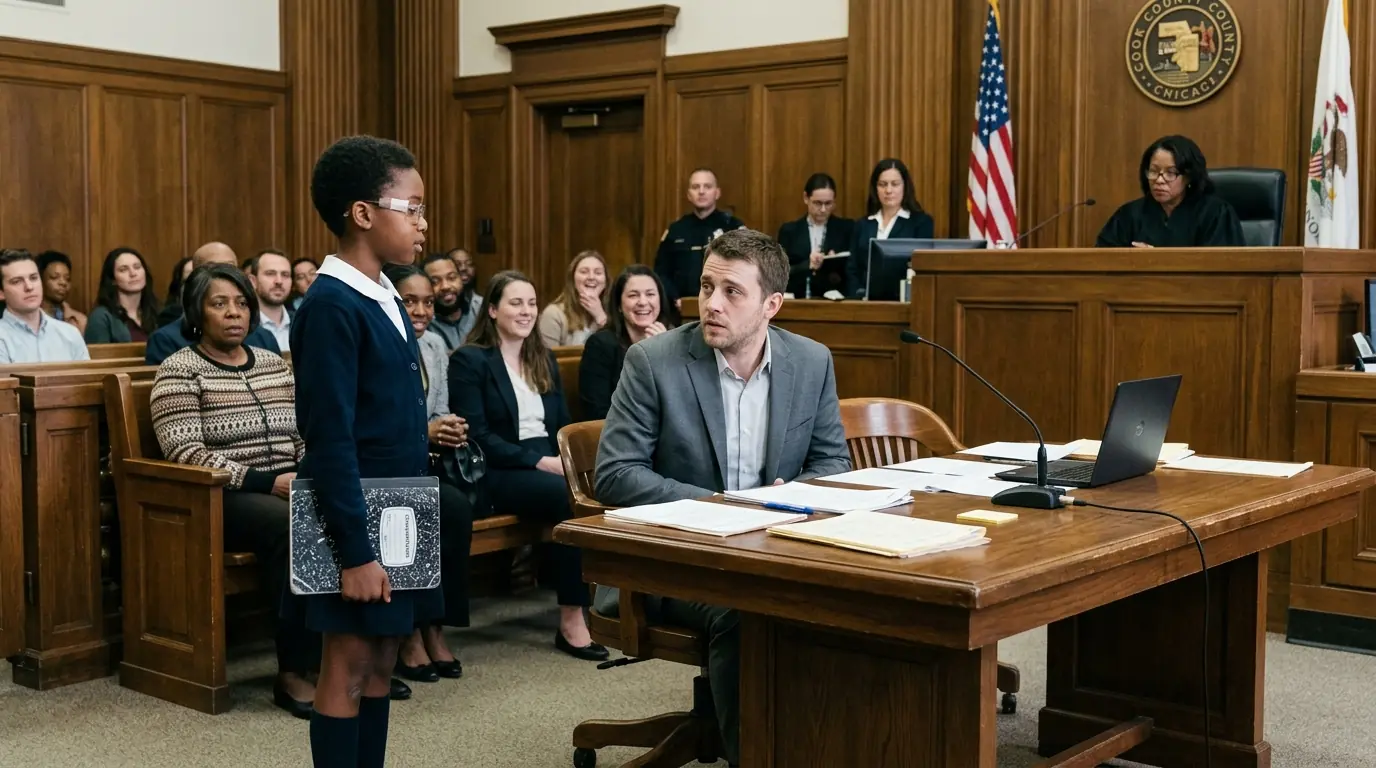
They shouldn't have laughed.
The morning it all collapsed, Ethan Caldwell was eating a granola bar in the back of a rideshare, scrolling through emails about a new community center his foundation was funding in Baltimore. By the time the car pulled up to his office building in downtown Chicago, his phone had already received forty-seven missed calls. He didn't know it yet, but his life had just changed overnight.
The headline hit every major news platform simultaneously, which in itself was unusual. That kind of coordination doesn't happen by accident: Tech Millionaire Ethan Caldwell Accused of Draining Charity Fund; Thousands of At-Risk Youth Left Without Support. Below the headline was a photo of him at a gala from two years ago, champagne in hand, smiling wide—carefully chosen to make him look like exactly the kind of person the story wanted him to be.
By 9:00 in the morning, his name was trending in all fifty states.
Ethan was twenty-eight years old, and up until that Tuesday, he had been one of the more quietly admired figures in the Chicago tech space. He hadn't gone to the right schools or come from the right family. He'd grown up bouncing between foster homes across three states, and he'd taught himself to code using a library computer and YouTube tutorials. His company, BridgeTech Solutions, built software infrastructure for underfunded public schools: tools that helped teachers track student learning gaps, tools that helped districts identify kids falling through the cracks.
The Caldwell Foundation, the charity now at the center of the scandal, had been funding after-school programs in six cities. He hadn't started the foundation for press coverage. He'd started it because he remembered what it felt like to be a kid nobody was looking for.
None of that was in the headline.
The story claimed that over $3 million designated for the charity's youth investment fund had been redirected through a series of questionable transactions over eighteen months. The money was supposed to go toward mentorship programs, educational stipends, and emergency housing assistance for kids aging out of foster care. Instead, according to the allegations, it had been funneled into high-risk, high-reward financial instruments under Ethan's direction. When those investments failed, the fund collapsed. The kids got nothing. And somehow, conveniently, Ethan's personal accounts had grown during the same period.
It looked damning on paper. That was the point. Anonymous sources fed the story to three different outlets at once. Legal analysts appeared on cable news within hours, people who hadn't seen a single document speaking with absolute certainty about Ethan's culpability. A former associate, unnamed, described him as obsessed with wealth accumulation despite the charitable fraud. A financial blogger with two hundred thousand followers published a thread that went viral, complete with charts she'd clearly assembled from public filings she didn't fully understand.
Ethan's attorney at the time was Douglas Hartwell, a well-connected defense lawyer who had never lost a high-profile case in his thirty-year career. He was expensive, confident, and politically connected in ways that mattered. When the story broke, Douglas called Ethan before 8:00 in the morning and told him not to say a word to anyone.
"We'll handle this," he said. "This is manageable."
Twelve days later, Douglas filed a motion to withdraw from the case. The stated reason was a conflict of interest—vague, unexplained, offered with no further detail. Ethan asked him directly what happened. Douglas wouldn't meet his eyes. He said it was a professional matter and that Ethan should seek new representation immediately. Then he left the conference room, and that was the last time Ethan saw him.
Rumors filled the vacuum quickly. Legal circles whispered that someone had approached Douglas's firm with a client whose interests directly opposed Ethan's—someone with deep enough pockets to make walking away from Ethan the more financially attractive choice. Others suggested something more direct. One anonymous post on a legal forum used the word "pressure" three times in a single paragraph before being deleted.
Whatever happened, the effect was clear: Douglas Hartwell was gone, and Ethan Caldwell was walking into a preliminary hearing without representation.
The Cook County Courthouse on that Thursday morning was louder than usual. News vans lined the street outside. Protesters held signs—some in support of Ethan, most against him, all of them working off media-shaped narratives rather than facts. Inside, the gallery was packed. People came the way people come to things they expect to be entertaining.
Ethan sat at the defense table alone. He was wearing a gray suit that suddenly felt too formal without anyone sitting beside him. His hands were folded on the table, but his left thumb kept moving, pressing slowly into his right palm—a thing he did when he was trying to stay calm.
Judge Patricia Owens was in her late fifties with a reputation for running a tight courtroom and a low tolerance for theater. She looked at the defense table, then at the paperwork in front of her, then back at the defense table.
"Mr. Caldwell," she said, "I've received a withdrawal notice from Mr. Hartwell's firm. Is that accurate? You currently have no legal representation?"
"Yes, Your Honor," Ethan said. His voice held, but just barely.
A murmur went through the gallery.
"And you understand that these proceedings will continue regardless of your representation status?"
"I understand."
"Have you made attempts to secure new counsel?"
He had. He had contacted fourteen firms in ten days. Some hadn't returned his calls. Others had declined politely, citing scheduling conflicts that weren't real. Two had been direct enough to admit they didn't want the visibility. One attorney had told him plainly, off the record, that nobody wanted to touch a case that felt predetermined.
That word, predetermined, had stayed with Ethan.
"I've been unable to secure representation so far," he said.
Judge Owens studied him for a moment. "The court will grant a fourteen-day continuance for representation purposes. However, Mr. Caldwell, I want to be clear. This case will proceed on schedule regardless of your circumstances at that time. You have a constitutional right to counsel, but if you cannot secure it, this court is not without recourse."
The prosecutor, a sharp woman named Assistant State's Attorney Karen Whitfield, didn't bother hiding her satisfaction. She made a note on her legal pad that probably said nothing important, but she made it slowly, visibly, the way people do when they want you to know they're not worried.
Ethan nodded at the judge. "I understand, Your Honor."
It was during this exchange that Nia Brooks, sitting in the third row of the public gallery beside her grandmother, opened her worn composition notebook to a fresh page and began writing.
She was twelve years old, small for her age, with close-cropped natural hair and glasses that had been repaired with a small strip of medical tape on the right arm. Her school uniform—navy blue cardigan, white-collared shirt—was pressed and neat.
Her grandmother, Ruth Brooks, was a retired hospital administrator in her mid-sixties. She sat straight-backed and watchful, the kind of woman who treated every room she entered with quiet seriousness.
They came to the courtroom on Tuesdays and Thursdays, had been coming for two weeks. Ruth had explained to the school that Nia had a medical appointment on those mornings, which wasn't entirely a lie. Ruth believed the law was medicine for society, and she believed Nia needed to be near it.