The spring evening hung heavy with the scent of hothouse roses as Isabella Everly stood at the edge of the conservatory at Thornfield Manor, gathering courage she wasn't certain she possessed. At twenty-five years of age, she was considered past the first blush of youth by society's unforgiving standards, yet her heart beat with the nervous flutter of a girl half her age.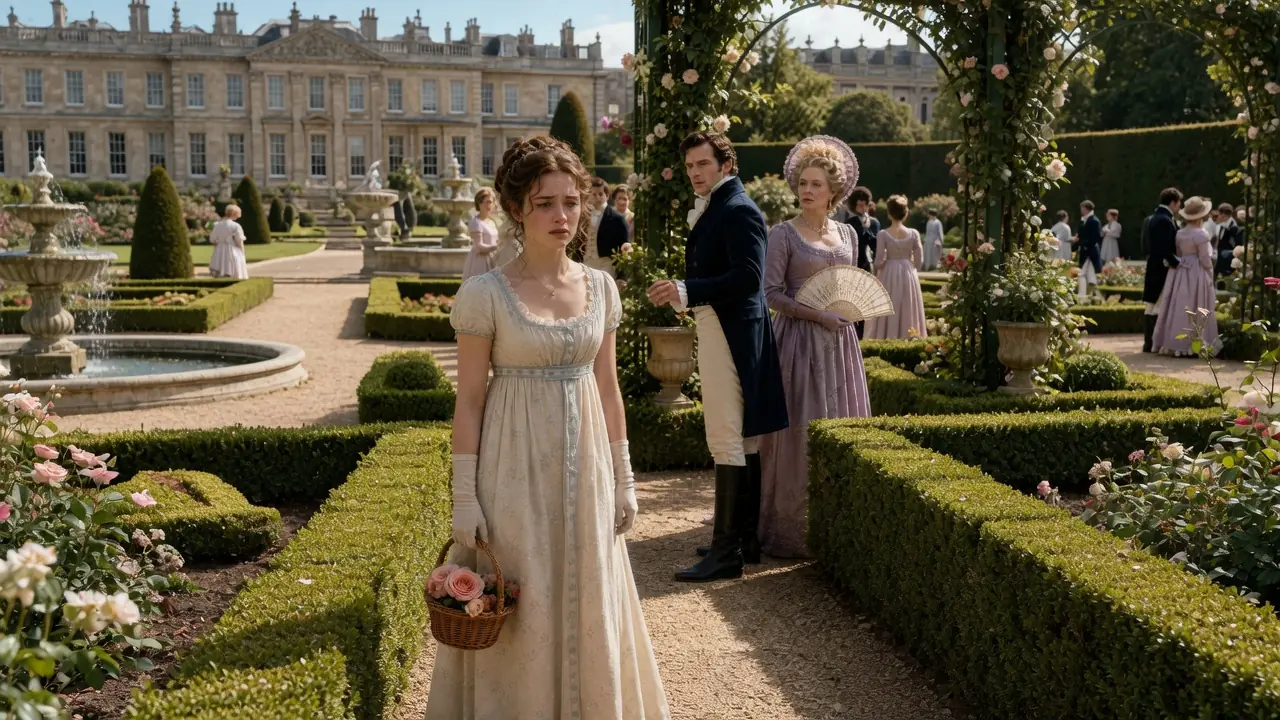
Through the glass walls, she could see the ballroom ablaze with candlelight, the orchestra's waltz drifting on the warm air. Footmen moved through the crowd with silver trays of champagne, while ladies in silk and gentlemen in evening dress swirled across the polished floor. The Earl of Thornfield's annual spring ball was the event of the Derbyshire season—an invitation coveted, a slight remembered for years.
Isabella smoothed the ivory silk of her gown, borrowed from Lady Catherine Pembroke, the only friend who hadn't abandoned her after her father's financial scandal. The fabric was finer than anything the Everly family could now afford. Once, such a gown would have been beneath her notice; now, it represented a charity she could barely stomach. The delicate lace at the sleeves had been mended twice, but in the flattering glow of the gas lamps, she hoped no one would notice.
Tonight, she told herself, would change everything.
Through the conservatory's glass panes, she could see him. Edward Hawthorne, Earl of Thornfield, stood apart from the crowd near the marble fountain, a glass of brandy in his hand. Even in stillness, he commanded attention. Tall and broad-shouldered, with dark hair that refused to lie quite flat despite his valet's evident efforts, he cut an imposing figure in his formal black evening clothes. His face was all sharp angles—a strong jaw, high cheekbones, and a mouth that seemed more accustomed to issuing orders than smiling.
But it was his eyes that had first captured Isabella's attention months ago at a garden party in London. Dark, almost black, and startlingly intense beneath straight brows, those eyes had looked at her then with what she had interpreted as interest, perhaps even admiration. She had been wrong about many things in her life, but she couldn't have been wrong about that, could she?
Isabella pressed a gloved hand to her stomach, willing it to settle. She had rehearsed this moment a hundred times in the privacy of her modest rooms at the boarding house where she now lived. The words came easily in her imagination—poised, articulate, persuasive. But now, watching Edward's profile silhouetted against the fountain's spray, her carefully prepared speech scattered like leaves in the wind.
"Just go to him," she commanded herself. "Say what you came to say."
Her feet moved before her courage could fail entirely. The conservatory door yielded silently to her touch, admitting her into the humid, perfumed air. Ferns and orchids crowded the space, creating shadowed alcoves lit by strategically placed lanterns. The fountain's gentle splashing provided a backdrop to the distant music. She had taken perhaps three steps when Edward turned, alerted by some subtle shift in the air, or perhaps merely the instinct of a man accustomed to being observed.
"Miss Everly." His voice was deep, measured, revealing nothing. "This is unexpected."
Isabella's carefully rehearsed words tangled on her tongue. She forced them out with more bluntness than she had intended. "My lord, I must speak plainly. I hope you'll forgive the irregularity."
One dark brow rose slightly. "Plainness is a rare commodity in society, Miss Everly. I find I'm curious what prompts such directness at a ball." He set down his brandy glass on the fountain's edge, giving her his full attention.
That intense gaze pinned her in place, and for a moment, Isabella nearly fled. But she thought of her father's lined face, of the creditors who still came calling, of her own dwindling options, and found her spine.
"Circumstances have reduced my family's standing," she began, the words rushing out now. "This is no secret. I won't insult you by pretending otherwise. My father's investment in the Yorkshire and Midlands Railway proved catastrophic when the company collapsed. We lost everything. The house in London, my mother's jewels, even the estate in Hampshire that had been in the Everly family for three generations."
Edward's expression remained neutral, but she thought she detected a slight softening around his eyes.
Encouraged, she pressed on. "I tell you this not to excuse what I'm about to say, but to provide context. These past months, at the few remaining gatherings where I'm still received, I have found myself drawn to you, my lord. I believe you felt it, too—those moments when our eyes met across Lady Pembroke's drawing room, or when we spoke of horsemanship at the Harrington garden party." She took a breath, committing fully now to this precipice. "I know I am not what I once was. I know my family's disgrace has tainted me by association, but my affection is genuine, Lord Thornfield, and my devotion would be absolute. I am practical, capable of managing a household with limited means—a skill I've learned from necessity. I would be a helpmate, not a burden. I would—"
"Stop."
The word was quiet, carrying the immense weight of command. Edward's face had transformed during her speech, the slight warmth evaporating like morning mist. What remained was cold, harder than marble, and infinitely more cruel.
"Miss Everly," he said, his tone now carrying that particular aristocratic drawl that made every syllable a weapon. "You honor me with your candor. Your honesty is, as I said, refreshing. So, let me respond with equal honesty."
He took a step toward her, then another, until he stood close enough that she could smell the brandy on his breath, see the fine lines at the corners of his eyes that suggested he was nearer forty than thirty. His voice dropped lower, more intimate, but somehow more devastating for it.
"I require neither a helpmate nor a woman who offers devotion like a commodity at market. Your affection, Miss Everly, however genuine you believe it to be, is wasted on me." He paused, and something flickered across his face—was it regret? It vanished so quickly she might have imagined it. Then he delivered the killing blow with perfect, measured cruelty. "I would rather marry my horse than bind myself to sentiment and a woman of no consequence. At least Champion has better breeding and requires less conversation."
The words struck with physical force. Isabella actually swayed, one hand reaching blindly for the fountain's edge to steady herself. Her face, she knew, must have drained of all color. She felt as though all the air had been sucked from the conservatory, from her lungs, from the world.
"My lord, I—" she began, but whatever she might have said next was obliterated by a sharp, theatrical gasp from behind her.
Isabella spun around to see the conservatory door standing wide open. How long had it been open? How much had been heard?
Lady Pemberton stood framed in the doorway, one hand pressed to her ample bosom, her expression a masterpiece of scandalized delight. Behind her, Isabella recognized with sinking horror Lady Ashworth, Lord Harrington, and the Duchess of Kendal herself—the highest-ranking lady in the county.
"Oh my," Lady Pemberton breathed, her voice carrying perfectly to the ballroom beyond. "Oh my dear, we were just... that is, we heard voices and thought perhaps someone was unwell."
The lie was transparent. Lady Pemberton's eyes glittered with malicious triumph. She had been Edward's mistress two seasons ago—everyone knew it—and she had made no secret of her displeasure when he had ended the arrangement. Now, she had stumbled upon, or perhaps carefully orchestrated, the perfect revenge against him and entertainment for herself.
Isabella forced herself to look at Edward. His face had gone rigid, a muscle jumping in his jaw. He had seen the audience now. For one heartbeat, two, she thought he might say something, might soften the blow somehow. He said nothing.
The silence stretched, excruciating. Through the open door, Isabella could see heads turning in the ballroom, conversations faltering as guests sensed the delicious whiff of scandal. Isabella drew herself up, summoning every scrap of dignity her mother had drilled into her since childhood. When she spoke, her voice was barely audible, but perfectly controlled.
"Forgive the intrusion, my lord. I see now that I misunderstood the nature of our acquaintance. I shan't trouble you again."
She dropped into a curtsy—not the deep, respectful obeisance due an earl, but the shallowest curtsy that could still technically be called polite. When she rose, she turned and walked toward the door, toward the watching aristocrats, toward her own social execution.
Lady Pemberton stepped aside with exaggerated solicitude. "My dear Miss Everly, are you quite well? You look so pale."
Isabella didn't answer. She walked past them, past the Duchess's cold appraisal and Lord Harrington's poorly concealed smirk, and out into the ballroom. The orchestra played on, but the music seemed to come from very far away. Isabella walked—she would not run, would not give them that satisfaction—toward the entrance. With each step, conversations died, heads turned, and fans snapped open as ladies leaned together to whisper. She felt every eye on her borrowed dress, her unfashionable hairstyle, her face that she knew must be white as chalk.
The whispers rose like a wave in her wake.
*“Did you hear what the Earl said? To compare her to his horse... his horse.”*
*“Well, after her father's scandal, what did she expect?”*
*“Poor creature, she must be desperate.”*
*“She's pathetic, throwing herself at a man so far above her station.”*
*“I heard she was quite pretty once, before the family lost everything.”*
*“Pretty doesn't pay creditors, does it?”*
Isabella's vision narrowed to a tunnel. *Just the door, just reach the door.*
"Isabella, wait!" Lady Catherine's voice cut through the whispers, genuinely concerned. Her friend pushed through the crowd, reaching for her arm, but Isabella couldn't stop. If she stopped, if she allowed kindness to touch her now, she would shatter. She shook her head minutely and kept walking.
The entrance hall was blessedly cool after the ballroom's heat. A footman, trained to impassivity, summoned her carriage without comment. The wait felt eternal, seconds stretching into hours while she stood there, spine straight, hands folded—a statue of composure, while inside she crumbled.
Finally, blessedly, the carriage arrived. She climbed in with mechanical precision, arranging her borrowed skirts with automatic care. The door closed, and the carriage lurched into motion.
*I would rather marry my horse.* The words echoed in her mind with the persistence of a funeral bell. Each repetition drove deeper, finding new ways to wound. *A woman of no consequence.* She pressed her gloved fingers to her temples, trying to stop the trembling that had spread through her entire body.
Through the carriage window, she watched Thornfield Manor recede into the darkness, its windows ablaze with light and laughter. She could imagine the conversations happening even now, her humiliation served up as entertainment with the champagne and canapés. By morning, the story would be all over Derbyshire; by week's end, London would know. Miss Isabella Everly, the impoverished viscount's daughter, who had thrown herself at the Earl of Thornfield and been brutally, publicly rejected—compared to a horse and found wanting.
The carriage rattled through the dark countryside, carrying her back to her modest rooms, back to her uncertain future, back to the ruins of whatever dreams she had still been foolish enough to harbor. Isabella closed her eyes and tried to breathe through the constriction in her chest. She had survived her father's financial ruin. She had survived her mother's death from heartbreak and shame. She had survived being cast out of the only social circle she had ever known, surviving on charity and the grudging kindness of distant relations. She would survive this, too. She had to, because the alternative—surrendering to the despair that threatened to swallow her whole—was unthinkable.
Somewhere beneath the humiliation and pain, a small flame of defiance kindled. He had called her a woman of no consequence? Very well. She would show him, show them all, that consequence had nothing to do with titles or ballrooms or the approval of cruel men who loved horses more than humanity. She didn't know how yet, but she would survive this. And perhaps, someday, she might even forgive herself for the foolish sin of having hoped.
---
The morning after the ball, Isabella woke to silence—not the comfortable quiet of a peaceful dawn, but the heavy, expectant silence that precedes a disaster. She lay still in her narrow bed at Mrs. Hartley's boarding house, staring at the water-stained ceiling of her modest room. Morning light filtered through thin curtains, casting pale shadows across walls that had once seemed merely economical, but now felt like a prison. The sounds of London stirred beyond her window—cartwheels on cobblestones, a baker's boy calling his wares, the distant clatter of a horse and carriage—but inside, the silence pressed against her ears like cotton wool.
She should rise, dress, and face whatever came next with the composure her mother had always insisted upon. *A lady's dignity,* her mother had said during those final, illness-ravaged days, *is the one possession no creditor can seize.* Her mother had been wrong about that, too.
A tentative knock broke the silence. "Miss Everly?" Jenny's voice, usually bright with morning cheer, carried a careful neutrality. "I've brought your breakfast, miss."
"Come in."
Jenny entered, carrying a tray that held tea, toast, and a single boiled egg—the standard breakfast Isabella could still afford. But it was the newspaper folded beside the teapot that drew Isabella's eye with the inexorable pull of a lodestone. Jenny set the tray down with exaggerated care, her eyes fixed anywhere but on Isabella's face.
"Will there be anything else, miss?"
"No, thank you, Jenny."
The maid bobbed a curtsy and fled. The door clicked shut with the finality of a coffin lid.
Isabella sat up, reached for the newspaper with hands that trembled only slightly, and unfolded it to the society pages. She didn't have to search long. There, buried in the third column between an announcement of the Duchess of Sutherland's upcoming musicale and a report on Lady Jersey's new phaeton, she found it:
> *A certain impoverished young lady of formerly good family made quite the spectacle at a recent Derbyshire ball, declaring her affections to a certain bachelor Earl of distinguished lineage. The gentleman's response, comparing matrimony to the lady unfavorably with equine companionship, has set tongues wagging from Mayfair to Manchester. One can only pity such desperate measures, though society must draw its lines somewhere, mustn't it?*
The words blurred. Isabella set the paper down carefully, as if it might shatter. Her hands shook now in earnest, a tremor that ran from fingertips to shoulders. They hadn't named her; they hadn't needed to. Anyone who mattered would know exactly which impoverished young lady, which Earl, which ball.
By noon, every drawing room in London would be discussing it. By evening, the story would have spread to Bath, to Brighton, to every country house where the ton gathered to pass judgment and find entertainment in others' misfortunes. She was ruined—completely, utterly, irrevocably ruined.
Isabella poured tea with mechanical precision, not tasting it when she drank. The morning stretched ahead with its usual obligations: social calls, perhaps a visit to Lady Catherine, an afternoon with the Duchess of Marlborough to discuss the upcoming charity bazaar. Routine, normalcy—the fragile scaffolding of a life lived on the margins of respectability. She would maintain that routine. She would hold her head high. She would not hide like a shamed creature.
By 10:00, she was dressed in her most respectable day dress—brown cambric, modest cut, only two seasons old—with her hair arranged simply beneath a plain bonnet. Her calling cards sat in their case in her reticule. She descended the boarding house stairs with her spine straight and her expression composed.
Mrs. Hartley, the landlady, looked up from her account books as Isabella passed through the entrance hall. Their eyes met. Mrs. Hartley's gaze held something Isabella couldn't quite name—pity, perhaps, or the uncomfortable sympathy of one who witnesses another's disgrace and thanks God it isn't their own.
"Going out, Miss Everly?"
"Yes, social calls."
Mrs. Hartley nodded slowly. "I see. Well, good day to you, then." The tone suggested she expected Isabella back soon, and not by choice.
Lady Catherine Pembroke's townhouse in Bloomsbury was Isabella's first stop. They had been friends since childhood, before Isabella's family's fortunes had collapsed, before everything had gone wrong. If anyone would still receive her, it would be Catherine.
The butler who answered the door had known Isabella for years. He had always greeted her with a slight smile, a respectful nod. Today, his face was professionally blank.
"I'm here to see Lady Pembroke," Isabella said, extending her card. "I believe she's at home this morning."
The butler looked at the card without taking it. "I'm afraid Lady Pembroke is not receiving today, Miss Everly."
"Not receiving? But it's Thursday. She always receives on Thursday mornings."
"Nevertheless, miss, she is not receiving." His tone made it clear: *not receiving you.*
Isabella's fingers tightened on her card case. "I see. Will you tell her I called?"
"Of course, miss." But his eyes said he would do no such thing.
Isabella turned away, descended the steps, and stood for a moment on the pavement. The spring morning was fine, the air soft with the promise of summer. Nursemaids pushed perambulators, tradesmen made their deliveries, and life continued its relentless forward march, while Isabella's own life crumbled like ancient parchment.
She tried Mrs. Ashworth next, then Mrs. Petersham. At each house, the same response, delivered with varying degrees of courtesy but identical finality: *not receiving, not at home, perhaps another time.*
At Lady Thornbury's house, Isabella saw a curtain twitch in an upstairs window. A face appeared—Miss Helen Thornbury, who had once claimed Isabella as her dearest friend. Their eyes met through the glass. Isabella lifted her hand in a small wave, a gesture born more of instinct than hope. Helen's face disappeared, and the curtain fell back into place.
Isabella understood then, with a clarity that was almost peaceful in its absoluteness: she had been cut—completely, irrevocably. Victorian society's mechanisms of ostracism moved with the precision of clockwork and the mercy of a guillotine. One day you were received, if marginally; the next, you were invisible.
She walked home through streets that suddenly felt foreign—past shops where she could no longer afford to purchase anything, through squares where she would no longer be acknowledged by the ladies taking their morning constitutional. London, her birthplace, had become enemy territory.
The letter was waiting when she returned to the boarding house, delivered by special messenger in the Duchess of Marlborough's distinctive cream-colored envelope with the ducal seal. Isabella took it up to her room before opening it, though she already knew what it would say.
> *Dear Miss Everly,*
> *It is with regret that I must inform you that your services as lady-in-waiting will no longer be required. Recent events have made your continued position within my household untenable. Please consider this notice effective immediately. Your final month's wages are enclosed, along with a character reference which I trust you will find adequate for securing future employment.*
> *I wish you well in your future endeavors.*
> *— The Duchess of Marlborough.*
The character reference was a masterpiece of damning with faint praise. *“Miss Everly performed her duties adequately and was always punctual.”* Nothing about her character, her accomplishments, her years of loyal service. Just *adequate* and *punctual*—the absolute minimum one could say without outright condemnation.
Isabella folded the letter carefully and placed it in her writing desk. The wages would extend her savings by another month, perhaps six weeks if she was frugal. Then what? Governess positions required references; companion positions required respectability. She had neither now.
A knock at her door interrupted her calculations of impending destitution. "Miss, your father's man is here. The Viscount requests your presence at his rooms."
Viscount Everly had aged a decade in the year since his financial ruin. Once robust and ruddy-faced, he now seemed diminished, his coat hanging loosely on a frame that had shed weight through worry rather than any deliberate effort. He lived in three cramped rooms in an unfashionable quarter, surrounded by the few possessions he had managed to retain—a favorite chair, some books, and a portrait of Isabella's mother that he couldn't bear to sell.
He stood when Isabella entered, his hands twisting together nervously. "Isabella, thank you for coming."
"Of course, Papa." She kissed his cheek, noting the smell of brandy on his breath, though it was barely past noon. "You're well?"
"Well enough." He gestured for her to sit, then paced to the window and back. "I've heard... that is, word has reached me about the ball. About the Earl of Thornfield."
Isabella's spine stiffened. "I see gossip travels quickly."
"Isabella," he turned to face her, his eyes pleading. "Perhaps... perhaps if you were to write to him, apologize for any presumption, explain that you meant no—"
"No."
"But surely if you approached him with proper humility, explained that you were overwrought, that the loss of your position as lady-in-waiting had disordered your senses—"
"I said no." Isabella's voice cut through his ramblings like ice through water. She stood, drawing herself up to her full height. "I would rather starve than beg that man for anything. I would rather scrub floors. I would rather throw myself in the Thames."
Her father's face crumpled like wet paper. "Isabella, please, be reasonable. Without your income from the Duchess, without any prospects, we cannot survive on my pension alone. If the Earl could be persuaded to overlook this incident, perhaps even—"
"Even what, Papa? Marry me out of pity? Take me as his mistress to spare you the shame of a pauper's funeral?" She heard the cruelty in her own voice and couldn't quite regret it. "That man humiliated me in front of half the county. He compared me to livestock. And you want me to apologize to him?"
Her father sank into his chair, suddenly looking every one of his sixty years. "I just want us to survive, child."
Isabella's anger drained away as quickly as it had risen, leaving only exhaustion. She knelt beside his chair, taking his weathered hands in hers. "We will survive, Papa. We always do. But I won't do it by begging scraps from men who treat me as less than human."
He looked at her with eyes that held more despair than hope. "Then how?"
She had no answer. Not then.
The letter from Mrs. Winters arrived three days later, as if summoned by Isabella's desperation.
> *Dear Cousin Isabella,*
> *I hope this letter finds you well. I have heard through the meandering channels of family gossip that circumstances have become difficult in London. I wonder if you might consider a change of scenery. I run a respectable boarding house in the village of Wickham in Lancashire. It is modest but comfortable, and I find myself in need of assistance. The village school requires a teacher—someone educated and refined who might instruct the daughters of shopkeepers and tenant farmers in letters, arithmetic, and deportment. The position offers no salary, but I can provide room and board in exchange for teaching duties and some assistance with the boarding house management. It is not London, nor anything approximating society, but it is honest work and respectful treatment. Should this interest you, you would be most welcome.*
> *Your cousin,*
> *— Margaret Winters.*
Isabella read the letter twice, then set it down and walked to the window. Below, London churned with its usual chaos. Somewhere in this city, Edward Hawthorne, Earl of Thornfield, was likely at his club or his stables, utterly unconcerned with the ruin he had wrought. Somewhere, Lady Pemberton was hosting a card party and serving up Isabella's humiliation along with the tea cakes.
Wickham. She tried to picture it and couldn't. A village in Lancashire, the north—far from London's cruel gossip, far from Derbyshire's ballrooms, far from every place and person who had witnessed her disgrace. Obscure, respectable, safe.
She pulled out her writing desk and composed her reply before she could reconsider. *“Dear Mrs. Winters, yes. I'll come.”*
Packing took less time than she had expected. Her possessions had dwindled over the past year to fit in two modest trunks: clothing, a few books, and her mother's cameo brooch. She packed mechanically, folding each item with care born of habit rather than sentiment.
Then her hand fell upon a small volume tucked in her bureau's bottom drawer—the book's green leather cover was still pristine, the pages uncut: *Collected Poems of William Wordsworth.* She had bought it six months ago at a bookseller's in Cheapside, spending precious shillings she could ill afford. Edward had mentioned in passing at the Harrington garden party that he admired Wordsworth's unvarnished observations of nature. She had imagined presenting it to him, imagined his surprise and pleasure, imagined a conversation about poetry that might deepen into something more.
What a fool she had been. Isabella carried the book to the fireplace, where a small fire burned against the morning chill. She held the volume over the flames, watching the firelight dance across its cover. *This is what hope looks like when it dies,* she thought.
She dropped it in. The pages caught quickly, curling and blackening—Wordsworth's words on nature and beauty and truth reduced to ash and smoke. She watched until nothing remained but embers, then turned back to her packing with dry eyes.
The coach to Wickham departed at dawn from the King's Cross coaching inn. Isabella arrived with her two trunks, her reticule containing the last of her money, and a heart that felt less broken than simply closed. Jenny had insisted on seeing her off, loyal to the end despite being unable to follow.
"You'll write to me, Miss? Let me know you arrived safely."
"Of course." Isabella embraced her, this girl who had served her faithfully through prosperity and disgrace. "Thank you, Jenny, for everything."
"It's not right, Miss. What they've done to you. It's not right."
"No," Isabella agreed, "but it's done."
She climbed into the coach, taking her place among merchants and clerks and farmers' wives—people who had never heard of the Earl of Thornfield or his annual spring ball. The coach lurched into motion. Through the window, Isabella watched London's familiar skyline recede—St. Paul's dome, the Thames's gray gleam, the chimney smoke that perpetually hazed the air. The city that had been her entire world, the place where she had been born and raised and ruined, vanished. Jenny waved until she was just a speck in the distance, then disappeared entirely.
Isabella turned forward in her seat, facing north toward an uncertain future in a place she had never seen. Her hands were steady in her lap; her expression was composed. Inside, where no one could see, she felt the last fragile threads that had connected her to her old life snap one by one. London, with all its cruelty and all its memories, disappeared behind her. Good riddance.
---
Twelve years later, the morning sun slanted through the tall windows of the Wickham schoolhouse, illuminating particles of chalk dust that danced in the air like snow. Isabella Everly—Miss Everly, as the village knew her—stood at the blackboard, her handwriting flowing across the slate in confident strokes.
*R E S P E C T*, she wrote, each letter precise and clear. "Now, who can tell me what this word means?"
Eight hands shot up, or rather, seven hands and one tentatively raised finger from young Margaret Foster, who sat in the front row with her slate clutched to her chest like armor. At seven years old, Margaret was the youngest of Isabella's students, a thin child with enormous brown eyes and a tendency to cry when she struggled with her letters.
"Alice," Isabella nodded to the eleven-year-old in the back, her brightest pupil.
"Respect means to regard with honor or esteem, Miss Everly," Alice said clearly. "To treat with consideration and courtesy."
"Excellent. Now, Margaret, can you copy the word for me?"
Margaret's small face scrunched with concentration as she laboriously scratched at her slate. *R... R...* She looked up, her eyes already brimming with frustrated tears. "It's too hard, Miss Everly. Why must we learn such hard words?"
Isabella set down her chalk and crossed to Margaret's desk, kneeling beside it so their eyes were level. Around them, the other girls continued their copying rows—the butcher's twin daughters, the daughter of the village blacksmith, orphans from the parish home, and little Beatrice, whose mother took in washing.
"Because respect is something every woman should know how to read, spell, and demand, Margaret," Isabella said gently. "The world will not give it freely. You must know its shape, its sound, its weight. Do you understand?"
Margaret nodded slowly, though Isabella suspected the child grasped only that the word was important, not why. That understanding would come later, as it had for Isabella herself. Some lessons could only be learned through living.
"Now, try again. Just the first letter. Make it strong."
Margaret bent over her slate, her tongue caught between her teeth in concentration. This time, the *R* emerged more boldly.
"Beautiful. Now, the *E*."
The schoolhouse was a simple building—a single large room with whitewashed walls, rough wooden benches, and a pot-bellied stove. Isabella had arrived twelve years ago to find it nearly derelict, used more for storing grain than educating children. Now, wildflowers—primroses and early bluebells—brightened the windowsills in repurposed jam jars. Isabella's own books lined a shelf she had commissioned from the village carpenter: primers and grammar texts, yes, but also novels, poetry, and a volume on natural philosophy that fascinated Alice.
"Miss Everly," Alice had finished her copying and moved on to the arithmetic problems Isabella had written on the board. "I've completed the multiplication tables. May I attempt the algebraic equations?"
Isabella smiled. Alice had a mind like a steel trap and an insatiable curiosity about mathematics that Isabella nurtured carefully. In London, a girl like Alice would be told such knowledge was unfeminine, unnecessary; here, where practicality mattered more than propriety, Isabella could teach her properly. "Yes, but show me your working. I want to see how you arrived at each answer."
The morning progressed through reading, penmanship, arithmetic, and a brief lesson in geography using the worn globe Isabella had purchased with her own meager savings. By the time the church bells struck three, all eight girls could spell *respect*, if not yet fully comprehend its significance. They would, though; Isabella would make certain of it.
"Tomorrow we'll discuss the Reform Acts," she announced as the girls gathered their slates and primers. "Sarah, please be prepared to explain why the expansion of suffrage matters, even though we cannot yet vote ourselves."
The girls filed out into the spring afternoon, chattering like starlings. Only Margaret lingered, her slate still clutched to her chest. "Miss Everly... will you walk with me?"
"Of course, dear."
Wickham had changed little in twelve years, and Isabella found comfort in its constancy. The village sat in a gentle valley, its stone cottages clustered around a Norman church and a modest square where farmers sold their goods on market days. No grand estates loomed on the horizons, no aristocratic carriages clattered through the streets. It was a place of shopkeepers and tenant farmers, blacksmiths and seamstresses—people who worked with their hands and measured worth in character rather than lineage, people who had given Isabella something she had never expected to find again: belonging.
"Good day, Miss Everly," Mrs. Thompson called from the doorway of her bakery, her flour-dusted apron bright against the stone. "I've put aside an extra loaf for you. The crust came out particularly fine today."
"Mrs. Thompson, you needn't—"
"Nonsense. A teacher works as hard as anyone. Harder, I'd wager, trying to drum sense into my Catherine." She pressed the loaf, still warm, into Isabella's hands. "No arguments now."
Isabella accepted it with thanks, knowing that argument would be futile and ungracious besides. The village had its own economy of kindness, a web of reciprocal generosity that had gradually encompassed her. She taught their children without fee; they ensured she never went hungry or cold. At the butcher's shop, Mr. Davies offered her a cut of beef at a discount, which meant no charge at all, though Isabella had long since learned to pay something or risk offending his pride. At the draper's, Miss Henley inquired whether Isabella might look in on her mother, whose cough had worsened. "Of course, I'll call this evening after supper."
Margaret tugged at her hand. "Are you a nurse, too, Miss Everly?"
"Not truly, but I know a bit about tisanes and poultices, and sometimes company is the best medicine."
It was true. Over twelve years, Isabella had become many things to Wickham: teacher, counselor, amateur physician, letter writer for those who couldn't manage their own correspondence, and advocate in small disputes that required someone literate and impartial. The village had saved her, and she tried to repay that debt daily.
They had reached the boarding house—a tidy three-story building with window boxes that Mrs. Winters kept bright with seasonal flowers. Margaret's path continued toward the parish home, but the child hesitated. "Miss Everly, Mr. Pearson—the vicar's son—he asked me to walk with him on Sunday. Should I say yes?"
Isabella hid her smile. Margaret was seven, Mr. Pearson was eight, and evidently precocious. "Do you wish to walk with him?"
"I... I don't know. Rose says boys are stupid."
"Rose isn't entirely wrong, but some boys grow into decent men. Whether Mr. Pearson will be one of them, only time will tell." She squeezed Margaret's hand. "Trust your own judgment, dear. Your instincts are sound."
Margaret brightened and scampered off, leaving Isabella on the boarding house steps. Before entering, she allowed herself a moment to simply stand, breathing in the spring air that smelled of grass and distant sheep.
Twelve years ago, she had arrived in Wickham broken, humiliated, barely clinging to the shreds of her dignity. Now, she was whole—different than she had been, harder in some ways, softer in others, but undeniably whole. She had turned down two marriage proposals in those twelve years. Mr. Fletcher, the village solicitor, had offered her respectability and modest comfort; Doctor Warren, passing through on his way to a practice in Manchester, had offered affection and adventure. Both had been good men, kind in their offers, but she had refused them both—not from lingering heartbreak or romantic idealism, but because she had learned something crucial in her years of independence: she didn't need a husband to have a life of meaning. She had her students, her village, her work. She had autonomy—that precious, hard-won autonomy that marriage would require her to surrender. Better alone and free than partnered and constrained.
Mrs. Winters was in the parlor when Isabella entered, her knitting needles clicking with rhythmic precision, but her attention was fixed on something in her lap—a black-bordered envelope that she held as though it might bite.
"Isabella, dear, this came by special courier not an hour ago." Her voice carried a note Isabella couldn't quite identify—concern, apprehension? "From Derbyshire."
The room tilted slightly. Isabella's hand found the doorframe, steadying herself. "Derbyshire?"
"The seal says Thornfield Manor."
Twelve years collapsed to nothing. Isabella saw herself at twenty-five, standing in a conservatory, offering her heart to a man who had crushed it beneath his heel as carelessly as one might crush an insect. She heard his voice: *“I would rather marry my horse than bind myself to sentiment and a woman of no consequence, Miss Everly.”*
Mrs. Winters set down her knitting. "You don't have to open it."
"No." Isabella turned the envelope over in her hands. The black border proclaimed mourning. The Thornfield seal—a hawk in flight—was pressed into crimson wax. She had seen that seal once before, on the invitation to the spring ball that had destroyed her life. "But I think I must."
She climbed the stairs to her small room under the eaves—the same room she had occupied for twelve years, with its narrow bed, simple washstand, and window overlooking the village square. Her books lined one wall, and her writing desk stood beneath the window. It was modest, even spartan by the standards of her youth, but it was hers—every item in it chosen by her, paid for with her own labor, arranged to her own taste.
She sat in the chair by the window, the envelope in her lap. Outside, the village went about its evening business. The lamplighter made his rounds; families settled in for supper. Life continued its steady, unremarkable pace.
Twelve years. She had thought of Edward perhaps a dozen times in twelve years—no, she was lying to herself. She had thought of him far more often than that in the first year, almost daily, gradually less as time passed and the wound scarred over, but she had never truly forgotten. How could she forget the man who taught her that love was a weakness to be exploited, that vulnerability was an invitation to cruelty? But she had built a good life despite him—because of him, perhaps. His rejection had freed her from the delusion that her worth depended on any man's approval.
Finally, she broke the seal. The letter was written in a strong, slashing hand—Edward's own. She recognized it from the few notes he had sent her father regarding horse breeding questions, back when the Everlys still had horses to breed. It was his personal script, not a secretary's copperplate, and that alone was significant.
> *Miss Everly,*
> *I am dying. Consumption. The physicians grant me weeks, perhaps days. I do not write to apologize; words cannot undo what was done. I do not write to beg forgiveness; I have no right to your mercy. I write because I find myself unable to face death without seeing your face once more. You are the only person who ever looked at me and saw something worth loving. You were wrong, of course, but the memory of your mistaken faith has become the only light in an otherwise dark accounting of my years. Come or don't—I have no claim on your time. But know that if you don't come, you will be my final regret in a lifetime crowded with them.*
> *— Edward Hawthorne, Earl of Thornfield.*
> *P.S. I did marry, briefly, Lady Margaret Sutherland. She died five years ago. We had no children; my cousin will inherit. I mention this so you understand: I am not asking you to be the Countess of Thornfield. I am asking you to be Isabella, one last time.*
She read it twice, then a third time, searching for mockery, for cruelty, for some trap hidden in the carefully chosen words. She found none—only exhaustion, regret, and a raw honesty that was somehow more devastating than cruelty would have been. He was dying. The man who had destroyed her was dying, and with his last breaths, he was asking for her—not demanding, not commanding, but asking.
Her hands, which had trembled taking the envelope, were steady now. She folded the letter precisely along its creases and set it on her desk. Outside her window, twilight deepened to night, and the stars emerged.
Edward Hawthorne was dying, and somehow, impossibly, against every instinct of self-preservation she had cultivated over twelve hard years, she knew she would go. Not for him, but for herself—to finally close a chapter that had been left jagged and unfinished, to prove to him, to herself, and to that broken girl who had fled London in disgrace that she had survived. She had more than survived; she had built a life of worth and meaning from the ruins he had left her with.
She would go to Thornfield. She would look Edward Hawthorne in his dying eyes, and then she would return to Wickham, to her students, and to her life. This time, she would be the one to walk away.
---
Isabella didn't sleep. She sat by her window through the long hours of the night, watching Wickham's dark streets transform from black to gray to the pale gold of dawn. The silence pressed against her like a physical weight, leaving too much room for memories she had spent twelve years learning to contain: Edward at a garden party in London, laughing genuinely at a remark; Edward in the paddock, his hands gentle on his horse's mane, murmuring to the animal in a soft, tender voice she had never heard him use with people; the way he had looked at her once across a crowded ballroom, his dark eyes finding hers through the press of dancers, holding her gaze for three heartbeats before she had dared hope.
And then, inevitably, the memory she had tried hardest to bury: *“I would rather marry my horse than bind myself to sentiment and a woman of no consequence.”* The humiliation still burned, even after twelve years. The words had a weight, a permanence, that time hadn't diminished.
But beneath the old anger and the old shame, something else stirred now—curiosity. What did a dying man want from the woman he had destroyed? What drove him to seek her out after twelve years of silence? And why—this was the question that kept her awake—why had love terrified him so much that he had chosen to destroy it rather than accept it?
The sky lightened, and birds began their morning chorus. Wickham stirred to life. Isabella pressed her forehead against the cool glass and prepared herself for what she was about to do.
Mrs. Winters took one look at Isabella over the breakfast table and set down her teacup with a decisive click. "You didn't sleep."
"No."
"The letter?"
Isabella nodded, reciting the text from memory—the dying man's confession, the request that was almost a plea, the postscript about his childless marriage. Mrs. Winters listened without interruption, her weathered hands folded on the tablecloth, her expression unreadable. She was perhaps the most practical person Isabella had ever known, which made her long silence all the more unnerving.
"What will you do?" Mrs. Winters asked finally.
"I don't know," Isabella pushed her breakfast around her bowl. "Part of me wants to burn that letter, throw it in the fire, and forget he exists."
"And the other part?"
"The other part wants to understand. Why did he do it? What was he so afraid of that he chose cruelty over anything else?"
"Do you want to see him suffer?" Mrs. Winters asked shrewdly.
"No, that's the strange part. I don't want revenge. I just want to understand. I want to look at him and finally comprehend what made him capable of such casual cruelty. Does that make sense?"
"Perfect sense," Mrs. Winters covered Isabella's hand with her own. "But I must ask, dear... sometimes the answers we seek don't heal us. They just give us different questions to carry. Are you prepared for that?"
Isabella thought of her students, of the life she had built, of the peace she had finally found. Was she prepared to risk that peace for the possibility of understanding a man who had once called her inconsequential?
"Then I'll carry different questions," she said quietly. "An internal examination shows I cannot carry this wondering for the rest of my life, Margaret. I cannot die having never understood what happened in that conservatory. I cannot."
Mrs. Winters squeezed her hand, then released it. "Then you have your answer. When will you leave?"
"As soon as I can arrange it. Two days, perhaps three."
"I'll help you pack."
Telling the village proved harder than Isabella had anticipated. She made the announcement at the end of lessons that afternoon, trying to keep her voice casual and matter-of-fact.
"I must travel to Derbyshire for a family matter. I'll be gone perhaps a week, possibly two. Miss Henley has agreed to continue your lessons while I'm away."
The reaction was immediate and distressing.
"But Miss Everly, who will teach us properly?" Alice looked stricken. "Miss Henley doesn't understand mathematics."
"How long will you be gone?" Sarah's voice wavered.
"Will you come back?" This came from little Beatrice, who had been abandoned by her mother at the parish home when she was three and still had nightmares about it.
But it was Margaret who truly undid her. The child launched herself at Isabella's skirts, her small arms wrapping tightly around her legs, her face buried in the fabric. "Please don't leave, Miss Everly. Please, please don't leave."
Isabella knelt down, gently disentangling the child's grip so she could look into those enormous, terrified eyes. "Margaret, look at me, dear." She waited until the child's gaze focused on her face. "I will come back. I promise you. This is my home. You are my family. Nothing will change that. Do you understand?"
"You promise?" Margaret's voice was desperately hopeful.
"I promise."
But even as she said it—even as she gathered the child close and felt the other girls pressing around her—Isabella wondered if it was true. What if facing Edward Hawthorne undid all the careful reconstruction work she had done? What if she had finally found peace only to voluntarily walk back into turmoil?
The village vicar, Mr. Ashford, appeared at the boarding house that evening. He was a lean man in his fifties with kind eyes and a tendency toward directness. "Mrs. Winters tells me you're traveling to see the Earl of Thornfield," he said without preamble once they were settled in the parlor. "The man who publicly humiliated you twelve years ago."
"Word travels fast in Wickham."
"It's a small village. We care about our own," he leaned forward, his expression serious. "Miss Everly, Isabella... that man doesn't deserve your kindness. He doesn't deserve even a moment of your time."
"Perhaps not," she met his eyes steadily. "But I deserve my own peace, and I won't have it until I face him."
"Peace?" Mr. Ashford shook his head. "Or closure? There's a difference, you know. Peace is what you've built here in Wickham, with your students and your work. Closure is what we tell ourselves we need before we do something foolish."
The words stung because they contained truth, but Isabella had made her decision, and she wouldn't be swayed. "Perhaps you're right," she admitted. "Perhaps I am being foolish, but it's my foolishness to commit and my consequences to bear. I've spent twelve years being sensible, Mr. Ashford—being careful, building a life of quiet respectability. But there's a wound that never quite healed, and I need to understand it before I can truly let it scar over."
He studied her for a long moment, then sighed. "You're determined, then."
"I am."
"Then I'll pray for you—for wisdom, for strength, and for your safe return to those who love you here."
After he left, Isabella sat alone in the darkening parlor, his words echoing in her mind: *those who love you here.* When had she last been loved? Not romantic love, but this other kind—this chosen family love that asked nothing but gave everything. She was risking that. For what? Understanding? Closure? Or was Mr. Ashford right? Was this just foolishness dressed up as purpose? She didn't know, but the coach left for Derbyshire in the morning, and she would be on it.
Isabella packed by lamplight, choosing items with care: simple dresses, practical and modest, her sturdiest boots, and a warm shawl for the journey. She added her one nice dress—dark green merino wool with modest trim, well-made if not fashionable—though she wasn't certain why. For the funeral, perhaps, or for some final meeting where she wanted to appear as more than the broken girl he had known. She didn't know what she was preparing for: a deathbed scene, a reconciliation, a final reckoning? All she knew was that she needed to look like the woman she had become, not the girl she had been.
Mrs. Winters appeared in the doorway as Isabella folded the last dress into her trunk. "I've made you sandwiches for the journey, and there's this," she pressed a small leather purse into Isabella's hand. "For expenses. Don't argue."
"Margaret, don't—"
"You've given this village twelve years of unpaid labor, Isabella. Let us give you something back."
Isabella's throat tightened. She embraced the older woman, this cousin who had become more than family, who had offered her sanctuary when she had nothing. "Thank you," she whispered, "for everything. For giving me a home when I had none."
Mrs. Winters pulled back, her eyes suspiciously bright. "You gave yourself a home, dear. I just provided the walls. Now go, face your ghost, and then come back to us."
The coach departed at dawn—the same hour Isabella had arrived twelve years ago, though in the opposite direction. She took her seat among merchants, clerks, and farmers' wives—people who had never heard of the Earl of Thornfield or his cruel rejection. As the coach rattled south, Isabella watched the familiar landscape of Lancashire give way to unfamiliar territory. She had traveled this route only once before, fleeing in the opposite direction, too heartbroken and humiliated to notice the scenery. Now, she forced herself to observe the rolling hills and the stone walls dividing the fields. This was England—the world of the gentry, the aristocracy, the people who had once been her peers and then her judges. She had left that world behind, building something better and real in Wickham.
So why was her heart beating so fast? Why did her hands tremble slightly in her lap? She wasn't the desperate girl who had confessed her love in a conservatory. She had built a life of meaning without Edward Hawthorne; she had proven to herself that his rejection hadn't destroyed her. So what did she want from this encounter?
Not his love—that ship had sailed twelve years ago and sunk beneath waves of humiliation. Not his apology—words couldn't undo what was done. Then what?
*Understanding,* she realized as the coach crossed into Derbyshire. *I want to understand why love terrified him so much that he destroyed it, why he chose cruelty over vulnerability, why he lived alone rather than risk connection. Because if I can understand that, perhaps I can finally understand myself—the girl who was broken, the woman who rebuilt, and the space between them where all my questions live.*
The landscape grew familiar: the crossroads where she had once met Lady Catherine for a garden party, the old mill where local girls did their washing, the stone bridge over the River Derwent that marked the boundary of Thornfield's lands. And then, on the horizon as twilight gathered, she saw it: Thornfield Manor.
It looked different than she remembered—darker, more forbidding. Or perhaps she was different and saw it with different eyes. The great house sprawled across its hillside like a wounded beast, its many windows dark, its gardens overgrown even from this distance. The coach turned up the long drive, the wheels crunching on gravel that clearly needed maintenance. Evening birds called from the ancient oaks lining the approach. The air smelled of rain, growing things, and something else—neglect.
Isabella's heart hammered against her ribs, her hands folded tightly in her lap. Every instinct screamed at her to demand the coach turn around, to flee back to Wickham and safety. Instead, she sat perfectly still as Thornfield Manor loomed larger with each rotation of the wheels, its stone facade dark in the dying light, its windows watching her approach like empty eyes. *Too late to turn back now,* she thought.
The coach halted before the main entrance. A footman appeared to help her descend, his livery shabby, his expression carefully neutral. Behind him, the great oak door of Thornfield stood closed, waiting. Isabella stepped down onto the gravel, her legs steady despite everything, her spine straight. She had come this far; she would see it through. Whatever awaited her beyond that door, she would face it. She had survived Edward Hawthorne once before; she would survive him again.
---
The coach lurched to a halt before Thornfield Manor's entrance, and Isabella sat for a moment, gathering herself. Through the window, she could see what twelve years had wrought. The manor had been magnificent once—she remembered it ablaze with light, its gardens immaculate, its stone facade proud against the Derbyshire hills. Now it seemed diminished, as though the house itself were slowly collapsing inward. Ivy had claimed much of the east wing, unchecked and wild. The gardens sprawled in tangles of overgrown roses and unpruned hedges. Several windows on the upper floors were shuttered, their wood weathered and peeling. It looked, Isabella thought, like a house waiting to die.
An elderly butler stood on the steps, his livery impeccable despite the general air of neglect. As Isabella descended from the coach, he moved forward with the careful precision of old bones and long service.
"May I help you, miss?" His voice was courteous but puzzled. Then his eyes widened. "Miss... Miss Everly? Can it truly be you?"
She had forgotten Mr. Jameson, though he had been the butler here when she had been received as a guest back in those months when she had still harbored foolish hope. He looked ancient now, his hair completely white, his face a map of wrinkles, but his eyes were sharp still, and they held something she couldn't quite identify—relief, perhaps, or pity.
"It's just Miss Everly now, Mr. Jameson. The Earl sent for me."
"Yes, miss. Yes, he did," the relief was unmistakable now. "He's been asking after you daily, hourly, these past few days. We began to think... but you're here now, thank God. This way, please." He gestured for a footman to collect her trunk, then led her toward the entrance.
The great oak door—the same door she had fled through twelve years ago while whispers followed her like knives—swung open to admit her.
The entrance hall struck her like a physical blow. It was cold, bitterly cold despite the spring warmth outside. The air smelled of camphor and beeswax, and something underneath that she recognized from sitting with dying villagers—the sweet, sickly scent of decay. Dust motes danced in the dim light filtering through windows that clearly hadn't been properly cleaned in months. White sheets draped the furniture like shrouds. The paintings had been turned to face the walls—a mark of deep mourning, though Edward still lived. This was a house that had already given up, a house waiting for death to make official what was already true.
Isabella suppressed a shiver and followed Mr. Jameson deeper into the gloom. They found the housekeeper in what had once been the morning room, now converted into a command center for managing an invalid's needs. Mrs. Dawson looked up from an array of medicine bottles and ledgers, her stern face softening slightly at the sight of Isabella.
"Miss Everly," she rose, smoothing her black bombazine dress. "The Earl said you might come. I confess I doubted it."
"So did I," Isabella admitted.
Mrs. Dawson dismissed Mr. Jameson with a nod and gestured for Isabella to sit. "I feel I should explain the situation before you see him. His Lordship has been ill for six months—consumption, the physicians say, though they can do little for it. He's been bedridden for two months now. Some days he's lucid, others..." She shook her head. "He refuses most visitors, eats almost nothing, and speaks rarely—except to ask if you've arrived yet."
"He's asked for me?" Despite everything, Isabella felt a flutter of something in her chest—not pleasure exactly, perhaps vindication, or merely surprise.
"Daily, hourly, toward the end. 'Has Miss Everly come? Has there been word?' Over and over." Mrs. Dawson's shrewd eyes studied Isabella. "I feel I must warn you, Miss. He's not the man you knew. The illness has reduced him. It's not pleasant to see."
Isabella thought of Edward at the ball: tall, commanding, cruel in his certainty. She thought of the power he had wielded with such casual ease, the way he had destroyed her with a handful of words. "He reduced me once," she said quietly. "Perhaps we'll finally be equals."
Mrs. Dawson's expression flickered with something that might have been approval. "Perhaps so. His chamber is upstairs in the east wing. I'll take you to him, if you're ready."
Was she ready? Isabella doubted she ever would be, but she had come this far. "Yes, please."
The east wing staircase creaked beneath their feet. More sheets, more closed doors, more signs of a household contracted around a single dying man. They passed what had once been a portrait gallery; Isabella remembered walking through it at that long-ago ball, studying the faces of Edward's ancestors. Now the portraits were covered, the gallery dark. Mrs. Dawson stopped before a heavy oak door at the corridor's end. She raised her hand to knock, then hesitated.
"Shall I announce you, Miss?"
"No," Isabella's voice was steady. "I'll announce myself."
Mrs. Dawson nodded and stepped back, leaving Isabella alone before the door. For a moment, she simply stood there, her hand on the latch, her heart hammering against her ribs.
Twelve years had led to this moment—twelve years of rebuilding, of healing, of learning to be whole without him. She could still turn back. She could return to Wickham, to her students, and to her peaceful life, leaving Edward Hawthorne to die as he had lived: alone. But she had come for answers, for understanding, for closure. Foolish or not, she had made her choice.
Isabella lifted the latch and entered.
The chamber was dim, the heavy curtains drawn against the afternoon light. What illumination existed came from a single lamp on the bedside table and the low fire in the grate. The air was thick with the smell of camphor, of medicines, of illness—of death approaching slowly but inexorably.
A canny perspective revealed a figure propped against pillows in the massive four-poster bed that dominated the room. Isabella's eyes needed a moment to adjust to the gloom, to make sense of what she was seeing. Then she saw him clearly, and shock stole her breath.
Edward Hawthorne was skeletal. His cheeks were hollow, his skin stretched tight over prominent bones. The hands that lay on the coverlet were all sharp angles and blue veins. His hair, once so dark, so thick, was streaked through with gray and lay limp against the pillow. He wore a nightshirt that hung on his wasted frame like a tent. But his eyes—those dark, intense eyes that had once looked at her across ballrooms and gardens—they burned still with fevered life, too large now in his gaunt face, but legacy-driven, undeniably alive, undeniably him.
Isabella stood just inside the door, frozen by the reality of his deterioration. She had known he was dying, the letter had been clear, but knowing and seeing were entirely different things. He turned his head slowly, as though even that small movement cost him immense effort. Their eyes met across the shadowed room.
Silence stretched between them, heavy with twelve years of accumulated hurt and questions and things left unsaid. Finally, Edward spoke. His voice was rough, barely above a whisper, ravaged by coughing and illness.
"You came."
Isabella forced herself to move forward, crossing the room with measured steps until she stood at the foot of his bed. When she spoke, her voice was steady, controlled—the voice of Miss Everly the teacher, not Isabella the heartbroken girl.
"Don't make more of this than it is. I came because I couldn't live with myself if I didn't, not because you deserve my presence."
A sound escaped him—a laugh that immediately transformed into a coughing fit. The spasm racked his thin frame, bending him forward despite the pillows. Isabella's instincts screamed at her to help, to move to his side, to offer water or support. She forced herself to remain still.
When the fit passed, Edward collapsed back against his pillows, gasping for air. His eyes were wet from the coughing, though perhaps something else gleamed there, too—pain, emotion, regret.
"No," he said when he could speak again. "I don't deserve it. I didn't deserve it then. I certainly don't deserve it now." He gestured weakly toward a chair beside the bed, the movement costing him visible effort. "Will you sit, or will you make me beg? I find I have very little pride left to spend."
Isabella considered remaining standing. It would be a power move, a way to assert her control over this encounter. She had the strength now; he was the one reduced, powerless, desperate. But petty dominance felt beneath her. She had come for understanding, not revenge. She sat.
But she did not sit close. She pulled the chair back several inches, maintaining a physical distance between them—a space he could not cross without her permission. Edward noticed. Despite his weakness, a faint smile touched his lips.
"Still keeping your distance. Wise."
"I learned caution from you," Isabella replied. "Among other things."
Silence fell again, awkward and heavy. The fire crackled. Beyond the heavy curtains, she could hear birds calling in the overgrown gardens—life continuing its relentless march while death waited patiently in this dim chamber.
Isabella broke the silence first. "Why did you send for me, Edward, after twelve years of silence? Why now?"
"Because I'm dying," his directness surprised her—no deflection, no social pleasantries. "And the dying have the privilege of honesty."
"How convenient for you."
He winced, though whether from physical pain or her words she couldn't tell. "You've grown sharp edges, Isabella. I remember you were softer."
"I remember me as softer, too," she met his eyes steadily. "You changed that."
Edward nodded slowly, a gesture of acknowledgment rather than apology. "I did... among many other sins."
"Your letter said you didn't write to apologize."
"I didn't."
"Why?"
"Apologies are for those who believe words can mend what they've broken. I'm not that naive; neither, I suspect, are you anymore."
"Then what do you want from me?"
He struggled to sit up more, to shift his position, but his body betrayed him. He fell back with a gasp of frustration. When he spoke again, his voice was quieter, stripped of everything but raw honesty. "I want... I want you to see me as I am now—powerless, dying, afraid."
"Why?" Isabella leaned forward slightly. "Why does it matter whether I see you or not?"
"Because you saw me as good once," his eyes held hers with desperate intensity. "When I wasn't. When I was capable of the cruelty you experienced. Now I want... I need someone to see me as human, even if that humanity is flawed and failing, even if it comes too late."
The words struck something in Isabella she had thought long dead—not sympathy exactly, not forgiveness, but recognition. She had spent twelve years learning to see herself clearly: flawed, capable of foolishness, but fundamentally human and worthy despite her mistakes. Was she now to deny him the same clarity? But no, he had had twelve years to seek this understanding; he had chosen to seek it only now, when death forced his hand.
Isabella stood abruptly. "I didn't travel two days to be your confessor or your absolution. If you want a priest, send for one."
She moved toward the door, her back straight, her steps measured. Behind her, she heard him shift in the bed, heard his labored breathing.
"Isabella..." his voice was barely audible. "Please."
She stopped, her hand on the door latch. That word—*please*—from Edward Hawthorne. She had never heard him use it, not once. It had always been commands, assumptions, the casual authority of a man accustomed to being obeyed. She didn't turn around.
"I'll stay at Thornfield tonight, but I make no promises beyond that. Do you understand?"
"Yes," his relief was palpable even across the room. "That's more than I have any right to ask."
Isabella opened the door and stepped into the corridor, pulling it closed behind her. Only then did she allow herself to sag against the wall, her legs suddenly trembling, her heart racing. She had seen him—the man who destroyed her, the man who had called her inconsequential, who had compared her unfavorably to livestock, who had humiliated her before half the county—and he was dying, reduced, afraid. She had thought she would feel triumphant or vindicated, or at least satisfied that justice, if late, had finally arrived. Instead, she felt only a deep, complicated sadness that she didn't yet have the words to name.
---
Three days Isabella had remained at Thornfield, and she still couldn't quite explain why. She told herself it was curiosity, the desire to understand what had shaped the man who had shattered her—perhaps compassion, too, the reluctant sympathy of someone who had sat beside too many deathbeds in Wickham to deny basic human comfort to the dying. But truthfully, she didn't know. She only knew that each morning, when she considered ordering her trunk brought down and the coach summoned, something stopped her—some unfinished business that kept her tethered to this decaying manor and its dying master.
A routine had established itself. Each afternoon, after Mrs. Dawson helped Edward with his medicine and minimal lunch, Isabella would enter his chamber and sit in the chair by his bed. They would talk carefully, like diplomats negotiating a treacherous peace—never about that night, never about the conservatory or the humiliation or the twelve years of silence. Instead, Edward asked about Wickham, about her school, about the girls she taught.
"Tell me about them," he said one afternoon, his voice stronger than usual. "Their names, what they're like."
So she did. She told him about Margaret, who struggled with her letters but never gave up; about Alice, whose gift for mathematics deserved a university education she would never receive; about Rose and Catherine, the twins who finished each other's sentences; about Sarah, who had learned to manage the schoolhouse stove with impressive skill despite being only ten.
Edward listened with the intensity of a man starving for connection. He asked questions, remembered details from one day to the next, and seemed genuinely interested in the small, ordinary lives of village children he would never meet.
"You found purpose," he observed once. "Real purpose—not the empty charitable works of society ladies, but something that matters."
"Yes," Isabella agreed simply, because it was true, and there seemed little point in false modesty with a dying man.
She told him about her writing, too—the essays on education she had penned under a pseudonym, published in small journals; about her quiet evenings reading by lamplight; about the life she had built from ruins. If he noticed that she never mentioned romance, never spoke of suitors or love or anything approximating the feeling she had once harbored for him, he had the grace not to comment.
But the conservatory hung between them always, unspoken—the wound that had never quite healed, waiting to be acknowledged or ignored until death made the choice for them.
On the fourth morning, Edward made his request. Isabella had come to his chamber to find Mrs. Dawson already there, mixing his morning medicines with the resigned efficiency of someone who knew they would do little good.
"I want to go outside," Edward announced without preamble. "To the gardens."
Mrs. Dawson's hand stilled on the medicine bottles. "My lord, you're far too weak. The exertion alone could—"
"Could what? Kill me?" Edward's laugh was bitter. "I'm dying, Mrs. Dawson. Weak is a given, but I want to see the gardens once more before I can't see anything at all."
The housekeeper looked to Isabella, clearly hoping for support. Instead, Isabella heard herself say, "I'll take him."
Mrs. Dawson's expression suggested she thought them both mad, but she was too professional to argue. "Very well, but you'll need the wheelchair, and he must be warmly dressed. I'll not have him catching a chill on top of everything else."
It took the combined efforts of Mrs. Dawson, Isabella, and a young footman to get Edward from bed to chair. They dressed him in a heavy robe over his nightshirt, wrapped blankets around his legs, and settled a hat on his head against the spring breeze. By the time they finished, he was gasping with exhaustion, his face gray beneath its fevered flush.
"Perhaps this isn't wise," Isabella said, doubt creeping in.
"Nothing I've done has been wise," Edward managed a wan smile. "Why start now?"
The gardens had been magnificent once. Isabella remembered them from her visits before the ball—immaculate beds of roses and peonies, graveled walks edged with lavender, topiary shaped into fantastic creatures. Edward's mother had designed them, or so gossip claimed, and her son had maintained them as a tribute to her memory. Now they sprawled wild and neglected. Roses climbed unchecked over trellises and walls, weeds choked the flowerbeds, and the gravel paths were barely visible beneath encroaching grass. Spring was attempting to assert itself—wildflowers dotted the overgrowth, birds nested in the untrimmed hedges—but it was the wildness of abandonment, not cultivation.
"Like me," Edward murmured as Isabella wheeled him along an overgrown path. "I've let everything go to seed."
She said nothing. What response could she offer? That the neglect was understandable given his illness? That gardens could be restored? Both seemed hollow, and she had learned in Wickham that sometimes silence was more honest than platitudes.
They reached a stone bench overlooking the estate's lower grounds. Beyond the gardens, green fields stretched toward the village where tenants' cottages sent up thin spirals of smoke—life continuing its ordinary business while death waited patiently in the manor above.
"Will you sit with me?" Edward asked. "Not hovering behind the chair like a nurse, but beside me, please."
Isabella hesitated. They had maintained a careful distance these three days—the space of a bedside table, a room's width, the gap between propriety and intimacy. To sit beside him would be the closest they had been since that night in the conservatory twelve years ago, but they were different people now. He was dying; she was whole. What harm could proximity do?
She sat on the bench, leaving a careful foot of space between them. Edward noticed; he noticed everything, but made no comment. They sat in silence as the spring breeze moved through the overgrown gardens, carrying the scent of wild roses and new grass.
Then Edward spoke, his voice quiet but clear. "I want to tell you about Juliana Ashworth."
Isabella turned to look at him. "Your lost love? Yes, I heard the story. She died in childbirth after you broke your engagement. Society said you were heartless; your friends said you were devastated."
"Society and my friends both got it wrong. The truth is uglier than either version." He stared out over the gardens, not meeting her eyes. "Juliana was pregnant when I discovered the truth, but the child wasn't mine. It was my closest friend's, Richard Hartley. They had been carrying on an affair for months, perhaps longer."
Isabella's breath caught. She had heard whispers of scandal, but never the full story.
"She came to me a week before our wedding," Edward continued, his voice flat, recounting facts rather than reliving pain. "Confessed everything, begged me to marry her anyway, to claim the child as mine, to save her from disgrace. She wept, said she had made a terrible mistake, that she truly loved me despite everything."
"What did you do?"
"I refused," the words were clipped. "Told her I wouldn't be cuckolded, wouldn't raise another man's bastard as my heir. I broke the engagement publicly, made certain everyone knew why. I thought I was upholding honor, family dignity—all the things a peer of the realm is supposed to value above personal feeling." He finally turned to look at Isabella, his dark eyes hollow with old guilt. "She married Baron Westfield three weeks later. He was sixty, cruel, but willing to give the child a name in exchange for her dowry. Nine months later, she died in childbirth. The baby died, too. A boy, they told me."
"I'm sorry," Isabella said, and meant it.
"Don't be. I'm not telling you this for sympathy." Edward's hands gripped the arms of his wheelchair. "I told myself I'd done the honorable thing, refused to be made a fool, upheld my family's dignity. But the truth... the truth I've had twelve years to acknowledge, is that I killed her, Isabella, as surely as if I'd pushed her off a cliff. My pride killed her and her child."
Isabella processed this, understanding settling over her like cold water. "So when I came to you in the conservatory, offering love... you terrified me."
The admission came quickly, as though he had been holding it back for days. "Absolutely terrified me, because you offered exactly what Juliana had pretended to—genuine affection, freely given. I had learned that love was either a lie or a trap, that opening myself to it would only lead to betrayal or destruction. Do you know what haunts me most?" Edward continued, his voice gaining strength even as his body sagged with exhaustion. "Not Juliana's death. I've made peace with that, finally. We were both young and foolish. She made her choices, I made mine. We were casualties of pride and fear."
"Then what?" Isabella turned to face him fully.
"I had one chance at genuine love offered freely, without agenda, without condition, and I was so damaged, so armored in fear, that I destroyed it. Not because I didn't recognize it, but because I did."
Isabella's breath caught in her throat. "You knew? That night, you knew what I was offering?"
"Of course I knew," his eyes met hers with devastating honesty. "Your love was the most terrifying thing I'd ever encountered, because I knew with absolute certainty that I was incapable of returning it—not because you were unworthy, but because I was broken. And rather than admit that brokenness, rather than try and fail, I simply destroyed the ground between us. Made it impossible for either of us to try."
Isabella stood abruptly, walking several steps away. Her hands were trembling. For twelve years she had carried the weight of that rejection, had questioned her worth, her judgment, her very capacity to love correctly. And he had known. He had known what she was offering and destroyed it anyway.
"You want absolution," she said, her voice shaking with suppressed emotion. "You want me to say 'I forgive you, Edward. Die in peace.' But I can't give you that." She turned to face him, and everything she had held back for three days came pouring out. "You took the best part of me—my capacity for open-hearted love—and you mocked it publicly. You made me believe there was something wrong with me, with my feelings, with my very nature. It took me years to learn to trust myself again, to believe my emotions weren't foolish or worthless. You nearly destroyed that in me, Edward. You nearly destroyed me."
Edward gripped the arms of his chair, visibly marshaling his strength for one last effort. Slowly, shakily, he pushed himself to his feet, swaying dangerously. Isabella instinctively moved forward to help, then stopped herself, watching as he clung to the bench for balance.
"You're right," he said, his voice rough but clear. "You were right about me, Isabella. Beneath all the cruelty and pride, there was someone worth loving. I was just too much of a coward to let you prove it." His legs trembled, threatening to give way. "You saw me—clearly saw the man I could have been—and I hated you for it. I hated that you made me want to be that man, because wanting meant risk, and risk meant potential pain, and I'd sworn never to risk pain again."
His strength gave out. He collapsed back into the wheeled chair with a gasp, his brief defiance costing him dearly. He sat gasping, his face gray, his hands shaking. Isabella remained where she was, her own hands clenched at her sides. She didn't cry—she wouldn't give him tears—but her voice was thick with emotion when she finally spoke.
"I will not lie and say I forgive you. I will not grant you peace you haven't earned." She took a slow breath, choosing each word with care. "But I will say this: I don't hate you anymore. I pity you, Edward. You lived your entire life in a cell you built from fear and pride, and you're dying without ever knowing what it feels like to be truly free, without ever taking the risk of genuine connection, even when it was offered freely." She moved behind his chair, gripping the handles. "That's your tragedy, not mine. I survived you. I built a life of meaning and connection. I learned to love again—not romantically, perhaps, but my students, my village, the people who chose to be in my life rather than those bound by obligation. You taught me what I didn't want. In that, at least, you served a purpose."
She began wheeling him back toward the manor, through the overgrown gardens that mirrored his neglected heart. Neither spoke during the slow journey. The spring breeze moved through the wild roses, carrying the scent of growth and decay in equal measure.
When they reached the terrace, Isabella stopped the chair. Edward sat slumped in exhaustion, but he looked up at her with those dark eyes that still burned with life despite everything. "Thank you," he said quietly. "For your honesty, for not lying to comfort me, for being exactly who you became despite what I did to you."
Isabella nodded once, then shattered the quiet by summoning Mrs. Dawson to help return him to his chamber. As the housekeeper and footman lifted Edward from the chair, he looked back at Isabella one more time.
"I loved you, you know," he said. "I realized it too late, understood it too poorly... but I did. I hope... I hope someone loves you better someday."
Isabella watched them carry him inside, his words hanging in the spring air. She didn't respond, because some truths, however honestly spoken, came too late to matter. And because she had already learned the most important lesson: she didn't need anyone to love her better. She had learned to love herself enough for both.
---
After the garden confession, something shifted between them—not forgiveness, but perhaps a kind of recognition. Isabella continued to visit Edward's chamber each afternoon, taking her place in the chair by his bed with the quiet regularity of a ritual. Not out of love, certainly not forgiveness, but something she finally identified as witness. She decided, without quite articulating it even to herself, that he shouldn't die alone. Whatever cruelty he had committed, whatever pain he had caused, no one deserved to leave the world with no one to mark their passing. She had sat beside enough deathbeds in Wickham—old Mrs. Davies, young Tom Fletcher who died of fever, the peddler who had collapsed in the village square—to understand that death required witnesses, someone to remember that a life, however flawed, had been lived.
One afternoon, as watery sunlight filtered through the heavy curtains, Isabella's gaze fell on something she hadn't noticed before—a small, carved wooden horse on Edward's bedside table. It was crude by aristocratic standards, clearly whittled by hand rather than professionally crafted. The wood had been worn smooth by what must have been decades of handling, its features softened to suggestion rather than detail.
"What is that?" she asked, nodding toward it.
Edward's eyes, fever-bright but lucid today, followed her gaze. A faint smile touched his lips—sad and distant. "My mother gave it to me when I was five, the day my father taught me that Hawthorne men don't cry, no matter the pain." He reached for it with skeletal fingers, the effort costing him visible strength.
Isabella resisted the urge to help, watching as he finally grasped it and brought it to rest on the coverlet between them.
"I'd fallen from my pony," he continued, his voice soft with memory. "Broke my arm. I was crying, sobbing, really—the way children do when they're frightened as much as hurt. My father grabbed me by my good arm, dragged me into his study, and told me that Hawthorne men don't show weakness, that tears were for women and commoners, that I would learn to master myself or be mastered by others." His thumb moved over the horse's worn surface—a gesture so habitual it seemed unconscious. "My mother found me that evening, alone in my room, arm bound and face still streaked with dried tears I'd been too stubborn to wipe away. She gave me this. Said it was all right to love things, to care, even if I couldn't show it in public. That the horse would keep my softer feelings safe until I was man enough to claim them again."
Isabella felt something crack inside her chest. "Did you? Claim them again?"
"No," the word was simple, devastating. "I've carried this for thirty-two years—a reminder that I was once capable of softer things, but I never found the courage to actually be soft again. By the time I might have tried..." He looked at her. "Well, you know what happened then."
Isabella understood with sudden clarity: he had been holding onto a scrap of humanity all these years, clutching this child's toy like a promise he had made to himself and never kept. The knowledge moved her despite everything, despite her anger and hurt and careful distance. Some tragedies, she realized, were too large for blame. They simply were.
"Tell me about Wickham," Edward said another day, when pain had receded enough to allow curiosity. "About your life there. I want to know what you built from the ruins I left you with."
Isabella hesitated. They had maintained careful boundaries these past days, speaking of neutral topics—books, the weather, memories carefully chosen to avoid the raw places. But his request was direct, genuine, and perhaps he had earned at least this much honesty.
So she told him. She told him about the schoolhouse that had been little more than a storage shed when she had arrived, that she had transformed into a place of learning. About her eight students, each so distinct, so precious to her.
"Margaret struggles terribly with her letters," she said, allowing warmth to creep into her voice. "But she never gives up. She'll work at a single word for an hour if needed, her tongue caught between her teeth, absolutely determined. That determination will serve her better than easy learning ever could."
"And the others?"
"Alice has a gift for mathematics that would astound university professors if any would deign to teach a blacksmith's daughter. Rose and Catherine finish each other's sentences. Sarah keeps the stove running so efficiently, I'm half convinced she's a mechanical genius. Emma helps the younger girls with their reading. Beatrice brings wildflowers for the classroom every Monday."
She spoke of the village, too—Mrs. Thompson's extra loaves, Mr. Davies' discounted beef, Miss Henley's mother, whom Isabella visited with tisanes and company. The web of reciprocal kindness that had caught her when she had fallen from society's heights and cushioned her landing into something resembling purpose.
"Your small room at Mrs. Winters," Edward prompted. "Your books, your quiet evenings... tell me about those, too."
So she did—the simple pleasure of lamplit reading, the essays she wrote under a pseudonym, the contentment of days structured around teaching and helping, and evenings of solitude that felt like peace rather than loneliness.
"You turned down marriage?" Edward asked when she mentioned almost casually the two proposals she had refused.
"I didn't need a husband. I needed a purpose. I found it."
He was quiet for a long moment, his breathing labored. Then: "Did you ever... did anyone else capture your heart after me?"
Isabella considered lying, offering him the comfort of believing she had found romantic love elsewhere, that his cruelty hadn't marked her permanently. But they were past lies now, and he was dying; truth seemed the only currency worth trading.
"No," she said quietly. "You broke something in me that never quite healed. Not my capacity to care—I love my students, my village, Mrs. Winters. But romantic love, the willingness to offer my heart to someone who could reject it... that died in your conservatory." She paused, choosing her next words carefully. "But I learned to live with the crack. Sometimes broken things hold water better than whole ones. They've learned where to be careful, where to reinforce, how to be useful despite the flaw."
Edward's eyes closed. "I'm sorry I did that to you."
"I know you are, but sorry doesn't fix it. And that's something you need to accept."
"I accept it," he whispered. "God help me, I accept it."
Later, when his strength permitted, Edward spoke of his own marriage—the loveless arrangement that had defined his final years. "What was she like?" Isabella asked, surprising herself with genuine curiosity.
"Lady Margaret... everything I thought I wanted," Edward replied, his voice dry with irony. "Well-bred, beautiful in a conventional way, emotionally distant. She required nothing of me but my name and the appearance of respectability. We barely spoke for five years. We inhabited the same houses but lived separate lives, meeting only for formal occasions when society demanded we appear as a couple."
"That sounds lonely."
"It was." He looked at her, and for a moment, she saw the full weight of his regret. "I chose loneliness over vulnerability, Isabella. Chose safety over risk. Turned out loneliness is its own kind of death—just slower than this consumption and far less merciful. At least this death has a schedule; that other one simply stretched on, day after empty day, until I couldn't remember what feeling anything had been like."
He shifted in bed, wincing with pain. "I envied you, you know, after I heard through servants' gossip—the way shameful things always travel—that you'd gone to Wickham, that you were teaching children, building something meaningful from nothing. I envied that you had the courage to start over."
"You could have started over, too," Isabella pointed out. "You had resources, position, time. You could have chosen differently."
"No," the word was flat, final. "I was too proud, too afraid, too much myself. Starting over requires admitting you were wrong the first time. I couldn't do that, wouldn't do that. So I chose pride instead of possibility. And this," he gestured weakly at his wasted body, "is where pride brought me."
Over the following days, Edward weakened rapidly. The moments of lucidity grew fewer, briefer. He slept more than he woke, and when consciousness did surface, it was often confused, untethered from time or place.
Once, he opened his eyes and looked at Isabella with desperate recognition. "Juliana," he whispered. "You came back. I'm so sorry... please forgive me."
Isabella didn't correct him. If his dying mind found comfort in confusing her with his lost love, what kindness would contradiction serve? She simply held his hand and murmured soothing nonsense until he drifted back to sleep.
Another time, he surfaced more clearly, his eyes finding her face with something like wonder. "Why did you stay, Isabella? Really?"
She had been waiting for this question, had known it would come. She had spent the past week examining her own motives, trying to understand why she remained in this place that had once destroyed her.
"Because twelve years ago, I walked through a ballroom while people whispered about me," she said slowly, working through her answer as she spoke it. "Every step felt like walking through fire. I survived that. I survived everything after—the social death, the exile, the humiliation. But I never came back to face it directly. I never returned to prove to myself that I had survived. I needed to come back here and prove to myself—not to you, Edward, but to myself—that you didn't break me. You wounded me, yes, deeply, but I healed. Differently than I was before, maybe, with scars... but I healed completely. I'm whole. I needed to stand in this house and know that with certainty."
"And did you prove it?" his voice was barely audible.
"Yes," she smiled, and it was genuine. "I'm whole without you. I was always whole; you just made me doubt it for a while."
Something like peace settled over his features. "Good," he murmured. "That's good."
Within the hour, he slipped into unconsciousness again. This time, he didn't wake.
Dr. Pemberton arrived at twilight, summoned by Mrs. Dawson's message that the end was approaching. He examined Edward with the gentle efficiency of a man accustomed to death, then drew Isabella aside in the corridor. "It will be tonight, I think, or tomorrow at the latest. He's very weak. His body is simply stopping."
Isabella nodded. She had seen this before in Wickham—the way death approached like a tide, inevitable and patient. "Should I send for anyone?" the doctor asked. "Family? A priest?"
"His heir has been notified. The priest came yesterday. I'll sit with him. He shouldn't be alone at the end."
Dr. Pemberton squeezed her shoulder gently. "You're a good woman, Miss Everly—better than most would be in your position."
After he left, Isabella returned to her post beside Edward's bed. The room was quiet except for his labored breathing—slow, irregular, sometimes stopping for long seconds before resuming with a rattling gasp. Candles burned low on the bedside table, casting wavering shadows on the walls. Mrs. Dawson brought tea, but Isabella didn't drink it. She simply sat, watching Edward breathe, bearing witness to the slow unraveling of a life.
She thought about the girl she had been twelve years ago: young, hopeful, foolish enough to believe that love offered freely would be received with gratitude. She thought about the woman she was now: older, wiser, scarred but functional. How strange that this man, who had hurt her so deeply, was ending his life with her hand in his.
She held that hand now—not romantically, not even with particular affection, but with simple human connection. Skin against skin, warmth against coldness, life witnessing death.
The candles burned lower, and the room grew colder. Edward's breathing slowed further, each breath coming after longer pauses, as though he were forgetting how or losing interest in the effort. Death, Isabella thought, was the ultimate equalizer. Earl or pauper, proud or humble, kind or cruel—everyone left the same way: alone, but perhaps, if they were fortunate, with a witness who remembered they were human.
She sat through the night, her hand in his, bearing witness to the end of Edward Hawthorne, Earl of Thornfield. And in the darkness before dawn, between one breath and the next, his hand went still in hers.
---
Dawn broke pale and uncertain over Thornfield Manor, filtering through the heavy curtains in thin, gray light. Isabella had dozed fitfully in her chair, her hand still resting near Edward's on the coverlet. She jerked awake at the sound of movement—a stirring, a breath that sounded different from the labored rhythm that had marked the night.
Edward's eyes were open, clear and lucid in a way they hadn't been for days. "Isabella." Her name on his lips was barely a whisper, but unmistakably present.
She leaned forward, her hand finding his. "I'm here."
He turned his head slightly to look at her, the effort costing him visibly, but his gaze was steady. "Thank you for coming. Not for my sake, though I'm grateful beyond words... for yours. You needed to see that the monster who hurt you was just a frightened man. A foolish one... but just a man." His hand, skeletal and cold as winter stone, reached more firmly for hers.
She took it, not as an act of forgiveness, but as an acknowledgment of shared humanity, of a story that had finally found its ending.
"I loved you, you know," the words came quietly, each one a massive effort. "Too late, probably poorly... but I did. I hope... I hope you find someone who loves you better."
Isabella squeezed his hand gently, her throat tight but her voice steady. "I hope you find peace, Edward. Wherever you're going, I hope you find what you spent your whole life running from."
A faint smile touched his lips. "Forgiveness, you mean? From myself? Something like that."
He took three more breaths—long, rattling, each one seeming to require more effort than he possessed. The fourth breath never came.
The stillness was absolute—no struggle, no drama, just the quiet cessation of life, like a candle going out in a windless room. Isabella sat for several minutes, her hand still holding his, watching as the final tension left his face. In death, he looked younger somehow, the lines of pain and regret smoothing into something almost peaceful. *Rest well,* she thought, though whether as a prayer or a simple farewell, she couldn't say.
Finally, she released his hand, arranged it carefully on the coverlet beside its twin, and went to summon Mrs. Dawson.
The housekeeper moved through the necessary rituals with the quiet efficiency of long practice. The physician was summoned to confirm death and sign the certificate; the undertaker was notified; messages were dispatched to Edward's heir—a cousin in Cornwall who would inherit the title and the slowly crumbling estate.
Mrs. Dawson found Isabella in the morning room, staring out at the overgrown gardens without really seeing them. "The funeral will be in three days, miss," the housekeeper said. "His Lordship left specific instructions. 'Simple,' he said. 'No grand monuments to hypocrisy.' Those were his words. The new Earl is being notified, though I doubt he'll arrive in time." She paused, studying Isabella's profile. "Will you stay for the funeral, Miss Everly?"
The question hung in the air. Isabella considered it—the social expectations, the appearance of propriety, the final marking of a man's passage from the world. But Edward was gone. Whatever she had come to Thornfield to find or prove or understand, she had found it in the days before his death, not after.
"No," she said quietly but firmly. "He's gone. The rest is formality. I'll leave this afternoon."
Mrs. Dawson nodded, as though she had expected this answer. "He left something for you. Made me promise to give it to you after he passed." She disappeared moments later, returning with a small package wrapped in brown paper and tied with string. Inside, Isabella found the wooden horse—smooth and warm from decades of handling—and a sealed envelope with her name written in Edward's distinctive hand.
"He wrote it three weeks ago," Mrs. Dawson said softly, "when he still had strength for such things. Made me swear I'd deliver it to you, but only after. He didn't want it to influence whether you stayed."
Isabella held the package, feeling its slight weight. "Thank you, Mrs. Dawson, for everything. For caring for him, and for being kind to me."
The older woman's stern face softened. "You're a good woman, Miss Everly. Better than most would be. He knew that at the end. I hope it brought him some comfort."
Isabella retreated to her guest room to read the letter in privacy. She sat by the window overlooking the gardens and broke the seal with careful fingers. The letter was written in Edward's hand, shakier than she remembered from his business correspondence years ago, but still recognizable.
> *Isabella,*
> *If you're reading this, I'm dead. Good. I was exhausted.*
> *The horse is for you, or rather, for one of your students. It was the only good thing I kept from childhood—the only reminder that I was once capable of softness before I learned to armor myself in pride. Perhaps a child who has known hardship can appreciate it better than I ever did. I like to think my mother would approve of it going to someone who might actually learn the lesson she tried to teach me.*
> *I've instructed my solicitor to transfer £500 annually to your school in Wickham. Not as payment or apology—such a sum couldn't possibly suffice for what I did to you. Consider it a posthumous attempt at usefulness. I wasted my life on pride and fear; let my money at least educate children who will have the courage I lacked. Mr. Pemberton of Pemberton & Sons in London has the details. The funds will continue in perpetuity, tied to the estate itself, so even my heir cannot discontinue them.*
> *I won't insult you with requests for forgiveness or declarations that I died loving you; you know the truth of both. What I will say is this: you gave me something precious when you loved me, and I squandered it. The fault was mine alone. Never doubt your capacity for love or your judgment in offering it. The flaw was always in me, never in you. Thank you for coming. Thank you for staying. Thank you for witnessing that I was human, even when I behaved as less than one. I hope your students learn to be braver than I was.*
> *— Edward.*
Isabella read it twice, then folded it carefully along its creases. Five hundred pounds annually. That was enough to expand the school, to hire an assistant teacher, to provide books and supplies for years to come. It was a fortune to Wickham, however inconsequential it might be to an earl's estate.
She wouldn't keep the letter. She couldn't; it represented a chapter of her life that needed to close, not be preserved and revisited. But she would keep the wooden horse for Margaret, and she would accept the money for her students. Edward had been right about one thing: he had been useless in life, but perhaps in death, he could finally be of service.
The carriage departed Thornfield at 2:00 under skies that had cleared to a pale spring blue. Isabella settled into her seat and watched through the window as the manor receded into the distance—first the house itself, then the overgrown gardens, finally the entire estate dissolving into the rolling Derbyshire landscape. She felt no sadness, no tears—just a curious lightness, as though she had set down a burden she had been carrying for so long she had forgotten what it felt like to move without its weight.
The ghost that had haunted her for twelve years was finally laid to rest, not through forgiveness—she still couldn't quite offer that—but through understanding. Edward had been human, flawed, damaged by his own fears and pride. He had hurt her terribly, but from weakness rather than malice. Knowing that didn't undo the hurt, but it contextualized it, making it something she could finally set aside.
She didn't mourn Edward, not really. She mourned the girl she had been at twenty-five, who had believed that love offered freely would be received with gratitude. That girl had died in a conservatory twelve years ago, her innocence sacrificed to a hard lesson about human nature. But that girl could rest now, too. Isabella had survived her death and built something better from the ruins.
The carriage rattled south and west, carrying her away from death and toward life.
---
The carriage rolled into Wickham just as twilight softened the edges of the village. Isabella saw familiar streets, familiar faces: Mrs. Thompson locking up the bakery, Mr. Davies closing the butcher shop, the lamplighter beginning his evening rounds. And there, at the schoolhouse gate, a cluster of small figures was waiting.
When they spotted her carriage, they began to run—a tumbling group of girls in worn dresses and pinafores, their faces alight with relief and joy. Margaret reached her first, throwing herself at Isabella the moment she stepped down from the carriage.
"You came back, Miss Everly! You came back!"
Isabella knelt on the cobblestones, gathering the child close, breathing in the familiar scent of chalk dust and lavender soap. "Of course I came back. I promised, didn't I?"
"We were afraid," Margaret said, her voice muffled against Isabella's shoulder. "Mrs. Winters said you went to see an earl. We thought maybe you'd stay there, in the grand house... that you wouldn't want to come back to us."
"There was nothing there for me to stay for," Isabella pulled back slightly to look into Margaret's tear-streaked face. "This is where I belong. You are my family. This is my home."
The other girls pressed around them—Alice and Sarah, Rose and Catherine, Emma and Beatrice—all talking at once, asking questions, expressing relief, simply needing to touch her and confirm her presence.
Isabella reached into her reticule and pulled out the wooden horse, worn smooth by generations of handling. "But I did bring something back. This is for you, Margaret. It's very old and very precious. Will you take care of it?"
Margaret's eyes went wide as she accepted the horse with reverent care. "For me? Truly?"
"A reminder that even small things have value when they're treated with care, that softness isn't weakness, that it's all right to keep something close to your heart even when the world tells you to be hard."
The child clutched the horse to her chest, nodding solemnly, perhaps not fully understanding, but sensing the gift's significance.
"Welcome home, dear." Isabella looked up to see Mrs. Winters approaching, her arms already opening for an embrace. Isabella rose and stepped into that embrace gratefully, letting herself be held by this woman who had offered her sanctuary when she had nothing.
"It's good to be home," Isabella murmured. "So good to be home."
They walked together toward the boarding house, the girls trailing behind in a chattering, giggling group. The schoolhouse stood dark but welcoming behind them, waiting for tomorrow's lessons. Warm light spilled from cottage windows onto the cobblestones. Above, the first stars were appearing in the darkening sky. Isabella breathed in the familiar air—wood smoke and baking bread, the distant scent of the moors—the indefinable smell of a place that had become hers through choice rather than accident. This was home: not grand, not aristocratic, but real, hers, chosen and earned and freely given.
That night, in her small room under the eaves, Isabella built up the fire and carefully fed Edward's letter to the flames. She watched the paper curl and blacken, his words disappearing into ash and smoke. The money he had left would educate her students, but his words, those she released.
She thought about love as the fire consumed the letter—how she had offered it freely once and been destroyed, how she had learned to love differently after, not the passionate, vulnerable, romantic love of her youth, but something steadier and perhaps more true: love for her students, love for her village, love for Mrs. Winters and the quiet life they had built together. And love for herself, finally earned through years of patient rebuilding.
Edward had been right about one thing: the flaw had been in him, not in her love. She had offered something precious, and he had lacked the courage to accept it. That failure was his to carry, not hers. She wasn't sorry she had loved him, wasn't sorry she had been capable of that open-hearted hope, even though it had been crushed. The ability to love was never the weakness; the inability to accept love, that was the true tragedy. She was only sorry he had never learned to accept what was offered freely.
But that, she realized, had never been her failing to carry. She had done her part; he had done his. Now both their parts were finished.
Tomorrow, she would teach Margaret and Alice and the others. Tomorrow, Mrs. Thompson would press extra bread into her hands. Tomorrow, she would visit old Mrs. Davies, whose cough had worsened with the spring damp. Tomorrow, her life would continue as it had for twelve years—rich in purpose, full of love given and received, meaningful in ways she had never imagined in that London ballroom where she had once moved through society. It was not the life she had planned at twenty-five, standing in a conservatory offering her heart to a man who couldn't accept it, but a good life nonetheless—maybe even better for having been built from ruins rather than inherited whole.
Isabella watched the last of the letter turn to ash, then climbed into bed. Through her window, she could see Wickham settling into the night—lights winking out in cottage windows, the village peaceful under starlight.
"I would rather marry my horse," he had said all those years ago. In the end, he died alone in a decaying manor, isolated by the pride he had valued more than connection, and she lived surrounded by love—not romantic love, perhaps, but something just as real, just as sustaining. Sometimes, Isabella thought as sleep took her, the universe had a sense of poetic justice after all. She had survived Edward Hawthorne. More than survived, she had built a life worth living from the rubble he had left behind. And that, she understood with her last conscious thought, was the only revenge that truly mattered—not his suffering, but her flourishing.