The conference room on the 42nd floor of Whitmore Global sat in the kind of silence that only money and fear can produce together. Sunlight cut across the long walnut table at a clean diagonal, touching the untouched water pitchers, the rows of closed laptops, and four partners from overseas who had flown in for the signing of a $400 million logistics deal. At the head of the table stood Astrid Whitmore, 28 years old, acting chief executive, daughter of the man whose name was on the tower. She wore a black bodycon dress with a soft V-neck line and heels that announced each step like a small verdict.
Her dark hair fell on one shoulder, her voice measured, her eyes sharper than anyone else in the room. At the far end of that same table sat Finn Corbin, 29 years old, wrinkled white shirt, sleeves rolled to the forearm, a thin folder in front of him. He was a risk operations analyst, not an executive, and he had not been introduced by name. Beyond the glass wall of the conference room, a 6-year-old girl named Callista Corbin sat with her knees pressed together, a worn stuffed rabbit held against her chest, waiting for her father to come back.
He had just told the room, in a level voice, that the multi-port disruption clause in the final addendum could expose Whitmore Global to more than $700 million in losses if the wrong ports hit trouble in the same quarter. Astrid listened with the patience of a woman who no longer believed what she was hearing. Then she leaned back, smiled with no warmth, and said five words at a volume only two rows of seats could hear. “Try me again. I dare you.”
Ten minutes later, she would not be able to speak.
Hours earlier, while that room was still empty and the city was still gray outside the towers, Finn Corbin sat on the edge of a small twin bed in a two-bedroom apartment and listened to his daughter breathe. Callista had been up coughing since a little past 2:00 in the morning, and he had spent the hour between 2:00 and 3:00 with his hand flat against her back, timing the space between each soft rattle. By the time the cough finally settled, the sky had begun to pale, and the building had begun to hum, and he had not slept again. The alarm on his phone went off at 5:45.
He turned it off before the second buzz. He moved quietly, the way fathers learn to move when a sleeping child is the most important thing in the house. In the kitchen, he scrambled two eggs, poured a small glass of orange juice, and started the coffee pot without pressing the button for himself yet. Coffee was a privilege he gave himself only after the lunch box was packed.
He opened his laptop on the kitchen counter and glanced at email while the pan settled. A message from Leon Hawthorne, corporate counsel, marked the multi-port addendum as cleared. Finn read the line twice. He had sent concerns about that exact clause three days earlier and had received nothing but a flat acknowledgement in return.
Now, with one sentence, Leon had turned a warning into paperwork. Finn closed the laptop without responding. He knew how to wait until he had the whole picture. At 6:20, his phone buzzed with a school notification.
An overnight pipe had burst in the elementary school on the east side, and classes were canceled for the day. Finn read the message standing at the sink with a dish towel over his shoulder. He did not slam anything. He did not curse.
He just looked at the message and then at the list of meetings waiting on his calendar, and then at the small hallway that led to Callista’s room. He had one meeting he could not miss. The partners had flown in. The signing was scheduled for just after noon.
He tried three numbers. The neighbor who sometimes watched Callista for an hour was away visiting her mother. The local drop-in center required 24 hours of notice and a physical form signed by a pediatrician. Callista’s grandmother lived four states away.
Finn set the phone down on the counter and stood there long enough for the coffee pot to finish. Then he did the only thing he could do. He packed a small canvas backpack with colored pencils, a sketch pad, a juice box, a bag of crackers, an allergy inhaler, and the stuffed rabbit because Callista would not leave the building without the rabbit. By the time she padded out to the kitchen in her pajamas, rubbing one eye with a small fist, he had her outfit laid on the back of the chair and a smile ready.
“Good morning, bunny,” he said. “Quick change in plans. School’s closed today. You are going to hang out with Dad for a little while.”
She looked up at him with the serious expression that still surprised him.
“Is it a big day at work?”
“A little bit.”
“I will be really quiet.”
“I know you will,” he said, kneeling to help her into her shoes. “Hot chocolate if you are.”
She thought about that for a moment. Then she nodded once, as if accepting the terms of a contract, and went to find the rabbit.
He thought of the weight of the inhaler in her backpack, the pediatrician appointment he had already rescheduled twice, and the invoice for rent that would post automatically on Friday. These were the things that made him a careful man. He could not afford a bad decision, not this week, not any week.
He parked in the garage beneath Whitmore Global at 7:51. He lifted Callista out of the car seat, slung her backpack over his shoulder, and walked her to the executive floor’s small visitor lounge, a glass-walled room meant for guests. He set her up on a chair by the window with the sketch pad and a juice box. He pointed to the receptionist, a woman named Nora who smiled at Callista as if she had been waiting her whole shift to do so.
“I need you to stay right here,” Finn said. “If you need anything, tell Miss Nora. If you need me, tell her to find me. I will come back and check on you, and we can have lunch together. Can you do this for Dad?”
Callista nodded, solemn as a judge. She lifted the rabbit slightly.
“We will wait.”
He kissed the top of her head and walked toward his cubicle. He did not see Astrid Whitmore, who was standing behind the frosted glass of an executive office, watching a small girl in sneakers and a blue cardigan holding a stuffed rabbit and staring out the window as if she had done this many times before.
Astrid had slept four hours and reread the signing agenda until she could recite it from memory. Her father, George Whitmore, had told her two weeks earlier that this deal would prove to the board that she could carry the tower on her shoulders, and she did not intend to let that remark fade. What she had not planned for was a child in the waiting area, a wrinkled shirt, and a junior operations analyst who would not simply sign and step aside.
When she turned from the window, Clinton Mercer was already in the doorway with two coffees and a folder under one arm. Clinton was 45, silver at the temples, his tie always half a shade more expensive than it needed to be. He was the company’s chief strategy officer, and he had been at Whitmore Global for almost a decade longer than Astrid had been in any position of power at all. He smiled in the way he always smiled, which was with his mouth only.
“The operations side is going to try to get cute this morning,” he said. “I am hearing Corbin wants another meeting on the addendum.”
“He already got one,” Astrid said.
“He did. Legal signed off. It is strange.”
“Strange how?”
Clinton set her coffee down and took a long breath. “He is a careful man, but he came up through field operations. He sees worst-case scenarios the way the rest of us see weather. Useful when you are loading ships, less useful when you are trying to close a deal with people who have flown halfway around the world to sign it.”
He glanced through the wall toward the lounge. “I noticed he has his daughter with him today. I hope everything is all right at home.”
Astrid followed his glance. The girl with the rabbit was drawing something, her small tongue caught between her teeth in concentration. Astrid turned back to her screen.
“Put the addendum on my desk. I will look at it before 10.”
“Already on your desk,” Clinton said, and left.
At his cubicle, Finn had already opened the shared legal folder. He laid two versions of the addendum side by side and cross-referenced them with the version history in the file system. What he saw was small and exact. The old clause had the two companies share responsibility for port disruption losses on a proportional grid with thresholds that opened and closed based on the severity of the event.
The new clause dropped the grid and replaced it with a flat waterfall in which Whitmore Global absorbed the first and largest share of any multi-port incident regardless of cause. If one port stalled, the exposure was manageable. If two or three stalled at once, as they sometimes did during strike seasons or bad weather in the Gulf, the new language pulled the company under the waterfall and kept it there. He checked the metadata.
The change had been saved at 10:52 the previous night after normal business hours by an account with senior edit rights. He opened his own outbox. He found the memo he had sent three days earlier flagging the same clause as too narrow, with a specific request for a written response before any final version went to the partners. Leon had replied with two words.
Noted. Thanks.
That was the whole response. Someone had not made the clause safer. Someone had made it worse. Finn did not shout.
He did not storm down the hall. He exported the version history, took screenshots with timestamps, and saved a full risk model of three scenarios to a small flash drive he kept for moments exactly like this one. Then he walked to the legal suite and knocked on Leon Hawthorne’s door.
Leon had spent long enough at the company to prefer quiet wins to loud ones. He looked up from his screen and did not smile.
“Finn.”
“You cleared the addendum this morning.”
“I cleared what I was given.”
“The multi-port language was changed last night. I flagged the original language three days ago. Leon, I need to know whether you understood what was changed and who asked for it.”
Leon adjusted his glasses. He looked past Finn toward the corridor.
“There was pressure to simplify before partners arrived. I was told the structure was sound.”
“Told by whom?”
“I was told.”
Leon looked back at his screen.
“Finn, I will be honest with you. If you want this clause reopened, you will be doing that on your own.”
Finn did not answer for a moment. Then he nodded once.
“I appreciate the honesty.”
He went up one floor and asked to see Astrid Whitmore. Her assistant said she had two minutes. Finn took them. He stood across from her desk, set his folder down, and walked her through the clause in four sentences.
Astrid listened with her chin raised and her fingers bridged. When he finished, she turned two pages and closed the folder.
“Legal signed off,” she said.
“I believe the change was made after legal’s full review. I can show you the version history.”
“You can send it to me by email. I will review it after the morning briefing.”
He wanted to say more. He did not. He thanked her for her time and left. In the corridor, he passed Clinton, who offered a small, almost kind nod, as if commending him for his restraint.
Finn did not return the nod. He went back to his desk, typed a calm, careful email, attached the version history and the scenario model, and sent it to Astrid, to Leon, and to a muted distribution list that included the chairman’s office.
By 9:30, Clinton had called a rapid internal review. On paper, it was a final alignment meeting. In practice, it was a stage. Finn was invited 15 minutes late, by which point the senior managers were already seated and drinking coffee that someone else had poured.
He walked in with his folder and saw Astrid at the head of the short table, Clinton on her right, Leon two seats down with his eyes on the grain of the wood. Finn took the empty chair at the far end. Clinton opened with the phrase he had clearly rehearsed.
“We have a small gap in the chain of operational confirmation on this morning’s addendum and a minor misunderstanding at execution management level. I want to resolve it here before noon.”
He did not name Finn. He did not have to. He used the pauses the way a surgeon uses instruments, placing each silence exactly where it would cut. Finn asked to speak.
He laid out the timeline without drama. He had flagged the clause on Thursday. He had asked for a written confirmation before any revision. Leon had acknowledged the note.
No one had replied with detail. The language in the version now before the partners was not the language the operations group had reviewed. He said this without raising his voice once. Across the table, Leon did not look up.
Astrid heard him out. Then she straightened a page in front of her and spoke in the even, practiced tone she had been trained to use in rooms like this.
“Caution has its place. A deal that took 14 months to structure cannot be stalled by a worst-case scenario that may never materialize. People in operations are wired to look at what could go wrong. Leaders are asked to look at what must be finished.”
It was the kind of sentence that played well in a conference room and badly on a conscience. Finn absorbed it. He did not argue the philosophy. He could not fix a philosophy in a single meeting.
He could only fix a clause. Astrid was not done. She did not look toward the lounge, but she did not need to.
“I also want to note,” she said, “that when personal circumstances arrive in the middle of a signing day, sometimes the people carrying them are not in the best position to assess pressure. That is something we should all be mindful of.”
Nobody mentioned the little girl in the waiting area. Nobody needed to. A small heat rose in the back of Finn’s neck and did not reach his face. He heard the gentle, sharp little sound of a door closing somewhere very close.
He did not answer the remark about personal circumstances. He would not hand them his daughter to use as a chess piece. He only said, “I will be available for technical support in the partner meeting if you require me.”
Astrid nodded once. The meeting moved on. No decision to revisit the clause was made. On the way out, a senior manager avoided Finn’s eyes.
Another, an older woman from finance who had known him for two years, touched his sleeve in the doorway and said very quietly, “Send me the version history.”
He sent it to her before he sat down.
Within the hour, Whitmore Global began to punish him in the polite, procedural way that large companies punish people. His access to two shared folders was revoked without notice. His employee badge chirped a wrong tone when he tried to enter the executive corridor and had to be buzzed in by reception. He found an email from human resources asking him to come in for a routine documentation review the following morning with no agenda attached.
Two colleagues who had waved at him that morning now spoke into their phones when he passed. He did not panic. He went to the lounge. Callista was still in her chair, legs swinging, drawing what looked like an ocean with a boat on it.
When he walked in, she lifted the drawing up proudly. He sat next to her for four minutes. He let her draw a small figure with a tie standing on the boat and said, “Is that me?” She nodded.
He held the paper up to the light and said it was the best boat he had ever seen. When he stood to leave, she looked at him and asked, “Why did your badge sound funny?”
“Machine is being slow today,” he said, adjusting her cardigan at the shoulder. “Nothing to worry about.”
He kissed her forehead and went back to work. At his desk, he checked his personal email on his phone. A calendar reminder blinked. Callista’s specialist appointment next Tuesday.
Already rescheduled twice. Another reminder for the pharmacy refill. Another for rent. Auto pay set for Friday.
He held the phone in his hand and thought about the careful architecture of a single parent’s month, how one misstep at work could collapse three walls of it. Then he opened his laptop. He backed up everything he had sent that morning to the flash drive. He added a clean cover sheet summarizing the exposure numbers.
He drafted a second, shorter memo addressed to the chairman’s office, respectful in tone, direct in content. He did not send it yet. He set it in a folder where he could send it in one click if the meeting at noon left him no other option. Then he went down to the lounge, sat beside Callista, and quietly ate a granola bar while she worked on a drawing of the two of them standing in a garden.
She asked, without lifting her pencil, “Did you do something wrong, Dad?”
He waited until he could make his voice as steady as he needed it to be.
“Not everyone who gets told they are wrong actually is,” he said. “Sometimes it takes a little while for other people to see what is really there.”
She thought about that. “Like when I spelled my name right, but the substitute teacher said it was wrong.”
“Something like that.”
She nodded. “Okay.”
She went back to drawing the garden.
The partner meeting began at 11:58 on the top floor. The room smelled of fresh coffee, clean wool, and nervous polish. The four delegates from overseas arrived together, shaking hands with Astrid in a slow, deliberate order that communicated that seniority still mattered to them. George Whitmore joined by video link from abroad, offsite, his face filling a screen at the end of the room.
He did not greet his daughter by name. He greeted the chief executive. Astrid opened the meeting with the kind of clean, controlled presentation that made people understand why she had been handed the chair. She spoke about expanded shipping lanes, long-term commitments, operational resilience, and the strength of the combined company’s fleet.
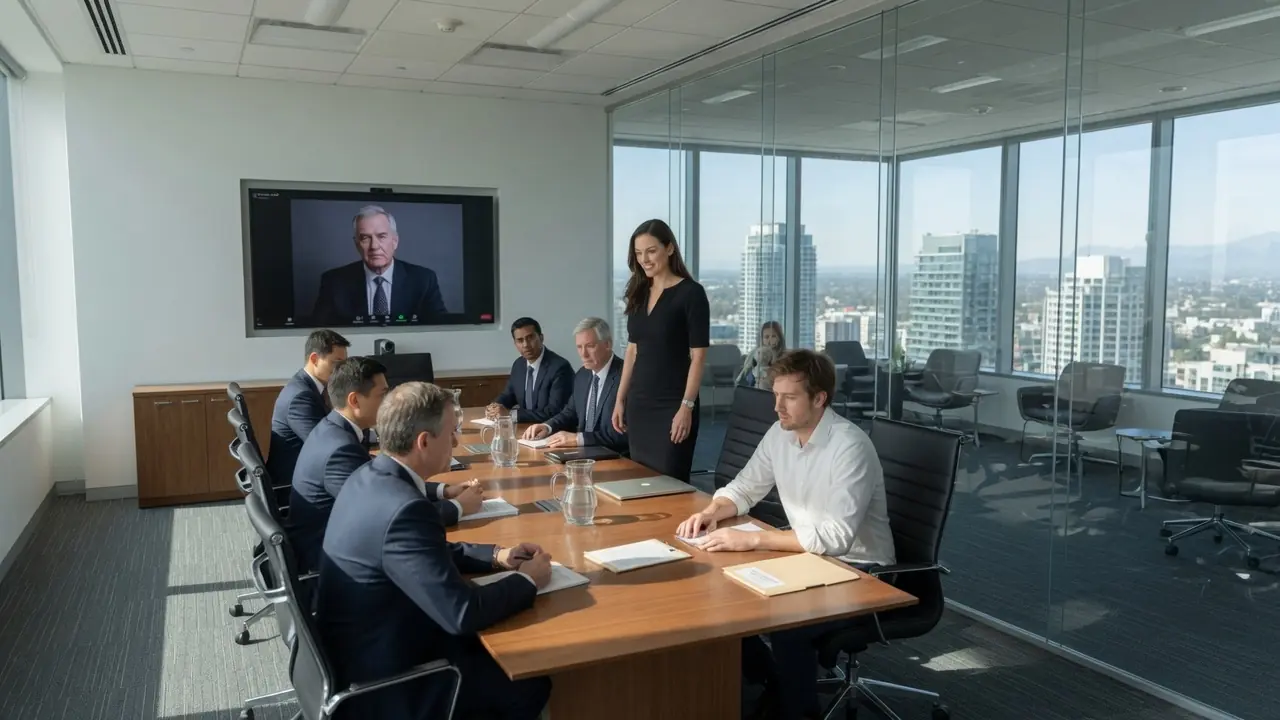
She answered early questions crisply, without notes. She was not a placeholder. She was a leader in training, and she meant for the room to see it. Finn sat at the far end, nearest the display controls.
No one introduced him by title. He understood. After the morning, he had not expected a seat nearer the middle. He opened his laptop to the shared slides and made himself useful.
Then the partners began to probe the operational details, and small cracks began to open. One delegate asked about the winter buffer on the northern lane. Astrid answered nine days. The correct answer, given the revised schedules, was 11 days.
Finn wrote the correction on the corner of a legal pad, tore it off, and slid it along the table at a pace designed not to catch the eye. Astrid’s gaze dropped for a half second, rose again, and she said smoothly, “I want to revise that. Our confirmed buffer is 11 days, accounting for the updated ice windows.”
She said it as if she had remembered on her own. Another partner asked about the priority order during coastal storm events. Astrid gave a clean outline and missed a carve-out. Finn wrote another note.
She read it. She folded the clarification into her next sentence. Clinton’s jaw began to tighten. Leon, seated two away, kept his pen above his notepad and did not put it down.
The delegation began to notice that someone near the wall was doing quiet work. Astrid noticed, too. She felt the small, bright anger of a person who had just been helped by the one person she had told herself she did not need. It did not feel like gratitude.
It felt like a debt, and she did not like debts. The senior delegate, a man with silver hair and kind eyes, turned over a page in his binder and cleared his throat.
“I want to return to the addendum on multi-port disruption,” he said. “In the version we received last night, the structure of loss sharing was adjusted. Could you walk us through how your side evaluated the impact if two or more strategic ports experience disruption simultaneously during a strike season or a severe weather window?”
The room went quiet in a way that no one in the room could mistake. Astrid answered the way she had rehearsed. She said the company had accepted a more flexible responsibility structure to ensure speed and trust. She used the word confidence four times.
She did not describe the waterfall. She did not need to lie outright. The language she used simply did not mention the edge the company was now standing on. The delegate listened.
He did not nod. He turned half a page and waited. Finn looked down at his laptop. He looked at the corner of the legal pad where the notes to Astrid had been.
He thought of Callista downstairs with her sketchpad, a juice box, a rabbit. He thought of the inhaler in her backpack and the rescheduled specialist. He thought of Leon’s voice earlier, flat with exhaustion.
“If you want this reopened, you will be doing that on your own.”
The delegate on the other side was waiting for someone at the Whitmore table to tell the truth. Finn lifted his head.
“If I may,” he said without rising.
His voice carried the way calm voices do in rooms that have just gone still.
“The current addendum differs from the structure operations reviewed two weeks ago. In the scenario you described, the revised language concentrates a disproportionate share of loss on our side. I believe it is right for this room to see the difference before we go any further.”
Astrid turned toward him slowly. For a beat, she looked like someone who had been trained by a decade of boardrooms for exactly this moment and found that none of the training had prepared her for the tone Finn had just used, which was neither challenging nor apologetic. It was factual. It was the tone of a man who had nothing to prove and nothing to hide.
She chose power. She leaned back in her chair, smiled the smile that had ended other meetings in her favor, and said, “Try me again. I dare you.”
It was not loud. It was the opposite of loud. She believed the room was still hers. She was wrong.
Finn looked at her for two full seconds. He was not angry. He was not pleased. He was simply done waiting.
“I do not need to try you again,” he said. “I only need to show the room what was missed.”
He turned to the senior delegate. “May I have 60 seconds to display a document?”
The delegate nodded once, slowly. Finn connected his laptop to the screen. The logo of Whitmore Global appeared and then was replaced by a clean date-stamp timeline. What followed took a little under 10 minutes.
In those 10 minutes, the architecture of the meeting changed. He opened, first, the memo he had sent on Thursday to legal and operations, flagging the multi-port clause and requesting a written response. He opened Leon’s two-word reply. He opened the file metadata for the current addendum, showing the revisions saved at 10:52 the night before by a senior account.
He opened a side-by-side of the old language and the new, annotated cleanly in plain English so that every non-lawyer in the room could follow. He opened the risk model with three scenarios: a port strike, a coastal weather event, and a container shortage. Each had dollar figures built from the company’s own historical filings. The total exposure under the revised language, if any two of the three scenarios overlapped within a single quarter, came to slightly over $700 million.
No one interrupted. Leon’s face went the color of old paper. Clinton kept his expression in place, but a small sheen had appeared above his collar. The partners read along in their own binders, pen tips moving down margins.
On the screen at the end of the room, the camera caught George Whitmore leaning forward. His voice, when it came through the speaker, was quiet and clear.
“Pause the signing.”
Finn opened one final file. It was a short internal note he had found in the system, written as a bullet list in a strategy document, referring to the operations team’s concerns about the addendum as, in its exact phrase, “risk-averse thinking that must not be allowed to slow a defining deal.” The author field showed a name every Whitmore employee at the table recognized.
Clinton did not move. He did not look at Astrid. He looked instead at the carpet. Astrid sat very still.
She had not been made a fool in front of this room. She had been shown, plainly and without cruelty, that she had been led. The difference mattered. She understood that the difference mattered only if she did something with it.
It was at that moment that the conference room door clicked softly open. No one had called for Callista. She had simply waited long enough. She stood in the doorway in her blue cardigan and sneakers, the rabbit pressed against her chest, her hair a little flattened on one side from the lounge chair.
She looked around the room at all the grown-ups she did not know, and then her eyes found her father, and the tightness went out of her small shoulders all at once.
“Daddy,” she said, “can we go home? I am hungry.”
No one spoke for a few seconds. The senior delegate’s pen paused above his page. One of his colleagues set down a water glass without a sound. The video feed of George Whitmore showed him taking a slow, careful breath.
Finn did not stand right away. He simply looked at his daughter with the same steadiness he had given the clause. And for a moment, the entire weight of the morning, the closed doors, the chirping badge, the empty folder access, the quiet human resources email, the long silence at the end of a table meant to make a man small, all of it sat visible on his face. He did not need to explain any of it.
The room understood.
Astrid stood up. She had been raised among boardrooms. She had been told that leaders did not apologize in front of partners. She decided in that second that whoever had told her that had been wrong.
She walked around the table with her heels steady on the carpet and stopped a respectful distance from the door. She did not touch the child. She looked at Finn.
“Mr. Corbin is right,” she said, her voice clear enough to carry to the video feed. “He raised his concerns on Thursday through proper channels. Those concerns were not answered in good faith. The addendum was altered last night under pressure I allowed to exist in this building. The internal review earlier today reached the wrong conclusion about the wrong person. And I let it happen.”
“If this deal had been signed as it stood, this company and our partners would be in a position none of us could accept.”
She turned her face just slightly toward the screen. “Chairman, I am asking that the signing be suspended until the original clause is restored and the authorship of the overnight edit is reviewed.”
George Whitmore’s face in the screen did not move for a moment. Then he nodded once.
“Suspension approved. I want a full audit by end of business tomorrow. Mr. Mercer, you will hand over your drafts and correspondence to internal counsel this afternoon. Mr. Hawthorne, you will cooperate fully. Acting chief executive, your signing authority on this deal is paused pending the audit.”
He softened just for a second. “Thank you, Mr. Corbin.”
Finn nodded. He still had not spoken since Callista had come through the door. He crossed the room and knelt in front of his daughter. He pushed a strand of hair out of her eyes.
“You were so good today,” he said. “So good. Let us go get lunch.”
“Okay,” she said.
She held the rabbit up to him to carry as well, and he tucked it under his arm the way he always did. He stood, took her hand, nodded once to the delegation, and walked out. The door closed behind them with a quiet click. Only then did the room begin to breathe.
In the week that followed, Whitmore Global moved slowly and carefully. Finn’s folder access was restored before the end of the day. His badge stopped chirping. The human resources email was replaced by a new one that referred to the prior one as a procedural error and apologized without flourish.
Colleagues who had avoided his eyes came by his cubicle on small excuses. He was polite with all of them. He did not make anyone feel small. He also did not make forgetting easy.
Clinton Mercer was placed on administrative leave during the audit. Within 10 days, his departure was announced as a mutually agreed transition. Leon Hawthorne kept his job for the moment, but he was moved out of the corporate counsel role and into a quieter compliance position. The company issued a short internal note about the incident that did not use Finn’s name.
The people who mattered knew whose name belonged in it. The multi-port clause was restored in its original form. The partners, who had been watching carefully, said they would sign. They said, in a line their senior delegate made a point of delivering in person, that they had decided to move forward because they had seen how this company handled a hard moment, not only how it handled an easy one.
Astrid came to find Finn one evening after the office had mostly emptied. She did not come in heels. She wore flats and a soft gray sweater, and her hair was pulled back simply. She stood at the edge of his cubicle and waited until he looked up.
When he did, she did not lead with a speech. She led with three words.
“I was wrong.”
Finn did not answer right away. He did not need to make it easy. He also did not want to make it harder than it had to be. He set his pen down.
“I was wrong about the clause,” she said. “I was wrong about the review. I was wrong about how I spoke to you in that room, and I was wrong about your daughter being in this building. I let that become a way to make you smaller. It should never have been.”
She took a small, steady breath. “I am not asking for forgiveness today. I am telling you that I know the difference between what I did and what I should have done.”
He let the silence settle for a moment.
“Thank you for saying that,” he said. “It matters.”
Then he added, carefully, “The thing I almost lost this week was not my pride. It was health insurance, rent, a specialist appointment, and a daughter who already knows what it feels like to wait. I want you to understand that before we go any further.”
She nodded. She understood.
Ten days later, he was offered the role of senior operations director with a team of his own, a seat at the deal review table, and a pay step that made his monthly math less cruel. The human resources lead asked him, almost as a formality, what questions he had about the package. He had one.
“Does this role allow me flexibility when my daughter is sick?”
The lead paused. It was not the question she had prepared for.
“Yes,” she said. “Yes, it does.”
He thought about it for two days, and then he accepted.
On a Friday evening a few weeks after that, Astrid Whitmore happened to be in the lobby when Finn came down from his new floor with Callista at his side. The little girl was telling him about a drawing she had made of a house with too many windows. He was laughing softly. They did not notice Astrid at first.
She was alone, between meetings, standing near the tall windows, and for a few seconds she did not step forward. She only watched. She had spent her adult life believing that power was the capacity to make a room fall silent when she spoke. In the last few weeks, she had learned that real power was sometimes the patience to stay quiet long enough for the truth to stand on its own and then to speak at the right moment, not for the sake of the ego, but for the sake of what needed to be protected.
Finn saw her as they reached the door. He lifted his hand, not quite a wave, and she lifted hers in return. Callista looked up at him, curious.
“Who is that, Dad?”
“Someone I work with,” he said.
“Is she nice?”
He considered it.
“She is trying to be,” he said. “That counts for something.”
They walked out into the late afternoon light. Astrid watched them go until they reached the car, and then she turned back toward the elevators, the sound of her heels softer than it had been on the morning she had said five cold words to a man at the far end of a conference room. She did not know yet what kind of leader she would become.
She did know that she had met one once on a day that nearly ended badly for everyone, and she had learned from him that the strongest voice in a room is not always the one that speaks first or loudest. Sometimes, it is simply the one that tells the truth kindly at exactly the right time with a small child waiting patiently on the other side of the glass.