The Hartwell Ballroom held 216 people on a Thursday evening. Maud Selwyn had counted them. Not out of curiosity, out of the particular discipline required to stand in the center of a room and feel, with some precision, exactly how invisible one had become. 216 people, 41 conversations, 11 glances in her direction, none of them intended. She was holding a glass of lemonade that had gone warm.
"You've been holding that for 20 minutes," said Mrs. Agnes Plum, arriving at her elbow without announcement, as was her habit. "The lemonade, it's not going to improve." "I'm aware." Mrs. Plum took the glass from her hand, set it on a passing tray, and replaced it with a fresh one. She did this without looking at Maud, which was, Maud had come to understand, her particular form of kindness.
The music shifted. Somewhere near the east wall, a woman laughed, bright, deliberate, aimed, and two heads turned toward Maud, with the careful indirection of people pretending not to look. Her fingers found the broken watch chain in her coat pocket. The clasp had snapped 6 months ago. She hadn't had it repaired. She wasn't sure why.
Then the room changed, not loudly, just rearranged itself, the way a room does when something enters that it wasn't expecting to have to accommodate. Maud looked up. The Duke of Arborne was standing at the top of the entrance stairs. He was not surveying the room. He wasn't doing anything in particular. But 215 people had noticed him, and one of them, Maud counted herself briefly among the 215, had stopped breathing for just a moment longer than was strictly necessary. He wasn't looking at her. She put that fact away somewhere careful and took a sip of her lemonade.
The Duke of Arborne did not dance. This was known. This was, in fact, one of the more reliable facts about him, more reliable than his rumored income, more reliable than the various explanations offered for his first marriage, more reliable than anything the gossip columns had printed about him in the last 6 years. He arrived at balls. He spoke to the necessary people. He left. He did not dance, which made it rather difficult to explain what he was doing standing in front of Maud Selwyn at 20 minutes past 10 with his hand extended.
She looked at it. The room, all 216 of it, went very quiet in the particular way that meant everyone was now listening while pretending to do something else entirely. "Miss Selwyn," he said. That was all. No elaboration. No social performance. Just her name and his hand and the faint suggestion that he had considered this before doing it.
She should have said no. There were 12 good reasons to say no and she had the presence of mind to identify most of them in the four seconds she stood there. Her reputation was already a complicated thing. A dance with Arborne would be discussed. A dance with Arborne would be remembered. She took his hand.
He danced correctly. Of course he did, but he also, and this was the part Maud had not anticipated, talked. "You were counting the room," he said. Not an accusation. Not quite a question. "I was not." "You looked at the east wall four times, the same corner." "There's nothing there worth looking at." She considered denying it. "It's a useful habit," she said instead. "When one would rather not be looked at, it helps to know where the looking is coming from."
He was quiet for a moment. "Then, does it work?" "Occasionally." It didn't tonight. She had no answer for that. She filed it away in the same careful place she'd put the fact of him not looking at her earlier and focused on the middle distance.
"You've been coming to these things for three seasons," he said. It wasn't a question, either. "You keep track?" "No. Mrs. Plum mentioned it." Maud looked at him. He was watching the room over her shoulder. Not dismissively, she thought. More like a man who had learned at some point that watching a room was safer than watching the person in front of him. She understood that.
"She talks about me?" Maud asked. "She talked about you once, in some detail." He paused. "She is not a woman who repeats herself." The music shifted into its second phrase. Around them, other couples moved and turned and performed the various rituals of being seen together in public. Maud was aware, with some precision, that she and Arborne were the subject of at least 14 separate conversations happening at this moment across the ballroom.
"You know this will be discussed," she said. "Yes." "You did it anyway." He looked at her then, directly, briefly, with an expression she couldn't immediately name. "Yes," he said again.
The music ended. He returned her to Mrs. Plum with the correct number of words and the correct degree of formality. And then he was gone, back into the room, back into the careful distance he seemed to carry with him everywhere. Mrs. Plum handed her a fresh glass of lemonade. "He asked after you," the old woman said. "Not about you. After you. There is a difference, Miss Selwyn." Maud held the glass. She did not ask what the difference was. She already knew. That was the problem.
Philippa Stuart found her by the window at half past 10. This was how it always was with Philippa. She found you, as though your location were something she had been keeping track of all evening, as though arriving at your side were a natural conclusion to some private calculation. "You danced," Philippa said. Her voice was warm. Her voice was always warm. "I did." "With Arborne." She said his name the way one might say the title of a book everyone had read but no one discussed in polite company. "Maud, half the room is still recovering." "I noticed."
Philippa touched her arm. Brief, light, the gesture of a woman expressing concern with great economy. "I only hope it doesn't complicate things. People do talk, and you know how it's been since, well..." She stopped. Let the "well" sit there, generous and terrible. "I simply don't want anything to make this season harder for you than it's already been." "That's kind," Maud said. "I mean it." Philippa's eyes moved once, just once, across the room toward Lady Forsyth, who had the sharpest tongue in three counties and the widest social reach in two. "You know I always mean it." She squeezed Maud's arm and moved away, already turning toward Lady Forsyth with a small, private smile.
From across the room, Mrs. Plum watched Philippa go. "At least Miss Stuart was beside you," she would say later to Maud. "A friend like that is worth something in a room like this." Maud would not correct her. She would think about correcting her for the rest of the evening.
She did not expect to see him again that evening. She was in the library, not hidden, exactly, but sufficiently removed from the ballroom that the music reached her only as a low, muffled suggestion of itself. She'd come for 5 minutes of quiet. She had been there for 20. Arborne walked in at quarter past 11. He stopped when he saw her. She stopped when she saw him. "I was looking for Hartwell," he said. "I was told he might be here." "He isn't." "No. He didn't leave." He looked at the room, the shelves floor to ceiling, the single lamp burning on the desk, the rain beginning against the window, with the expression of a man who had not, perhaps, been looking for Hartwell at all.
"Do you read, Miss Selwyn?" "Everyone reads. Everyone owns books." "It isn't the same thing." She considered him. "What's the difference?" "The ones who read have opinions about the ones they've read. The ones who own them have opinions about the ones they haven't." He moved toward the nearest shelf, ran one finger along the spines without pulling anything out. "Hartwell owns books." Something loosened in her chest, just slightly, just enough to be noticeable.
"Scott," she said. "I find him overlong. The landscapes go on." "They do." "You've read him." "Against my better judgment, twice." He turned. He was looking at her again with that directness she still hadn't learned to anticipate. "What else?" They talked for, she would not count the minutes, she decided, and then counted them anyway. 14. 14 minutes about books, about which ones went on too long and which ones ended too soon, about the particular dishonesty of happy endings, and whether readers deserve to be lied to for their own comfort.
He said, "Most people prefer the lie." She said, "Most people haven't considered the alternative." He looked at her in a way that made her think he was going to say something. He didn't. He picked up a book from the desk, Hartwell's presumably, turned it once in both hands, the way one handles something that belongs to someone else, and set it back down. Both hands, she noticed. Always both hands, as though the thing deserved the care. She filed that away, too, in the place that was getting crowded.
"I should return?" She said. "Yes," he said. He didn't move. She was the one who left.
By Friday morning, the story had a shape. By Friday afternoon, it had details. By Saturday, it had become the kind of fact that no one could trace to a source, because it had passed through enough mouths to feel, by now, entirely self-evident. Miss Maud Selwyn had been found alone with the Duke of Arborne in the Hartwell library. At night. The door had been closed. Or nearly closed. Or open, but the kind of open that might as well have been closed. The details varied. The conclusion did not.
Maud heard it first from her aunt, who had heard it from Mrs. Cavendish, who had apparently heard it from no one in particular, but was very certain of the facts. Her aunt sat across the breakfast table with the expression of a woman managing a crisis she had not budgeted for and said carefully, "I'm sure it was nothing, but you understand how it looks." Maud understood exactly how it looked.
She also understood, with the cold particular clarity of someone who had been invisible long enough to know what visibility cost, that the library had been empty except for herself and Arborne. That 14 minutes of conversation about Scott and happy endings had been witnessed by no one, except perhaps for whoever had been walking past the door. Whoever had thought to mention it.
She went to Philippa that afternoon. Philippa was in her sitting room arranging flowers and looked up with an expression of such immediate, practiced sympathy that something in Maud's chest went very still. "I've heard," Philippa said before Maud could speak. "It's dreadful, truly. I've already told two people it was completely innocent. You know I'd never let something like this go unchallenged." She set down the flowers and crossed the room and took both of Maud's hands in hers. Her grip was warm, firm, the grip of a woman who wanted to be believed. "You trust me, don't you?" Maud looked at her, at the sympathy she had always trusted, at the hands holding hers. "Yes," she said.
She walked home in the rain and stood at her window for a long time watching the street below, turning the broken chain over in her fingers. She had been here before, the sensation of something approaching that she couldn't yet name, couldn't yet locate, couldn't yet prove. The watch was at home in its box. The chain was here, in her hand. She still hadn't had it repaired. If she trusted the wrong person, she was already out of time.
He came to call on Tuesday morning. Morning calls were made by women for women in the careful language of social obligation. A duke did not appear at a respectable household's door at 10:30 on a Tuesday with his card and no prior arrangement. Arborne did. Maud received him in the morning room. Her aunt left the door wide open, pointedly open, and withdrew.
He sat. He looked at her. "I know what's being said." "Yes?" "I intend to correct it." "How?" He was quiet. Outside a carriage moved slowly past the window. The sound of it filled the room and left. "My first wife," he said and stopped. Maud did not move. He looked at the window. Then back at her. The expression on his face was not grief. It was older than grief, more settled. The expression of a man who had carried something so long he had stopped noticing the weight and had just unexpectedly noticed it again.
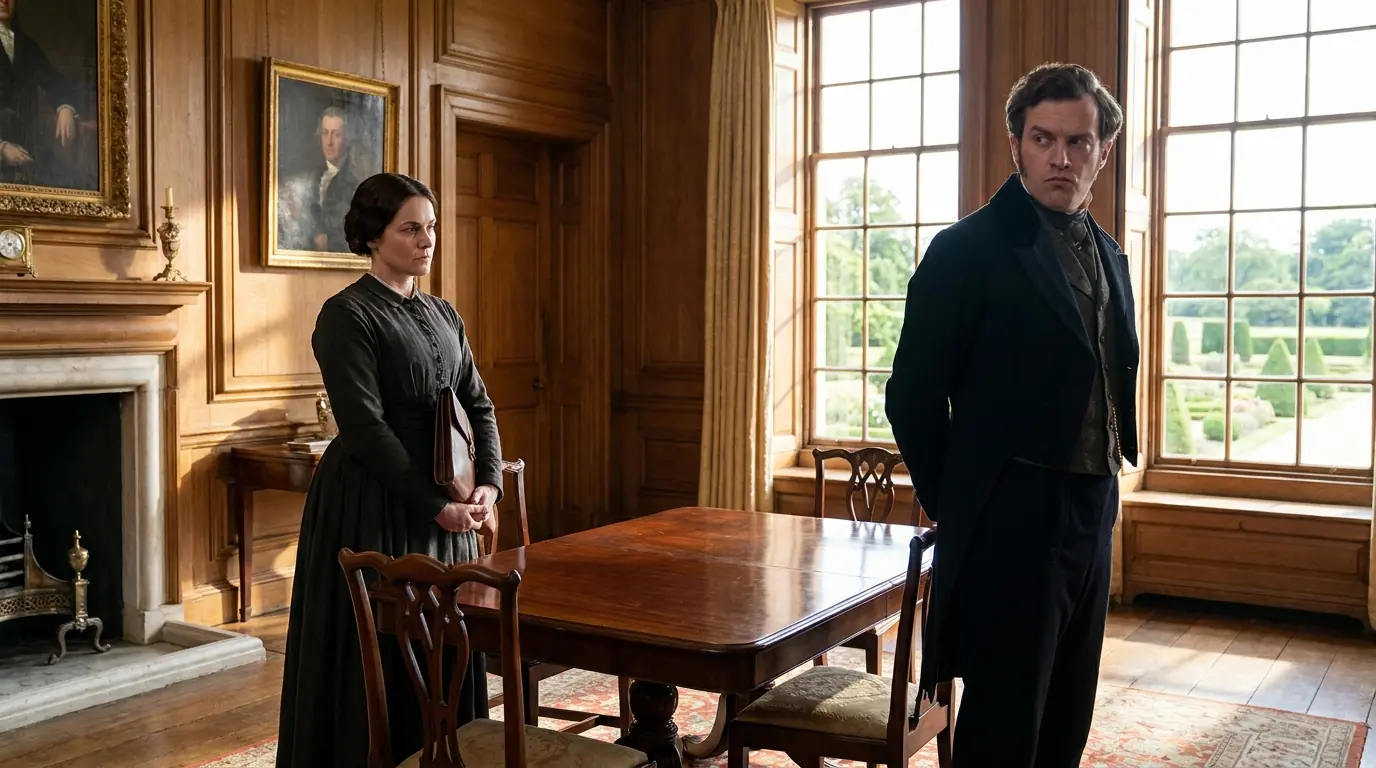
"She was unhappy," he said. "I didn't know how to fix it. That is the whole of it and I have never said it to anyone." The room held the sentence. He collected himself quickly, cleanly. "I will speak to the relevant people," he said. "The matter will be addressed." He stood, picked up his gloves from the table, both hands, always both hands, and left.
Maud sat in the morning room for a long time after. She was not thinking about the scandal. The Pembridge dinner was on Wednesday. Mrs. Plum said, "Absence is its own kind of statement, Miss Selwyn, rarely the one you intend." She went.
Philippa was already there, seated near the head of the table but with the ease of a woman entirely at home in any room she chose to occupy. She caught Maud's eye and smiled. Warm, immediate, the smile Maud had trusted for three years. Maud smiled back.
It was Lady Forsyth who said it. Halfway through the second course, in the tone of a woman raising a concern that pained her. "I do think it speaks to the question of judgement, not the incident itself. I'm sure it was innocent, but the pattern. Three seasons of these small," she paused, selected carefully, "irregularities." The table heard it. Maud looked at her plate, at the fish she hadn't touched. She counted the seconds it took for the conversation to move on. It moved on quickly. It always did.
After dinner, Philippa found her in the hall. "She's dreadful," she said, touching Maud's arm. "Everyone knows she's dreadful." Maud looked at her, at the warm eyes, the careful grip. There was something there, just for a moment, a tightness around the mouth that was not quite guilt and not quite satisfaction, and was somehow horribly both. Then Philippa smiled, and it was gone. "You have friends," Philippa said. "Remember that."
Maud found her coat. She left.
By Thursday morning, she knew. Not the whole of it, but the fact of it, settled into her chest sometime between Wednesday night and Thursday dawn with the quiet finality of something that had always been true and had been waiting for her to stop not knowing it.
The alternatives arranged themselves clearly. She could say nothing, absorb the damage, survive this season as she had survived the others. She could confront Philippa directly and be met with warmth and denial and the devastation of not being believed. She could leave London entirely. Her aunt would call it a rest. Everyone else would call it confirmation. Each option had a cost.
She looked at each one. She was still looking when Arborne's note arrived. Three lines in handwriting that did not perform itself. "I have spoken with Hartwell. He confirms the library was empty that evening except for ourselves. I intend to make that known. I wanted you to be aware before I did. Arborne."
She read it twice. He had not asked her permission. He had simply told her what he intended and given her the courtesy of knowing first, as though her knowledge of a thing that concerned her were a given rather than a gift.
She reached into her coat pocket. The broken chain was cold. She thought about Philippa's hand on her arm, about "you trust me, don't you?" About the way a question can be a door held shut from the other side.
She wrote one letter. Not to Arborne, to Philippa. Six sentences. The last: "I will not be requiring your particular form of friendship any longer." She sealed it before she could reconsider. Then she sat with what she'd made irreversible. The friendship was gone. Three years of it. The shared mornings, the borrowed novels, the hand on her arm in every difficult room. Gone, and she had been the one to end it.
She opened her fingers. The broken chain lay in her palm. She set it on the desk, left it there.
He came that afternoon. Her aunt showed him in with the expression of a woman who had stopped trying to manage events and decided instead to witness them. They sat in the morning room. The door was open. The house was quiet in the way houses go quiet when everyone in them is listening.
"You didn't ask me to fix it," he said. "No." "Why?" "Because it wasn't yours to fix. It was mine to decide what to do with it." He looked at her for a long time. She did not look away. "I know," he said. Two words. Their weight was out of all proportion to their size. Maud felt the room hold them the same way it had held his sentence about his wife and did not reach for anything to fill the silence. They sat with it. That was enough.
By Friday, London had a new story. The Duke of Arborne had called on Miss Maud Selwyn twice. The second time, he had stayed for 40 minutes. Her aunt had been present for none of it, or all of it, depending on which version one preferred. Hartwell had apparently confirmed something to someone, and that something had passed through the correct channels with unusual speed. The irregularities were no longer being discussed.
Philippa Stuart attended the Cavendish musical that Saturday. She was received. She was spoken to. But somewhere between the first piece and the interval, a small and nearly imperceptible thing had shifted. The way a room rearranges itself around an absence rather than a presence. No one cut her. No one needed to. She sat through the second half of the program with her hands folded in her lap and her smile entirely intact and left before the final applause.
Maud was not there to see it. She had not been invited. She had sent her regrets the week prior, before any of this, before the note, before the morning room. And had not, in the end, been sorry.
He found her in the Hartwell Library again. This time he had not been looking for Hartwell. She was standing at the window watching the rain move across the garden below. She heard him come in. She did not turn immediately. Not from coldness, but from the particular luxury of knowing she didn't have to.
"The chain?" he said. She turned then. He was looking at her coat pocket, at the faint outline of nothing, the absence of the small habitual weight she had been carrying for 6 months. "I left it at home," she said. "To be repaired?" She considered the question genuinely, not quickly. "To decide what to do with," she said. "I haven't yet."
He crossed the room. Not quickly. The way a man moves when he's being careful not to frighten something that is not, actually, frightened. But that has been frightened before and deserves the care regardless. He stopped in front of her. Close enough that she would have had to take a deliberate step back to create distance. She didn't.
"I should tell you," he said. "That I am not good at this." "At what?" "At," he paused. "Selected." "At being known." She looked at him, at the face she had been reading for 4 weeks, the careful composure, the places where it had cracked and he had not quite managed to repair them before she saw. "Neither am I," she said.
Something shifted in his expression. Not relief. Deeper than relief. The look of a man who had said a true thing and been met with another true thing and had not known until this moment how much he had needed that.
He reached into his coat pocket. He set a watch chain on the window ledge between them. Gold. Unbroken. Not hers. She could see that immediately. New. He said nothing.
She picked it up.
One year later, Miss Maud Selwyn, she would keep the name, she had decided, she had earned it, attended the Hartwell ball. She did not count the room. She stood near the window with a glass of lemonade that was still cold, which was a small thing and also not a small thing, and she watched the chandeliers burn and the couples turn and the careful machinery of the London season perform itself with its usual magnificent indifference.
Mrs. Plum appeared at her elbow. "You are not doing the thing," Mrs. Plum observed. "No." "The standing very still so no one notices thing." "No," Maud considered. "I don't think I need to anymore." Mrs. Plum looked at her, at the watch chain at her collar, gold, catching the light, worn not tucked away, and made a sound that was not quite a comment and not quite approval and was, from Agnes Plum, as close to both as one was likely to receive.
Arborne found her 20 minutes later. He did not ask her to dance. He stood beside her at the window and they watched the room together, the same room, the same chandeliers, the same music playing slightly too loud for conversation, and she was aware, with the same precision she had once used to count absences, that she was not invisible. She had not been invisible for some time. She thought she might be getting used to it.