There is a category of audacity that transcends ordinary entitlement.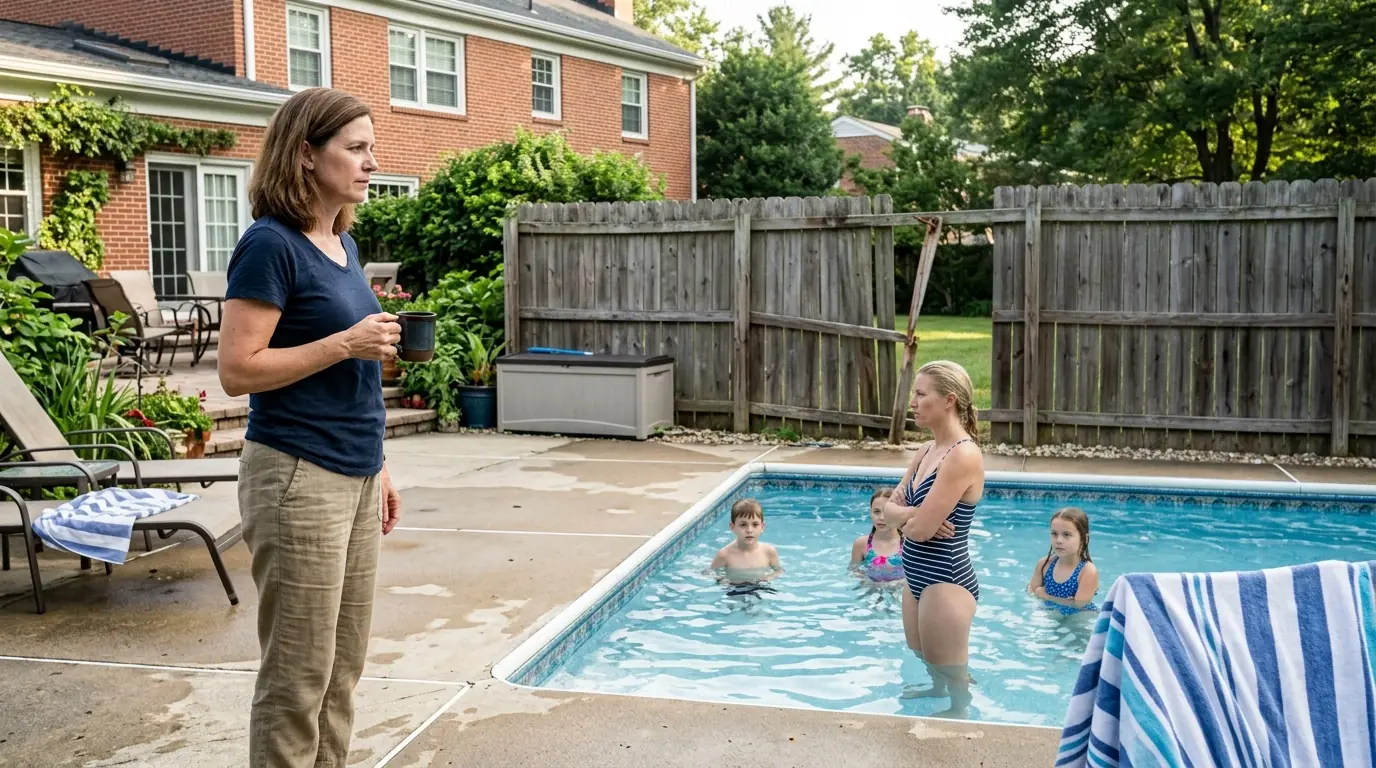
Ordinary entitlement is someone parking in your assigned space and acting irritated when you ask them to move.
Ordinary entitlement is a neighbor attaching holiday lights to your side of a shared fence without asking because, technically, you probably were not using that particular board.
Ordinary entitlement is someone allowing their dog onto your lawn every morning because they have decided the first three feet of your property belong emotionally to the neighborhood.
These things are annoying.
They create friction.
Sometimes arguments.
But they still exist within a recognizable relationship between reality and belief.
What I am describing happened outside that category.
What I am describing is a woman who used my swimming pool without permission for seven months, repeatedly entered my fenced backyard after being told explicitly not to, forced open a section of fence I had repaired specifically to prevent her access, received a written certified notice informing her that further entry would constitute trespass, was personally warned by a police officer to stop entering my property, and then, after all of that, arrived at my front door accompanied by two uniformed police officers and announced that I had damaged her property because I had drained my own swimming pool.
Not metaphorically hers.
Not “ours” in some vague neighborhood sense.
Hers.
She told two police officers that the twenty-two-by-forty-four-foot concrete pool in my backyard belonged to her and that I had no right to drain it.
That is not merely entitlement.
That is a person confusing repeated access with ownership and then attempting to formalize that confusion by bringing law enforcement into the argument.
Fortunately, the officers who came to my house did not accept confidence as evidence.
They asked questions.
Then more questions.
They examined property records.
Permits.
Invoices.
Certified mail.
Security footage.
Insurance documents.
Maintenance records.
And because I am an accountant and therefore psychologically incapable of encountering a recurring problem without eventually creating a labeled folder for it, I happened to have all of those things waiting for them.
The documentation file was approximately two inches thick in printed form.
Its digital version contained thirty-seven video clips, fourteen photographs, contractor invoices, correspondence, certified mail receipts, county records, and a chronological incident summary.
Officer Martinez looked at it for nearly twenty minutes before saying:
“You've been expecting this conversation.”
I answered honestly.
“Not this exact conversation.”
I had not predicted Sandra would claim ownership.
I had only predicted that eventually I might need to prove what had actually happened.
There is a difference.
My name is Rachel Pemberton.
I was forty-seven years old when the situation reached its most absurd point.
I work as an accountant specializing in commercial property and small-business financial management.
That means I spend most of my professional life looking at things other people prefer to consider boring until suddenly those things become important.
Receipts.
Contracts.
Dates.
Bank statements.
Invoices.
Insurance declarations.
Documentation does not feel important while everything is functioning normally.
It becomes important the exact moment two people remember the same event differently.
I learned that early in my career.
One missing signature could become a thirty-thousand-dollar disagreement.
One undocumented phone conversation could become months of litigation.
One vague sentence could cost someone far more than spending ten minutes writing a clear one.
So I document.
I have folders for household repairs.
Vehicle maintenance.
Insurance.
Taxes.
Medical records.
Appliance warranties.
I once found a nine-year-old receipt for a water heater in under four minutes.
My younger sister calls this behavior pathological.
My attorney calls it helpful.
Both may be correct.
I bought the house at 14 Cloverfield Road fifteen years before the police appeared at my door.
The neighborhood was quiet, older, and comfortably unremarkable.
Most homes had been built between the late 1970s and early 1990s.
Large maples lined the sidewalks.
Children rode bicycles between driveways.
People generally knew the names of the neighbors immediately beside them and perhaps three or four houses beyond that.
The house itself was a two-story brick colonial.
Three bedrooms.
Two and a half bathrooms.
Attached garage.
A backyard large enough to justify owning a riding mower, which I initially considered excessive until my first July there.
The backyard was one of the reasons I bought the property.
It was wide, private, and mostly level.
There was already a six-foot wooden privacy fence along both side boundaries.
No pool.
I had always wanted one.
My parents had never owned a pool.
When I was a child, swimming meant the municipal recreation center or begging invitations from friends whose parents had pools.
There was something about stepping outside your own back door and entering cold water on a ninety-degree afternoon that seemed, to me, like an almost unreasonable luxury.
So I budgeted.
For three years.
I obtained quotes.
Compared concrete pools with fiberglass.
Researched filtration systems.
Read maintenance estimates.
Asked questions contractors clearly did not expect a customer to ask.
Finally, I hired Aqua Design Solutions.
They installed an in-ground concrete pool twenty-two feet wide and forty-four feet long.
Deep end: eight feet.
Shallow end: three and a half.
Tile border at the waterline.
Concrete coping.
Small equipment enclosure behind the garage.
Nothing especially extravagant.
No waterfall.
No built-in bar.
No elaborate lighting system.
Just a large, well-built pool.
The project required excavation permits, electrical inspection, fencing compliance, and a final county inspection.
I kept everything.
Of course I did.
Original estimate.
Signed contract.
Permit.
Inspection certificate.
Electrical sign-off.
Photographs during excavation.
Change orders.
Proof of final payment.
The pool cost enough that writing the check made me physically uncomfortable.
Then the first summer arrived.
I regretted nothing.
After work, I would come home, change clothes, and swim for twenty minutes.
Weekends became slower.
Coffee outside.
Book beside the water.
Occasional friends.
My nieces visiting.
Long summer evenings when the water stayed warm until after sunset.
For twelve years, the pool was exactly what I had hoped.
A private pleasure.
A place I maintained carefully.
Aqua Design Solutions eventually stopped providing weekly service, and I moved to another company, Blue Water Pool Care.
Every Friday during swimming season, someone came to check chemistry, clean the filters, inspect equipment, and leave a service sheet.
I kept those too.
Twelve years of them.
Sandra Fielding moved into 16 Cloverfield Road nine years after I bought my house.
Her property directly bordered mine along the eastern fence.
She arrived with two children.
Evan was seven.
Molly was five.
At first, Sandra seemed energetic and friendly.
Very friendly.
Within two weeks, she knew almost everyone on the street.
She introduced herself before I had the opportunity.
She came over carrying lemon bread.
“New neighbor tax,” she said cheerfully.
I accepted it.
It was good lemon bread.
Sandra was perhaps forty at the time.
Tall.
Blonde.
Athletic.
She worked from home in some kind of sales-management role and seemed to have endless flexibility during weekdays.
She also possessed strong opinions on essentially everything.
Garbage collection.
Property taxes.
School pickup policies.
Neighborhood landscaping.
Mail delivery.
The correct height for hedges.
The fact that the Johnsons left their Christmas lights up until February.
Sandra was not malicious then.
At least I did not interpret her that way.
She simply had a powerful belief that most things benefited from her involvement.
The first pool conversation happened approximately three months after she moved in.
Saturday morning.
June.
I was pruning roses near the front porch when Sandra approached.
“Rachel.”
“Morning.”
She looked toward the side yard.
“You opened the pool.”
“I did.”
“The kids have been staring at it from the upstairs window for two weeks.”
I smiled.
“I wondered why I kept seeing faces above the fence.”
Sandra laughed.
“They're desperate to swim.”
I knew what was coming.
“Would you mind terribly if they used it occasionally?”
I did not answer immediately.
That is important.
I should perhaps have answered no.
But I liked the children.
They were polite.
And I had no objection in principle to neighbors enjoying the pool sometimes.
“I'll think about it.”
Sandra smiled.
“Of course.”
Two days later she knocked.
“Did you think?”
I had.
“Yes.”
Her face brightened.
“Occasionally is fine.”
“Wonderful.”
“With you supervising.”
“Obviously.”
“And preferably when I'm home.”
“Of course.”
That was the agreement.
Informal.
Neighborly.
Simple.
The word occasionally turned out to be our first serious disagreement.
The first week, Sandra brought the children one afternoon.
I was gardening.
They swam for an hour.