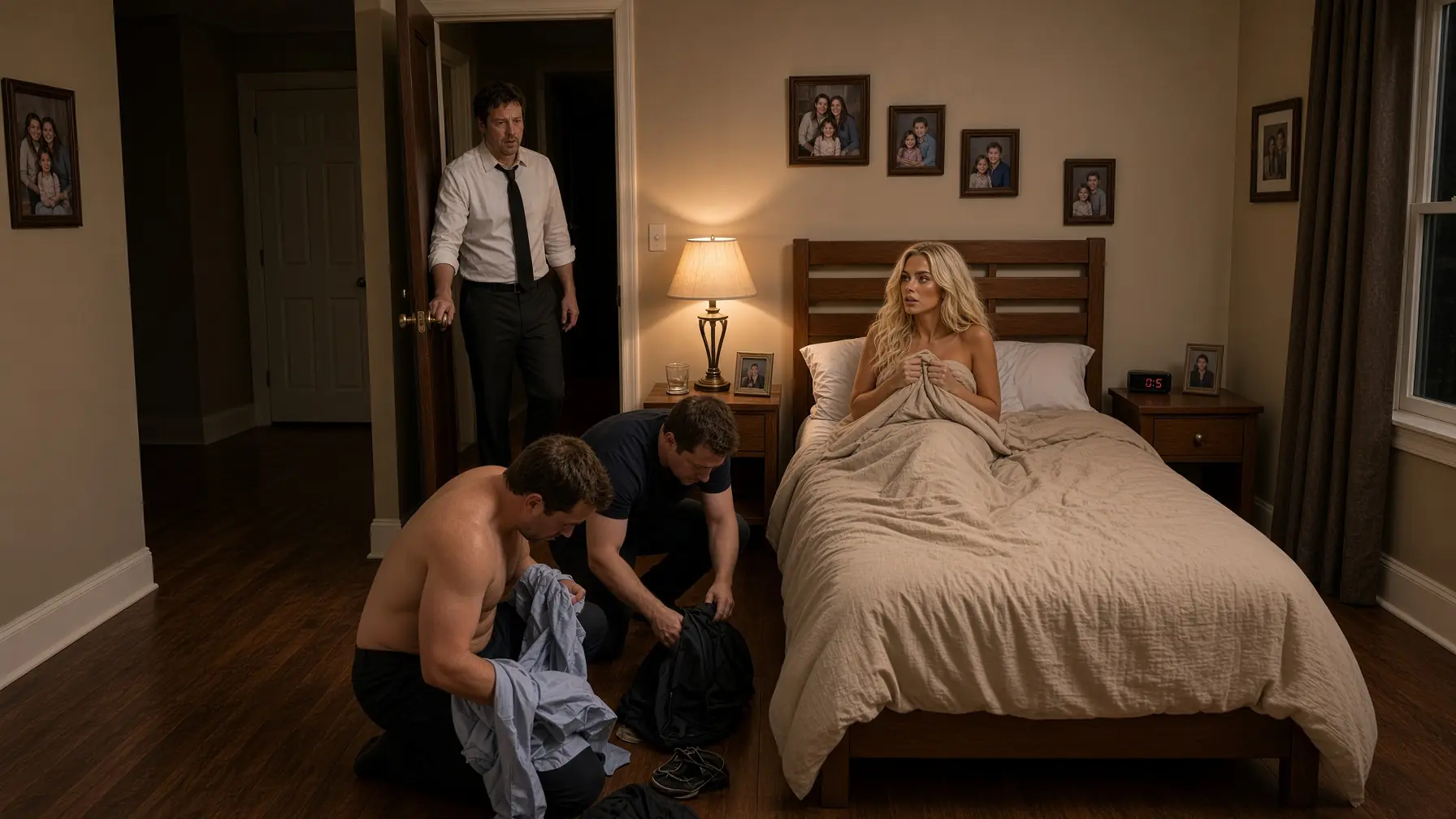
The strange part about ending my marriage was how calm I felt when it finally happened. For almost three years, I had imagined what I would do if I caught my wife lying again, and every version involved shouting, broken furniture, or some dramatic speech I would later regret. Instead, when I opened our bedroom door and saw two men in a bed I had shared with my wife for twelve years, something inside me simply went quiet. I remember thinking, with almost ridiculous clarity, So this is where the story ends.
My name is Aaron Whitaker, and at the time I was forty-one years old, living outside Richmond, Virginia. I was a senior executive for a cybersecurity company, the kind of job that paid extremely well but required long hours, conference calls at strange times, and several trips each year. My wife, Melissa, was thirty-nine and owned a successful pediatric dental practice with another dentist from her residency program. On paper, we were exactly the kind of couple people looked at and assumed had figured life out.
We had three children: Olivia was eleven, Mason was eight, and Claire was six. Our home sat on almost two acres in a neighborhood where people worried about school rankings, landscaping companies, and whether someone’s Christmas lights stayed up too long. We had two nice cars, took at least one major vacation every year, and never had to wonder whether a grocery bill would clear the account. I understood how fortunate we were, and for a long time I believed gratitude itself could protect a marriage.
Melissa and I met when I was twenty-seven and she was finishing dental school. She laughed easily back then, had a habit of stealing food from my plate after insisting she was not hungry, and could spend an entire Sunday morning sitting at the kitchen counter talking about absolutely nothing. We married after three years together and bought our first house before Olivia was born. I was not naïve enough to think our marriage was perfect, but I did believe it was solid.
We argued about normal things. I worked too late, Melissa spent too much on furniture, I forgot school forms, and she occasionally scheduled family activities without checking whether I had a client call. Neither of us threatened divorce, disappeared for days, or used silence as punishment. We fought, cooled down, apologized, and moved forward.
My career accelerated after Mason was born. I became a vice president, then an executive vice president, and my compensation eventually crossed into numbers that still seemed absurd to the kid I had been growing up in a two-bedroom apartment. Melissa’s practice did well too, especially after she developed a reputation for treating children who were terrified of dentists. We were busy, but for several years being busy felt like proof that we were building something.
When Claire turned three, we sold our first house and moved into the place outside Richmond. It had a finished basement, a pool, a guest room, a large office for me, and enough bedrooms that every child could grow without anyone fighting over space. Melissa spent months decorating it, and I remember watching her hang family photographs along the upstairs hallway. I thought those pictures represented our future.
Around that same time, I started buying myself nicer cars. Nothing exotic, but every two or three years I traded up because cars had always been my one expensive weakness. Melissa still drove the Lexus SUV she had bought before Claire was born, and she never complained about it. That made me feel guilty.
For her thirty-sixth birthday, I surprised her with a pearl-white Audi e-tron. Electric cars were still enough of a novelty then that the kids spent the entire afternoon playing with the screens and arguing over who got to sit in front first. Melissa cried when she saw it in the driveway and wrapped her arms around my neck in front of the neighbors. That evening we drove nowhere for almost two hours simply because she wanted to keep driving.
I sometimes think about that day because it sits so close to the beginning of everything that went wrong. I do not believe the car caused anything, obviously, but memory likes landmarks, and that one became mine. Within months, Melissa started changing in ways I initially blamed on work, hormones, exhaustion, or parenting. Almost anything sounded more reasonable than the truth.
She became impatient with the kids. Olivia noticed first because she was old enough to remember the version of her mother who used to sit on the edge of her bed every night and ask questions about school until Olivia begged her to leave. Suddenly Melissa seemed irritated by those same conversations. Sometimes Olivia would walk into the kitchen hoping to tell her something and leave ten minutes later looking embarrassed because Melissa had barely looked up from her phone.
I tried correcting it gently. “Liv misses you,” I told Melissa one night after the kids went upstairs. She immediately became defensive and said I was making her feel guilty for having a demanding practice. I backed off because I knew how difficult her job could be, and because husbands learn quickly that some conversations become arguments the moment timing is wrong.
Then the phone changed.
Melissa had always been someone who left her phone anywhere. Kitchen counter, bathroom sink, passenger seat, couch cushion. Suddenly it traveled with her like a medical device. She took it into the shower, placed it face down during dinner, and changed the passcode she had used for years.
I noticed.
I did not immediately care.
People deserve privacy even in marriage, and I had access to enough confidential company information to understand why phones can become more guarded over time. Melissa also handled patient information and occasionally texted staff members at night. If I had confronted her then, she would have had ten perfectly believable explanations.
The first detail I could not explain came from our family mobile plan.
All five phones appeared inside the same location app. We originally enabled it because Olivia had received her first smartphone and Melissa wanted to know where she was after school. I almost never looked at Melissa’s location because there had never been a reason.
One Tuesday evening in August, I opened the app while trying to figure out whether Olivia had made it to soccer practice. Melissa’s icon caught my attention.
She had told me she was at Pilates.
She was not.
Her phone showed her twenty minutes north of our house in a neighborhood called Westbridge Estates. I knew the area because one of my company’s founders lived there, and the houses started at numbers that made ours look modest.
I assumed the app was wrong.
Phones drift.
Locations lag.
Technology lies all the time.
Melissa came home around eight wearing leggings and carrying the same gym bag she always took to Pilates. She was in a terrible mood, complained about traffic, snapped at Mason over cereal left on the counter, and went upstairs before I could ask anything. I decided that was not the evening to start a conversation about a dot on a map.
The following Thursday, I checked again.
Same house.
The week after that, same place.
Tuesday and Thursday became strangely predictable.
Melissa left wearing workout clothes, stayed at the Westbridge address between seventy and ninety minutes, then drove home. Once she actually went to the Pilates studio afterward for fifteen minutes, which I later realized was probably enough time to create a believable activity record.
I wrote down the address.
That was the first thing I did that made me feel like a suspicious husband instead of a confused one.
The property belonged to a man named Christopher Hale. He was fifty-eight, owned several commercial real-estate companies around Richmond, and appeared regularly in local business magazines because he donated money to universities and hospitals. His online biography included a photograph of him standing beside his wife at a charity gala.
I did not know him.
Melissa did.
Not socially, according to anything I remembered, but his family had been patients at her practice.
I watched for several more weeks.
Some Tuesdays she actually went to Pilates.
Some Thursdays she went nowhere unusual.
Then she returned to Christopher’s house two weeks in a row.
By then, I was sleeping badly.
One evening after the kids went to bed, I sat across from Melissa in our kitchen and asked whether something was wrong between us. She gave me the same exhausted expression I had seen too many times. “Aaron, please don’t start another emotional audit of the marriage tonight.”
I almost stopped.
Then I said, “Where do you go when you tell me you’re at Pilates?”
Her entire face changed.
Not guilt exactly.
Alarm.
“What?”
“I asked where you go.”
“I go to Pilates.”
“Not every time.”
She stared at me.
“How would you know?”
“The family-location account.”
There was a pause.
Then she became furious.
“You track me?”
“I noticed your location.”
“You are monitoring where I go?”
“No.”
“Apparently you are.”
I tried explaining that I had opened the app for Olivia, but the explanation did not matter. Melissa stood from the table and accused me of stalking her, invading her privacy, treating her like a teenager, and secretly building a case against her. Within five minutes, my question about one address had somehow become a referendum on my character.
I let her talk.
Then I asked the only question that mattered.
“Are you sleeping with someone?”
She stopped.
“No.”
“Are you having any kind of relationship with Christopher Hale?”
The silence lasted perhaps two seconds.
Enough.
“Who?”
I looked at her.
“Don’t.”
She became angry again.
“I treat hundreds of families.”
“He owns the house you visit.”
“I have friends.”
“Is he one?”
“This is insane.”
“Then answer.”
“I already did.”
That night Melissa slept in the guest room.
For the next two weeks, our house became almost unbearable. She spoke to me only when necessary, acted deeply wounded that I could suspect her, and told her sister that I had become controlling because of work stress. I started wondering whether I really had crossed some line.
That is what still bothers me.
Not simply that she lied.
That she made the truth feel like a defect in my perception.
One Friday night she found me sitting alone downstairs after everyone went to bed. She stood near the basement stairs for a long time and finally said, “We need to talk.”
I already knew.
Christopher had been seeing her for almost eight months.
She claimed it began emotionally after he stayed late one evening to discuss his daughter’s treatment. He told her his marriage had been unhappy for years, she told him she felt invisible at home, and conversations became texts. Texts became lunches, lunches became visits, and eventually she slept with him.
“How many times?”
“I don’t know.”
“That means enough that counting became inconvenient.”
She looked down.
“Maybe ten.”
“His wife?”
“She doesn’t know.”
“The kids?”
“No.”
“My kids.”
Melissa started crying.
“I know.”
“No.”
I leaned forward.
“You know you have children. That isn’t the same thing as thinking about what this did to them.”
She covered her face.
“I’m sorry.”
I believed her.
That was my mistake.
Maybe not forgiving her.
I still do not believe forgiveness itself is foolish.
My mistake was treating regret as proof of transformation.
Melissa said she wanted our marriage. She deleted Christopher’s number in front of me, blocked him, agreed to marriage counseling, and promised full transparency. She said the affair had frightened her because she finally realized how close she came to destroying the life she actually wanted.
For a while, everything improved.
We started seeing a counselor named Dr. Karen Bell every Thursday afternoon. Melissa talked about feeling lost after motherhood, professional burnout, resentment over how often my work took priority, and missing the version of herself who existed before schedules and children. I listened.
Some of what she said hurt.
Some was fair.
I had become a provider more efficiently than I remained a husband.
I traveled too much.
I answered emails during dinner.
There were times Melissa tried to tell me she felt lonely and I responded by suggesting vacations, date nights, or household help instead of sitting still long enough to understand what she meant.
I owned that.
What I did not own was her affair.
Dr. Bell made the distinction clearly during one session. “Marriage problems belong to the marriage,” she said. “Choosing secrecy belongs to the person making that choice.”
Melissa nodded.
I remember being grateful.
For the first time in months, somebody had separated my shortcomings from her betrayal without pretending either did not exist.
We started having Friday lunches together.
Once a month, we took what Melissa called an “adult day” where the kids stayed with my parents and we did anything that did not involve school calendars or errands. Sometimes we went to a winery. Sometimes we stayed home and watched movies.
The woman I married seemed to return.
She laughed more.
She started talking to Olivia again.
One night I walked past Claire’s room and saw Melissa lying beside her reading a book the way she used to.
I stood in the hallway and nearly cried from relief.
For about a year, I thought we had survived.
I gradually stopped checking locations.
Stopped noticing when her phone moved.
Stopped wondering whether every delayed appointment had another meaning.
Trust did not come back all at once, but enough returned that daily life no longer felt like an investigation.
I threw myself into the children.
Coached Mason’s baseball team.
Helped Olivia with a science project that nearly destroyed our dining table.
Took Claire to breakfast every Saturday because she had entered a phase where pancakes apparently solved all emotional problems.
Work improved too.
The company landed a major federal contract, and I became responsible for a division that required more travel but also gave me greater control over my schedule. Melissa encouraged me to accept the promotion.
“You’ve earned it,” she said.
I asked if she was sure.
She looked almost offended.
“We’re okay now.”
I believed her.
Two years after the first affair, I flew to Denver for what was supposed to be a four-day client negotiation. The meetings mattered enough that our CEO came with me, along with two attorneys and another executive. We expected long days and possibly a weekend extension.
Instead, the client’s lead negotiator developed appendicitis the first evening.
Everything stopped.
Their team suggested rescheduling.
Our CEO wanted everyone home.
I caught a flight the following afternoon.
I thought about texting Melissa.
Then decided not to.
Not because I suspected anything.
That detail is important.
I wanted to surprise her.
My flight landed shortly after five.
I drove home through Friday traffic, stopped once for groceries because I knew we were low on milk, and reached our neighborhood just before seven. Olivia was sleeping at a friend’s house, while Mason and Claire were staying with Melissa’s sister because Melissa told me she had planned a quiet weekend alone.
The first thing I noticed was the vehicle.
A black Range Rover.
Not ours.
Parked inside my garage beside Melissa’s Audi.
The garage door was open.
I sat in my car for maybe twenty seconds.
I remember the grocery bag on the passenger seat.
Milk.
Bananas.
Coffee.
Normal things.
I convinced myself someone from Melissa’s office had stopped by.
Then I saw another car parked farther down the driveway near the side gate.
A silver BMW.
I walked inside.
The kitchen was empty.
Two wineglasses sat beside the sink.
Music played upstairs.
Not loud.
I knew before I climbed the steps.
People sometimes say intuition is mystical.
It isn’t.
Sometimes your brain simply finishes the equation before your heart agrees to look at the answer.
I walked down the hallway.