The grease and bleach smell of the diner was Maya’s whole world from 6:00 in the morning until 6:00 at night. It was a symphony of sputtering bacon, the low hum of the coffee machine, and the clatter of ceramic on Formica. She moved through it like a ghost, her feet knowing the worn paths between tables, her hands refilling coffee cups without a conscious thought. She was good at being invisible, at seeing everything and being seen by no one. It was a skill honed over a decade of serving strangers.
On this particular Friday, the rain outside hammered against the windows, smearing the neon EAT sign into a blurry pink watercolor. The noon rush was dying down, leaving behind a handful of stragglers. In the corner booth, the Iron Guardians sat nursing their beers and coffee. They were a weekly fixture, a rumbling, leather-clad storm cloud that occupied the best table in the house. Their leader, a man built like a refrigerator with a beard that could hide a family of birds, went by Bear. His voice was gravel, his eyes were chips of flint, and his presence took all the oxygen out of the room. He and his men were loud, but they paid well and never caused real trouble. Maya had learned the delicate dance of serving them. Be efficient, be respectful, and never, ever stare.
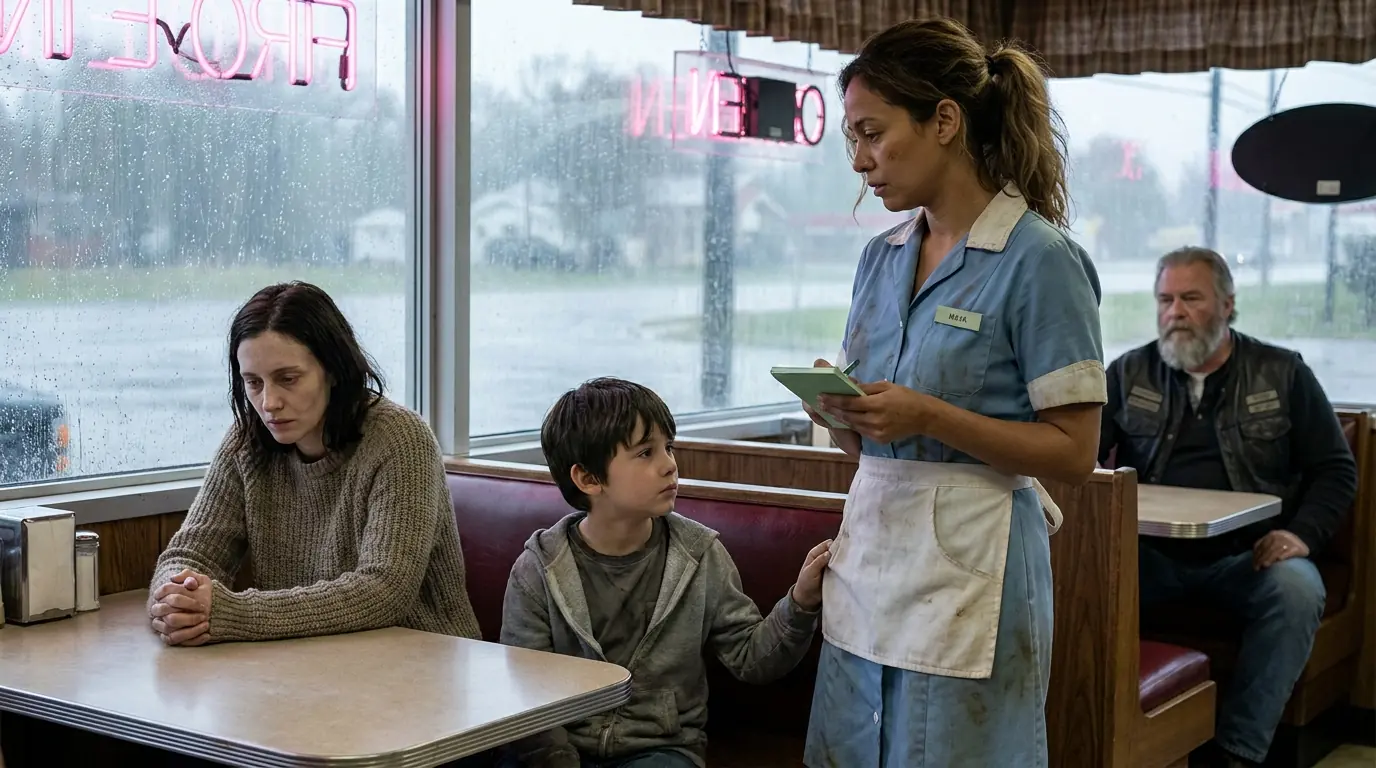
At a small table by the window, a woman and a little boy sat in a pocket of profound silence. Maya had seated them 20 minutes ago. The woman, whose name she didn’t know, had hands that trembled so badly she had to hold her water glass with both of them. Her eyes, wide and dark, darted to the door every time the little bell above it jingled. She wore a long-sleeve sweater despite the diner’s stuffy warmth, and the collar was pulled high, as if to ward off a chill that came from inside.
The boy was a miniature version of her, with the same dark hair and haunted eyes. He was maybe seven or eight, but he sat with the stillness of an old man, his small shoulders slumped. He hadn’t said a word. He just stared at the salt shaker on the table, his face pale and listless.
Maya approached, her order pad in hand.
“Ready to order?” she asked, her voice soft, practiced.
The woman flinched.
“Oh, yes, just a coffee for me, please. Black.”
Maya’s pen hovered.
“And for the little guy?”
The woman’s gaze flickered to her son, then back to Maya, a flicker of panic in her eyes.
“He’s… he’s not hungry right now.”
Maya looked at the boy. His stomach gave a low, mournful growl that was audible even over the sizzle of the grill. His eyes were fixed on the pictures of pancakes and bacon on the laminated menu, a look of desperate longing on his face. He looked hungry, not just missed-a-snack hungry, but a deep, hollowed-out kind of hungry that seemed to have settled into his bones.
Something tightened in Maya’s chest. She had seen this look before. She bent down slightly, making herself smaller, less of a threat. She smiled directly at the boy, ignoring the mother for a second.
The boy didn’t answer, just shrank back into the booth. His mother’s hand shot out and rested on his shoulder, a gesture that was meant to be comforting, but looked more like an anchor.
“Leo,” the woman whispered. “His name is Leo.”
“Well, Leo,” Maya said, keeping her voice light, “we have the best chocolate chip pancakes in the state. I could bring you a small plate on the house, my treat.”
The mother’s head snapped up.
“No. No, thank you. We can’t. Just the coffee.”
Her voice was sharp with a fear that was far bigger than the cost of a plate of pancakes.
Maya knew when to back off. She nodded, straightened up, and turned to leave. But as she did, she felt a tiny, feather-light tug on her apron.
She looked down. It was the boy, Leo. His small fingers were barely pinching the fabric. He leaned forward, his eyes huge, and his lips moved to form a sentence so quiet it was little more than a breath.
“I haven’t eaten since Tuesday.”
The words hit Maya like a physical blow. Tuesday. It was Friday. Three days. The diner noise faded to a dull roar in her ears. The clatter of plates, the murmur of the bikers, the hiss of the rain. It all disappeared.
In its place was the boy’s whisper, echoing in the sudden, vast silence of her mind.
She looked from his pale face to his mother’s and saw the silent tears tracking down the woman’s cheeks. She wasn’t crying from sadness. It was the pure, unadulterated shame of a parent who couldn’t provide.
Maya’s gaze lifted, and her eyes met another pair from across the room. It was Bear. He wasn’t laughing with his men anymore. He was watching her, watching the table by the window, his expression unreadable. He’d seen the exchange. He’d seen the tug on her apron. He hadn’t heard the words, but he knew the language of desperation when he saw it. He gave a slow, almost imperceptible nod, then turned back to his table.
It wasn’t a threat. It wasn’t a warning. It was something else. Acknowledgement. Permission.
Maya gave the boy’s hand a gentle squeeze.
“Okay, Leo,” she whispered back, her voice thick. “We’re going to fix that.”
Maya walked back to the kitchen, her heart pounding a frantic rhythm against her ribs. Sal, the cook, a gruff man with a heart of gold buried under layers of cynicism, looked up from his grill.
“What’s wrong with you? You look like you’ve seen a ghost.”
“Sal,” she said, her voice steady despite the tremor in her hands. “I need the biggest breakfast platter you can make. The Grand Slam, extra bacon, extra pancakes, and a tall glass of milk.”
Sal grunted.
“Table number?”
“It’s for the kid at table seven,” she said. “Put it on my tab.”
He stopped, spatula hovering over a sizzling burger patty. He squinted at her.
“Your tab? You barely make enough to cover rent, kid.”
He peered out the small service window, his eyes finding the woman and her son. He saw the worn-out clothes, the way the woman clutched her coffee cup like a lifeline. He didn’t need the whole story. He’d been working in diners his whole life. He’d seen it all.
“Don’t worry about the tab,” he said, his voice softer than usual. “House covers it.”
He turned back to the grill and cracked four eggs onto the hot surface with a decisive crackle.
“Coming right up.”
Maya felt a wave of relief so strong it almost buckled her knees. She poured the milk, her hands still shaking slightly. This was more than just a meal. It was a line she was crossing. She was getting involved.
She carried the tall, cold glass of milk out first, placing it gently on the table in front of Leo. The boy stared at it as if it were a magic potion. His mother, Sarah, looked at Maya, her eyes wide with a mixture of gratitude and terror.
“Please,” she whispered. “You don’t have to. We can’t pay.”
“It’s okay,” Maya said, her voice a low murmur. “Everyone gets a little help sometimes. Just let him have it.”
Sarah hesitated for a moment longer, then gave a small, defeated nod.
Leo grabbed the glass with both hands and drank, his small throat working convulsively. He didn’t stop until the glass was empty. He set it down with a clink, and a small, milky mustache appeared on his upper lip. It was the first sign of life she’d seen from him.
When Sal slid the platter through the service window, it was a work of art. A mountain of fluffy pancakes, a pile of glistening bacon, scrambled eggs, hash browns, and sausages. The smell alone was enough to make your mouth water.
As Maya carried it to the table, the aroma filled the air, turning heads. She saw the bikers at the corner table pause their conversation, their eyes following the heaping plate. She set it down in the middle of the table.
“Share,” she said simply.
Leo’s eyes were like saucers. He looked at his mother, a silent question. For the first time, a real smile touched Sarah’s lips, though it was wobbly and fragile.
“Go on, sweetie,” she whispered.
The boy picked up a fork and attacked the pancakes with a ferocity that was startling. He ate with a single-minded focus of a starving animal, shoveling food into his mouth, barely chewing.
Sarah watched him, her tears starting again, but this time they were different. They were tears of relief. She picked up a piece of bacon and took a small, hesitant bite. Her whole body seemed to relax as the food hit her system.
The quiet drama at table seven did not go unnoticed. The diner had fallen quiet. The other patrons were watching, pretending not to. And in the corner, the Iron Guardians were watching, not pretending at all.
Then, the scrape of a chair on linoleum. Bear was on his feet. He moved with a slow, deliberate grace that was unnerving in a man his size. Every eye in the diner followed him as he walked across the room, his heavy boots making no sound. He stopped at Maya’s side, looming over the small table.
Sarah froze, a piece of toast halfway to her mouth. Her face went ashen, all the color draining away. She looked like a cornered animal. Leo stopped eating, his fork clattering onto his plate. The air grew thick and heavy.
Bear didn’t look at Maya. He didn’t look at Sarah. He looked at the boy. His gaze softened, the hard flint in his eyes melting away into something else, something Maya couldn’t quite name. It looked like memory. It looked like pain.
His voice, when he spoke, was a low rumble, but it was gentle.
“Son,” he said, “you enjoying those pancakes?”
Leo, his mouth full, could only nod, his eyes wide with a mixture of awe and fear.
Bear’s gaze shifted to Sarah. She flinched, pulling her son closer to her.
“We don’t want any trouble,” she stammered, her voice barely audible. “We’ll leave.”
“No one’s leaving,” Bear said calmly.
He pulled a chair from a nearby table and, to everyone’s shock, sat down. He didn’t crowd them. He just sat, creating a solid, immovable presence at their table.
He looked at Maya.
“Refill my coffee here, would you, sweetheart?”
Maya snapped out of her trance, hurried to get the coffee pot. When she returned, Bear was talking to Leo, asking him about school, about cartoons. The boy, sensing no threat from this mountain of a man, started to answer in small, shy sentences. Sarah watched the exchange, her terror slowly being replaced by confusion.
As Maya filled his cup, Bear looked up at her.
“Good job, kid,” he murmured, so low only she could hear.
Then he turned his attention back to the table. He looked at Sarah, his expression serious, but not unkind.
“You running from someone?” he asked, his voice direct, but not accusatory.
Sarah’s face crumpled. She opened her mouth to deny it, to lie, but the exhaustion and the fear were too much. She could only nod, a single, jerky movement.
“My dad’s looking for us,” Leo said suddenly, his voice small, but clear. “He gets mad.”
The simple, childish words landed in the silent diner with the force of a bomb.
“He gets mad.”
It explained everything. The hidden bruises, the frantic glances at the door, the hunger.
Bear’s jaw tightened. A muscle pulsed in his cheek. He stared at the tabletop for a long moment. The other bikers at his table were silent, watching their leader. They were a pack, and he was their alpha. They waited for his signal.
Finally, he looked up, first at Sarah, then at Maya.
“Finish your meal,” he said to Sarah, his voice firm, but reassuring. “No one’s going to bother you here, I promise.”
He stood up, placed a hand briefly on Leo’s shoulder, a touch so gentle it was startling, and walked back to his booth. He sat down, and a low, intense conversation started among the bikers. Their laughter was gone. Their faces were grim. They were no longer a group of guys having a beer. They were a council of war.
Bear signaled Maya over a few minutes later. She approached the table, her heart still thumping. The air around them was electric.
“How much for their meal?” Bear asked, his voice low.
“It’s on the house,” Maya said quickly.
He shook his head.
“No, it’s on us.”
He pulled a thick, worn leather wallet from his back pocket and slapped $200 bills onto the table.
“This is for their food, and for whatever else they need.”
Before Maya could react, the other bikers started doing the same. One by one, they reached into their pockets, pulling out wads of cash, 50s, 20s, 100s. They threw them onto the table until a small mountain of money sat in front of her. It was more money than she made in a month.
“Give it to her,” one of them, a man with a scarred face and a patch over one eye, said. “Tell her to get a room for a week, a good one, and get that kid some new clothes. And tell her,” Bear added, his eyes locking onto hers, “that we’ll be here. One of my guys is going to sit in his truck in the lot, just in case her trouble decides to show up.”
Maya was speechless. She could only nod, her throat tight with emotion. She scooped up the pile of money, the crumpled bills warm in her hands, and walked back to Sarah and Leo.
They had finished eating and were getting ready to leave, a new energy in their movements. The food had worked its magic.
Maya placed the stack of cash on their table.
“This is for you,” she said softly.
Sarah stared at the money, her eyes filling with disbelief.
“I… I can’t take this.”
“You can,” Maya insisted, “and you will. They want you to get a safe place to stay, and they’re going to watch the parking lot for you. You’re safe.”
The dam broke. Sarah buried her face in her hands and sobbed, deep, gut-wrenching sobs of a person who had been holding on by a thread for far too long. Leo, seeing his mother cry, wrapped his small arms around her neck.
Maya stood by, her hand on Sarah’s shoulder, until the storm of tears passed.
It was then that the bell over the diner door jingled violently. A man stood there, dripping rain onto the welcome mat. He was tall, thin, with a mean, pinched face, and eyes that scanned the room with a predator’s intensity. They landed on Sarah and Leo, and a nasty smile spread across his lips.
“There you are,” he said, his voice slick and cold. “Thought you could run, did you?”
Every person in the diner froze. Sarah’s body went rigid with terror. She instinctively shielded Leo, pulling him behind her.
The man, Rick, took a step inside.
“Let’s go, Sarah. We’re leaving.”
Before he could take another step, two massive shapes blocked his path. Bear and the scarred biker had moved from their booth to the doorway in a silent, fluid motion. They didn’t say a word. They just stood there, two immovable mountains of leather and muscle.
Rick faltered. He hadn’t counted on this.
“This is a private matter,” he snarled, trying to puff out his chest. “Get out of my way.”
Bear just crossed his arms. The movement stretched the leather of his jacket, and the muscles in his arms bulged.
“I don’t think so,” he said, his voice a low, dangerous rumble. “The lady is finishing her coffee, and you’re not welcome here.”
“She’s my wife!” Rick spat, his face turning red.
“Doesn’t look like she wants to be,” the other biker said, his one good eye glaring at Rick with pure contempt. “Now, I suggest you get back in your car and drive away. Far away.”
Rick looked from the two bikers to the rest of the club, who were now all on their feet, watching him. He was outsized, outnumbered, and he knew it. His bravado crumbled, replaced by a sullen rage. He shot a look of pure hatred at Sarah.
“This isn’t over,” he hissed.
Then he turned and practically fled, slamming the door behind him. A collective breath was released in the diner. Sarah was shaking uncontrollably, but she was safe.
Bear walked back to her table. He knelt down, a surprising gesture of gentleness, so he was at eye level with Leo.
“He’s not going to bother you again,” he said to the boy, “ever.”
He then looked at Sarah.
“We know a place, a shelter for women. It’s safe. It’s clean. They’ll help you get on your feet. My friend runs it. We’ll take you there.”
And they did. The Iron Guardians escorted Sarah and Leo from the diner, surrounding them like a presidential detail. They didn’t just give them money and protection for an hour. They gave them a bridge to a new life.
Maya watched them go, the rain finally letting up outside, a sliver of sun breaking through the clouds. She stood in the doorway of the quiet diner, the smell of bacon and coffee mixing with the clean scent of rain, and felt like she had just witnessed a miracle, a small, gritty, leather-clad miracle.
The years that followed settled into a comfortable rhythm. Maya eventually took over the diner with Sal, becoming a partner instead of an employee. The Iron Guardians remained regulars, their corner booth a permanent fixture, but something had changed. The bond between them and Maya was no longer just waitress and customer. It was family. They watched out for her, and she always made sure their coffee was hot and their plates were full.
Sarah, with the help of the shelter and the bikers’ continued, quiet support, thrived. She got her nursing degree, the one she’d abandoned when she met Rick. She found a job at the local hospital and bought a small house with a yard for Leo to play in. The fear slowly faded from her eyes, replaced by a calm strength Maya had never thought she’d see.
Leo grew from a quiet, haunted boy into a bright, confident teenager who played soccer and got good grades. The hunger of that day was a distant memory, but it had shaped him. He was kind, compassionate, and always the first to share his lunch with a kid who didn’t have one.
Once a year, on the anniversary of that rainy Friday, Sarah and Leo would come back to the diner. They would sit at the same table by the window. Bear and a few of the other Guardians would join them. Maya would take the day off and sit with them, not as a waitress, but as a friend.
On Leo’s 18th birthday, they were all there. Leo, now a tall young man with his mother’s kind eyes, stood up to make a toast. He raised his glass of iced tea.
“I want to thank you all, Mom and Dad,” he said, his voice clear and strong. “You didn’t just give us a meal that day. You gave us our lives back. Maya, you listened when no one else would. Bear, you stood up for us when we couldn’t stand up for ourselves. You showed a scared little boy what real strength looks like.”
He looked around the table, at the weathered faces of the bikers, at Maya’s smiling, tear-streaked face, at his mother, who was glowing with pride.
“So, here’s to listening,” he said, “to the quiet whispers that can change the world, and to the heroes who wear leather instead of capes.”
They all raised their glasses. The clinking of glass was the only sound, a small, perfect note in the familiar symphony of the diner. It was a testament to the fact that sometimes the biggest changes in the world start with the smallest acts of courage, a plate of pancakes, a whispered confession, and a group of people who chose to get involved.
Every day, we are surrounded by people, strangers on the bus, co-workers in the office, families in diners. And every single one of them is living a story we know nothing about. But if we just pay a little more attention, if we listen to the whispers instead of just the noise, we might get the chance to be a hero in someone else’s story.
You don’t need a cape. You just need to care.