Samuel Reed had asked 11 men for work in 3 weeks, and 11 had told him no. He'd learned to stop saying what he used to do. Saying commissary clerk made men's faces go careful, like they were deciding how to be polite about turning him down. So, he asked for work instead, any work, and let the rest stay folded in his coat pocket. His money was thin enough now that another week of nothing wasn't a thing he could treat lightly.
Shoshone was loud with railroad traffic and dust. Bennett Eating House sat two streets back from the depot. Louisa Bennett stood at the service counter, checking a supplier's note, a pencil stub in her hand. Behind her, Agnes Doyle ruled the kitchen, and a young woman named Minnie Lyle carried plates through the back passage like she'd been born to it. The door opened.
A man stepped in with his hat already off, a small valise in one hand, tired around the eyes, standing like someone used to being looked over. "Ma'am," he said, "wondering if you've got any honest work needs doing. " "What kind? " "Any kind, wood, water, washing, carrying. " Louisa studied him the way she studied a delivery she wasn't sure about yet. "And? " "And if I haven't? " He didn't flinch at that. "Then I'll ask down the street. I just need food and a place to sleep. " He said it simply like a fact about the weather, not a plea.
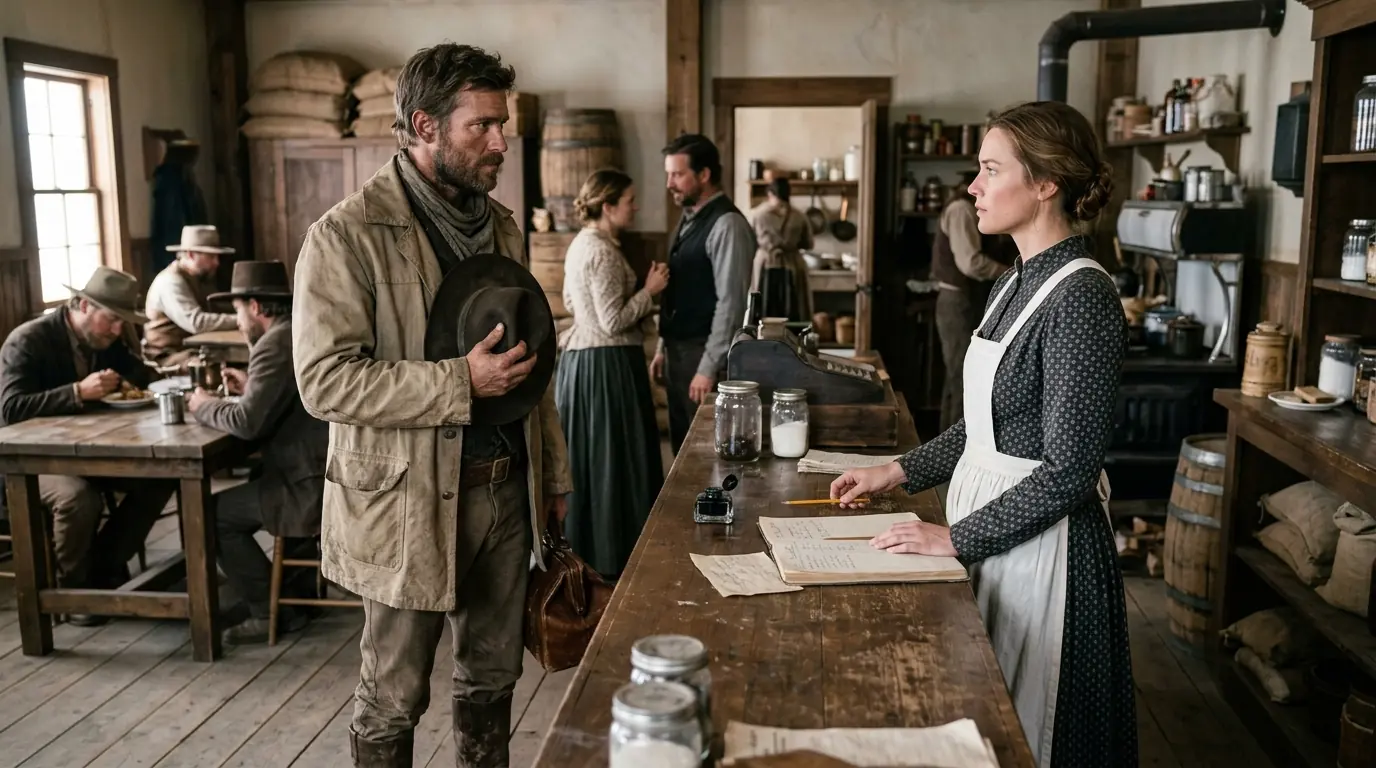
Louisa set the pencil down. She didn't offer him charity, and she told him so straight out, the way she told a supplier when a price wasn't fair. If he worked, she paid him. Three days a trial to see how he handled himself. Meals through the term, the small room off the back passage, the one with just enough space for a cot, his to use while he earned it.
Ordinary backhouse work, nothing fine, nothing that required trust she hadn't earned yet. "Fair enough," Samuel said, and didn't ask for anything more than that. He started that same afternoon, hauling wood, hauling water, scrubbing pots. Agnes showed his way without comment. He didn't act insulted by any of it.
He didn't wander into the kitchen uninvited, and Agnes noticed that before she said a word to anyone about him. Many noticed he remembered where things belonged after being told once, and never made her explain the same thing twice. Which was more than she could say for most men who came through looking for a few days work. By the second afternoon, nobody had to point him toward the next task. He found it himself, finished it, and found the one after that.
Louisa noticed she didn't have to check on him every 20 minutes, which was its own kind of relief she hadn't realized she'd been missing. Two days in, a delivery came during the noon rush. Crates of dry goods stacked at the back door. Samuel asked, almost without thinking, how many suppers Louisa usually served between 6 and 8, and whether this delivery was sized for today or for something bigger coming. Louisa looked up from the crate she was counting.
That wasn't a question a man hauling wood usually thought to ask. Samuel caught the look and went quiet, like he'd said more than he meant to. He went back to stacking crates, but the question sat there between them, small and unexplained. She tested him with the next delivery. Asked him to check the count against the supplier's slip himself.
He found a short count in 10 minutes. Nothing dramatic. Just an honest mistake somewhere between the wagon and the door. And told her straight out instead of making a show of it. Louisa sorted it out with the supplier herself and gave him the next count, too.
And the one after that without being asked twice. That evening, with the day's work already finished and no reason left to keep talking, Louisa asked where he'd worked before Shoshone. "Railroad camps. " Samuel said. "Construction side. " He didn't say more than that. She didn't push.
She told him Bennett Eating House had been hers for years now and neither of them needed to keep standing there once the telling was done. They kept talking anyway. A few minutes longer than the conversation required. About nothing in particular. Louisa couldn't have said, walking away from the counter that night, why she remembered it.
Nothing had been decided. Nothing had been said that mattered to the business at all. She just found she was still thinking about it later. Which wasn't a thing that usually happened with a hired hand 3 days into a trial. The trouble started the way trouble in a working kitchen usually does.
With a good idea applied in the wrong place. Samuel had watched the rear passage long enough to see dirty wear and incoming supplies and moving staff all crossing the same narrow strip of floor. And he shifted the wash station 3 ft to open a cleaner path. He didn't ask first. For an hour it looked like an improvement.
The crossing eased. The traffic ran smoother. And he let himself feel briefly pleased with it. Then Minnie came through with an ordinary load and found her usual route blocked and had to carry it the long way around at exactly the hour it mattered least to be slow. Nothing broke.
Nobody was hurt. But it was a real cost, small and avoidable. And Louisa found him before the supper rush was over. She told him flat out why that route couldn't close. Deliveries, fuel, water, all threaded through it at a particular hour every day, a rhythm he hadn't been here long enough to know.
Samuel didn't argue that it had worked fine at camp. He said only that he hadn't known that part of her house. "What cannot move? " he asked her. Louisa found herself explaining the whole rhythm of her mornings, more than she had meant to. He put the route back and rebuilt his arrangement around it instead of through it, and by the next day service, it worked.
Louisa left the arrangement in place and Samuel understood the answer without needing her to say it. The three-day trial was nearly up when Louisa reviewed the work with him, no more than the facts of it, the way she reviewed any account. He'd expected nothing past the agreed term. She told him the three days had been worth paying for. No more sentiment in it than that.
And asked if he'd found other work yet. "Not yet," he said. She didn't ask him to stay. She was still deciding what she thought about that herself when Edwin Marsh came through the door with a proposition that changed the shape of the week. A traveler party heading to Shoshone Falls needed supper for 24 on top of Louisa's regular trade on a set evening not far off.
It would be the busiest supper Bennett Eating House had yet attempted. Edwin needed a clear answer, not hope. Louisa didn't ask Samuel first. She checked with Agnes on what the kitchen could carry. Checked her tables, her ordinary customers, her supply.