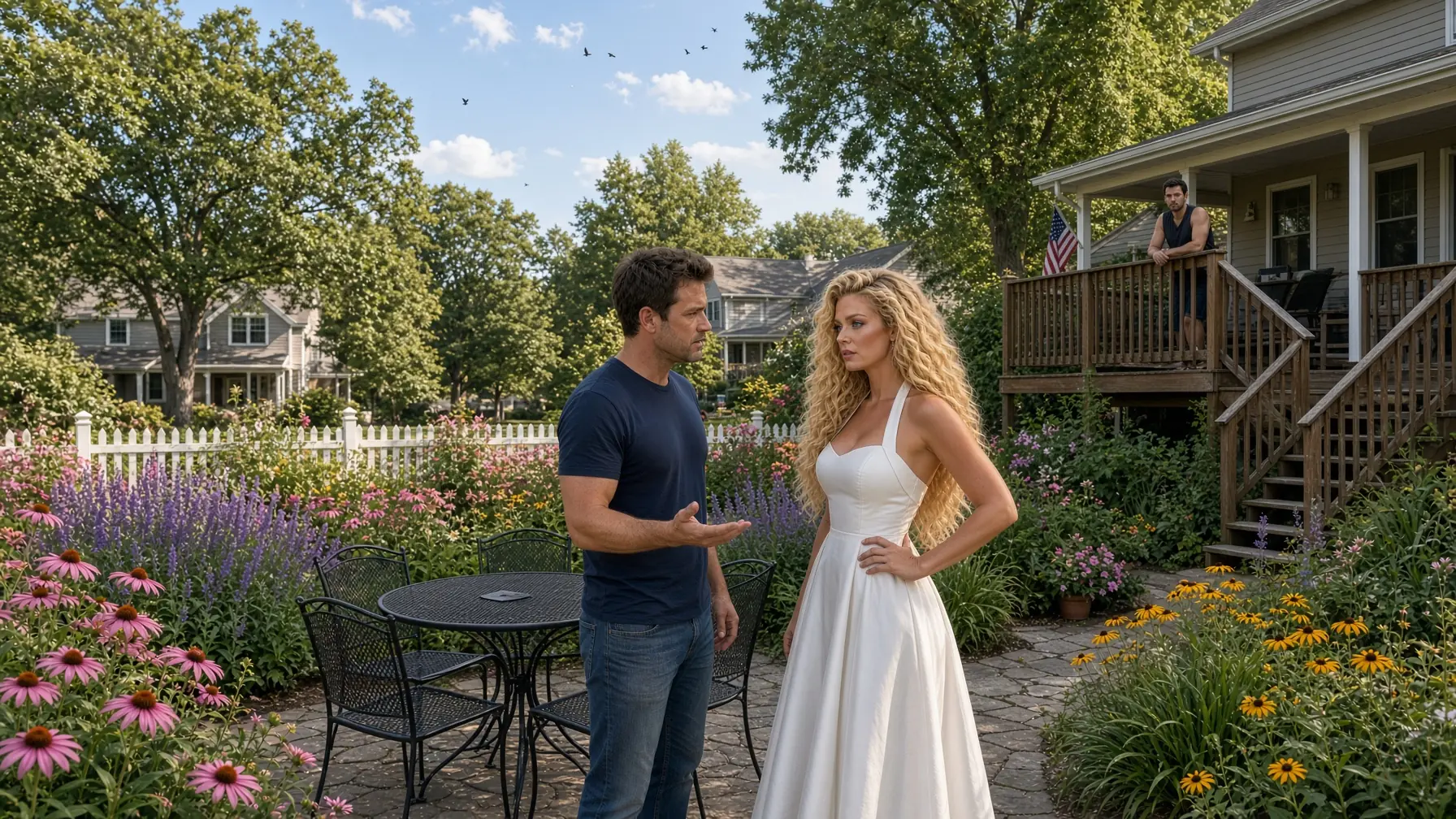
I probably would have forgotten the first time I caught our neighbor watching my wife. People look at people, especially in a neighborhood where the houses sit close enough that you can hear somebody drop a grill lid two yards over. What made it difficult to dismiss was that I kept seeing him outside at almost exactly the same time she was. By the middle of July, I had started noticing the pattern before I was willing to admit that I was noticing it.
My name is Ethan Cole, and I was forty when this happened. My wife, Megan, was thirty-four, and we had been married for eight years after meeting at a friend’s birthday party outside Indianapolis. I managed distribution for a regional appliance company, which meant most of my workday involved trucks, warehouse schedules, inventory shortages, and apologizing for problems I had not personally created. Megan worked four days a week as an occupational therapy assistant at a rehabilitation clinic about twenty minutes from our house.
Our marriage was not dramatic. We paid bills, argued about thermostat settings, watched crime documentaries neither of us admitted were repetitive, and spent Sunday mornings deciding whether groceries counted as a date if we bought coffee first. Megan knew I would leave cabinet doors open without realizing it, and I knew she would abandon half-finished glasses of water in every room as if preparing emergency hydration stations. We were ordinary enough that I had always considered ordinary one of the best things about us.
Two years earlier, we had bought a ranch-style house in Greenwood, Indiana, on a quiet street called Hawthorne Creek Lane. The backyard was not huge, but it had enough room for a deck, a patch of lawn, and a long flower bed running beside the wooden privacy fence. Megan had never cared much about gardening when we rented, but something about owning dirt apparently activated a part of her personality I had not met before. By our second summer, she could discuss soil acidity with the seriousness of a cardiologist reviewing bloodwork.
She rebuilt most of the side garden that spring. The old shrubs came out, and in their place appeared roses, lavender, black-eyed Susans, coneflowers, salvia, hydrangeas, and at least six plants whose names I repeatedly forgot despite being corrected. Megan came home from the nursery with bags of mulch, ceramic pots, and the glowing expression of somebody who had spent far more money than intended but considered the experience spiritually justified. I complained mostly for tradition.
After work, she usually changed out of her clinic scrubs and went outside before dinner. In hot weather, that meant denim shorts, sandals, and whatever light summer top she grabbed first, often strapless because she hated tan lines across her shoulders. She had dressed that way for as long as I knew her, including years before we owned a yard. I never considered her clothes remotely connected to what happened next.
Our neighbor on the west side was a man named Logan Hart. He was thirty-seven, divorced for about three years, and worked as a freelance architectural photographer, which allowed him to spend long stretches editing from home between shoots. He had moved into the neighborhood about nine months before the summer in question and had always seemed friendly enough. We talked about lawn equipment, property taxes, football, and the mysterious ability of city crews to repair every pothole except the one directly in front of our mailbox.
Logan borrowed my pressure washer once and returned it cleaner than when I gave it to him. I helped him carry a television into his living room when he replaced the one his ex-wife apparently took after the divorce. He was neither a close friend nor somebody I disliked. If anything, that made the whole situation harder to interpret because I had no existing reason to assume something bad about him.
The first time I noticed him looking at Megan was a Tuesday evening. I had just come home with two bags of takeout when I saw her kneeling beside the roses near the fence, pulling weeds with her hair tied up. Logan stood on his back deck holding a drink, his body angled toward our yard. His eyes stayed on her for several seconds before he looked away, and I continued inside because nothing about that moment seemed worth turning into a story.
Two nights later, Megan went outside around six-thirty. Logan’s sliding door opened a few minutes afterward, and he walked onto his deck with a coffee mug despite the temperature being close to ninety degrees. He leaned against the railing and called something about the flowers, Megan answered, and they talked for maybe two minutes. Again, nothing happened that a reasonable person could point to as inappropriate.
Then it happened again. Sometimes Logan watered one plant near the property line for fifteen minutes, and sometimes he wandered outside carrying his phone and stood where he had a clear view of Megan’s garden. Once he spent an entire evening repositioning two patio chairs that had been in the same location since spring. If Megan went inside, his outdoor project usually ended soon afterward.
I hated that I noticed. There is something embarrassing about realizing you are mentally tracking another man’s porch because your wife happens to be attractive. I had never wanted to become the kind of husband who treated marriage like ownership or believed every man looking in his wife’s direction constituted a threat. So every time the thought appeared, I gave myself the same answer: Logan lives next door, Megan gardens every evening, and normal routines overlap.
Megan certainly did not seem concerned. She and Logan talked over the fence sometimes about plants, weather, or whichever construction project in the neighborhood had become the current source of entertainment. She laughed when he joked, and he asked questions about flowers because apparently even men who could photograph luxury kitchens for a living were capable of learning what hydrangeas were. Nothing in those conversations gave me a clean reason to intervene.
One Friday, I was grilling burgers when Logan walked toward the fence. Megan was cutting dead blooms from a rose bush, and Logan told her the whole garden looked better than anything the previous owners had managed. She laughed and said, “That’s because Ethan finally stopped trying to help,” which was unfair but not entirely false. Logan glanced at me and said I had clearly learned the most important rule of marriage.
I laughed too. Megan stood and brushed dirt from her shorts, then started explaining why one rose bush was struggling compared with the others. Logan listened, but after a minute I noticed his eyes move away from the flowers and settle on her. It was not some exaggerated stare that would have made the situation simple; it was just a little longer and a little more deliberate than necessary.
Megan seemed not to notice. Or perhaps she did and did not care. That question bothered me more than Logan himself because once it appeared, I could not easily dismiss it. I flipped the burgers and told myself I was inventing meaning because I had already begun watching for it.
Over the next week, I caught myself glancing toward Logan’s deck whenever Megan opened our back door. That irritated me enough that I intentionally stopped doing it for two days, partly because I wanted to prove I still had control over my own attention. On the third evening, I walked into the kitchen and found myself checking again without thinking. Logan was already outside, standing at the railing while Megan watered flowers near the fence.
She came inside twenty minutes later. I was putting dishes away and must have looked distracted because she asked what was wrong. I said nothing, but she followed my eyes toward the window just as Logan carried his cup back inside. “Are you monitoring the neighborhood now?” she asked, smiling.
“High-level security operation,” I said. Megan laughed and kissed my cheek before going upstairs to shower. I wanted that to be enough to make the whole thing feel stupid. Instead, I remembered how quickly Logan had looked up when she first stepped into the yard.
The next afternoon, I decided to bring it up. I knew the conversation would sound ridiculous if I handled it badly, so I waited until Logan had left and Megan was alone by the flower bed. She was kneeling in the mulch wearing white shorts and a dark green summer top when I leaned against the deck railing. I asked whether I could say something without her immediately assuming I had lost my mind.
“That introduction inspires confidence,” she said.
“Have you noticed Logan is outside a lot when you’re out here?”
She looked toward his house. “He lives there.”
“I understand the real-estate arrangement.”
Megan smiled slightly, but I did not.
Her expression changed when she realized I was serious. I told her I had noticed that he often came outside within minutes of her and seemed to spend a lot of time looking toward our yard. Megan shrugged and said people in adjacent houses were naturally going to see one another. When I said I thought he was watching her specifically, she sat back on her heels.
“What exactly are you saying?” she asked.
“I’m saying it makes me uncomfortable.”
“Because I’m outside in this?”
She gestured toward her clothes.
I immediately said no.
Megan stood anyway. “Ethan, I’m not changing the way I dress in my own backyard because our neighbor has eyes.” I told her that was not remotely what I had asked, but she said the implication was obvious. The conversation was suddenly about whether I thought her shorts were too short even though I had never once mentioned them.
I felt myself becoming frustrated. “I am talking about Logan, not your clothes,” I said, and Megan answered that I was still making his behavior her problem. I told her I was not asking her to change anything and only wanted to know whether she had noticed the same pattern. She said maybe I was noticing a pattern because I had decided one existed.
That answer landed harder than the argument about clothes. I asked what she meant, and she said Logan worked from home, used his deck constantly, and naturally noticed when people were outside. She said she did not want to start thinking about how she looked every time she walked into her own yard. I told her again that she did not have to.
“Then why are we doing this?” she asked.
“Because something feels off to me.”
Megan sighed. “Sometimes feelings are just feelings.”
I could not argue with that.
So I stopped.
Not because I believed I was wrong, but because repeating myself was not going to produce better information. If Logan’s timing was coincidence, time would make that obvious without me turning our backyard into an interrogation room. I told Megan I was dropping it, and she looked relieved enough that I immediately hated how the whole conversation had gone.
For the next several days, I simply paid attention. I did not write anything down, change schedules, or stand behind blinds like some suburban detective in a bad movie. I went to work, came home, cooked dinner, and noticed whatever happened in front of me. The first useful detail arrived when Megan had to stay late at the clinic and never went outside.
Logan’s deck remained empty all evening. That meant almost nothing, and I knew it. The following day Megan went to the garden shortly after six, and his sliding door opened about four minutes later. He stood outside with a drink and asked how the roses had handled the weekend heat.
Still explainable.
Thursday gave me something closer to a test, though I did not originally intend it as one. I got home first and decided to water the garden because Megan had texted that she was stuck in traffic. I spent fifteen minutes with the hose, including enough time to nearly drown one section of lavender. Logan did not appear.
Megan arrived while I was still outside. She changed clothes, took the hose from me, and accused me of conducting an agricultural war crime. She had been outside less than five minutes when Logan’s door opened. He carried a bottle of water onto the deck and called, “Hey, gardener.”
My stomach tightened.
Megan smiled and said hello. Logan asked whether everything was surviving the heat, and she told him most of it was doing better than my watering technique. He laughed, then looked toward me and finally seemed to realize I had been standing near the patio the entire time. His posture changed enough that even I noticed.
“Hey, Ethan,” he said.
“Logan.”
He stayed another minute, checked his phone, and went back inside.
I said nothing to Megan.
That evening I began accepting that I was probably not imagining the timing. What I still did not know was whether Logan was simply attracted to my wife in an ordinary, private way or whether he was intentionally placing himself near her because he wanted something from the attention. Attraction was not a crime, and I had no interest in policing thoughts I could not see.
Another week passed. I started noticing that Megan knew more small details about Logan’s life than I had realized. She mentioned one morning that he had a photography job in Cincinnati and would be gone overnight, then became irritated when I asked how she knew. “He told me yesterday,” she said, as though the question itself confirmed I was becoming unreasonable.
Another evening she told me Logan was considering replacing his deck. He apparently knew that Megan’s clinic had hired a new receptionist, and she knew his sister had recently gotten engaged. None of that was alarming in isolation. Neighbors talk, especially people whose yards share a fence.
What bothered me was realizing how many conversations had happened outside my attention. That did not make them secret. It simply made me understand why Megan had been quicker than I expected to defend the situation. She was not dealing with a stranger occasionally glancing from a porch; she and Logan had developed a small routine of familiarity.
Friday afternoon changed the question completely.
I came home early because a delivery system failure forced our warehouse to shut down until an outside vendor restored it. Megan was still at work, so I changed clothes and went outside to repair a loose board beside the garage. Tall ornamental grasses hid most of that corner from Logan’s yard, which meant somebody looking over the fence would not immediately see me.
I was halfway through removing an old screw when Megan’s car pulled into the driveway. Fifteen minutes later, I heard the back door close and her footsteps moving across the patio. I considered calling out to let her know I was there but decided I would finish the board first.
Then Logan’s voice came over the fence.
“Hey, trouble.”
Megan laughed. “Since when am I trouble?”
“Depends what you’re wearing.”
My hand stopped on the screwdriver.
There was a short pause.
Megan said, “You’re ridiculous.”
Logan answered, “Am I wrong?”
I stayed where I was, suddenly uncomfortable with the fact that moving would reveal I had heard. Megan changed the subject to the flowers, and Logan followed easily enough, asking about a rose bush that had finally started blooming. The conversation became normal again until he said, “That color looks really good.”
Megan said, “The flowers?”
Logan laughed softly.
“Sure.”
This time Megan laughed too, but there was hesitation in it. “Behave.”
“I am behaving.”
“You have an interesting definition.”
Then came the sentence that removed the last possibility that I had invented the pattern.
Megan said, “You always seem to find a reason to come outside when I’m gardening.”
Logan answered immediately.
“Can you blame me?”
I looked down at the screwdriver in my hand.
There it was.
Simple.
Clear.
He knew.
More importantly, she knew too.
I stepped around the ornamental grass.
Logan saw me first.
His face changed so quickly that it almost made the entire situation unnecessary to explain. The relaxed smile disappeared, his shoulders straightened, and he looked at me as though trying to determine exactly how much I had heard. Megan turned a second later.
She looked uncomfortable.
Not surprised by Logan’s comment.
Uncomfortable that I had heard it.
That mattered.
“Hey,” Logan said.
“Hey.”
He gestured toward the garden. “Just talking about the roses.”
“I heard.”
Silence.
Logan nodded once. “I’ve got editing to finish.”
“Okay.”
He walked back toward his house.
Megan looked down at her gloves.
I said, “We need to talk.”
She nodded.
That response told me the conversation would be different this time.
Inside, I washed dirt from my hands while Megan stood beside the kitchen island. Neither of us spoke for half a minute. When I finally turned around, I asked the simplest question I could think of. “How long have you known he was flirting with you?”
Megan looked away.
“Known is a strong word.”
“Megan.”
She exhaled. “A few weeks.”
I nodded.