The morning began, as so many mornings in the Peton household did, with Lady Peton’s nerves. “You cannot imagine what I have suffered,” she announced to no one in particular, pressing a hand to her chest as though her heart might escape if not physically restrained. The anxiety, the palpitations, the absolute torment of waiting. And where is Rosalind? Why is Rosalind never where she ought to be?
Lady Cordelia Peton, eldest of the four daughters, and universally acknowledged as the beauty of the family, examined her reflection in the gilt-framed mirror above the mantelpiece and adjusted a golden curl. “Rosalind is at that dreadful hospital again, Mama. She told you at breakfast.” “She tells me many things. That does not mean I am required to listen.”
Lady Peton consulted the letter clutched in her trembling hand for the fourteenth time since its arrival an hour earlier. The paper had grown soft and creased from handling, the elegant script blurring slightly where nervous perspiration had touched it. The Duke of Thornfield wishes to call upon us regarding a matter of matrimonial interest. Girls, do you comprehend what this means?
Lady Beatrice, the second daughter, looked up from her embroidery with the perpetually worried expression that had earned her the reputation of being delicate. “It means we must change into receiving gowns and ensure the good china is brought out for tea.” “It means,” Lady Margaret, the third daughter, and the one most inclined toward practicality, said flatly, “that someone has finally noticed we exist, though I cannot imagine why a duke would trouble himself with our family when he might have any heiress in England.”
“Margaret, really?” Lady Peton fixed her plainest daughter with a look of profound disappointment. “Your father may not have been an earl, but he was the son of a marquess’s second cousin. Our bloodline is impeccable, and our circumstances—” She faltered slightly, for circumstances were not a subject Lady Peton enjoyed discussing. The late Lord Peton had been a charming man, a devoted husband, and an absolutely catastrophic investor. The family’s genteel poverty was the worst-kept secret in London society.
“Our circumstances are no concern of the duke’s. What matters is that he is coming here to this house to meet my daughters.” “Three of your daughters,” Margaret muttered. “Rosalind will not thank you for including her.” “Rosalind will do as she is told for once in her ungrateful life.” Lady Peton rose from her chair with renewed purpose. “Cordelia, change into the primrose silk. It brings out your eyes. Beatrice, for heaven’s sake, stop fidgeting. The duke will think you have fleas. Margaret,” she surveyed her third daughter with the expression of a general forced to work with inadequate troops, “simply try not to speak. Your opinions do you no favors.”
The next two hours passed in a fever of preparation. The drawing room, which had seen better days but retained enough elegance to pass muster, was dusted and rearranged three times. The good china, the only remaining evidence of Lady Peton’s once handsome dowry, was retrieved from the cabinet where it lived in reverent protection. Fresh flowers were sent for, wilting flowers were disposed of, and the curtains were adjusted to allow precisely the right quality of light to flatter feminine complexions while disguising the worn patches in the carpet.
Through it all, a footman was dispatched to the foundling hospital with an urgent summons for Lady Rosalind. The message contained words like emergency and family crisis and come at once, which Lady Peton felt were not technically lies. The absence of the family’s youngest daughter when a duke came calling would indeed constitute a crisis of the highest order. At precisely three o’clock, the knocker sounded. Lady Peton clutched Beatrice’s arm hard enough to leave bruises. Cordelia smoothed her skirts and arranged her face into an expression of serene welcome. Margaret, stationed near the window where the light was least flattering, resigned herself to invisibility.
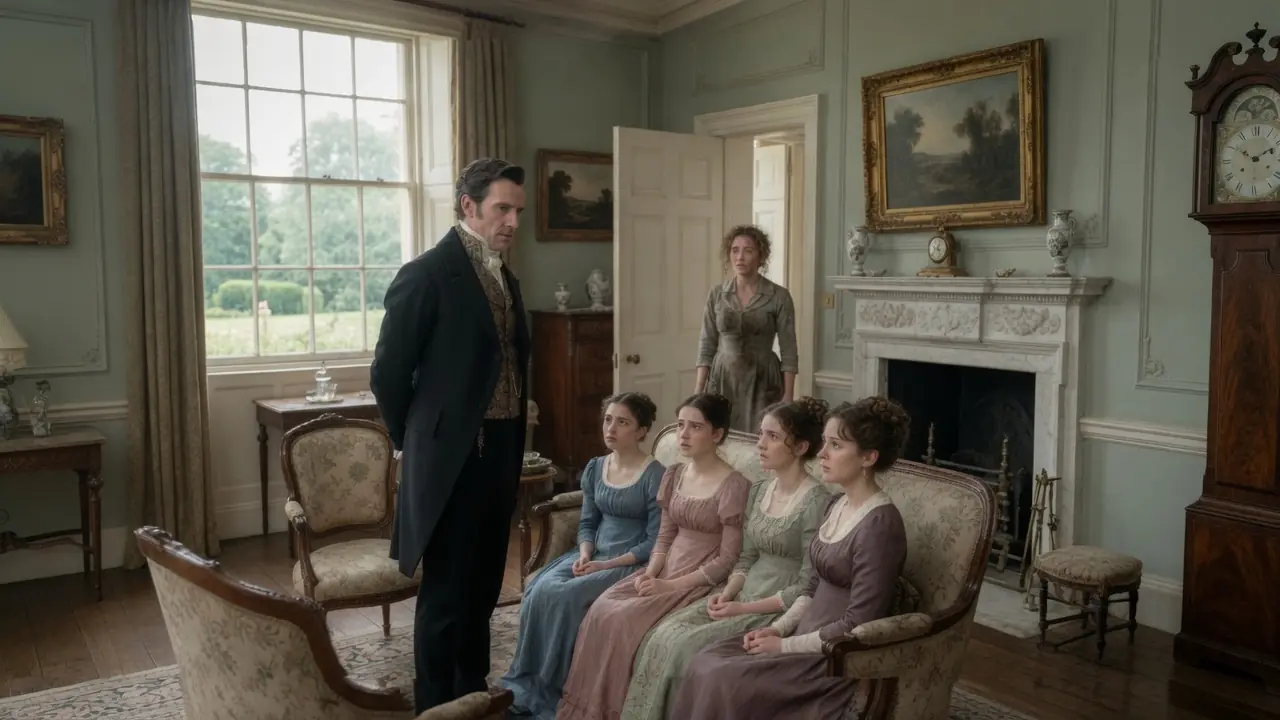
The butler announced with suitable gravity, “His Grace, the Duke of Thornfield.” The man who entered the drawing room seemed to bring winter with him. It was not simply his appearance, though that was striking enough. He was tall, broad-shouldered, and dressed in the austere perfection that only the finest London tailor could achieve. Dark coat, spotless cravat, not a single unnecessary ornament. His hair was black, shot through with silver at the temples in a way that should have aged him but instead lent him an air of distinguished authority. His face might have been carved from marble—strong jaw, aristocratic nose, cheekbones that caught the afternoon light with geometric precision.
But it was his eyes that truly chilled the room. Gray as a storm over the Channel, they surveyed the assembled Peton women with an expression of absolute, impenetrable neutrality. This was not a man who had come courting. This was a man who had come to conduct business. “Lady Peton.” His voice matched his appearance—cool, cultured, utterly without warmth. “I thank you for receiving me on such short notice.”
Lady Peton’s curtsy nearly unbalanced her. “Your Grace, the honor is entirely ours. Please, won’t you sit? Tea will be brought directly. May I present my daughters? This is Lady Cordelia, my eldest.” “Charmed,” the duke said, though he sounded anything but. “Lady Beatrice, my second.” “A pleasure,” the same flat tone. “And Lady Margaret, my third.” “Indeed.” His gaze had already moved on, cataloging the room with the same dispassion he had applied to its inhabitants. “I understood you had four daughters, Lady Peton.”
A flush crept up Lady Peton’s neck. “My youngest, Lady Rosalind, is—she will be joining us shortly. She was delayed by charitable obligations.” Something flickered in those gray eyes, not quite interest, but perhaps a distant cousin of it. “Charitable obligations. How admirable.” The way he said it made the word sound like a disease.
Tea arrived. It was poured with trembling hands and received with mechanical courtesy. Cordelia, following her mother’s fervent eye signals, attempted to engage the duke in conversation about the weather, the season, and the latest exhibition at the Royal Academy. He responded to each topic with monosyllabic precision, offering nothing and encouraging nothing. Beatrice, when applied to, managed a few stammering observations about music before subsiding into terrified silence. Margaret, true to her mother’s instructions, did not speak at all, though her expression suggested she had a great deal she wished to say.
Finally, when the excruciating ritual of polite conversation had exhausted even Lady Peton’s determination, the duke set down his teacup with an air of decision. “I believe in efficiency, Lady Peton. It is what has made me successful in all my endeavors, and I see no reason to abandon it in matters of matrimony.” He surveyed the three young women before him as one might examine horses at Tattersalls, assessing bloodlines and temperaments with clinical detachment.
“I require a wife. My obligations to my title demand an heir, and society demands that he be legitimate. I have therefore determined to marry before the season concludes.” Lady Peton made a small squeaking sound that might have been excitement or terror. “I have selected your family,” the duke continued, “for several reasons. Your bloodline, while not illustrious, is respectable and untainted by scandal. Your daughters appear to be healthy, reasonably well-mannered, and of appropriate age for childbearing. Your financial situation—” Here the faintest hint of something that might have been dark humor crossed his features. “Your financial situation makes it likely that a proposal from me will be viewed favorably.”
The silence that followed this speech was absolute. Even the fire seemed to hold its breath. “I will marry any of your daughters,” the duke concluded, his gray gaze sweeping across Cordelia, Beatrice, and Margaret with perfect indifference. “I care not which. Select among yourselves, and send me word. I will call again in three days to receive your answer.” He rose, clearly considering the matter settled, and Lady Peton rose with him in a flutter of disbelieving joy.
Cordelia’s lovely face had gone pale. Beatrice looked as though she might be sick. Margaret’s expression suggested she was composing a scathing mental critique of everything she had just witnessed. It was at precisely this moment that the drawing room door burst open. Lady Rosalind Peton had been elbow-deep in washtubs when her mother’s summons arrived. The foundling hospital, where she volunteered three days a week, was perpetually understaffed and underfunded, and Rosalind had long since abandoned any pretense of ladylike restraint when there was work to be done.
She had spent the morning bathing feverish infants, the early afternoon helping the overworked cook prepare gruel, and had been in the process of sorting through donated clothing when the footman appeared with his message of dire emergency. She had not changed her dress. There had been no time. Her serviceable gray wool, chosen specifically because it did not show stains, bore evidence of her morning’s labors—damp patches at the cuffs, a smear of something unidentifiable near the hem, and a general air of having been through trials that primrose silk would never survive. Her auburn hair, which had been neatly pinned that morning, had largely escaped its confines and now rioted around her face in defiant curls. Her hat was askew. Her cheeks were flushed from rushing through London streets at an unladylike pace. Her green eyes were bright with worry that was rapidly transforming into something else entirely as she took in the scene before her.
The first thing she noticed was that no one appeared to be dying. The second thing she noticed was that everyone was staring at her. The third thing she noticed was the tall, cold, impossibly arrogant-looking man standing in the center of the room as though he owned it. “What,” Rosalind said flatly, “is going on?” “Rosalind?” Lady Peton’s voice had the particular quality of strained brightness that preceded her worst episodes of maternal disappointment. “Darling, how—how wonderful that you could join us. May I present His Grace, the Duke of Thornfield. Your Grace, my youngest daughter, Lady Rosalind.”
Rosalind’s eyes narrowed. She had heard of the Duke of Thornfield. Everyone had heard of the Duke of Thornfield. The Frost Duke, society called him, when it dared to call him anything at all. Cold as charity and twice as discriminating, the most eligible bachelor in England and the least likely to actually marry, because no woman alive could meet whatever impossible standards he set. And he was standing in her mother’s drawing room looking at her with an expression of faint distaste while her three sisters sat in varying attitudes of shell-shocked compliance.
“Your Grace,” she said, and the curtsy she offered was minimal at best. “I apologize for my appearance. I was told there was an emergency.” “There is.” The duke’s voice was like ice water—bracing, unpleasant, and impossible to ignore. “I have just proposed marriage to your family.” Rosalind blinked. “I beg your pardon.” “Rosalind, dear, perhaps you should sit down,” Lady Peton began.
“I require a wife,” the duke said, as though explaining something simple to someone rather slow. “I have informed your mother that I will marry any of her daughters, and that they should select among themselves who will have the honor. It is a generous offer. I expect it will be accepted.” For a long moment, Rosalind simply stared at him. She stared at his perfectly arranged cravat and his perfectly polished boots and his perfectly symmetrical face with its perfectly cold expression. She stared at her sisters—beautiful Cordelia, who looked like she had been slapped; nervous Beatrice, who was actively trembling; practical Margaret, whose jaw was set in a hard line of suppressed fury.
And something inside Rosalind, something that had been building for years, finally snapped. “Let me be certain I understand you,” she said, and her voice was dangerously calm. “You have come into this house uninvited—” “I was invited,” the duke interrupted. “Your mother—” “You have come into this house,” Rosalind continued as though he had not spoken, “and announced that you require a wife in the same tone one might use to order a new pair of gloves. You have examined my sisters like livestock at market and declared that any of them will do, as though they were interchangeable, as though their individual hopes and dreams and personalities were of no consequence whatsoever. And you expect this to be considered a generous offer?”
The temperature in the room, already cool thanks to the duke’s presence, dropped several degrees further. “Rosalind,” Lady Peton’s voice was a squeak of pure horror. “I expect,” the duke said slowly, “that my offer will be considered in light of the substantial material benefits it provides. I am not a romantic man, Lady Rosalind. I do not pretend to be. I am offering your family security, status, and wealth beyond their current imaginings. In exchange, I ask only for the basic duties of a wife. I fail to see what is objectionable about this arrangement.”
“Then you are either a fool or a monster, and I cannot determine which.” Rosalind’s hands had clenched into fists at her sides. “Marriage is not a business transaction, Your Grace—or rather, it should not be. It is the binding of two lives, two souls, two futures. It should be entered into with respect, with affection, with at least the hope of happiness. Not,” she gestured at him, at the room, at the entire absurd situation, “not this. Not a man who cannot even be bothered to learn which sister he is proposing to because it does not matter. Because we are all the same to him. Because we are not people at all, merely potential broodmares for his precious heir.”
The silence that followed was so complete that Rosalind could hear her own heartbeat pounding in her ears. The duke had gone very still. Those gray eyes, which had been cold before, were now absolutely arctic. When he spoke, his voice was soft in a way that was somehow more frightening than shouting would have been. “You speak of respect and affection, Lady Rosalind. Tell me, in your extensive experience of marriage, which I assume you must have to speak with such authority, did respect and affection protect you from the disappointments of reality? Did romantic love put food on your table when investments failed and debts mounted? Did hope of happiness keep the creditors from your door?”
Rosalind felt the blood drain from her face. He knew. Of course he knew. A man like the Duke of Thornfield would have researched her family’s circumstances before ever setting foot in their home. “I thought not,” he continued when she did not answer. “You speak of souls and futures as though they exist in some ethereal realm untouched by practical concerns. But we do not live in that realm, Lady Rosalind. We live in this one. And in this one, a woman’s choices are limited. She may marry well and secure her future, or she may cling to romantic ideals and find herself dependent on the charity of relations who resent her. I am offering your sisters a third option—security without pretense. A business arrangement honestly acknowledged as such rather than dressed up in pretty words that mean nothing.”
“And you think this is better,” Rosalind demanded, “to enter a marriage knowing it is nothing but a transaction, to spend a lifetime with someone who does not love you, does not even wish to love you?” “I think it is honest,” the duke’s lip curled slightly, “which is more than most marriages can claim. I have seen what happens when people marry for love, Lady Rosalind. My own parents were desperately in love when they wed. Within five years, they had made one another so miserable that they could not be in the same room without drawing blood. My mother died bitter and broken. My father drank himself into an early grave. Love did not save them. Love destroyed them.” He paused, and something flickered in those cold eyes—something that might have been pain quickly suppressed. “I will not repeat their mistakes. I will not promise what I cannot deliver. And I will not be lectured on the sanctity of marriage by a young woman who has never experienced it.”
The words hit Rosalind like a physical blow. She had imagined she knew what kind of man the Duke of Thornfield was—arrogant, yes, and cold and impossibly high-handed. But she had not expected this. This raw honesty about his own wounds, his own fears, this acknowledgement that behind the frost was something that had been burned. It did not change her opinion of his proposal, but it complicated it.
“Your parents’ marriage was one example,” she said, and her voice was softer now, though no less firm. “It does not follow that all marriages based on love must end the same way, just as it does not follow that marriages based on practical considerations must be happy ones.” She thought of her sister Eleanor, of the charming Lord Ashby who had swept her off her feet with pretty words and prettier promises, of the bruises Eleanor had tried so hard to hide, of the light that had gone out of her eyes a little more each year. “There is more than one way for a marriage to destroy someone, Your Grace.”
For a long moment they simply looked at one another. Something passed between them—recognition, perhaps, or acknowledgement. Two people who had seen behind the curtain of societal expectations and understood that the reality was often far uglier than the performance. Then Lady Peton burst into noisy sobs. “My nerves!” she wailed. “Oh, my poor nerves. Rosalind, how could you? The Duke of Thornfield—the Duke of Thornfield was kind enough to honor us with his proposal, and you have insulted him beyond redemption. We shall be ruined. We shall be cast out of society entirely. We shall die in poverty and disgrace, and it will all be your fault.”
“Mama, please calm yourself,” Beatrice said, though she looked nearly as distressed as her mother. “I will not calm myself. I will not. After everything I have sacrificed, everything I have worked for—” “Lady Peton.” The duke’s voice cut through the hysteria like a blade. “Compose yourself. Your nerves are not in danger, and neither is your social standing. I take no offense at your daughter’s passionate opinions. Indeed, I find them rather refreshing. It has been some time since anyone dared speak to me with such frankness.”
Lady Peton’s sobs stuttered into confused silence. “However,” the duke continued, “I believe I have taken enough of your time for one afternoon. I will call again, as I said, in three days. I trust that by then your daughters will have reached a decision.” His gaze swept across the room once more, lingering for just a moment longer than necessary on Rosalind. “Good day.”
He was gone before anyone could respond, the front door closing behind him with a quiet finality that somehow echoed through the entire house. For a long moment, no one spoke. Then Lady Peton rose from her chair, crossed the room in three quick steps, and slapped Rosalind across the face. “You wicked, selfish, impossible girl,” she hissed. “Do you have any idea what you have done? Any idea at all?”
Rosalind’s cheek stung, but she did not flinch. She had weathered her mother’s disappointment too many times to be surprised by it now. “I have told a man the truth about his abhorrent proposal. I cannot find it in myself to regret that.” “You have humiliated us. You have humiliated me.” Lady Peton’s eyes were wild. “The Duke of Thornfield does not offer marriage to families like ours. He does not offer marriage to anyone. This was our chance—your sisters’ chance—and you have thrown it away on your ridiculous principles.”
“My principles are not ridiculous.” Rosalind’s voice was steady, though her heart was pounding. “Marriage should not be—marriage should be whatever keeps a roof over our heads.” Lady Peton’s composure shattered entirely. “Do you think I do not know what you believe? That I trapped your father with a pretty face and an empty head. That I care more for status than for my daughters’ happiness. You know nothing, Rosalind. Nothing. I married your father because I loved him. Yes—loved him, despite what you clearly think of me. And that love did not protect us when he lost everything. Love did not educate you girls. Love did not keep us in society when every door should have closed against us. Practicality did that. Calculation did that. The marriage of love you dream of—it is a luxury that families like ours cannot afford.”
The words hung in the air, raw and terrible and uncomfortably true. Rosalind looked at her mother, really looked at her, perhaps for the first time in years. She saw the lines of worry around Lady Peton’s eyes, the gray in her hair that no amount of careful styling could fully disguise, the desperate fear behind the social ambition. This was a woman who had watched her world crumble and rebuilt it through sheer force of will. A woman who had sacrificed her own happiness to ensure her daughters had choices she herself had never had. And Rosalind had just destroyed the best choice any of them were likely to receive.
“I’m sorry, Mama,” she said quietly. “I did not mean to.” “You never mean to.” Lady Peton turned away, suddenly looking much older than her years. “That is the tragedy of you, Rosalind. You never mean to cause harm. It simply happens whenever your principles encounter reality.” She left the room without another word. Beatrice hurried after her, murmuring about sal volatile and rest. Margaret remained by the window, her expression unreadable.
Cordelia was the one who finally broke the silence. “Well,” she said in the bright, brittle voice she used when pretending not to feel things, “that was certainly dramatic. I do hope you are satisfied, Rosalind. You have saved us all from the terrible fate of wealth and security.” “I have saved you from a man who sees you as interchangeable.” Rosalind’s voice was harsher than she intended. “Does that not bother you at all? He did not even ask your names.” “He did not need to ask our names. He knows who we are.” Cordelia’s lovely face twisted into something almost ugly. “Do you think this is the first time I have been evaluated and found acceptable? Every ball, every dinner party, every morning call—that is all any of us are doing, Rosalind. Being evaluated. The duke was simply more honest about it than most.”
“Being honest about cruelty does not make it less cruel. Being cruel about honesty does not make you more righteous.” Cordelia gathered her skirts and rose from the settee. “I am going to my room. When Mama has recovered enough to discuss which of us will accept the duke’s proposal, please send for me. I at least understand what is at stake.” She swept out, and then it was only Rosalind and Margaret and the dying fire and the weight of everything Rosalind had done.
“She is right, you know,” Margaret said quietly. “Not about accepting the proposal—I would sooner marry a garden statue than that man—but about understanding the stakes. Mama is frightened, Rosalind. Genuinely, truly frightened. And when she is frightened, she becomes—what she becomes.” “I know.” Rosalind sank into the chair the duke had vacated, suddenly exhausted. “I know, Margaret. But I could not stand there and say nothing while he—while he treated you all like—marriageable daughters in a society where marriageable daughters are commodities.”
Margaret’s smile was thin. “We have always been that, Rosalind. You simply refuse to see it because it is wrong.” “Many things are wrong. That does not stop them from being true.” Margaret moved toward the door, then paused, looking back at her youngest sister with an expression that mixed pity and exasperation in equal measure. “For what it is worth, I am glad someone said what we were all thinking, even if it was spectacularly ill-timed.” She left, and Rosalind was alone.
The fire crackled and popped. The good china sat cooling on its tray, untouched except for the single cup the duke had used. Outside, the sounds of London continued unabated—carriages rattling past, street vendors calling their wares, life going on as though nothing of significance had occurred in this small drawing room. Rosalind closed her eyes and tried to remember what righteous anger felt like. It had been so clear just moments ago—the duke was wrong, his proposal was insulting, and she had been justified in saying so. But now, in the quiet aftermath, the certainty was beginning to fray at the edges.
She thought of her father, who had loved his wife and daughters desperately and had bankrupted them through a combination of poor judgment and worse luck. She thought of Eleanor, who had married for love, or what she believed was love, and now lived in elegant misery with a man who owned her body and soul. She thought of her mother, who had sacrificed everything for security and found that even security was not guaranteed. And she thought of the duke standing in this room with winter in his eyes, offering a future without love because he had seen what love could do.
He was not wrong. That was the terrible part. He was not entirely wrong. But he was not right either. Rosalind believed that with every fiber of her being—marriage could be more than a transaction. Love could be more than a trap. There had to be a way to find security and happiness both, to build a partnership of equals rather than a hierarchy of owner and owned. She simply had not found it yet. And perhaps she never would. Perhaps her principles, as her mother so often said, would leave her alone and dependent on relatives who resented her burden. Perhaps she would grow old in some cramped corner of Cordelia’s grand house, a cautionary tale mothers told their daughters. This is what happens to girls who refuse to be practical. Perhaps. But at least she would be able to look at herself in the mirror. At least she would not have sold herself for the privilege of a title she did not want and a life she could not bear. At least—
The drawing room door opened and the butler appeared with an expression of carefully neutral concern. “Lady Rosalind, a letter has arrived for Lady Peton by private courier. The messenger says it is urgent and requires an immediate response.” “Mama is resting. Give it to me.” He hesitated. Lady Rosalind was not, strictly speaking, the appropriate person to receive correspondence addressed to her mother, but something in her expression must have convinced him, because he handed over the sealed envelope without further protest.
The paper was heavy and expensive. The seal, pressed in dark red wax, bore an elaborate crest that Rosalind did not immediately recognize. But when she turned the envelope over, the direction written in bold black script made her heart stop. Lady Peton, regarding the matter discussed this afternoon, from His Grace, the Duke of Thornfield. Her hands were trembling as she broke the seal.
Lady Peton, upon further reflection, I find that I have changed my mind regarding the terms of my proposal. I will not, as I originally stated, marry any of your daughters. I have a specific preference, and I see no reason to deny it. I will marry Lady Rosalind, and only Lady Rosalind. She has one week to accept or refuse, but I would ask her to consider before she refuses that she is unlikely to receive a more advantageous offer. I am not proposing because I require her specifically—I require a wife, and any suitable woman would serve. But Lady Rosalind is the first person in many years to speak to me as though I were a human being rather than a title. I find I am unwilling to give that up. I do not promise love. I do not promise romance. I do not promise any of the things she clearly believes are essential to a marriage. What I promise is honesty, respect, and the freedom to live as she chooses within the bounds of propriety. She may continue her charitable work. She may read whatever she likes and say whatever she thinks. She will not be required to perform a happiness she does not feel. In short, I am offering her the one thing she seemed to believe I could not—a partnership between equals. Whether she has the courage to accept it remains to be seen. I await her decision. Thornfield.
Rosalind read the letter three times. Then she read it again. Then she began to laugh. It was not happy laughter or amused laughter or even the slightly hysterical laughter that sometimes followed moments of extreme tension. It was the laughter of someone who had just discovered that the universe has a sense of humor and that humor is cruel. The Duke of Thornfield—cold, arrogant, impossible Duke of Thornfield—had chosen her. Not her beautiful sister or her accomplished sister or her practical sister. Her. The one who had insulted him to his face. The one who had called his proposal abhorrent and his attitude monstrous. The one who had made absolutely clear that she wanted nothing to do with him or his mercenary approach to marriage.
He had chosen her because of that, not in spite of it. And the worst part—the truly terrible part—was that some small, traitorous corner of her heart was intrigued. A partnership between equals. The freedom to live as she chose. Honesty and respect instead of pretty lies. These were the things she had always wanted, the things she had believed were impossible to find in a society that treated women as decorative possessions. The duke was offering them to her. The duke who did not believe in love, who had watched his parents destroy each other, who had chosen to freeze rather than risk burning again. He was offering her something real, something honest, something that might perhaps be built into something more if she were brave enough to try.
But that was ridiculous. She could not seriously consider marrying a man she had met once—a man who had made clear he would never love her, a man whose primary qualification was that he would not pretend to feel things he did not feel. Could she? Rosalind looked at the letter in her hands. She thought of her mother’s tears and her sisters’ resigned acceptance. She thought of Eleanor’s bruises and her father’s debts and the life of genteel poverty that awaited her if she continued to refuse every offer she received. She thought of the duke’s eyes—gray and cold, and yet somehow for just a moment vulnerable—and she thought of what he had said about love, that he had seen it destroy people and he wanted no part of it.
Perhaps that was true. Perhaps love was dangerous and passion was destructive and the only safe marriage was one built on practical considerations rather than romantic dreams. Or perhaps the duke was simply afraid. Perhaps behind all that frost was a man who had been hurt so badly that he could not imagine opening himself to hurt again. A man who had chosen numbness over pain because pain was the only alternative he knew. Rosalind knew something about pain. She knew something about choosing safety over risk, about building walls and refusing to let anyone close enough to knock them down. She had been doing it for years, after all. Ever since she watched Eleanor’s happiness curdle into despair. Ever since she understood that marriage for women was a gamble with impossible odds. All the power on one side, all the vulnerability on the other.
But the duke was offering to change those odds. Not through love, which could disappear as quickly as it came, but through contract, through terms negotiated and agreed upon, through a partnership that depended not on the whims of the heart but on the obligations of the word. It was cold. It was mercenary. It was everything she had railed against just hours ago. And yet—
Rosalind stood, still clutching the letter, and walked to the window. Outside, London continued its endless dance of commerce and ambition. Somewhere in this city the Duke of Thornfield was waiting for her answer, waiting to see if she would prove herself as impossible as her reputation suggested or if she would recognize that he was offering her something no other man ever had—the chance to matter. She did not know what to do. For the first time in her carefully principled life, Rosalind Peton had no idea what the right answer was. She knew only that she had one week to find it, and that whatever she decided, nothing would ever be the same again. The letter trembled in her hand, the duke’s bold signature staring up at her like a challenge. I await her decision. So did she.
The letter of refusal took Rosalind three days to write. Not because she was uncertain—she was entirely certain, she told herself firmly, that marrying the Duke of Thornfield would be a catastrophic mistake—but because finding the right words proved unexpectedly difficult. Every draft she composed seemed either too harsh or too gentle, too formal or too familiar, too final or not final enough. The first attempt began: Your Grace, I am sensible of the honor you have done me, but I must decline. She crumpled it after the second sentence, disgusted by its searing courtesy. The second attempt began: Your Grace, I would sooner marry a particularly intelligent lamppost than accept your insulting proposal. This was more satisfying to write, but perhaps not conducive to maintaining civil relations between their families. The third attempt began: Your Grace, I have given considerable thought to your offer and find that while I appreciate the honesty of your terms, I cannot in good conscience— She stopped there, troubled by the word appreciate. Did she appreciate his honesty? Was that what this strange, unsettled feeling in her chest meant?
In the end, the letter she sent was brief and businesslike. Your Grace, I thank you for your proposal but must respectfully decline. I wish you success in finding a bride more suited to your requirements. Lady Rosalind Peton. She sealed it with her own modest stamp, gave it to a footman for delivery, and tried to convince herself that the matter was now closed. Her mother, who had oscillated between furious tirades and tearful pleading for the past three days, would eventually accept the situation. Her sisters, who had regarded her with varying degrees of resentment and confusion since the duke’s letter arrived, would eventually forgive her. Life would return to normal. She almost believed it.
The duke’s response arrived the following morning. Lady Rosalind, I am in receipt of your refusal. I do not accept it. I shall call upon you this afternoon at three o’clock to discuss the matter further. Thornfield. Rosalind stared at the letter in disbelief. He did not accept it. What did that even mean? One could not simply refuse to accept a refusal. That was not how refusals worked. She was still sputtering with indignation when the clock struck three and the butler announced, with the particular expression of a man who has given up trying to understand his employers, that the Duke of Thornfield was waiting in the drawing room.
“Tell him I am not at home,” Rosalind said. “I attempted to convey that, my lady. His Grace said he would wait.” “Tell him I am indisposed.” “His Grace said he would wait for that as well.” “Tell him I have contracted plague and am unlikely to survive the week.” The butler’s expression did not change. “His Grace said that if you had contracted plague, he would expect you to come downstairs and give it to him personally, as that seemed more in keeping with your character.” Despite herself, Rosalind felt her lips twitch. It was, she had to admit, a reasonably accurate assessment.
“Very well,” she said, rising from her chair with as much dignity as she could muster. “Tell His Grace I shall be down presently, and tell my mother that if she attempts to join us, I shall tell the duke about the incident with Lord Petisham’s wig at the Worthington ball.” The butler bowed and withdrew. Rosalind took a moment to compose herself, checking her appearance in the mirror and finding it acceptable—she had dressed more carefully today than she usually did, for reasons she refused to examine—before descending to the drawing room.
The duke was standing by the window, his tall figure silhouetted against the afternoon light. He turned when she entered, and something in his expression shifted almost imperceptibly—a softening around the eyes, a slight relaxation of the jaw—before the familiar mask of aristocratic indifference fell back into place. “Lady Rosalind. How gratifying that you could tear yourself away from your charitable obligations.” “How gratifying that you could tear yourself away from terrorizing the rest of London society.” She did not curtsy.
“I received your letter, Your Grace. I confess I do not understand it. When a woman refuses a proposal of marriage, it is customary for the gentleman to accept that refusal and withdraw.” “I have never been much interested in custom.” The duke moved away from the window, and Rosalind became suddenly aware of how large he was—not merely tall, but broad, solid, taking up space in a way that made the drawing room feel smaller than it had moments before. “Nor, I suspect, have you. If you were interested in custom, you would have accepted my proposal immediately and spent the rest of your life being a perfectly proper duchess. Instead, you insulted me to my face and then refused my suit by letter. This suggests to me that you and I have rather more in common than you would like to admit.”
“We have nothing in common.” “No?” He raised one dark eyebrow. “We are both stubborn beyond all reason. We both say exactly what we think, regardless of consequence. We both find society’s expectations tedious and largely pointless. And we both—” He paused, and something flickered in those gray eyes. “We both understand what it is to build walls, Lady Rosalind. To protect ourselves from the weakness of caring too much.” The accuracy of this assessment stung more than Rosalind wanted to admit. “You presume to know a great deal about me, Your Grace, for a man I have met exactly once.” “Twice now. And I have been making inquiries.”
He began to walk a slow circuit of the room, examining the furnishings with apparent interest. “You volunteer at the Witmore Foundling Hospital three days a week, where you are known for your refusal to treat the children as charity cases and your insistence on teaching the older girls skills that might actually be useful. You have refused six proposals of marriage in three seasons, each time giving a different excuse that your mother found inadequate. You read extensively in philosophy and natural history, subjects considered inappropriate for young ladies, and have been known to correct gentlemen who express ignorant opinions in your presence.”
Rosalind felt heat rising in her cheeks. “You have been spying on me.” “I have been researching you. There is a difference.” He stopped his circuit directly in front of her, close enough that she could smell the faint scent of sandalwood and leather that clung to his coat. “I am not in the habit of proposing marriage to women I know nothing about. When I decided to marry you, I wished to understand exactly what I was getting.” “You decided to marry me before you had ever seen me.” “I decided to marry one of your sisters before I had ever seen any of you. The decision to marry you specifically came after our first meeting, when you demonstrated that you were precisely the kind of woman I had spent ten years convincing myself did not exist.”
Rosalind’s heart was doing something strange and uncomfortable in her chest. “What kind of woman is that?” “One who is not afraid of me.” The duke’s voice was quiet, almost soft. “One who sees past the title to the man beneath and finds him wanting. One who would rather live in genteel poverty than sell herself for security.” He paused. “One who believes that marriage can be more than a transaction, even if she has never seen evidence to support that belief.” “I do not understand you.” The words came out as barely more than a whisper. “You told me you do not believe in love. You told me you want a marriage based on practical considerations, nothing more. And yet you are standing here saying—” “I am standing here saying that I was wrong.”
The admission seemed to cost him something. A muscle tightened in his jaw, and his eyes for just a moment lost their coldness. “Not about love. I still believe that romantic love, as society understands it, is a dangerous illusion. But I was wrong to think that a marriage of convenience could be built with any suitable woman. It cannot. It requires someone specific, someone whose particular qualities complement one’s own.” He took a breath. “Someone like you.”
Rosalind should have refused him again. She should have told him that his pretty words changed nothing, that she was not interested in being anyone’s convenient bride, that he could take his proposal and his inquiries and his presumptuous certainty and leave her alone. Instead, she heard herself say, “You do not know me. Not truly. You know facts about me, but facts are not knowledge. They are not understanding.” “Then help me understand.” The duke’s voice was low, urgent. “Give me a chance to know you as you actually are, not as society sees you. Let me prove that I am more than the Frost Duke, that there is something beneath the ice worth discovering. If after you have seen the real man, you still wish to refuse me—” He paused, and something that might have been pain crossed his features. “Then I will accept your refusal. I will trouble you no further. But do not refuse me out of fear, Lady Rosalind. You are too brave for that.”
It was the word brave that undid her. Rosalind had been called many things in her life—difficult, impossible, stubborn, unladylike—but no one had ever called her brave. No one had ever looked at her refusal to follow society’s rules and seen courage instead of obstinacy. “What are you proposing?” she asked carefully. “Not marriage. Not yet. What do you want from me right now, in this moment?” “Time.” The duke’s answer was immediate. “I want time with you. Conversation without an audience. The chance to show you who I am when I am not performing for society’s benefit.” He hesitated, then added more quietly, “I want to know what you are afraid of, and I want to tell you what I am afraid of, because I think—I hope—that our fears might be more similar than you imagine.”
It was madness to consider it. Rosalind knew that with perfect clarity. Spending time alone with the Duke of Thornfield, allowing him to court her properly, would mean opening herself to precisely the vulnerability she had spent years avoiding. It would mean risking the comfortable certainty of refusal for the terrifying possibility of acceptance. But it would also mean the chance to understand him, to see past the frost to whatever lay beneath, to discover whether this strange, cold, unexpectedly honest man might be capable of becoming something more.
“The foundling hospital,” she heard herself say. “You mentioned becoming a patron. Were you serious?” Something shifted in the duke’s expression. Surprise, perhaps, or respect. “I was entirely serious. I have more money than any one man needs and precious little to do with it that feels meaningful.” “Then come tomorrow at ten o’clock. I will show you the hospital, introduce you to the children, explain what we need and why.” Rosalind met his eyes steadily. “If you truly wish to know who I am, you should see where I spend my time, what I care about, what I believe is worth fighting for. And if I acquit myself adequately, then perhaps we can discuss your proposal further—with a clear understanding that I have made no promises and reserve the right to refuse you as many times as necessary.”
The duke’s lips curved into something that was almost, but not quite, a smile. “Lady Rosalind, I believe we have reached an accord.” He bowed correctly and precisely and took his leave. Rosalind remained standing in the drawing room for several long minutes after he had gone, her heart racing and her mind churning with the peculiar, exhilarating, terrifying sense that she had just agreed to something far more significant than a tour of a charitable institution. She had agreed to hope. And hope, as she knew all too well, was the most dangerous thing of all.
The duke arrived at the Witmore Foundling Hospital at precisely ten o’clock the following morning, and Rosalind, who had been pacing the entrance hall for the past quarter hour, convincing herself that he would not actually come, felt something loosen in her chest at the sight of his tall figure emerging from his carriage. He was dressed more simply than she had expected, in a dark coat and serviceable boots that would not be ruined by the hospital’s less-than-pristine floors. His expression, too, was different—less cold, more curious, as though he had left the Frost Duke at home and brought instead the man who lurked beneath.
“Lady Rosalind.” He bowed with perfect correctness. “I confess I was not certain you would be here.” “I confess I was not certain you would come.” She did not curtsy, but she did offer him something that approximated a smile. “Welcome to Witmore. I should warn you, it is not a pretty place. The children are not always clean, the staff are overworked, and the conditions are far from what you are accustomed to.” “If that disturbs you—” “It does not.” The duke’s voice was calm, certain. “I have seen worse.” There was something in his tone that made Rosalind pause. “Have you?” “My father’s tenants, before I inherited and began making improvements. The conditions in which some of them lived.” He stopped, jaw tightening. “I have not forgotten. I try to ensure I never forget.”
It was not the answer she had expected—the Duke of Thornfield, who society believed cared for nothing but his own comfort and consequence, troubled by the suffering of common tenants. It did not fit the image she had constructed of him. “Come,” she said, more gently than she had intended. “Let me show you what we do here.” The tour took the better part of two hours. Rosalind led him through dormitories and classrooms, through the kitchens where underfed cooks stretched inadequate budgets to feed dozens of hungry mouths, through the sick room where three children lay recovering from various ailments and one lay dying of consumption.
She introduced him to the matron, a formidable woman named Mrs. Hartley, who regarded the duke with deep suspicion until he asked intelligent questions about the hospital’s administration and actually listened to the answers. She watched his face as they walked, looking for signs of distaste or boredom or the particular aristocratic discomfort that accompanied close proximity to poverty. She found none. Instead, she saw something she had not expected—recognition. Understanding. The duke looked at these children—dirty and hungry and abandoned by the world—and he saw them not as charity cases or social problems, but as people.
“This girl,” he said, pausing before a cot where a child of perhaps eight lay sleeping fitfully. “What is wrong with her?” “Fever. She came to us three weeks ago, half-starved and already ill. Mrs. Hartley thinks she will recover, but—” Rosalind hesitated. “But we cannot be certain. We lose children here, Your Grace, despite our best efforts, despite everything we do.” “I know,” his voice was quiet. “My mother lost three children before they reached their first year. I was the only one who survived infancy. She never spoke of it, but I found her journals after she died. The grief.” He stopped, pressing his lips together. “Some losses cannot be borne. They can only be survived.”
Rosalind looked at him, really looked at him, and saw for the first time the shape of the man he had been before frost became his armor. A child who had grown up knowing he was the only survivor of his mother’s hopes. A son who had watched his parents destroy each other and sworn never to be so vulnerable. A man who had learned to bury every feeling because feelings could break you if you let them. “Why are you showing me this?” she asked softly. “The real you, I mean. The man behind the Frost Duke. You could have played a part. You could have pretended to care about the hospital to impress me and then forgotten about it entirely once you had secured your objective.” “Because you would have seen through the pretense.” His gray eyes met hers, and something in them made her breath catch. “Because you are the only person I have met in years who would recognize the performance for what it was and refused to be fooled by it. Because,” he paused, and when he spoke again his voice was rough, “because I am tired, Lady Rosalind. Tired of performing. Tired of pretending. Tired of being so cold that nothing can touch me. You asked what kind of wife I wanted, and I told you I wanted someone who would fulfill her duties without requiring romantic attachment. That was a lie. What I want—what I have always wanted—is someone who sees me, truly sees me, and is not frightened by what they see.”
The sick room suddenly felt very small. Rosalind was acutely aware of the duke’s proximity, of the warmth radiating from his body, of the way his eyes searched her face as though looking for an answer to a question he had not quite dared to ask. “I am not frightened of you,” she said. “I never was.” “No.” A ghost of a smile crossed his features. “You were furious, which was considerably more interesting.” “I was furious because your proposal was insulting.” “It was. I regretted it almost immediately. But I did not know how to do better. I had forgotten, you see. Forgotten how to want things. Forgotten how to feel anything but duty and obligation and the endless cold that keeps the pain at bay.” He reached out slowly and touched her cheek with one gloved finger. Just a brush, feather-light, gone almost before she registered it. “You reminded me, standing there in your muddy dress with fire in your eyes, telling me I was a fool or a monster—you reminded me that I used to feel things, that I used to believe in things, that I used to want more from life than mere survival.”
Rosalind could not speak. Her heart was pounding so hard she was certain he must hear it. This was not how the Frost Duke was supposed to behave. This was not the cold, distant, impossibly arrogant man who had stood in her mother’s drawing room and announced his intention to marry whichever Peton sister was least objectionable. This was someone else entirely—someone wounded and hopeful and achingly real. “I need time,” she managed at last. “I cannot—I am not ready to—” “I know.” His hand dropped to his side. “I am not asking for an answer today. I am asking only for the chance to keep proving myself, to keep showing you who I am, to keep earning—” He paused, and the word that came next seemed to cost him something. “To keep earning your trust.”
Trust. That was the crux of it, Rosalind realized. Not love. Not romance. Not the grand passion that songs and stories promised. Trust—the foundation upon which everything else might be built. “Come back tomorrow,” she said. “We are teaching the older girls to read. You could help if you wished.” The duke’s expression shifted into something that was almost wonder. “You would trust me with children?” “I am trusting you with considerably more than that, Your Grace. Whether you prove worthy of it remains to be seen.” She turned and walked away before he could respond, her heart still racing and her mind churning with possibilities she was not yet ready to name. Behind her she could feel his gaze following her—warm despite its gray coldness, intent despite its careful distance. Hope, she thought again. The most dangerous thing of all, but perhaps also the most necessary.
The Duke of Thornfield became a regular fixture at the Witmore Foundling Hospital over the following weeks. He arrived every morning at ten o’clock, dressed in serviceable clothes that grew progressively less fine as he discovered what foundling hospital work actually entailed. He learned the names of every child in residence—all forty-seven of them—and remembered which ones preferred porridge thick and which preferred it thin, which ones were frightened of thunder and which ones were fascinated by it, which ones needed firm guidance and which ones needed gentle encouragement. He read to the younger children in a voice that had lost all trace of aristocratic condescension. He helped the older boys with their mathematics, displaying a patience that Rosalind would never have suspected from their first meeting. He sat with the dying girl—little Mary, whose fever had returned with terrifying force—and held her hand through her final hours, then helped carry her small body to the cart that would take her to be buried.
“You should not have done that,” Rosalind told him afterward when they stood together in the hospital’s small garden and the weight of death hung heavy between them. “Duchesses do not carry coffins. It is not proper.” “I am not a duchess,” his voice was rough, “and she was alone. Someone should carry her. Someone should remember that she existed.” Rosalind looked at him—at the lines of grief carved into his face, at the dampness he was not quite managing to blink away from his eyes—and felt something shift irrevocably in her chest. “Why does it matter to you?” she asked quietly. “These children—they are not your responsibility. They are nothing to you.” “They are human beings who deserve to be seen.” He turned to face her, and his expression was raw in a way she had never witnessed. “I spent too many years not seeing, Lady Rosalind. Hiding behind my title and my wealth and my carefully constructed indifference, pretending that the suffering of others was not my concern because acknowledging it might mean feeling something.” He drew a shuddering breath. “You taught me otherwise—or rather, you reminded me of what I already knew and had chosen to forget.”
“I taught you nothing. You already cared. You simply would not admit it.” “Perhaps.” His lips curved into something that was almost a smile. “Or perhaps you gave me permission to care again, to believe that vulnerability was not the same as weakness, that opening oneself to pain was the price of opening oneself to joy.” The garden was small and walled, hidden from the street by climbing roses that had not yet begun to bloom. They were entirely alone. The impropriety of it should have troubled Rosalind, but she found she could not bring herself to care about propriety. Not now. Not when the duke was looking at her as though she held the answer to every question he had ever asked.
“I have been thinking about your proposal,” she said, surprising herself. Something flickered in his eyes—hope, perhaps, or fear. “And?” “I am not ready to accept it. Not yet.” She held up a hand to forestall his response. “But I am no longer certain I wish to refuse it either. You are not the man I believed you to be. Whether that makes you a man I could marry—” She paused, searching for words that would not come. “I do not know yet. I need more time.” “You may have all the time you require.” His voice was gentle, patient, so different from the cold efficiency of his first proposal. “I will wait, Lady Rosalind, for as long as it takes. Even if you ultimately refuse me. Even then.” He stepped closer, and Rosalind found she could not bring herself to step back. “I told you once that I did not believe in love. I still do not believe in the love that society celebrates—the grand passion that burns hot and dies faster. But I am beginning to believe in something else, something quieter, something that builds over time through shared work and shared grief and shared moments of unexpected grace.” His hand rose again to touch her cheek, and this time she did not pull away. “I do not love you yet, Lady Rosalind. But I could. I believe I could, if you gave me the chance.”
Her heart was doing something strange and unfamiliar. It felt like breaking and healing at once, like walls crumbling and something new rising in their place. “And if I gave you the chance,” she said softly, “what would you do with it?” “I would learn you.” His thumb traced a gentle arc across her cheekbone. “I would discover what makes you laugh and what makes you cry and what brings that magnificent fire to your eyes. I would read the books you love and argue philosophy with you and tell you when I think you are wrong because I know you would hate a husband who agreed with everything you said. I would take you to my estates and show you the places that shaped me. I would introduce you to my aunt, who has been demanding to meet the woman who finally thawed the Frost Duke, and to my tenants, who would adore you. I would build a life with you, Lady Rosalind. A real life. Not the frozen performance my parents enacted and not the mercenary transaction I proposed in your mother’s drawing room. Something new. Something true.”
Rosalind’s eyes were burning. She blinked rapidly, refusing to let the tears fall, refusing to show him how deeply his words had affected her. “That is quite a list of promises, Your Grace.” “Sebastian.” His voice was barely more than a whisper. “Please. My name is Sebastian.” It was the intimacy of that request—a Christian name offered without pretense—that finally broke through Rosalind’s defenses. She had called him the Frost Duke, the Duke of Thornfield, Your Grace. She had held him at arm’s length with titles and formality, protecting herself from the danger of seeing him as a person. But he was a person. This wounded, hopeful, unexpectedly tender man was a person, and he was asking her to see him.
“Sebastian,” she said, and his eyes closed briefly, as though the sound of his name on her lips was something precious. “Thank you,” he murmured. “That is—thank you.” She did not know who moved first. Perhaps neither of them did. Perhaps it was simply gravity or inevitability or the accumulated weight of all the moments they had shared, drawing them inexorably together. But suddenly his lips were on hers, and the world tilted on its axis, and Rosalind understood with terrible clarity why poets wrote about the destruction love could wreak. The kiss was not gentle. It was not careful or restrained or proper. It was hungry and desperate and raw, a collision of two people who had spent too long alone and had finally found something worth breaking their solitude for.
Sebastian’s hands framed her face, his fingers threading through her hair, and Rosalind clutched at his coat as though he were the only solid thing in a world that had suddenly become uncertain. When they finally broke apart, both of them were breathing hard. “Well,” Rosalind managed, her voice unsteady, “that was improper.” Sebastian’s laugh was shaky. “Completely, utterly improper. If anyone had seen—” “If anyone had seen, I would tell them that a duke proposed marriage to me in the most insulting manner possible and I have been making him work for forgiveness ever since.” “Is that what this is? Forgiveness?” “I do not know what this is.” She looked up at him. This man who had entered her life like a winter storm and somehow left her feeling warmer than she had ever been. “But I am tired of being afraid to find out.”
Sebastian’s expression softened into something that made her heart ache. “Does this mean you will consider my proposal? Truly consider it?” “I will consider it.” Rosalind stepped back, putting distance between them before she lost all sense of propriety entirely. “But I still require time. And I still reserve the right to refuse you.” “Of course.” But he was smiling—actually smiling, with warmth and genuine joy—and Rosalind thought that perhaps the Frost Duke had finally begun to thaw.
The scandal broke three weeks later. It began, as scandals often do, with a whisper. Lady Peton heard it first at a morning call she had been dreading from a woman whose friendship had always been somewhat conditional. “My dear Lady Peton, I felt you should know,” Mrs. Worthington said, her eyes glittering with the particular malice of gossip well deployed. “There are rumors circulating about your youngest daughter. Such distressing rumors. I am certain they are entirely unfounded, of course, but still one hears things.” Lady Peton, whose nerves had been remarkably steady since the Duke of Thornfield began courting Rosalind in earnest, felt her composure crack. “What sort of rumors?”
“Well,” Mrs. Worthington leaned forward with the air of someone bestowing a great favor, “it is said that Lady Rosalind has been seen alone with the duke—regularly alone—at that dreadful charitable institution she frequents. Unchaperoned, my dear, for hours at a time. The duke is courting my daughter,” Lady Peton said stiffly, “with my full knowledge and approval.” “Oh, certainly, certainly. But you know how people talk, and some are suggesting that the duke’s interest is not entirely honorable. That he is merely amusing himself with a young woman too naïve to recognize his true intentions.” Mrs. Worthington’s smile sharpened. “The Impossible Peton, they called her. Now they are calling her something rather less flattering, I’m afraid.”
Lady Peton returned home in a state of high agitation and confronted her daughter immediately. Rosalind, who had spent the morning at the hospital and the afternoon with her head in the clouds, found herself facing a mother whose expression combined terror and fury in equal measure. “It is not true,” she said when Lady Peton had finished her tearful recitation of the rumors. “Sebastian—the duke—has been entirely proper. We have never—” “You call him Sebastian?” Lady Peton’s voice rose to a shriek. “You have been alone with him often enough to call him Sebastian. Rosalind, do you have any idea what you have done?” “I have done nothing wrong. The duke has been a perfect gentleman. We have talked. That is all.” “Talked. And worked together at the hospital. Worked together at a charitable institution without a chaperone.” Lady Peton pressed a hand to her forehead. “I knew your charity work would be the ruin of us. I knew it. And now the duke will withdraw his suit and you will be unmarriageable and we shall all be destroyed because you could not behave like a proper young lady for five minutes together.”
Rosalind wanted to argue, wanted to defend herself, but a cold fear was beginning to creep into her heart. What if her mother was right? What if the rumors reached Sebastian and he decided she was more trouble than she was worth? What if everything they had built together over these precious weeks crumbled in the face of society’s judgment? She did not have to wonder for long. A letter arrived the following morning, bearing the Thornfield seal.
My dear Rosalind, I have heard the whispers. I imagine you have as well. I am writing to assure you that my feelings for you are unchanged and my intentions toward you remain entirely honorable. However, I fear the situation requires decisive action. The gossips will not be silenced by denials, and I will not allow your reputation to be damaged by association with me. I propose we marry immediately by special license before the scandal can spread further. This will silence the rumors and protect your good name. I know this is not the courtship I promised you. I know you wished for more time. But I hope you will trust that my motives are genuine. I await your answer. Yours, Sebastian.
Rosalind read the letter three times, her emotions churning. Marriage. Immediate marriage. It was what she had spent weeks resisting, and now Sebastian was offering it as a solution to a problem he had not created. She should have been grateful. She should have accepted immediately, relieved that the man she had grown to care for was willing to sacrifice his own preferences to protect her. Instead, she felt a creeping unease that she could not quite explain. The source of the rumors remained unclear, but when Rosalind mentioned the matter to Margaret that evening, her sister’s face went pale.
“Lord Ashby has been asking about you,” Margaret said quietly. “I overheard him at the Cavendish musicale, questioning Lady Winterton about your activities.” “I thought nothing of it at the time, but now—” “Lord Ashby.” Rosalind’s blood ran cold. “What interest could Eleanor’s husband possibly have in my affairs?” “I do not know. But he has been watching you, Rosalind. I have noticed it for weeks. The way his eyes follow you when you enter a room. The way he contrives to be near you at gatherings. I thought perhaps I was imagining it, but—” “You were not imagining it.” The voice came from the doorway, where Lady Eleanor Ashby stood with shadows under her eyes and a tremor in her hands. “Marcus has been obsessed with you ever since you refused to flatter him at the Peton ball last season. He does not tolerate defiance from women. He—” She stopped, swallowing hard. “He has decided to punish you. And he has decided that the best way to do so is to destroy your prospects with the duke.”
Rosalind stared at her eldest sister—at the sister she had watched fade from a vibrant young woman into a hollow shell of herself—and felt rage building in her chest. “How do you know this?” “Because he told me.” Eleanor’s voice was flat. Empty. “He takes pleasure in telling me things, in ensuring I understand exactly how powerless I am to stop him.” She met Rosalind’s eyes, and for a moment something fierce flickered behind the exhaustion. “He is feeding the rumors, Rosalind. He is the one who told Mrs. Worthington about your unchaperoned meetings with the duke. And he will not stop until he has ruined you completely.”
The truth settled over Rosalind like a shroud. Lord Ashby—charming, handsome Lord Ashby, who had courted Eleanor with pretty words and prettier promises—was systematically destroying her reputation. Not because she had done anything wrong, but because she had refused to play the role he expected of her. And Sebastian was proposing marriage to save her from the consequences. She should have been grateful. She should have accepted. Any sensible woman would have. But Rosalind was not sensible. She was impossible. And she could not shake the terrible suspicion that marrying in haste would mean marrying in doubt—that Sebastian’s proposal, however well-intentioned, was contaminated by the very scandal it was meant to address.
She needed time to think. Time to understand her own heart. Time to determine whether she was choosing Sebastian because she wanted him or simply because she was afraid of what would happen if she refused. And so she did something she knew was cowardly—something she would regret for the rest of her life. She ran. The letter she left behind was brief and inadequate.
Sebastian, I cannot marry you. Not like this. Not with the shadow of scandal forcing our hand. I do not know if what I feel for you is love or gratitude or simply the fear of facing society’s judgment alone. I do not know if you are proposing because you truly want me or because you feel obligated to rescue me from the consequences of our association. I need time to discover the truth of my own heart. Please do not follow me. Please do not try to find me. I am sorry. Rosalind.
She was halfway to Devon, jolting along in a hired carriage with only a small bag of belongings and the remnants of her pride, before she allowed herself to cry. She was a coward. She knew that now with terrible clarity. Sebastian had offered her everything she had ever wanted—partnership, respect, the chance to build something real—and she had fled rather than risk accepting it. But she could not stop thinking about Eleanor’s hollow eyes, about the way Lord Ashby’s charm had curdled into cruelty, about all the marriages that began with hope and ended with despair. What if Sebastian’s tenderness was a performance? What if the man who had held dying children and read philosophy with orphans was simply playing a role to secure her acceptance? What if she married him in haste and discovered too late that the Frost Duke was not thawed at all, merely biding his time?
She knew these fears were irrational. She knew Sebastian had given her no reason to doubt him. But fear was not rational, and the wounds left by watching Eleanor’s destruction ran deeper than Rosalind had ever allowed herself to acknowledge. She needed space. She needed distance. She needed to understand her own heart before she bound it to another. And so she ran to the only place she could think of—a cottage in Devon belonging to Miss Harriet Apprentice, the governess who had raised her and who had in many ways understood her better than her own mother ever had. Miss Apprentice had retired to the countryside three years ago, and her letters had painted a picture of peaceful solitude that Rosalind suddenly craved with desperate intensity. She would stay a few weeks. She would think. She would examine her feelings without the pressure of scandal or society or Sebastian’s gray eyes searching her face for answers. And then, perhaps, she would know what to do.
The carriage rattled on through the gathering dusk, carrying her farther and farther from everything she had ever known. Behind her, somewhere in London, the Duke of Thornfield was reading her letter and learning that the woman he had opened his heart to had fled rather than accept him. Rosalind closed her eyes and tried not to imagine his face. She failed.
The cottage was smaller than Rosalind remembered from Miss Apprentice’s descriptions—a modest stone building nestled in a fold of Devon hills, surrounded by gardens that had grown wild in their keeper’s advancing years. Rosalind arrived at dusk, exhausted and hollow, to find her former governess standing in the doorway with a lamp in one hand and an expression of complete unsurprise on her weathered face. “I wondered when you would come,” Miss Apprentice said, as though runaway aristocrats appeared on her doorstep with regularity. “Your sister wrote to warn me. Come in, child. You look half dead.”
The next three days passed in a blur of sleep, silence, and simple meals eaten at a scarred wooden table. Miss Apprentice asked no questions. She simply provided food, warmth, and the particular kind of peace that came from being with someone who had known you since childhood and loved you despite—or perhaps because of—your impossible nature. On the fourth day, Rosalind finally spoke. “I have made a terrible mistake.” Miss Apprentice looked up from her mending, spectacles perched on the end of her nose. “Have you indeed?” “I ran away from a man who—” Rosalind stopped, the words tangling in her throat. “From a man who offered me everything I ever wanted, because I was afraid.” “Afraid of what?” “Of being wrong.” The admission cost her more than she expected. “Of trusting him and discovering I was wrong. Of becoming Eleanor—trapped in a marriage with a man whose kindness was only a performance.”
“Ah.” Miss Apprentice set down her mending. “You are afraid this duke is another Lord Ashby—a charmer who will show his true colors once you are safely wed.” “Yes. No. I don’t know.” Rosalind pressed her hands to her face. “He is nothing like Lord Ashby. He has never been anything but honest with me—sometimes painfully honest. But Eleanor thought Lord Ashby was honest, too, at first. She thought his devotion was genuine. And now—” “And now you believe that all devotion is suspect. That every tender feeling is a trap waiting to spring.” Miss Apprentice’s voice was gentle. “Rosalind, child, I have known you since you were seven years old. I have watched you build walls around your heart so high that no one could climb them. And I have watched you convince yourself that those walls were wisdom rather than fear.”
Rosalind looked up, startled by the sharpness in her former governess’s tone. “You came here seeking permission to hide,” Miss Apprentice continued. “Permission to convince yourself that running away was the brave choice, the careful choice, the choice that would protect you from harm. But you know the truth, don’t you? You know what running away actually was?” “Cowardice.” The word was barely a whisper. “Yes. And something worse than cowardice.” Miss Apprentice reached across the table to take Rosalind’s hands in her own. “It was a betrayal. You told this duke—this man who opened himself to you despite every wound he carried—that his vulnerability was not enough, that his patience was not enough, that no matter what he did or said or offered, you would never trust him enough to stay.”
The truth of it struck Rosalind like a physical blow. She had been so focused on her own fears, her own wounds, her own desperate need to protect herself that she had not stopped to consider what her flight would mean to Sebastian. He had shown her his scars—the parents who destroyed each other, the broken engagement, the years of careful frost protecting a heart that still knew how to bleed—and she had responded by confirming his worst fears about love and vulnerability. She had taught him that opening himself to another person led only to abandonment. “What have I done?” The words emerged as something between a gasp and a sob. “He trusted me. He told me things he has never told anyone. And I—” “Made a mistake.” Miss Apprentice squeezed her hands. “Humans make mistakes, Rosalind. Even impossible ones. The question is not whether you made a mistake. The question is what you intend to do about it.”
What she intended to do about it. As if the answer was simple. As if she could simply return to London, appear on Sebastian’s doorstep, and expect him to forgive her for proving every fear he had ever had about love. But perhaps it was that simple. Perhaps the bravery she had always claimed to possess—the bravery Sebastian had seen in her when no one else did—meant doing hard things, even when the outcome was uncertain. “I need to go back,” she said slowly. “I need to tell him—”
The knock at the door interrupted her. It was not a polite knock. It was the knock of someone who had traveled a great distance very quickly and had no patience left for social niceties. Before Miss Apprentice could rise to answer it, the door swung open, and the Duke of Thornfield stood on the threshold. He looked terrible. His usually immaculate clothes were dusty and travel-worn. His cravat had been tied with clear disregard for fashion, and shadows pooled beneath his eyes as though he had not slept in days. His dark hair, normally perfectly ordered, showed evidence of having been pushed back by frustrated hands multiple times. But it was his eyes that caught Rosalind’s breath. Gray and storm-dark, they held a mixture of fury and anguish and desperate hope that made her heart clench painfully in her chest.
“You,” he said, and his voice was rough as gravel, “are the most infuriating woman I have ever met.” Rosalind rose from her chair, her legs unsteady. “Sebastian—” “I specifically recall asking you not to run.” He stepped into the cottage, filling the small space with his presence. “I specifically recall offering you time, patience, whatever you needed. And in return, you left me a letter. A letter, Rosalind. Not even the courtesy of a face-to-face conversation. And disappeared in the middle of the night like a thief fleeing the scene of a crime.” “I know.” Her voice emerged smaller than she intended. “I know, and I’m sorry.” “Sorry.” He laughed, and there was no humor in it. “You’re sorry? Do you have any idea what the past five days have been like? I received your letter and I thought—I thought I had done something wrong. I thought I had pushed too hard, moved too fast, frightened you away somehow. I spent two days tearing myself apart, trying to understand what I could have done differently, how I could have been better, what was so fundamentally broken in me that even you—even you, who saw past the frost, who understood what I was trying to become—could not bring yourself to stay.”
Rosalind felt tears burning behind her eyes. “That wasn’t—I didn’t mean—” “And then—” Sebastian’s voice cracked on the word. “And then I discovered the truth about Lord Ashby. Your sister Margaret came to see me—despite the scandal it caused her—and told me everything. The rumors. The manipulation. Eleanor’s suffering. And I understood, finally, why you ran. But understanding did not make it hurt any less.” “I was afraid.” The admission tore itself from Rosalind’s throat. “I was so afraid of becoming Eleanor. Of trusting someone and discovering too late that their tenderness was a lie. I watched her marriage destroy her, Sebastian. I watched her become a ghost of herself. And I swore I would never—” “And so you decided that I must be the same.” His voice was quieter now, but no less intense. “That every man who offered kindness was simply waiting for the chance to reveal his cruelty. That no matter what I did or said, no matter how I proved myself, I would always be guilty of crimes committed by someone else.” “I know it wasn’t fair. It wasn’t just unfair.” Sebastian moved closer, and Rosalind found herself backing up until she hit the wall. “It was a betrayal. I gave you everything I had, Rosalind. Every secret. Every wound. Every hope I had not dared to feel in a decade. And you took it all and decided it was not enough. That I was not enough.”
His face was inches from hers now. She could see the individual threads of silver in his hair, the fine lines around his eyes, the tremor in his jaw that betrayed the emotion he was fighting to control. “Tell me,” he said, and his voice had dropped to barely a whisper. “Tell me I was wrong to trust you. Tell me that you never felt anything for me, that it was all pretense, that I imagined the connection between us. Tell me that, and I will leave you in peace and trouble you no more.” Rosalind looked into his eyes—those gray eyes that had once seemed so cold and now burned with a fire that stole her breath—and felt the last of her walls crumble into dust. “I can’t tell you that.” Her voice shook. “I can’t, because it isn’t true. I felt—I feel—” She drew a ragged breath. “I love you, Sebastian. I love you. And I was so afraid of that love that I ran rather than risk it. And I know that doesn’t excuse what I did. I know you have every right to hate me.” “Hate you.” Something shifted in his expression, the anger softening into something more complex. “I have spent five days riding across England like a madman. I have neglected my duties, scandalized my household, and probably ruined whatever was left of my reputation for cold detachment. Do you really believe I would have done any of that if I hated you?” “Then what—” “I love you.” The words seemed to surprise him as much as they surprised her, as though he had not fully admitted them even to himself until this moment. “I love you and I don’t know how to stop and I don’t want to. I spent ten years building walls so I would never feel this frightened again. And you walked in late and knocked them all down with your magnificent, impossible fury.”
Rosalind’s heart was pounding so hard she could feel it in her throat. “You came all this way—” “I would have followed you to the ends of the earth.” His hand came up to cup her face, his touch gentle despite the intensity in his eyes. “I would have crossed oceans. I would have waited years. Do you understand, Rosalind? When I said I would marry only you, I meant it. Not because you are convenient or appropriate or any of the cold calculations I use to justify my interest. Because you are you. Because there is no one else in the world who makes me feel the way you do. Because a life without you in it is not a life I want to live.” She was crying now, tears spilling down her cheeks and onto his fingers, but she could not bring herself to care.
“I don’t deserve—” “Stop.” His voice was firm but tender. “Stop telling yourself you don’t deserve happiness. Stop punishing yourself for being afraid. Everyone is afraid, Rosalind. The question is not whether we feel fear. The question is whether we let fear make our choices for us.” His thumb traced a gentle arc across her cheekbone. “You made a mistake. So did I, with that cold and insulting proposal. We are both imperfect. We will both continue to make mistakes. But I would rather make mistakes with you than achieve perfection with anyone else.” From somewhere near the fireplace, Miss Apprentice cleared her throat meaningfully. “I believe I shall take a turn in the garden,” she announced, though neither Rosalind nor Sebastian paid her any attention. “A very long turn. Do try not to burn the cottage down while I’m gone.” The door clicked shut behind her, and they were alone.
“Marry me.” Sebastian’s voice was rough with emotion. “Not because of scandal. Not because of obligation. Not because society expects it. Marry me because I cannot imagine my life without you in it. Marry me because you love me and I love you and together we can build something neither of us believed was possible.” Rosalind’s walls had crumbled. Her fears had been faced and found wanting. And standing before her was a man who had traveled across England to tell her that her mistakes did not define her, that love—real love—meant choosing each other despite imperfection. “Yes,” she whispered.
The word had barely left her lips before his mouth was on hers. This kiss was different from their first—deeper, more certain, carrying the weight of everything they had survived to reach this moment. Sebastian’s hands framed her face, her fingers tangled in his coat, and for a long, perfect moment, the rest of the world ceased to exist. When they finally broke apart, both of them breathless, Sebastian rested his forehead against hers. “I should mention,” he said, a hint of his old dry humor returning, “that I have already procured a special license. Just in case.” Rosalind laughed—a real laugh, full and bright and free. “Just in case I said yes to the madman who followed me halfway across England.” “I prefer to think of it as optimistic planning.” His lips curved into a smile that transformed his entire face. “Is tomorrow too soon?”
It was too soon by any conventional measure. There would be no time for a proper wedding dress, no time for engraved invitations, no time for the elaborate preparations society expected. But Rosalind had never been conventional. “Tomorrow,” she agreed, “is perfect.” They were married the next morning in the small stone church in the village nearest to Miss Apprentice’s cottage. The bride wore a simple traveling dress that had seen better days. The groom’s cravat was still slightly askew despite his best efforts. The only witnesses were an elderly former governess with suspiciously bright eyes and the bewildered village vicar, who had never before officiated at such an unconventional ceremony. It was, by society’s standards, a complete disaster. It was, by the standards that actually mattered, absolutely perfect.
“I, Sebastian Ashworth, take thee, Rosalind Peton, to be my wedded wife,” he said, and his voice was steady, but his eyes were not, “to have and to hold from this day forward, for better, for worse, for richer, for poorer, in sickness and in health, to love and to cherish, till death do us part.” Rosalind repeated the vows with a voice that trembled only slightly, and when the vicar pronounced them man and wife, Sebastian kissed her with a tenderness that made Miss Apprentice dab at her eyes with a handkerchief.
“My duchess,” he murmured against her lips. “My impossible, wonderful duchess.” “My duke,” she replied, smiling. “My frostbitten, insufferable duke.” They returned to London as a married couple, and the scandal that had seemed so catastrophic just days before melted away like snow in spring. It was difficult to whisper about improper assignations when the duke and his new duchess were so obviously, radiantly in love, and it was impossible to maintain rumors about the Impossible Peton when she had achieved the most impressive match of the season.
But Sebastian was not content merely to silence the gossip. He intended to destroy it at its source. “Lord Ashby has been spreading malicious falsehoods about my wife,” he informed his solicitors, his voice carrying the particular coldness that had earned him his reputation. “I want you to investigate his financial affairs, his personal conduct—every secret he has tried to bury.” What the investigation revealed was worse than even Rosalind had suspected. Lord Ashby’s debts were staggering. His treatment of servants was abusive. And his behavior toward Eleanor—documented in letters she had written to her sisters and never dared send—constituted grounds for a legal separation if a powerful enough ally could be found to pursue it. Sebastian was more than powerful enough.
The proceedings were swift, brutal, and utterly devastating to Lord Ashby’s position in society. Within six weeks, Eleanor was living separately from her husband, her reputation rehabilitated by the Duke of Thornfield’s very public support, and Lord Ashby himself had been quietly encouraged to take an extended tour of the Continent—the kind of tour from which men of his sort did not typically return. “You did this for me,” Eleanor said when she came to thank Rosalind at the Thornfield London residence. Her eyes were still shadowed, but there was something in them that had been absent for years. Hope. “You and your husband. You did this because of me.” “I did this because it was right,” Rosalind said, taking her sister’s hands. “And because no one should have to live the way you were living. Not ever.” Eleanor embraced her, and for a long moment the two sisters simply held each other—mourning what had been lost, celebrating what had been saved, looking forward to a future that finally held the possibility of happiness.
The first year of their marriage was not without its challenges. Sebastian, despite his best intentions, sometimes retreated behind old walls when conflict arose, withdrawing into cold silence rather than facing disagreement directly. Rosalind, despite her determination to be brave, occasionally found herself testing his devotion with arguments designed to push him away before he could choose to leave. But they had made promises to each other—promises about honesty and patience and the hard work of building something real—and slowly, imperfectly, they learned how to keep them.
“You are doing it again,” Sebastian said one evening when Rosalind had picked a fight about something neither of them could later remember. “You are trying to make me prove that I will not abandon you by giving me reasons to abandon you.” Rosalind opened her mouth to deny it, then closed it again. He was right. He was almost always right about her particular patterns of self-sabotage. “I know,” she admitted. “I’m sorry.” “Stop apologizing.” He crossed the room to where she stood by the window, wrapping his arms around her from behind. “Start trusting that I am not going anywhere, no matter how many times you try to push me away. And if I keep trying, then I will keep refusing to leave.” His lips brushed her temple. “I am remarkably stubborn, as you may have noticed.” “I had noticed, yes.” She leaned back into his embrace. “It is one of your more irritating qualities.” “You love my irritating qualities.” “I love you,” she corrected. “The irritating qualities I merely tolerate.” He laughed—that real laugh that she had learned to treasure—and turned her in his arms so he could kiss her properly.
They had many such conversations over the months and years that followed. Many arguments. Many reconciliations. Many moments of frustration and fear and doubt. But they had something else too—something stronger than the wounds they carried and more powerful than the fears they fought. They had each other. And that, in the end, was enough.
Eight years later, the garden at Thornfield Abbey was in full summer bloom, roses climbing the ancient stone walls and lavender perfuming the warm afternoon air. Lady Rosalind Ashworth, Duchess of Thornfield, stood on the terrace, watching her husband attempt to teach their twin sons the proper way to hold a cricket bat. The lesson was not going well. “No, Edmund, you must keep your elbow higher. Thomas, put down the butterfly. We are trying to—Edmund, that is not a bat. That is your brother’s arm.” “Papa,” a voice called from the branches of a nearby oak tree, “you are making a terrible muddle of it.”
Sebastian looked up at his daughter—eight years old, with his dark hair and her mother’s green eyes—and gave her a look of fond exasperation. “Lady Charlotte, young ladies do not climb trees.” “Lady Charlotte is not a young lady,” Charlotte replied serenely. “She is an adventurer. Adventurers must climb trees to survey their territory for hostile forces.” “And have you spotted any hostile forces?” “Only you, Papa. You are hostile to proper cricket instruction.” Rosalind bit her lip to keep from laughing as Sebastian abandoned his lesson entirely and made his way to the terrace, leaving the twins to their own chaotic devices.
“Your daughter,” he announced, dropping into the chair beside her, “is impossible.” “My daughter,” Rosalind smiled. “Funny, when she is being clever and charming, she is always your daughter.” “That is because cleverness and charm are clearly inherited from my side of the family.” “And the stubbornness? The refusal to follow rules? The absolute certainty that she is always right?” Sebastian’s lips twitched. “Those are unfortunate mutations.” Rosalind laughed and reached for his hand. Eight years of marriage. Three children. Countless challenges faced and overcome. And still his touch sent warmth spreading through her chest. Still she looked at him and marveled that this complicated, wonderful man had chosen her.
“I was thinking,” she said, “about the day we met. The day you called me an arrogant peacock with the emotional depth of a puddle.” “I believe I said you had the romantic sensibility of a particularly cold fish. The peacock comment came later.” He laughed, pulling her close despite the impropriety of such affection in view of the children. “I was thinking about it, too. How terrified I was underneath all that frost. How certain I was that marriage meant misery.” “And now?” Sebastian kissed her forehead, her cheeks, her lips. “And now, I cannot imagine having lived any other way. You were worth every wall you knocked down, Rosalind. You were worth learning how to feel again.” She leaned into him—this man who had proposed marriage like a business arrangement and learned to love like his life depended on it, because perhaps it did. “And you were worth believing that partnership was possible. That love didn’t have to mean surrender.”
From across the garden, Edmund’s voice rang out. “Thomas hit me with the cricket bat!” “I did not! Edmund ran into the cricket bat!” And from the oak tree, Charlotte’s serene observation: “You are both being ridiculous. This is why girls should be allowed to play cricket.” Sebastian and Rosalind shared a look of amused resignation before rising to sort out their offspring. But Sebastian caught her hand before she could move, pulling her back for one last kiss. “Thank you,” he murmured against her lips. “For what?” “For walking in late. For seeing through the frost. For being impossible enough to make me want to be possible.” Rosalind smiled, her heart full to overflowing with a happiness she had once believed she would never find. “Thank you for not accepting my refusal. For following me across England when any sensible man would have given up. For proving every day for the past eight years that I was right to trust you.”
“Mama! Papa! Edmund is crying!” “Coming!” Rosalind called, and then more quietly to Sebastian, “One of these days they will learn to resolve their disputes without our intervention.” “I doubt it very much.” But he was smiling as he said it. “The Ashworth stubbornness is, as you noted, quite pronounced.” Hand in hand, the Duke and Duchess of Thornfield walked across the garden to tend to their children, their footsteps stirring the sweet scent of lavender, their shadows stretching long in the golden afternoon light. Behind them, Thornfield Abbey rose against the sky—ancient stones that had witnessed centuries of love and loss and everything in between. It had seen Sebastian’s parents destroy each other within its walls. It had seen Sebastian himself retreat into frost and silence and the cold comfort of duty. And now it saw something else entirely. It saw a family—imperfect, chaotic, occasionally prone to cricket-related violence—but bound together by something stronger than stone or tradition or the expectations of society. Love. Real love. The kind that was built over time through shared work and shared grief and shared moments of unexpected grace. The kind that could thaw even the coldest heart. The kind that lasted.
Charlotte dropped from her tree to join the family conference on Edmund’s tears. Thomas, apparently feeling guilty, offered his twin a slightly crushed butterfly as a peace offering. Sebastian suggested ice from the kitchen for the growing bruise. And Rosalind reminded everyone that this was why they did not play cricket unsupervised. It was, by any reasonable measure, complete chaos. It was, by the only measure that mattered, absolutely perfect. And as the family made their way back toward the house—Sebastian carrying Edmund, Rosalind holding Thomas’s hand, Charlotte chattering about her plans to build a tree fortress—Rosalind thought about the young woman she had been eight years ago. The Impossible Peton. The one who had sworn she would never marry, never trust, never risk her heart on something as dangerous as love.
That woman would not recognize the life Rosalind had built. That woman would not believe it was possible. But that woman had been wrong about a great many things. She had been wrong about marriage. Wrong about trust. Wrong about the impossibility of finding a partner who would see her as an equal rather than a possession. Most of all, she had been wrong about herself. She was not impossible. She was merely waiting. Waiting for a man arrogant enough to propose to a room full of women and specific enough to choose the one who insulted him to his face. Waiting for a love that would challenge her and change her and make her braver than she had ever been alone. Waiting for Sebastian.
The summer sun was beginning its slow descent toward the horizon, painting the sky in shades of gold and rose. From somewhere in the house, the cook was calling that dinner would be ready soon. The twins were already squabbling about who would sit where. And Charlotte was attempting to convince her father that adventurers should be allowed to eat in trees. It was noisy and messy and nothing like the quiet, controlled life Rosalind had once imagined for herself. It was everything she had ever wanted. And as she walked through the doors of Thornfield Abbey with her family around her and her husband’s hand warm in her own, Rosalind Ashworth—impossible, wonderful, profoundly beloved—smiled. Because this was what it meant to live. This was what it meant to love. And this was the happily ever after she had finally, impossibly, found.