The wind came howling across the Montana plains like the devil himself was chasing it, carrying snowflakes sharp as broken glass. Eleanor Hayes pulled her thin woolen shawl tighter around her shoulders and pressed her back against the rough bark of a cottonwood tree, but the cold bit through her worn dress just the same. Her fingers, already numb inside patched gloves, fumbled with the clasp of her carpetbag, the only possession she had left in the world worth calling her own. At twenty-five years old, with not a soul to turn to, the thought sat heavy in her chest as she watched storm clouds gather on the horizon, dark and threatening as her prospects.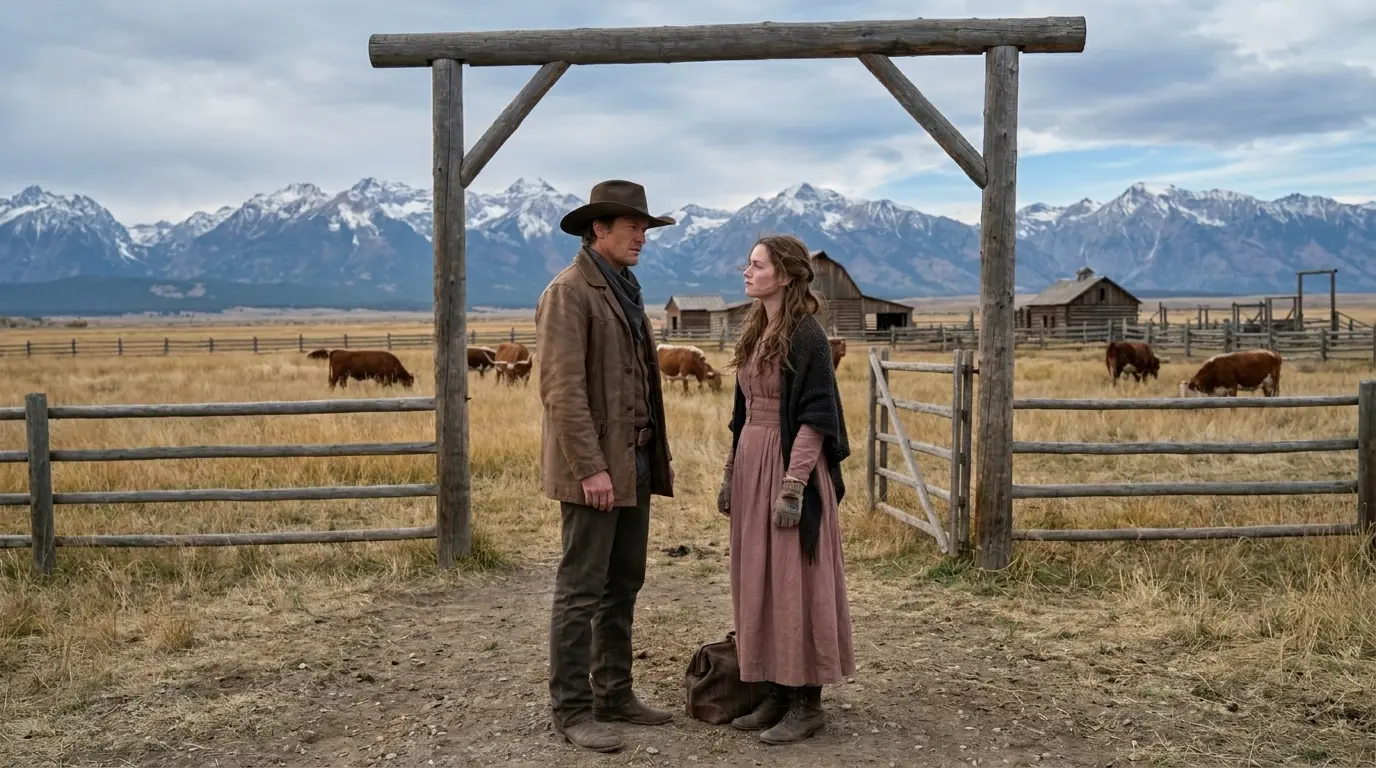
Three days earlier, she had been Miss Hayes, the schoolteacher, respected if not wealthy. Now she was merely another woman with nowhere to go and winter bearing down like a freight train. The school board had gathered in Miller's General Store the previous Tuesday, their faces grim as undertakers.
"The budget's been cut again," old Mr. Peterson had said, refusing to meet her eyes. "The territory can't afford to keep a teacher through the winter months."
Just like that, her position was gone. The room she rented above the bakery went with it. Mrs. Kowalski needed the space for paying tenants, she had explained with something that might have been sympathy.
Eleanor shifted her weight and felt the three silver dollars in her pocket clink together. It was every cent she had to her name, not enough for passage east even if she had somewhere to go back to. Her family's farm in Ohio had been sold to cover debts two years earlier, and her intended, Harold Wickham, had made it clear that a penniless teacher was no longer suitable wife material for a man of his standing.
The wind rose again, and she could taste snow in the air. Real snow, the kind that buried a person if they were not careful. She had heard stories of travelers found in spring, frozen solid as fence posts. The thought made her stomach clench with something beyond hunger.
Through the swirling snow, she could just make out the iron gates of the Caldwell ranch. Everyone in Bitter Creek knew about Thomas Caldwell's spread, the largest in three counties. They said he owned cattle by the thousands and a house fine enough for any Eastern lady.
She had seen him in town once or twice, a tall man with shoulders broad as an ax handle and eyes the color of a winter sky, always polite when he tipped his hat but distant as the mountains. Eleanor had heard the whispers, too, about how his wife had died giving birth to their second son and how he had been raising the boys alone ever since. The ladies at church tsk-tsked regularly, saying it was not proper for a man to tend a house and raise children both, though none had offered much help beyond the occasional casserole.
Eleanor was not certain what drew her toward those gates. Desperation, perhaps, or the simple fact that freezing beneath a tree seemed a poor way to end her story. The wind was howling fiercely now, and she could barely see ten feet ahead. Snow was beginning to cling to the ground in earnest.
The gate stood open, unusual for such a prosperous spread, and Eleanor found herself walking up the long drive without quite deciding to do it. Her boots crunched through the thin layer of snow as she pulled the shawl over her head. The house loomed from the storm like something from a dream: two stories of solid timber, glass windows catching what little light the gray sky offered, smoke rising from the chimney, and warm yellow light spilling from the rooms below.
It looked like everything she had lost and everything she had never possessed, all wrapped into one impossible vision. She was still standing there, carpetbag in hand and snow collecting on her shoulders, when the front door opened.
Thomas Caldwell filled the doorway as though he had been carved from the same timber as his house. Even from thirty feet away, Eleanor could see the surprise on his face when he spotted her. He stepped onto the covered porch without bothering to put on a coat.
"You lost, miss?" His voice carried easily across the yard, deep and steady as bedrock.
Eleanor felt her cheeks burn despite the cold. What was she doing there? What could she possibly say that would not sound like begging? Because that was what she was, a beggar at his gate, hoping for scraps of kindness.
"I—the storm came up suddenly," she called back, which was true enough, even if it was not the whole truth.
Thomas studied her for a long moment, taking in her threadbare coat and the way she clutched the old carpetbag. His eyes were sharp, the kind that missed nothing. Then he stepped down from the porch and walked toward her, his boots leaving deep prints in the snow.
"You're the schoolteacher," he said when he was close enough to speak without shouting.
It was not a question.
"I was," Eleanor corrected, lifting her chin despite the tremor threatening her voice. "My position was eliminated this week."
He nodded slowly, as though the news did not surprise him. "I figured as much when I saw you walking up the drive with everything you own in that bag."
Heat flooded her face again. Was she so obvious? So pathetic?
"The storm's getting worse," Thomas continued, glancing at the sky. "It'll be a blizzard before long. You got somewhere to be?"
The simple question struck her like a physical blow. Somewhere to be. If only it were that easy.
"Not particularly," she managed.
They stood in the falling snow, two strangers taking each other's measure. Eleanor could see something working behind those winter-blue eyes, some calculation she could not read. When he spoke again, his words were careful and deliberate.
"I've got coffee on the stove. The house is warm. In a storm like this, a person could freeze to death before making it back to town."
It was an offer, but more than that, it was an acknowledgment of exactly how desperate her situation was, delivered without pity or judgment. It was practical kindness from one person to another.
"That's very generous, Mr. Caldwell, but I couldn't impose."
"You're not imposing." He was already turning toward the house. "Come on before we both turn into ice sculptures."
Eleanor hesitated only a moment longer, weighing pride against survival. Pride was a luxury she could no longer afford. She followed Thomas toward the warm light spilling from his windows, her tracks disappearing almost as quickly as she made them.
The porch offered blessed relief from the wind. When Thomas opened the front door, the warmth flowing from the house felt like salvation itself. Eleanor stepped inside and immediately understood why the ladies in town spoke of the place with such reverence.
The entryway alone was larger than the room she had rented, with polished wooden floors and a staircase curving toward the second story like something from a picture book. Yet what caught her attention was what she did not see. There was no woman's touch anywhere, no flowers in vases or embroidered cushions on the chairs. The house was clean enough, but stark and functional, like a barn that happened to contain fine furniture.
"Boys," Thomas called, hanging his hat on a peg beside the door. "Come meet our guest."
Running feet sounded from deeper in the house. Soon, two small faces appeared around the corner of what looked like a sitting room. The older boy, seven or eight by Eleanor's estimation, had his father's strong jaw and serious eyes. The younger one, perhaps five, had softer features and hair that stuck out in every direction.
"This is Miss Hayes," Thomas told them. "She's going to wait out the storm with us."
The older boy, Daniel—Eleanor remembered hearing the name in town—regarded her with open suspicion. The younger, Samuel, stepped forward with the fearless curiosity of childhood.
"Are you really a teacher?" Samuel asked, his eyes wide.
"I was," Eleanor replied, crouching to his level. "Do you like learning things?"
"Papa says I have to learn my letters, but they're hard."
"They are hard at first," she agreed. "But once you know them, they open up whole worlds."
Samuel nodded solemnly as if this made perfect sense. Daniel remained where he was, watching her as though she might steal something if he looked away.
"Coffee's this way," Thomas said, gesturing toward the kitchen. "Boys, get back to your supper."
The kitchen was easily the largest Eleanor had ever seen, with a cookstove that could have heated half the schoolhouse and cabinets reaching to the ceiling. Yet like the rest of the house, it felt empty somehow—functional, but not lived in. Thomas poured coffee from a pot that had seen better days. The liquid was dark as midnight and strong enough to wake the dead.
Eleanor wrapped her cold fingers around the tin cup and breathed in the warmth.
"The storm's getting worse," Thomas observed, nodding toward the window, where snow was now falling in thick, heavy flakes. "The roads will be impassable by morning."
Eleanor stared into her coffee, trying to think of something to say that would not sound like a plea. She could not ask to stay the night. It would not be proper, and besides, she had nothing to offer in return.
"I heard about the school," Thomas said after a moment. "Shame. Children need learning."
"Not enough to pay for it, apparently."
"The territory's strapped for cash, the railroad's taking its time getting here, and without easy transport for cattle, tax revenues are down." He took a sip of coffee, studying her over the rim. "What will you do now?"
It was the question she had been dreading. Eleanor set down her cup with hands that trembled slightly.
"I'm not sure. Look for another position somewhere, I suppose."
"Where?"
Such a simple word, yet it laid bare the impossible truth of her situation. There were no other teaching posts within a hundred miles, not for a woman alone with no family connections and no money for travel.
"I don't know," she admitted.
Thomas was quiet for a long moment. The wind rattled the windows, and somewhere in the distance one of the boys laughed. The sound was bright and warm, a sharp contrast to the storm outside.
"I've got a proposition for you," Thomas said finally.
Eleanor looked up, surprised by the seriousness in his voice.
"I need a wife. Not for romance or any of that foolishness, but for practical reasons. Someone to keep house, help with the boys, and make sure there's hot food on the table and clean clothes in the drawers. Winter's coming hard, and I can't manage it all alone."
Eleanor stared at him, certain she had misheard.
"I beg your pardon?"
"A business arrangement," Thomas continued, as steadily as though he were discussing the price of cattle. "You need shelter and security. I need help running this place. We could make it work."
"Mr. Caldwell, I hardly know you."
"What's to know? I'm a decent man who pays his debts and keeps his word. I don't drink to excess or raise my hand to women or children. I own this land free and clear, and I've got money in the bank. You'd want for nothing."
Eleanor felt the world tilt around her. Men did not simply propose marriage to women they barely knew, especially men like Thomas Caldwell.
"The boys need a mother," he continued. "They're good children, but they're running wild without a woman's influence. And I—" He paused, choosing his words. "I need a partner. Someone I can count on."
Outside, the wind shrieked like something alive and angry. Eleanor thought of the three silver dollars in her pocket, of the long winter ahead, and of the very real possibility that she might not survive it without help.
"It wouldn't be a real marriage," Thomas added quickly, as if reading her thoughts. "Separate rooms, separate lives in many ways. Just two people helping each other through."
Eleanor looked around the kitchen at the empty spaces where a woman's touch should have been. Then she thought of the boys in the next room, growing up without softness or gentle guidance, and of herself standing at those iron gates with snow gathering on her shoulders and nowhere else to go.
"Why me?" she asked quietly.
Thomas considered the question. "You're educated. The boys could use that. You're alone, which means you'd be committed to making this work. And—" He paused, then met her eyes directly. "You're desperate enough to say yes."
The brutal honesty stole her breath. There were no pretty words or false promises, only the truth laid out as plainly as a winter morning.
"I need time to think," Eleanor said.
Thomas nodded toward the window, where the snow was now so thick they could barely see the barn. "The storm isn't going anywhere. Neither are you tonight. We can talk more in the morning."
He was right. Wind, weather, and circumstance had already made part of the decision for her. She was there for the night whether she liked it or not. The question was what she would choose when morning came.
As Eleanor sat on the edge of the bed listening to the storm rage outside, she tried to imagine what her life would be like in this house. She pictured waking every morning to cook breakfast for a man who barely knew her name, washing clothes and tending children who might never accept her as their mother, and living as a stranger in a home that would never truly be hers.
Then she considered the alternative: cold, hunger, and the very real possibility that winter would kill her before spring came again. Sometimes survival was the only choice that mattered. Outside, the storm howled on, and Eleanor pulled the quilts to her chin, trying to imagine what tomorrow might bring.
Morning came gray and silent, with the particular stillness that followed a true storm. Eleanor woke to the smell of coffee and bacon drifting beneath her door and the sound of boots moving through the kitchen. For a moment, she forgot where she was. Then the events of the previous day came rushing back, along with the weight of the decision awaiting her.
She dressed quickly in her one good gown, a navy wool dress that had seen better days but remained respectable, and pinned her dark hair back as neatly as she could. When she emerged from the small room, Thomas was standing at the kitchen window, looking out over a world transformed by snow.
"The storm's blown itself out," he said without turning. "Dropped close to two feet by the look of it."
Eleanor joined him at the window and caught her breath. The landscape had been erased and rewritten in white. Drifts rose halfway up the fence posts, and the road, if it could still be called that, was nothing but an unbroken expanse of snow stretching toward town.
"You weren't exaggerating about the roads being impassable," she murmured.
"It takes a few days to dig out after a storm like that. Sometimes longer."
Thomas finally turned to face her, and she could see the question in his eyes. "Coffee's fresh. The boys are still sleeping."
Eleanor accepted the tin cup he offered, grateful for something to do with her hands. The coffee was strong and hot, cutting through the chill that seemed to have settled in her bones.
"I've been thinking about what you said," she began, then stopped. How did one discuss a marriage proposal that was not really a marriage proposal? "About your arrangement."
Thomas nodded, his expression revealing nothing.
"I need to understand what you're truly asking. You say the boys need a mother, but what does that mean exactly? What would you expect from me?"
Thomas leaned against the counter and considered his answer. "The boys need consistency. Someone to make sure they eat proper meals and keep clean. Someone to teach them manners and help with their letters. They're good children, but they've been without a woman's guidance for two years."
"And what about you? What would you expect from a wife?"
The word felt strange on her tongue, attached to something that had once seemed impossibly far from her reach.
"Someone to manage the household, make sure food is prepared and clothes are mended. Someone I can depend on when I'm out working the cattle or handling business in town." He paused, studying her face. "Someone who won't run at the first sign of hardship."
Eleanor set down her coffee cup. "And in return?"
"Security. A roof over your head and food on your plate. Protection. My name, if that matters to you." Thomas spoke as matter-of-factly as if they were negotiating the price of grain. "You'd be mistress of this house. The boys would be yours to raise as you see fit."
It was a practical arrangement, nothing more. There was no mention of affection or companionship, and certainly no promise of love. Eleanor found herself oddly relieved by his directness, even as part of her felt hollow at the clinical nature of it.
"Separate rooms," she said, more to clarify than to question.
"Separate rooms," Thomas confirmed. "You'd have your privacy, and I'd have mine. Unless—"
He trailed off and seemed to think better of whatever he had nearly said.
"Unless what?"
"Unless someday we decided differently. But that would be a long way off, if ever, and it would be your choice as much as mine."
Heat rose into Eleanor's cheeks, and she looked away. The practical arrangement was one thing, but the possibility of something more in some distant future was territory she was not prepared to explore. Not yet.
The sound of small feet on the stairs interrupted them, followed by Samuel calling for his father. Thomas started toward the hallway, but the boy appeared in the kitchen doorway first, rubbing sleep from his eyes.
"Papa, is the lady still here?"
"Miss Hayes is still here," Thomas confirmed. "Say good morning."
Samuel ducked his head shyly. "Good morning, Miss Hayes."
"Good morning, Samuel. Did you sleep well?"
The boy nodded, then seemed to remember something important. "Did you see all the snow? It's up to the windows."
"I did see it. There's quite a lot, isn't there?"
"Papa says we might be snowed in for days and days. Will you stay that long?"
The innocent question hung in the air like smoke. Eleanor felt Thomas watching her, waiting for the answer. She looked down at Samuel's hopeful face and then past him to Daniel, who had appeared in the doorway, still wary but listening intently.
"I might," Eleanor said carefully, "if your father doesn't mind the company."
"Can you really teach us letters?" Samuel asked, bouncing slightly on his toes.
"I can. Would you like me to?"
"Yes. Daniel says letters are stupid, but I think they're like secret codes."
"They are very much like secret codes," Eleanor agreed, smiling despite herself. "Once you learn them, you can decode any book."
She glanced at Daniel, who was trying and failing to look uninterested. "What do you think, Daniel? Would you like to learn some secret codes?"
The older boy shrugged, but she caught a flicker of curiosity in his eyes. "Maybe."
Thomas cleared his throat. "Boys, go get dressed. Miss Hayes and I need to finish talking."
Samuel groaned but obediently headed toward the stairs. Daniel lingered a moment longer, his gaze moving between Eleanor and his father with an expression far too knowing for a child his age.
When they were alone again, Thomas poured himself another cup of coffee.
"They like you," he said.
"Samuel does. Daniel is reserving judgment."
"Daniel is protecting himself. He's old enough to remember his mother and old enough to know what it means to lose someone." Thomas stared down into his coffee. "He's been the man of the house in his own mind since she died. It won't be easy for him to let someone else take over."
Eleanor felt a pang of sympathy for the serious little boy. "And if I stayed—if we went through with this arrangement—what would happen if it didn't work? If the boys couldn't accept me, or if we found we couldn't manage together?"
Thomas was silent for a long moment. When he answered, his voice was careful and measured.
"I suppose we'd have to figure it out if it happened. But I'm not a man who gives up easily, and I don't think you are either, or you wouldn't have survived this long on your own."
It was not precisely comforting, but it was honest. Eleanor valued that more than pretty reassurances that might prove false.
"The town will talk," she said. "A marriage this sudden, under these circumstances—people will assume things."
"People always assume. The question is whether you care what they think."
Eleanor had spent her entire life caring what people thought. It was what proper ladies did. Yet proper ladies also did not find themselves penniless and homeless with winter closing in.
"I'd want to continue teaching," she said suddenly. "The boys, certainly, but others too. I know the school is closed, but there must be children who could benefit from lessons."
Thomas nodded. "The house is large enough. We could set up a proper schoolroom upstairs."
The casual way he accepted her condition surprised her. Most men would have balked at a wife working, even if that work was teaching.
"You wouldn't mind children coming and going?"
"It might be good for Daniel and Samuel. Give them children their own age to play with."
Thomas set down his cup and looked directly at her. "Anything else you need to know?"
Eleanor felt as though she stood at the edge of a cliff, looking into unknown country. Every practical instinct told her to accept. She had nowhere else to go, no other prospects, and winter stretched ahead like a death sentence. Yet marriage, even marriage in name only, was not something to enter lightly.
"If I agreed," she said slowly, "how soon would you want to do it?"
"As soon as the preacher can get here. The roads should be clear enough in a few days."
So fast. Her entire life could change in the span of a week. It seemed impossible, yet there she was, considering it in complete seriousness.
"Miss Hayes?" Samuel called from the stairway. "Can you help me with my buttons?"
Eleanor looked toward the sound, then back at Thomas. "May I?"
He nodded, and she went to help the boy with his shirt. Samuel chatted happily while she worked, telling her about his favorite games and asking whether she knew any songs. Daniel appeared shortly afterward, dressed but with his hair sticking out at odd angles.
"Come here, both of you," Eleanor said, taking a comb from her pocket. "Let's get you properly groomed."
She smoothed Daniel's hair despite his protests and was rewarded with something that might have been the beginning of a smile. Samuel submitted to having his face scrubbed without complaint, then asked if she could braid his hair like a girl's.
"Boys don't generally wear braids," Eleanor explained gently. "But I could teach you to tie sailor knots if you'd like."
"Could you really?"
"I had a brother who loved ships," Eleanor said, the memory of her lost family bringing an unexpected pang. "He taught me all sorts of useful knots."
Thomas watched the domestic scene from the kitchen doorway, and Eleanor caught something in his expression that might have been relief or perhaps longing. It was hard to tell.
"I want to learn knots too," Daniel announced, apparently forgetting to remain suspicious.
"Then I'll teach you both," Eleanor promised.
Later, after the boys had been fed and sent to play in the sitting room, Eleanor found herself alone with Thomas again. The weight of the decision pressed down on her like the snow outside, heavy and inescapable.
"You haven't given me an answer," Thomas said.
Eleanor looked around the kitchen at the signs of a household that needed a woman's touch. She thought of the boys upstairs, hungry for attention and guidance. She thought of the long winter ahead and the very real possibility that refusing the offer meant choosing to die.
More than that, she thought of the moment Daniel had allowed her to fix his hair and the way Samuel had looked at her as though she might be the answer to an unspoken prayer.
"If I say yes," she said quietly, "it will be for them as much as for me. Those boys need more than I can give them in a few days."
Thomas nodded. "They do."
"And you would truly let me set up a school?"
"I would."
Eleanor drew a deep breath. "Then yes. I'll marry you, Mr. Caldwell."
The words felt strange leaving her mouth, though not as strange as she had expected. Thomas did not smile or display any particular emotion. He merely nodded as if she had agreed to help with the harvest.
"I'll ride to town as soon as the roads clear and speak to Reverend Morrison about performing the ceremony."
"What will you tell him about why we're marrying?"
"The truth. That we're two practical people making a practical decision." Thomas paused. "Unless you'd prefer a different story."
Eleanor considered it. A whirlwind romance would certainly be more romantic and perhaps more socially acceptable, but there was something to be said for honesty, even when it was uncomfortable.
"The truth will do."
Thomas extended his hand. After a moment's hesitation, Eleanor shook it. His grip was firm and warm, calloused from years of hard work. It felt like sealing a bargain, which she supposed it was.
"Welcome to the family, Miss Hayes," he said.
From the sitting room came the sound of the boys arguing, followed by a crash suggesting that something had been knocked over. Thomas winced.
"I should warn you," he said. "They're not always as well-behaved as they've been this morning."
Eleanor smiled, her first genuine smile since reaching the ranch. "Mr. Caldwell, I've spent three years teaching school. I'm not easily shocked by misbehaving children."
As if summoned by her words, Samuel appeared in the doorway with tears streaming down his face and a red mark on his forehead.
"Papa, Daniel hit me with the wooden horse!"
Thomas sighed and headed toward the sitting room to resolve the crisis. Eleanor followed, already beginning to understand what she had agreed to. It was going to be a long winter, but for the first time in weeks, she felt something that might have been hope.
Three days after the roads cleared, Reverend Morrison arrived at the Caldwell ranch looking as though he would rather be anywhere else in Montana Territory. The elderly preacher sat stiffly in the front parlor, his Bible clutched in weathered hands, casting disapproving glances between Thomas and Eleanor as if they were wayward children who had tracked mud through his church.
"This is highly irregular," he said for the third time, adjusting his wire-rimmed spectacles. "Marriage is a sacred institution, not a business transaction."
Eleanor smoothed her hands over her best dress, the same navy wool she had worn the morning after the storm, now freshly pressed and adorned with a simple white collar fashioned from an old petticoat. It was not much of a wedding gown, but it would have to do.
"With respect, Reverend," Thomas said, his voice patient but firm, "the marriage will be legal and binding. The reasons behind it are our own concern."
The preacher's lips pursed as though he had tasted something sour. "And the children? What example does this set for young Daniel and Samuel?"
"It sets the example that sometimes practical decisions serve everyone better than romantic foolishness," Thomas replied.
Eleanor noticed movement in the doorway and saw both boys peering around the corner. Daniel's expression was unreadable, while Samuel was practically bouncing with excitement. The younger boy had spent the entire morning asking whether Eleanor would truly become his new mama after the "wedding ceremony," as he called it.
"Can we start now?" Samuel called, apparently tired of waiting.
"Boys, go to the kitchen," Thomas instructed. "Mrs. Murphy will give you some bread and jam."
Eleanor smiled. Mrs. Murphy was the neighbor who had volunteered to witness the ceremony and prepare a simple meal afterward. She was a practical woman who had taken one look at the arrangement and declared it sensible enough, much to Reverend Morrison's dismay.
Once the boys had reluctantly departed, the preacher opened his Bible with visible reluctance.
"Very well. But I want it understood that I am performing this ceremony because you have asked it of me, not because I approve of the circumstances."
"Understood," Thomas said.
The ceremony itself was mercifully brief. Eleanor repeated words that felt strange and foreign on her tongue, promising to honor and cherish a man she had known for less than a week. Thomas delivered his responses in the same matter-of-fact tone he used when discussing cattle prices, though his eyes never left her face.
When Reverend Morrison pronounced them husband and wife, an awkward moment followed. It became clear that he expected Thomas to kiss his new bride. Thomas looked at Eleanor with a question in his eyes. She gave an almost imperceptible nod, and he leaned down to press his lips briefly against hers, a chaste, formal kiss that sealed their bargain.
"Well," Mrs. Murphy said brightly as the reverend packed away his Bible, "that's done, then. Mrs. Caldwell, welcome to the family."
Mrs. Caldwell. Eleanor felt a strange jolt at hearing her new name. She was no longer Eleanor Hayes, the displaced schoolteacher. She was Eleanor Caldwell, wife and mother, mistress of one of the largest ranches in three counties.
The boys burst back into the room before anyone could say more. Samuel launched himself at Eleanor with such enthusiasm that she nearly lost her balance.
"Are you really our mama now?" he asked, his small arms wrapped around her waist.
"I suppose I am," Eleanor said, smoothing his unruly hair.
Daniel hung back, watching the display with the same wariness he had shown since her arrival. Eleanor met his eyes over Samuel's head and saw the challenge there. Prove yourself worthy, his expression seemed to say.
After Reverend Morrison and Mrs. Murphy departed, the new family found themselves alone together for the first time. The house felt different somehow, as though the brief ceremony had shifted something fundamental in its foundation.
"I'll show you to your room," Thomas said.
Eleanor realized that although she had been staying in the small housekeeper's quarters, her new status as wife—even a wife in name only—required different accommodations.
Thomas led her upstairs to a bedroom at the end of the hallway. When he opened the door, Eleanor found a room furnished with unmistakable femininity. A delicate writing desk sat beneath the window, and the bed was covered by a quilt worked in shades of blue and yellow. It was beautiful, but heartbreakingly still, as if it had been waiting for someone to bring it back to life.
"This was—" Eleanor began, then stopped.
"My wife's room. Margaret's room." Thomas's voice was carefully neutral. "I thought you might prefer it to the one downstairs. There is more privacy up here."
Eleanor stepped inside and ran her fingers along the edge of the writing desk. She could almost feel the presence of the woman who had once sat there, perhaps writing letters or tending the household accounts. It felt like trespassing.
"I don't want to disturb anything," she said quietly.
"The room needs to be lived in," Thomas replied. "Margaret has been gone for two years. It is time the room served its purpose again."
He left her alone to settle in. Eleanor stood in the center of the room for several minutes, trying to absorb the reality of her situation. This was her space now, her sanctuary, in a house filled with strangers who were suddenly her family.
She unpacked her few belongings, hanging her dresses in the wardrobe beside gowns that had belonged to another woman. Margaret Caldwell had favored fine fabrics and elegant cuts, silk dresses and wool coats that spoke of comfort and prosperity. Eleanor's simple cotton and wool garments looked shabby beside them.
From the window, she could see the barn and corral, where several horses grazed. Beyond them, the land stretched toward distant mountains, vast and unforgiving. It was beautiful in its harsh way, but it also emphasized how isolated they were and how dependent they would be upon one another for survival.
A soft knock interrupted her thoughts.
"Come in," she called.
Samuel's head appeared around the doorframe. "Papa says supper is ready. He made beans and bacon."
Eleanor smiled. "That sounds wonderful. I'll be right down."
She followed him downstairs and found the kitchen transformed from the stark, functional room she remembered. Mrs. Murphy had evidently set the table with proper dishes and found a small vase for late-blooming wildflowers. It was a modest touch, but it made the room feel more welcoming.
Thomas stood at the stove, serving their simple meal with movements that spoke of long practice. He had removed his jacket and rolled up his sleeves, and Eleanor was struck by how domestic he looked, nothing like the imposing figure who had first appeared in the doorway during the storm.
"It smells good," she said, taking a seat at the table.
Daniel was already seated, picking at his food without much enthusiasm. Samuel chatted happily about everything and nothing, clearly delighted by the novelty of having a woman at their table again.
"Mrs. Murphy said you might teach us our letters properly now," Samuel announced between bites of beans. "She said real teachers know all sorts of things."
"I do know quite a few things," Eleanor agreed. "Would you like to start tomorrow?"
"Can we?" Samuel turned to his father with pleading eyes.
Thomas nodded. "If your new mama thinks you're ready."
The word mama seemed to catch in his throat, and Eleanor felt a pang of sympathy. The arrangement was as strange for him as it was for her, perhaps more so. She was stepping into a new role. He was watching his sons attach themselves to a replacement for someone irreplaceable.
"I think we could begin with simple words," Eleanor said. "Things you see every day. Horse. Barn. Sky."
"What about my name?" Samuel asked eagerly.
"Especially your name."
Daniel finally looked up from his plate. "I already know some letters," he said quietly.
"Do you? That's wonderful. Perhaps you can help me teach Samuel."
Something shifted in Daniel's expression. Perhaps he was surprised that she acknowledged what he already knew instead of dismissing it. It was a small crack in his defensive wall, and Eleanor quietly counted it as progress.
After supper, while Thomas tended to the evening chores, Eleanor remained in the sitting room with the boys. She brought down one of her few books, a collection of simple stories, and began to read aloud. Before long, she realized how intently both children were listening.
"You read differently than Papa," Samuel observed when she paused.
"Different how?"
"More like the words have feelings."
Eleanor smiled. "Words do have feelings, in a way. The trick is learning how to hear them."
"Read more," Daniel said.
It was the first direct request he had made of her. Eleanor continued until Thomas returned, stamping snow from his boots and hanging his coat beside the door. He stood in the sitting-room doorway for a moment, watching the scene, and Eleanor wondered what he was thinking.
"Time for bed, boys," he said at last.
The announcement produced the usual chorus of protests and negotiations, but eventually both children were herded upstairs to wash and change into their nightclothes. Eleanor helped Samuel with his buttons and listened to his prayers, a sweet, rambling conversation with God that covered everything from his new mama to his favorite horse and a request for no more blizzards.
Daniel was more reserved. He accepted her help but offered little conversation. When Eleanor tucked the blankets around him, however, he looked up with something like curiosity.
"Are you really going to stay?" he asked quietly.
"I really am," she promised.
"Even when it gets hard? Papa says winters here are terribly hard."
Eleanor thought of all the difficult things she had already survived: the loss of her family, the end of her engagement, and the long months of uncertainty and want.
"I think I can manage hard," she said.
Something in her tone must have convinced him, because Daniel nodded and settled against his pillow.
"Good," he said simply.
When Eleanor returned downstairs, Thomas was cleaning the supper dishes. She picked up a towel and began drying without being asked. They worked in comfortable silence for several minutes before he spoke.
"They like you."
"Samuel does. Daniel is still deciding."
"Daniel has been the man of the house too long. He's forgotten how to be a child."
Eleanor dried a plate thoughtfully. "Maybe that is not entirely a bad thing. Children who have to grow up quickly often become strong adults."
"Perhaps. But I'd like him to have some childhood left, if possible."
It was the most personal thing Thomas had shared with her: this simple wish for his son's happiness. Eleanor felt something warm unfurl in her chest. It was not romantic feeling, exactly, but something like partnership, a belief that perhaps they could truly manage this together.
"I'll do my best to help with that," she said.
Thomas nodded and hung up the dishcloth. "I'll be up early tomorrow. The cattle need checking, and there is fence to mend before the next storm."
"What time should I have breakfast ready?"
"Five-thirty, if that's not too early."
Eleanor had risen at that hour for years as a schoolteacher. "That's fine."
"The boys usually eat around seven. Samuel likes his eggs soft, and Daniel likes his firm. Both will eat anything sweet you put in front of them, but don't let them fill up on it or they'll be sick."
These domestic details felt both ordinary and momentous. Eleanor was learning the rhythms of her new family, the small preferences and habits that would shape her days.
"I'll remember," she said.
Thomas appeared to realize that he was giving instructions as if she were a hired hand rather than his wife. He paused and looked directly at her.
"Eleanor—Mrs. Caldwell—this is your house now too. You don't need permission to change things or do what you think is best."
It was a generous gesture, and Eleanor appreciated it more than she could express.
"Thank you. That means a great deal."
They stood for a moment in the kitchen, two people bound by law and circumstance, both trying to find their way through strange new territory.
At last, Thomas cleared his throat. "I should let you get settled. Tomorrow will be a long day."
"Good night, Mr. Caldwell."
"Thomas," he corrected gently. "We're married now, after all."
"Good night, Thomas."
Eleanor climbed the stairs to her new room—Margaret's room—and prepared for bed. As she brushed her hair before the vanity mirror, she caught sight of her reflection and was surprised by what she saw. The woman looking back did not appear defeated or desperate. She looked determined and ready for whatever came next.
Outside, the wind was rising again, rattling the windows and reminding her how quickly the weather could change on the plains. Inside, however, the house felt solid, warm, and safe. She had made her choice and spoken her vows.
Tomorrow would bring new challenges: learning the rhythms of ranch life, winning over a wary little boy, and discovering how to be a wife without truly being a wife. But that night, for the first time in months, Eleanor Caldwell fell asleep in a bed that belonged to her, in a house where she had a right to remain.
It was not the life she had dreamed of as a girl, but it was a life. Perhaps, just perhaps, it could become a good one.
The first week of Eleanor's marriage passed in a blur of small discoveries and careful navigation. She learned that Thomas took his coffee black and strong, that Samuel feared thunderstorms but not blizzards, and that Daniel had taught himself to read simple words by studying labels on cans in the pantry. She learned that the kitchen stove had a temperamental damper that required coaxing and that the upstairs floorboards creaked in a particular pattern capable of waking the boys if she was careless on her way to bed.
What she did not learn was anything meaningful about the woman whose place she had taken. Margaret Caldwell remained a carefully guarded mystery. Her clothes still hung in the wardrobe, and her hairbrush remained on the dressing table with a few auburn strands caught in its bristles, but no one spoke of her. It was as if the family had collectively agreed that mentioning the dead would somehow make Eleanor's presence less legitimate.
The silence around Margaret became more pronounced on the eighth day of Eleanor's marriage, when she discovered Daniel sitting on the floor of what had once been a nursery. He held a small wooden horse and stared at a portrait that had been turned to face the wall.
Eleanor hesitated in the doorway, uncertain whether to intrude upon what was clearly a private moment. The room was thick with dust and abandonment. Baby furniture stood beneath sheets like ghosts of a life that might have been.
"She made this for me," Daniel said quietly without turning.
He held up the wooden horse, its paint worn smooth by small hands.
"Before Samuel was born, she said every boy needed a good horse to ride."
Eleanor stepped carefully into the room. "It's beautiful work."
"She could make all sorts of things. Toys and quilts and—" His voice caught. "She was making a cradle for the baby who didn't come."
The simple statement settled over Eleanor like a shroud. Another baby. Another loss no one had mentioned.
"She died having Samuel," Daniel continued, still looking at the overturned portrait. "But there was supposed to be a baby sister too. They both died."
Eleanor's throat tightened. She had known childbirth had claimed Margaret Caldwell, but she had not known about the second child. The double loss explained so much: Thomas's carefully controlled grief, the extra weight of sadness the boys carried, and the absolute silence surrounding their mother's memory.
"I'm sorry," Eleanor said, lowering herself to the floor beside him. "That must have been very frightening for you."
"Papa cried," Daniel whispered, as though confessing a terrible secret. "I wasn't supposed to see, but I did. He held Mama and cried like the world was ending."
Eleanor thought of Thomas as she had come to know him—steady, practical, and emotionally restrained—and tried to imagine him broken by grief. The image was almost too painful to contemplate.
"Sometimes even the strongest people need to cry," she said gently.
Daniel finally turned the portrait around. It showed a woman with kind eyes and auburn hair holding baby Samuel, while a younger Daniel stood proudly beside her chair. Margaret Caldwell had been beautiful in a wholesome, practical way, with laugh lines around her eyes and work-worn hands folded gently in her lap.
"She looks like someone who gave very good hugs," Eleanor observed.
"She did. She smelled like bread and lavender, and she always had time to listen." Daniel's voice was wistful. "Do you think she's watching us from heaven?"
Eleanor considered her answer carefully. "I think that if she is, she would want you and Samuel to be happy and to grow up strong and good."
"But what if she doesn't like that you're here now? What if she thinks you're trying to replace her?"
The question struck Eleanor like a physical blow. It was the fear she had not admitted even to herself—that she was somehow betraying the memory of a woman she had never met, that her presence insulted the love Thomas had lost.
"I'm not trying to replace your mother," Eleanor said firmly. "No one could do that, and I would never want to. But perhaps there is room for both of us in your heart. Your mother can have the love you will always carry for her, and I can have whatever new kind of caring we build together."
Daniel studied her with serious eyes that seemed too old for a boy of seven. "You promise you won't leave, even if it gets hard?"
"I promise."
The boy appeared to weigh her answer. Then he carefully placed the wooden horse on a shelf, where it could watch over the room.
"Samuel doesn't remember her much. He was too little. But I tell him stories sometimes so he won't forget."
"That's a good thing to do." Eleanor paused. "Would you tell me some of those stories sometime? I'd like to know about her."
For the first time since Eleanor had met him, Daniel smiled without reservation. "I'd like that."
They left the nursery together, but Eleanor carried the weight of what she had learned. That evening, after the boys were asleep, she found Thomas in his study, working on account books by lamplight.
"May I come in?"
He looked up, surprise flickering over his features. Eleanor rarely disturbed him in the evenings, respecting the unspoken boundaries of their arrangement.
"Of course."
She settled into the chair across from his desk and searched for the right words. "Daniel showed me the nursery today. He told me about the baby girl who didn't survive."
Thomas's pen went still upon the page. When he looked up, his eyes were carefully blank.
"He shouldn't have been in that room. I've told the boys to stay out of there."
"He misses her. He misses them both—his mother and the sister he never had the chance to meet."
"The past is the past," Thomas said, his voice clipped. "No good comes from dwelling on what cannot be changed."
Eleanor saw the tension in his shoulders and the way his hand gripped the pen too tightly.
"Forgetting is not the same as healing."
"I'm not trying to forget." Thomas set down the pen and leaned back in his chair. "But I can't live in yesterday, Eleanor. I have today to manage and tomorrow to prepare for. That is all any of us can do."
She understood the sentiment, but she also heard the pain beneath it. "The boys need to talk about her sometimes. They need to know it is safe to remember."
"And what would you have me tell them? That their mother was perfect and wonderful and that nothing I can provide will ever measure up? That every morning I wake knowing I failed to protect the most important people in my life?"
The raw honesty caught Eleanor off guard. She had never heard such emotion in Thomas's voice or seen his carefully maintained composure fall away.
"You couldn't have prevented what happened," she said quietly.
"Couldn't I? I should have insisted that she go to Denver for the birth, where there were proper doctors. Instead, I listened when she said she wanted the babies born at home. I let sentiment override sense, and it cost her everything."
Eleanor's heart broke a little for the man carrying such crushing guilt.
"Thomas, you cannot know that another choice would have changed anything. Even if it might have, torturing yourself will not bring her back."
"No," he agreed. "It won't. But it reminds me not to make the same mistakes again."
The conversation hung heavily between them, full of grief, regret, and carefully guarded vulnerability. Eleanor wanted to reach across the desk and offer some gesture of comfort, but she sensed he would not welcome the contact.
"The boys need to know they can speak of her," she said instead. "Not constantly, and not in a way that keeps the wound raw, but sometimes, when the memories come."
Thomas was quiet for a long while, staring at the papers without seeing them.
"She used to sing to them," he said at last. "Irish lullabies her grandmother taught her. Samuel was too young to remember, but Daniel sometimes hums the melodies when he thinks no one is listening."
"That's beautiful."
"She wanted to teach them piano. We were going to buy one when the railroad finally came through and shipping became easier." Thomas's smile was brief and sad. "She had all sorts of plans for when the boys grew older. She wanted to start a lending library, perhaps organize a quilting circle for the women in the area."
Eleanor felt a pang of something that might have been envy. Margaret Caldwell had been more than Thomas's wife. She had been his partner in dreams for the future, his companion in building a life that reached beyond mere survival.
"She sounds like she was wonderful," Eleanor said.
"She was." Thomas met her eyes directly. "She was everything good and gentle in this world, and I need you to understand that what we have—what we arranged between us—is not the same thing. It cannot be."
The words stung, but Eleanor appreciated the honesty.
"I understand."
"Do you? Because I don't want you to have expectations that cannot be met. I don't want you hoping for something that died two years ago."
Heat rose in Eleanor's cheeks. "I'm not hoping for anything beyond what we agreed. I know what this arrangement is."
Even as she said it, she realized it was not entirely true. During the past week, as she had watched Thomas with his sons and glimpsed kindness and humor beneath his practical exterior, she had begun to hope—not for grand romance, but for friendship, partnership, and the possibility that two people thrown together by circumstance might one day choose to remain together for better reasons.
Now, faced with the full weight of Thomas's love for his dead wife, those small hopes seemed foolish and presumptuous.
"I should let you return to your work," she said, rising.
"Eleanor."
The use of her name made her pause.
"I'm grateful for what you're doing—for the boys and for the household. I don't want you to think otherwise."
"I know."
"And if you need anything, or want something changed or improved, you only have to ask."
It was a generous offer, but Eleanor heard the distance in it. She was the hired help who happened to wear a wedding ring, useful and appreciated but not truly part of the family's heart.
"Thank you," she said simply.
She climbed the stairs to her room, the room that had been Margaret's sanctuary, and sat at the writing desk where another woman had once planned her future. Outside, the wind was rising again, promising another storm, and Eleanor pulled her shawl more tightly around her shoulders.
She had known the marriage would not be easy. She had accepted Thomas's proposal fully aware that she was entering a union without love, joining a family in which she would always be the replacement rather than the first choice. Yet hearing him speak of Margaret with such reverence and witnessing the depth of his continued devotion made the reality harder to bear than she had expected.
A soft knock interrupted her melancholy thoughts.
"Come in," she called.
Daniel peered around the doorframe, dressed in his nightgown and bare feet.
"I couldn't sleep."
"Bad dreams?"
"No. Just thinking too much."
He entered and settled into the small chair beside the window.
"I heard you and Papa talking downstairs."
Eleanor felt a stab of concern. "What did you hear?"
"Enough." Daniel's expression was serious beyond his years. "Papa told you about the baby, didn't he? About how Mama died?"
"He did."
"He blames himself. I heard him tell Mr. Murphy once when he thought I was asleep, but it wasn't his fault."
The boy's loyalty to his father was touching, though Eleanor suspected Thomas's guilt ran deeper than any reassurance from the outside could reach.
"Sometimes people blame themselves for things they could not control," she said carefully. "It is a way of trying to make sense of something senseless."
"Do you blame yourself for things?"
The directness of the question caught her off guard.
"Sometimes."
"Like what?"
Eleanor considered how much honesty was appropriate for a seven-year-old. "I used to blame myself for my family losing our farm in Ohio. I thought that if I had been smarter or worked harder, perhaps I could have helped save it."
"But you were only a girl then."
"I was. But feelings do not always make sense."
Daniel nodded solemnly. "I used to think that if I had been better, if I had not fought with Samuel so much or tracked mud into the house, maybe Mama would not have died."
Eleanor's heart clenched. "Oh, Daniel, your mother's death had nothing to do with anything you did or did not do."
"I know that now. Mostly." He looked through the window at the darkening sky. "But sometimes the bad thoughts come back anyway."
Eleanor wanted to gather the serious little boy into her arms and promise that the thoughts would disappear if she held him tightly enough. Instead, she gave him the truth.
"That is normal. Grief is like weather. Sometimes the sky is clear, and sometimes storms blow through. The important thing is remembering that storms always pass."
"Is that why you married Papa? Because of our storm?"
The boy's perception startled her.
"Partly," Eleanor admitted. "We all needed shelter from different kinds of storms."
Daniel was quiet for a moment. Then he asked, "Do you think you'll ever love us? Really love us, not just take care of us?"
The question pierced straight through Eleanor's carefully maintained composure.
"Oh, Daniel. I already do."
The words surprised her with their truth. Somewhere during the past week, between helping with buttons, reading bedtime stories, and listening to small confidences, she had begun to love the children—not as replacements for anything she had lost, but as themselves, two brave boys trying to understand a world that had taken too much from them too soon.
"Really?" Daniel's eyes shone with hope. "Even though we're not truly your children?"
"Love does not work that way," Eleanor said gently. "It is not only about sharing blood or even sharing a name. It is about caring for someone's happiness and wanting to be part of their story."
Daniel considered this with the gravity he brought to every important matter. Finally, he nodded.
"I'm glad you're here, Eleanor. Even if Papa doesn't love you the way he loved Mama, I'm still glad."
It was exactly what Eleanor needed to hear. It was not a promise of the love she could not have, but an acknowledgment of the love she could earn—the love she was already earning, one small moment at a time.
"I'm glad I'm here too," she said. "Now let's get you back to bed before your father discovers us conspiring in here."
As she tucked Daniel into bed for the second time that night, something settled into place inside Eleanor's chest. She might never possess Thomas's heart; that belonged to a ghost with whom she could not compete. But she could have his respect, his partnership, and the love of his children.
For now, that would have to be enough.
The first public test came on a Sunday morning three weeks after the wedding. When Thomas announced that they would attend services in town, Eleanor felt her stomach tighten with nerves as she helped the boys into their best clothes. This would be her first appearance before Bitter Creek as Mrs. Thomas Caldwell.
She chose the navy dress again, still the finest garment she owned, and pinned her hair back severely in an effort to look as respectable as possible. In the mirror, she saw a woman who looked older than twenty-five, marked by recent hardship but determined to hold her head high.
The ride to town was quiet, the wagon wheels crunching over snow that had refrozen into icy ruts. Daniel sat beside his father on the driver's bench, while Eleanor rode in the back with Samuel, who chattered excitedly about seeing his friends at church. She wished she could share his enthusiasm.
Bitter Creek's church was a simple wooden building with a bell tower whose sound carried for miles across the prairie. As their wagon approached, Eleanor saw families arriving, their breath clouding the cold air as they greeted one another with the easy familiarity of people who had known each other for years.
The conversations stopped when the Caldwell wagon pulled up.
Eleanor felt the weight of every gaze as Thomas helped her down. The whispers began before her feet touched the ground, sharp, sibilant sounds carried through the winter air like the hiss of snakes.
"Quick work, wasn't it?"
"Poor Margaret isn't even cold in her grave."
"The schoolteacher thinks she's landed quite a prize."
Eleanor raised her chin and took Samuel's hand, following Thomas toward the church doors. The crowd parted before them like water, and conversations resumed in hushed, urgent tones as they passed.
Inside, the scrutiny was even more intense. Eleanor could feel eyes following every movement as they made their way to the Caldwell family pew, the same pew where Margaret had once sat holding her babies and singing hymns in a voice people still remembered fondly.
Mrs. Henderson, the banker's wife, leaned toward Mrs. Patterson, who had taught Samuel before Eleanor's arrival. Both women glanced pointedly at Eleanor, their expressions ranging from disapproval to barely concealed hostility.
Eleanor sat straight-backed between Thomas and Samuel, trying to focus on Reverend Morrison's sermon about charity and Christian kindness. The irony was not lost on her that the same man who had reluctantly performed their marriage was now preaching about loving one's neighbor.
After the service, the true trial began. The congregation gathered outside for the weekly social hour, and Eleanor found herself at the center of attention she had never wanted.
"Mrs. Caldwell." Mrs. Henderson approached with a smile that did not reach her eyes. "How are you finding married life? Quite different from teaching school, I imagine."
"Different, yes, but rewarding," Eleanor replied carefully.
"I'm sure it must be a lovely home. And of course, there is the security that comes with marrying so well."
The emphasis on security made Mrs. Henderson's opinion of Eleanor's motives unmistakable. Other women gathered around, drawn by the promise of gossip. Eleanor recognized most of them from her teaching days, when they had been polite if not especially warm. Now their manner was distinctly chilly.
"It must be difficult," Mrs. Patterson said with false sympathy, "stepping into dear Margaret's shoes. She was so beloved by everyone who knew her."
"Margaret was certainly special," Eleanor agreed, refusing to take the bait.
"Oh, she was more than special," Mrs. Jenkins added. "She was practically a saint, always carrying soup to the sick and helping women through childbirth. When my youngest was born, Margaret sat with me for three days and barely slept."
The others nodded and murmured agreement, their voices taking on the reverent tone usually reserved for actual saints.
Eleanor understood what they were doing. They were testing her, watching to see how she reacted to being compared with a paragon she could never equal.
"She sounds like a remarkable woman," Eleanor said quietly. "The boys speak of her with such love."
"Do they?" Mrs. Henderson raised her eyebrows. "And how are the poor dears adjusting to having a stranger thrust so suddenly into their mother's place?"
Heat rose in Eleanor's cheeks, but before she could answer, a small voice spoke from behind her.
"She's not a stranger," Samuel announced, slipping his hand into Eleanor's. "She's our new mama, and she teaches us letters and knows how to tie sailor knots."
The women looked surprised by the boy's forthright defense. Eleanor squeezed his hand gratefully.
"Well," Mrs. Patterson said stiffly, "children do adapt quickly to new circumstances."
"They do indeed," said another voice.
Eleanor turned to see Mrs. Murphy approaching with a determined expression.
"And speaking of adaptation, Eleanor has done wonders with those boys. You should see how well-behaved they are now and how much young Samuel has learned in only a few weeks."
Gratitude rushed through Eleanor, but Mrs. Henderson was not deterred.
"Oh, I'm sure Mrs. Caldwell is adequate in her domestic duties. It is simply that some of us remember when this family was the heart of the community. Margaret organized the church socials, led the ladies' auxiliary, and coordinated aid for families in need. Such large shoes to fill."
The challenge was unmistakable. In front of half the congregation, Eleanor was being told that she was expected not only to become Thomas's wife and the boys' mother but also to assume all of Margaret's public roles—responsibilities for which she had neither training nor confidence.
"I'm sure Eleanor will find her own way to contribute," Mrs. Murphy said firmly. "Every person brings different gifts to a community."
"Of course," Mrs. Henderson agreed with a smile sharp as winter wind. "Though we do hope those gifts will be substantial. The Caldwell family has always been generous with its time and resources."
Eleanor felt trapped between competing expectations. If she tried to fill Margaret's role, she would inevitably fall short and be criticized. If she did not try, she would be condemned as selfish and inadequate. Either way, she could not win.
"Mrs. Caldwell," Reverend Morrison said as he approached. "Might I have a word?"
Eleanor followed him a few steps away from the cluster of women, grateful for the temporary reprieve even though she suspected his conversation would be no more comfortable.
"I wanted to speak with you about the children's religious education," he said in a carefully neutral tone. "Margaret was very involved in their spiritual development. I trust you intend to continue that tradition."
"Of course. I've been reading Bible stories with them in the evenings."
"Good. Good. And the church school—Margaret started a Sunday program for the younger children. The ladies were hoping you might take it on."
The weight of expectation settled upon Eleanor's shoulders like lead.
"I'm not certain I am qualified for that responsibility, Reverend. Perhaps one of the other ladies—"
"But you are a trained teacher," he pressed. "Surely that makes you the most qualified person in the community."
Before Eleanor could respond, a commotion near the church steps drew everyone's attention. Daniel had gotten into an altercation with Billy Henderson, Mrs. Henderson's son, and the two boys stood facing each other with raised fists.
Thomas strode over and caught Daniel by the shoulder. "What is going on here?"
"He said my new mama is only a gold digger," Daniel burst out, tears of anger streaming down his face. "He said she only married you for money and doesn't really care about us."
The blood drained from Eleanor's face as every conversation in the churchyard stopped. Silence stretched taut as a bowstring while Thomas looked from his son to Billy Henderson and then to the ring of adults watching.
"Billy," Thomas said quietly, his voice carrying clearly through the stillness, "I believe you owe my wife an apology."
"I was only repeating what I heard," Billy mumbled, glancing nervously toward his mother.
"Then perhaps," Thomas continued, deliberately turning his gaze to Mrs. Henderson, "you need to be more careful about what you listen to."
Mrs. Henderson's face flushed red. "Mr. Caldwell, I hardly think it is appropriate to blame a child for—"
"I'm not blaming the child," Thomas cut in. "I'm suggesting that adults should consider their words more carefully when little ears are listening."
The rebuke was gentle but unmistakable. Several people looked away uncomfortably.
Eleanor realized that Thomas was defending more than her honor. He was defending the family they had begun to build, fragile though it might still be.
Samuel, who had been watching with wide eyes, stepped forward.
"My mama does care about us," he declared to the assembled crowd. "She makes breakfast every morning and reads us stories. She fixed my torn shirt without even being asked, and she promised she won't leave us, even when things get hard."
The heartfelt declaration of a five-year-old carried more weight than all the adults' posturing. Several faces softened, and Mrs. Murphy wiped what might have been a tear from the corner of her eye.
Inspired by his younger brother, Daniel stepped beside him.
"And she's teaching us to read properly. She knows about numbers and history. And she makes Papa smile sometimes—real smiles, not only polite ones."
The last observation appeared to surprise Thomas himself. He looked down at Daniel with something like wonder.
Eleanor's throat tightened at the boys' loyal defense.
Mrs. Henderson, clearly aware that the tide had turned, attempted to recover.
"Well, of course the children are fond of their new stepmother. Children are naturally adaptable."
"They are," agreed Mrs. Wilson, one of the quieter church ladies who rarely involved herself in gossip. "But children are also honest about what they see. If they say Mrs. Caldwell cares for them, then she does."
Other voices began murmuring agreement. Eleanor realized that the boys' spontaneous defense had accomplished what all her careful politeness could not. They had vouched for her character in terms no one could dispute.
"Perhaps," Mrs. Murphy suggested with pointed cheerfulness, "we should welcome Mrs. Caldwell into our community instead of making her feel she must prove herself worthy of it."
Nods and murmurs spread through the crowd, and the tension gradually began to dissipate. People returned to their ordinary conversations, though Eleanor noticed that several women now made a point of speaking to her with genuine warmth.
As the family walked back to the wagon, Thomas fell into step beside Eleanor.
"I'm sorry about that," he said quietly. "Some people have too much time and too little sense."
"It's all right," Eleanor replied, though her hands were still trembling. "I expected there would be talk."
"That does not make it acceptable."
They rode home in thoughtful silence, broken only by Samuel's chatter about everything he had seen at church. Daniel kept glancing at Eleanor with something like pride, and she understood that their relationship had shifted during the morning's events. By defending her, he had publicly claimed her as part of the family.
That evening, after the boys were asleep, Eleanor stood with Thomas in the kitchen as they completed their nightly routine.
"Thank you," she said at last. "For standing up for me today. For standing up for us."
Thomas paused while drying a dish. "You're my wife. Those are my children. What affects you affects all of us."
It was a practical statement, but Eleanor heard something warmer beneath it.
"The boys were very brave today."
"They were. And very honest." Thomas set down the towel and looked directly at her. "Do I truly smile more now?"
"Real smiles," Eleanor said, feeling heat rise in her cheeks. "Sometimes, when you're not thinking about it."
Thomas considered this. "I hadn't realized."
"It isn't a bad thing," Eleanor said quickly. "It only means you're settling into this new life we're building."
"We," Thomas repeated, as though testing the word. "Yes. I suppose we are building something together, aren't we?"
Eleanor nodded, not trusting her voice.
It was not love. Not yet, and perhaps it never would be. But it was partnership, respect, and the beginning of something that felt like family. Outside, the wind howled around the house, but inside the warmth held steady.
They had weathered their first true test as a family, and they had come through it together. That was something upon which they could build.
The trouble began with missing cattle. During his weekly count, Thomas discovered that twenty head were gone from the north pasture, with no sign that they had wandered through a broken fence or open gate. The missing animals were among his finest breeding stock, worth more than most families earned in a year.
"Could be wolves," suggested Jake Morrison, Thomas's most trusted ranch hand, though his tone suggested he did not believe it himself. "It's been a hard winter. Maybe they're getting desperate."
Thomas studied the trampled ground. "Wolves don't cut fence wire, Jake. And they don't drive cattle in organized groups toward the railroad."
Eleanor overheard the exchange through the kitchen window while preparing the midday meal. A chill unrelated to the February weather settled in her stomach. She had heard stories of cattle rustlers and of families who had lost everything to organized thieves capable of disappearing into the wilderness with entire herds.
That evening, Thomas called a meeting with his ranch hands. Eleanor listened from the hallway as the men gathered in the front parlor, their voices low and serious.
"It isn't only us," reported Miguel Santos, a quiet man who managed the horses. "I saw Henderson's foreman in town yesterday. They've lost cattle too, and the Johnson place to the north is missing nearly fifty head."
"Has anyone seen anything suspicious?" Thomas asked.
"Strangers have been asking questions in town," Jake said. "A well-dressed fellow claims he's a cattle buyer, but he's asking mighty specific questions about who owns which land and how many men each ranch employs."
Eleanor felt her blood run cold. This was not random theft. It was reconnaissance.
"There's something else," Miguel added quietly. "That fellow was asking about the railroad survey. He wanted to know which route they had finally chosen."
Thomas was silent for a long moment. Eleanor could almost hear him thinking through the implications.
"The railroad," he said at last. "Someone wants our land for the railroad."
The pieces fell into place. The thefts were not only about cattle. They were intended to weaken the ranch financially and make it harder for Thomas to hold his property. Someone was trying to force him to sell.
"What do we do?" asked Peter Walsh, barely eighteen and still new to ranch work.
"We watch, we wait, and we protect what is ours," Thomas replied grimly.
Eleanor returned to the kitchen before the men emerged, but her hands trembled while she cleaned the supper dishes. She had come to the ranch seeking safety and security. Now even that refuge was under threat.
The next morning brought worse news. Thomas returned from the eastern pastures with a face like granite.
"They hit us again last night," he announced. "Fifteen more head, and they killed one of my bulls rather than leave it behind."
Eleanor felt sick. The senseless killing of an animal they could not steal spoke of something darker than greed.
"Why would they do that?" Daniel asked. He and Samuel were listening with the intense attention children gave to adult troubles they did not fully understand.
"To send a message," Thomas replied carefully. "Some people believe they can take what does not belong to them."
Eleanor saw the worry in his eyes and the way his jaw tightened when he thought no one was watching. This was no ordinary cattle theft. It was a campaign of intimidation.
Three days later, the campaign escalated. Eleanor was preparing bread when shouting broke out in the yard. Looking through the window, she saw Miguel helping Jake Morrison toward the house, Jake's shirt darkened by blood.
Without thinking, Eleanor ran outside, her heart pounding.
"What happened?"
"Found him near the creek," Miguel panted. "Shot in the shoulder. He's lucky it wasn't worse."
Together, they half carried Jake into the kitchen. Eleanor immediately assessed the wound with the practical calm she had learned from years of treating cuts and scrapes at the schoolhouse. The bullet had passed cleanly through the fleshy part of his shoulder. It was painful, but it should not prove life-threatening if properly cleaned.
"I need hot water, clean cloth, and the bottle of whiskey from Thomas's study," she instructed Miguel. "Then send someone to find Thomas."
As Eleanor worked, Jake told his story through gritted teeth.
"I was checking the fence line like Mr. Caldwell asked. There were three men, maybe four, cutting wire and driving cattle toward the old mining road. When they saw me, one of them simply shot. He didn't even warn me away first."
Eleanor's hands went still for a heartbeat. These were not ordinary thieves trying to avoid capture. They were deliberately warning anyone who interfered that they would be hurt.
"Did you recognize any of them?" she asked, resuming her careful cleaning.
"One looked familiar. I think I've seen him in town, but I can't place where."
Thomas arrived while Eleanor was bandaging Jake's shoulder. His face went white with controlled fury when he saw his most trusted employee's blood.
"How bad is it?"
"A clean wound," Eleanor reported. "He will need rest and careful tending, but he should recover."
Thomas's eyes met hers across the kitchen table. She saw something new in his expression: recognition of her competence under pressure, extending far beyond ordinary household work.
"Jake, I want you in the bunkhouse for the next few days. No riding alone and no checking fence lines without at least two men beside you."
"Mr. Caldwell, I can still work."
"You can work when you're no longer bleeding," Thomas cut in firmly. "These men mean business, and I will not have anyone else shot on my property."
That evening, after Jake had been settled in the bunkhouse and the boys put to bed, Thomas and Eleanor sat in the kitchen making plans.
"I've sent Peter to town to wire the territorial marshal," Thomas said. "But it will be at least a week before anyone can reach us, assuming the weather holds."
Eleanor poured coffee for both of them, her mind turning over possibilities. "What do we do in the meantime?"
"We defend what is ours. I have six good men, counting Jake when he heals, and this house is built solid. We can hold out if we have to."
Eleanor thought of Daniel and Samuel sleeping peacefully upstairs, unaware that their world was under threat.
"What if they come to the house?"
Thomas's expression darkened. "Then they will discover that threatening my family was a mistake."
The quiet steel in his voice sent a shiver through Eleanor, not of fear but of something close to pride. Thomas was a man who would protect what was his, whatever the cost.
"What can I do to help?" she asked.
He looked surprised. "Eleanor, if trouble comes, I need you to take the boys into the root cellar. There are supplies there, and it is the safest place on the ranch."
"That is not what I meant." Eleanor straightened in her chair. "I can shoot, Thomas. My father taught me when I was twelve, and I know basic medical care, as you saw today. If trouble comes, I want to help, not hide."
Thomas stared at her as though seeing her for the first time. "You would risk yourself for this place?"
"This is my home now," Eleanor said simply. "Those are my children, and you are my husband. Where else would I be?"
Something shifted in Thomas's face, surprise yielding to something deeper and more complex. For a moment, Eleanor thought he might reach across the table and take her hand. Instead, he nodded slowly.
"All right. But if things turn against us—if it becomes clear we cannot hold them off—you take the boys and run. Promise me."
"I promise."
The attack came two nights later. Eleanor woke to gunfire and men shouting. For a moment, she lay frozen in bed, hoping it was only a nightmare. Then she heard Thomas bellowing orders in the yard, and reality crashed over her like cold water.
She threw on her robe and rushed to the window. In the moonlight, muzzle flashes flared near the barn, and dark figures moved between the buildings. The rustlers had decided to strike the ranch directly.
Eleanor ran to the boys' room. Daniel was already awake, sitting upright with wide, frightened eyes. Somehow, Samuel remained asleep despite the chaos outside.
"What's happening?" Daniel whispered.
"Bad men are trying to steal our cattle," Eleanor said, forcing calm into her voice. "Your papa and the ranch hands are fighting them off. I need you to be very brave and help me with Samuel."
Daniel nodded solemnly and reached for his clothes. Eleanor gently woke Samuel, who began crying when he heard the gunshots.
"It's all right, sweetheart," she soothed, lifting him into her arms. "We're going to play our hiding game, just as we practiced."
During the preceding days, she had turned the emergency plan into a game, teaching the boys where to go if trouble ever came. Now she was grateful for that foresight as she hurried them downstairs.
The root cellar was reached through a trapdoor in the pantry floor. Eleanor had stocked it with blankets, water, and food, hoping it would never be needed. She opened the door and saw Daniel pale at the dark space below.
"I don't want to go down there," Samuel whimpered.
"I know, darling, but it is safe. Papa will come for us when the bad men are gone."
Eleanor was about to follow them when a violent crash sounded at the front of the house. Someone was trying to break in.
Her blood turned to ice. If the rustlers entered, they could find the boys easily enough. The cellar might hide them from a hurried intruder, but not from men with time to search.
"Daniel," she whispered urgently, "take Samuel to the very back corner. Cover yourselves with the blankets, and do not make a sound no matter what you hear. I will return soon."
"Where are you going?" Daniel's voice was tight with fear.
"To make certain the bad men do not find you."
Eleanor closed the trapdoor and quickly rearranged the pantry to conceal it. Then she took Thomas's shotgun from beside the kitchen door, a weapon she had learned to load and fire during her first week at the ranch.
The front door splintered as she reached the hallway. Two armed men burst inside, moving with the confidence of people who expected no meaningful resistance. They froze when they saw Eleanor at the end of the hall, the shotgun raised and aimed directly at them.
"This is private property," she said, surprised by the steadiness of her own voice. "You need to leave now."
One man laughed. "Well, look at this. Thomas Caldwell's new bride is trying to play soldier."
"Last warning," Eleanor said, tightening her grip.
The men exchanged glances, and she saw the calculation in their eyes. They believed she was bluffing, that a schoolteacher turned rancher's wife would never fire.
They were wrong.
When the first man stepped toward her, Eleanor fired. The blast shook the house, and he fell with a cry, clutching his wounded leg. His companion raised his pistol, but Eleanor was already reloading with movements her father had drilled into her until they were instinctive.
"Take another step, and I fire again," she warned.
The second man hesitated, looking between his wounded companion and the determined woman holding the shotgun. In that instant, Thomas appeared behind them in the ruined doorway, his own weapon drawn.
"The smart choice would be to drop your gun," Thomas advised quietly.
Whatever fight remained in the intruders disappeared. The wounded man was bleeding but not gravely injured, and his companion seemed far more interested in surrender than heroics.
As Thomas bound them, Eleanor finally allowed herself to shake. The rush that had carried her through the confrontation ebbed away, leaving her knees weak and her hands trembling.
"Eleanor." Thomas's voice was soft, almost wondering. "Are you all right?"
She nodded, not trusting herself to speak.
He stepped closer. For one moment, she thought he might embrace her, but instead he gently took the shotgun from her hands.
"The boys?"
"Safe in the root cellar."
Thomas looked at her with pride, gratitude, and something else she could not yet identify.
"You could have hidden with them."
"They are my children too," Eleanor said simply.
In that moment, something fundamental changed between them. Thomas no longer looked at her as the practical answer to his domestic problems. He saw his partner, his equal, his wife in every sense that mattered.
"Yes," he said quietly. "They are."
In the days following the attack, something shifted within the Caldwell household, like river ice breaking apart beneath the first warmth of spring. The change was subtle at first: a hand lingering on a shoulder, conversations lasting longer than necessary, and glances holding more warmth than mere partnership required.
Eleanor felt it most clearly in the small moments. When Thomas returned from checking the cattle each evening, he sought her out in the kitchen not simply to report on the day's work, but to ask about her thoughts, her concerns, and her plans for the boys' education.
One afternoon, while Eleanor changed the bandage on Jake Morrison's healing shoulder, Thomas watched with an attention that seemed to catalogue every competent movement of her hands. Jake had been staying in the house since the attack, and under Eleanor's care his wound was mending well.
"You have a gift for healing," Thomas observed.
"My mother taught me," Eleanor replied as she secured the clean bandage. "She said every woman should know how to tend wounds and illness. You never know when you may be the only help available."
"She was a wise woman."
Something in Thomas's voice made Eleanor look up. He was watching her with an expression she could not quite read, admiration perhaps, mixed with something deeper.
Jake cleared his throat, reminding them both of his presence. "Mrs. Caldwell, I cannot thank you enough. The doctor in town could not have done better."
Heat rose in Eleanor's cheeks. "I'm only doing what needs to be done."
Later, after Jake returned to the bunkhouse and the boys became occupied with their evening chores, Thomas approached Eleanor again.
"Eleanor."
The way he spoke her name was different now, softer and more personal.
"What you did that night, when those men broke into the house—"
She paused in her washing. "I protected my family."
"That is precisely it." Thomas stepped closer. "When did you begin thinking of us as your family? Truly thinking of us that way?"
Eleanor considered the question with the seriousness she gave all important matters.
"I don't believe there was one moment. It happened gradually. I watched Daniel struggle with his letters and felt proud when he succeeded. I saw Samuel's face light up when I braided friendship bracelets with him. I listened to you speak about expanding the herd and realized that I cared whether those plans succeeded."
She dried her hands on her apron, not quite meeting his eyes.
"And that night, when I heard those men breaking in, my first thought was not about my own safety. It was about keeping them away from the boys. From you."
Thomas was silent for a long moment. When Eleanor finally looked up, something in his expression caught her breath.
"I've been thinking," he said carefully, "about what this marriage was meant to be. About what we agreed to."
Eleanor's heart began to race. Was he regretting the arrangement? Had she overstepped by taking such an active role in defending the ranch?
"It was supposed to be practical," he continued. "A business arrangement that served both our needs."
"Yes," she said quietly.
"But somewhere along the way, it became something else. At least for me."
Thomas reached out, his fingers brushing hers where they rested upon the dish towel.
"Eleanor, I need you to know that you are not Margaret's replacement anymore. You are not a solution to a problem. You are yourself, and I find that I care about you in ways I never expected."
Tears pricked Eleanor's eyes.
"Thomas, I am not asking for anything you are not ready to give."
"I know," he said quickly. "I know this is not what you agreed to. But I needed you to understand that what I feel is not obligation or gratitude. It is something real."
Before Eleanor could answer, running feet thundered through the house, followed by Samuel calling for her. The moment broke apart, but the warmth in Thomas's eyes remained as they turned to deal with whatever crisis the boys had discovered.
That night, Eleanor lay awake in Margaret's room—her room now—staring at the ceiling and trying to untangle the emotions Thomas's words had awakened. She had entered the marriage expecting no more than security and a roof over her head. She had not expected to care genuinely for the stern, practical man who was revealing himself to be far more complicated than she had first believed.
More unsettling still, she had begun to suspect that her own feelings had grown beyond gratitude and partnership. When Thomas smiled the real smiles Daniel had mentioned, something fluttered in her chest. When he praised her competence or sought her opinion, she felt valued in a way she had never known before.
And when he had stood in the kitchen speaking of caring for her, she had wanted nothing more than to step into his arms and discover what it might feel like to be truly wanted rather than merely needed.
The realization was both thrilling and terrifying.
Three weeks later, the territorial marshal finally arrived with two deputies to investigate the cattle rustling. Marshal William Brady was a weathered man in his fifties who listened to their account with the patience of someone who had handled similar cases before.
"Railroad speculation," he confirmed after Thomas finished explaining the attempts to acquire his land. "We've been tracking a group operating across three territories. They identify valuable property, then use intimidation and theft to force owners to sell cheaply."
Eleanor served coffee to the lawmen in the front parlor and noticed how Thomas unconsciously positioned himself close to her chair—not possessively, but protectively.
"What can be done?" Thomas asked.
"We have enough evidence to arrest the men you're holding," Marshal Brady replied. "And they are talking in hopes of receiving lighter sentences. It appears the main organizer is a Denver man named Harrison Blackwood. He has been buying land options for an Eastern railroad syndicate."
Eleanor felt Thomas tense beside her.
"Blackwood? I know that name."
"I thought you might. He has been asking specifically about your property. He believes your land is essential to the railroad route they want to build."
"And if I refuse to sell?"
Marshal Brady's smile was grim. "Then they will continue trying to make you want to sell. Operations like this do not give up easily."
The marshal and his deputies remained for two days, taking statements and collecting evidence. During their visit, Eleanor noticed how naturally she and Thomas had begun acting as true partners. They finished one another's thoughts, made decisions together, and presented a united front to the outside world.
On the evening before the lawmen departed, Thomas found Eleanor in the kitchen preparing supper.
"Marshal Brady says they will probably send men to arrest Blackwood within the month," he reported. "But he warned that we may face more trouble before the matter is settled."
Eleanor nodded, unsurprised. "We will manage whatever comes."
"We," Thomas repeated.
It was the same word he had tested weeks earlier, but now his voice held satisfaction rather than surprise.
Eleanor set down her mixing spoon and turned fully toward him. "Thomas, that night you spoke about your feelings changing. Mine have changed too."
He went very still. "Changed how?"
Eleanor drew a breath and gathered her courage.
"I came here expecting to trade my work as a housekeeper and teacher for security and shelter. I thought that would be enough. But living here and becoming part of this family awakened feelings I did not know I was capable of."
Hope flickered in Thomas's eyes, and she continued before she lost her nerve.
"I love Daniel's serious questions and Samuel's endless enthusiasm. I love the way you listen when I speak about building a proper school. I love watching you work with the horses and seeing how gentle you are despite your strength."
Her voice dropped nearly to a whisper.
"And I love the man you have shown yourself to be—not only the practical rancher who offered me a marriage of convenience, but the father who carries his children's pictures in his pocket, the leader who inspires loyalty in his men, and the husband who defended his wife's honor when he barely knew her."
Thomas stepped closer and lifted one hand to her cheek.
"Eleanor—"
"I'm not asking you to forget Margaret," she said quickly. "I would never ask that. But if there is room in your heart for someone new, someone different, then I would like the chance to earn a place there."
Thomas answered by leaning down and kissing her—not with the formal politeness of their wedding day, but with the warmth of a man who had found something precious he believed lost forever.
Eleanor melted into the kiss, her hands finding his shoulders and feeling the solid reality of him beneath her palms. When they finally parted, both were breathing hard. Thomas rested his forehead against hers.
"There is room," he said simply. "Margaret will always be part of my past. But you are my present and my future, if you will have me."
"I will have you," Eleanor whispered.
Rapid footsteps sounded in the hallway, and they sprang apart just as Daniel appeared in the doorway with Samuel close behind.
"Papa!" Samuel announced cheerfully, oblivious to the charged atmosphere. "Miguel says supper smells so good it could wake the dead."
Daniel, however, looked between his father and Eleanor with eyes far too knowing for a seven-year-old. After a moment, a slow smile spread across his face.
"You were kissing," he said matter-of-factly.
Eleanor felt her cheeks flame, but Thomas only chuckled and ruffled his son's hair.
"Indeed, we were."
"Does that mean you truly love each other now?" Samuel asked with the directness of childhood. "Not only married for practical reasons, but real love?"
Eleanor and Thomas exchanged glances, and she saw her own joy reflected in his eyes.
"Yes," Thomas said firmly. "Real love."
Samuel whooped and threw his arms around Eleanor's waist.
"I knew it! I told Daniel that Papa's smiles were getting bigger and that you had a special look on your face when you watched him work."
Daniel approached more calmly, but pleasure showed clearly in his expression.
"I'm glad," he said. "Mama would have wanted Papa to be happy again."
The generosity of that statement from a child who had lost so much brought tears to Eleanor's eyes. She knelt and gathered both boys into her arms.
"I love you both very much," she said. "And I promise to take good care of your papa."
"And we'll take good care of you too," Daniel said solemnly.
That night, after the boys were asleep and the house had settled into quiet, Eleanor and Thomas sat together in the front parlor. They were not touching, but the space between them hummed with new possibility.
"What happens now?" Eleanor asked.
"Now we finish what we started," Thomas replied. "We build a life together—a real one, based on choice rather than necessity."
Eleanor considered the journey that had brought them there, from her desperate arrival in a blizzard to an evening when everything between them had changed. It had not been the romance of storybooks. It had been something real, built on respect and partnership, tested by adversity, and strengthened each time they chose one another.
"I would like that," she said.
Thomas reached across the space between them and intertwined his fingers with hers.
"The railroad matter is not over. There may be more trouble ahead."
"Then we will face it together."
"Together," Thomas agreed, lifting her hand and pressing a gentle kiss to her palm.
Outside, the Montana wind howled across the plains, carrying the promise of another storm. Inside the Caldwell house, warmth and light pushed back the darkness.
They had found something neither had been seeking when they made their practical arrangement. Love had grown in the space between necessity and choice, taking root in shared purpose and blooming into something capable of weathering whatever storms lay ahead.
It was not the beginning Eleanor had dreamed of as a young woman, but it was a beginning nonetheless. Sometimes, she reflected as she sat beside her husband in the firelight, the finest stories were the ones no one saw coming.
Spring came early to Montana Territory that year, arriving with a gentle warmth that made Eleanor believe in new beginnings. The last of the snow melted from the pastures, revealing green grass that seemed to shimmer with possibility.
Six months had passed since the arrests of Harrison Blackwood and his associates. The Caldwell ranch had settled into a rhythm of peace and prosperity that sometimes felt almost too good to be true.
Eleanor stood at the kitchen window watching Thomas work with a new colt in the corral. Daniel and Samuel perched on the fence, offering encouragement and advice that the horse ignored with dignified patience. The sight filled her with such contentment that she paused in her bread making simply to absorb it.
"Mama, the schoolchildren are here!" Samuel called from the front yard, his voice bright with excitement.
Eleanor wiped her hands on her apron and hurried to welcome her students. The informal school she had established in the upstairs room had grown from Daniel and Samuel to eight children from neighboring ranches. Their families were grateful for the opportunity to provide a proper education without sending the children on the long journey into town.
The morning lessons unfolded with the usual mixture of eager questions and restless squirming. Eleanor found herself reflecting, not for the first time, upon how different her life had become from that of the frightened, desperate woman who had arrived at the Caldwell gates during a blizzard.
That woman had been seeking mere survival. Mrs. Eleanor Caldwell had found something far richer.
At midday, when the children broke for lunch, Eleanor was surprised to see Thomas approaching the house with an expression she could not quite read. He had spent most of his recent days in the north pasture preparing for the spring calving season.
"Eleanor," he called. "Could I speak with you for a moment?"
She followed him onto the front porch and noticed that he kept glancing toward the road as if expecting someone.
"Is something wrong?" she asked.
Before Thomas could answer, the sound of wagon wheels drew their attention. A small convoy was approaching—not ordinary ranch traffic, but something decidedly more formal. Reverend Morrison's buggy led the procession, followed by several wagons carrying what appeared to be half the population of Bitter Creek.
"Thomas Caldwell," Eleanor said slowly, "what is going on?"
Her husband's serious expression cracked into something like sheepishness.
"Well, you see, I've been thinking about something you said months ago. About how our first wedding was more of a business transaction than a celebration."
Eleanor's heart began to race as the wagons drew closer and familiar faces came into view: Mrs. Murphy carrying a covered basket, the Henderson family despite their earlier coolness, and even Jake Morrison dressed in his Sunday best, his shoulder now nearly healed.
"Thomas—"
"I know we're already married," he said quickly. "Legally binding and all that. But I thought—well, we thought—it might be time to do it properly. With flowers, music, and a celebration that matches what we have built together."
The wagons reached the house, loaded with food, decorations, and Mrs. Henderson's prized fiddle. Reverend Morrison climbed down from his buggy with far more enthusiasm than he had displayed at their first ceremony.
"Mrs. Caldwell," the preacher called cheerfully, "I hope you don't mind the intrusion, but your husband was quite insistent that we mark this day properly."
Eleanor looked from Thomas to the gathering crowd, her throat tight with emotion.
"This day," Thomas said softly. "Our six-month anniversary. The day our contract marriage became something real."
Samuel came running from the corral, with Daniel following at a more dignified pace. Both boys wore the grins of people who had been keeping a wonderful secret.
"Surprise, Mama!" Samuel shouted, throwing himself into Eleanor's arms. "Papa planned a real wedding for you!"
Daniel approached with his usual seriousness, though his eyes were bright with pleasure.
"We helped," he said proudly. "I picked the flowers, and Samuel helped Papa practice his speech."
Tears gathered in Eleanor's eyes as she looked around at the people surrounding her, people who had once regarded her with suspicion and distrust and who had now come to celebrate the love she and Thomas had found.
"I don't know what to say," she whispered.
"Say yes," Thomas suggested, his own voice rough with emotion. "Say you will marry me again, properly this time. Not because you need shelter or because I need a housekeeper, but because we choose one another. Because we love one another."
Eleanor answered by throwing her arms around his neck, laughing and crying at once.
"Yes," she said. "Oh, yes."
The next hour passed in a whirl of activity. Mrs. Murphy and several other women swept Eleanor away to help her prepare while the men arranged tables and chairs in the front yard. Someone had brought early spring wildflowers, carefully gathered by Daniel from the meadow.
"Now this is more like it," Mrs. Murphy declared as she helped Eleanor into her best navy dress, the same one she had worn for the first ceremony. This time, however, Mrs. Patterson had contributed a delicate lace collar.
"A proper wedding for a proper couple," she said.
Eleanor caught sight of herself in the bedroom mirror and was startled by the change. The gaunt, desperate woman of six months earlier had been replaced by someone with color in her cheeks and light in her eyes. She looked like a woman who was loved and knew it.
When she emerged from the house, the front yard had been transformed. Tables groaned beneath contributed food. Children ran between the adults with boundless excitement, and lanterns had been strung between the trees despite the daylight.
Thomas waited beside a makeshift altar beneath the old oak tree, and Eleanor's breath caught at the sight of him. He wore the same best suit he had worn for their first wedding, but everything else was different. Where he had once been stiff and formal, he was now relaxed and smiling. Where his eyes had once been guarded, they now held the certainty of a man about to marry the woman he loved.
As Eleanor walked toward him, she was dimly aware of the gathered crowd, Mrs. Henderson's fiddle carrying a sweet melody, and the children's excited whispers. Her attention remained fixed upon Thomas and the way he watched her approach as though she were the most precious thing in his world.
This time, when Reverend Morrison asked whether she would take Thomas Caldwell as her husband, Eleanor's answer rang clear and strong.
"I will."
When Thomas spoke his vows, his voice carried across the yard with the confidence of a man declaring absolute truth.
"Eleanor," he said, taking both her hands, "six months ago, I offered you a practical arrangement. Today, I offer you my heart. You have brought laughter back into this house, wisdom to my children, and love to a man who believed he would never find it again. I promise to cherish you, to stand beside you, and to choose you every day for the rest of my life."
Eleanor's vows were simpler, but no less sincere.
"Thomas, you gave me shelter when I had nowhere else to go. More than that, you gave me a family, a purpose, and a love I never dared hope for. I promise to be your partner in all things, to love your children as my own, and to help you build a future worthy of the dreams we share."
When Reverend Morrison pronounced them husband and wife, Thomas's kiss was neither hesitant nor formal. It was the kiss of a man embracing his beloved, and Eleanor answered with the joy of a woman who knew she was truly wanted.
The celebration that followed contained everything their first wedding had lacked. There was music and dancing, laughter and toasts, children playing games while adults shared stories and food.
Eleanor was moved repeatedly: by Mrs. Henderson's grudging but genuine congratulations, by Jake Morrison's toast to "the finest lady ever to grace this territory," and by the sight of Daniel and Samuel teaching the younger children the sailor knots she had shown them.
As the sun began to set, painting the sky in shades of gold and rose, Eleanor found a quiet moment with Thomas on the front porch. The celebration continued below them, but for a little while they were alone.
"Thank you," she said, leaning against his shoulder. "For all of this. For giving me the wedding I never knew I wanted."
"Thank you," Thomas replied, tightening his arm around her, "for giving me the family I thought I had lost forever."
They sat in comfortable silence, watching their friends and neighbors celebrate a love that had grown from practical necessity into something beautiful and enduring.
"Do you think Margaret would approve?" Eleanor asked quietly.
Thomas considered the question with the seriousness he gave all important matters.
"I think she would be happy that her children have a mother who loves them, that her husband has found joy again, and that this house is filled with laughter. Margaret always believed love was not finite, that there was always room for more."
A weight Eleanor had not realized she still carried lifted from her shoulders. She would never replace Margaret in the boys' memories or in the history of the Caldwell family. But she had made a place of her own—not as a substitute, but as something new and equally precious.
"Papa! Mama!" Samuel called from the yard. "Come dance with us!"
They rejoined the celebration, and Eleanor was swept into a lively reel with Thomas while the children clapped and laughed around them. When the music ended, she was breathless and dizzy, but she could not remember ever feeling so purely happy.
As evening deepened and the guests began departing, Eleanor was touched by the warmth of every farewell. These people had finally accepted her, not as the desperate stranger who married Thomas for security, but as Eleanor Caldwell, a valued member of their community.
When the last wagon disappeared down the road and the boys had been put to bed amid excited claims that it had been the best party ever, Eleanor and Thomas found themselves alone in the kitchen, cleaning the remnants of the celebration.
"So," Thomas said, hanging the dish towel with exaggerated formality, "Mrs. Caldwell, how was your wedding day?"
Eleanor laughed, the sound bright and free. "Much better than the first one, Mr. Caldwell. Though I must say I am rather fond of how that first one turned out in the end."
Thomas stepped closer and placed his hands at her waist. "Any regrets about the road that brought us here?"
Eleanor considered the losses that had driven her to his door, the desperate bargain they had struck, and all the ways their story might have ended differently.
"None," she said firmly. "Every difficult step led me here—to this life, this family, and you. I would not change any of it."
Thomas's smile was answer enough, but he spoke anyway.
"Good. Because I intend to spend the rest of my life making certain you never have reason to regret choosing us."
Us. Eleanor tasted the word. It still amazed her how naturally they had become an us—not only herself and Thomas, but all four of them together, a family forged not merely by blood but by choice, commitment, and love.
Outside, the Montana wind whispered across the plains, carrying promises of summer warmth, autumn harvests, and years filled with the ordinary magic of shared days and common purpose. Inside the Caldwell house, warmth and light held steady against every storm.
They had begun with a contract, a practical arrangement between two people who needed what the other could provide. Together, they had built something far more valuable: a true family founded upon love that had grown slowly and surely, tested by adversity and strengthened by choice.
It was not the beginning Eleanor had imagined as a young woman, but it was perfect in its own way. The most beautiful love stories did not always begin with passion and roses. Sometimes they began with two people choosing to stay, work, and hope, then discovering along the way that they had found something worth keeping forever.
In the harsh frontier of Montana Territory, where survival so often mattered more than sentiment, Eleanor Caldwell learned that love did not always arrive with fanfare. Sometimes it came quietly, dressed in work clothes and carrying practical promises. Sometimes it grew in the space between necessity and choice, taking root in shared purpose and blooming into something capable of weathering any storm.
And sometimes, if one was very fortunate, it became the foundation upon which a marriage, a home, a family, and a future could be built—all of it worthy of every hope one had ever dared to carry.