I told my husband I was still at the office because “quarterly reports” sounded boring enough to be believable. Nobody questions spreadsheets, deadlines, or a tired employee complaining that numbers refuse to reconcile. At 9:08 on a rainy Thursday night in Indianapolis, I sat inside my parked car beneath the garage of the Westbury Hotel and typed, Still buried in reports. Don’t wait up. Love you. I stared at those last two words longer than everything else.
Love you.
I almost deleted them. Not because they were completely false, which would have made my life simpler in a terrible way, but because I still loved my husband while actively betraying him. That contradiction had become the ugliest thing about me.
I sent the message.
Then I sat without starting the engine.
The parking garage smelled like concrete, damp tires, and the faint exhaust of cars moving on the level above. My navy blouse carried the trace of a cologne that did not belong anywhere near my marriage, and my lipstick looked uneven from checking it too often in the hotel bathroom mirror. A charcoal cardigan lay folded over my work bag because I had worn it inside the lobby to hide the red dress beneath it.
That detail bothered me.
I had started planning what betrayal should look like from the outside.
I was thirty-seven years old, married twelve years, and somehow had become a woman who dressed in layers so people from work would not recognize her entering a hotel. My name was Erin Lawson, and until that year I would have described myself as organized, dependable, cautious, the person who returned shopping carts and mailed birthday cards early. I managed operations for a healthcare software company and spent most of my days solving other people’s problems with color-coded spreadsheets.
Then there was Michael.
My husband.
Michael Lawson taught eighth-grade science at a public school fifteen minutes from our house. He owned too many flannel shirts, believed leftover soup tasted better the next day, and had never once remembered to replace the toilet paper roll correctly no matter how many years I complained about it.
He was not exciting in the way I had started defining excitement.
That sentence still embarrasses me.
Michael loved quietly. He checked my tires before winter, left coffee beside my laptop when I had early calls, remembered which takeout place gave me headaches, and replaced the porch bulb before I noticed it had burned out. When I had pneumonia three years earlier, he slept on the floor beside the couch because I said the bedroom felt too warm.
I had started calling that predictability.
Comfort.
Routine.
Somewhere along the way, I let those words become insults.
My phone buzzed.
Michael had answered.
Okay. Drive safe. Chili is in the fridge.
That was all.
I read the message twice.
Chili in the fridge.
No suspicion.
No demand to know when I would be home.
No guilt.
He trusted me.
And because he trusted me, lying had become easier.
That was one of the hardest things I later had to admit in therapy. I did not cheat because Michael was controlling or cruel or absent. I cheated partly because he was safe enough for me to believe I could leave him waiting and still find home exactly where I left it.
The man upstairs in Room 714 was named Owen Price.
He worked for the consulting company helping us implement a new scheduling platform. He was forty, divorced, sharp, funny, and very good at making whoever stood in front of him feel like the most interesting person in the room. At first, I thought that quality meant he was interested in me.
Later, I understood he was simply practiced at attention.
It began with ordinary things.
Lunch after a client meeting.
A message about a broken spreadsheet formula.
A joke sent too late at night.
Then a conversation about how exhausted we were.
Then another about marriage.
I told Owen that Michael was a good man.
I said that several times.
As if praising my husband while betraying him somehow made me less disloyal.
Owen would answer, “Good doesn’t always mean right for you.”
I should have ended it the first time he said that.
Instead, I felt understood.
Three months after the messages started, I was sitting beneath the Westbury Hotel with my blouse smelling like him and my husband’s chili waiting in our refrigerator.
I started the car.
Rain followed me all the way home.
Our neighborhood on the north side was quiet when I turned onto Briarwood Drive. Most porch lights were already on, leaves stuck dark and flat against the sidewalks, and somebody’s Halloween decorations leaned sideways in the wind. Michael’s Subaru sat in the driveway.
The kitchen light glowed through the side window.
He was awake.
I considered driving past.
Just once around the block.
Five more minutes before I had to return to myself.
Then I saw the porch light.
Michael always left it on when I was out late.
I parked.
Before stepping out, I checked my face in the mirror.
The woman looking back at me was still recognizably Erin Lawson. Same hazel eyes, same small scar near my eyebrow, same hair that frizzed whenever it rained. That was worse than looking like a stranger.
A stranger would have been easier to hate.
I took off my earrings and dropped them into my purse.
Then I looked at my left hand.
Bare.
My stomach turned.
My wedding ring was gone.
For several seconds, I could not remember where I had put it.
Then the hotel bathroom appeared in my mind.
White marble sink.
Hand soap.
My ring resting beside the faucet.
Owen knocking once and saying parking validation ended at nine.
I had washed my hands and dried them.
I remembered picking up my purse.
I remembered the elevator.
I did not remember putting the ring back on.
Panic climbed into my throat.
I searched the center console.
Nothing.
My purse.
Nothing.
Coat pocket.
Nothing.
I considered calling the hotel.
Then another thought arrived.
Maybe it had slipped somewhere inside my coat.
I would find it after Michael went to bed.
I told myself that.
Even then, I was still planning the next lie.
I entered quietly.
The house felt wrong.
Not dramatically wrong.
No broken glass.
No raised voices.
No suitcase beside the door.
Just silence.
The television was off.
The dishwasher was not running.
Michael usually listened to podcasts while waiting for me.
That night there was nothing.
“Mike?”
His answer came from the kitchen.
“In here.”
Two words.
Flat.
Controlled.
I hung my coat automatically.
One sleeve slipped off the hook.
Normally I would have fixed it.
I left it hanging.
The hallway felt longer than usual.
Family photographs lined one wall.
Our wedding outside a barn in Bloomington.
A camping trip where Michael burned pancakes so badly we fed them to squirrels.
Our tenth anniversary near Lake Erie.
The first Christmas after we bought the house.
All those photographs still believed we were one thing.
I entered the kitchen.
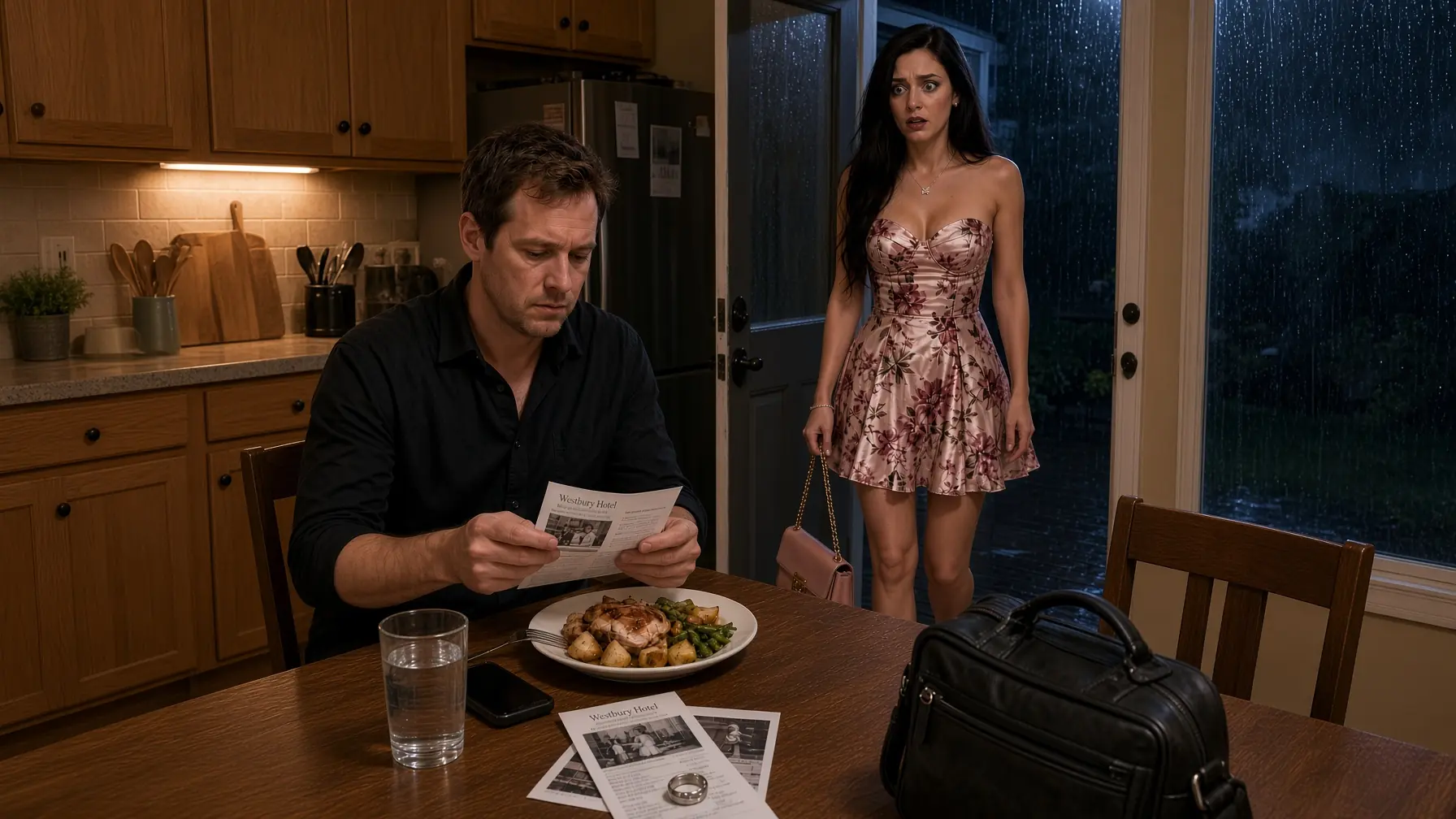
Michael sat beneath the pendant light at the table.
He had not eaten.
A covered pot sat on the stove.
One bowl rested beside the sink.
His hands were flat on the table.
Between them lay my wedding ring.
I stopped.
For a second, I actually looked down at my bare hand as if the ring might somehow still be there.
Michael watched recognition spread across my face.
He said nothing.
Beside the ring lay a narrow strip of white paper.
Hotel letterhead.
The Westbury.
Room 714.
Two glasses of cabernet.
Valet validation.
My name.
The timestamp was 8:53 p.m.
My knees weakened.
“Michael.”
His face did not change.
He looked as if he had been sitting there for hours learning how not to react.
“I found the ring in your coat pocket.”
I looked toward the hallway.
“No.”
“Yes.”
I remembered then.
After leaving the room, I had gone back because I thought the ring might still be in the bathroom. It was not. I must have slipped it into my cardigan pocket earlier, during dinner upstairs, before everything else.
Michael pushed the hotel receipt toward me.
“Sit down.”
I sat.
My legs made the decision before my mind did.
“Mike, I can explain.”
He closed his eyes briefly.
“Do not say reports.”
Everything inside me went cold.
“What?”
“Do not tell me the server crashed.”
I stared.
“Do not tell me the numbers came late.”
His voice remained almost conversational.
“Do not insult me with one more detail about work.”
I could barely breathe.
“How did you know?”
He looked at me.
That question was the wrong question.
I knew it immediately.
His expression hardened.
“That’s where your mind goes?”
“No.”
“You want to know how you got caught.”
“That isn’t what I meant.”
“It’s what you asked.”
I covered my mouth.
Michael looked toward the receipt.
“Sarah called here around eight.”
Sarah was my assistant project manager.
My stomach dropped.
“She wanted to know if your charger was still in the conference room because she found one under the table.”
I said nothing.
“She mentioned everybody left before seven.”
Rain ticked against the kitchen window.
Michael continued.
“So I called your office.”
I swallowed.
“No answer.”
He rubbed his thumb slowly against the edge of the table.
“Then I remembered the location sharing.”
The map.
We activated it almost a year earlier because I drove alone to Chicago during an ice storm. I had forgotten it existed.
Michael had not.
“You were at the Westbury.”
I stared at my hands.
“I drove over.”
My head lifted.
“What?”
“I drove there.”
His voice cracked slightly on the final word.
That was the first sign of emotion he had allowed through.