I told my husband I was trapped at the office finishing reports because it sounded like the safest lie.
Reports were dull.
Reports were believable.
Reports were the kind of thing a tired wife might text at 9:14 p.m. while her husband sat at home, reheating dinner, assuming she was doing the responsible thing.
I typed the message from the parking garage beneath the hotel.
Still stuck with reports. Don’t wait up. Love you.
The last two words sat on the screen longer than the others.
Love you.
I almost erased them.
Not because they were untrue.
Because some broken part of me still meant them, and that somehow made everything worse.
I sent the text anyway.
Then I sat in my car with the engine off, listening to the soft ticking sound beneath the hood and the muted rush of traffic above me. My blouse carried the faint trace of a cologne that did not belong to my husband. My lipstick had faded unevenly. My hair was pinned too carefully, as if looking composed could make the evening less shameful.
On the passenger seat was my work bag.
There were no reports inside it.
Only my laptop, a notebook, and the gray cardigan I had worn into the hotel because I did not want anyone from the office recognizing the green dress underneath.
That was the kind of woman I had become.
A woman who packed layers for betrayal.
My husband, Daniel, replied five minutes later.
Okay. Drive safe. I put soup in the fridge.
I stared at the message until my eyes stung.
Soup.
That was Daniel.
Not dramatic speeches. Not huge declarations. Soup covered neatly with foil. The porch light left on. Gas in my car when he noticed the tank was low. My favorite cup placed beside the coffee maker on mornings when I had early meetings.
He loved in useful ways.
I had started calling that boring.
That was my first mistake.
Or maybe it was only the first one I was finally willing to admit.
The drive home through Cincinnati felt longer than it should have. Rain slicked the streets and stretched the traffic lights into red and green ribbons across the windshield. I kept both hands tight on the wheel and rehearsed what I would say if Daniel was still awake.
The client changed the deadline.
Megan sent the numbers late.
The system crashed again.
I built the lie carefully, adding enough dull detail to make it sound less like a lie and more like something I had survived.
By the time I turned onto our street, I had almost convinced myself.
Almost.
Our neighborhood was quiet.
Two porch lights glowed across the road. A dog barked once, then fell silent. The maple tree in our front yard had lost most of its leaves, and the wet branches moved in the wind like thin black fingers.
Daniel’s car sat in the driveway.
The living room window was dark.
The kitchen window was lit.
He was awake.
My stomach tightened.
For one terrible second, I considered driving past the house. Just once around the block. Just five more minutes before I had to step into the life I had been damaging piece by piece.
But the porch light was on.
Daniel always left it on.
So I parked.
I checked my face in the mirror.
A stranger stared back at me.
Not entirely. That would have been easier. It was still me. Laura Bennett. Thirty-six. Married eleven years. Senior project coordinator. Woman who remembered birthdays, folded towels a certain way, baked banana bread for new neighbors, and somehow found herself spending Thursday night in room 618 of the Fairlane Hotel with a man named Adrian Wells.
Adrian.
Even thinking his name in our driveway felt filthy.
I removed my earrings and dropped them into my purse.
Then I looked down at my left hand.
My wedding ring was still there.
A narrow gold band with a tiny dent near the bottom from the year I hit it against the basement doorframe while carrying Christmas decorations. Daniel had offered to have it fixed. I said no. I told him I liked the mark because it proved the ring had lived with us.
I rubbed my thumb over that dent now and felt sick.
Inside, the house was too quiet.
I closed the front door softly and stood in the entryway, listening.
No television.
No dishwasher.
No footsteps.
Only the low hum of the refrigerator from the kitchen.
“Daniel?” I called.
My voice sounded too bright.
His answer came from the kitchen.
“In here.”
Two words.
Calm.
Flat.
Not angry enough to warn me.
Not warm enough to save me.
I took off my coat and hung it on the hook by habit. One sleeve slipped down and dangled awkwardly. I almost fixed it, then stopped.
Some small part of me understood that the house had bigger things to judge than a crooked coat.
I walked down the hall.
The family photos on the wall looked sharper than usual.
Our wedding day, Daniel laughing because the wind had nearly pulled my veil loose. Our tenth anniversary at Lake Michigan. A Christmas morning where I sat cross-legged on the floor with coffee while he tried to untangle lights.
The kitchen opened at the end of the hall.
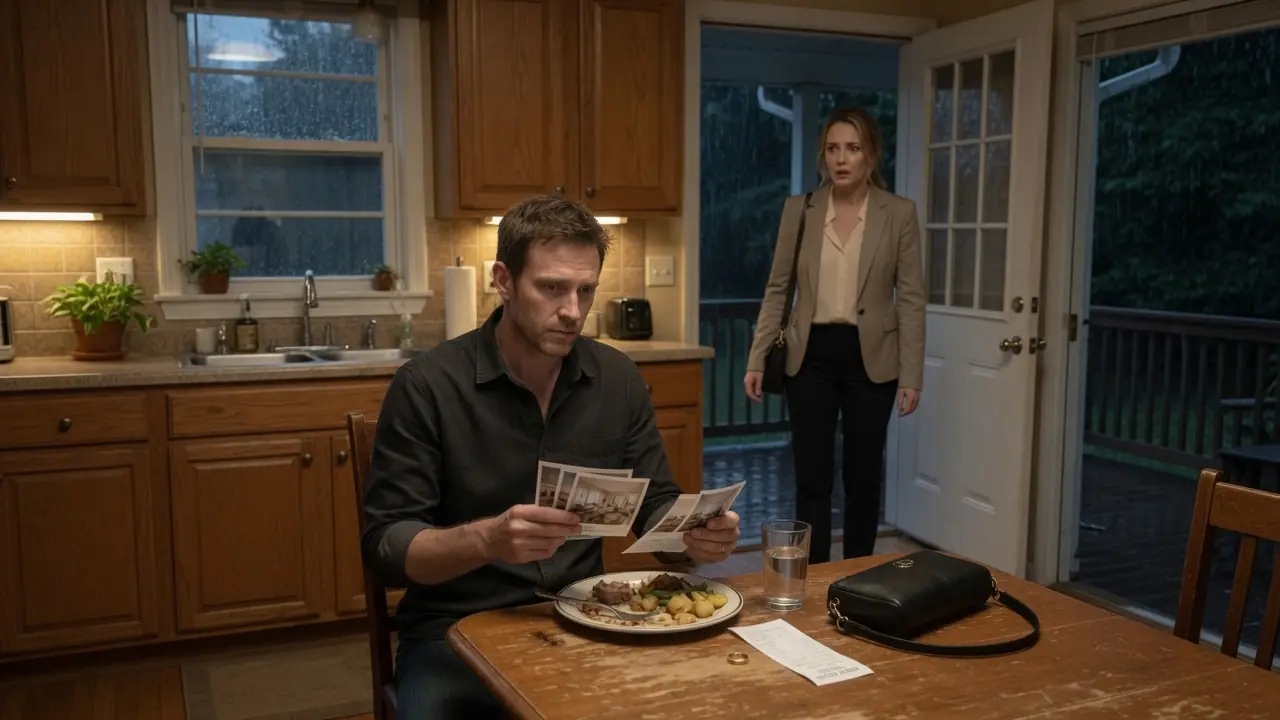
Daniel sat at the table beneath the pendant light.
He had not eaten.
Two bowls sat on the counter. One covered with foil. One empty.
His hands rested flat on the table.
Between them lay my wedding ring.
For one second, I looked down at my own hand in confusion.
My finger was bare.
Only the pale circle of skin remained where the ring had been.
I stopped walking.
Then I remembered the hotel bathroom.
The marble sink.
The small glass tray beside the faucet.
I had taken the ring off to wash my hands because soap always caught beneath it. Adrian had knocked on the bathroom door and said we had to go. I had dried my hands too quickly. I had looked in the mirror.
I had meant to put the ring back on.
No.
I had only thought about putting it back on.
My knees weakened.
Daniel watched the realization cross my face.
He did not raise his voice.
That was the first punishment.
He turned over a piece of paper on the table and pushed it toward me.
A hotel receipt.
The Fairlane Hotel.
Room 618.
Two glasses of wine charged to the room.
Parking validated at 9:06 p.m.
My name printed beneath the total.
I stared at the receipt until the letters blurred.
“Daniel,” I whispered.
He looked at me as if he had been waiting hours for that word and no longer believed it meant anything.
“I found your ring in your coat pocket.”
My eyes moved toward the hallway.
“No.”
“You must have put it there after the hotel,” he said. “Maybe without thinking. Maybe because you couldn’t stand wearing it on the way home. I don’t know.”
“I—”
He lifted one hand.
“Don’t start with reports.”
The sentence stopped me cold.
My mouth stayed open, but no sound came out.
He looked down at the receipt.
“I called your office.”
Cold spread through my chest.
“What?”
“After you texted me.”
“Why?”
He gave a quiet, humorless breath.
“Because Megan called here at eight asking if you had left your laptop charger at work. She said your team finished early.”
The kitchen seemed to tilt.
“I didn’t know she called.”
“No,” he said. “I figured that.”
Rain tapped against the window above the sink.
Daniel leaned back in his chair.
“So I called your desk. No answer. Then I remembered the location sharing we turned on last winter when you drove to Cleveland alone.”
My stomach dropped.
The map.
The little blue dot.
I had forgotten all about it.
“The dot was at the Fairlane Hotel,” he said.
I closed my eyes.
He continued.
“So I drove there.”
The room went silent except for my breathing.
“You were there?” I asked.
“Yes.”
“When?”
“Long enough to see you come out.”
My eyes opened.
He looked older than he had that morning. Not in some dramatic way. Just tired, like something had settled into his bones and would not leave. His hair was damp around the edges, as if he had stood in the rain without noticing.
“You saw me?”
“Yes.”
“With him?”
His throat moved.
“Yes.”
I sat down because standing was no longer possible.
The chair legs scraped the tile.
Daniel flinched at the sound.
That tiny flinch broke me more than shouting could have.
“I’m sorry,” I said.
The words were small.
Almost useless.
Daniel looked at me.
“For what?”
I blinked through tears.
“What?”
“Tell me what you are sorry for.”
“I’m sorry I hurt you.”
He nodded slowly.
“That’s the headline. Try again.”
I pressed my hands to my face.
“I’m sorry I lied.”
“Yes.”
“I’m sorry I went to the hotel.”
“Yes.”
“I’m sorry about Adrian.”
There it was.
The name.
Daniel’s jaw tightened.
“Adrian Wells.”
I looked up sharply.
His mouth curved into something that was not a smile.
“I’m not as clueless as you needed me to be.”
“I never thought you were clueless.”
“No,” he said. “You thought I was safe.”
That landed harder.
Because it was true.
I had not thought Daniel was stupid. I had thought he was steady enough to be predictable. Kind enough to wait. Patient enough to believe my explanations because he trusted the life we had built.
His goodness had become part of my hiding place.
That was one of the ugliest truths in the room.
“How long?” he asked.
I looked at the receipt.
“Daniel…”
“How long?”
My throat closed.
“Three months.”
He shut his eyes.
The silence that followed was enormous.
It filled the room with every late night, every false deadline, every text from a parking lot, every dinner he had wrapped and saved while I was somewhere else.
“Physical for three months?” he asked.
“No.”
His eyes opened.
“Do not make me dig for it.”
I nodded quickly.
“Messages started three months ago. Lunches after that. The first hotel was six weeks ago.”
His face changed.
Six weeks was not one mistake.
Six weeks had a calendar.
Six weeks contained our anniversary dinner, his mother’s birthday, the Saturday he repaired the sink while I said I had errands.
He looked at my bare finger.
“How many times?”
I swallowed.
“Four.”
He absorbed it.
Then he looked away.
I wanted to tell him that I had tried to stop. That Adrian had pushed and apologized and praised me until I felt like someone newly discovered. That I had felt lonely, ordinary, middle-aged, unseen.
But every explanation sounded like a knife pointed at the man I had already wounded.
So I said nothing.
Daniel looked back at me.
“Did you love him?”
“No.”
The answer came too fast.
His mouth tightened.
“Try answering like you are not trying to survive.”
I took a shaking breath.
“I don’t love him,” I said. “I loved how I felt when he wanted me.”
Daniel nodded once.
His eyes shone now, though no tears fell.
“And how was that?”
I looked down.
“Interesting. Beautiful. Like I was not just dependable.”
“Dependable,” he repeated quietly.
“I didn’t mean—”
“You did.”
I covered my mouth.
He leaned forward slightly.
“I spent eleven years trying to be dependable for you.”
“I know.”
“No,” he said. “You benefited from it. That is not the same as knowing.”
The sentence went through me cleanly.
He stood and walked to the sink. For a moment, he braced both hands on the counter and stared out into the rain-dark yard.
I knew that posture.
For years, it had meant he was trying not to say something too sharply. I used to cross the kitchen and place my hand on his back. Sometimes he softened. Often enough that I had started believing his pain could be managed by my timing.
Now I stayed in the chair.
The distance between us was no longer measured in feet.
“Did he know you were married?” Daniel asked without turning around.
“Yes.”
“Did he know my name?”
I hesitated.
He turned then.
The answer was already on my face.
“Yes,” I whispered.
“Of course.”
“He asked.”
“And you told him.”
“Yes.”
“Did you talk about me?”
The question was quiet.
Dangerous.
I wanted to lie.
Even then, with the ring and the receipt on the table, some panicked part of me still reached for a softer version.
But there were no clean lies left.
“Yes,” I said.
Daniel’s face lost some color.
“What did you say?”
“Not cruel things.”
He laughed once.
It was awful.
“Not cruel things. That helps.”
“I said you were good.”
“That must have been inconvenient.”
“I said you were kind.”
“But?”
I closed my eyes.
“But I felt lonely.”
When I opened them, he was staring at me.
“You were lonely in a house where I asked every day how you were.”
“I know.”
“Where I waited up.”
“I know.”
“Where I cooked because you said you forgot to eat.”
“I know.”
“Where I thought giving you space was respect because you said pressure made you feel trapped.”
Tears blurred him.
“I know.”
His voice broke for the first time.
“You don’t get to call it loneliness when you trained me to stop reaching.”
I sobbed then.
At first quietly, then not.
Daniel did not come to me.
I deserved that.
When the worst of it passed, he returned to the table but did not sit.
“I need to know something,” he said.
I wiped my face.
“Anything.”
“Were you going to leave me?”
“No.”
He almost looked more hurt by that.
“No?”
“No.”
“So you were going to keep both lives.”
The bluntness stripped away every softer word I had used inside my own head.
I had called it confusion.
A crisis.
A mistake I did not know how to end.
But he was right.
I had been keeping two lives.
Adrian for the feeling.
Daniel for home.
“No,” I said, but the word collapsed the moment it left my mouth.
Daniel heard it collapse.
He nodded.
“I think you were.”
I looked at the ring.
“I ended it tonight.”
“At the hotel?”
“Yes.”
“With wine on the bill?”
“It wasn’t like that.”
He looked at me.
The correction came softly.
“I know how it was.”
My phone buzzed in my purse.
Both of us looked toward the hallway.
It buzzed again.
Daniel’s expression changed.
“Is that him?”
“I don’t know.”
“Get it.”
I stood on unsteady legs and brought my purse into the kitchen.
My phone lit up with Adrian’s name.
One message.
You made it home?
The question looked tender.
It was not.
Daniel held out his hand.
For half a second, I hesitated.
That half second was another betrayal.
Then I gave him the phone.
He read the message.
“Unlock it.”
“It is unlocked.”
He opened the thread.
And every word became another person in the kitchen.
Every joke.
Every late-night confession.
Every complaint about my marriage.
Every message where Adrian called me brilliant, beautiful, wasted, underappreciated.
Every message where I let him.
Daniel did not read all of it.
He read enough.
His face went very still.
Then he typed.
This is Daniel. Do not contact my wife again. Do not come to my home. Do not send anything else. Every message will be saved.
My wife.
He typed it.
But the words did not feel like love.
They felt like a legal boundary around the wreckage.
Adrian replied almost immediately.
She said she was tired of feeling ordinary.
Daniel read it over my shoulder.
The blood left my face.
“Did you?”
I closed my eyes.
“I said I felt ordinary.”
“That is not the same?”
“It is. It isn’t. I don’t know.”
Another message appeared.
Ask her how many times she took the ring off before tonight.
Daniel stared at the screen.
I stopped breathing.
He looked at my hand.
Then at the ring on the table.
“How many?”
Some truths destroy because they are small.
“Twice,” I whispered.
His eyes closed.
One tear fell.
Only one.
He wiped it quickly, almost angrily.
“I can’t be here,” he said.
“Daniel.”
“No.”
He grabbed his keys from the counter.
“I can’t stand in my own kitchen while another man narrates my marriage.”
I stood too.
“Please don’t drive upset.”
He turned so fast I stepped back.
Not because he threatened me.
Because his pain finally had heat.
“You don’t get to sound like my wife right now.”
The words emptied the room.
Then the heat faded, leaving only exhaustion.
“I’m going to my sister’s.”
“Can we talk before you go?”
“We are talking.”
“I mean really talk.”
“There is no conversation tonight that does not have him in it.”
He picked up his coat from the chair.
I looked at his left hand.
His wedding ring was still there.
“Are you taking it off?” I whispered.
He followed my gaze.
For a long moment, he said nothing.
Then he turned the ring once around his finger.
“No. Not tonight.”
Hope rose in me before I could stop it.
He saw it immediately and shook his head.
“Don’t. I am not taking it off because I refuse to let one night make a decision my whole heart is not ready to make. That is not the same as staying.”
I nodded, crying silently.
He walked to the front door, then stopped.
“When people ask, I won’t lie for you.”
The hallway seemed to narrow.
“What does that mean?”
“It means I’m done protecting a version of us you had already started destroying.”
Then he left.
He did not slam the door.
He closed it softly.
That was worse.
His car started outside. Headlights moved across the front window, then slipped away down the street. The sound faded into rain.
I stood in the hall until my legs shook.
Then I went back to the kitchen and sat in his chair.
It was still warm.
That broke me.
I bent over the table and cried until my throat hurt, until the pendant light blurred, until the ring and the receipt became only shapes.
The house did not comfort me.
It accused me with ordinary things.
Soup in the fridge.
His glasses near the mail.
The grocery list on the counter.
Eggs.
Dish soap.
Coffee filters.
Pick up Laura’s dry cleaning.
Normal life had been waiting here while I was in a hotel, teaching another man where my marriage was weakest.
My phone buzzed again.
Adrian.
I turned it over.
Then over again.
Another message appeared.
He’s going to make himself the victim. Don’t let him.
For the first time all night, I felt something other than shame.
Disgust.
At him.
At myself.
At the way betrayal always tries to borrow language after the damage is done.
I took screenshots.
Every message.
Every one.
Then I blocked him.
Not because blocking him made me faithful.
It was too late for that.
I blocked him because leaving the door open would have been one more insult to the man who had just walked out into the rain.
I did not sleep.
At dawn, the kitchen still smelled faintly of soup and wet wool. The receipt remained on the table. My ring sat beside it. My phone lay face down, finally silent.
At 7:09, Daniel texted.
I am safe. At Rebecca’s. We need space. Save everything. I will come by tomorrow to talk about next steps.
Rebecca was his sister.
Next steps.
Not us.
Not home.
Not I love you.
Next steps.
By eight, my mother knew something was wrong because Daniel’s sister had called her. By nine, my supervisor knew because I reported what had happened with Adrian. By ten, two women at work had stopped pretending they had not suspected anything. By noon, Adrian was removed from the project pending investigation.
The world did not explode.
It narrowed.
Every room became a place where someone might know.
Every call became a consequence.
Every silence felt earned.
That evening, my mother came over and found me sitting at the kitchen table.
She looked at the receipt.
The ring.
My face.
Then she sat across from me.
I thought she would scold me.
She did not.
She only said, “You had a man who came home.”
I started crying again.
“I know.”
“Do you?”
I could not answer.
She shook her head slowly.
“Coming home is not nothing, Laura.”
That sentence stayed.
Because Adrian had offered escape.
Daniel had offered home.
And I had mistaken home for something less thrilling than being wanted in secret.
Daniel returned the next day.
He looked like he had not slept. He carried a folder and wore the charcoal jacket I had given him two Christmases ago. I hated that he still wore it. I hated that I remembered the way he smiled when he opened it.
He sat across from me at the same table.
I had not moved the receipt or the ring.
He noticed.
“Good,” he said quietly.
I did not ask what he meant.
He opened the folder.
Bank statements.
Mortgage papers.
Insurance documents.
A copy of our marriage certificate.
A legal pad covered in his handwriting.
My stomach dropped.
“Is that from a lawyer?”
“No.”
I breathed.
“Not yet,” he added.
The breath caught.
He looked down at the papers.
“I’m staying at Rebecca’s for now. We need to separate some finances. Not because I’m filing today. Because neither of us should make practical decisions while drowning.”
I nodded.
“Okay.”
“You can stay here this week. After that, we talk about whether I come back, whether you leave, whether we sell, or whether divorce is where this goes.”
The word divorce entered the kitchen like cold air.
“I understand.”
He looked up.
“Do you?”
“I think so.”
“No. Say what you understand.”
I swallowed.
“You don’t know if you want to stay married.”
“More.”
“You won’t lie to protect me.”
“Yes.”
“You don’t owe me privacy from consequences.”
His eyes held mine.
“That one matters.”
“I know.”
He leaned back.
“Do you want to tell me the whole timeline now, or do we save it for a counselor?”
“I’ll tell you.”
“All of it?”
“All of it.”
So I did.
Badly.
Haltingly.
Without making it pretty.
The first message.
The first lunch.
The first deleted text.
The first hotel.
The second.
The third.
The fourth.
The lies I told.
The ways Adrian made me feel seen.
The ways I used Daniel’s steadiness as cover.
I told him about the ring.
Both times.
He closed his eyes at that part.
I kept going because stopping would have been easier for me, not kinder to him.
When I finished, it was dark outside.
Daniel sat quietly.
I waited for a verdict.
He gave none.
Instead, he said, “I need therapy.”
“I know.”
“No,” he said. “Not for us. For me. I need somewhere to put what you did before it turns me into someone I hate.”
The honesty hurt.
“I’ll go too.”
“You should.”
“Marriage counseling?”
He looked at the ring on the table.
“Not yet.”
Weeks passed.
Then months.
Daniel stayed at Rebecca’s. I stayed in the house. We met every Sunday at a diner halfway between her apartment and ours. At first, we talked only about bills, the mortgage, insurance, the HR investigation, and practical things that could be written down.
Adrian was fired after the messages came out.
He sent one email from a personal account blaming me for “misrepresenting the emotional nature of the relationship.”
I forwarded it to HR.
Then I deleted nothing.
That became the rule.
Delete nothing.
Hide nothing.
Polish nothing.
My sister did not speak to me for almost a month. When she finally called, she asked one question.
“Was it worth being wanted by a man who could betray you the way you betrayed Daniel?”
I said no.
She said, “Then do not waste his pain by learning nothing.”
I wrote that down.
Not because it made me better.
Because I needed plain words more than comfort.
Individual therapy came first.
Mine was humiliating in the way truth becomes humiliating when there is no audience to charm. I learned to stop saying it happened and start saying I chose it. I learned that feeling lonely did not give me permission to be secretive. I learned that being ordinary was not the same as being unloved.
I learned that attention can feel like rescue when you have not done the honest work of telling the truth at home.
Daniel did not tell me much about his therapy.
Only once, in the diner, he said, “My therapist asked what I miss most.”
I looked at him carefully.
“What did you say?”
He stirred his black coffee though there was nothing in it to stir.
“I said I miss assuming you were telling me the truth.”
I could not speak.
In March, we started marriage counseling.
Not reconciliation.
Exploration.
That was the counselor’s word.
Daniel hated it.
I hated it too.
But it was accurate.
We sat on opposite ends of a gray couch while Dr. Ellis asked questions that seemed simple until they opened wounds.
“What did the affair give you?”
“What did it cost?”
“What did marriage mean before?”
“What does marriage mean now?”
Daniel answered that last one without looking at me.
“Before, it meant home. Now it means evidence.”
I cried.
He did not comfort me.
Later, in the parking lot, I said, “I’m sorry I cried in there.”
He looked at me.
“You are allowed to cry. I am allowed not to fix it.”
That was new.
Necessary.
Painful.
Spring came slowly.
The maple tree in our yard started to bud. The porch steps needed repainting. Daniel came by one Saturday to pick up more clothes and noticed the loose railing near the front steps.
He fixed it before leaving.
I watched from the doorway.
“You don’t have to do that.”
He tightened the last screw.
“I know.”
“Then why?”
He stood and looked at the railing.
“Because I still don’t like unsafe things in a house I might come back to.”
I did not move.
A house I might come back to.
Not a promise.
Not nothing.
That night, I took my ring from the kitchen table and placed it in a small dish beside the sink.
I did not wear it.
I only stopped making it sit beside the receipt.
The receipt went into an envelope with the printed messages and Daniel’s notes. He took the envelope to a safe-deposit box. Neither of us spoke on the drive there.
By summer, he came home.
Not fully.
He moved into the guest room.
We told people only what they needed to know. Some judged me. They were not wrong. Some pitied him. He hated that. Some acted as if nothing had happened. Those people were both kind and cowardly, and I understood them more than I wanted to.
The house changed.
Passwords shared.
Phones open.
Schedules clear.
No unexplained late nights.
No joking about trust.
No using pain as a weapon when a question deserved an answer.
We did not rebuild quickly.
Trust returned in scraps.
Some mornings Daniel smiled at me over coffee.
Some nights he stood in the kitchen staring at the ring dish.
Some days I thought we might survive.
Some days I knew survival was too simple a word for what we were doing.
On our anniversary, I expected nothing.
I made coffee and went to work. I came home on time. I cooked dinner because it was my night. Daniel set the table because that was still something he did.
We ate quietly.
After dinner, he placed a small box between us.
My heart stopped.
“Open it,” he said.
Inside was not jewelry.
It was a simple leather keychain stamped with one word.
HOME.
I stared at it.
“I don’t understand.”
Daniel looked tired, but not cold.
“I am not ready to call us healed.”
“I know.”
“I am not ready to forget.”
“I know.”
“I am not even sure home means what it used to mean.”
My eyes burned.
“But I am here,” he said. “And you are here. Today, that means something.”
I held the keychain carefully.
“Thank you.”
He nodded.
A month later, in the grocery store, it happened.
We were standing near the coffee aisle, quietly debating whether the expensive brand was really better or only packaged better, when a woman reached in front of us and apologized.
Daniel stepped back and said, “No problem. My wife was still deciding anyway.”
My wife.
Two ordinary words.
Almost lost beneath the hum of refrigerators and cart wheels.
But I heard them.
So did he.
We froze for half a second.
The woman walked away, unaware that two words had just crossed a bridge neither of us knew was strong enough to hold weight.
I looked at him.
He looked at the coffee shelf.
“Don’t make it big,” he said.
“I won’t.”
I made it big only inside.
That night, when we got home, I stood by the sink and looked at the ring in the little dish.
Daniel came in behind me.
Neither of us spoke for a while.
Then he said, “Do you want to wear it?”
I turned.
“Only if you want me to.”
“That is not the question.”
I looked at the ring.
Then at him.
“Yes,” I said. “But not because I think it fixes anything.”
“What would it mean?”
I answered slowly.
“That I remember what it cost. That I do not get to hide inside the word wife. That if you choose me again, I spend every day respecting that choice.”
Daniel’s eyes filled.
He hated when they did.
I loved him enough now not to reach too quickly.
He picked up the ring.
“Is there anything else?” he asked.
The question was quiet.
Final.
Necessary.
“No,” I said.
He searched my face.
I let him.
At last, he slid the ring onto my finger.
It felt heavier than before.
Less innocent.
More honest.
He did not kiss me.
He only held my hand for a moment, then let go.
“That is not forgiveness,” he said.
“I know.”
“It is a beginning.”
“I know.”
“And you keep earning it.”
“I will.”
Years later, people who knew pieces of the story still told it wrong.
Some said Daniel was a saint.
He hated that.
Some said I was lucky.
I hated that because lucky made his pain sound like fortune.
Some said affairs happen when marriages go cold.
That was the worst one.
Because it made betrayal sound like weather.
It was not weather.
It was choices.
Mine.
Again and again.
A text answered.
A boundary moved.
A lie made smoother.
A ring removed.
A receipt printed.
A husband waiting under a kitchen light with soup in the fridge and proof on the table.
I do not tell this story to make myself sympathetic.
I was not the victim of the night everything came out.
Daniel was.
Our marriage was.
The woman I thought I was, maybe, but she had been dying by my own choices for months.
I tell it because the clean lie began the ending, and the ugly truth became the only place anything honest could begin again.
I told my husband I was stuck finishing reports.
The truth came home before I did.
And when Daniel placed my ring beside the hotel receipt, he did not only expose what I had done.
He showed me what I had treated as ordinary.
A man who waited.
A home that trusted me.
A name I had not earned simply because I wore it.
Now, when I pass the kitchen table, when soft light falls across the wood, when my ring taps gently against a coffee mug, I remember the night my husband stopped calling me his wife.
And I remember that hearing the word again was not something I won back with tears.
It was something I had to become worthy of.
One honest day at a time.