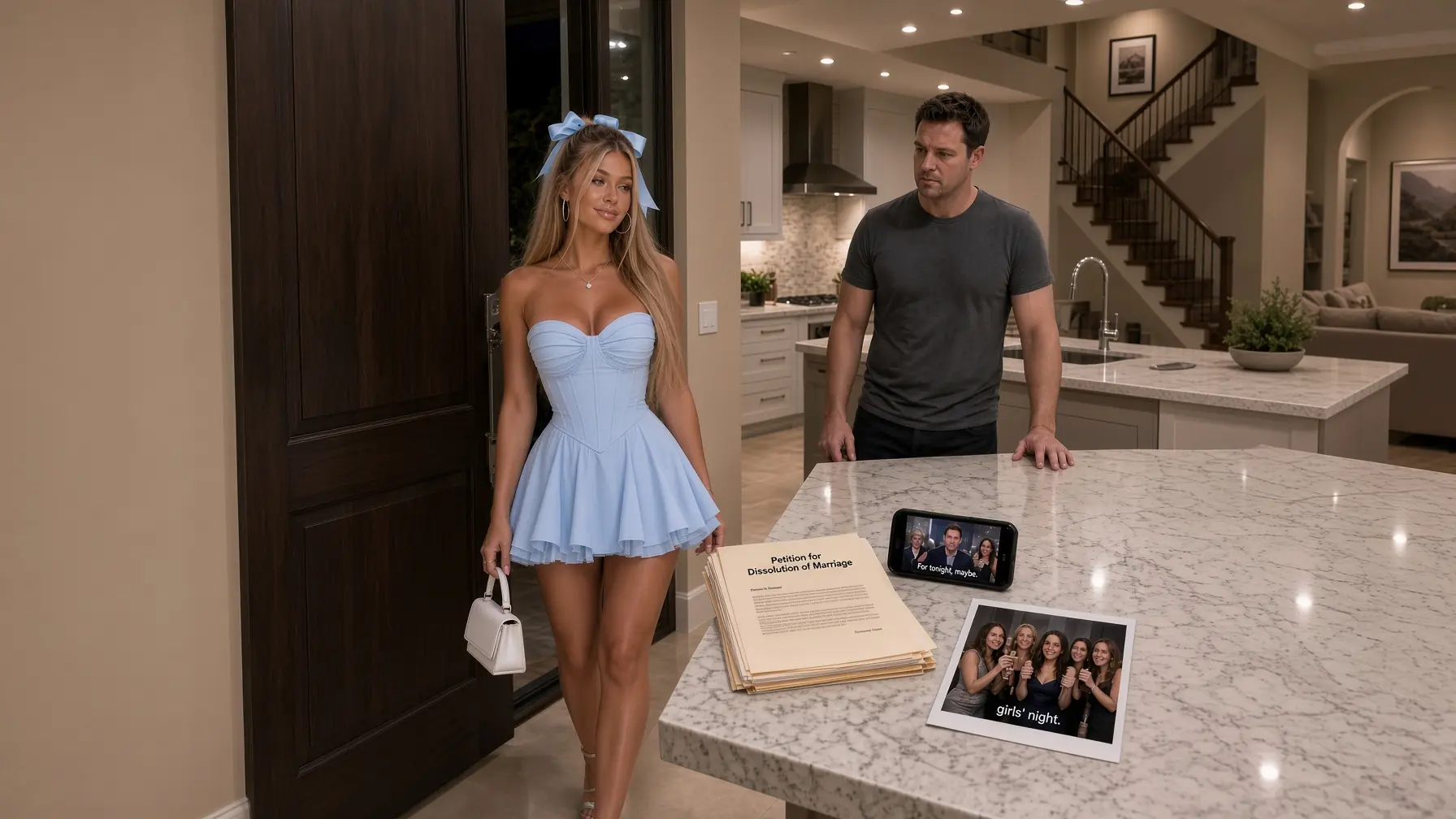
The first thing I noticed when I opened our front door was that the kitchen lights were still on. The second was my husband standing behind the island with both palms flat against the granite, watching me with an expression so controlled that I immediately knew anger would have been easier. I was still wearing the dark blue satin dress I had chosen for girls’ night, one heel was beginning to rub the back of my ankle raw, and my left ring finger was completely bare. Nathan did not ask whether I had fun.
He did not ask why it was almost one in the morning, who drove me home, or whether my friends were still outside. Instead, he placed his hand on a thick manila folder and pushed it across the island until it stopped directly in front of me. I saw the words Petition for Dissolution of Marriage near the top of the first page and felt every explanation I had prepared during the drive home disappear at once. “Nathan,” I whispered, but his face did not change.
My name is Elise Warren, and at that point Nathan and I had been married for seven years. We lived in a two-story townhouse in Scottsdale, Arizona, had a mortgage we were finally paying down faster than required, and had spent the previous year talking seriously about trying for our first child. Nathan was the kind of husband people often describe as steady, which sounded boring until you needed somebody who did not disappear when life became inconvenient. I had spent years being grateful for that quality before somehow learning to take it for granted.
I looked down at the papers and reached for the safest argument available. “Nothing happened tonight,” I said, hearing the panic enter my own voice. “I took off my ring, Nathan, but I didn’t stop being your wife.” His jaw tightened before he answered.
“You stopped being honest with your husband before you even left this house.” His voice rose slightly on the word honest, but he never shouted. That sentence scared me more than if he had accused me of kissing someone because I immediately realized we were starting the conversation in two completely different places. I had spent the entire ride home thinking about what happened at the lounge, while Nathan had been thinking about our bedroom before the night ever began.
Hours earlier, I had been standing in front of the mirror finishing my makeup while Nathan changed from his work clothes. My wedding ring sat inside a small ceramic dish beside my perfume, and I had already decided I was leaving it there. Nathan noticed almost immediately because that was the kind of detail he noticed after seven years of marriage. “Why aren’t you wearing your ring?” he asked.
It should have been an easy question. Instead, I looked at my bare finger and said the skin underneath the band had been bothering me all week. Then, because one lie apparently did not feel convincing enough, I added that I was afraid I might lose it after a few drinks. Nathan glanced at my hand, nodded, and said, “Makes sense.”
He believed me because trusting me had never been a complicated process for him. Nathan did not inspect my phone, ask for my passwords, or treat every night with friends like a threat to our marriage. He had spent seven years assuming that if he asked me a direct question, I would give him a direct answer. Looking back, that simple trust was one of the things I damaged before I even stepped outside.
The real reason the ring came off had begun in our group chat that afternoon. My friend Brittany had written, No husbands, no boyfriends, no rings tonight, followed by laughing emojis and a picture of a martini. Everyone treated it like a harmless joke about pretending to be twenty-five again instead of women in our thirties with mortgages, jobs, and relationships waiting at home. I laughed too.
There were five of us going out, and only one was actually single. Nobody was discussing affairs, hotel rooms, or secret plans. The joke was simply that for a few hours we would dress up, drink too much, dance, and pretend we were unattached enough to remember what life felt like before responsibility became permanent. At least, that was the explanation I used.
I still loved Nathan. I fully expected to sleep beside him when the night ended, and there was no man I had arranged to meet. I had no hidden phone number or unfinished romance waiting downtown. In my mind, those facts made removing the ring harmless.
The truth I did not want to admit was simpler. I knew Nathan would not find the joke funny. I knew he might ask why pretending to be single required removing the one object designed to make my marriage visible to strangers, and I did not want to have that conversation before leaving. So I lied because honesty might interfere with something I had already decided I wanted to do.
Standing across from him after midnight, I suddenly understood why that mattered. The betrayal he was reacting to had started before alcohol, before flirting, and before any stranger walked toward our table. It began when I decided my husband should receive less information so I could enjoy my night without his opinion becoming inconvenient. I still was not ready to admit that out loud.
I told Nathan I could explain everything that happened after dinner. He nodded once and allowed me to speak, which should have comforted me. Instead, his calm made me feel like somebody being invited to explain something he already understood. I started at the beginning.
We met in Old Town Scottsdale around seven-thirty at a restaurant with an open patio and strings of white lights across the courtyard. We ordered appetizers, shared two bottles of wine, and spent the first hour talking about work, vacations, one friend’s impossible new supervisor, and Brittany’s latest argument with her mother-in-law. There was nothing secretive or dangerous about dinner. That normal beginning became part of my defense.
Afterward, we walked several blocks to a lounge Brittany had reserved. Before going inside, someone insisted on taking photographs under the neon sign near the entrance. We lined up, leaned into one another, and laughed while a server took several pictures using Brittany’s phone. Then somebody remembered the group-chat joke.
“No husbands, no boyfriends, no rings,” Brittany shouted. We all lifted our left hands toward the camera. Mine was bare because I had lied to Nathan thirty minutes earlier to make sure it would be.
At the time, the picture felt silly. I remember thinking we looked like women trying too hard to imitate a bachelorette party despite nobody getting married. That thought should have been enough to make me stop participating. Instead, I laughed with everyone else.
One of the photographs went onto Brittany’s social story. Another was sent into a group chat. What none of us realized was that Brittany accidentally selected an older chat created years earlier for couples’ game nights.
Nathan was still inside it. So were two other husbands. The photograph arrived on his phone with the caption copied beneath it.
NO HUSBANDS. NO BOYFRIENDS. NO RINGS TONIGHT.
Nathan received that message less than three hours after I looked him in the face and said the skin beneath my ring was irritated. He later told me he stared at the photograph for several minutes before walking upstairs. My wedding band was exactly where I left it.
That was when the first lie died. I simply did not know it yet. Nathan knew there had been no irritation, no fear of losing the ring, and no harmless reason I forgot to mention.
What he did not know was what taking it off meant to me. That uncertainty did more damage than I understood. Once you discover somebody has intentionally lied, your mind begins filling the empty space around the lie with possibilities.
I tried to keep explaining. Nathan listened without interrupting. The longer he remained quiet, the more desperately I wanted the story to reach the part where I could prove I had not physically cheated.
The lounge was crowded by the time we arrived. There was live music near the front, a DJ farther inside, and small cocktail tables packed tightly around the bar. We spent the first hour mostly with one another. Nothing happened that I considered remotely inappropriate.
I danced with my friends. I drank tequila after promising myself I would stick to wine. I took too many photographs and laughed at Brittany trying to convince the bartender that it was someone’s birthday so we could get free shots. If the evening had ended there, Nathan and I probably would have had one serious argument about the ring and moved on.
Around eleven, three men began talking to Brittany near our table. One of them, a tall man named Derek, gradually ended up beside me. He was maybe thirty-five, wore a gray sports jacket, and had the kind of confidence people acquire from spending too many nights believing bars are designed for their entertainment. He asked what I was drinking.
I said tequila and soda. He brought one over twenty minutes later. I accepted it.
That was another moment I later tried to make smaller. Accepting one drink from a stranger is not automatically betrayal. What mattered was that I knew why he bought it and still wanted the conversation to continue.
He asked whether all of us were single. Brittany laughed and repeated the stupid ring joke. Nobody corrected him immediately.
I did not correct him either. I remember noticing the opportunity. For once, I could be Elise without somebody already knowing I was Nathan Warren’s wife.
That thought sounds worse written plainly than it felt beneath loud music and alcohol. At the time, it felt like playacting. I was still married, still going home, still planning to wake beside Nathan, so I convinced myself letting somebody temporarily believe otherwise could not change anything real. But I enjoyed what the misunderstanding gave me.
Derek leaned closer and told me I did not look like somebody who should be spending a girls’ night worrying about a husband. I laughed. He asked whether there was actually a husband.
I could have answered in one word. Yes. Instead, I smiled and said, “Tonight I’m not worrying about one.”
Back in our kitchen, that sentence sounded completely different. The music was gone. The drinks were gone. There was only my husband and a divorce folder between us.
Nathan asked, “Did you tell him you were married?” I hesitated. His face changed before I answered.
“Eventually,” I said.
Nathan looked toward the countertop. “What does eventually mean?”
I explained that Brittany mentioned his name during another conversation perhaps fifteen minutes later. Derek asked who Nathan was, and I said my husband. I wanted that clarification to repair everything.
It did not. Nathan understood exactly what had happened during the fifteen minutes before it. I had allowed someone to believe I was available because I liked the difference in how he treated me.
“But I told him,” I said. Nathan nodded.
“After you already got what you wanted from pretending you didn’t have to.” His answer irritated me because it sounded like he was assigning a motive more selfish than the one I wanted to claim. The problem was that I could not find a better explanation.
I told him again that I never kissed Derek. I did not dance pressed against him, give him my number, or leave the lounge with him. Those facts were all true. Each one sounded increasingly like a lawyer defining what technically did not qualify as the worst offense.
Nathan noticed. “You keep telling me the things you didn’t do,” he said. “I’m asking why you needed me not to know what you wanted to do.”
I started crying. He did not.
For almost an hour after returning home, I kept trying to move our conversation toward physical fidelity. Nathan kept moving it back toward honesty. We were not arguing about the same definition of loyalty.
To me, the important line had always been physical. No kissing, no sex, no affair, no secret hotel room. Anything beneath that threshold lived inside a gray area I believed a strong marriage should survive.
Nathan’s definition started earlier. It included what I encouraged, what I concealed, what I allowed people to assume, and whether I behaved differently because my husband was absent. I had never thought seriously about that distinction because until that night it had never threatened to cost me anything.
I told him one lie could not erase seven years. To my surprise, Nathan agreed.
“One lie doesn’t erase anything,” he said. “But sometimes it changes how you understand other things that already happened.”
That sentence frightened me more than the papers. Because I knew immediately which memories my own mind began revisiting.
There had been work conferences where I enjoyed attention from male coworkers longer than necessary. There were nights out when I left details out because I knew Nathan might consider them disrespectful even though nothing physical happened. Once, on a trip to San Diego, I let a bartender flirt with me for almost an hour and never mentioned I was married until he asked whether I wanted his number.
I never cheated. I had always used that sentence like a clean bill of health. Nathan had apparently been evaluating something more complicated.
That did not mean every omitted detail suddenly became infidelity. He never claimed it did. What bothered him was discovering I had built my own private definition of acceptable behavior and never asked whether it matched the marriage we were both supposedly inside.
I became defensive again. I told him he was turning one foolish evening into evidence that my entire character was deceptive. Nathan said he was trying not to do that.
Then he looked toward his phone.
That was the first moment I really noticed it beside the divorce papers. The screen was dark. Nothing about it should have frightened me.
But if Nathan had only seen the photograph, I knew exactly what I could explain. The picture showed five women with bare fingers. The caption explained the joke.
Neither proved what happened inside. So why had Nathan printed divorce papers before I came home?
I asked him what else he had seen. He did not answer immediately.
That silence made me remember the last thirty minutes at the lounge. It was the part of the night I had avoided examining during the ride home. Suddenly, I understood that maybe I was not the only person who remembered it.
Nathan asked me to continue first. “Tell me the rest.”
I realized then that he was waiting to see how much truth I would offer without knowing what evidence existed. That stripped away the last safe strategy I had. I either told everything or gambled on him not knowing the part I wanted hidden.
So I told him about the drink. I told him about Derek asking whether I was married. I admitted I had not answered immediately.
Nathan waited.
I told him the sentence about not worrying about a husband that night. His eyes closed briefly.
“That all?” he asked.
The answer yes almost came automatically. Then I remembered another moment.
Derek had asked whether I came to that lounge often. I said occasionally. He smiled and said maybe we would run into each other again.
I answered, “Maybe.”
I never gave him a number. I never intended to arrange another meeting. I honestly doubted I would recognize him three months later.
But I said maybe because saying no would have ended the attention cleanly. For one extra second, I wanted the possibility to remain open.
I told Nathan. “That’s everything.”
This time it really was.
He unlocked his phone.
My heart started pounding. Nathan opened a video and placed the phone between us.
The clip lasted maybe eighteen seconds.
Brittany had recorded herself and another friend laughing at the table. I was visible behind them with Derek leaning toward me.
The audio was messy. Music covered some words.
Then Derek’s voice came through clearly enough. “So are you actually single tonight?”
On the video, I laughed. My own voice answered, “For tonight, maybe.”
Nothing happened afterward. The clip ended almost immediately.
There was no kiss. No secret touching. No affair.
That almost made the evidence harder to confront.
Nathan was not showing me proof of something I could deny happened. He was showing me myself deliberately creating ambiguity around a marriage I claimed was secure enough to survive anything.
I watched the clip twice.
I remembered the exact feeling. I had been tipsy, happy, a little reckless, and deeply flattered.
I knew I was married. I knew the correct answer.
No, I’m married.
Instead, I gave a stranger enough uncertainty to keep treating me like I was available.
Not because I planned to sleep with him. Because I wanted to remain desirable inside his imagination for a few more minutes.