"Turn that pump back on, now."
"Ma'am, this is my well. I'm just replacing the filter."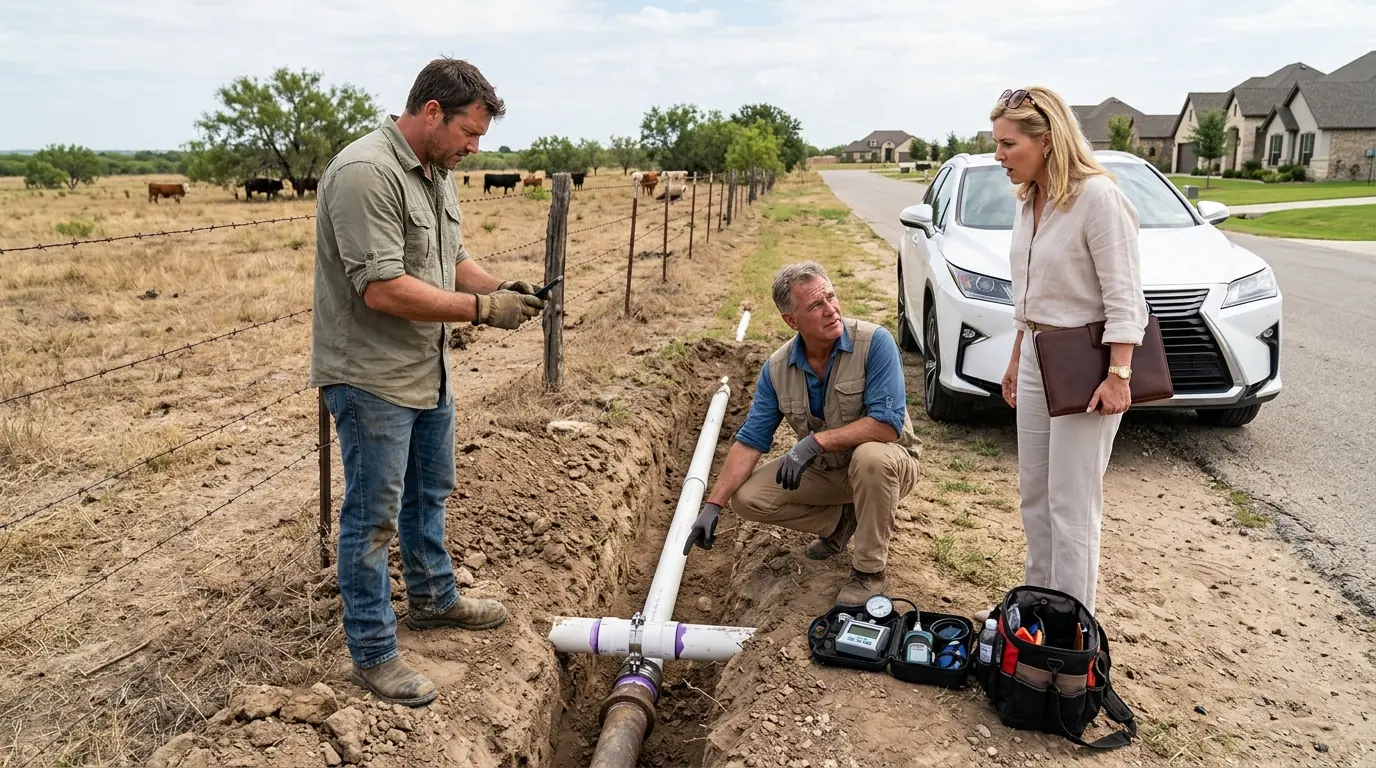
"I don't care. 62 homes have no water because of you. My children can't bathe. My toilets won't flush. And you're standing there in your disgusting boots telling me about filters?"
"It's my property, my well, my pump."
"Your property?" She laughed like I'd said something pitiful. "Nobody cares about your sad little ranch. I already called 911. When they get here, you'll turn it on or I'll make sure you never turn anything on again."
I turned it back on, and that's when I discovered why 62 homes went dry the moment I shut off my own well. A well she had no contract for, no right to, and no idea I'd spent 10 years tracing stolen water for a living.
But let me back up, because this story doesn't start with a 911 call. It starts with a well.
The well sat 60 ft behind my house, capped with a steel plate my grandfather welded himself in the summer of 1962. He was a cattleman named Walter Whitfield who believed two things would outlast everything else in the Texas Hill Country: limestone and good water. He was right about both. He drilled down 312 ft into the Edwards Aquifer and hit a vein so clean the county tested it twice because they didn't believe the numbers. That well fed our cattle, our garden, our kitchen sink, and every living thing on 1,200 acres of Blanco County ranchland for over 60 years.
My father Earl built the rest: a 6-inch main line running north to south along the western ridge, branch lines to every pasture, every trough, every stock tank. He mapped every foot of pipe by hand on graph paper and kept the drawings in a fireproof cabinet next to his marriage certificate and the deed. That's how seriously he took it. Water wasn't a utility in our family; it was an inheritance.
I came back 2 years ago after Dad passed. I'd spent a decade in Austin working as a civil engineer specializing in municipal water infrastructure: pressure systems, flow dynamics, contamination tracing—the kind of work where you spend your days making sure a half million people can flush their toilets without thinking about it. I was good at it, but when the cancer took Dad in 14 months, I drove home, buried him next to Mom under the live oaks, and never went back to the office.
The ranch needed me. The morning smelled like cedar smoke and wet limestone, and the evenings tasted like dust and diesel from the old tractor Dad never replaced. 180 head of Hereford cattle needed me, and the well—Grandpa's well—needed someone who understood what 60 years of mineral deposits, shifting aquifer pressure, and hill country summers could do to a pump system if you ignored it.
Ridgecrest Estates appeared 9 years before I came home. 62 houses built on 400 acres of what used to be the Dawson Ranch next door. The developer, a man named Glenn Caldwell, bought the land, bulldozed the mesquite, and dropped cookie-cutter homes on half-acre lots with HOA fees, a clubhouse, and a community pool shaped like the state of Texas. The brochures promised hill country living with modern convenience. What they didn't mention was where the water came from.
I first met Linda Caldwell on a Wednesday afternoon in March, 3 weeks after I moved in. She pulled up my gravel drive in a white Cadillac Escalade, so clean it looked like it had never touched a Texas road. She stepped out in a linen sundress, Gucci sunglasses pushed up into platinum blonde hair, and heels that had no business being within a mile of a cattle ranch. She was beautiful, the way a coral snake is beautiful—the kind of pretty that makes you stop and look right before it kills you.
She carried a leather portfolio with the Ridgecrest Estates HOA logo embossed in gold. She smiled like we were old friends, then she opened her mouth.
"Mr. Whitfield, your cattle operation is producing odors that are affecting our residents' quality of life. I'm here to discuss solutions." She said the word solutions the way a surgeon says options: polite, clinical, and loaded with the implication that only one of them involved survival.
I told her my family had been ranching this land since 1958 and the cattle weren't going anywhere. She tilted her head, smiled wider—the kind of smile that rearranges a face without reaching the eyes—and said she understood completely. Then she clicked her heels back to the Escalade, and I watched her drive away, trailing a cloud of limestone dust that settled on her windshield like a warning she didn't bother to read.
The letters started the following week. Official Ridgecrest Estates HOA stationery: cream-colored, watermarked, printed in a serif font that screamed, "We retained a graphic designer before we retained a plumber."
The first one informed me that my perimeter fence was inconsistent with the aesthetic standards of the surrounding community. My fence was barbed wire on cedar posts. It had been there since 1974. Ridgecrest had been there since 2015, but Linda Caldwell operated on the principle that whoever prints the letterhead makes the rules.
The second letter complained about dust. My cattle walking across dry pasture created airborne particulate matter that was, quote, "degrading the respiratory environment of Ridgecrest residents." I read that sentence three times and still couldn't decide if it was a health complaint or a graduate thesis on the dangers of living next to dirt.
The third letter was my favorite. It stated that my livestock were engaging in—and I am not making this up—"aggressive visual trespass." Apparently, my Herefords had been standing near the fence line and staring into Ridgecrest backyards in a manner that several residents found intimidating and unsettling. I walked out to the pasture and looked. 1,400-pound cows were chewing cud and blinking at the horizon with the emotional intensity of a stuffed animal. If that was aggression, my entire herd deserved an Oscar for subtlety.
Linda didn't stop at letters. She called Blanco County Animal Control and reported my cattle as dangerous and uncontained. An inspector named Phil drove out, walked the fence line, watched my cows eat grass for about 4 minutes, and said he'd seen more threat in a church parking lot. He drove away without issuing a single citation. I watched his truck disappear down the caliche road and felt the familiar weight of dealing with someone who treats petty complaints like artillery shells.
Two weeks later, Linda launched a full petition to the county zoning board requesting a livestock density limit on all properties adjacent to Ridgecrest Estates. She wanted my herd capped at 20 head on 1,200 acres. That's one cow per 60 acres, a ratio so absurd the animal would die of loneliness before it found a blade of grass worth chewing.
She got 34 signatures. She got them by going door-to-door in Ridgecrest carrying a bottle of wine in one hand and her leather portfolio in the other, wearing a smile that could charm a rattlesnake out of its skin. Most people signed because it was easier than arguing with a beautiful woman holding a Cabernet and a clipboard. A few signed because they genuinely believed cow odor was a constitutional issue. Nobody signed because they'd read the actual text.
But old Hank Morrison, my neighbor to the north—61 years old, born on his ranch, still running cattle the way his granddaddy taught him—brought me a copy and tapped signature number 19: Gerald Faulkner, a Ridgecrest resident who had been dead for 2 years from a heart attack in his kitchen. His widow still lived in the house; his handwriting did not still sign petitions.