The problem was he had never even met her. One signature, one document he didn’t read, and suddenly George Raventon, Duke of Hailwick, was already bound to a woman he had no intention of marrying. He didn’t believe in arranged marriages. He didn’t believe in mistakes, and he certainly didn’t believe in keeping them. So he made a decision. If he couldn’t refuse the marriage, he would make sure she did.
The ship had barely settled against the docks when George Raventon, Duke of Hailwick, stepped onto English soil as if it owed him an explanation. Months overseas had sharpened him. Sun, politics, negotiations, heat. England felt quieter, colder, predictable. He did not miss it. The carriage waiting for him was polished to perfection. His family crest gleamed like it had something to prove. George barely looked at it.
“Home, Your Grace?” the driver asked. George paused just long enough to sound uninterested. “Yes. Let’s have this done.” The Hailwick estate stood exactly as he remembered. Imposing, elegant, and faintly suffocating. Nothing had changed, which meant everything had stayed the same inside. The air smelled of polished wood, old money, and expectations.
A servant bowed. “His Grace, your father, is expecting you in the study.” Of course he was. George didn’t bother removing his gloves. The study doors opened without announcement. The old Duke sat behind a heavy desk, thinner than George remembered, but no less commanding. Illness had touched him. Authority had not.
“You’re late,” his father said calmly. “I arrived today, and still managed to be late.” George exhaled, unimpressed. “I assume this is not a social call.” A faint smile crossed the old Duke’s face, the kind that meant something was already decided. “No. Sit.” George remained standing. “I prefer efficiency.”
“Of course you do,” his father replied. “That is why you’ll appreciate this.” He slid a set of documents across the desk, neatly arranged, sealed, prepared. George glanced at them. Estate transfer. “Yes. Finally, something useful.” The Hailwick estate, vast, powerful, inconveniently tied to his father’s control, was the only reason George had returned at all. “Conditions?” George asked.
His father leaned back slightly. “Nothing you cannot handle.” That was not an answer, but George was tired and practical. He picked up the pen. There was a pause, brief, almost invisible, a moment where a different man might have read the details. George Raventon was not that man. He signed. One clean stroke, then another, then the final seal.
“Done.” He placed the pen down. “It’s finished.” “Yes,” his father said quietly. “It is.” Silence settled, too quiet. George narrowed his eyes slightly. “You’re enjoying this immensely.” That was new. George leaned back just enough to signal attention, but not concern. “What did I just agree to?”
The old Duke folded his hands, and for the first time there was something almost pleased in his expression. “You are now formally engaged,” he said, “to Lady Margaret Arden.” George didn’t react, not immediately. The words landed, registered, and then very slowly, “I beg your pardon.” “Lady Margaret Arden,” his father repeated. “Daughter of Lord Arden, educated abroad, suitable, intelligent, and most importantly, already agreed upon.”
George took a step forward now. The air shifted. “This can be undone.” A pause, then, “No,” said the old Duke, not loudly, not dramatically, just certainly. George held his gaze, measured it, tested it, and found nothing. No hesitation, no loophole, no weakness. For the first time since stepping back into England, George Raventon felt something unexpected. Not anger. Something sharper. Interest dangerously close to amusement.
He let out a slow breath, then gave a small, almost impressed nod. “Well,” he said quietly, “that is unfortunate.” His father raised a brow. “You will meet her,” he said. “I’m sure I will,” George replied. “And you will proceed accordingly.” George turned toward the door. “And if I don’t?”
George tried to put this question to the test. His father’s voice followed him, steady as stone. “You will remain a guest in a house that should already be yours.” George stopped, just for a second, then smiled. Not warmly. Not kindly. But with the calm precision of a man who had just been challenged. Without turning back, he said, “Then I suppose she will have to refuse me.” And with that, the Duke of Hailwick walked out of the room, already planning exactly how to make his future wife regret ever agreeing to him.
Lady Margaret Arden was not where she was supposed to be, which in her experience was usually where the most interesting things happened. The ballroom shimmered with predictable elegance. Crystal chandeliers, polished laughter, carefully measured smiles. Every young lady present knew her role. Stand correctly. Speak softly. Smile just enough to suggest mystery. Never opinion. Margaret did none of these things.
She stood near the edge of the room mid-conversation with a visibly overwhelmed gentleman twice her age. “No,” she said calmly, “that is not what Rousseau meant.” The gentleman blinked. “I—well, perhaps a broader interpretation.” “It is not broader,” Margaret replied gently. “It is incorrect.” A nearby lady nearly dropped her fan. Margaret smiled kindly, not apologetically. “You’re thinking of Voltaire,” she added. The gentleman exhaled in quiet defeat. “Yes. I suppose I am. Most people do.”
Across the room, whispers had already begun. “That’s her, the one who studied abroad. They say she speaks five languages. They say she refuses invitations. They say—” Margaret picked up a glass of champagne she had no intention of finishing. She had learned something very useful while traveling. People were far more comfortable talking about you than to you. It saved time.
“Margaret.” Her mother’s voice, tight, controlled, carrying urgency beneath politeness. Margaret turned. Lady Arden approached with the careful grace of someone managing both reputation and rising panic. “You’ve been seen,” her mother murmured. “I am in a ballroom,” Margaret said. “That was the risk.” “This is not a time for wit.” “It rarely is.”
Her mother inhaled slowly. Across the ballroom, a group of young ladies practiced delicate laughter. One of them glanced over. “Poor thing,” she whispered. “She doesn’t even look pleased.” Margaret heard it. She always heard everything. She turned slightly, meeting the girls’ eyes with polite curiosity. The laughter stopped. Not because Margaret was intimidating, but because she wasn’t trying to be anything at all.
Her mother stepped closer. “This is an extraordinary match. You will behave accordingly.” “Define accordingly.” “Grateful. Elegant. Agreeable.” Margaret considered that. “Then I can offer one of the three.” Her mother closed her eyes briefly. “Margaret, I will not pretend to be someone else to secure a husband.” “You will not have to. You already have one.” Margaret smiled. Not sweetly. Not rebelliously. Just knowingly. “That remains to be seen.”
Later that evening, as the orchestra softened and conversations blurred into background noise, Margaret stepped out onto the terrace. Cool night air. Finally, something honest. She leaned lightly against the stone railing, looking out over the dark gardens. England hadn’t changed, but she had. And now, apparently, so had her future.
Footsteps approached behind her. A young man, nervous, well-dressed, eager. “Lady Margaret,” he said, bowing slightly. “May I have the honor?” “No,” she replied. He froze. “I beg your pardon.” “No,” she repeated, calm as ever. “But thank you for asking.” He stood there, uncertain whether to feel rejected or relieved. “You are quite direct.” “Yes.”
A pause. Then, unexpectedly, he smiled. “I suspect your husband will find that challenging.” Margaret’s gaze drifted back to the gardens. Something almost amused flickered in her eyes. “I suspect,” she said quietly, “he already does.” And somewhere across London, a duke was making plans to ensure she would refuse him, while the woman he had accidentally married was beginning to wonder why she hadn’t yet decided to do exactly that.
George Raventon did not believe in dramatic entrances, so he made none. The Arden estate was bright, polished, and entirely too welcoming. He disliked it immediately. A servant announced him with unnecessary enthusiasm. “The Duke of Hailwick.” George stepped inside like a man attending a negotiation, not a social visit. Because that was exactly what this was.
Lady Arden greeted him first, gracious, composed, quietly assessing. “Your Grace, we are honored.” “I’m sure you are,” George replied politely. Just enough charm to pass, not enough to invite comfort. He declined tea. He declined small talk. He declined everything that resembled warmth. “I would prefer to meet Lady Margaret directly.” There it was. Straight to the point.
A brief hesitation, then, “Of course.” Margaret was not in the drawing room, not in the garden, not in any place prepared for her presentation, which George noted was already inconvenient. “She is in the library,” a servant said carefully. George glanced toward the corridor. “Of course she is.”
The library doors were slightly open. No announcement this time. Good. George stepped inside and stopped. Lady Margaret Arden was seated by the window, one leg tucked slightly beneath her, a book resting loosely in her hand. No performance, no posture correction, no attempt to rise immediately. She looked comfortable, as if this meeting were optional. She turned the page before looking up. Just one more line. Then her eyes lifted to him. Calm. Curious. Unimpressed.
A beat passed. Then she closed the book, marked her place, set it aside, and finally stood. “Your Grace,” she said. No curtsy. Not immediately. Just acknowledgement. George studied her. This was not what he expected. No rehearsed smile, no carefully lowered gaze, no calculation he could recognize, which meant there was calculation, just not the kind he was used to.
“You’re reading during our first meeting,” he said. Not a question. An observation with intent. Margaret tilted her head slightly. “You arrived unannounced.” A pause, then gently, “I adapted.” Strike one. Interesting. George stepped further into the room. “You are aware of our arrangement.” “I am aware that documents have been signed,” she said. “By me. Yes,” she added, without reading them, “I hear.” Strike two. He almost smiled. Almost.
“I assume you find this situation acceptable.” “I find it real,” Margaret replied, “which is not the same thing.” George circled slightly, slow, deliberate, testing. “You intend to proceed with it.” “I intend to understand it first.” That was not how this was supposed to go. “Allow me to simplify things,” George said, his tone sharpened, controlled, precise. “I have no interest in this marriage.”
Margaret nodded. “That seems likely.” He paused. That was too easy. “I will not offer you affection.” “I would find that suspicious.” Strike three. “I will not pretend devotion.” “I would find that exhausting.” George stopped moving, now fully facing her. “You are remarkably calm for a woman being advised to reconsider her future.”
Margaret met his gaze directly. Not defiant. Not soft. Just steady. “Are you asking me to refuse, Your Grace?” There it was. Clean. Direct. Unavoidable. George held her eyes. Careful now. This was the moment. “Yes,” he said. Silence. Not awkward. Not heavy. Just suspended. Margaret considered him. Not quickly. Not slowly. Precisely.
Then she smiled. Not sweet. Not mocking. Something far more dangerous. “I don’t think I will.” George blinked. Once. That was all. “I believe that was your intention,” she continued calmly, “to encourage me to withdraw. It is efficient. It is practical. It is transparent.” She stepped closer, just enough to shift the space between them. “But I have a question,” she said. George didn’t move. “Ask it.”
“If you are so certain you do not want this marriage,” a pause, just long enough, “why did you sign it?” Silence again. Different this time. George answered without hesitation. “I was given a choice.” “And you chose incorrectly.” That earned something. A flicker. Approval. Margaret nodded slightly. “That does happen.” Another pause. Then she turned away, picked up her book again. Conversation over. Dismissed.
George watched her. For the first time since returning to England, he had lost control of a conversation. “You’re making a mistake,” he said. Margaret didn’t look up. “Possibly,” she replied, then after a beat, “but at least I made it on purpose.” George stood there a moment longer. Then a slow, deliberate smile appeared. Not amused. Not polite. Interested.
“Very well, Lady Margaret,” he said quietly. “You may keep your decision.” A pause, then lower, “but you will change it.” This time she did look up, and for the first time there was something new in her expression. Not resistance. Not agreement. Anticipation. “We shall see,” she said. And just like that, their marriage had not begun, but the game had.
George Raventon did not repeat mistakes. He refined them. If Lady Margaret would not refuse him privately, then she would do so publicly, where expectations pressed harder, where judgment carried weight, where performance mattered. So he chose the battlefield carefully. A dinner. Not intimate. Not kind. But precise. The guest list was curated. Daughters of influence. Mothers with opinions. Men who measured worth in silence and titles. And of course, Lady Margaret Arden.
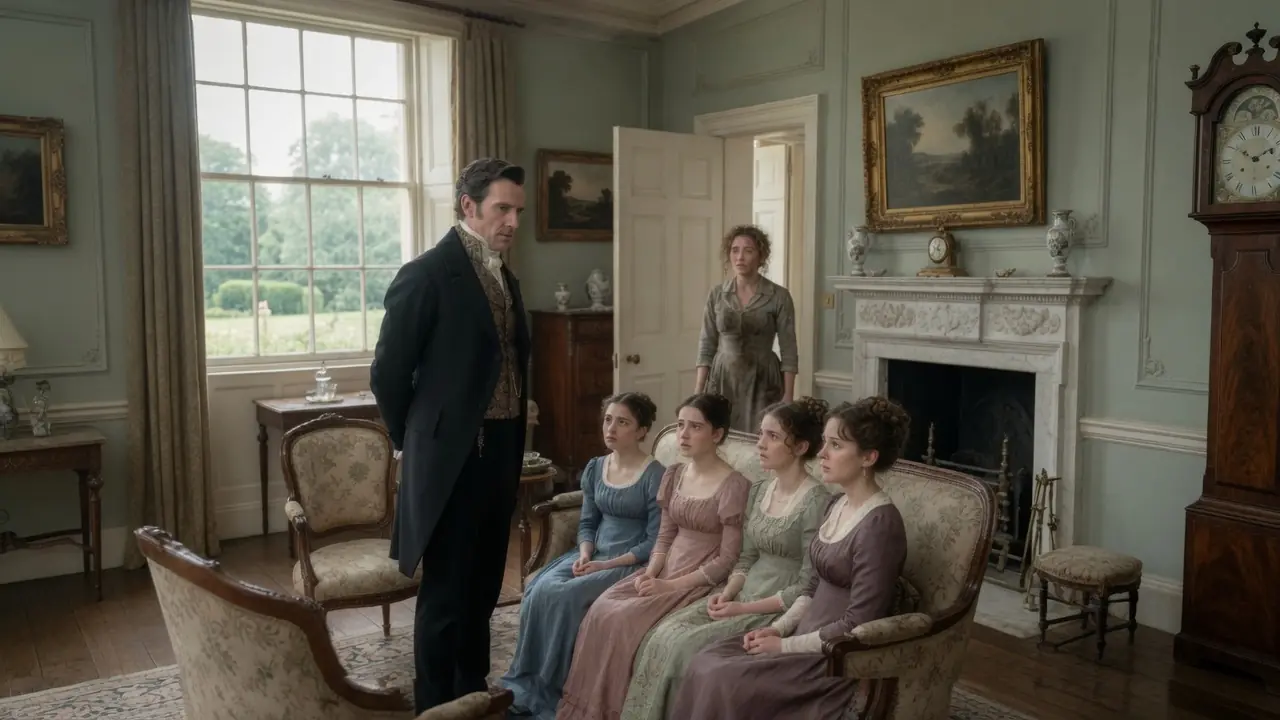
“She will not enjoy this,” one guest murmured quietly. George heard it. He almost agreed. Margaret arrived ten minutes late. Not enough to offend. Just enough to be noticed. Every eye turned. Of course they did. Her dress was elegant, but not strategic. No excessive ornament. No attempt to compete. No effort to win the room. Which George realized was already a problem.
“Lady Margaret,” he said as she approached, “you’re late.” She met his gaze calmly. “Yes.” A beat, then, “I assumed the evening would improve with my arrival.” A pause, then a few quiet laughs. Not loud. Not forced. Real. George’s jaw tightened slightly. “Confidence is a dangerous trait,” he said. “Only when it is misplaced.” Strike.
Dinner began. The conversation flowed as expected. Surface-level charm. Polite agreements. Carefully disguised competition. Margaret did not participate, not at first. She listened. Observed. Measured. Then someone made a mistake. “I do believe,” a well-dressed gentleman said, “that education in women is admirable, but unnecessary beyond a certain point.” Silence. Subtle. Expectant.
Margaret set down her glass. Gently. “Which point would that be?” she asked. The man smiled, confident. “Beyond what is required to be agreeable.” A few approving nods. Margaret tilted her head slightly. “Fascinating.” A pause, then, “In that case I must be vastly overeducated.” Laughter. This time louder. The gentleman flushed.
George watched carefully now. “You disagree,” the man pressed. Margaret smiled. Soft. Almost kind. “I don’t disagree,” she said. “I simply find it inefficient to limit intelligence for the comfort of others.” Silence again. Different now. The room had shifted, and Margaret had not raised her voice once.
George leaned back slightly, studying her. This was not embarrassment. This was not failure. This was control. Across the table, one of his closest acquaintances leaned toward him. “She is either exceptionally clever,” the man whispered, “or completely unaware of what she is doing.” George didn’t look away from her. “She is aware,” he said quietly. And that was precisely the issue.
As the evening continued, something unexpected began to happen. People stopped testing her and started watching her. Listening. Adjusting. Even those who had dismissed her now included her. Not out of kindness. But out of interest. George set his glass down slowly. This was not the outcome he had designed. Pressure. She had turned it into advantage. And worse, she had done it effortlessly.
Later, as guests moved into softer conversation and music filled the space, George approached her again. “You seem to be enjoying yourself,” he said. Margaret glanced at him. “I am learning from them.” A faint smile. “No,” she said. “From you.” That was not expected. “And what have you learned?” George asked. Margaret stepped slightly closer. “That you invited me here to be diminished.” Direct. Clean. Accurate. George didn’t deny it.
Instead he asked, “And?” She held his gaze. “I believe I improved your evening.” A pause, then something dangerous flickered in his expression. “You are very certain of yourself.” Margaret considered that. “No,” she said softly. “I am simply not trying to be anyone else.” Silence. And for the first time, George realized something he had not planned for. This was not a woman he could outmaneuver easily. This was a woman who, by doing nothing unusual, was quietly undoing everything he intended. And somewhere beneath the irritation, something else began to form. Not admiration. Not yet. But recognition. And that was far more dangerous.
George Raventon did not lose control. He adjusted. If Lady Margaret could not be unsettled in conversation, if she could not be diminished in society, then she would be tested where it mattered most. Reality. Responsibility. Expectation. Three days later, a message arrived at the Arden estate. An invitation from Hailwick. But not to dinner. Not to a ball. To his estate. Specifically to review it.
Margaret read the letter once, then again, then smiled, just slightly. “Is something amusing?” her father asked. “Yes,” Margaret said calmly. “He’s inviting me to fail.” The Hailwick estate was nothing like the Arden home. Where Arden was warm, Hailwick was precise, structured, demanding. Every corridor held expectation. Every room required management. Every decision carried consequence.
George met her at the entrance. No pleasantries this time. No performance. “Lady Margaret.” “Your Grace.” A pause. Measured. “I trust you received my invitation.” “I did.” “And you accepted.” Margaret glanced past him at the estate, the grounds, the scale of it. “I was curious,” she said. About the estate? No, she replied after a beat. About you. That landed.
George turned without responding. “Come,” he said. The tour began, but it was not a tour. It was a test. Accounts were presented. Numbers. Logistics. Land management. Tenant disputes. Investment decisions. Complex. Layered. Unforgiving. George watched her carefully. This was where most people faltered. Where charm failed. Where confidence cracked. Margaret did neither.
She asked questions. Not many. But the right ones. “Why is this field underperforming?” The steward hesitated. “It has always been so, my lady.” Margaret looked at him. “That is not a reason. That is a habit.” A pause, then she turned to George. “You’re losing money here.” Not accusatory. Not dramatic. Just factual. George’s jaw tightened slightly. “Continue,” he said.
Hours passed. Room after room. Decision after decision. And slowly something shifted. The staff began answering her directly. Not out of politeness. Out of trust. By the time they reached the final room, the steward spoke to her before George. “My lady, there is also the matter of the southern tenants.” George stopped walking. That had not happened before.
Margaret turned to him. “Is there?” she asked. George held her gaze. “Yes,” he said. Then, after a beat, “You may address it.” A test within a test. Margaret considered. “Then call a meeting,” she said. The steward blinked. “With respect, my lady, the tenants will not trust letters.” Margaret replied, “They will trust presence.” Silence. Then she added, “And if they do not, then at least they will know they were heard.” The steward nodded slowly. “Yes, my lady.”
George said nothing, but something had just gone very wrong. Later, they stood alone in the long corridor. Quiet. Still. “You handled that well,” George said. Not praise. Not quite. Margaret tilted her head slightly. “Were you expecting otherwise?” “Yes.” Honest for once. She studied him. Not amused. Not victorious. Just thoughtful. “You invited me here to struggle,” she said. “I invited me here to understand.” “No,” Margaret replied softly. “You invited me here to reconsider.” A pause. “And have you?” George asked. Margaret met his gaze. “Not in the way you intended.”
Silence. Then something shifted. Not in her. In him. George exhaled slowly. For the first time, this was no longer strategy. It was personal. “You are adapting too quickly,” he said. Margaret smiled faintly. “No,” she said. “I am simply not resisting.” That answer stayed with him, because suddenly he realized something he had not considered. He had tried to isolate her. To place her somewhere she would not belong. To make the world feel against her. But instead she had moved through it, and the world had adjusted to her. And now, without meaning to, George Raventon, Duke of Hailwick, was the one standing slightly outside of it, watching, measuring, and for the first time, not entirely certain where he stood.
Margaret turned to leave, then paused just briefly. “You know,” she said, without looking back, “if you continue like this,” a beat, “you may accidentally convince me to stay.” And then she walked away. George didn’t follow. Didn’t speak. Didn’t move. Because that was the first moment he understood something dangerous. He was no longer trying to end the marriage. He was trying not to lose it.
George Raventon did something unexpected. He stopped. No invitations designed as tests. No conversations built as traps. No carefully placed pressure. Nothing. And that was far more noticeable than anything he had done before. Three days passed. No message. No summons. No strategy. Margaret noticed on the second day. By the third, she was certain. “He’s gone quiet,” her mother said cautiously. Margaret didn’t look up from her book. “Yes.” A pause. Margaret turned the page. “I’m curious.” Because silence from a man like George Raventon was not absence. It was decision.
The next invitation, when it came, was different. No formality. No pressure. No expectation hidden beneath polite wording. Just a walk at Hailwick Gardens, if you wish. Margaret read it once, then again. And for the first time, she didn’t immediately understand his intention. That alone was enough reason to go.
The gardens were quiet. Not arranged for display. Not prepared for guests. Just real. George was already there. No formal attire. No audience. No performance. He turned as she approached. “Lady Margaret.” “Your Grace.” A pause. Different from before. Lighter. Less constructed. “You came,” he said. “You asked,” she replied. Another pause. Then they walked. No direction given. No conversation forced. Just steps on gravel, evening light, silence that didn’t demand to be filled.
Margaret glanced at him. “You’re not trying to persuade me today.” “No.” “You’re not testing me.” “No.” She tilted her head slightly. “How unusual.” A faint smile touched his expression. “I was informed my previous methods were ineffective.” That earned something. Not laughter. But close.
They walked a little further, then George spoke again. “I misjudged you.” Margaret looked at him. “Yes,” she said simply. No softness. No false modesty. Just truth. He nodded once. “I assumed you would behave as expected.” “I rarely do.” “I noticed.” A pause. Then, for the first time, there was no edge in his voice. No control. No strategy. Just honesty. “I also assumed,” he continued, “that I would not care if you didn’t.”
That changed something. Margaret didn’t respond immediately. Didn’t deflect. Didn’t redirect. She simply looked at him. And for the first time, she wasn’t assessing him. She was seeing him. “That does complicate things,” she said quietly. “Yes.” They stopped walking, facing each other now. “You wanted me to refuse you,” she said. “I did.” “And now?” A pause. Not hesitation. Choice. “I would prefer that you didn’t.”
There it was. No performance. No manipulation. Just truth. Margaret studied him carefully. “You’re late,” she said. That almost made him laugh. “I’ve been told.” A quiet moment passed. Then Margaret looked away briefly toward the gardens, the fading light, the space between decisions. “When I was abroad,” she said slowly, “I learned something.” George didn’t interrupt. “People are very certain about what they want.” A pause. “Until they’re given it.” She turned back to him. “And then they become afraid of losing it.”
Silence. George met her gaze. “I am not afraid.” Margaret smiled slightly. “Not yet.” That was the moment everything changed, because for the first time, this was no longer a negotiation. No longer a test. No longer a game he was controlling. It was something else. Something neither of them had planned. And neither of them was entirely willing to walk away from.
Now both families were looking for an answer. They gathered in the room which was prepared for resolution after receiving invitations, which was precisely why it felt so tense. Chairs arranged. Voices lowered. Expectations sharpened. Lord Arden stood near the fireplace, already impatient. “This matter cannot continue indefinitely.” The old Duke of Hailwick remained seated, watching everything with quiet satisfaction, as if he already knew how this would end.
George stood by the window. Still. Controlled. But no longer detached. Then the doors opened. Margaret entered. No announcement. No hesitation. And as always, the room adjusted to her. Her mother straightened. Her father exhaled. The old Duke narrowed his eyes slightly. Interested. Margaret stopped at the center of the room. “Well,” she said lightly, “this looks serious.” No one laughed, which only made it better.
Lord Arden cleared his throat. “Margaret, we require clarity.” “Of course,” she said, then glancing around, “though I do wonder why it required an audience.” A pause. George almost smiled. “You were to consider the arrangement,” her father continued, “and now you will give your answer.” Margaret nodded once, then turned. Not to her parents. To George. “You wished me to refuse you,” she said. Direct. Unavoidable. A ripple moved through the room.
George didn’t deny it. “I did.” Lord Arden frowned. “You what?” “No one asked you,” Margaret said gently. A stunned silence. The old Duke coughed, possibly to hide a laugh. Margaret stepped a little closer to George. “And now?” she asked. All eyes shifted to him. This was the moment. The expected moment. The one where he would assert control, clarify intention, close the matter.
Instead, George took a breath. “I will not ask you to stay.” Confusion. Immediate. Visible. Lady Arden blinked. “I will not require it,” he continued. Now the room was properly unsettled. “And I will not expect it.” Lord Arden turned sharply. “Then what exactly are we doing here?” George didn’t look at him. “Finishing something,” he said quietly. Then to Margaret, “If you choose to leave,” a pause, “you will be entirely free to do so.”
Margaret watched him carefully. “And if I don’t?” she asked. Now the room leaned in. George’s voice lowered. Not for effect. For truth. “Then it will not be because of a signature.” Silence. And not because of expectation. Another beat. “But because you chose it.” That landed. Not loudly. But completely.
Margaret didn’t move. Didn’t speak. For just a moment, she let the room sit in it. Then she turned. Not to George. To both families. “You’re all very invested in this,” she said calmly. “Yes,” her mother answered immediately. “That is unfortunate.” A pause. Margaret smiled slightly. “Because it has very little to do with you.” The old Duke actually laughed this time. Lord Arden did not.
Margaret turned back to George. “You signed without understanding,” she said. “I did.” “You tried to undo it.” “I did.” “You failed.” “I did.” A flicker of something passed between them. Then Margaret stepped closer. Not carefully. Not cautiously. Decidedly. “And now,” she said, “you are offering me freedom.” “Yes.” A pause. “And hoping I refuse it.” George didn’t answer, which was answer enough.
Margaret studied him. Slowly, a smile formed. Not playful. Not mocking. Certain. “That is unfortunate for you,” she said. The room tensed again. “Because I don’t make decisions based on what is convenient,” a step closer, “or expected,” closer still, “or even sensible.” George didn’t move. “I make them,” she said softly, “because they are interesting.” A pause. Then she extended her hand. “I will not refuse you.”
A breath passed through the room, but she wasn’t finished. “But let us be clear, Your Grace.” Her eyes held his. “This was never your decision to keep.” A beat. “It was mine to make.” George looked at her hand, then at her, and for the first time there was no calculation left. He took her hand. Not as a victory. Not as surrender. But as agreement.
Behind them, voices erupted. Relief. Confusion. Mild outrage. Lord Arden: “Is that a yes?” Margaret didn’t look back. “Yes.” The old Duke, quietly satisfied: “I knew it.” Lady Arden, half whispering: “Did we succeed?” Margaret answered without turning. “No.” A pause. Then lightly, “But we arrived at the correct outcome anyway.”
George glanced at her. “That sounds dangerously like approval.” Margaret tilted her head. “Don’t become comfortable.” A beat. Then, just slightly, she smiled. And just like that, what began as a mistake did not end in perfection. It ended in something far more dangerous. Mutual choice. And neither of them had any intention of making it easy.
Three weeks later, the marriage took place exactly as expected, and nothing like anyone had imagined. The ceremony was elegant. The guests were satisfied. The families were relieved. But the bride did not lower her voice, and the groom did not pretend indifference. At one point, Margaret corrected the officiant’s Latin quietly, but not quietly enough. George did not apologize. He agreed with her.
There were whispers, of course. There always were. But by the time the vows were spoken, it was no longer a question of arrangement or expectation or convenience. It was something far less predictable. Two people who had tried quite deliberately not to choose each other and failed. Some stories begin with love. But this one began with a mistake and became something neither of them could walk away from.