"Hold it. Step away from the door. Keep your hands visible."
"Okay. I'm in my own driveway. What's the problem here?"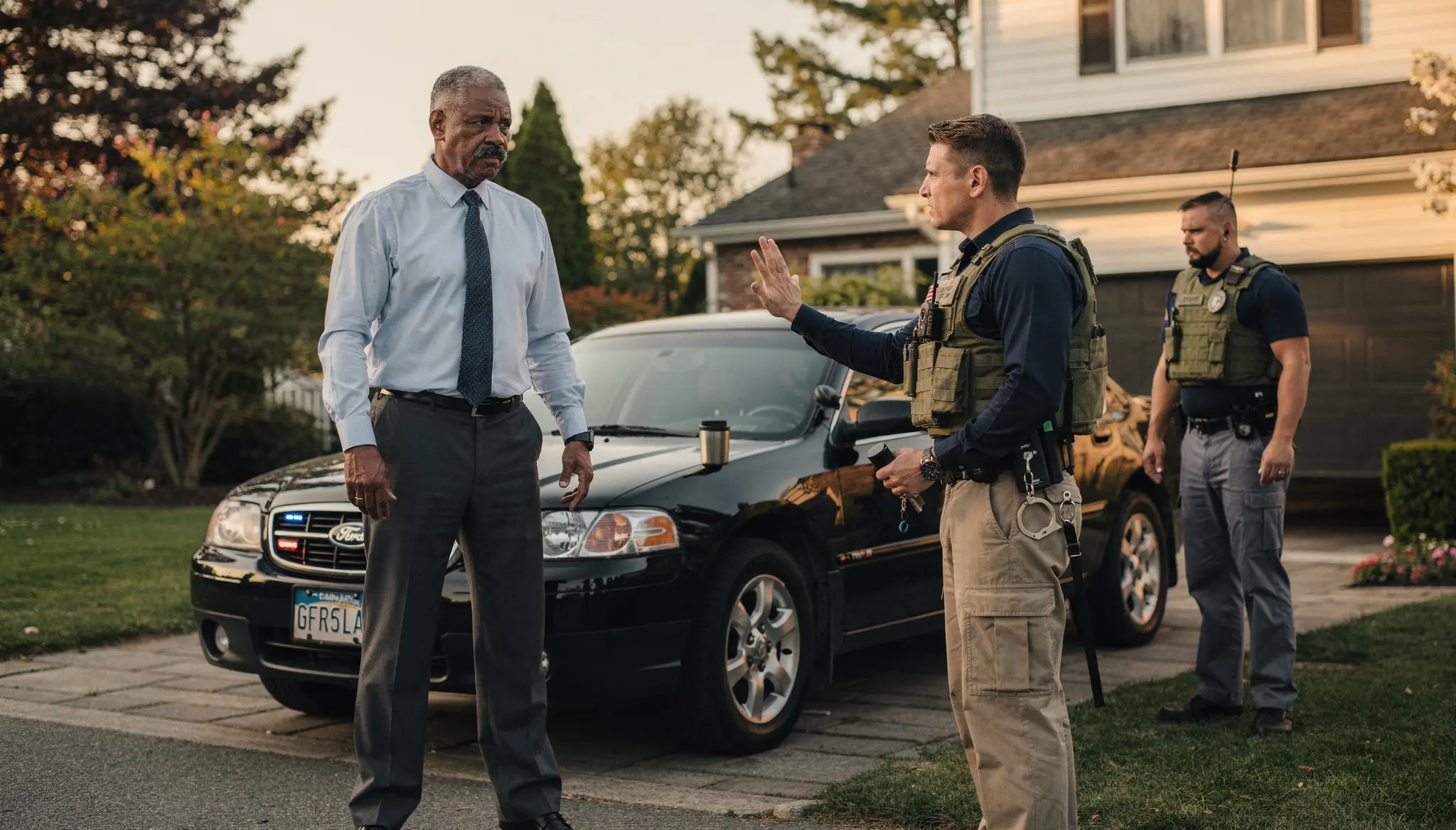
"We received a tip about this address. We need to verify your status."
"I'm the police chief. I run the police department in this town. You got a warrant?"
"Doesn't matter. You're coming with us until we sort this out."
Two ICE agents thought they were executing a routine immigration check. They had an address, a tip from an anonymous source, and the confidence that comes from years of operating without consequences. But when they pulled into the driveway of Chief Raymond Harris at 6:52 a.m. on a Friday morning and demanded he prove his immigration status, they set in motion a chain of events that would end with both agents in federal prison, their careers obliterated, a legal precedent that would reshape how federal enforcement operates in New Jersey.
Oakwood Drive sat in one of Maplewood's quieter neighborhoods. Tree-lined, well-kept lawns, the kind of street where people waved to each other and knew whose kids belonged to which house. Chief Raymond Harris had lived at number 47 for 19 years, raised three children there, hosted neighborhood barbecues in the backyard, watched his daughter leave for her first day as an ADA in Manhattan from that same driveway.
Friday morning, 6:52 a.m., Harris stepped out the front door in his dress shirt, coffee travel mug in hand. His unmarked vehicle sat in the driveway, the same SUV he'd driven to work every day for nine years as chief. The black Dodge Durango pulled in before he reached his car. Two men, olive tactical vests, ICE insignia. They stepped out with the posture of officers who expected compliance. Harris watched them approach. Thirty-one years of law enforcement had taught him to read body language. These two radiated the particular arrogance of agents who'd never been told no. "Sir, hands where I can see them. We need to verify your immigration status." Harris set his coffee mug on the hood of his car. Slowly, deliberately. "What are you talking about?"
"We received a tip about an undocumented person living at this address. You fit the description." "The description?" Harris had heard that phrase a thousand times in complaints, in depositions, in civil rights cases he'd reviewed as chief. "I'm the police chief, you reckless rookies." The agent, Derek Sloan, according to the badge visible on his vest, didn't hesitate. "That's what they all say. You're being detained until we can verify your identity."
"You're standing in my driveway without a warrant, demanding I prove I'm American." "Sir, turn around." "No." The word hung in the morning air. Final. Above the garage, the Ring camera recorded everything. Harris had installed it three years ago after a string of package thefts. He'd never imagined it would document this.
Across the street, his neighbor, David Morrison, had stepped onto his porch with his own coffee. He was watching. His phone was rising. "You're making a career-ending mistake," Harris said. Sloan reached for his handcuffs. "Oh, boy, you're screwed. Turn around now." Harris didn't turn. He stood in his own driveway, the house his family had owned for 19 years behind him, and watched two federal agents destroy themselves.
"For the record, I'm identifying myself as Chief Raymond Harris, Maplewood Police Department. Badge number 0001. Thirty-one years in law enforcement." Sloan's partner, Michael Torres, had positioned himself to the left. His body cam was active. So was Sloan's. Three recording sources already, and the encounter was barely two minutes old. "Anyone can claim to be a cop." "My credentials are in my back pocket. My badge is in my vehicle. My department is four miles from here." Harris gestured toward his SUV. "That's my unmarked unit. Municipal plates. Run them."
Sloan didn't move toward the vehicle. Didn't reach for his radio. Didn't do any of the verification that basic training required. "We're not running anything. You're coming with us." "On what authority?" "Immigration enforcement."
"You need a warrant to detain someone on private property." "We don't need a warrant for immigration checks." "You do when you're on my driveway, demanding I prove citizenship without probable cause." Torres shifted uncomfortably. His body cam captured the movement. The doubt his partner refused to acknowledge.
"Derek, maybe we should verify." "I said he's coming with us." Harris looked at Torres. "Your partner is committing multiple federal violations. Unlawful detention. Trespass. Fourth Amendment violation. You're on camera. You're complicit."
"Sir, we're just following up on a tip." "A tip you didn't verify at an address you didn't research against a man you didn't identify." He turned back to Sloan. "Last chance. Run my plates. Call my department. Do your job."
"Turn around." Sloan grabbed Harris's arm. The chief didn't resist. Didn't pull away. Simply stood still while the agent's hand closed around his bicep. "You just committed assault on a law enforcement officer. Battery. Unlawful restraint."
"You're not a law enforcement officer until I verify." "I've been in law enforcement since before you were born. I've arrested people for exactly what you're doing right now." David Morrison had crossed the street. His phone was raised, recording from ten feet away.
"Ray, what's going on?" "David, stay back. Document everything. These men are ICE agents. At least, they claim to be. They don't seem to know how warrants work." Sloan turned toward Morrison. "Sir, step back. This is federal business."
"This is my neighbor's driveway, and you're putting hands on the chief of police." "He claims to be." "Claims?" Morrison laughed. "I've lived across from Ray Harris for 15 years. I've been to his daughter's graduation party. I know exactly who he is."
Another neighbor had emerged, then another. The quiet Friday morning was becoming a very public confrontation. Sloan's grip remained on Harris's arm. The Ring camera recorded it. Morrison's phone recorded it. Torres's body cam recorded it. "My wife is inside," Harris said calmly. "Dr. Vanessa Harris, pediatrician. She's watching this through the window. She's already called my department." Sloan's face flickered. "Your department?"
"Maplewood PD, the one I command. They'll be here in about four minutes." "You're bluffing." "I've never bluffed in 31 years. Ask anyone who knows me." In the distance, a siren began to wail. The Maplewood cruiser pulled onto Oakwood Drive at 7:04 a.m., lights active, no siren. The officer had killed it two blocks away.
Deputy Chief Angela Morrison, no relation to the neighbor, stepped out and assessed the scene in three seconds. Her chief in his driveway, two ICE agents, one with his hand still on Harris's arm. Civilians recording from multiple positions. "What the hell is happening here?" Sloan turned. He saw the uniform, the rank insignia, the expression of someone who commanded respect and expected answers. "Ma'am, this is federal."
"That's my chief. Release him." "We're verifying his immigration." "His immigration status is that of an American citizen. Born at Newark Beth Israel. Family's been in New Jersey four generations. Release him now." Torres had already let go of whatever tentative grip he'd maintained. Sloan's hand remained.
"I don't take orders from local." "You're assaulting a law enforcement officer in his own driveway without a warrant, without probable cause. Release him or I'm placing you under arrest." "You can't arrest federal agents."
"Watch me." Morrison's hand moved to her radio. "Dispatch, this is Deputy Chief Morrison. I need backup at 47 Oakwood Drive. Federal agents have assaulted Chief Harris. Notify the county prosecutor. Notify the FBI field office. Notify the attorney general's office." The radio crackled with acknowledgement. Sloan released Harris's arm.
"This is a misunderstanding." "There's no misunderstanding." Harris straightened his shirt, picked up his coffee mug from the hood of his car. "You drove into my driveway without a warrant. You demanded I prove my citizenship. You put your hands on me after I identified myself as police chief." He looked at Morrison. "Angela, secure their body-cam footage, preservation order, and get their badge numbers."
"Already on it." More sirens now. County units responding to the deputy chief's call. Sloan's confidence had evaporated. Torres looked like he wanted to disappear into the concrete. "We received a tip." "You received a tip. You didn't verify it. You didn't research the address. You didn't identify who lived here. You saw a black man in an upscale neighborhood and decided that was enough."
Two county sheriff vehicles arrived. Then a state police cruiser. The quiet suburban street was becoming a crime scene. Harris turned to Morrison. "I want their phones secured before they can delete anything. I want their vehicle searched for documentation of this tip, and I want FBI here within the hour." "Chief, you should probably..."
"I should probably go to work, which is what I was doing when these two decided to violate my constitutional rights." He looked at Sloan one final time. "I've spent 31 years in law enforcement. I've testified in hundreds of cases. I've trained officers at the FBI National Academy, and you thought you could roll up to my house without a warrant and haul me away because I fit a description." He shook his head. "The description was black. That's all you had. And now you're going to explain that to federal prosecutors." An unmarked FBI vehicle turned onto the street. Harris recognized the agent stepping out. He'd worked joint task forces with her for years.
"Ray, are you okay?" "I'm fine, Janet. These two aren't going to be." The investigation revealed exactly what Harris had suspected. Derek Sloan had accumulated 19 complaints in seven years: warrantless stops and unverified tips targeting minority professionals in affluent neighborhoods. Sixteen were dismissed. Three resulted in reprimands that changed nothing. His stop records revealed the pattern. Eighty-three percent of his enforcement actions targeted black or Hispanic individuals. Zero had resulted in actual immigration violations. Every single subject had been an American citizen or legal resident.
The anonymous tip was traced within 48 hours. A burner phone purchased in Newark. The caller, later identified through voice analysis, was Richard Davenport, a neighbor three houses down who had complained about the Harris family's annual Fourth of July party for six consecutive years. Davenport had a history. Noise complaints, parking disputes, a letter to the homeowners association questioning whether certain residents were maintaining property values. The language was careful. The intent was clear. He had called ICE because a black family lived on his street. Text messages between Sloan and Torres painted the operational picture.
"Got a tip about Oakwood Drive. Nice neighborhood. Probably an overstay." "Upscale area. Worth checking. These people think money makes them untouchable." "These people." The phrase appeared 17 times in Sloan's communications over three years.
Torres had participated in 11 of Sloan's stops. He had expressed doubt in several. He had been told to follow orders. His cooperation with investigators was immediate and complete. His testimony would be essential. His career was still over. The FBI's analysis concluded that Sloan had operated a pattern of discriminatory enforcement for at least five years. His supervisors had enabled it by dismissing complaints and celebrating arrest statistics. Harris's home security footage was pristine. The Ring camera had captured everything in high definition. The demand for immigration status. The claim about fitting a description. The hand on his arm. The moment Sloan chose to ignore identification from a 31-year law enforcement veteran. Neighbor footage added additional angles. David Morrison's phone video. Security cameras from two adjacent properties. The evidence was comprehensive and damning.
The federal grand jury convened six weeks later. Sloan was indicted on deprivation of rights under color of law, assault, unlawful detention, and conspiracy to violate civil rights. Torres received lesser charges in exchange for cooperation. Richard Davenport was indicted separately for filing false reports and conspiracy. Harris testified for three hours. He didn't need notes. Thirty-one years of courtroom experience had prepared him for exactly this. "They didn't see a homeowner. They didn't see a police chief. They didn't see 31 years of service. They saw a black man in an expensive neighborhood, and they decided that was suspicious enough." The grand jury returned indictments on all counts.
The federal courtroom in Newark drew statewide attention. A police chief detained in his own driveway. ICE agents who ignored identification. The footage played on every news channel. Harris testified in his dress uniform, 31 years of service displayed through medals and insignia. "I identified myself as chief of police. I offered to show credentials. I pointed to my unmarked vehicle with municipal plates. The agent responded, ‘That's what they all say.'"
"What happened next?" "He grabbed my arm in my own driveway, in front of my neighbors, while my wife watched through the window." The body-cam footage played for the jury. Sloan approaching. The demand for immigration status. Harris's identification. The dismissal. The grab.
"That's what they all say." The phrase echoed through the courtroom. Torres testified under his cooperation agreement. He described Sloan's methodology, the preference for affluent neighborhoods, the assumption that minority residents were targets, the dismissal of complaints as oversensitivity.
"Did you believe Chief Harris's identification?" "Yes." "Did you communicate that to Agent Sloan?"
"I tried. He told me to shut up." "Did you attempt to verify independently?" "No. I followed his lead." Richard Davenport testified under subpoena. His motivation collapsed under cross-examination.
"You called ICE because Chief Harris is black." "I called because I had concerns." "Concerns about what?"
"His barbecues. His daughter's graduation party. There was noise." "You called a federal immigration tip line about noise." Davenport had no answer. Sloan's defense argued good faith. Following a tip, standard procedure. The prosecutor's response was surgical.
"Standard procedure requires warrant verification. Standard procedure requires identity confirmation. Standard procedure does not include grabbing a police chief in his driveway because you don't believe black men can live in nice neighborhoods." The jury deliberated for four hours. Sloan was found guilty on all counts. Torres was convicted on the reduced charges, and Davenport was convicted of filing false reports and conspiracy. Sloan showed no reaction. Torres wept quietly. Davenport stared at the table. The judge scheduled sentencing for eight weeks later.
"Agent Sloan, you were entrusted with federal authority. You used it to harass, detain, and assault an American citizen, a police chief in his own driveway, without a warrant, without verification, without any legal basis." The judge reviewed sentencing materials without expression. "Your pattern spans five years. Eighty-three percent of your stops targeted minorities. Zero resulted in actual violations. Every complaint was dismissed because your supervisors prioritized numbers over rights." Sloan's sentence: five years in federal prison, enhanced for pattern of conduct and assault on a law enforcement officer.
Torres received 18 months. Cooperation had reduced his exposure but couldn't eliminate it entirely. Davenport received two years of probation, 100 hours of community service, and mandatory diversity training. The judge noted that his actions had weaponized federal enforcement against his neighbors. Sloan and Torres were led from the courtroom in handcuffs, while Davenport was released pending the terms of his probation. The civil settlement followed within three months. The Department of Homeland Security agreed to pay $9.7 million rather than face a trial exposing systemic failures across the Newark field office.
Harris directed the distribution. Three million to scholarships for law enforcement professionals from underrepresented communities. Two million to civil rights organizations focused on immigration enforcement accountability. One million to the New Jersey Law Enforcement Memorial Foundation. The remainder secured his family. College for his youngest daughter. A foundation in his father's name supporting Newark firefighters' families. ICE entered a consent decree in New Jersey requiring warrant verification for all residential enforcement actions, mandatory identification protocols, and civilian oversight of complaint processes. The policies Sloan had violated were now explicitly codified. Harris returned to work the same day as the incident. He walked into his morning briefing and addressed his officers.
"What happened this morning is exactly what we train against. Officers who assume. Officers who ignore identification. Officers who let bias override procedure." He looked around the room. "We're better than that. We verify. We document. We treat every person, regardless of where they live or what they look like, with the dignity they deserve." The department's training curriculum was updated within the month. Harris's encounter became a case study. What happens when officers ignore constitutional requirements? What happens when assumptions replace investigation? He testified before the New Jersey State Legislature three months later. His testimony was broadcast statewide.
"I've spent 31 years in law enforcement. I've arrested violent criminals. I've worked undercover against drug traffickers. I've rescued children from burning cars. And the most helpless I've ever felt was standing in my own driveway while federal agents ignored my identification because they couldn't believe a black man was a police chief." The legislature passed three bills within the year. Enhanced warrant requirements for state cooperation with federal immigration enforcement. Mandatory recording of all immigration-related stops. Civilian review boards for complaints against federal agents operating in New Jersey. Harris was appointed to the governor's task force on law enforcement accountability. His recommendations shaped policy for the next five years.
His daughter, the ADA in Manhattan, used the case in her own training materials. His son, the Marine captain, shared it with his military police unit. His youngest, a Howard senior, wrote her thesis on the intersection of local and federal enforcement authority. Four generations of service. Four generations of proving that some families don't need to justify their presence. Richard Davenport sold his house six months after the verdict. The neighborhood had made clear he wasn't welcome. No one vandalized his property. No one threatened him. They simply stopped waving, stopped talking, stopped pretending he was part of the community he had tried to weaponize against his neighbors. His house sold for 15% below market value. The buyers were a young black couple, doctors at Newark Beth Israel. Harris helped them move in.
David Morrison, the neighbor who had recorded the confrontation, was awarded a civilian commendation by the Maplewood Police Department. His footage had been essential to the prosecution. "I just did what anyone would do," he said at the ceremony. "Ray is my neighbor, my friend. I've known him 19 years. Those agents had no idea what they were walking into." The Ring camera footage became part of law enforcement training nationwide. The FBI Academy used it. The Police Executive Research Forum distributed it. The moment Sloan grabbed Harris's arm and everything that followed became a teaching tool for what not to do.
Harris never removed the Ring camera. It still recorded every morning when he left for work. Same driveway, same routine, same coffee mug. The only difference was the small American flag pin he added to his suit jacket. His father had given it to him decades ago. He'd never worn it to work before. "I'm not making a statement," he told his wife when she noticed. "I'm just tired of proving something that should be obvious." His wife, Dr. Vanessa Harris, still watched from the window every morning. Old habit now, making sure no one else pulled into the driveway with bad intentions. No one did.
Derek Sloan served four years of his five-year sentence, and was released to a halfway house in Pennsylvania. Barred from federal employment for life, stripped of his pension, his name appears in law enforcement databases as a cautionary tale. Michael Torres completed his 18 months. He testified at three subsequent trials involving ICE misconduct. His cooperation continued. His career didn't. Richard Davenport moved to Florida. Public records show he's been cited twice for homeowners association violations at his new residence. Some patterns don't break. Chief Raymond Harris served three more years before retiring at 62. His final day drew 500 people to the Maplewood Community Center: officers, residents, families he'd served for three decades.
His successor was Angela Morrison, the first female chief in department history and the deputy chief who had confronted federal agents for assaulting her commander. The Harris family still lives at 47 Oakwood Drive. Four generations of New Jersey roots don't transplant easily. His daughter won her first major federal case last year, a civil rights prosecution that cited her father's incident in the opening statement. His son was promoted to major in the Marines and still uses the case study in his training programs. His youngest graduated from Howard summa cum laude and started law school in the fall with a focus on civil rights. The driveway looks the same as it did that Friday morning. Concrete. Unremarkable. The kind of space where Americans should be able to stand without proving they belong.
Harris still drinks his coffee there some mornings. Watches the sunrise over the houses he's protected for 19 years. Sometimes neighbors walk by and wave. Sometimes they stop to talk. No one mentions the incident anymore. It's part of history now, documented, adjudicated, resolved. But the Ring camera still records. The flag pin still sits on his jacket, and somewhere in federal databases, the case file remains open as a training reference.
Case number 2024-CR-0000847. Subject: Unlawful detention of law enforcement officer. Location: 47 Oakwood Drive, Maplewood, New Jersey. Outcome: Conviction, settlement, reform.
Lesson: Some driveways you don't pull into without a warrant. Chief Raymond Harris proved that lesson the only way available: by standing still while federal agents destroyed themselves, by being exactly who he said he was, and by documenting everything.