Society believes a woman who reads too many books is quietly ruining her chances at the marriage mart. It rarely considers that for some women books are not a pastime but an inheritance—the only thing left to them after a father dies with more learning than money—and that such an inheritance can be worth considerably more in the end than any dowry a fashionable mother ever assembled for her daughter.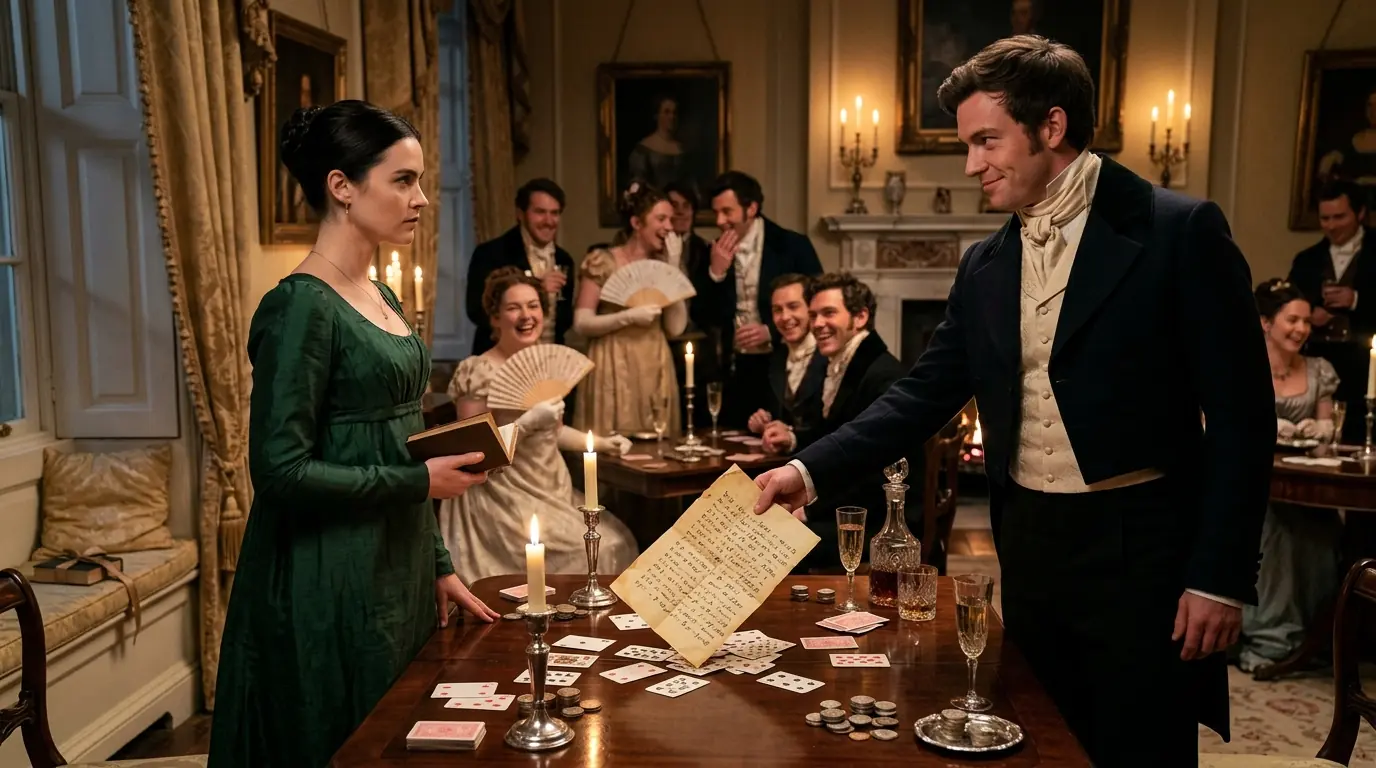
Eleanor Marsh had been laughed at for her reading her entire adult life. She was about to discover exactly what that reading was worth.
The drawing room at Featherstone House was arranged, as it always was on card nights, with the sort of careless opulence that spoke of money never quite earned honestly enough to be spent without showing off about it. Lady Featherstone, Eleanor's aunt by marriage and the nearest thing to family Eleanor had left in the world, had spared no expense on the wax candles or the champagne. Though she spared a great deal of expense on her niece, whose allowance amounted to little more than her room, her board, and the unspoken understanding that she would make herself useful and otherwise invisible.
Eleanor sat in her usual corner near the tall windows, half in shadow, a book of Latin verse open on her lap that she had read perhaps a dozen times before and no longer needed the light to follow. She wore a gown two seasons out of fashion, let out at the seams by her own hand rather than a modiste's, her dark hair pinned back with a severity that did her narrow, watchful face no particular favors. She was six-and-twenty, unmarried, and had long since stopped expecting that to change.
The card players did not look at her. The card players never looked at her. She had learned, in the three years since her father's death had left her with nothing but his library and a mountain of unpaid tutoring fees, that a poor relation is only truly welcome in a room when she is refilling someone's glass.
She had come to Featherstone House at one-and-twenty, when the last of her father's small savings had finally run dry, and there had been nowhere else for her to go but the door of an aunt by marriage who had never particularly liked her brother, and liked his penniless daughter rather less.
Lady Featherstone was not, in her own estimation, an unkind woman. She fed Eleanor, clothed her adequately, and expected in return that Eleanor manage the household correspondence, tally the linen inventory twice a year, and otherwise contribute to the general uncomplaining usefulness of a poor relation who understood precisely how little she was owed and how much she owed in return.
Eleanor had made her peace with the arrangement some years ago, the way a person makes peace with weather they cannot change. She read in the evenings because reading was the one thing left to her that no one else in the house particularly wanted, and therefore the one thing she was never asked to give up.
The Duke of Blackwood arrived a little after ten, and the entire temperature of the room shifted the moment he crossed the threshold.
Alexander Kestrel was not, by any account Eleanor had heard whispered around Lady Featherstone's card tables, a man anyone particularly liked. He was cold, they said. Proud in the particular, brittle way of a man whose pride is the only thing holding him upright. He was also, by every account, quietly drowning.
The old Duke, his father, had died eighteen months prior, leaving behind a title, eleven thousand acres of Northumberland land, and a set of debts so tangled and so vast that half of London's drawing rooms had spent the intervening year and a half speculating with unhidden relish on exactly when Blackwood Court would be sold off to pay them.
Alexander crossed the room to the card table with the rigid, controlled bearing of a man who has trained himself never to let his face show what he is thinking, and lost within the first hour a sum at whist that made even Lady Featherstone's painted eyebrows climb toward her powdered hairline. He did not seem to notice or care. There was a wildness beneath his composure that evening, a fraying at the edges Eleanor recognized because she had seen it before—in her own father in the last desperate months before his death, when a man has run out of every ordinary avenue and has begun quietly to consider the extraordinary ones.
It was near midnight when Alexander, three glasses of brandy past his usual restraint, pulled a folded, yellowed letter from the breast of his coat and slapped it down on the card table with enough force to rattle the candlesticks.
"One thousand pounds," he announced to the room at large, his voice carrying with the particular clarity of a man who has decided that if he is going to make a fool of himself, he intends to do it thoroughly. "One thousand pounds, ladies and gentlemen, to any soul in this room who can tell me what this blasted letter says."
The room went quiet, then erupted in the particular tittering laughter of people who suspect they are being invited to laugh at someone else's misfortune and are only too happy to oblige.
Lady Featherstone leaned forward, sensing scandal the way a hound senses a hare. "Your Grace, whatever can you mean? Surely a man of your education can read a simple letter."
"It is not simple," Alexander said, and there was real bitterness beneath the brandy now, a rawness he had clearly not intended to show. "It is my father's hand, and it is written in some private cipher of his own invention. And I have had my solicitor, two Cambridge dons, and a codebreaker retired from the War Office pore over the wretched thing for the better part of a year, and not one of them has produced a single sensible word from it. My father left instructions with his solicitor that this letter was to be opened only if the estate ever fell into genuine peril."
He laughed—a short, ugly sound with no humor in it at all.
"The estate has been in genuine peril for eighteen months, and I possess the one letter my father apparently believed would save it, and I cannot read a single word of it. So, one thousand pounds. Read it for me, and it is yours."