Blizzard-stripped shingles were peeling off the barn roof at Willow Bend Ranch, Montana territory, on the January night in 1886 when a bank notice would change everything the valley thought it knew about a widow's chances. By winter, the whole valley would owe Cora Hale a debt no ledger at the First Territorial Bank could ever measure, and it would start with $9, 240 acres of half-dead range, and a knock at a door she almost didn't answer. I have gathered a great many ranch stories off this stretch of the territory, and most of them belong to the man who rides in to fix what everyone assumed a woman couldn't manage alone. This is not one of those stories, and I want that understood plainly before we go one step further. Cora Hale saved her own ranch.
The man who knocked on her door that winter helped her do it, and he is worth knowing in full. His losses were as real as hers, and what grew between them was earned by both. But the hand on the ledger, the hand on the plow line, and the hand that finally beat a land baron in a territorial courtroom belonged to her every single time. Cora had run Willow Bend alone for 2 years by the night this story finds her, ever since a spooked gelding threw her husband Daniel in the March mud and left her too far off to reach him in time. She was 26 that winter, chestnut-haired, weathered plain across the knuckles from work most women in the county were never expected to do.
And she had learned to read a bank letter the way other people read scripture, carefully, and braced for the worst line to be the true one. She kept her own books, in her own ledger, in her own hand, because she had watched too many widows in that country hand their affairs to a man who managed the affairs right out from under them before the ink was even dry. She could doctor a breech foal at 4:00 in the morning with her whole arm inside the mare to the shoulder and not lose either animal. She could ride fence 12 miles in a whiteout and find every down post by feel before the cold found her first. What she could not do that particular January was make 240 acres of failing irrigation grow enough grass fast enough to keep a bank quiet.
Laura Ingalls Wilder once wrote that it is a great thing to know what to do with a day, and there were nights that whole first winter when knowing what to do with the very next single day was the only rope Cora Hale had left to hold on to. The letter from the First Territorial Bank had sat face down on her kitchen table for 3 days before she could make herself read it a second time. The balance owed was $385, due in full by the 2nd of March, or Willow Bend would stand for auction on the courthouse steps down in Fort Lyle. She had $9 in the tin behind the flour bin. 22 months of patching fence and mending pumps and turning away every man who came sniffing around her boundary line had come down to $9 and 30 days and a name, Willow Bend, that half of Cedar Fork no longer quite believed in.
She had turned down three separate offers on the land in those 2 years. Each one dressed up as neighborly concern, each one from the same big cattleman down the valley who owned more range than any three other outfits combined and had made a study of which widows and homesteaders were close enough to breaking to say yes. The town itself had mostly stopped taking bets on how long she'd last after the second winter. Not out of unkindness, exactly, but because a woman running 240 acres alone was, in Cedar Fork's plain estimation, simply a fact working itself slowly toward its obvious conclusion. Cora had heard the talk at the mercantile and the church social both, and had learned to let it pass through her the way weather did, without changing her course by an inch.
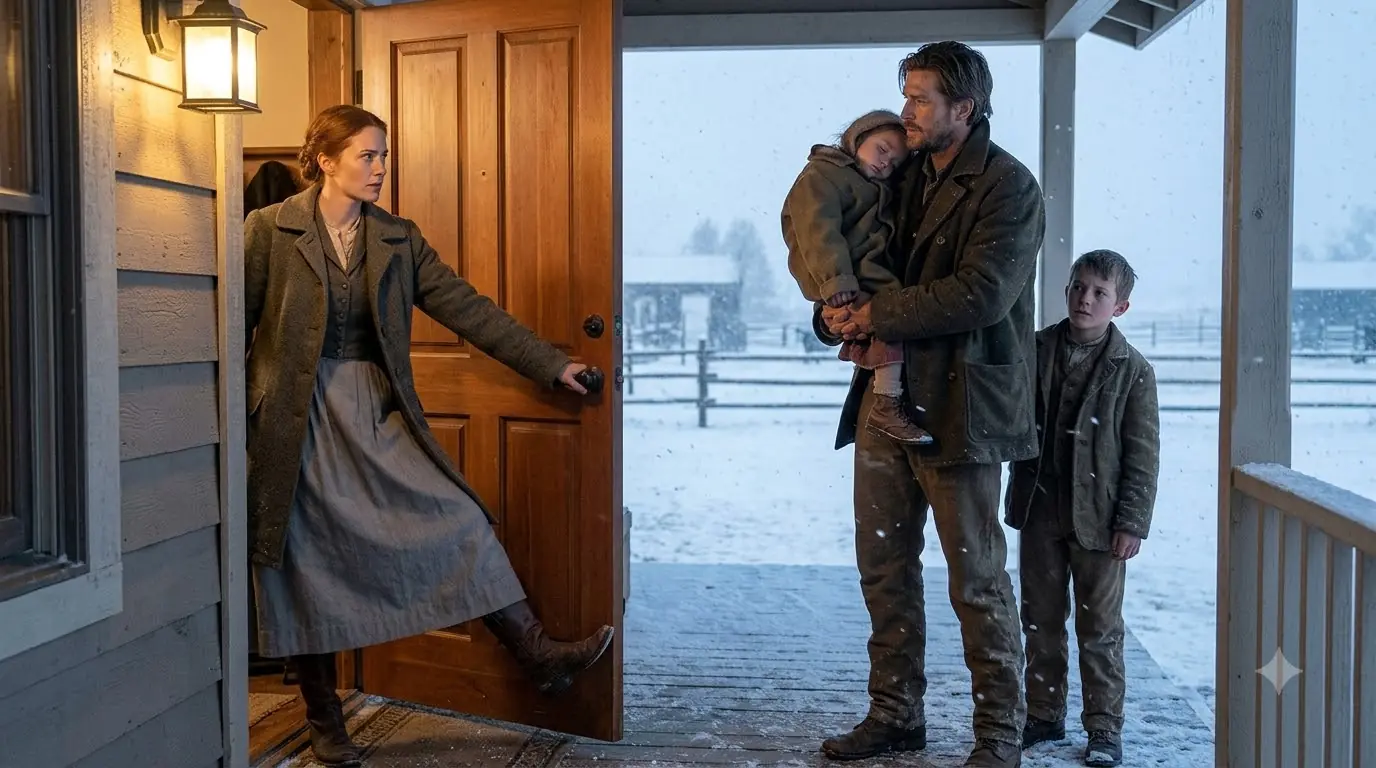
She was standing at that same window when the knock finally came, watching snow drive sideways across a pasture Daniel had fenced with his own two hands the spring before he died. She was not watching because she expected the weather to improve. She was watching because sitting back down at that table and reading the bank notice a third time felt like something that might break loose inside her chest and never quite settle back into place. The knock itself was three solid raps, the unhurried kind that meant whoever stood on the porch had already decided to keep standing there until somebody let them in. Cora set the letter face down, shrugged her coat on over her house dress, and cracked the door only as far as her own boot wedged against the bottom panel would allow, a habit Daniel had drilled into her years before. "
Don't open all the way," he used to say, "until you know exactly what you're opening to." The man on the porch was tall and road-worn, a little girl asleep against his shoulder wrapped in a coat three sizes too big for her, a boy of nine standing half hidden behind him, studying Cora's boots instead of her face. His name was Levi Dawson, he explained, and the children were his daughter Wren and his son Sam, and he wouldn't have troubled a stranger's door except that the children needed to get warm. And if there was any milk to spare for the girl, he'd be more grateful than he knew how to say plainly. His eyes were gray in the particular way of a color that had once run warmer and hadn't fully recovered.
Cora studied him three long seconds. " Any weapons on you?" she wanted to know. " A skinning knife on my belt," he allowed and a rifle out in the wagon and both would stay exactly where they were. She looked past him toward the dark shape of that wagon down at her fence line.
One horse standing with its head low worn through the same long cold he was. She stepped back and let the door swing wide. She fed Sam broth first because he was working the hardest of anyone in that kitchen not to look hungry. And warmed a cup of milk for Wren at the stove, testing it against her own wrist the way she would have for an infant. The girl was running a fever.
Mild, but real. Levi laid it all out plainly while the children ate without once fishing for pity. His wife Mara had died of a fever the September before. The homestead they'd built together over in Larkspur County was lost that same hard season and he'd been looking for honest work of any kind ever since. Something in Cora's own better judgment lost an argument with itself and she found herself asking whether he knew the first thing about irrigation. "
Depends entirely on the system." He granted, careful not to promise more than he could prove. Hers was failing badly. Channels bleeding water before it ever reached half the south pasture and two paid men who'd each warned her the whole thing needed tearing out and rebuilding at a price she simply didn't have. Levi posed careful specific questions about grade and soil and the age of the ditch lines.
and by the time he finished with them, Cora had the strange steadying sense that both those men had been selling her repair to a problem that didn't actually exist. They had been 3 weeks on the road by then, sleeping in the wagon bed under whatever cover the weather allowed, ever since the last of Levi's money ran out paying a doctor in a town too small to remember the name of back when Wren's fever had first come on. He did not tell Cora that part that first night, not fully, only that Larkspur County had cost him everything a man could lose short of his own two children, his homestead, his standing, and the woman he'd built both of those things beside. What he carried, instead of complaint, was a kind of careful, watchful competence, the manner of a man who had learned the hard way that the world did not owe him softness, and had decided the only honest answer to that was to make himself useful wherever he landed, plainly and without asking anyone's pity for the effort. There was a room off the back of the barn with a stove in it, she explained.
He and the children could stay the night. Come morning, he'd walk her channels and tell her plainly what he actually found, and they'd talk about the shape of any work arrangement after that. Thirty days. That was the whole of it, the number that sat under everything that followed like a stone lodged behind Cora's ribs, and Levi never once made her feel foolish for carrying it. When she finally voiced the deadline out loud, standing at the channel line the following cold morning, his face showed no pity at all, only a steady kind of attention that settled her more than sympathy ever could have. "