The morning light came into the breakfast room at Marwood Court the way it always did in late September: sideways and gold, falling across the white cloth, the cooling coffee, and the small silver rack of correspondence that Marcus Annesley, Earl of Marwood, had already begun sorting with one hand while the other held his newspaper flat.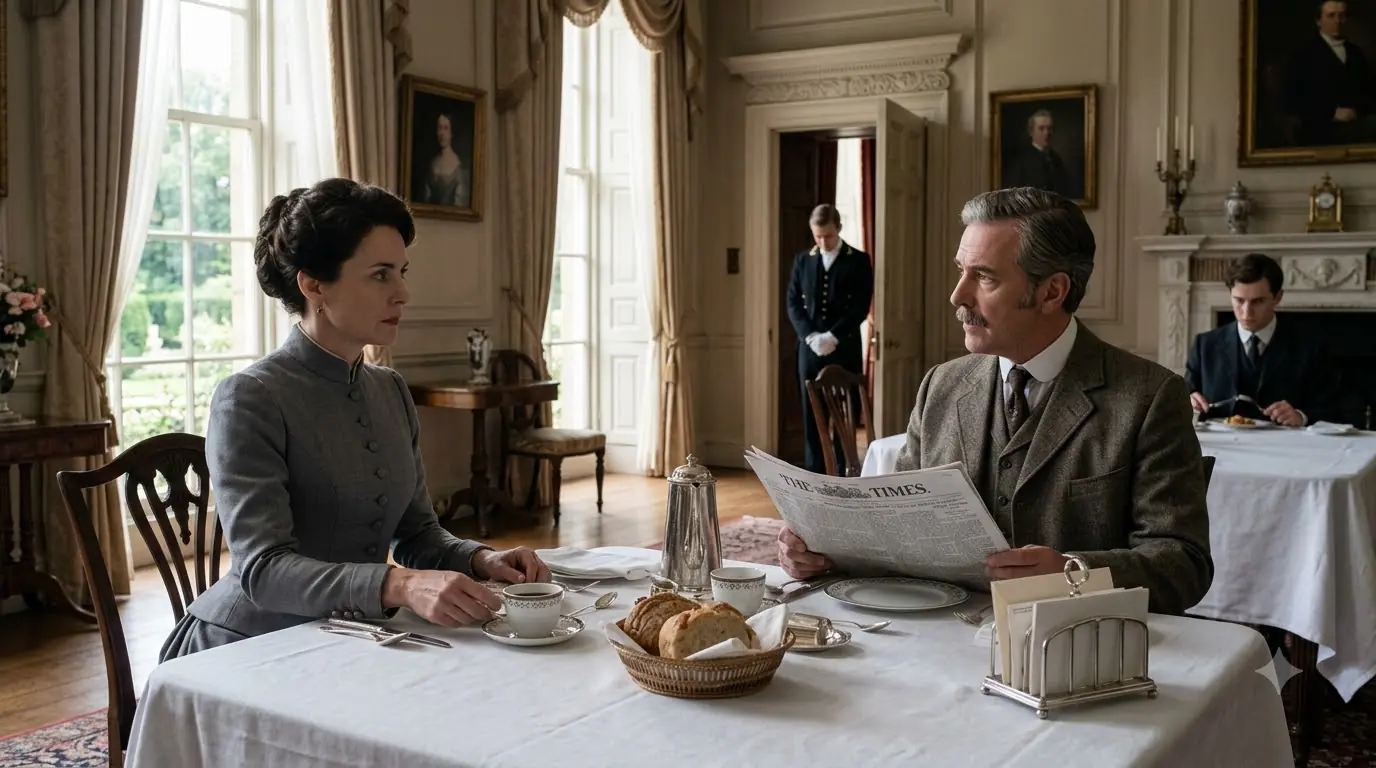
His wife, Lady Cassandra, sat across from him in the chair she had occupied at this table for 11 years. She had poured her own coffee without remark. She had broken a piece of bread and set it on her plate without eating it. She was wearing the gray morning dress, the one with the small buttons at the wrist that she fastened herself because she had told the maid long ago not to wait.
There was a window behind her, and the light came through it and fell on her hair. Marcus did not see any of it, because he was reading about the condition of the roads in the north county and whether the new drainage scheme would require a second petition to Parliament.
Cassandra said something—something perfectly ordinary about the day, about whether the Ashford family was expected for dinner on Thursday or Friday. A question that required only a yes or no.
Marcus did not lower the newspaper. He did not look up from the correspondence. He said, in the flat and automatic voice of a man registering mild inconvenience—the way a man says the weather has been too damp, the way a man says the soup was oversalted—he said, "I am tired of seeing your face."
The room went very quiet.
Cassandra set down her cup. She did it with precise, unhurried care. The small porcelain click of it against the saucer was the only sound, and she sat still for exactly two seconds—which was long enough for the footman near the door to look at the floor, and for the young cousin visiting from Wiltshire to go entirely rigid over his eggs.
Then she said, in a voice that was perfectly level, with the unhurried delivery of a woman who has already decided: "Then look elsewhere."
Marcus looked up. He raised his eyes above the top edge of the newspaper, and he found that she had already risen—not quickly, not dramatically, but with the same complete and finished calm with which she had set down the cup. And she was folding her napkin, and she was placing it beside her untouched bread. There was something in the way she moved, something in the set of her shoulders and the direction of her attention, that made it clear she had already left the room in every way that mattered before her body had followed.
She walked out.
The footman did not move. The cousin did not speak.
The newspaper was still in Marcus's hands, held open at the same page, and he sat looking at the doorway where she had been—the empty doorway, the pale corridor beyond it, the morning light continuing its indifferent progress across the floor.
And he found in that moment that he could not reconstruct the last time he had truly looked at her. Not glanced across the table, not registered her presence as a fixed point in a room—looked at her the way you look at a person you have chosen, the way you look when you want to see.
He tried to find it. He set down the newspaper, and he tried genuinely to locate it in memory: the last time he had given her his full attention. The effort produced nothing he could name with any certainty. A dinner, perhaps, two years ago, when she had worn the blue? But had he looked at her, or had he simply been aware of her? A morning in the garden three years ago? But he could not be sure it was her and not the head gardener he had been watching.
He sat at the table where the coffee was cooling and the bread sat untouched on her plate, and the footman was still looking at the floor, and Marcus found that he could not, with any confidence, describe his wife's face.
He had said he was tired of seeing it. He could not bring it to mind.
The cousin from Wiltshire, a young man of 22 with the social instincts of a startled deer, quietly excused himself and left the room.
And Marcus remained at the table alone with the cooling coffee and the folded napkin and the question he could not answer, which was: when had he last looked, and what had he seen?
He did not know. He genuinely, in that sunlit breakfast room, did not know.
The story does not begin there, though it arrives there. It begins 11 years earlier, in the spring of 1843, when Cassandra Vane, 27 years old, the second daughter of a Herefordshire clergyman with more books than income and a lively, specific intelligence that had nowhere particular to go, married Marcus Annesley at the parish church in Ledbury in a ceremony attended by more of his people than hers, and understood from the expressions of his aunts that she was considered a romantic choice—which was another way of saying a surprising one.
It was a genuine love match. That is the first and most necessary thing to say about it. Marcus at 33 was not yet an earl; his father was still living, the title still theoretical. And he had come to Herefordshire for the shooting and stayed for a woman who had opinions about Flemish portraiture and expressed them without softening them first to see if he agreed. He had leaned across a supper table at the Hereford house and asked her what she meant, and she had told him exactly what she meant, and by the end of the evening, he'd been entirely lost.
They had married within the year.
In the second year of the marriage, he used to come to her while she painted. She had a room then—a proper, light-filled room in the west wing of the house they rented in Shropshire before the title, before Marwood Court and all its rooms and all its obligations. And she painted miniatures on ivory, small formal portraits that she had been doing since she was 17.
Marcus would appear in the doorway in the late afternoon and then drift closer until he was behind her shoulder, watching the work take shape under her brush. He never spoke when she was working. He simply stood there, one hand warm at her nape, his attention moving between the ivory in her hand and her face. And it was the quality of his attention that she remembered most clearly: not the touch, though the touch was good, but the fact that he was genuinely watching, genuinely interested, as though her work was something that mattered and she was someone worth the trouble of seeing.
That was the last time.
She did not understand it was the last time until much later. At the time, it simply stopped—gradually, then entirely—as his father died and the title arrived with it, larger and more encumbered than anyone had prepared him for. Marcus grew into the earldom the way a young tree grows into a stake, bending toward its requirements, and his household receded behind him as he moved forward.
He was not cruel. He was not unfaithful. He was not even consciously neglectful, which was in some ways the most difficult thing to make sense of. He was simply elsewhere: attending to the estate, to the tenants, to the drainage and the roof, to the parliamentary business and the county dinners.
The house at Marwood Court ran smoothly because Cassandra ran it quietly and without complaint. She was good at it, and no one ever said so because no one ever thought to notice.
The grief of no children came and went without ever being named. There had been one pregnancy in their third year that had not continued, and they had stood at opposite sides of that loss without finding a way across it. Then the distance between them had grown a little wider, and then a little wider again. By the time either of them might have spoken, it had become the kind of silence that it seems rude to break.