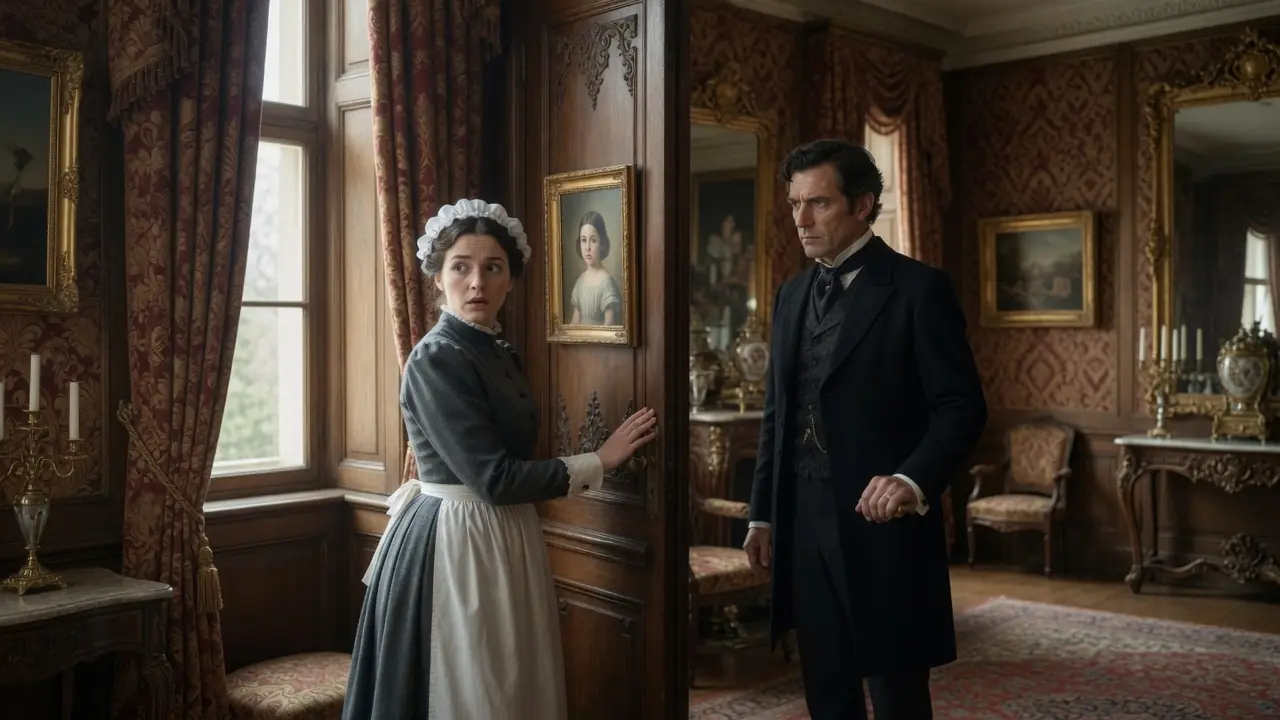
The painting was small, no larger than a dinner plate, tucked between two towering bookshelves in a room she had no business entering. But there it was, a girl of perhaps five years old, sitting on a velvet cushion the color of crushed raspberries, wearing a white lace dress with pearl buttons that caught the light like tiny moons. The girl’s hair fell in dark curls around her shoulders. Her eyes, wide and serious, were the exact shade of amber that stared back at Ara every morning in the servants’ washroom mirror.
She dropped the feather duster. It hit the marble floor with a sound so small it should not have mattered, but in the silence of the Duke’s private chambers in the forbidden east wing of Ashworth Hall, it sounded like a crack of thunder. “Impossible,” she whispered. Her legs would not move. Her hands would not obey. She stood frozen, a statue in a gray cotton dress and white apron, staring at a portrait that could not exist. Because no one had ever painted her as a child. She was certain of this.
She had grown up in the village of Thornfield, the daughter of a washerwoman and a carpenter who could barely afford bread, let alone a portrait painted in oils by what was clearly a master’s hand. The gold frame alone was worth more than her mother had earned in a lifetime. Yet the face in the painting was hers. Not similar. Not reminiscent. Hers. She knew that tiny scar above the left eyebrow, the one she had gotten from falling against a stone wall when she was four. She knew that specific way her lower lip was slightly fuller than the upper. She knew the exact placement of the small brown birthmark just below the right ear, half hidden by curls.
No stranger’s child shared all of these marks. No coincidence stretched that far. The room pressed in around her. She became aware of its details as if seeing them for the first time, though she had cleaned this chamber every Thursday for the past eleven months. The heavy curtains of midnight blue velvet always drawn against the light. The writing desk with its locked drawers. The shelves lined with books in languages she could not read. The faint smell of cedar and old leather. And something else, something sharper, like ink that had not yet dried.
And now this painting which she had never noticed before because it had been hidden behind a panel that today for the first time stood slightly open. Someone had been here before her. Someone had opened that panel and left it ajar. Whether by accident or design, she could not say, but the result was the same. She had seen what she was never meant to see. A floorboard groaned somewhere beyond the door. Ara snatched up the feather duster, pressed it to her chest like a shield, and forced herself to breathe. One breath. Two. The footsteps in the corridor grew louder, then softer, then faded entirely. A servant passing. Nothing more.
She looked back at the painting. The girl in the portrait sat perfectly still, as painted children do. But there was something in her expression that was not stillness at all. It was patience, as if the child knew that someone would come eventually to find her here, as if she had been waiting. Ara reached out. Her fingers trembled. She touched the edge of the gold frame and felt the cold bite of metal against her skin. Real. Solid. Not a dream and not a trick of the light.
She tilted the painting gently, and there on the back, written in a hand so elegant it looked like calligraphy, were two words and a date. “My Aurora, 1793.” The year she was born. Her name was not Aurora. Her name was Ara Voss. It had always been Ara Voss. Her mother had told her so a thousand times, had sung her to sleep with the name on her lips, had written it in the family Bible in careful, unpracticed letters. Ara Catherine Voss, born the seventh of March, 1793, in the village of Thornfield, County of Ashworth.
But the child in the painting was her. And the Duke of Ashworth, a man who had never once looked at her, never once spoken her name, never once acknowledged her existence beyond a curt nod when she delivered his morning tea, had kept this portrait hidden in his most private room for what appeared to be her entire life. She closed the panel. She picked up the duster. She finished cleaning the chamber with hands that shook so badly she knocked a brass candlestick from the mantle and had to catch it before it struck the floor. She replaced everything exactly as it had been. She checked the panel twice to make sure it was closed precisely as she had found it, not quite flush, that thin dark line of shadow still visible between wood and wall.
Then she walked out of the room, down the corridor, through the servants’ passage, and into the kitchen, where she sat on a stool beside the bread oven and pressed her hands flat against her knees until they stopped trembling. Mrs. Callaway, the head cook, looked up from a pot of something that smelled of onions and rosemary. She was a broad woman with flour on her sleeves and a face that had seen enough of life to recognize trouble when it walked through her kitchen door.
“You look as though you have seen a ghost, girl.” “I am fine, Mrs. Callaway.” “You are the color of unbaked dough, and your eyes are the size of saucers. That is not fine. Sit. Eat something. There is bread from this morning and butter in the crock.” Ara ate. The bread was warm, and the butter was salted, and she tasted none of it. Her mind was in the east wing behind a wooden panel, staring at a face she knew better than any face in the world.
“My Aurora.” Who was Aurora? Who was she? The question settled into her chest like a stone dropped into deep water. It sank and sank and found no bottom. Ashworth Hall was the largest estate in the county, a sprawling monument to three hundred years of the Ashworth family’s power, ambition, and if the village gossips were to be believed, their considerable capacity for secrets.
The house itself was built of pale gray stone that turned silver in the rain and gold in the late afternoon light. It had forty-seven rooms, twelve fireplaces, a library that stretched the entire length of the west wing, and grounds that rolled out in every direction like a green sea, broken only by hedges, gardens, and a lake so still it looked like a mirror dropped from the sky. Ara had come to work here eleven months ago in the autumn of 1811, when her mother’s cough had turned into something that no amount of broth or prayer could fix. The medicine cost money. The doctor cost more. And the only place within walking distance that was hiring servants was Ashworth Hall.
She had applied for the position of downstairs maid, the lowest rung on the household ladder, and had been interviewed by Mrs. Blackwood, the housekeeper, a woman whose spine appeared to be made of iron and whose eyes missed nothing. “Can you read?” Mrs. Blackwood had asked. “Yes, ma’am. My mother taught me.” “Can you keep your mouth closed and your hands busy?” “Yes, ma’am.” “Can you follow rules without asking why?” “Yes, ma’am.” “Good. You will clean the rooms you are assigned. You will not touch what you are not instructed to touch. You will not speak to the Duke unless he speaks to you first, which he will not. You will not enter the east wing without explicit permission from me. You will receive your wages on the first of each month. Is that clear?” “Yes, ma’am.”
And for eleven months, Ara had followed these rules. She had cleaned parlors and polished silver and scrubbed floors until her knees ached and her hands cracked from the cold water. She had been invisible as a good maid was meant to be, a ghost in a gray dress who moved through the grand rooms and left them gleaming and unchanged. The east wing had been added to her duties only six weeks ago when Mary, the upstairs maid, who normally tended those rooms, had broken her ankle falling down the back staircase and been sent home to recover. Mrs. Blackwood had handed Ara the ring of keys with the expression of someone handing over a live coal.
“The Duke’s chambers are cleaned every Thursday between ten and eleven in the morning while he rides. You will dust, sweep, and ensure the fire is laid. You will not open drawers, read papers, or linger. Am I understood?” “Yes, ma’am.” And she had not opened drawers or read papers or lingered. Not until today. Not until a hidden panel had stood open by some accident or some design and a painted child had looked out at her from across eighteen years and said without words, “I know you. I am you.”
The Duke of Ashworth was named Hadrien Cole. She knew this the way all servants knew things about their employers, through the slow accumulation of overheard conversations, kitchen gossip, and the particular quantity of silence that surrounded a man who inspired both respect and unease in everyone who came near him. He was thirty-four years old. He had inherited the title and the estate at the age of twenty when his father had died in a riding accident that some said was not an accident at all, though no one said this loudly or with any evidence beyond the meaningful raising of eyebrows.
He had never married. He had no children. He had a younger sister, Lady Charlotte, who lived in London and visited twice a year, filling the house with noise and light and the smell of French perfume before vanishing again like a brilliant, expensive bird. He was tall. His hair was black and kept short in a style that suggested impatience with anything that required maintenance. His eyes were gray, not the soft gray of morning mist, but the gray of storm clouds, of steel, of something ancient and unforgiving.
He returned at eleven, handed the reins to the stable boy without a word, and disappeared into the house. He had never spoken to her. He had never looked at her long enough for her to believe he knew her name. He was to her a figure made of distance and authority, as real and as unreachable as the stone walls of the house itself. And yet he kept a portrait of her as a child, hidden in his private room, inscribed with a name that was not hers, and a date that was her birth year. She could not make these two facts exist in the same world.
That night, in the narrow bed she shared with Polly, the kitchen maid, in the servants’ quarters on the third floor, Ara stared at the ceiling and did not sleep. Polly snored gently beside her, one arm flung out across the pillow, lost in the uncomplicated dreams of someone who had never found a portrait of themselves where no portrait should be. Ara thought about her mother, Catherine Voss, née Hartley, a woman who had worked her hands raw every day of her life and still found the energy to teach her daughter to read by candlelight, using a Bible and a book of fairy tales that she guarded as though they were made of gold.
Catherine, who was now propped up in bed in their small cottage in Thornfield, growing thinner by the week, her cough a constant companion that no amount of medicine seemed to quiet. Had her mother lied to her? The thought was a betrayal so sharp that she flinched from it physically, turning on the thin mattress and pressing her face into the pillow. Catherine Voss did not lie. Catherine Voss was honest to the point of pain. A woman who would tell you your soup was terrible and your dress was ugly and your singing needed work all in the same breath because she believed the truth was the only gift worth giving.
But someone had painted her as a child. Someone had dressed her in white lace with pearl buttons and sat her on a velvet cushion and written “My Aurora” on the back of the canvas. And that someone had given the painting to the Duke of Ashworth, or else the Duke had taken it or found it or inherited it. However it had arrived in that hidden panel, it had been placed there with care, with intention, with the unmistakable tenderness of someone preserving something precious. She had to go back. She had to look at the painting again. She had to be sure. Thursday was five days away. Five days had never felt so long.
She moved through her duties like a sleepwalker. She polished the silver in the breakfast room and stared through the window at the east wing, counting the windows until she found the one that belonged to the Duke’s chambers. She swept the grand staircase and paused on the landing where a series of family portraits lined the wall, studying each one for any resemblance to the child in the painting. She found none. The Ashworth family had sharp angular features, high cheekbones, and pale eyes. The child in the painting had a round face, soft features, and eyes the color of amber.
On Tuesday, she found an excuse to visit the village. Mrs. Callaway needed herbs from the apothecary, and Ara volunteered before anyone else could. She walked the two miles to Thornfield in the thin March rain, her shawl pulled tight around her shoulders, and arrived at her mother’s cottage with wet shoes and a heart full of questions she was not sure she had the courage to ask. Catherine Voss was in bed, as she always was now. The cottage was clean, kept tidy by Mrs. Phelps from next door, who came in twice a day as a kindness. There was a fire in the grate and a pot of tea on the table and a cat named Thistle curled on the windowsill watching the rain.
“Ara.” Her mother’s face lit up. The cough was worse, a rattling, persistent thing that lived in her chest like a tenant who would not leave. But her eyes were bright, and her smile was real. “Come, sit. Tell me everything. Are they feeding you enough? You look thin.” “I am fine, Mama.” “You are thin. I can see your collarbone from here. Sit. There is bread in the box.” Ara sat on the edge of the bed and took her mother’s hand. It was lighter than it should have been, as though the illness was slowly subtracting weight from every part of her, reducing her bit by bit until one day there would be nothing left to reduce.
“Mama, I want to ask you something.” “Then ask.” “Was there ever anyone who wanted to paint me when I was small?” The change was instant. Catherine’s hand tightened around hers. Her smile did not disappear, but it froze, becoming something fixed and deliberate, a door closing behind a pleasant expression. “Paint you? Why would anyone paint you? We could barely afford milk.” “I know. I just wondered. Someone at the hall was talking about childhood portraits, and I thought—” “No one painted you. You were a carpenter’s daughter in a village of two hundred people. We did not have portraits. We had each other, and that was enough.”
Catherine’s voice was firm, but her hand was still tight, too tight. And her eyes had shifted to the window, to the rain, to anywhere that was not her daughter’s face. Ara recognized the deflection. She had inherited her mother’s honesty, but she had also inherited her mother’s stubbornness, and she knew with a certainty that settled in her bones like cold that Catherine Voss was not telling the truth. “Mama.” “Enough, Ara. Some questions are better left unasked. Now tell me about the hall. Is the housekeeper still a tyrant?”
Ara told her about the hall. She described Mrs. Blackwood’s iron spine and Mrs. Callaway’s onion soup and Polly’s snoring and the way the library smelled of old paper and leather on rainy afternoons. She did not mention the painting. She did not mention the Duke. She did not mention the name Aurora. But when she left, walking back through the rain with the herbs for Mrs. Callaway tucked inside her shawl, she carried her mother’s reaction with her like a second heartbeat. The tightened hand. The frozen smile. The eyes that fled to the window. Catherine Voss knew something, and whatever it was, it frightened her.
Thursday arrived with the reluctant gray light of early spring. Ara dressed in the dark as she always did, pulling on her gray dress and white apron and pinning her hair beneath her cap with fingers that trembled only slightly. Polly murmured something about turnips and rolled over. The clock in the servants’ hall struck five. She went through her morning duties with mechanical precision. She laid the fires in the drawing room, the morning room, and the small parlor. She polished the brass door handles in the entrance hall. She ate breakfast in the kitchen with the other servants, a bowl of porridge and a cup of tea so strong it could have stood up on its own. She said nothing unusual. She smiled when Polly made a joke about the footman’s new haircut. She was invisible. Ordinary. Unremarkable.
At ten o’clock, she watched from the kitchen window as the Duke rode out on Solomon. Horse and rider moved across the gravel drive and onto the path that led through the park, a single dark figure against the green. She watched until they disappeared beyond the line of oaks, and then she picked up her cleaning supplies and walked to the east wing. The corridor was quiet. It was always quiet in this part of the house, as though the walls themselves understood that silence was expected. Her footsteps were soft on the carpet. The key turned in the lock with a click that echoed. She opened the door. The room was exactly as she had left it, curtains drawn, desk undisturbed, the faint smell of cedar and leather. She closed the door behind her and stood for a moment, letting her eyes adjust to the dimness. Then she walked to the bookshelves.
The panel was closed, not almost closed as it had been before, but fully, completely shut. Someone had been here. Someone had noticed. Her heart hammered. She should leave. She should clean the room as she always did and walk out and forget what she had seen and never look again. That was the safe choice. That was the choice a sensible person would make. Ara Voss was sensible in almost every area of her life. She was sensible about money and food and sleep and the careful management of her mother’s medicine. But she had never been sensible about the truth. The truth in Ara’s experience was the only thing worth being reckless for.
She pressed the edge of the panel. It did not move. She pressed harder. Nothing. She ran her fingers along the seam, searching for a latch, a catch, a mechanism. Her fingertips found a small indentation in the wood no larger than a thumbnail. She pressed it. The panel swung open. The painting was gone. The space behind the panel was empty, clean, not even a dust mark to show that something had rested there, as though the portrait had never existed, as though she had imagined the whole thing. But she had not imagined it. She knew what she had seen. The white lace dress. The pearl buttons. The scar above the left eyebrow. “My Aurora, 1793.”
She stared at the empty space and felt something shift inside her, something fundamental, like a key turning in a lock she had not known existed. The painting was gone because someone had moved it. And the only person who had access to this room, the only person who would know about a hidden panel in his own private chambers, was the Duke. He knew she had found it. The thought was ice in her veins. She closed the panel, cleaned the room with shaking hands, and left.
For three days, nothing happened. The Duke rode at ten and returned at eleven. He took his meals alone. He passed through corridors without looking left or right. If he was aware that his maid had discovered a secret portrait hidden in his chambers, he gave no sign of it. His expression, on the few occasions Ara glimpsed it from a distance, was the same as it always was. Composed. Remote. Unreadable. A face that gave away nothing because it had been trained from childhood or from necessity to hold everything behind its walls. But she was watching now. Where before she had moved through the house with her eyes down, seeing only floors and furniture, now she observed.
She noticed that the Duke’s study light burned late into the night, a golden rectangle visible from the servants’ courtyard when she went to empty the evening dishwater. She noticed that he had received three letters in as many days, each one sealed with a crest she did not recognize, dark red wax stamped with what looked like a rose wrapped in thorns. She noticed that Mrs. Blackwood visited his study after each letter arrived and stayed for exactly fifteen minutes before emerging with an expression that was, for the first time since Ara had known her, something less than perfectly composed. Something was happening in Ashworth Hall. Something connected to the painting. Or to Ara.
Instead, she went to the library. The Ashworth Hall library was a cathedral of books. Two stories of shelves rose to a ceiling painted with clouds and angels and a sun that looked as though it was setting over a classical landscape. Rolling ladders on brass rails allowed access to the upper shelves. The windows were tall and narrow, letting in light that fell in long, warm columns across the reading tables. The air was thick with the particular stillness that only accumulated knowledge could create, the patient silence of ten thousand stories waiting to be opened.
Servants were not forbidden from the library. This was one of the few genuinely generous policies of the household, established, according to Mrs. Callaway, by the Duke’s mother before her death. Any member of the household, from the butler to the scullery maid, could borrow books on their half day, provided they were returned in the condition they were found. Ara had used this privilege several times before, selecting novels that she read by candlelight in the narrow hours between work and sleep. Today, she was not looking for novels.
She found the family histories on a shelf in the far corner of the lower floor. They were bound in dark leather, stamped with the Ashworth crest in gold, and organized by generation. She pulled down the volume that covered the most recent period, 1770 to 1810, and carried it to a reading table by the window. The book was dry, dense, full of names and dates and property transfers and marriages recorded in the clipped, formal language of someone who believed that facts were more important than feelings.
She read through births and deaths and inheritances, through accounts of lands purchased and disputes settled and titles passed from father to son with the mechanical regularity of a clock. She found what she was looking for on page 217. The entry was brief, almost dismissive, the way unpleasant things were often recorded in family histories, with just enough detail to acknowledge their existence and not one word more. “In the year 1793, a child was born to Lord Ashworth,” the entry read, referring to the current Duke’s father. “The child, a girl, was removed from the household shortly after birth, owing to circumstances of a sensitive and private nature. No further record exists.”
Ara read the passage three times. Each time the words meant the same thing, and each time the meaning felt larger, heavier, more impossible. A child. A girl born in 1793. Removed from the household. Her birth year. She turned the page, looking for more, for any detail, any name, any explanation of what “circumstances of a sensitive and private nature” meant. There was nothing. The next entry concerned a land dispute with a neighboring estate. The girl had been mentioned once and then erased, a single sentence in three hundred years of family history.
Ara closed the book. Her hands were steady now. The shaking had stopped, replaced by something colder and more certain. A clarity that felt less like understanding and more like the moment before a storm, when the air goes very still and the birds go quiet and you know that whatever is coming cannot be stopped. She was returning the book to its shelf when she heard the door open. She turned. The Duke of Ashworth stood in the library doorway.
For a moment, neither of them moved. He was still in his riding clothes, tall boots and a dark coat that made his shoulders look broader than they were. His hair was damp from the mist outside. His gray eyes found her, and for the first time in eleven months, they stayed. He looked at her, not through her, not past her, not with the general unfocused acknowledgement of a man whose house contained dozens of servants whose individual existence rarely registered. He looked at her the way you look at something you have been both dreading and expecting, with a recognition so deep it seemed to pull the air from the room.
His gaze dropped to the shelf where her hand still rested on the spine of the family history. Something moved across his face, fast and unreadable, like a shadow passing behind a glass. “You have found the book,” he said. His voice was low and even and revealed nothing. Ara’s throat was dry. Every rule she had been given, every instruction from Mrs. Blackwood about silence and invisibility and not speaking unless spoken to, pressed against the inside of her chest. But he had spoken to her, and she had never been good at silence when the truth was on the line.
“I found the painting first,” she said. The words landed between them like a stone dropped into still water. She watched the ripples cross his face, the tightening of his jaw, the slight narrowing of his eyes, the way his hands, which had been loose at his sides, closed into fists and then deliberately, carefully opened again. “Yes,” he said. “I know.” “Who is Aurora?”
The question hung in the air. The library was so quiet she could hear the clock on the mantelpiece ticking. Each second a small precise hammer blow against the silence. The Duke did not answer immediately. He stepped into the room and closed the door behind him, a gesture that should have frightened her, being enclosed in a room with a man who held absolute power over her employment, her income, her mother’s medicine. But she was not frightened. She was something beyond fear now, in that open, exposed place where the need to know outweighs every other instinct.
He walked to the window. He stood with his back to her, looking out at the grounds, at the gray March sky and the bare trees and the lake that reflected nothing today but clouds. “Aurora,” he said, and the name sounded different in his mouth than it had looked on the back of the painting. Heavier. More worn. As though he had carried it for a long time, and the weight had shaped itself to his voice. “Aurora was my sister.” “Lady Charlotte is your sister.” “Charlotte is my half-sister. We share a father. Aurora,” he paused. The silence lasted three heartbeats. “Aurora was my full sister. Same mother, same father. Born when I was sixteen.”
“What happened to her?” He turned from the window. His expression was controlled, locked down. Every line of his face held in place by an effort of will that was almost visible. But his eyes, those gray storm-cloud eyes, were not controlled at all. They were full of something old and deep and unresolved. A grief that had not faded with time because it had never been allowed to surface. “My mother died giving birth to her,” he said. “My father, in his grief, in his guilt, could not bear to look at the child. She was a reminder of what he had lost. So he gave her away.”
“Gave her away to a family in the village, a carpenter and his wife, good people, kind people. He asked them to raise her as their own and never speak of her origins. In exchange, he settled a sum of money on them and promised that the child would never be troubled by the Ashworth name.” The room tilted. Ara felt it tilt, felt the floor shift beneath her feet, as though the foundation of the house had moved. A carpenter and his wife in the village. Her father had been a carpenter. Her mother was a carpenter’s wife.
“No,” she said. The word came out as a whisper. “I was sixteen when she was born,” the Duke continued. His voice was steady, the steadiness of a man who had rehearsed this moment in his mind a thousand times and was now delivering the words from memory rather than from feeling. “I held her once for perhaps ten minutes before my father took her away. She had dark hair and amber eyes, and she looked at me as though she already knew who I was.”
Ara pressed her hand against the bookshelf. The wood was solid beneath her fingers. Real. Anchoring. “I tried to find her,” he said. “When my father died and I inherited the estate, I searched, but the carpenter and his wife had been careful. They had changed her name. They had moved to a different village. It took me years. And when I finally found her, she was already here. Here, working in my house, cleaning my rooms, walking past me in the corridor every morning with her eyes down and her hair pinned under a white cap. And I could not say a word because I did not know how to begin.”
Ara’s vision blurred. She blinked and the tears she had not realized were forming spilled down her cheeks in two hot silent tracks. “The painting,” she said. “I commissioned it when she was five. I hired an artist and sent him to the village to paint the carpenter’s daughter under the pretense of a local patronage project. The carpenter’s wife was pleased. She thought it was a kindness from a stranger. She did not know it was a brother who could not stop searching for the sister he had lost.” His voice cracked on the last word. Just barely. Just enough. He caught it and held it and continued.
“I have kept that portrait for thirteen years. It is the only image I have of her. Of you.” The word landed like a hand placed gently on a wound. You. Not her. Not Aurora. You. “My name is Ara,” she said, and her voice broke, and she did not try to fix it. “Your name,” he said, “is whatever you choose it to be. I am not here to take anything from you. Not your name, not your life, not the family you know. I am only here because you found the painting and I could not allow you to wonder without answers. You deserve answers. You have always deserved them.”
She wiped her eyes with the back of her hand. The tears kept coming. She let them. “Does my mother know?” The question was quiet. Almost inaudible. “She has always known. Your father knew as well before he passed. They were good to you. Better than anyone in this family ever was.” She thought of her mother’s hand tightening around hers, the frozen smile, the eyes that fled to the window. Not lies, she understood now. Not betrayal. Fear. The deep, persistent fear of a woman who had been given a child to love and told that the price of keeping her was silence.
“Why did you let me work here?” she asked. “If you knew who I was, why did you let me scrub your floors?” The question carried an edge she had not entirely intended, a sharpness born of confusion and grief and the sudden, overwhelming awareness that her entire life had been constructed on a foundation she had not known existed. The Duke heard the edge. He did not flinch from it. “I did not know,” he said. “Not at first. When you arrived, I saw the name Ara Voss on the household register and thought nothing of it. I did not see your face until three weeks after you began. You were laying a fire in the morning room, and you looked up as I passed, and I—” He stopped.
For the first time, his composure did not merely crack but gave way entirely. For one moment his face was open and unguarded and full of a pain so vivid it was almost physical. “I saw my mother.” The words fell into the silence of the library and stayed there, suspended, glowing faintly like embers in a dark room. “You have her face,” he said quietly. “Her exact face. The same eyes. The same expression. The same way of looking at a person as though you can see straight through to the truth of them. When I saw you in the morning room, it was as though twenty years had dissolved and she was standing in front of me again.”
“But you never said anything.” “What could I have said? You were a maid in my household. I was your employer. Any approach would have been misunderstood. Any explanation would have upended your life. I told myself I would find the right moment. I told myself I would wait until I was certain. Until I had all the facts arranged and all the legal matters settled and every possible question answered before I spoke.” He exhaled, a sound that was almost a laugh, but sadder. “I am still waiting. The moment has not arrived. You simply arrived before it did.”
Ara stood in the column of window light, tears drying on her cheeks, and looked at the man who was, if everything he said was true, her brother. She searched his face for resemblance and found it in unexpected places, not in the color of his eyes or the shape of his jaw, which were his father’s, but in the way he held himself when he was trying not to feel. The straightened spine. The locked shoulders. The hands that opened and closed as though deciding between reaching out and pulling back. She knew that posture. She saw it in her own reflection every time she forced herself to walk past a room she wanted to enter or hold back a word she wanted to say.
“I do not know what to do with this,” she said honestly. “Nor do I,” he said. “I have never known. I have spent fourteen years not knowing what to do with this. And I can tell you with certainty that the not knowing does not improve with time. It only becomes more familiar.” Something in the way he said it, the dry, precise honesty of it, the complete absence of self-pity, made her almost smile. Almost.
“You should have told me sooner,” she said. “Yes. You should not have let me clean your chambers without knowing the truth.” “Yes. It was wrong.” “Yes, it was. I was a coward, and I am sorry.” She had not expected the apology. She had expected justification, explanation, the careful logic of a powerful man who was accustomed to defending his choices. The simplicity of the “sorry” caught her off guard, and she felt something in her chest shift. Not forgiveness exactly, but the first distant possibility of it. A door left slightly ajar.
“I need time,” she said. “Take whatever you need. Nothing will change. Your position is secure. Your wages are secure. Your mother’s medicine will continue. I ask nothing of you except that you know the truth, because you found it on your own and it belongs to you.” He moved toward the door, and she understood that he was leaving, that he was giving her the room and the silence and the space she had asked for, and that this was, for a man who had spent fourteen years waiting to have this conversation, an act of restraint so profound it was almost painful to witness.
“Your Grace.” He stopped. His hand was on the door handle. “The painting. Where did you move it?” He was quiet for a moment. When he answered, his voice was so low she had to lean forward to hear it. “I keep it beside my bed. I’ve always kept it beside my bed. The panel was only for when the servants cleaned.” He opened the door. “You were never meant to see it, Ara. But I think perhaps you were always meant to find it.”
He left. The door closed. The library returned to its patient silence. Ten thousand books waiting on their shelves, holding their stories inside their covers like secrets they were ready to release the moment someone asked. Ara sat down at the reading table. She put her head in her hands. And for the first time since she had come to Ashworth Hall, she allowed herself to cry without trying to stop, to feel without trying to manage, to be confused and overwhelmed and angry and grateful and frightened all at once. Because the truth was all of these things and none of them, and something larger than all of them combined.
She was not Ara Voss, daughter of a carpenter. She was not Aurora Ashworth, sister of a duke. She was both. She was neither. She was a woman sitting in a library with a broken history and a brother she did not know how to claim and a mother who had loved her enough to lie. The rain had started again. She could hear it against the tall, narrow windows. A sound like fingers tapping, patient and persistent, the world knocking gently at the glass and asking to be let in.
Three weeks passed. Ara continued her duties. She cleaned the east wing on Thursdays. She polished silver and swept stairs and laid fires and carried trays. She was the same maid she had been before, performing the same tasks in the same gray dress. And yet everything was different because she was different. Because knowledge once gained changes the person who holds it even when nothing external changes at all. The Duke maintained his distance. He rode at ten and returned at eleven. He took his meals alone. He did not seek her out or send messages or create occasions for contact. He had said, “Take whatever you need,” and he was keeping his word with a patience that she was beginning to understand was not coldness but discipline. The hard, disciplined patience of a man who had learned that the things he wanted most were the things most likely to be destroyed by reaching for them too quickly.
But small things changed. A book appeared on the servants’ hall table one morning, a volume of poetry by a writer Ara loved, with a pressed flower marking a page she had once mentioned to Mrs. Callaway was her favorite. No note. No attribution. Just the book, as though it had arrived by coincidence. A new blanket appeared on her bed, thicker and warmer than the thin wool she had been using. Polly assumed it was a surplus from the linen cupboard. Ara knew it was not. The doctor’s visits to her mother increased from once a month to once a week. Catherine mentioned this in her letters with puzzled gratitude, noting that the doctor seemed to have acquired a sudden and inexplicable interest in her case, arriving with new medicines and new treatments that she could not possibly afford but that were somehow being provided at no charge.
These were the gestures of a man who did not know how to say, “I am your brother and I love you,” but could not stop himself from showing it in every way that did not require words. Ara collected them like evidence. Each one was a small stone placed on a scale, tipping the balance slowly and inevitably toward something she was not yet ready to name.
On a Tuesday in April, something disrupted the careful, fragile balance. Ara was polishing the banister in the entrance hall when the front doors opened and a man walked in who was not the Duke. He was perhaps fifty, dressed in clothes that were expensive but slightly ill-fitting, as though his body had recently changed shape and his tailor had not been informed. His face was ruddy, his eyes were small and calculating, and he carried himself with the aggressive confidence of a man who believed he was important and needed everyone around him to agree.
“I am here to see Ashworth,” he announced to no one in particular. Mr. Harding, the butler, appeared with the seamless efficiency that was his particular gift, materializing from the shadows as though he had been waiting for exactly this moment. “Lord Peton. His Grace is expecting you. If you would follow me.” Lord Peton. Ara knew the name from kitchen gossip. He was the Duke’s cousin on his father’s side, the son of the old Duke’s younger brother. He visited Ashworth Hall once or twice a year, always with an agenda that Mrs. Callaway described, with her characteristic bluntness, as “scheming and grabbing.” He was also, according to the household register Ara had begun consulting with researcher’s dedication, the next in line for the Ashworth title and estate if the Duke died without an heir.
Lord Peton passed on the staircase without seeing her. She was invisible to him, as maids were invisible to most visitors. A piece of the furniture that happened to be holding a polishing cloth. But as he passed, she caught a fragment of a muttered conversation between him and a second man who had entered behind him, a thin, sharp-featured individual with ink-stained fingers who carried a leather case full of documents. “The claim is solid if we can prove the girl exists. A living, legitimate daughter changes the inheritance entirely.”
The words dissolved into the distance of the corridor. Ara stood on the staircase, polishing cloth in hand, and felt the bottom drop out of her stomach. A living, legitimate daughter changes the inheritance entirely. They were talking about her. She did not know how she knew this. She had no proof, no evidence, nothing but a fragment of a sentence overheard on a staircase. But the certainty was absolute, the kind of knowing that lives in the body rather than the mind, below thought, below reason, in the place where instinct and truth are the same thing. Someone else knew about Aurora. And they were here to use that knowledge.
She found Mrs. Callaway in the kitchen. The cook was engaged in the violent preparation of a roast, attacking the meat with a cleaver as though it had personally offended her. Ara sat on her usual stool by the bread oven and waited until the violence subsided. “Mrs. Callaway. Lord Peton.” “That vulture.” The cleaver came down with particular force. “What about him?” “He brought a man with him. Thin. Ink on his fingers. Carrying documents.” “That will be Mr. Greaves, his solicitor. A weasel in human clothing. They arrived together like bad weather.” Mrs. Callaway wiped her hands on her apron and looked at Ara with the shrewd, assessing gaze that she usually reserved for ingredients she suspected of being past their best.
“Why do you ask?” “I overheard something on the staircase.” “Servants who overhear things on staircases usually wish they had not.” “He said something about a claim, about a girl, about the inheritance.” Mrs. Callaway went very still. The cleaver rested on the cutting board. The kitchen, which was usually a place of noise and steam and the comfortable chaos of meal preparation, seemed to hold its breath. “You had better tell me exactly what you heard, child.” Ara told her. When she finished, Mrs. Callaway sat down heavily on the stool opposite. An event so unprecedented that Polly, who was peeling potatoes at the far end of the table, stopped mid-peel and stared.
“I was afraid of this,” Mrs. Callaway said quietly. “I have worked in this house for twenty-three years. I was here when the old Duke made his arrangements. I was here when the baby was taken away in the night. And I have watched Lord Peton circle this estate like a crow on a fence post ever since, waiting for his chance.” “You knew,” Ara said. “About Aurora.” “I knew. Mrs. Blackwood knows. Mr. Harding knows. The three of us have kept the secret since before you were born. Because the Duke asked us to. And because we are loyal to this house. Not to the name on the deed, but to the people in it.” She looked at Ara with an expression that was tender and fierce in equal measure. “Including you, child. Especially you.”
“What does Peton want?” “What he has always wanted. The estate. The title. The money. Ashworth has no legitimate male heir. When he dies, the title passes to Peton. That has been the arrangement for fourteen years, and Peton has been counting on it, spending against it, making promises to creditors based on an inheritance he considers guaranteed. But if there is a daughter, if there is a legitimate daughter of the old Duke, and if that daughter can be proven to exist, and if she is acknowledged by the family, then the inheritance becomes complicated.”
“Under the specific terms of the Ashworth Charter, which is unusual for its time, the estate itself, not the title but the land and the house and the income, can pass to a female heir in the absence of a male one. The old Duke’s father established this provision. He had three daughters before he had a son and wanted to ensure they would be provided for. So if I am who the Duke says I am, then I am the heir to Ashworth Hall.” “Not the title. The title dies with the Duke if he has no sons. But the house, the land, the income from the tenants, all of it would pass to you rather than to Peton.”
The kitchen was quiet. Polly had given up all pretense of potato peeling and was watching the conversation with her mouth open. Mrs. Callaway shot her a look that could have curdled milk, and Polly returned to her potatoes with sudden and conspicuous dedication. “Peton has found out.” “It seems so. The question is how, and what he intends to do about it.” “He said the claim is solid if he can prove the girl exists.” “Then he is working to prove it. Which means he will be looking for records. Birth records. Baptismal records. The arrangement documents between the old Duke and your parents. If those documents still exist, and if Peton can get his hands on them, he will try to use them.”
“Use them? How?” Mrs. Callaway’s expression darkened. “To challenge. To contest. To argue that the daughter was born outside legitimate marriage and should have been raised in the family, and that her concealment was a fraud upon the estate. If he can prove fraud, he can argue that the entire inheritance structure is compromised and that the estate should be administered by the courts, which in practice means administered by whoever has the best solicitor, which is Peton.” She paused. “Or alternatively, he will try to control you.”
“Control me?” “If you are the heir, then whoever controls you controls the estate. You are eighteen years old, unmarried, a maid with no connections and no education in the law. If Peton can position himself as your guardian, your adviser, your benefactor, he achieves the same result as inheriting directly. He gets the estate without the inconvenience of waiting for the Duke to die.” Ara felt cold. Not the cold of winter or of stone floors, but the cold of understanding. The particular chill that comes from realizing that you are not merely a person with a secret, but a piece on a board in a game you did not know was being played.
“I need to speak to the Duke,” she said. “Yes,” said Mrs. Callaway. “You do. And quickly, before Peton speaks to you first.” She found him in the stables. This surprised her because the Duke was never in the stables at this hour. He rode in the morning, and the horse was put away by noon, and the stables were left to the grooms and the stable boys and the particular quiet of large animals at rest. But there he was, standing in Solomon’s stall with his coat off and his sleeves rolled up, brushing the horse with long, even strokes that spoke of habit and comfort and the kind of calm that only physical, repetitive work could provide.
He did not look calm. His jaw was tight, and his shoulders were set in that locked, guarded posture she now recognized as his defense against feeling. He had seen Peton. He knew what was coming. “Your Grace.” He looked up. The brush paused mid-stroke. Solomon turned his great dark head and regarded Ara with the placid disinterest of a horse who had seen everything and been impressed by none of it. “Ara.” It was the first time he had used her name since the library. The sound of it in his voice, in that low, careful register, made something tighten in her chest.
“I know about Peton,” she said. “I know what he wants.” The Duke set down the brush. He stepped out of the stall and closed the gate behind him. In the diffused light of the stable, with straw on his boots and his hair slightly disordered, he looked less like a duke and more like what he actually was, a man carrying too much weight and trying to set it down without breaking anything. “What did you hear?” She told him. He listened without interrupting, his expression growing steadily more closed, more controlled, more locked down with each sentence.
When she finished, he was quiet for a long time. “I had hoped for more time,” he said finally. “Time for what?” “To do this properly. To tell you the truth at a pace that did not feel like a catastrophe. To give you the chance to decide what you wanted before anyone else tried to decide for you.” He ran a hand through his hair, an unconscious gesture that disrupted his composure in a way that was almost endearing. “Peton has been investigating for months. I received the first indication in January, letters from my solicitor in London warning that someone had been making inquiries about the old Duke’s personal affairs, specifically about the year 1793. I hoped to resolve it quietly. It appears I cannot.”
“What does he have?” “I do not know yet. The documents that prove your identity, the arrangement between my father and your parents, your true birth record, these were kept in my father’s private safe. I have them. They are here in this house. But Peton is resourceful. And the witnesses to the arrangement, the doctor who delivered you, the priest who baptized you under your true name, these are people who can be found and persuaded. Or bribed.” He met her eyes. “I will not allow him to harm you, Ara. Whatever his plans, whatever his resources, I have spent fourteen years protecting you from a distance. I will not fail at it now.”
“I do not need protection. I need information. I need to understand what I am dealing with.” Something shifted in his expression. It was small, barely perceptible, but she saw it. A flicker of something that might have been surprise or might have been recognition. The look of a man seeing something familiar in an unexpected place. “You sound like my mother,” he said quietly. “Then your mother was a sensible woman.”
The almost-smile again, not quite reaching his mouth but present in his eyes, a ghost of warmth in all that gray. “She was sensible and stubborn and brave to the point of recklessness and absolutely unwilling to let anyone else fight her battles for her. My father used to say that marrying her was like marrying a thunderstorm. Beautiful and terrifying and impossible to control.” “He does not sound like a man who would give away his own daughter.” The warmth vanished. The Duke’s face closed like a door. “He was not always the man he became. Grief changed him. Guilt changed him more. By the time you were born, he was already half destroyed by losses I will not detail because they are not mine to share. Giving you away was not cruelty. It was the act of a man who believed he would damage everything he touched and wanted to spare at least one person from the wreckage.”
“That is not his decision to make.” “No, it was not. And I have been angry about it for every day of my life since. But being angry at a dead man is an exhausting occupation. And I have found that it is more useful to focus on what can still be changed.” “What can be changed?” He leaned against the stable door. Solomon huffed behind him, a warm breath that stirred the straw at their feet. The late afternoon light came through the high windows in golden shafts, catching dust motes and the faint steam of the horse’s body, creating an atmosphere that was warm and close and unexpectedly intimate, as though the stable had become a confessional.
“Everything,” he said. “If you wanted to, I can acknowledge you publicly as my sister. I can have the documents verified and filed with the courts. I can establish your claim to the estate in a way that is legally unassailable. Peton’s schemes depend on secrecy and control. If the truth is public, if you are known and recognized, he has nothing to leverage.” “And what happens to me?” “You stop being a maid. You become Lady Aurora Ashworth, daughter of the late Duke, sister of the current one. You would have a place in this house, not as a servant, but as family. You would have an income, an education, a future that extends beyond polishing silver and laying fires.”
“I would lose everything I know.” “Yes.” The honesty was absolute. He did not soften it, did not wrap it in reassurance or force optimism. He laid the cost on the ground between them and let her see it for what it was. “My mother,” Ara said, “would always be your mother. Nothing I do changes that. Catherine Voss raised you, loved you, sacrificed for you. No document, no title, no legal proceeding alters the fact that she is your mother in every way that matters.” “She is dying.” The words came out before she could stop them. They hung in the stable air, raw and undecorated, a truth she had been carrying for months and had never said aloud to anyone.
The Duke went very still. His eyes, those gray guarded eyes that she was beginning to read despite their defenses, filled with something she could not name. Not pity. Something deeper than pity. Something that recognized loss not as an abstract concept but as a lived, ongoing experience. The kind of knowing that only comes from having lost something yourself. “I know,” he said. “The doctor reports to me. I am sorry, Ara. I am more sorry than I know how to say.” “Then say nothing. Just—” She stopped. She did not know what she wanted. She did not know how to ask for it. She was eighteen years old and standing in a stable with a brother she had met three weeks ago, discussing the loss of the mother who had raised her and the inheritance of a life she had never imagined. And every part of it was too large for the container of herself.
“Just help me keep her comfortable,” she finished. “I will. I have been. I will continue. Whatever she needs, for as long as she needs it.” She nodded. The tears were back, but she did not fight them this time. She had learned in the three weeks since the library that some tears were not weakness, but weight being released. The body’s way of setting down what the mind could not. “I need to think.” “Take whatever time you need. You keep saying that.” “Because I keep meaning it.”
She left the stable. Behind her, she heard the soft sound of a brush against a horse’s coat. And she understood that the Duke was returning to the only comfort available to him, the rhythmic, physical, wordless work of caring for a creature that expected nothing from him but presence. She thought about this as she walked back to the house, about the different kinds of care, about how her mother had cared for her with warmth and food and stories and the fierce protective love of a woman who had been given a child and decided that the giving made her a mother in truth, about how the Duke had cared for her with distance and silence and hidden paintings and anonymous gifts, the careful, watchful love of a man who did not know how to claim what was his without risking its destruction. Two people loving the same girl in two completely different languages, and neither one knowing that the other was speaking at all.
Peton made his move four days later. Ara was in the kitchen garden cutting herbs for Mrs. Callaway when she heard footsteps on the gravel path behind her. She turned. Lord Peton stood at the garden gate, his bulk blocking the light, his small eyes fixed on her with an expression that combined friendliness and calculation in roughly equal measure. “Miss Voss,” he said. “Might I have a word?” She had been expecting this. She had prepared for it. But preparation and reality are different countries, and standing face to face with a man who wanted to use her as a tool for his own ambition felt different from imagining it in the safety of her own mind.
“My lord.” “I will not waste your time with pleasantries. I believe we have something in common, Miss Voss. Or should I say, Miss Ashworth?” She said nothing. She held the herbs in her hand, the rosemary and thyme, and felt their sharp, clean scent rise between them like a boundary. “I know who you are,” he continued. “I have documents that prove who you are. And I have a proposition that I believe will benefit us both.” “I am listening.”
“You are the legitimate daughter of the late Duke of Ashworth. As such, you are entitled to this estate, these grounds, and the considerable income they generate. My cousin Hadrien, the current Duke, has kept this from you for your entire life. He has kept you ignorant and poor and working as a servant in your own house while he enjoys the wealth and comfort that should rightfully be yours.” The words were smooth, polished, delivered with the practiced ease of a man who had rehearsed them. They were also, Ara noted, designed to accomplish a specific thing. To make her angry at the Duke. To drive a wedge between them. To isolate her.
“Go on,” she said. “I can help you claim what is yours. I have the legal expertise, the connections, and the resources to mount a challenge that will succeed. In exchange, I ask only for a modest arrangement. A partnership, if you will. You receive the estate and I receive a fair share of its income as compensation for my assistance.” “A fair share.” “Sixty percent.” “Sixty percent.” “The estate generates twelve thousand a year. Sixty percent is a reasonable fee for the legal and social advocacy required to establish your claim. You would still receive nearly five thousand annually, a vast improvement over your current wages as a maid.”
Ara looked at Lord Peton. She looked at his expensive, ill-fitting clothes and his calculating eyes and his mouth, which smiled without any corresponding movement from the rest of his face. She looked at him and saw with perfect clarity exactly what he was. A man who had looked at her and seen not a person but a key, a tool, a means to an end that had nothing to do with her welfare and everything to do with his own greed. “No,” she said. The smile did not falter. “I understand your hesitation. Perhaps you need time to consider.”
“I do not need time. The answer is no.” “Miss Voss, you are a maid earning twelve a year. I am offering you five thousand. Surely you can see the advantage.” “I can see that you are offering me forty percent of something that, by your own argument, is entirely mine. I can see that you expect me to be grateful for the opportunity to give you the majority of my own inheritance. And I can see that you came to me in the kitchen garden rather than the front parlor because you wanted this conversation to happen without witnesses.”
The smile disappeared. In its place was something harder, something that had been behind the smile all along. “You are making a mistake,” Peton said. His voice had dropped the polish. Underneath it was gravel. “Your cousin Hadrien is not the ally you imagine. He has his own reasons for keeping you close, and none of them are sentimental. If you refuse my help, you will find yourself alone, without resources, without legal standing, and without anyone to protect your interests.” “I have survived eighteen years without your protection, my lord. I expect I will manage a few more.”
She turned back to the herb garden. Her hands were shaking, but her voice had been steady, and that was what mattered. She heard Peton’s footsteps on the gravel, sharp and angry, retreating toward the house. She did not turn around. When she told the Duke that evening, standing in his study because she had walked past the door and he had said her name and the word had pulled her inside like gravity, his reaction was not what she expected. He laughed.
It was not a full laugh, not the free, unburdened sound of a man who found something genuinely amusing. It was brief and sharp and carried more relief than humor, but it was real, and it transformed his face for one instant from stone to something living and warm. “Sixty percent,” he said. “Sixty percent. He is more audacious than I gave him credit for. He is also more dangerous. He does not take rejection well.” “No, he does not.” The laugh faded. The Duke sat behind his desk, his hands flat on the surface, and looked at Ara with an expression that was serious and searching and full of a question he seemed to be asking himself rather than her.
“You turned him down?” “Of course I turned him down.” “He offered you five thousand a year.” “He offered me a cage with a higher ceiling. It is still a cage.” That look again, the one she had seen in the stable. Surprise. Recognition. The collision of the familiar and the unexpected. He was seeing his mother in her again, she realized. Not her face this time, but something deeper. A quality of character. A way of seeing through the surface of things to the mechanism beneath.
“We need a plan,” he said. “Yes. I have asked my solicitor to come from London. He will arrive Friday. In the meantime, I need you to do something that will require considerable courage and that you may not want to do.” “What?” “Tell your mother the truth. Tell her what you have found, what you know, and what is coming. Because Peton will go to Thornfield. He will try to find Catherine. He will try to use her fear and her illness and her love for you as leverage. And she needs to be prepared.”
Ara closed her eyes. Behind them, in the dark, she saw her mother’s face on the pillow, thin and pale and fierce, with a love that had never asked for anything in return. “I will go tomorrow.” “I will send a carriage.” “I will walk.” He opened his mouth, then closed it. He understood. There were some journeys that needed to be made on foot, step by step, with time to think between each one. “Ara,” he said as she was at the door. She turned. “Whatever happens next, whatever Peton does, whatever the courts decide, whatever name is on the documents, you should know something.” He paused. His hands on the desk were very still. “I am glad you found the painting. I’ve been carrying this secret alone for fourteen years, and I’m glad finally to set it down.”
“Is that why you left the panel open?” The question was quiet. She had been thinking about it for weeks. The panel that had stood ajar on that first Thursday, the too-convenient accident that had started everything. She watched his face and saw the answer before he spoke it, in the way his jaw tightened and his eyes shifted. The way a man looks when a truth he has been protecting is gently, precisely revealed. “I did not leave it open on purpose,” he said carefully. “But you did not close it.” “I may have neglected to verify that it was fully secured on the one day of the week when your maid was scheduled to clean the room.” “A coincidence, Your Grace.” “Hadrien,” he said. “If we are to be honest with each other, which I believe we are attempting.”
The day she went to Thornfield was a Wednesday in late March, the kind of day when the light has the tentative, apologetic green that appears in March, as though the plants themselves are not quite certain that winter is over. The sky was overcast but bright, the kind of sky that cannot decide between rain and shine and so offers both, alternating between brief moments of warmth and shadow. She arrived at her mother’s cottage at noon. Catherine was sitting up today, propped against pillows, with Thistle the cat on her lap and a cup of tea in her hand. She looked better than she had two weeks ago. The new medicine was working, or at least it was holding the illness at a distance, buying time that everyone knew was borrowed but that felt in the moment like a gift.
“Ara.” The smile. The unchanged, unchangeable smile of a mother seeing her child. “Sit. Tell me everything.” Ara sat on the edge of the bed. She took her mother’s hand. She held it gently, aware of its lightness, its fragility, the blue veins visible beneath the skin like rivers on a map of a country she was slowly losing. “Mama,” she said. “I need to tell you something, and I need you to tell me something, and both of these things are going to be difficult.”
Catherine’s hand tightened. Not with the fear Ara had seen before, not the reflexive grip of a woman protecting a secret, but with something steadier. Resolution. The expression of a woman who had been waiting for a conversation for eighteen years and had finally accepted that it had arrived. “You know,” Catherine said. It was not a question. “I know.” Catherine closed her eyes. When she opened them, they were bright with tears, but her voice was clear. “Then sit close, my love, and let me tell you everything.”
The story Catherine told was not the same story the Duke had told. Not because either was lying, but because a story changes depending on where you stand when you tell it. From the Duke’s position, the story was about a brother who lost a sister. From Catherine’s position, it was about a woman who gained a daughter. She and Thomas Voss had been married for six years without children. They had wanted them desperately, had prayed for them, had consulted doctors and midwives, and even, in a moment of desperation, a traveling woman who sold herbs and charms from a cart. Nothing had worked. Catherine had begun to accept, with the quiet grief that accompanies the slow death of a hope, that she would never be a mother.
Then one night in March, a carriage had arrived at their door. Inside was a man Catherine recognized as the personal secretary to the Duke of Ashworth. He carried a bundle in his arms. The bundle was a baby girl, three days old, with dark hair and amber eyes and a cry that filled the small cottage like music. The secretary explained the arrangement. The child was the Duke’s daughter. The Duke wished the child to be raised in secrecy by a good family away from the estate. In exchange, the family would receive a sum of money paid annually, sufficient to provide for the child’s needs. The conditions were absolute. The child must never know her origins. The family must never contact the Duke. The child’s name must be changed. The arrangement must never be spoken of to anyone under any circumstances, for as long as any party to it lived.
Catherine had looked at the baby. The baby had looked at Catherine. And in that exchange of gazes, in that moment of mutual recognition between a woman who wanted a child and a child who needed a mother, the decision was made. They named her Ara after a character in a story that Catherine’s grandmother had told her as a child, a girl who found her way home through a forest of impossible darkness by following the sound of her own name. “I did not lie to you,” Catherine said. Her voice was thick with tears, but steady with conviction. “You are my daughter. You have always been my daughter. The fact that someone else gave birth to you does not change what I know in my heart, which is that you were meant to be mine. You were brought to me in the night like a miracle, and I’ve loved you every moment of every day since, and I will love you every moment of every day that remains. And if I lied about one thing, I never lied about that.”
Ara could not speak. The tears on her cheeks were hot and constant, and she did not wipe them. She held her mother’s hand, this woman who had lied and sacrificed and loved in equal measure, and felt the world rearrange itself around a new understanding. “I am not angry,” she said when she could say anything at all. “I thought I would be angry, and I am not.” “You have every right to be.” “I have every right. But I am not. You kept me safe. You kept me loved. You kept me whole. And now I need you to trust me because there are people who want to use this secret to take something that does not belong to them. And I’m going to need your help to stop them.”
Catherine listened as Ara explained about Peton, about the inheritance, about the Duke Hadrien, the brother she was only beginning to know. Catherine listened with the focused attention of a woman who had spent eighteen years preparing for a storm she had always known was coming. “What do you need from me?” Catherine asked when Ara finished. “The documents. The ones from the arrangement. The secretary must have given you something.” Catherine was quiet. Then she reached beneath her pillow, a gesture so practiced it was almost casual, and withdrew a small leather pouch soft with age, tied with a ribbon that had once been blue but had faded to the color of a winter sky.
“I have kept this under my pillow since the night you arrived,” she said. “Eighteen years. I sleep on it every night. It is the proof of where you came from, and I have guarded it because I always knew that someone someday would come looking for it.” Ara opened the pouch. Inside was a single sheet of paper folded twice, sealed with dark red wax stamped with a rose wrapped in thorns, the Ashworth family crest. She broke the seal and unfolded the paper. And there, in the same elegant handwriting she had seen on the back of the painting, was the record of the arrangement, the old Duke’s signature, Catherine and Thomas Voss’s signatures, the date, and the name of the child. Aurora Catherine Ashworth. Catherine. Her mother’s name, given to her by a father who, even in his grief, had wanted the woman who would raise his daughter to leave her mark on the child’s identity.
Ara folded the paper and placed it back in the pouch. She held it in her hand and felt its weight, so slight physically, so immense in every other way. “Thank you, Mama.” “Go,” Catherine said. “Go and do whatever needs to be done. And come back to me when it is finished.” “I will always come back to you.” “I know. That is why I was never afraid of losing you. I knew from the very first night that you were the kind of person who comes back.”
The solicitor arrived from London on Friday as promised. His name was Mr. Whitfield, a quiet, precise man with spectacles and an air of competence so thorough it was almost visible, surrounding him like a personal atmosphere. He set up in the Duke’s study with documents and correspondence and a pot of tea that Mrs. Callaway replenished every two hours without being asked. Ara sat in the study at the Duke’s invitation and listened as Mr. Whitfield laid out the legal landscape with the clear, methodical care of a man who believed that the law, properly understood, was the most powerful tool in existence.
The situation was this. The Ashworth Estate Charter, written in 1692, allowed for female inheritance of the estate’s property and income in the absence of a direct male heir. This was unusual but not unprecedented. The title itself could not pass to a woman, but the house, the lands, and the income could. If Ara’s identity was established and acknowledged, she would become the legal heir to the estate, superseding Lord Peton’s claim. Peton’s strategy, Mr. Whitfield believed, was twofold. First, he would attempt to prove that her birth was not legitimate, arguing that the old Duke had never formally recognized her. Second, and more dangerously, he would argue that the concealment of her existence constituted a fraud upon the estate, which would allow him to petition the courts for control of the property as the next eligible male relative.
“The first argument is weak,” Mr. Whitfield said, adjusting his spectacles. “The arrangement document signed by the old Duke constitutes formal recognition. The second argument is stronger because fraud upon an estate is a serious matter and courts take it seriously. However, the fraud argument depends on demonstrating that the concealment was done to deprive someone of a rightful claim. Since the concealment was done at the request of the old Duke himself, the argument collapses. You cannot defraud yourself.” “Can Peton argue that the current Duke committed fraud by continuing the concealment?” Ara asked. Mr. Whitfield looked at her over his spectacles with an expression of mild surprise and considerable approval.
“He can argue it. He will argue it. And it is the most dangerous element of his strategy because the current Duke did in fact continue the concealment after inheriting the estate and discovering the truth. A court might ask why.” The Duke, who had been sitting behind his desk in his customary posture of rigid composure, spoke for the first time. “Because I was trying to protect her.” “I understand that, Your Grace. A court may also understand it. But a court may also see it as a man protecting his own inheritance by keeping a rival claimant ignorant and impoverished. Peton’s solicitor will certainly present it that way.”
The room was quiet. Ara looked at the Duke. He looked back. In his eyes she saw the ghost of the fear he had described in the stable. The fear of damaging what he loved by reaching for it. “Then we do not let them present it that way,” Ara said. “We get ahead of it. We acknowledge the truth publicly, voluntarily, before Peton can file anything. If the Duke comes forward on his own, it is not concealment. It is a private family matter being resolved in its own time.” Mr. Whitfield smiled. It was a small smile, the kind that a teacher gives a student who has arrived at the right answer by their own reasoning. “Precisely, Miss Voss. Or rather Miss Ashworth, if you choose to accept that name.”
She looked at the Duke. He looked at her. The question was there, the same question that had been there since the library. The central question of this entire extraordinary, impossible, life-altering month. Will you claim this? Will you claim me? “I am going to need time to decide about the name,” she said. “Of course. But I will accept the truth publicly on one condition.” “Name it.” “I do not want to stop being a maid. The Duke blinked. Mr. Whitfield’s eyebrows rose to a height that seemed architecturally impossible.
“Not forever,” Ara continued. “But I do not want to wake up tomorrow in a different bedroom, wearing different clothes, and pretending to be someone I have not yet figured out how to be. I want to keep my duties, at least for now. I want to keep my room, at least for now. I want the truth to be public, but I want my life to change at my own pace, not at Peton’s pace and not at the court’s pace. I have spent eighteen years being Ara Voss. I cannot become Aurora Ashworth overnight. The transition needs to be mine.” The Duke was quiet for a long time. When he spoke, his voice was rough. “You are remarkable.” “I am practical. There is a difference.” “In my experience, the two are the same thing.”
He extended his hand across the desk. It was the first time he had offered her a gesture of physical connection. The first time he had reached across the distance he had maintained since their first conversation in the library. His hand was steady. His eyes were not. She took it. His grip was warm and firm, and she felt in the contact the echo of a thousand gestures he had wanted to make and had denied himself. Every time he had passed her in the corridor and wanted to stop. Every time he had seen her carrying firewood and wanted to take it from her. Every time he had heard her voice through a closed door and wanted to open it.
“Welcome home, Ara,” he said. The public acknowledgement was made the following week in the form of a legal declaration filed with the county court and a letter published in the county newspaper. The language was careful, composed by Mr. Whitfield with the precision of a man crafting a lock that only one key could open. It stated the facts without embellishment: that Ara Catherine Voss, née Aurora Catherine Ashworth, was the legitimate daughter of the late Duke of Ashworth; that her existence had been concealed at her father’s request; and that the current Duke, upon confirmation of her identity, wished to acknowledge her publicly and formally as his sister and as a member of the Ashworth family.
The county reacted as counties do, with a combination of shock, fascination, and the immediate certainty that they had always known something was different about that girl. Mrs. Phelps from Thornfield told anyone who would listen that she had always thought Ara had a noble bearing. The vicar noted that the girl had always read the hymns more clearly than anyone else in the congregation, which was, in his opinion, a sign of good breeding. The village baker offered Catherine Voss a free loaf of bread, which Catherine accepted with the dry observation that noble connections improved the quality of one’s breakfast at least.
Peton filed his challenge within the week. Mr. Greaves, his solicitor, presented a petition to the county court arguing that the Duke’s concealment of Ara’s existence constituted fraud and that the estate should be placed in receivership pending a full investigation. The petition was comprehensive, well-researched, and entirely predictable. Mr. Whitfield responded with the arrangement document bearing the old Duke’s signature and seal. He presented Catherine Voss’s testimony, given in writing due to her illness, confirming the details of the arrangement. He presented the baptismal record obtained from the church in the next county where the old Duke’s secretary had taken baby Aurora to be christened in secret. And he presented the portrait, the small painting of a five-year-old girl with amber eyes and a scar above her left eyebrow, inscribed on the back with the words “My Aurora, 1793,” which constituted physical evidence of the current Duke’s long-standing awareness of and emotional attachment to his sister’s existence.
The case proceeded through the spring and into the summer. Ara attended every hearing, sitting in the public gallery in her gray dress, her hands folded in her lap, watching the legal arguments unfold with the focused attention she brought to everything. The Duke sat beside her when he was not being called to testify. Close enough that their shoulders sometimes touched. Close enough that she could feel the tension in his body and the effort he made to contain it. He testified with the same precise, restrained honesty he brought to every conversation. He described finding the documents after his father’s death. He described the search for his sister. He described the moment he recognized her in the morning room and the years of watching from a distance that followed. He did not embellish. He did not plead. He laid the truth on the ground and let the court see it for what it was.
When asked why he had not acknowledged Ara immediately upon discovering her identity, he was silent for a long moment. Then he said, in a voice that carried to every corner of the courtroom, “Because I was afraid. I was afraid of disrupting her life. I was afraid of the responsibility. And I was afraid that if I told her the truth, she would look at me and see not a brother, but a stranger who had allowed her to live in poverty while he lived in comfort. I was a coward. The court may judge me for that. I have already judged myself.” Ara in the gallery felt her throat tighten. Beside her, Mrs. Callaway, who had come to offer moral support and had brought a bag of sandwiches because she believed that no legal proceeding should be endured on an empty stomach, muttered something under her breath that sounded very much like “that boy,” spoken with the exasperated tenderness of a woman who had watched a child grow into a man and loved him through every difficult stage.
Peton’s case unraveled over the course of three hearings. Mr. Whitfield dismantled each argument with the methodical pleasure of a man taking apart a machine to show that its components did not fit together. The fraud argument failed because the concealment was initiated by the old Duke himself. The legitimacy argument failed because the arrangement document constituted formal recognition. The receivership argument failed because the current Duke had voluntarily and publicly acknowledged Ara’s claim, which demonstrated good faith rather than fraudulent intent.
On the fourteenth of July, the court ruled in favor of the Duke and Ara. The Ashworth Estate Charter was upheld. Ara Catherine Voss, née Aurora Catherine Ashworth, was recognized as the legitimate daughter of the late Duke and the legal heir to the Ashworth estate. Lord Peton’s petition was dismissed with costs. Peton left the courthouse without looking at anyone. His solicitor followed, carrying the leather case of documents that had become, over the course of the proceedings, progressively lighter as one argument after another was removed and discarded. They climbed into a carriage and drove away. Ara watched them go and felt nothing. No triumph. No satisfaction. No vindication. Only the flat, exhausted relief of someone who has been carrying something heavy for a very long time and has finally been allowed to set it down.
The Duke stood beside her on the courthouse steps. The July sun was warm on the stone, and the air smelled of summer, of cut grass and roses and the particular golden quality that English afternoons take on when the light is at its longest and most generous. “It is done,” he said. “Yes.” “How do you feel?” She considered the question. She considered the courtroom behind her and the road ahead and the house waiting in the distance, its pale gray stone catching the light, its forty-seven rooms holding secrets she was only beginning to discover. “Hungry,” she said. The Duke looked at her. She looked at him. And then, for the first time, they laughed together. A real laugh, full and free and completely unguarded, the sound of two people who have survived something difficult and discovered on the other side of it that they understand each other in a way they did not expect and cannot entirely explain.
Mrs. Callaway, standing three steps below with her bag of sandwiches, said, “I told you no one should go to court without provisions,” and began distributing ham and cheese with the calm efficiency of a woman whose solutions to life’s problems were frequently, and correctly, food-based. They ate sandwiches on the courthouse steps, the Duke of Ashworth and his sister and his cook sitting in the sun, eating ham and cheese, laughing at nothing and everything. And if anyone passing thought the sight was unusual, they had the good sense not to say so.
The summer that followed was the strangest and the sweetest of Ara’s life. She kept her word and continued her duties, though the duties themselves shifted gradually as Mrs. Blackwood, with her characteristic efficiency, began training her in the management of the household she would one day own. Ara learned about tenants and rents and crop rotations and the maintenance of a three-hundred-year-old building that seemed to require constant, expensive attention. She also learned about her brother. Hadrien was, she discovered, a man of quiet and specific habits. He read in the evening by the fire. He kept a journal that he wrote in every night before bed. He was an excellent rider and a terrible card player. He had a dry, precise sense of humor that emerged without warning and disappeared just as quickly. He could discuss literature and philosophy and the proper management of drainage ditches with equal authority and passion. He was generous to his tenants, fair to his servants, and completely, utterly, helplessly unable to express his emotions directly.
She learned this last quality most clearly one evening in September, when she found him in the library, standing before a portrait of their mother that hung above the fireplace. He was not looking at it. He was standing with his back to it, his arms crossed, his jaw tight, staring at the floor with the expression of a man losing an argument with himself. “You could just talk to it,” Ara said from the doorway. He looked up. “I beg your pardon.” “The portrait. You are clearly having a conversation with it. You might as well face the right direction.” He stared at her. Then he turned, looked at the portrait, and said nothing, but his arms uncrossed and his jaw relaxed. And after a moment, he exhaled a breath that sounded as though it had been held for years.
“She would have liked you,” he said. “She would have liked you, too.” “She did like me. I was her favorite.” “You were her only child for sixteen years. The competition was limited.” The almost-smile. The real one. The one that reached his eyes. “You are a deeply impertinent person.” “I have been told it runs in the family.” He laughed. And then he did something he had never done before, something that crossed the careful distance he had maintained throughout their entire relationship. He reached out and pulled her into an embrace, wrapping his arms around her shoulders and holding her against his chest with a fierceness that surprised them both.
He was warm and solid, and he smelled of cedar and old books and horses. And Ara stood in her brother’s arms in the library of her family’s house and felt, for the first time in her life, a sense of belonging so complete it was like a missing piece of herself clicking into place. “I am sorry,” he said into her hair. “For all the years I was not there.” “You were there,” she said. “You were always there. I just did not know it.” He held her for a long time. The fire crackled. The portrait watched. And outside, the September evening settled over Ashworth Hall like a blanket, gold and warm and full of the quiet promise that the best things, the truest things, the things most worth having, are always the things that take the longest to arrive.
Katherine Voss died on a Tuesday in October with the leaves turning gold outside her window and Thistle the cat on her lap and Ara holding her hand. She died quietly, as she had lived, without drama or fanfare, with a final squeeze of her daughter’s fingers and a whisper that Ara had to lean close to hear. “You were the best thing,” Catherine said. “The very best thing.” And then she was gone, and the room was quiet, and the leaves went on turning because that is what leaves do. They turn and fall and return, season after season, in a cycle of loss and renewal. That is the oldest story there is.
The Duke came to the funeral. He stood at the back of the small village church in Thornfield in a dark coat with his hands folded and his head bowed, and he paid his respects to the woman who had raised his sister with the same silent, serious reverence he brought to everything that mattered. He did not speak to anyone. He did not draw attention to himself. He was simply there, a presence, a witness, a brother standing in the background of his sister’s grief and holding space for it without trying to fix it or diminish it or explain it away.
After the service, after the mourners had dispersed and the grave had been covered and the vicar had said his final words, the Duke and Ara walked back to Ashworth Hall together. They did not take the carriage. They walked the two miles in the October afternoon through the lane with its canopy of turning oaks and the field where the last wildflowers of the year were making their final stand against the coming winter. They did not speak for most of the walk. There was nothing to say that had not already been said, or that could not be said better by the simple act of walking together, step by step, through a landscape that was changing around them just as they were changing within it.
Near the gates of the estate, Ara stopped. The Duke stopped beside her. “She asked me to tell you something,” Ara said. “Before she died. She said to tell the Duke that she kept her promise, and that she would keep it again a thousand times, because the promise gave her you.” The Duke’s face did not change. His composure did not crack. But his hand found hers, and he held it. And they stood at the gates of Ashworth Hall in the October light while the leaves fell around them like letters from a language they were only beginning to learn.
A year passed. Then two. Ara grew into her new life with a grace that surprised everyone, including herself. She was Ara Voss in the village, where she visited her mother’s grave every Sunday and brought flowers from the Ashworth gardens and sat on the bench that the Duke had placed there, a simple stone bench with no inscription because Catherine, who valued honesty above all things, would have found any engraved sentiment inadequate compared to the truth. She was Miss Ashworth in the county, at the social events and dinners and charitable functions that her position now required her to attend. She wore the clothes that Lady Charlotte, who had arrived from London in a whirlwind of silk and perfume and unbridled enthusiasm upon learning she had a sister, helped her choose. She navigated the complex rituals of county society with a combination of natural poise and strategic observation that impressed even Mrs. Blackwood, who was not easily impressed.
And she was Ara at home, in the house that was slowly, room by room, becoming hers. Not in ownership, not yet, but in belonging. She knew which floorboards creaked. She knew where the morning light fell in the library. She knew the particular sound the front door made when the wind was from the east, a low moan that Mrs. Callaway insisted was a ghost and that Ara insisted was a hinge in need of oil. She and Hadrien settled into a rhythm. They took breakfast together most mornings in the small dining room that overlooked the garden. He drank tea. She drank coffee, a preference that he considered slightly barbaric and that she defended with a passion that was, by the third month, clearly part of a running joke that neither of them acknowledged as a joke because acknowledging it would have ruined it. They argued about books. They disagreed about the management of the south field. They agreed about the importance of fair wages for tenants and the inferiority of cold soup as a concept. They discovered that they shared a tendency toward silence in the face of strong emotion, a tendency they had each believed was unique to themselves and that turned out to be a family trait inherited from a mother they had both loved and lost in different ways.
Charlotte came and went, filling the house with her particular brand of cheerful chaos. She had decided within approximately six minutes of meeting Ara that they were destined to be the closest of sisters, and she pursued this destiny with the single-minded energy of a woman who had never been told no, or if she had been told no, had simply not heard it. “You must come to London,” Charlotte said one evening, draped across a sofa in the drawing room with a glass of wine and an expression of absolute certainty. “You must meet everyone. You must see the opera. You must buy at least twelve dresses and attend at least four balls and break at least two hearts.” “I have no interest in breaking hearts,” Ara said. “That is precisely why you will break them. The ones who are not trying are always the most devastating.”
The Duke, reading by the fire, turned a page and said without looking up, “Please do not encourage her to devastate anyone, Charlotte. We have only just finished the legal proceedings.” “Legal proceedings are dull. Hearts are interesting.” “Ara, do you dance?” “No.” “I will teach you. Hadrien, you must help. You are an adequate dancer when you can be persuaded to attempt it.” “I was not aware I was being recruited.” “Consider yourself recruited. Tuesday evening, the music room. Bring your sense of rhythm, such as it is.”
The dancing lessons became a regular occurrence, and they were, to Ara’s surprise, one of the most unexpectedly joyful discoveries of her new life, not because of the dancing itself, which she found awkward and slightly embarrassing, but because of the laughter. Charlotte played the pianoforte with enthusiastic imprecision. Hadrien danced with the rigid formality of a man who had learned the steps from a diagram. And Ara stepped on both of their feet with such reliable consistency that it became a point of pride. They laughed. They laughed in a music room while Charlotte played increasingly dramatic compositions and Hadrien attempted to explain the concept of a waltz with the frustrated patience of a man teaching military strategy to someone who kept wandering off to look at flowers. They laughed until Ara’s stomach hurt and Charlotte was crying and Hadrien was sitting in a chair with his hand over his face making sounds that might have been laughter or might have been despair and were probably both.
It was, Ara thought later, lying in her bed, which was now a proper bed in a proper room in the family wing rather than the narrow servants’ quarters, the sound of a family learning how to be one. Three years after the painting. Three years after the moment she had stood in a duke’s private chambers and whispered “impossible” and felt the world tilt beneath her feet. Ara stood in the same room. The curtains were open now, had been open for two years, since the day she had marched in and pulled them back and told Hadrien that a room without light was a room without hope and that she would not tolerate either condition in her house.
The morning sun streamed through the tall windows and fell across the desk where Hadrien was writing a letter and across the bookshelf where the hidden panel stood permanently open, empty because the portrait was no longer behind it. The portrait hung in the main hall now, beside the portraits of every other member of the Ashworth family. A small painting of a five-year-old girl with dark curls and amber eyes and a serious expression, in a white lace dress with pearl buttons, in a gold frame that caught the light. Beside it hung a new portrait, commissioned by Hadrien the previous year, of Ara as she was now, twenty-one, composed, direct, with her mother’s face and her brother’s bearing and something in her eyes that was entirely her own.
Beneath both portraits, on a small brass plaque, were the words: “Aurora Catherine Ashworth, called Ara. Beloved daughter and sister. Found and claimed.” She ran her fingers along the plaque. The metal was warm from the sunlight. “You are going to be late,” Hadrien said from the study doorway. He was dressed for riding, which meant he was dressed the way he was always dressed, practically, simply, like a man who valued function over appearance and was only occasionally persuaded by Charlotte to wear something that did not look like it had been selected in complete darkness.
“I am never late.” “You are frequently late. You were late to your own acknowledgement hearing.” “That was one time, and I was late because Mrs. Callaway insisted on packing a bag of sandwiches.” “A decision that proved prescient, as I recall.” “I am not arguing about sandwiches at eight o’clock in the morning.” “You argue about everything at every hour. It is your most consistent quality.” She looked at him. He looked at her. And in the look that passed between them was everything that three years had built. Every conversation and every argument and every silence and every laugh. Every moment of recognition and every moment of surprise. The slow, patient, painstaking construction of a relationship that had no model and no precedent, that was not quite the bond between siblings who had grown up together and not quite the bond between strangers who had found each other, but something new, something entirely its own, built from the ground up by two people who had decided, independently and then together, that the truth was worth more than comfort and that love was worth more than fear.
“Come riding with me,” he said. “I do not ride.” “I will teach you.” “The last time you tried to teach me something, I stepped on your feet for an hour.” “Horses do not have feet. They have hooves. Much harder to step on.” She laughed. He almost smiled. The morning light filled the hall, and the portraits watched, all of them, three hundred years of Ashworths looking down from their frames at the latest addition to their number, a girl who had come to this house with a feather duster and a gray dress and had found, behind a hidden panel, the truth of who she was.
And who she was, she understood now, was not a name or a title or an inheritance. Who she was was the sum of every person who had loved her. Catherine, who had given her a home. Hadrien, who had given her back her history. Charlotte, who had given her laughter. Mrs. Callaway, who had given her sandwiches, which was, in its way, just as important. She was Ara. She was Aurora. She was the carpenter’s daughter and the Duke’s sister and the heir to Ashworth Hall. She was all of these things at once. And she was beginning to understand that this was not a contradiction but a wealth, not a confusion of identity but an abundance of it. The rare and fortunate condition of a person who has been loved by enough people to have more than one name for who she is.
“Fine,” she said. “I will learn to ride. But if I fall off, you are explaining it to Charlotte.” “If you fall off, Charlotte will blame me regardless. She has decided that everything that goes wrong in this household is my fault.” “Last week she blamed me for the weather.” “The weather was terrible.” “It was October. October is always terrible. That is not a personal failing.”
They walked out together through the entrance hall, past the portraits, past the brass plaque, past the morning light that lay across the stone floor like a golden road. They walked out the front door and into the morning, where Solomon waited with a second horse beside him, a gentle bay mare with kind eyes and a temperament that suggested she had been selected specifically for a rider who might step on things. Ara looked at the horse. The horse looked at Ara with an expression of patient resignation. “Her name is Patience,” Hadrien said. “Of course it is.”
She climbed into the saddle. It was awkward and graceless, and she was absolutely certain she was doing it wrong. Hadrien adjusted her grip on the reins with the careful precision he brought to everything. His hands steady. His instructions clear. His voice the low, patient tone of a man who had finally learned that the things worth teaching are the things worth teaching slowly. They rode out across the grounds side by side, the great house growing smaller behind them, the morning spreading wide and green and open ahead. The air smelled of grass and the last of the summer roses and the particular quality of October that is neither warm nor cold but both, the season of transition, the season of things changing into what they will become next.
Ara rode badly. She gripped too hard and sat too stiffly. And Patience, living up to her name, plodded forward with the calm, philosophical gait of a horse who understood that new riders required tolerance, and that tolerance, while not exciting, was a virtue. Hadrien rode beside her. He did not rush her. He did not correct too often. He was there, a steady presence at her side, the way he had been there, she now understood, for her entire life. Even when she had not known it. Even when he had been nothing more than a shadow behind a panel. A name she did not know. A brother she had not yet found.
The lake came into view, still as glass, reflecting the sky and the trees and the two riders approaching its edge. Ara pulled Patience to a stop and looked out across the water. The world was quiet. The world was wide. “Hadrien.” “Yes.” “Thank you. For the painting. For the panel you forgot to close. For all of it.” He was quiet for a moment. Solomon shifted beneath him, and the morning light caught his eyes, turning the gray to silver, the color of something old and strong and enduring.
“You found it yourself,” he said. “I merely failed to hide it well enough.” “That is one way to describe it.” “It is the modest way.” “I am practicing modesty. Charlotte says I lack it.” “Charlotte is not wrong.” They sat by the lake in the morning light, brother and sister on their horses, looking out at a reflection of the sky that was as clear and complete as the sky itself, a perfect mirror showing them the world and themselves in it, together, finally, after all the years of separation and silence and secret paintings and hidden truths.
And if the reflection trembled slightly in the breeze, rippling and reforming and rippling again, that was only the water doing what water does, moving and changing and finding its level, always finding its level, no matter how far it has traveled or how many obstacles it has met, always finding its way to the place where it is still and deep and home.