The wheels of the stagecoach screamed against the frozen ruts of the trail, a sound that felt like it was tearing the sky. Inside, Clara Jenkins sat alone, vibrating with the cold and the rhythm of the hard road. She was eighteen years old. She wore a lace bridal gown.
The dress had been an extravagance paid for with money sent by the man who had ordered her. It was thin, ivory-colored lace over cheaper satin, and it had seemed like a good idea in the humid afternoon of a St. Louis dress shop. It was meant to impress. It was meant to make her look like a bride, not a purchase.
Now the lace was stiff with frost, and the fine kid leather shoes, also new, felt like blocks of ice strapped to her feet. The Montana Territory in the dying light of an 1870s afternoon looked like the moon, gray, white, and dead. The coach lurched to a final stop in what passed for a street: Bear's Hollow. It was not a town.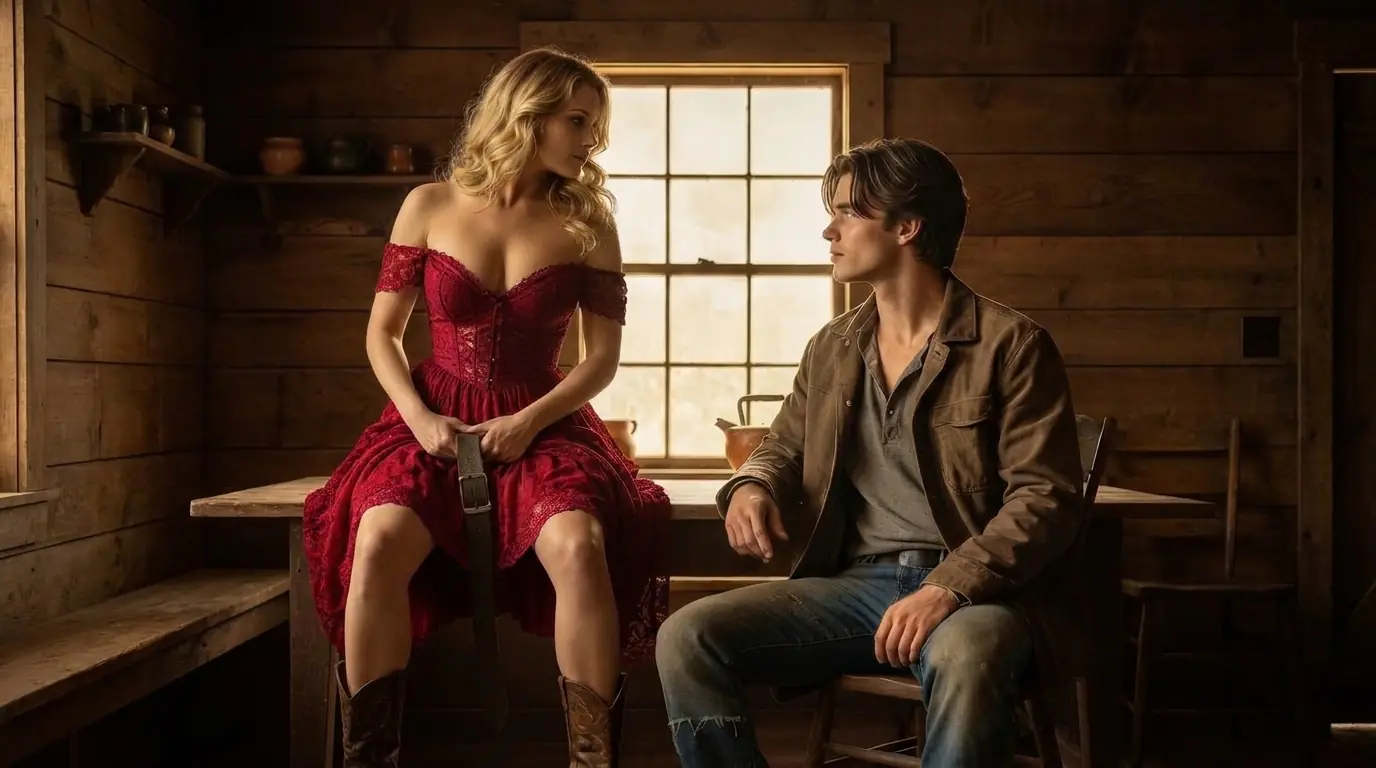
It was a wound in the snow, a collection of raw timber buildings leaning against a harsh wind. "End of the line, miss!" the driver yelled from outside. He did not bother to open the door. Clara gathered her single small carpetbag.
Her hands were raw and blue. She pushed the door open, and the wind snatched her breath away, slamming the thin lace of her veil back against her face and half blinding her. She stepped down into a foot of dirty, packed snow. The driver was already hauling her trunk, her only other possession, onto the depot platform.
He did not look at her. He spat a line of brown tobacco juice into the snow and pointed. "Depot's there. Henderson will see to you." Then he was gone, driving the coach and team toward the warmth and whiskey of the livery stable.
Clara stood alone on the street. The quiet was absolute, broken only by the whine of the wind and the distant, tiny sound of a piano from the saloon. Men bundled in buffalo coats and leaning against the storefronts turned to look at her. Their eyes were flat and curious, like coyotes sizing up a wounded deer.
The dress meant to declare her taken seemed to signal only that she was available. She felt the burn of their stares through the satin, a different kind of cold. She hurried into the depot, a small square room dominated by a pot-bellied stove that radiated a suffocating heat. The air smelled of kerosene, wet wool, and stale coffee.
A thin man with wire-rimmed spectacles looked up from a ledger. This must be Henderson. "Can I help you?" he asked, his eyes immediately falling to the ruined lace bunched in her hands. "I am here to meet Mr. Amos Reed," Clara said.
Her voice was a dry whisper. "He sent for me. I am Clara Jenkins." The depot agent's face did not change, but his eyes softened with a weary pity that terrified her more than the leers outside. He took off his spectacles and polished them slowly on his vest.
"You are Miss Jenkins," he said, not as a question, but as a confirmation of a sad fact. "Yes. Mr. Reed was to meet the coach." Mr. Henderson put his spectacles back on. He leaned forward on the counter.
"Miss Jenkins, I am afraid I have some hard news for you. Mr. Reed, he passed on." Clara stared. The words did not connect. "Passed on? He is not here?"
"No, miss. He is dead." The word hung in the hot, dry air. Dead. "How?" she managed.
The room was beginning to tilt. "A disagreement down at the Lucky Ace Saloon two nights ago." Henderson gestured vaguely toward the sound of the piano. "He got into it with a couple of miners over a card game. A knife was pulled. Mr. Reed did not make it through the night."
Clara backed away from the counter until she hit the wall. Her small carpetbag dropped from her numb fingers. She was not grieving. She had never seen a picture of Amos Reed.
She had only his letters, three of them, blunt and functional, detailing the transaction. Her father, broken by drought and debt, had arranged it all. She was sold, but she had clung to the word bride. She had clung to the dress.
It was a role she could play. It was a shell of respectability. Now the man was dead. The arrangement was void.
She was not a bride. She was not even a widow. She was just cargo delivered to the wrong address. "What about his property?" she stammered. "His arrangements? He had a ranch. He wrote."
Henderson shook his head, his pity hardening into impatience. He had other work to do. "Mr. Reed had no ranch. He had a claim up in the hills that had not paid out in a year. He had a room above the saloon, and he had debts. Whatever he owned was settled before his body was cold to pay the saloon keeper and the undertaker."
He looked at her, at the ridiculous expensive dress. "There is nothing left, miss. No arrangements were made for you." Clara felt the floor give way. She had twelve cents in her reticule.
She had a trunk full of linens and clothing she could not sell here. She was eighteen years old, wearing a wedding dress in a town full of hard men, and the man who was supposed to own her was in a pine box. "What am I to do?" she whispered, asking the room, not the man. Henderson sighed.
He looked toward the saloon, then back at her. "There is work for a woman in a town like this at the Lucky Ace. The proprietor, Mr. Flannery, might give you a room for a time." Clara understood his meaning. She saw the women in St. Louis with their painted faces and hard eyes, standing in the doorways of the riverfront establishments.
Her stomach turned over, a cold acidic knot. "No," she said. "I cannot." "Well," Henderson said, turning back to his ledger, "I cannot help you. You cannot stay here. This depot closes in ten minutes."
The door opened, letting in a blast of Arctic air. A trapper came in, smelling of grease and animals, and dropped a heavy pelt on the counter. He looked at Clara, his eyes running down the lace, and he grinned, revealing broken yellow teeth. Clara turned and fled.
She burst back out into the twilight. The wind was sharper now, carrying needles of ice. The town looked even more menacing. The piano music was louder.
She began to walk nowhere. She just walked away from the depot, past the saloon. "Well, look at here," a voice called from the saloon's porch. Two miners, drunk and loud, stumbled out.
"It's the angel of Bear's Hollow." "Lost your way, darling?" the other one slurred, blocking her path. "The church ain't built yet, but we'll take your prayers." Clara tried to push past him.
His hands shot out and grabbed her arm. The rough wool of his glove snagged the delicate lace. "Not so fast, a pretty thing like you. Reed's girl, ain't you? Heard he ordered himself some fine china."
He laughed, a wet rattling sound. "Too bad for him. Good for us. Wasted trip, sweetheart, unless you want to make it worth your while."
"Let me go." Clara twisted, her voice high with panic. "She's a feisty one." She ripped her arm free, tearing the sleeve of the dress from wrist to elbow. She stumbled backward and ran.
She did not look where she was going. She just ran, her frozen feet slipping in the ruts. She ducked into the first dark space she saw, an alley between the general store and the assay office. It was a narrow slot, dark and rank with the smell of frozen garbage and urine.
She pressed herself against the icy wood of the wall, gasping, trying to muffle the sound of her own breath. The white dress was a beacon, even in the shadows. She heard him before she saw him. Heavy footsteps, the crunch of boots on the snow.
"Knew you'd wait for me," the miner slurred. He filled the entrance to the alley. He was a big man, a shape of buffalo hide and drunken malice. "Please," she begged. "I have no money. I have nothing."
"I ain't looking for money." He lunged. He grabbed her, his arms wrapping around her like steel bands and crushing the air from her lungs. He slammed her back against the wall.
The impact knocked her head against the timber, and the world exploded in white-hot stars. He was fumbling at her, his hot whiskey-soaked breath on her face. "Going to give you a Montana welcome, little bride," he grunted, one huge hand moving to the bodice of her dress, his fingers thick and clumsy. Clara screamed, a thin, useless sound swallowed by the wind.
She fought, but she was trapped. Her hands, frozen and numb, beat uselessly against his massive chest. She felt the lace tear at her collar. This was it.
This was the end. She had crossed a thousand miles to be ruined in a frozen alley. "Let her go." The voice was not loud.
It was low and flat, like stones grinding together. The miner froze. He slowly turned his head. A man stood at the mouth of the alley.
He was tall, and where the miner was wide with drink and muscle, this man was built of sharp, hard lines. He wore a patched sheepskin coat and a hat pulled low, shadowing his face. He held no gun. His hands were just at his sides.
"Go to hell, Silas," the miner growled, but his grip on Clara loosened. "This ain't your business." "I said," the man named Silas repeated, his voice unchanged, "let her go." He took one step into the alley.
He moved with a quiet, lethal grace that was more frightening than the miner's drunken rage. The miner looked at Silas, then at Clara. The fight, or the lust, seemed to drain out of him, replaced by a sullen, sober fear. He shoved Clara away from him.
She fell sideways into a pile of snow-covered crates, the satin of her dress soaking up the filth. "She ain't worth the trouble," the miner spat. He pushed past Silas and disappeared into the street. Clara stayed where she had fallen, shaking so violently she could not get her breath.
She was crying, but the tears froze instantly on her cheeks, burning her skin. The man, Silas, did not move toward her. He stood in the alley watching her, his face a map of shadows. He looked at the torn dress, the filth, and the way she was curled into a ball of white misery.
He seemed to be assessing her like a rancher checking livestock for a fatal injury. After a long moment, he looked up at the sky. The clouds were low and thick, a bruised, churning purple. "Storm's coming in," he said.
His voice was rough, unused. "A bad one. You stay here, you'll be dead by morning." Clara said nothing. She could not speak.
He nudged a crate with the toe of his worn boot. "Town's got no place for you. You ain't safe." He turned as if to leave. "Wait."
The word tore from her throat, raw and desperate. "Please, where can I go?" Silas stopped. He looked back at her, his eyes in the gloom the color of the sky, a flat, cold gray.
"I got a cabin up in the hills. It's shelter." He nodded toward the street, where a big, sturdy-looking horse waited patiently, ground-hitched. "You can ride with me, or you can freeze. Makes no mind to me."
He was offering her a choice that was not a choice at all. Go with this stranger, this quiet, dangerous man, or stay here and wait for the miner to return or for the cold to finish the job. She remembered the depot agent's words. There is work.
She pushed herself up, her limbs aching. The ripped lace of her sleeve dangled, frozen stiff. She looked at the man. He was not kind.
He was not cruel. He was empty, like the land. "I will go," she said. Her voice shook, rattling in her chest.
She had to add one more thing, a small, pathetic barrier. "Just for tonight." Silas grunted. It might have been agreement.
He walked out of the alley to his horse. He did not offer her a hand. Clara stumbled after him, her ruined shoes skidding on the ice. He untied the horse, mounted in one fluid motion, then looked down at her.
He offered his forearm. It was like iron. She put her hand on it, and he hauled her up as if she weighed nothing, seating her sideways in front of him on the saddle. He wrapped one arm around her waist to hold her steady.
His grip was impersonal, binding her to him like a sack of flour. She was pressed against the rough sheepskin of his coat. It smelled of wood smoke, horse, and something cold and metallic. He kicked the horse, and they moved.
They left Bear's Hollow behind. No one watched them go. The piano music faded, and soon the only sound was the steady plod, plod of the horse's hooves in the deepening snow and the rising scream of the wind. The journey was a blur of misery.
She stopped shivering after the first mile and just went numb, a dull, aching void. The man, Silas, did not speak, not one word. He rode with his head down, navigating the barely visible trail that climbed higher and higher into the hills. The horse was steady, climbing rocks and pushing through drifts with a grim determination.
Clara leaned against the solid wall of Silas's chest, too cold and exhausted to be frightened of his closeness. He was just a shape, a barrier against the wind that was trying to peel her from the saddle. She did not know how long they rode. An hour. Two.
The world was gone, replaced by a vortex of driving snow and the burning agony of her hands and feet. She thought, I am going to die here on this horse in this stupid dress. Then the horse stopped. "We're here," Silas said.
Clara looked up. She could see nothing, just white. He swung his leg over the back of the horse, landing softly. He reached up, and she tumbled into his arms.
Her legs had no feeling. They buckled the moment they touched the ground. He held her upright for a second, steadying her, and then let go as if she were hot. "Cabin's here."
She saw it now, a dark shape against the white. It was not a cabin. It was a shack. A crude box of logs chinked with mud, half buried in a snowdrift.
A thin curl of smoke rose from a stone chimney and was immediately ripped away by the wind. He pushed the door open, a single slab of wood on leather hinges, and gestured for her to go inside. Clara stumbled past him into the darkness. It was one room, small, no more than ten feet by twelve.
The floor was packed earth. The wind whistled through a dozen cracks in the walls. It was freezing, the air inside only a few degrees warmer than the air outside. A small rusted stove stood in one corner.
Its fire had burned down to glowing embers. In the opposite corner, she saw it. One bed. It was a rough-hewn frame lashed together with rawhide and piled high with quilts and what looked like a heavy buffalo robe.
Her heart, which had been a frozen lump, began to pound a slow, heavy beat of panic. Silas came in behind her, letting the door slam shut. He brought the storm in with him. He brushed the snow from his hat and shoulders, his back to her.
He was all business. He went to the stove, grabbed a piece of wood from a small pile, and used a poker to stir the embers. He did not look at her. He did not help her.
He was distant, his silence as cold as the air. The atmosphere was unbearable. It was thick with unspoken questions. She was cautious, watching his every move.
He was removed, acting as if she were not there. "Get by the stove," he ordered, still not turning. "You'll lose a foot." Clara moved, her legs stiff and wooden.
She held her raw, blue hands out to the weak warmth. The dress, caked with snow and alley filth, began to thaw, dripping onto the dirt floor. She was so very cold and so very afraid. Silas lit a single kerosene lamp.
The small flame threw huge dancing shadows. It illuminated his face for the first time. It was a hard face, younger than she had thought, maybe thirty, but he looked as if he had been carved from the same rock as the mountains. There was a long, thin scar that ran from the corner of his left eye down to his jaw.
His eyes were empty. He poured water from a bucket, a skin of ice already formed on its surface, into a tin pot and set it on the stove. He found a tin cup and scraped some coffee grounds into it from a sack. He did not offer her any.
He seemed to have forgotten her entirely. He checked his rifle, which he had leaned against the wall, then pulled a stool from the shadows and sat near the door. Clara stood by the stove, steaming like a wet horse. She did not know what to do.
She could not take the dress off. It was the only thing she had, and she could not be undressed in this cabin in front of him. He looked at her. His gaze was slow and deliberate.
He looked at the torn lace, the mud, and the way she was shaking. "There's a peg," he said, jerking his chin toward the wall. "You can hang that." She did not move.
He sighed, a puff of white air even indoors. "Suit yourself." Darkness fell. The storm outside raged, a high-pitched, maddening howl.
The cabin was an island in the noise. Silas ate. He took a piece of hardtack from a tin and chewed it slowly, washing it down with boiled coffee. Clara watched him, her own stomach aching with a hunger that felt like nausea.
Finally, the tension of the single bed became too much. "Where will I sleep?" she whispered. Silas finished his coffee and stood up. He walked to the bed.
Clara's breath caught in her throat. He grabbed one of the thinner quilts and the buffalo robe. He walked back to the door, to the coldest part of the cabin, and tossed them on the floor. "I'll take the floor," he said.
He sat down on the pile, his back against the door, and laid his rifle across his lap. He was blocking the only exit. Was he keeping her in or keeping the storm out? He nodded toward the cot.
"Take the bed. You're shaking the floorboards." Clara hesitated, but the cold was winning. She was so tired she could barely stand. She moved to the cot.
She did not take off the dress. She did not even take off the frozen, ruined shoes. She crawled under the remaining quilts, pulling them up to her chin. They were heavy, thick with wool, and they smelled like him, like smoke and leather and the clean, sharp scent of pine.
The lamp was turned down low. The cabin was filled with two sounds: the scream of the wind outside and the silence of the man by the door. Clara lay there, rigid, listening to the storm. Then the reality of her day crashed down on her.
The man who was supposed to marry her was dead. She had been mocked, attacked, and pulled from an alley like a piece of trash. She was trapped in a shack with a strange, silent man who scared her, and she was wearing a filthy, torn wedding dress. A single hot tear escaped and froze on her temple.
Then another came. Soon she was crying. She tried to do it silently, biting down on her own frozen glove, but the sobs were too big. They were dry, aching spasms that shook the entire cot.
She was crying for her lost home, for her father who had sold her, for the man who had died, and mostly for the terrified, stupid girl she was. Across the small, dark room, Silas heard her. He heard every muffled choke, every hitched breath. He sat in the dark, his hand resting on the cold steel of his rifle.
He did not move. He did not say, "Hush." He did not say it would be all right. He did not offer a single word of comfort.
He just sat, a dark shape by the door, and let her weep. He let her break. Sometime before dawn, exhaustion finally claimed her, and she fell into a cold, shallow sleep. She woke to gray light.
The cabin was frigid. The fire in the stove was dead. For a moment, she did not remember where she was. Then she saw the dirt floor, the low ceiling, and the man.
He was already awake, or perhaps he had never slept. He was standing by the single small window, scraping a hole in the thick frost with his thumbnail. Clara sat up. Every muscle in her body screamed in protest.
The wet satin dress was frozen stiff, cracked like porcelain. "I must go," she said, her voice a croak. "Thank you for the shelter, sir. I must go back to town."
Silas did not turn around. He just looked at her over his shoulder. "Go where?" "Back to the depot. I must figure out something."
She swung her legs off the cot. Her feet, still in their shoes, were numb, heavy blocks. "No," he said. "You cannot keep me here," she said, panic rising again.
He turned from the window, his face grim in the flat gray light. He said nothing. He just walked to the door, pulled the wooden bar that secured it, and opened it. Clara stood up, ready to run.
The storm had not stopped. It had grown. It was not a storm. It was a wall, a solid, churning, absolute whiteness.
The wind howled like a thousand grieving women. The snow was not falling. It was moving sideways, a horizontal river of ice. She could not see five feet.
She could not see the stable, if he had one. She could not see the mountains or the sky or the world. She was trapped. She slowly backed away from the open door.
Silas looked at her, his gray eyes unreadable. He pushed the door shut, the wind fighting him, and dropped the heavy bar back into place. The sound of the bar sliding home was a note of finality. Clara turned to face him in the cold, dim cabin.
She was trapped with him. Not just for a night, but for now. The sound of the heavy bar dropping back into place was like a lock turning on a cell door. The cabin, which had been a temporary, desperate shelter, was now a prison.
The silence that fell between them was heavier than the snow, suffocating. Clara stood in the center of the small room, still wrapped in the frozen, filthy ruins of her wedding gown. Silas turned from the door. He did not look at her, not directly.
His gaze slid past her to the stove. "Fire's out," he said. His voice was a flat, practical sound in the screaming wind. He moved to the stove, his motions economical.
He knelt, used a small hatchet to shave tinder from a larger log, and struck a match. The small flare of light illuminated his face, all hard planes and shadow. He was a man who wasted nothing, not motion, not words, not warmth. Clara's teeth were chattering so hard her jaw ached.
She was a burden, a useless, freezing burden. She had to change that. She had to earn the air she was breathing. "I will work," she said.
Her voice was a reedy, desperate sound. Silas did not look up from his task of coaxing the embers back to life. "I can cook," she pressed on, the words tumbling out. "I can clean. I will keep the fire. I do not have money. My trunk is at the depot, but I will earn my keep. I will not be... I will not."
She trailed off. He still had not acknowledged her. A small flame finally licked up from the tinder, and he carefully added larger splits of wood. "There is nothing to clean," he said, his back to her.
"I have coffee and salt pork, and the fire is lit." "I will keep it lit," she insisted. "I will melt the snow for water. I can mend."
She looked down at her dress, the torn lace a mockery. "I am a good seamstress." He stood up finally and faced her. He looked at the dress.
He looked at her, really looked, and Clara had to fight the urge to cover herself. "You need to get out of that," he said. "I have nothing else. My clothes, my trunk..."
"It will be there when the storm clears, if it is not buried by a drift." He moved to a small, crude chest in the corner, the only other piece of furniture besides the cot and his stool. He lifted the lid and pulled out a pair of dark wool trousers and a heavy red flannel shirt. He tossed them onto the cot.
They were his. "They are clean," he said. "They will be big, but they are warm and dry." He held them out.
Clara stared at the clothes. They were a man's. They were his. To take them felt like another, deeper kind of surrender, but the cold was a blade, and her satin dress was a wet, icy shroud.
She reached for them, her hand blue and chapped, trembling as she took the heavy wool from him. His knuckles, rough and calloused, brushed the back of her hand. Clara flinched. It was not a small movement.
She recoiled as if he had struck her, a violent, full-body spasm that sent her stumbling back two steps. She dropped the clothes onto the dirt floor, her breath catching in a small, terrified gasp. Silas froze. He had been impatient.
He had been distant. Now he was perfectly, dangerously still. His gray eyes narrowed. He watched her, not as a man watches a woman, but as he had watched the storm, trying to gauge its nature, its danger.
He saw the raw panic in her eyes. He saw the way she wrapped her arms around herself, her hands clutching the filth of her dress as if it were armor. He remembered her in the alley. He remembered the miner's drunken words.
Reed's girl, ain't you? Heard he ordered himself some fine china. He looked at the wedding dress, at her youth, at the terror that was not just of him, but of everything. It clicked into place in his mind with the cold, hard certainty of a trap springing.
This was not a woman who had come to meet a groom. This was a girl who had been shipped like freight. She had been sold, not loved, and she was terrified of what that meant. He felt something twist in his gut, a sour, cold anger he had not felt in years.
He broke the stare. He bent down, picked up the clothes, and placed them carefully back on the cot, well away from her. Then, in a room that offered no privacy, he gave her the only thing he could. He turned his back to her.
He walked to the frosted window and stared out at the white, churning void. His shoulders set a solid wall of wool and silence. "Change," he said, his voice flat, but the hard edge was gone. "The cold will kill you before I do."
Clara stared at his back. He was not looking. Her fingers were stiff, clumsy, and shaking, but she unhooked the tiny pearl buttons at the back of her dress. Her movements were frantic.
The wet, frozen gown sloshed to the floor around her ankles, a puddle of ruined lace and failed dreams. She was left in her thin chemise and drawers. She was freezing, but the shame burned. She scrambled to pull on the wool trousers.
They were huge, meant for a man's hips, and she had to roll them twice at the waist. She pulled the flannel shirt over her head. It fell to her knees, a tent of warm, soft wool that smelled of him, pine soap and wood smoke. She felt ridiculous.
She felt small, but she was, for the first time in days, warm. She gathered the wet, muddy dress from the floor, folded it into a tight, sad bundle, and pushed it deep into the corner under the cot, out of sight. "It is done," she whispered. Silas turned from the window.
He looked at her. She was a child swimming in his clothes. He gave a single curt nod. He picked up the coffee pot.
"You said you would melt snow," he said. "The bucket is by the door." And so their rhythm began. The storm did not break.
It raged for three days, then four. The world shrank to the four walls of the cabin. The wind was a constant high-pitched scream. Time was measured not by sun, but by the level of wood by the stove.
They did not speak. They did not need to. The cabin was too small for words, which would have landed like stones. Their silence became its own language.
In the mornings, Clara would wake in the dark, in the heavy warmth of the cot, to the sound of Silas already moving. He slept on his pallet by the door, always. He never slept deeply. He would rise, rebuild the fire, and then, wrapping himself in a heavy buffalo coat, step out into the white hell.
He had a horse, she learned, in a small lean-to dug into the hill. He had to check on it. He had to check his traps. He would be gone for an hour, and Clara would feel a strange, hollow panic until he returned, a figure of ice, his beard and eyebrows caked in white frost.
While he was gone, she worked. She kept her promise. She melted snow for coffee and for washing. She swept the packed-earth floor with a crude broom of branches.
She scrubbed their two tin plates, their single pot, and their two cups. She organized his meager supplies, the sack of flour, the tin of coffee, the block of salt pork. She was trying to build a wall of tasks between herself and her fear. She was proving her worth moment by moment.
He watched her. He saw how she never let the wood pile get low. He saw how she scrubbed the pot until it shone, though it was just him and her. He saw that she never, ever sat idle.
She was always busy, always earning the space she took up. And he saw how she flinched. If he stood up too quickly, she would press herself against the wall. If he reached past her for the coffee pot, her hands would fly up to guard her chest.
He began to move more slowly around her. He would clear his throat before standing. He would tap the table before reaching. He was, without knowing it, taming her the way he would have tamed a spooked, green-broke filly.
They did not talk about her past. They did not talk about his. They barely spoke at all. "Wood is low," he would say.
"I will bring more in," she would reply. "Coffee is hot." "Thank you." Their trust was not built on confessions.
It was built on the silence. It was built on the steady rhythm of survival. He did not hurt her. She did not cry.
He provided. She worked. It was an arrangement as cold and practical as the one that had brought her here, but it was one she had a say in. On the fifth day, the wind died.
The silence that fell was shocking, a heavy blanket pressing on the ears. "Storm's broke," Silas said, looking out the newly scraped window. The world outside was a brilliant, blinding white, the sky a painful, piercing blue. He pulled on his coat.
"The wood pile is near gone. I have to cut more." He went outside. Clara, feeling the cabin suddenly too small, pulled on the oversized boots he had left for her and followed. The cold was sharp but clean.
The air smelled like pine and ice. The cabin was buried to its roof in a drift on one side. The world was remade, soft and white and deadly. Silas was at a stacked pile of logs, his back to her.
He was swinging a heavy ax, splitting rounds with a powerful, economic grace. Thwack, thwack, thwack. He stopped when he heard her footsteps crunching in the snow. "You should stay inside. It is cold."
"I want to learn," she said, the words coming out in a white puff of air. "If you were not here, the fire would go out." He looked at her for a long moment. He saw the logic.
It was hard logic. He nodded. "Not with this ax," he said. "You will hurt yourself."
He retrieved a smaller hatchet from the lean-to. "This is for splitting, not chopping. Find the crack in the wood. Let the weight of the ax do the work. Do not fight it."
He set up a small round for her. She took the hatchet. It was heavier than it looked. She lifted it, aimed, and swung.
The head glanced off the wood with a dull thud, and the handle vibrated, stinging her hands. "You are fighting it," he said. His voice was not unkind. It was just true.
"Hold it lower. Aim true. Again." She did it again and again. Her hands, soft from a city life, began to blister in the cold, but she did not stop.
Finally, a piece of wood split, flying off to the side. She looked up at him, a small, involuntary smile of triumph. He did not smile back. He just nodded again.
She worked until her arms felt like lead and her hands were raw. She piled the split wood by the door, making a dozen trips. He worked beside her, his large ax splitting logs in a single clean stroke. Later, he walked out toward the line of trees, checking the snares.
She watched him go. She was learning to read him. She had seen him with his horse, a big roan gelding. His voice, when he spoke to the animal, was low and gentle, a soft rumble that she never heard in the cabin.
His hands, which she feared, were endlessly patient with the animal, brushing snow from its back and checking its hooves. He was never loud. He was never angry. He was just quiet, a quiet deep as the snow.
He came back holding a rabbit by its hind legs. It was stiff, already frozen. He walked up to her, holding it out. "You said you could cook," he said.
It was not a question. "Meat needs preparing." He offered her the rabbit and the long, sharp skinning knife from his belt. Clara looked at the dead animal.
She looked at the blood on its nose. She looked at the knife. Her stomach turned over. She had cooked, yes, pieces of meat bought from a butcher, not this.
She shook her head, ashamed. "I do not know how." She expected him to be angry, to mock her. She had failed another test.
Silas just looked at her for a second, then took the rabbit and the knife. "Then you will learn. Watch. You will do the next one."
He sat on the woodpile. She watched his hands, the same hands that swung the heavy ax, the same hands that had pulled her onto the horse. They were not brutal. They were swift, precise.
He skinned the animal with a surgeon's care. He was respectful of the life he had taken. He wasted nothing. He laid the pelt aside.
"This will be good for lining gloves," he said. He gutted the rabbit, his motions clean. He was not the miner in the alley, all fumbling rage and crude force. He was the opposite.
He was competence. He was control. And in his own strange way, he was gentle. That night, they ate rabbit stew.
It was the first real food she had tasted in days. The silence between them felt different. It was not empty. It was comfortable.
A week passed. The snow settled. The world was still. They had run out of coffee.
"I have to go to town," Silas announced one evening. "Need supplies. You will be safe here. The path is still too deep for anyone to come up here."
Clara's heart seized. "No. Please take me with you. I cannot stay here alone." "You will be fine. I will be back by nightfall."
"Please," she begged, and she hated the sound of her own voice. "Do not leave me here. What if the fire? What if..."
He saw the panic in her eyes. The fear of being alone was, for her, greater than the fear of him. He sighed. "It is a hard ride, and the town... they will look at you."
"I do not care. I am not in the dress anymore." He nodded. "Fine. Get your coat."
The ride to town was slow, the big roan horse sinking to its chest in the drifts. Clara sat behind him this time, her arms wrapped tightly around his waist. It was different now. She was not pressed against him in terror.
She was holding on for balance. She could feel the solid, warm strength of his back. She trusted it. Bear's Hollow looked half dead, buried in snow.
Silas left her on the horse outside the general store. "Stay here. Do not move." He was inside for a long time. Clara sat on the horse, feeling the stares of the few men on the street.
But they did not approach her. She was wearing a man's hat, Silas's hat, and she sat on Silas's horse. She was, for now, his property. The thought made her feel both safe and sick.
She was so busy watching the saloon, fearing the miner would return, that she did not notice the small wooden box Silas carried when he came back out. He had their supplies in a heavy sack. He also had her trunk. He had gone to the depot.
He had paid Henderson. He tied the heavy trunk to the back of the saddle. "It was not easy," he grumbled. "But it is here."
Clara could not speak. He had retrieved her life. He had brought her trunk. They rode back up the mountain in silence.
That night, the cabin felt different. It felt like a home. She opened her trunk and found her simple wool dresses, her linens, her hairbrush. She touched them like relics.
She found the small velvet-covered box her mother had given her. Inside was a locket and her mother's wedding ring. Silas was cleaning his rifle by the fire, the lamp oil casting a warm yellow glow. Clara looked from the ring in her hand to the man.
"You have been kind," she said, her voice small. He did not look up. He just kept wiping the barrel. "I am not kind. I am practical."
"You brought my trunk. You saved me." He stopped his work. "I did not save you. I just opened the door. You did the rest."
She watched him. He was a good man, a hard man, but a good one. She looked at his hands, his left hand. It was bare.
"Mr. Silas..." "Just Silas." "Silas, were you ever married?" He stiffened.
The rag in his hand went still. He stared into the fire, his face hardening, the scar on his cheek pulling tight. He did not answer for a long time. She thought he would not.
"I was," he said, his voice low, rougher than usual. "What happened to her?" Clara whispered. "Was it the fever?"
Silas gave a short, bitter laugh that had no humor in it. "No. It was not the fever." He set the rifle down. He looked at his own bare hands.
"She left." "Left?" Clara was confused. "Left to go where?"
"Oregon. With my brother." He said it flatly, like a weather report. "They run a mercantile. He wrote me a letter. Said she was happier stocking shelves than living in a cabin. Said he was sorry, but love was love."
Clara stared at him. The emptiness she had seen in him was not emptiness. It was a hole. He had not just been left.
He had been betrayed. He had been replaced. He too knew what it was to be set aside for something better. The new knowledge settled between them.
His secret, now shared, made a space for hers. "I am sorry," she said. He just shook his head. "It was a long time ago."
They sat in silence. The fire crackled. The storm was over. The world was quiet.
Clara looked into the flames. "The man, Mr. Reed, the one who died..." Silas turned his head. He was watching her, waiting. "I never saw him. Just his letters. My father made the arrangement. We needed the money. The farm was dying."
She was twisting her hands in her lap. "I was supposed to be his bride," she whispered, the tears she had held back for days finally welling up. "I wore the dress. I thought if I looked the part, maybe it would be all right."
She looked up at him, her eyes shining with unshed tears. "That night, the night he died in the saloon, that was supposed to be my wedding night." A single tear escaped and ran down her cheek. "I never even spoke his name. I was just a thing. A thing he had bought, and I was so afraid. I was so afraid of what he would do."
She was crying now, the quiet, painful sobs of that first night. "I was supposed to be his bride," she choked out. "But I never got to be anything." Silas listened.
He was perfectly still. He did not move. He did not reach for her. He did not pat her hand or offer empty words.
He knew, with a certainty that came from his own deep wounds, that his touch would be a terror, not a comfort. His pity would be an insult. So he just stayed. He sat across the small room and watched her, his gaze unwavering.
He gave her the one thing no one else had: the respect of his absolute, unblinking attention. He let her break. He let her say the words. He was her witness.
She trembled, the sobs shaking her small frame. She was not cold. She was terrified. The fire burned low, and the cabin fell into deep shadow.
The only light came from the glowing red embers in the stove. Silas was still on his pallet, his back against the wall, his legs stretched out. He was just a dark shape in the gloom. He wore a thick leather belt, its buckle glinting faintly.
It was the belt that held his trousers. It was the belt that held his knife. It was a symbol of his strength. Clara's crying subsided into shuddering breaths.
She sat on the edge of the cot, her hands clenched. She looked at the dying fire. Then she looked at him. She looked at the belt.
It was like the strap her father had used. It was like the belt the miner must have worn. It was a line of leather, a tool, a weapon, a thing of power, a thing to fear. She needed to know.
She needed to understand him. Slowly, her hands shaking, she slid off the cot. She crept across the dirt floor on her knees. Silas watched her.
He did not move. He did not breathe. He saw her coming, but he did not know what she wanted. She stopped in front of him.
She was looking at the belt. Then, with a trembling, hesitant hand, she reached out. She did not touch his leg. She did not touch his arm.
She touched the belt. Her fingers, small and cold, brushed the thick, worn leather. Silas's entire body went rigid. A jolt went through him.
She did not pull away. She curled her fingers around it. She was not pulling. She was not submitting.
She was holding on. She was holding the one thing that symbolized all her fear. She was testing it. She was testing him.
He let her. He did not move a muscle. He let her hold it. He let her feel its weight, its strength.
He gave her that power. Her knuckles were white. She stared at her own hand, gripping the leather that was warm from his body. This was Silas, and he was not moving.
He was letting her hold him, in a way. After a long, silent minute, her grip loosened. Her trembling stopped. She slowly let go.
She pulled her hand back and tucked it in her lap. Slowly, his eyes never leaving hers, Silas reached down. He unhooked the heavy brass buckle. He unthreaded the belt from its loops.
He coiled it slowly, deliberately, and then he set it on the stool across the room, away from them both. He lay down on his pallet and turned his back to her. Clara crawled back onto the cot and pulled the quilts up to her chin. The fire was almost out, but for the first time since she left St. Louis, she was not cold, and she was not afraid.
The world changed with the sound of dripping. For weeks, the cabin had been locked in a high, whistling silence. Now from the roof came the steady, rhythmic plink, plink, plink of melting. The great storm had finally truly broken.
The snow, which had been a white, suffocating wall, was now just a landscape, albeit a deep and treacherous one. The routine inside the small shack had settled. It was a life built of small, silent tasks. Clara woke first, her body now accustomed to the cot, and would move to the stove, her hands no longer soft, rebuilding the fire from the embers Silas had banked the night before.
He would rise from his pallet by the door and nod, a silent good morning, before pulling on his coat to check his snares and see to the roan. They lived around each other with a quiet grace. The flinching had mostly stopped. Clara no longer recoiled when he reached for the water bucket, and Silas no longer cleared his throat before he crossed the room.
They had learned each other's physical space. They had, in their silence, become accustomed. With the thaw, their small world was about to break open. "Supplies are low," Silas said one morning, scraping the last of the coffee grounds into the pot.
"Flour's near gone. Salt, too. I got to go to town." Clara, who was mending one of his shirts, her small, neat stitches a stark contrast to his own rough repairs, froze. The needle stopped in the wool.
The cabin, which had been her prison, had become her fortress. The thought of him leaving, of being left alone in the vast, empty white, sent a spike of cold panic through her. "I will come with you," she said. It was not a request.
Silas looked up from lacing his boots. "No." "I can ride. I am strong now. I will not slow you down."
"It ain't about that," he said. He stood up, avoiding her eyes, and reached for his heavy sheepskin coat. "The ride is hard. The trail's half flooded with melt."
"I do not mind the cold. Please, Silas, do not leave me here." Her voice was rising, taking on the thin, reedy edge of desperation he had not heard since the first night. He turned to her, and his face was hard, but his eyes were not.
"Clara, you will stay here." "Why?" she demanded, standing up, the mending falling to the floor. "Are you afraid I will run? Where would I run to?"
"I am afraid of what they will say," he said, his voice dropping low, rough with an emotion she could not place. "You ride into town with me. You, a young woman. I, a man. We come from the same cabin. We have been here for weeks. You know what they will call you."
Clara's face burned hot, then went white. She did know. She had seen the way the men in Bear's Hollow looked at her in the wedding dress. To arrive now in his borrowed clothes from his cabin would be worse.
"They will say I am your..." She could not finish the word. "They will say you are a whore," he finished for her. The word landed in the air like a slap.
"And they will be wrong. But they will say it, and they will treat you like one. You are safe here. You are not safe there. I will be back before sundown."
He did not wait for her to argue. He picked up his rifle, slung his hat on his head, and was gone. The door shut. She heard the bar drop.
He had locked her in. She rushed to the door, pounding on the heavy slab. "Silas, do not. You cannot." She heard the crunch of his boots in the snow fading, then the jingle of harness, the grunt of the horse, and silence.
She was alone, truly alone, for the first time since she had arrived. The silence of the cabin pressed in on her. It was no longer the shared, comfortable quiet. It was an empty, echoing void.
She was trapped. She did her chores. She scrubbed the pot. She swept the floor.
She rebuilt the fire. It took her less than an hour. The day stretched before her, a barren, terrifying expanse. She paced the small room, ten feet by twelve.
She was a caged animal. She ran her hands along the rough-hewn logs, the chinking of mud and straw. She felt the sudden, desperate urge to know, to understand the man who had locked her in for her own protection. She went to the wooden chest, his chest, the one from which he had pulled the wool clothes on that first day.
She had never opened it. It was his. It was private. Now she did.
Her hands trembled as if he might walk in and catch her. She lifted the heavy lid. The smell of pine soap and old leather rose up. Inside were his few possessions.
Two more flannel shirts, neatly folded. A block of shaving soap and a straight razor. A small stack of letters tied with twine, which she did not dare to touch. Under them was a small leather-bound book tied shut with a rawhide thong.
It was not a ledger. It was a sketchbook. Her fingers fumbled with the knot. She untied it.
She opened the cover. Clara gasped. It was a horse drawn in charcoal, so real it looked ready to leap from the rough, yellowed paper. It was not a tame horse, not the placid roan he rode.
This was a wild thing. Its mane was a storm of black lines, its eyes wide with a spirit that was almost human. The muscles in its neck were bunched, its head thrown back in a silent scream of freedom. She turned the page.
And another. And another. They were all horses: wild stallions, mares with long-legged colts, herds running against a sky that was nothing but a few angry smudges of charcoal. He had captured their power, their wildness.
He drew their spirits, not just their bodies. She found one drawing of a foal, its legs still crooked and new, lying in a patch of delicately drawn grass. It was so tender, so gentle, it made her ache. This was him.
This was the man who had been betrayed by his wife and brother. This was the man who had lived alone in this harsh, cold place and had seen this beauty, this untamed life. He was not just the hard, silent protector. He was not just the scar on his cheek.
He was this. He was a man who understood things that had no words. A man who hid a deep, wounded tenderness. Clara sat on the dirt floor, the book in her lap, and felt her heart crack open in a way that had nothing to do with fear.
It was a painful, swelling warmth. She carefully tied the rawhide thong, put the book back, and gently closed the lid of the chest. The empty cabin did not feel so empty anymore. Miles away, the main street of Bear's Hollow was a river of mud and slush.
The spring thaw had turned the packed snow into a cold brown soup. Silas tied the roan to the rail outside the general store, his boots sinking to the ankles as he stepped onto the boardwalk. The town smelled of wet earth, wood smoke, and whiskey. He pushed into the store.
Mr. Henderson, the depot agent, was there sorting mail in the corner that served as the post office. A few miners lounged by the stove. Silas kept his head down. He gathered his supplies: flour, coffee, salt, a side of bacon, more kerosene.
He piled them on the counter. The storekeeper, a man named Peters, began to tally the cost. "Quiet up on your hill, Silas?" Peters asked, his pencil scratching on a pad. "Quiet enough," Silas said.
"Heard that storm near buried you folks up high." "Near enough." Henderson drifted over from his mail corner. His spectacles were fogged, and he wiped them on his vest.
He looked nervous. "Silas," Henderson said, his voice low, pitched so the miners could not hear. "A word, if you please." Silas turned his head, his eyes flat and cold.
"I am busy, Henderson." "This is important. It pertains to a matter from back before the storm." Silas went still.
He set a tin of cartridges on the counter. "What matter?" Henderson licked his lips. "You recall that young woman, the one who arrived on the coach in the dress?"
Silas's hand, which was reaching for his purse, stopped. "I recall her," he said. The air around him seemed to drop ten degrees. "Well," Henderson whispered, leaning closer, "it is a strange, dark thing."
"Silas, a U.S. marshal was through just last week, soon as the trail was passable. He was asking after her. Not just him. He had two men with him."
Silas's eyes narrowed. "What men?" "Brothers. Name of Reed. The kin of the man who died in the saloon. Amos Reed."
Silas felt the cold knot that had lived in his gut for weeks tighten. He remembered Clara's face when she had confessed, I was supposed to be his bride. "They are looking for her?" Silas asked. His voice was a low rumble.
"They are hunting her, Silas. That is the word I would use. They came in here loud and angry. Said she was a runaway. Said she was property."
The word, the same one Silas had feared, hung in the air between them. "They claim the arrangement was made," Henderson continued, his voice hurried. "That she was paid for. That with Amos dead, she belongs to the family. They claim she ran off. They say she dishonored them. They want her back."
Silas stared at a crack in the wooden counter. He was thinking of the girl who had flinched at his touch, the girl who had wept in the dark, the girl who had held his belt as if it were a life raft. "She is not property," Silas said. "They got papers, Silas, or so the marshal said."
"They are riding with the law. They are calling it theft. They want her, or they want what she is worth. And they seem to lean toward her." Henderson shivered.
"They were hard men, vicious. They mean her no good. I told them I did not know. I told them what you said." Silas looked up, his gray eyes locking with the agent's.
"What did I say?" "That you saw her," Henderson said, confused. "Walking south out of town. That she probably froze in the storm."
"That is right," Silas said. The lie came easy, as easy as breathing. It felt more true than the truth. "She is gone, likely dead."
"God help her if she ain't," Henderson muttered, turning back to his letters. Silas paid for his supplies, his movements clipped and precise. He did not say goodbye. He loaded the heavy sacks onto the roan, his mind racing.
It was worse than he thought. He had assumed her fear was of the future, of the unknown. He had assumed she was just an abandoned bride. He was wrong.
She was not abandoned. She was hunted. She had not just been lost. She had escaped.
The terror he had seen in her, the way she had clung to him, the fear of being left alone, all clicked into place. She was running from them, from the kin of the man who had bought her. He pulled himself into the saddle, his face a mask of cold fury. He turned the horse, not toward the trail, but toward the livery.
He stopped and leaned down. "Jed," he called to the stable boy. "You seen a marshal through here with two other men?" The boy nodded.
"Yes, sir, Mr. Silas. They rode out yesterday heading north toward the Milk River. Said they was checking the trapper lines up there, asking after a runaway girl." They were looking north.
His cabin was east, but they would circle back. They would search every hollow. Silas kicked the roan hard. The horse leaped, spraying brown slush.
He rode out of Bear's Hollow as if the devil himself were on his tail. He did not spare the horse. He pushed the animal hard up the slick, dangerous trail, his heart pounding a rhythm of pure cold dread. She is alone. She is alone. She is locked in.
He rode through the cold afternoon, the sun already dipping behind the high peaks. The shadows in the valleys were long and purple. He raced the coming night. He saw the smoke from his chimney, a thin gray curl against the darkening sky.
He was close. He pushed the roan the last quarter mile, the horse breathing hard, its flanks lathered. He did not even tether the horse. He slid from the saddle and ran to the cabin door, fumbling with the bar, his hands numb.
He threw the door open. "Clara." The cabin was dim. The fire was low. It was quiet.
She was not by the stove. She was not at the small table. He saw her on the cot. She was curled in a tight fetal ball, her knees drawn up to her chest, her face buried in the quilts.
She was rocking in a small, rhythmic, desperate motion. In her hand, she was clutching his belt. He had left it on the stool, coiled, and had not touched it since that night. She had taken it.
She was holding it, her knuckles white, the thick leather a dark line against her pale skin. She was whispering a dry, rasping sound. "If he finds me, I'll die. If he finds me, I will die. Please, if he finds me, I'll die."
She was not speaking to him. She was in a dark place, a place of pure animal terror. Her time alone locked in the cabin had not been a comfort. It had been a torment.
It had allowed the full, crushing weight of her reality to find her. Silas's heart, which had been pounding with exertion, now just ached, a deep, cold, hollow ache. He did not ask who. He did not ask what was wrong.
He knew. He knew who it was. He moved slowly. He did not want to startle her.
He dropped his coat by the door. He walked to the cot and sat on the edge. The crude frame groaned under his weight. She flinched, her whole body seizing, but she did not look up.
She just clutched the belt tighter. He did not touch her back. He did not touch her hair. He reached out his big, calloused hand and did the only thing he could.
He covered her hand with his. His warmth enveloped her cold, small fist. He did not try to take the belt from her. He just held her hand, skin on skin, an anchor.
"Clara." She stopped whispering. She stopped rocking. She slowly, so slowly, turned her head.
Her eyes were wide, dark with a terror so deep he could not see the bottom of it. "They are coming," she whispered. "I know it. They will find me."
Silas looked into her eyes. He did not lie. He did not say, "You are safe." He did not say, "It will be all right."
He said, "Ain't nobody taking you." His voice was a vow. It was a promise made of rock and ice and iron. It was the truest thing he had ever said.
She stared at him. She searched his face, his scarred, hard face, and she saw the truth of it. She saw the horses from the sketchbook. She saw the man who had turned his back so she could change.
She saw the man who had brought her trunk. Her hand under his slowly uncurled. The belt was still in her grasp, but the death grip was gone. That night, the lines blurred.
The small, defined spaces of the cabin, his pallet and her cot, seemed to dissolve. He made a stew from the rabbit he had snared that morning. They ate in silence, but the silence was charged. It was no longer a space between them.
It was a space containing them. The danger was outside, but in here they were a single small unit. When the meal was done, he banked the fire. He picked up his quilt and buffalo robe and moved to his pallet by the door.
He heard her voice, small and thin in the darkness. "Silas." He stopped, his back to her. "Yeah?"
"The floor is cold." He turned. He could just make her out, a shape under the quilts on the cot. "It is always cold," he said, his voice gentle.
"I know." She paused. "Will you stay beside me?" Her voice was trembling.
He could hear the shame in it, the desperation. He knew what she was asking, and he knew what she was not asking. "I do not want to be alone," she whispered. "Not tonight. Please."
It was not a request for a lover. It was a plea for a guard, a human wall against the dark and the men who were hunting her. He did not speak. He walked from the door to the cot.
He did not get under the quilts. He laid his heavy buffalo robe on top of them. Then he lay down on top of the robe, on his back, his hands laced behind his head. He was a warm, solid, breathing presence.
He lay parallel to her, a foot of space between them, but he was there. He was on the bed. He was not blocking the door. He was blocking the fear.
Clara let out a breath she felt she had been holding since she left St. Louis. She was on her side, facing away from him, but she could feel the heat radiating from his body. She could smell the faint scent of wood smoke and clean snow that clung to him. Outside, a new soft snow began to fall.
Not a storm, just a quiet, gentle blanket. The cabin was dark. The fire was a low red eye in the stove. The only sound was the almost silent hiss of the falling snow.
And then, in the cold, still air, their breath, his a slow, deep rhythm, hers a lighter, trembling cloud, rose in the darkness between them. Their breath mingled, two white plumes rising, twisting together, and disappearing. He awoke before the light, as he always did. The first thing he felt was the strangeness of it.
The weight. He had slept on the cot on top of the quilts, and sometime in the deep, cold hours of the night, she had shifted, her back pressing against his, a small, unconscious search for warmth. He lay still, breathing the cold air, feeling the light, steady rhythm of her breath against his shoulder blades. It was the most human contact he had felt in years, and it was a quiet, sharp agony.
He was a man who had built a fortress of solitude. Now there was someone inside the walls. He slid off the cot before she woke, his movements practiced and silent. He rebuilt the fire.
He pulled on his boots. The cabin was almost out of flour, and the salt pork was gone. He had to go back. When she stirred, he was standing by the door, his coat on.
"I am going to town," he said, leaving no room for argument. "The bar is on the outside. Do not open it for any sound you hear. Not until you hear my voice."
She sat up, the quilts pulled around her waist, her hair a wild sleeping tangle. The terror from the night before was still in her eyes, a dull, bruised shadow. "They will be there," she whispered. "I know."
"I am going to see. I am going to find out what we are up against." He settled his hat on his head. "Keep the fire hot. I will be back by dark."
He did not wait for her to plead. He stepped out and slid the heavy wooden bar into place. The sound was a dull, heavy thud. Clara listened to his footsteps fade, the crunch of snow, the jingle of the harness.
Then silence. The cabin was a box, and she was in it. She went to the small frosted window, scraping a hole with her nail. She watched him ride down the trail, a dark, capable shape on the big roan until he disappeared into the pines.
The hours that followed were a torment. Every sound was a threat. The drip, drip of the melting snow was a footstep. The scurry of a squirrel on the roof was a hand at the door.
She sat on the stool, her hands clenched, watching the bar. She thought of the sketchbook, of the wild horses, and it gave her a sliver of courage. He was not just a hard man. He was a seeing one.
He saw the wildness. Maybe he saw it in her, too. Silas rode into Bear's Hollow with his eyes open. The thaw had made the street a hell of mud and ice.
It was busier. The passable trails had brought in miners and trappers. He did not go to the general store, not first. He tied the roan in front of the saloon and pushed through the doors.
The morning crowd was thin. A few men sat at a table, and the proprietor was wiping glasses. Silas walked to the long, scarred bar. "Whiskey," he said.
The proprietor, Flannery, a man with a heavy belly and dead eyes, pushed a dirty glass and a bottle toward him. Silas poured a finger. He did not drink. "Town's getting busy."
"Spring always is." Flannery eyed him. "You come down from your mountain for the social life?" "Supplies," Silas said.
He slid a coin across the bar. "Heard a U.S. marshal was through." Flannery's rag stopped. "Him and some others stirred up a nest looking for that mail-order girl. The one Reed bought."
"She is gone," Silas said. "Froze in the storm." Flannery gave a short, ugly laugh. "Maybe, maybe not. The Reed brothers seem to think otherwise."
"They seem to think she had help. They seem to think she is still local." He gestured with his chin toward the wall. Silas turned his head. It was a piece of paper nailed to the rough plank wall next to a bounty for a wolf.
Reward, one hundred dollars, for the return of the bonded passenger, Clara Jenkins, eighteen years of age, blue eyes, brown hair, slight build. Absconded from the care of her legal guardian, the Reed family. She is considered property of the Reed estate. Return to Marshal T. Gideon or to the Reed brothers at the Lucky Ace Saloon.
Silas read the words. Bonded passenger. Absconded. Property. His hand resting on the bar slowly clenched into a fist.
The knuckles went white. One hundred dollars, the price of a good horse. "Property," Silas said, his voice flat. "That is what the paper says," Flannery said, shrugging.
"They claim he paid her passage and a fee to her family. They want her back, or they want their money. And they seem to want her more." He leaned in.
"The younger one talks. Says he means to tame her for his brother's honor." A cold, white-hot rage, slower and deeper than anything he had ever known, began to simmer in Silas's stomach. It was the kind of rage that did not make a man loud.
It made him deadly quiet. He picked up the whiskey glass, turned, and threw its contents onto the poster. The paper stained, the ink running. "Fire hazard," Silas said before Flannery could protest.
Silas turned and walked out of the saloon. He bought his supplies with grim, hurried efficiency: flour, salt, bacon, ammunition. He bought a new sharp axe head and a coil of good rope. He was not just buying for the cabin.
He was buying for a journey. He rode the roan hard back up the mountain. The sun was still high when Clara heard the unmistakable sound of his horse. She ran to the door, her ear pressed against the wood, her whole body shaking with relief.
The bar lifted. The door swung open. Silas stood there, framed against the bright white snow. His face was a mask of stone.
He did not say hello. "Pack your trunk," he said. Clara's heart stopped. "They are here."
"They are in town. They posted a notice, a bounty. They called you property." He said the word as if it tasted like ash. Clara did not cry.
She did not panic. A strange, cold calm settled over her. She had been running from this in her mind for so long that the reality of it was almost a relief. "I cannot pack the trunk," she said quietly.
"It is too big. We have one horse." "We will take what we can," he said. "Food. Blankets. The axe. Leave the rest."
She went to the trunk. Her hands were steady. She pulled out her one good wool dress, her heavy winter cloak, and her mother's small box. She laid them on the cot.
Then, at the bottom, her fingers brushed the ruined satin. She pulled it out. The wedding dress. It was still damp, stained with the mud and filth of the Bear's Hollow alley.
It was a wrinkled, spoiled thing, a shroud. "I cannot pack this," she said. Her voice was low, and for the first time, it held the same cold iron as his. "And I cannot leave it."
Silas was strapping a bedroll, his face grim. He stopped and looked at her. "What then?" "I will burn it."
She took the dress and walked out of the cabin into the bright, cold sunlight. She did not wait for him. She walked to the crude fire pit they used on warmer days. She found the tinder he kept in a dry box, and she struck a match.
She built a small fire, her movements sure. When the flames were licking at the kindling, she stood up with the dress in her hands. Silas came and stood beside her. He did not speak.
She held the dress for a long, silent moment. It was the symbol of her entire life, of being sold, of being worthless, of being a thing to be bought and used. "He never even claimed it," she whispered. Then she threw it into the fire.
The delicate lace, already brown with filth, went up like a spiderweb. It vanished in a flash of orange. The heavier satin blackened, sizzled, and then began to melt, curling in on itself like a dying leaf. A thick, acrid smoke rose into the clean mountain air.
They stood together and watched it burn. They watched until it was nothing but a black, greasy stain on the snow, a pile of ash that the wind began to pull apart. The last of the lace, the cuff she had torn in the alley, was the last to go. It held its shape for a second, a perfect black skeleton of thread, and then dissolved.
"It is done," she said. The fire, the smoke, and the finality of the act unlocked the last door inside her. He had to know. If he was to protect her, he had to know exactly what he was protecting her from.
"Silas," she said, her back still to the fire. "I have to tell you." He turned. His face was quiet.
He was waiting. "Amos Reed, the man who bought me," she said. Her voice was flat, deadened by the truth of it. "He was not just a man waiting for a bride. He was a drunk, a monster."
Silas's gaze did not waver. "Go on." "When I got to his room, the one above the saloon, he was not there, but another girl was." Silas's body went rigid.
"She was like me, from back east. He had her before. She was not a wife. She was just his. He came in drunk. He never saw me. I was in the hall. He started shouting at her about money, about a spilled drink, and he hit her."
Clara was shaking, but her voice did not break. She was beyond tears. "He hit her, and she fell, and he kept... I heard it, Silas. I heard the sounds. I ran. I ran down the back stairs. I ran until I could not breathe. I hid in a shed."
"When I came back, she was gone. The next morning, I heard he told people she had fallen, but I know what he did." She looked up, her eyes finally meeting his. They were clear and cold and full of a terrible adult knowledge.
"He never touched me. He never even saw me. But I saw him, and I saw what he did to the girl who came before me. That is what I was running from. Not from being a bride. From being his."
And now his brothers. Men cut from the same cloth. Men who believed she belonged to them, to do with as they pleased. Silas stood silent for a full minute.
The only sound was the hiss of snow melting around the fire pit. His rage, which had been simmering, was now a still, white-hot center. It was a killing rage, but it was locked down tight. He looked at the ashes of the dress.
He looked at her small, pale face, so full of a grit he was only just beginning to understand. "They say I am his property," she whispered. "That I belong to them now." Silas took a step toward her.
He did not touch her. He just willed her to hear his words, to let them sink into her bones. "You ain't his," he said, his voice a low, rough growl. "You ain't theirs. You're yours."
He turned back to the cabin. "We leave west now." They left the cabin with nothing but what they could carry. Silas had the rifle, the axe, the bedrolls, and the food.
Clara had her small bundle of clothes and her mother's box. They did not look back. They journeyed west, away from the sun, toward the high, unbroken peaks. They avoided the trails.
They avoided the valleys. They stayed high on the ridges, moving through old game trails, their world a silent, endless expanse of snow, rock, and pine. The roan was a miracle. The horse was strong and sure-footed, pushing through deep drifts and never complaining.
Silas walked, leading the horse, and Clara rode. When the terrain was too steep, she would slide off and walk behind him, her hand on the horse's flank, using it for balance. They crossed rivers. The spring melt had turned small creeks into roaring gray torrents choked with ice.
Silas would find a shallow place, his face set in concentration. He would wrap the rope around his waist, tie the other end to the saddle, and wade in first, the icy water surging past his hips, his feet finding purchase on the slick, unseen rocks. "Stay on him," he would command, his voice raised over the water. "Hold the horn. Do not let go."
He would pull them across, man and horse and woman, a single straining unit fighting the current. They would emerge on the other side soaked and freezing, but across. They did not talk. The journey was too hard.
It demanded every ounce of their breath and their will. They camped under the stars. Silas would build a lean-to from pine boughs, a small, tight shelter against the wind. He would build a fire, small and hot, using deadfall.
He would snare a rabbit or catch a fish from a half-frozen stream. The first days were a blur of hard, cold misery. But they were moving. They were free.
One night, maybe a week into their journey, they made camp in a high meadow, sheltered by a stand of aspen. The snow here was thinner. They were far from Bear's Hollow, far from the Reed brothers. The immediate, crushing danger had faded.
Silas was cleaning two small trout by the fire. He was tired. His movements were slow. One of the fish, slick and silver, slipped from his cold, wet hands and landed in the dirt.
Silas stared at it. He let out a long, weary sigh and muttered a low curse under his breath. And Clara laughed. It was not a giggle.
It was not a polite sound. It was a real laugh, a rusty, choked sound that burst out of her, surprising them both. It was the first time she had laughed in so long. It hurt her throat.
Silas looked up, stunned. He had never heard her make a sound that was not born of fear or sorrow. He saw her, her face lit by the fire, her eyes crinkling, her mouth open in a true, unguarded smile. He stared at the fish.
He looked back at her, and the corner of his own mouth, the one without the scar, twitched. A low rumble, half grunt and half laugh, escaped his chest. "It ain't funny," he grumbled, but he was smiling. A real, cracked, unused smile.
"You looked so..." she gasped, trying to catch her breath. "So angry at that fish." "It was a slippery fish." The shared, simple moment broke something.
The last wall of ice. They ate the trout, the clean one and the dirty one rinsed in the stream. The silence that fell afterward was not empty. It was full.
They sat side by side, sharing the one heavy wool blanket, their shoulders touching, staring into the small, crackling fire. The stars above them were bright, cold, and infinite. She had watched him for weeks. She had seen him swing an axe.
She had seen him draw a horse. She had seen him face down a poster that called her property. She had seen his rage. And she had seen his smile.
She was not afraid of him, not anymore. She was not that girl in the wedding dress. She was not property. She was hers, and she wanted to be his.
Her hands were shaking. They were chapped, her knuckles split, her nails broken. They were not the hands of a lady. They were the hands of a survivor.
Her eyes, however, were sure. She turned to him. The movement was small. He turned his head to look at her.
The firelight played on the hard planes of his face. She did not say a word. She lifted her hand, the one that was not holding the blanket, and she touched his face. Her trembling fingers rested on the rough skin of his jaw just below the long white scar.
It was a question. It was a statement. It was a choice. Silas froze.
He felt the light, cold touch of her fingers as if it were a brand. He saw her eyes, dark and wide in the firelight. He saw the trust there. He saw the simple, terrible, brave want.
A deep, painful shudder went through him. The woman he had loved had left him for his brother. He had been broken, empty. This girl, this woman, was offering him something he thought was dead.
He could take what she offered. He wanted to. God, he wanted to. But he stopped.
He reached up, his own hand rough and large, and gently, so gently, covered her hand with his. He did not push it away. He just held it, stopping her. He saw the flicker in her eyes, the confusion, the instant, crushing fear of rejection, the shame.
She started to pull her hand back. "Clara," he said, his voice rough. He held her hand, not letting her pull away. "I am sorry," she stammered, her face crumbling. "I thought I..."
"No," he said firmly. He made her look at him. "It ain't that. It ain't that I do not."
He struggled for the words. He was a man of actions, not speeches. He looked away from her into the dark trees beyond the firelight. The shadows were deep.
"I want your first time," he said, the words costing him, "to feel like yours." She stared at him, not understanding. "Not like this," he clarified. His voice was a low growl of pure, pained honesty.
"Not in the dirt. Not because you are grateful I did not let those men get you. Not because you are scared of the dark." He turned back to her, his gaze holding hers. It was the most intimate look he had ever given her.
"I do not want it to be his shadow." His, Amos Reed's, the Reed brothers', the father who sold her, the man in the alley. He was bundling them all up. He would not be another man taking something from her in the dark.
He would not let her first time be an escape, a payment, or an act of fear. He wanted it to be an act of her. She understood. The tears that welled in her eyes were not of sorrow.
They were of a release so profound it left her breathless. He had not rejected her. He had seen her. He had seen all the broken, soiled parts of her, and he was protecting the last small, untouched piece.
She nodded, a single, slow movement. "Then stay," she whispered. Her voice was thick but steady. "Stay until I am ready."
He looked at her, and the smile that cracked his face this time was slow and true, and it reached his cold gray eyes. He squeezed her hand, the one he was still holding. "Even if it takes all winter," he promised. He released her hand.
He pulled the blanket higher over her shoulders, his knuckles brushing her chin. She did not flinch. They sat by the fire, side by side, their shoulders touching. They did not move.
In the vast, cold, dangerous wilderness, under a billion uncaring stars, they were, for the first time, truly and completely safe. They journeyed west for another two weeks, chasing the thaw. The world turned from white to brown. The trails became thick, sucking mud, and the rivers, swollen with melt, were cold, gray, and furious.
They left the high ridges and followed the sound of iron on wood. The logging camp was a raw, smoking scar in the middle of a forest of giants. The air smelled of wet sawdust, pine resin, and the sour tang of male sweat. It was a place of noise, the scream of the saws, the crash of falling timber, the braying of mules.
It was a place of men, dozens of them, hard-eyed and rough, with hands like leather mallets. Silas, leading the weary roan with Clara perched on its back, did not hesitate. He walked straight to the biggest tent, where a man with a ledger and a face like a worn boot was arguing with a teamster. "Need work," Silas said.
The foreman looked him up and down. He saw the axe on his saddle, the rifle, and the lean, hard set of his shoulders. "You can swing an axe?" the foreman asked. "I can."
"Can you drive a team?" "I can." The foreman spat a stream of tobacco. "Pay is two dollars a day and found. Mess tent is there. Bunks are there."
"I got my wife," Silas said. The word, spoken so plainly, hung in the air. Clara felt it land on her, a weight that was not a burden, but a shield. The foreman's eyes slid to Clara.
She sat tall, her face scrubbed clean, her hands folded on the saddle horn. She was not in a wedding dress. She was not a painted woman. She was just a woman, quiet and clearly with this man.
He grunted. "We got no place for wives." "We do not need a place," Silas said. "We need a patch of ground. There is an old line shack empty by the south cutting. We will take that. I will trade my pay for scrip at your store, and she will cook for herself."
The foreman considered. A man with a wife was a stable man. He did not get drunk and start fights on Saturday night. He did not run off.
"Fine," the foreman said, scribbling in his ledger. "Shack is yours. You are on the east crew. Whistle blows at four."
He looked at Clara. "Ma'am." It was the first time anyone had called her that. The shack was crude, barely more than the cabin they had left, but it had four walls, a stove, and a door that barred from the inside.
It was theirs. A new life began. Silas would leave in the dark, his footsteps muffled by the sawdust, and return after dusk, his body aching, smelling of pine and sweat. He was a good worker.
He was quiet. The other men respected his silence and the hard, fast rhythm of his axe. Clara made the shack a home. She scrubbed the floor.
She used the camp scrip, metal tokens, to buy flour, beans, and salted fish at the company store. She mended Silas's clothes, her stitches neat and strong. She learned the faces of the loggers from a distance, and the lie became true each day. It felt less like a pretense.
Silas, as he had on the trail, slept on a pallet of blankets on the floor, but the small cabin was thick with a shared life. He would sit, cleaning his tools by the fire, while she read from the one small book she had brought in her trunk. They spoke of small things: the price of bacon, the weakness of the roan's left foreleg, the chance of more rain. She was Silas's wife.
The name was a balm. The loggers, rough and lonely, tipped their hats. "Ma'am." The foreman gave her a nod.
No one looked at her with the hungry, appraising eyes of Bear's Hollow. She was taken. She was respectable. She was safe.
The winter and the fear began to feel like a dream. The danger found them on a Tuesday. Clara had gone to the company store to buy thread. The store was a large, dim shed that smelled of kerosene and coffee beans.
A few men were inside waiting for the clerk. She stood by the door, patient. Then a new man pushed in, letting the door slam. He was not a logger.
His clothes were cleaner, and he wore a pistol tied low like a man who used it. He walked to the clerk. "I am looking for a man," he said. His voice was loud, arrogant.
"Tall. Scar on his cheek. Might be traveling with a girl. Brown hair. Name of Clara."
Clara's heart stopped. It did not just beat fast. It stopped, a cold, solid lump in her chest. She had never seen his face, but she knew the voice.
She had heard it in the hall outside Amos Reed's room. It was the other man, the brother. He turned, scanning the men in the store, and she saw him clearly. He was younger than Amos, harder, and on his neck, just below his ear, was a jagged, puckered white scar like a brand.
The clerk shook his head. "Got a lot of men here. A lot of them scarred. Name?"
"Silas," the brother said. "He might call himself Silas." "Got a Silas," the clerk said. "Good worker. Minds his own."
"He got a woman?" Ethan Reed's eyes were bright. "Got a wife?" the clerk said, his voice flat, not liking the man's tone. "Where is his cabin?"
Clara did not wait for the answer. She did not breathe. She backed out of the store, one silent step at a time. The moment she was outside, she ran.
She fled, her feet slipping in the mud. She did not run to the cabin. The cabin was a trap. She ran for the trees, for the forest, for the wilderness that had protected her before.
Silas was still at the cutting. He would not be back for hours. She was alone. The safety she had built, the lie that had felt so true, dissolved.
She was property again. She was hunted. She reached the edge of the camp and plunged into the thick forest. She ran until her lungs burned, until a stitch in her side doubled her over.
She found a fallen log, a huge, moss-covered giant, and crawled behind it, pulling herself into the tightest ball she could. She hid just as she had hidden in the shed in Bear's Hollow. She was shaking so violently she was afraid the leaves would rattle. Time ceased to exist.
She was back in the terror. He will find me. He will drag me back. He will beat me like the other one.
She did not hear him coming. Silas did not move like other men. The work whistle had blown. He had walked back to the cabin, every muscle aching.
He had seen the strange horse, a fine-looking bay tied outside the foreman's tent. He had felt the air change. The camp was too quiet. He reached his cabin.
The door was ajar. "Clara." Silence. He stepped inside.
Her shawl was gone. The small bundle she kept tied was gone. The stew pot was cold. The cold, deep rage that had lived in his gut for months turned to ice.
He did not call for her. He did not ask questions. He walked to the door and looked at the ground. The mud was everywhere, but her tracks, small and light, were clear, and they were running.
They led straight to the woods. He followed. He was the best tracker in the territory. He moved through the forest as if he were part of it.
He found her in less than ten minutes. She was huddled behind the log, her face buried in her arms, her shoulders shaking with dry, silent sobs. He stopped. He did not want to startle her.
"Clara." She sprang up like a deer, a wild, terrified scream dying in her throat when she saw him. "Silas." She threw herself at him, clinging to his rough wool coat, burying her face in his chest.
"He is here, the brother. I saw him. He has a scar. He asked for me. He is here."
"I know," Silas said, his arms coming around her, holding her tight. His voice was a low, steady rumble in her ear. "I saw the horse. It is all right. We will leave tonight. Soon as it is full dark, we will pack the roan, and we will be gone."
"He will find us," she sobbed, her words muffled. "He will never stop." "He will," Silas said, his voice hard. "He will stop."
He put his hands on her arms, gently prying her off him so he could look at her. "Listen to me. You are calm. You are going to walk back to the cabin with me. We are going to act normal. We will eat. We will pack. And we will leave. He will not expect us to move this fast. All right?"
She nodded, wiping her face, her breath still hitching. "All right." He put his arm around her. "Come on. Stay close."
They walked out of the tree line, back into the clearing, and the man was there. Ethan Reed stood between them and their cabin. He was smiling, a slow, ugly smile that did not reach his eyes. "Found her," he said.
He was not speaking to them. He was speaking to the half-dozen loggers who had drifted over, curious, drawn by the confrontation. "Well, well, Clara," Ethan said, his eyes crawling over her. "You have led me on a hell of a chase. You look used up."
Silas pushed Clara behind him. His body was a solid wall. "This ain't your business. This is my wife. You will leave this camp."
Ethan laughed, a loud, barking sound. "Wife? This is property. My dead brother's property. She is a runaway, a bonded girl. Stole herself right from under our noses."
"And you," he said, looking Silas up and down, "you are the thief who took her." "She ain't property," Silas said, his voice dangerously low. "She is a free woman. Now get."
"She is a Reed," Ethan snarled, his smile vanishing. He shouted to the loggers, "This man is harboring a runaway. She belongs to me by law. I got a bounty on her."
He lunged. He was fast, but he was not lunging for Silas. He was lunging for Clara. He shoved Silas aside and grabbed her arm, his fingers digging in like claws.
"You are coming with me, girl," he yelled, yanking her forward. "Going to teach you what we do with thieves." Clara screamed. Silas did not shout.
He did not warn. He moved. His fist, hard as an axe head, connected with the side of Ethan's jaw. The sound was a sharp, wet crack that echoed in the sudden silence.
Ethan staggered, letting go of Clara, blood spurting from his mouth. He was stunned. No one had ever hit him like that. Silas did not wait.
He hit him again, a brutal blow to the gut that folded Ethan in half. This was not a fight. This was a reckoning. Silas, who had held his rage in check for months, let it go.
But Ethan was a Reed. He was mean. He fell back, and as he fell, he pulled a long, glittering knife from a sheath on his belt. He slashed upward.
Silas tried to jump back, but the blade was too fast. It sliced across his left forearm, deep. He grunted, the pain a hot white flash. Ethan scrambled to his feet, the bloody knife in his hand, his face a mask of fury.
He lunged again, aiming for Silas's stomach. Silas caught his wrist. The two men strained, locked together, their boots churning the mud. Silas was stronger, but he was bleeding, his grip slipping.
Ethan was trying to bring the knife to bear, to plunge it into Silas's ribs. "Silas!" Clara screamed. The loggers watched in a silent, grim circle. This was not their fight.
Ethan slammed his forehead into Silas's face. Silas's head snapped back, his grip loosened. Ethan ripped his hand free and slashed again, the knife cutting a long, deep gash across Silas's ribs. Silas roared, a sound of pure agony and rage, and tackled Ethan.
They went down, rolling in the mud. Silas was on top, his hands finding Ethan's throat, ignoring the pain. Ethan, choking, his face turning purple, fumbled at his hip. His hand went to his pistol.
He pulled the heavy Colt, his fingers clumsy with mud, trying to bring the barrel up to press it against Silas's chest. Clara saw it, the dark metal, the desperation. She was not the girl from St. Louis. She was not the girl in the alley.
She was not the girl who hid in the shed. She moved. She did not scream. She lunged.
She grabbed the gun. Her small, chapped hands wrapped around the heavy barrel, fighting Ethan's grip. He tried to turn it on her, his eyes wide with animalistic fury. "No!" she shrieked, the word tearing from her throat.
She was not strong enough to pull it away, so she jammed it down hard into the mud. She used all her weight, twisting, her fingers breaking, her nails tearing. The gun came free. She stumbled back, clutching the pistol.
It was heavy, caked in mud, but it was in her hand. Silas had rolled off Ethan, clutching his bleeding side, trying to get to his knees. Ethan was getting up, his knife still in his hand, ready to finish him. Clara raised the gun.
She held it with both hands, her arms shaking so badly she could barely aim, but she did. She pointed it straight at Ethan Reed's chest. Ethan froze. He looked from the bleeding Silas to the girl holding the gun.
"You'll never touch me," Clara said. Her voice was not a whisper. It was a cold, clear, shaking command. "Never again."
"Put the gun down, miss." The voice was new. It cut through the tension like a fresh-honed blade. A man stepped into the circle.
He was tall, wearing a long duster, and a tarnished silver star was pinned to his vest. He held a Winchester rifle, and it was aimed at no one in particular. It was just ready. "Marshal T. Gideon," he said.
"I said," the marshal repeated, his eyes like chips of ice, "put the gun on the ground slowly." Silas was on one knee, his head bowed, blood dripping in a steady stream onto the mud. "Clara, do as he says," he gasped. Clara's hands were shaking.
She looked at the marshal. She looked at Ethan. She looked at Silas, bleeding for her. She slowly bent and placed the heavy pistol on the ground.
Ethan Reed scrambled to his feet, his face triumphant. "Marshal, thank God. Arrest her and him. That man attacked me, and she is a thief. She's my property. I got a bounty poster to prove it."
The marshal looked at Ethan, his face a ruin of blood and mud. He looked at Silas, trying to stanch the flow of blood from his ribs. He looked at Clara, who had moved to Silas's side, standing between him and the world. "You are Ethan Reed," the marshal said.
"I am, and I demand you arrest them." "I have been following your trail for two weeks, Mr. Reed," the marshal said, his voice flat. "Ever since you rode out of Bear's Hollow, you have been posting fraudulent notices, inciting public disorder, and claiming a bounty that does not exist."
"It is not fraudulent," Ethan sputtered. "My brother paid for her." "I rode through Bear's Hollow, Mr. Reed. I spoke to Mr. Henderson at the depot. I spoke to Mr. Flannery at the saloon. I even found the grave of your brother Amos. What I did not find was a marriage certificate, a bill of sale, or any legal paper tying this woman to you or your kin."
The marshal took a step closer. "All you have is vengeance, and that ain't worth a damn in my territory." "But she is ours." "Who is this man, ma'am?" the marshal asked, looking at Clara.
Clara looked at Silas, his face pale, his eyes on her. She put her hand on his shoulder. "This is Silas," she said, her voice clear. "He is my husband."
The lie was no longer a lie. It was a truth she had earned. "He's lying," Ethan screamed. "She's lying."
The marshal ignored him. "What I see," he said, his voice carrying to every logger, "is a man, Mr. Reed, who rode into a private camp and assaulted a citizen. I see another man who defended his wife. I see a wife who defended her husband. As far as the law is concerned, this matter is settled."
He turned his cold gaze on Ethan. "You will get on your horse. You will ride east back to whatever hole you crawled from. If I ever see your face in this territory again, I will arrest you. Am I understood?"
Ethan Reed's face was a mask of pure, impotent hatred. He had lost. He had lost to a scarred-up loner and a slip of a girl. He said nothing.
He spat a bloody gob into the mud, turned, and walked to his horse. He mounted, gave one last poisonous look at Clara, and rode out of the camp. The marshal watched him go. The circle of loggers melted away.
Clara knelt by Silas. The front of his shirt was soaked dark red. "Silas," she whispered, her hands hovering, afraid to touch the wound. "You're hurt bad, son," the marshal said, lowering his rifle.
"I will be fine," Silas grunted, his teeth gritted. "Get him inside, ma'am," the marshal said. He touched the brim of his hat. "I reckon your trouble is over."
He turned and walked away, his spurs jingling, leaving them alone in the churned mud. Clara tore a long strip from her own petticoat, pressing it hard against the wound in his ribs. "Help me," she called out. Two of the loggers, their faces grim, hurried over.
They carried him into the shack and laid him on the cot. It was the first time he had ever lain on it. Clara worked. The girl who had been afraid of a dead rabbit was gone.
She sent a logger for hot water and whiskey. She pulled Silas's bloody shirt open, her hands gentle but firm. The cut on his arm was long, but it was clean. The one on his ribs was deep, angry, and still weeping blood.
She washed it, her hands steady, her face a mask of concentration. He did not make a sound, but his body was rigid with pain, his skin cold and clammy. She cleaned the mud and blood from his skin. She saw the new raw wound and, beside it, the old faded scars from a life she could only imagine.
She saw the fresh bruises on his jaw from where Ethan had struck him. He was a map of all the pain he had taken for her. She finished cleaning the gash. The whiskey was for the wound and for him.
She poured a little into the raw flesh. He hissed, his whole body jolting, but he did not cry out. She poured the rest into a cup. "Drink."
He did. She took her needle and the thread she had gone to the store to buy. She stitched the wound closed, her work small and neat, just like the mending on his shirts. When it was done, she wrapped his ribs with clean strips of linen.
He was pale and exhausted, his eyes closed. She sat on the edge of the cot, looking at him. He had almost died for her. He had taken the knife that was meant for her, for her past.
She leaned down, her brown hair falling, curtaining her face. She pressed her lips to the fresh stitches on his arm. She kissed the old white scar that ran down his cheek. She kissed the bruise on his jaw.
He shivered, and his good hand came up, finding her arm, his grip surprisingly strong. "Clara," he whispered, his voice a dry rasp. She looked at him. His eyes were open, and they were not full of pain.
They were full of her. The cabin was dark. The fire was low. The smell of blood, whiskey, and soap filled the small space.
She knew, and he knew. The long winter was over. "It hurts," she whispered, her gaze falling to the new dark stitches on his side. Then she lifted her eyes to his.
"But I want this. I want you." The kerosene lamp burned low, casting a small, trembling circle of gold in the dark cabin. The only sounds were the soft hiss of the stove and the ragged, shallow breathing of the man on the cot.
Silas's eyes were closed, his face pale and slick with the cold sweat of pain. His bare chest, laced with old white scars and new dark purple bruises, rose and fell. The neat black stitches Clara had sewn were a stark line against his skin. He was in her bed, the cot that had been her island, her refuge.
Now he lay upon it, broken for her. Clara sat on the edge, her hand still resting on his good arm. His skin was warm. Her whisper still hung in the air between them.
I want this. I want you. He had not answered. He had only looked at her, his gaze a deep, raw thing that stripped away the last of her defenses.
He was too weak to move, too wounded to act. The choice, for the first time in her life, was entirely, terrifyingly hers. "Clara," he rasped, his voice rough. He tried to sit up, a flicker of old instinct.
He was the man. He should. "Shh," she whispered. She placed her hand gently on his shoulder, pressing him back down.
"Do not. You will tear the stitches. Lie still." He obeyed. The surrender in his eyes was more intimate than any touch.
She looked at him, at this strong, silent man now laid low. He had been her rescuer, her guard, her wall against the world. Now he was just Silas, a man who was hurting, a man who had wept for a lost wife, a man who drew wild horses in secret. She was not afraid.
The last cold kernel of fear that had lived in her belly for a year was gone. Ethan Reed had burned it out of her. Holding the gun, she had not been a victim. She had been a defender.
"You said to wait," she said, her voice small but steady. "You said not in the dirt. Not because I was scared." "I remember," he breathed.
"I am not scared, Silas. Not anymore." She leaned closer, her hair brushing his uninjured shoulder. "And this is not the dirt."
She leaned down and kissed him. It was not the desperate, frantic kiss of the men in her nightmares. It was a simple press of her lips to his, dry and chapped. It was a promise.
It was an answer. His lips were hot, and they trembled under hers. When she pulled back, his eyes were still closed, but a single tear had escaped the corner, tracing a clean path through the grime on his temple. He was the one who was afraid now.
Afraid to hope. Afraid to be whole. "Clara," he whispered. "I am cut. I am not..."
"I know," she said. She reached for the lamp and turned the wick down, plunging the cabin into a deep, soft darkness, lit only by the red glowing eye of the stove. "I will be gentle." It was slow.
It was aching. It was tender. She moved with the same quiet care she had used to stitch his wounds. She undressed herself in the dark, her simple wool dress falling to the floor.
She shivered in the cold air, but it was not the cold of fear. She lay down on the narrow cot beside him, her small, warm body fitting against his long, still one. He was on his back, his bandaged arm resting on his stomach. He was a landscape of pain.
She did not demand. She did not take. She gave. She explored him with a hesitant, healing touch.
Her cold fingers traced the old scar on his cheek. She kissed his closed eyelids. She laid her cheek against his uninjured shoulder, feeling the unsteady beat of his heart under her ear. He did not move.
He just let her. He let her be the one in control. He gave her the one thing no one ever had, his complete, unconditional stillness, his trust. When her hand moved to the waistband of his trousers, he flinched, his whole body tensing.
"It is all right," she whispered against his skin. "It is just me. I am here." It was not perfect. It was clumsy.
He was weak. His breathing hitched with pain every time he shifted. She was new. Her body was a mystery she was solving in the dark by the touch of his.
There was a moment of sharp, awkward pain, a small gasp she muffled against his neck. He went rigid. "I hurt you," he gritted, his voice full of sudden, sharp self-loathing. "No," she said, her voice thick. "No. You are here. You stayed."
Then she began to cry. It was not the frantic, terrified sobbing of the alley. It was not the hopeless, choked weeping of her first night in his cabin. It was a different kind of crying.
It was a great, shuddering release. The tears ran hot from her eyes, soaking his shoulder and his neck. She wept for the girl in the wedding dress, for the body that had been called property, for the fear she had carried for so long. She wept because she was finally, impossibly safe.
She was not just a body. She was not a transaction. He had waited for her. She was being seen.
Her quiet sobs shook the small cot. Then a sound joined hers, a rougher, deeper sound, a sound that had been locked away for years. Silas was weeping. His good hand, the one that had held her steady on the horse and held her hand in the dark, came up and tangled in her hair.
He held her head against his chest, as if she were the only thing keeping him from flying apart. He wept for his betrayal, for the brother who had stolen his life, for the wife who had called him cold and broken. He wept for the years of silence, for the frozen, empty cabin on the hill, for the man he had become. "I thought I was too broken," he choked out, the words ripped from a place so deep inside him he did not recognize his own voice.
"I thought I was too ruined to love." Clara lifted her head in the dim red glow from the stove. She could just make out the shine of tears on his scarred cheeks. He was a man made of iron, and he was shattering in her hands.
She put her hand on his face, her fingers wiping away his tears. "Then we will heal slow," she whispered, her own voice thick with all the love she had never been allowed to give. "Together." He pulled her closer, his arms wrapping around her, careful of his ribs.
He held her as if she were the last piece of light in a dark world. And in the small, rough logging cabin, surrounded by the smell of pine and blood, two broken, ruined people began to mend. Spring came on in a flood. The last of the snow vanished, and the world turned a fierce, bright green.
Silas's wounds healed. The cut on his arm left a long, puckered scar, another line on the map of his life. He went back to work at the cutting, but his eyes were different. They were not the flat gray stones of the man she had met.
They were clear. They were alive. He would come back to the cabin at night, and she would be there. He would no longer sleep on the floor.
The cot was small, but they made it fit. One night, sitting by the stove, he looked at her. "He is gone, Clara. Ethan Reed. He is not coming back. We are safe here."
Clara looked around the small borrowed shack. It had been their sanctuary, but it was not theirs. "I do not want to go back," she said, her voice quiet. "Back to Bear's Hollow or back east. There is nothing behind us."
"I know," he said. He had been thinking the same thing. His cabin on the hill felt like a grave now. "Then let us not go back," she said.
"Let us go forward." Silas stayed at the logging camp until he had a stake. He worked with a quiet fury, his axe swinging faster, his loads heavier. He was not just working for himself.
He was working for them. When he had enough, he went to the foreman. He did not quit. He bought a patch of land from the company high up in a meadow a few miles from the camp, where the trees were tall and a creek ran clear and cold.
They left the logging shack on a bright, clear morning. They had the roan, and Silas had bought a mule to carry their supplies. They had a new axe, a saw, a bag of nails, and a sack of flour. They began to build.
It was not a shack. It was a cabin. They felled the trees together. He taught her how to score the logs, how to fit the notches.
His strong, steady arms would lift the heavy timber, and she would be there, ready with the chinking, a mix of mud and moss and straw, her hands caked with earth. He worked with a quiet, joyful purpose she had never seen. He was building. He was not just surviving.
He was making something. He built a fireplace from riverstone, his hands sure and patient, fitting each rock perfectly. He built a door that hung straight and true on new iron hinges. He built two windows.
They were a luxury, two wide openings, one facing east and one south. He traded his rifle, his last true connection to his old lonely life, to a passing trapper for two panes of real clear glass. "So you can see the light," he told her. Last, they built a bed.
It was not a narrow cot. It was not a pallet on the floor. They built it together from smooth, sanded pine. They made it wide and strong and placed it under the south window where the afternoon sun would fall.
They built it to last. Their new life was quiet. It was hard, but it was theirs. The logging camp was still their only connection to the world.
Once a week, they would ride in for supplies. The town folks, the loggers, the teamsters, and the wives who lived in the respectable part of the camp still talked. The whispers followed them. They saw the scarred man and the young woman who lived with him.
They knew she was not his wife, not in the eyes of God or the law. They knew the story of the fight, of the bloody man who had ridden out, of the marshal who had turned a blind eye. But no one ever challenged Clara again. The women would stop talking when she entered the company store.
The men, who had once eyed her with a casual hunger, now dropped their gaze. They tipped their hats, their respect borne not of convention, but of a hard-won, dangerous truth. She did not flinch. She did not look away.
She would meet their stares with a calm, quiet dignity. She was not the property of Amos Reed. She was not the runaway bride. She was Clara of Silas's meadow.
She walked tall. And Silas smiled. It was not the quick, pained smile of the campfire. It was a slow, easy thing.
It would happen when he watched her planting a small, stubborn garden by the creek. It would happen when she read to him by the fire, her voice filling the warm, quiet space they had built. His face, once carved from stone, had softened. He was again the man who drew wild horses.
One afternoon, late in the summer, Silas came back from checking a snare line. He stopped at the edge of the meadow. Clara was sitting on the porch of their new cabin, a piece of charcoal in her hand. Propped in her lap was a smooth piece of pine board.
She was drawing. He stood silent, watching. She was hunched over her work, her tongue stuck out the corner of her mouth in concentration, her brown hair shining in the sun. He walked up behind her, his boots silent in the grass.
He looked over her shoulder. It was a horse, a wild, beautiful thing, its head thrown back, its mane a storm. It was the horse from his old sketchbook. She was drawing it from memory.
He wrapped his arms around her from behind, pulling her back against his chest. He rested his chin on the top of her head. She leaned into him, a perfect fit, her hand coming up to cover his scarred one. "It is not right," she murmured, looking at her drawing.
"The legs are too thin." "They look fine to me," he said, his voice a low rumble against her back. She smiled. They sat in comfortable silence for a long moment.
The only sound was the buzz of insects in the warm meadow grass and the rush of the creek. Clara's gaze drifted from her drawing to the inside of the cabin. On a peg by the door, just inside, hung his old belt, the one she had clutched in terror. The one she had held as a test.
It had hung there since the day they moved in. A relic, unused, untouched. "I never thought," she said, her voice soft, "a belt could mean something good." Silas tightened his hold, his lips brushing her hair.
He looked at the belt, a simple strip of worn leather glinting in the dim light. It was just a thing, a symbol. "It does now," he replied. "Because you took it."