“It will be a ruin within a year,” the Duke laughed.
A year later, it was the finest house in England.
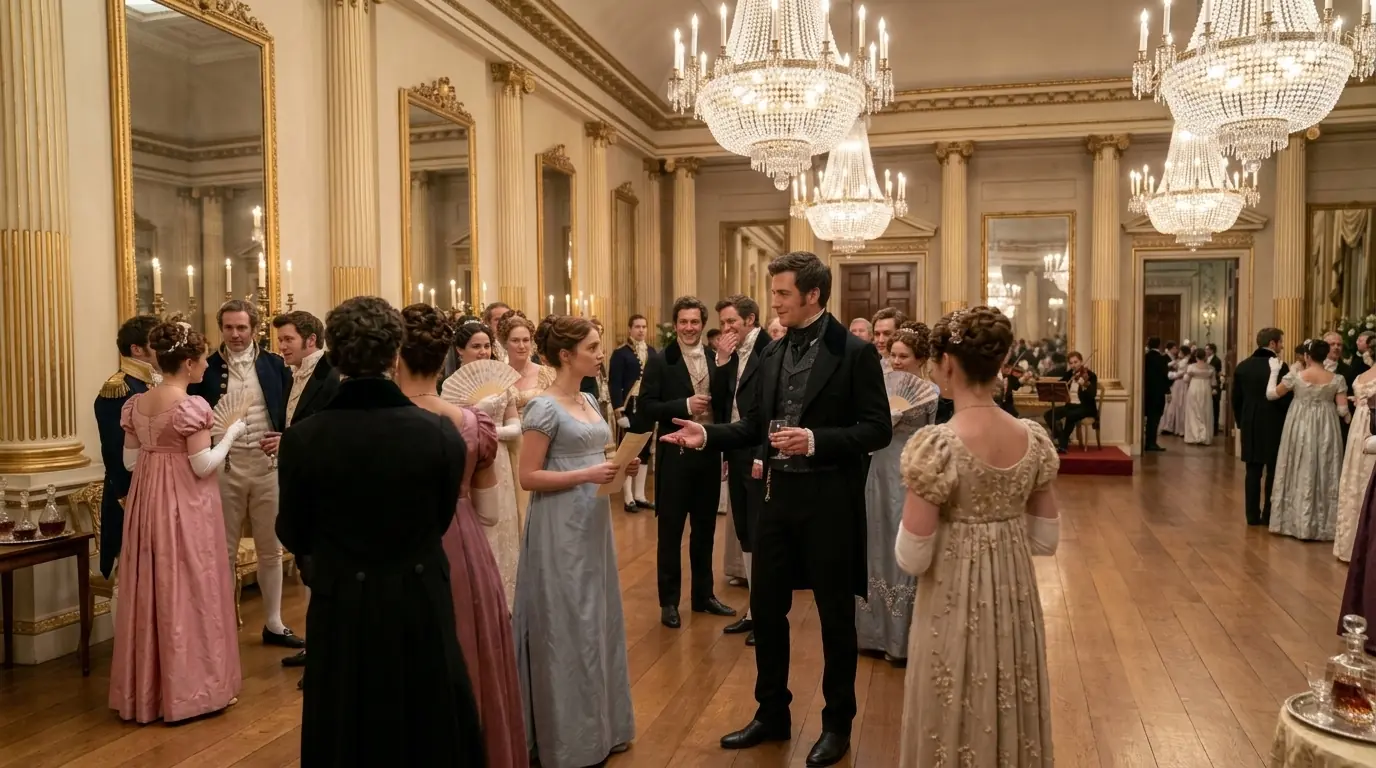
The ink on the deed was barely dry when the Duke’s mocking laughter echoed across the ballroom. “It will be a ruin within a year,” he sneered, loud enough for the Prince Regent to hear. Twelve months later, that doomed estate was not merely standing. It had become the crown jewel of England.
London in the spring of 1815 was a city intoxicated by victory, wealth, and vicious society gossip. At the center of the ton’s glittering web were the Almack’s Assembly Rooms, where fortunes could be made or destroyed with a single whisper from the patronesses. It was there, beneath crystal chandeliers and the watchful eyes of Princess Lieven, that the most scandalous wager of the decade was born.
Miss Rosalind Carstairs did not belong in that room. At twenty-four, she was the orphaned daughter of a disgraced cavalry officer, possessing no immense dowry and no powerful connections. What she did possess, however, was a recently inherited piece of parchment: the deed to Ashdown Park, a sprawling, derelict Elizabethan estate in the desolate hills of Yorkshire.
For a century, the property had been rotting away, swallowed by ivy, debt, and the relentless English rain. Its roof sagged. Its galleries leaked. Portions of the west wing had become unsafe even for servants to enter. Yet to Rosalind, it was still the last physical remnant of her family’s history.
Enter Richard St. John, Duke of Alderley.
Alderley was a man whose wealth was matched only by his profound arrogance. His own immaculate estate, Kingswood, bordered Ashdown Park. For years, the Duke had waited for the Carstairs family line to wither completely so he could absorb the Ashdown lands for pennies, demolish the historic manor, and build a sprawling equestrian track across the property.
When Rosalind appeared at Almack’s wearing a gown hopelessly five years out of fashion, the Duke approached her with the casual cruelty of a predator. He was surrounded by his sycophants, including the notoriously sharp-tongued Beau Brummell, when he offered her two thousand pounds for the estate.
It was a humiliatingly low sum, an insult disguised as charity.
“Take the money, Miss Carstairs,” the Duke drawled, swirling his brandy. “Ashdown is a corpse. The roof has collapsed, the foundations are sinking into the mud, and I am told the west wing is entirely inhabited by badgers. You have neither the funds nor the intellect to save it.”
Rosalind held her head high and looked the Duke directly in the eye.
“Ashdown Park is my family’s legacy, Your Grace. I do not intend to sell it. I intend to restore it.”
The room fell dead silent. Even the musicians seemed to hesitate.
The Duke threw back his head and released a sharp, booming laugh that cut through the stillness.
“Restore it with what, madam? Your sheer willpower? I will tell you what will happen. It will be a ruin within a year. By next spring, you will be begging me to take it off your hands for one hundred pounds simply to pay your debtors.”
“A wager, then?” Rosalind replied, her voice steady enough to carry across the floor.
The Duke’s laughter stopped.
“If I fail to make Ashdown Park the finest house in the county within one year, I will sign the deed over to you for nothing. But if I succeed, you will publicly apologize to me in this very room, and you will match the cost of the restoration pound for pound in a donation to the local orphanage.”
A murmur ran through the ballroom.
The Duke’s eyes narrowed. He loved a sure victory.
“Accepted,” he said quietly.
Three days later, when Rosalind finally arrived at Ashdown Park, the reality of her bravado struck her like a physical blow.
The Duke had not exaggerated.
The house was a skeletal monstrosity. The great oak doors had rotted on their hinges, and the entrance hall was blanketed in moss, dust, and bird droppings. The vaulted ceiling of the long gallery had caved in, allowing the gray Yorkshire sky to weep directly onto warped floorboards below. In the old drawing room, rain had stained the plaster in wide brown blooms. Several chimneys were unsafe. A servant warned her not to cross one section of the west corridor because the floor had become soft enough to give way beneath a careless step. Even the once-grand gardens had surrendered to bramble and nettle, their paths nearly erased.
Water ran down interior walls. Ivy had worked its way through cracked stone. In one abandoned chamber, part of the ceiling had fallen entirely into the floor beneath it. The west wing looked as though a strong winter storm might simply carry it away.
Then came the worse news.
The estate was saddled with a crippling five-thousand-pound tax debt payable before the end of the year.
Rosalind had almost no liquid money, no permanent workforce, and a ticking clock.
Yet she possessed a weapon the Duke had completely failed to account for: a brilliant, analytical mind that understood the changing tides of the modern world.
Traditional banking houses would never lend a meaningful sum to a single woman with a ruined country estate and no husband to guarantee the note. Rosalind knew that before she ever asked. So she did not waste time begging institutions designed to reject her.
Instead, she studied the land.
She rode every boundary. She reviewed old family maps. She questioned tenant farmers, quarrymen, and woodcutters who had worked the property long before her birth. Hidden beneath neglected sections of the Ashdown lands was a vast vein of high-grade limestone, and beyond the northern ridge stood a forgotten forest of centuries-old oak. She calculated how much could be extracted without stripping the estate bare, how many laborers would be needed, what carts and tools would cost, and which northern buyers were already paying premium prices for stone. By the time she returned to London, the estate was no longer merely a ruin in her mind. It was a balance sheet waiting to be understood.
Rosalind returned to London with geological surveys, timber valuations, production estimates, projected freight costs, and a business plan detailed enough to make a merchant banker blink.
She marched directly into the private offices of Thomas Coutts of Coutts & Co. on the Strand.
She did not bring promises. She brought numbers.
Her proposal was radical but simple. She would sell limestone and selected oak into the rapidly expanding industrial markets of northern England to fund the restoration. She needed a bridge loan of ten thousand pounds to begin extraction, hire labor, and stabilize the manor before winter.
Thomas Coutts, a man who had financed kings and survived economic storms that ruined lesser houses, read the documents in silence.
He read them twice.
Then he looked over his spectacles at Rosalind.
“You understand,” he said, “that if the operation fails, there is no family fortune behind you to absorb the loss.”
“I understand.”
“You could lose Ashdown.”
“I know.”
“You could face debtor’s prison.”
Rosalind did not flinch.
“Then I suggest we ensure the figures are correct.”
Coutts stared at her for a long moment, then laughed once under his breath. He had seen reckless people before. Rosalind was not reckless. She was calculated.
Intrigued by her defiance of Alderley and impressed by the precision of her ledgers, Coutts granted the loan.
Rosalind returned to Yorkshire armed with capital and an idea of exactly what she wanted Ashdown to become.
She bypassed the expensive London architects favored by aristocratic families and instead sought out Elias Beckford, a young structural engineer whose obsession with new industrial building methods had earned him ridicule from conventional builders.
He arrived at Ashdown wearing a mud-spattered coat and carrying more measuring instruments than luggage.
Rosalind met him in the courtyard and unrolled her plans across a makeshift table balanced on stone blocks.
“I do not want a medieval museum, Mr. Beckford,” she told him. “I want light. I want warmth. I want a house that forces the Duke of Alderley to choke on his own pride. We will use the bones of the old world, but we will rebuild it with the muscle of the new.”
Beckford smiled.
By the summer of 1815, Ashdown Park had transformed from a quiet graveyard into a deafening hub of industry.
Rosalind and Beckford made a decision that scandalized the local gentry. Instead of painstakingly carving new stone supports for the damaged west wing, they imported massive cast-iron structural columns from Sheffield.
It was a technique associated with mills, warehouses, bridges, and factories, not the residence of a gentleman.
The local nobility mocked Ashdown as “the iron foundry of Yorkshire.” Invitations stopped coming. One neighboring gentleman loudly predicted that the first frost would crack the whole structure apart. Another joked that Rosalind would soon be living in a factory with tapestries. Rosalind heard every insult and answered none of them. Every hour spent defending herself was an hour stolen from the deadline.
The iron was comparatively inexpensive, structurally powerful, and could be erected in a fraction of the time required for traditional stonework. Once the framework was secured, Beckford disguised much of it beneath elegant plasterwork, carved detailing, and dark mahogany veneers.