They laughed at her in court, but this defendant was not who they thought she was. She had come prepared to rewrite the rules.
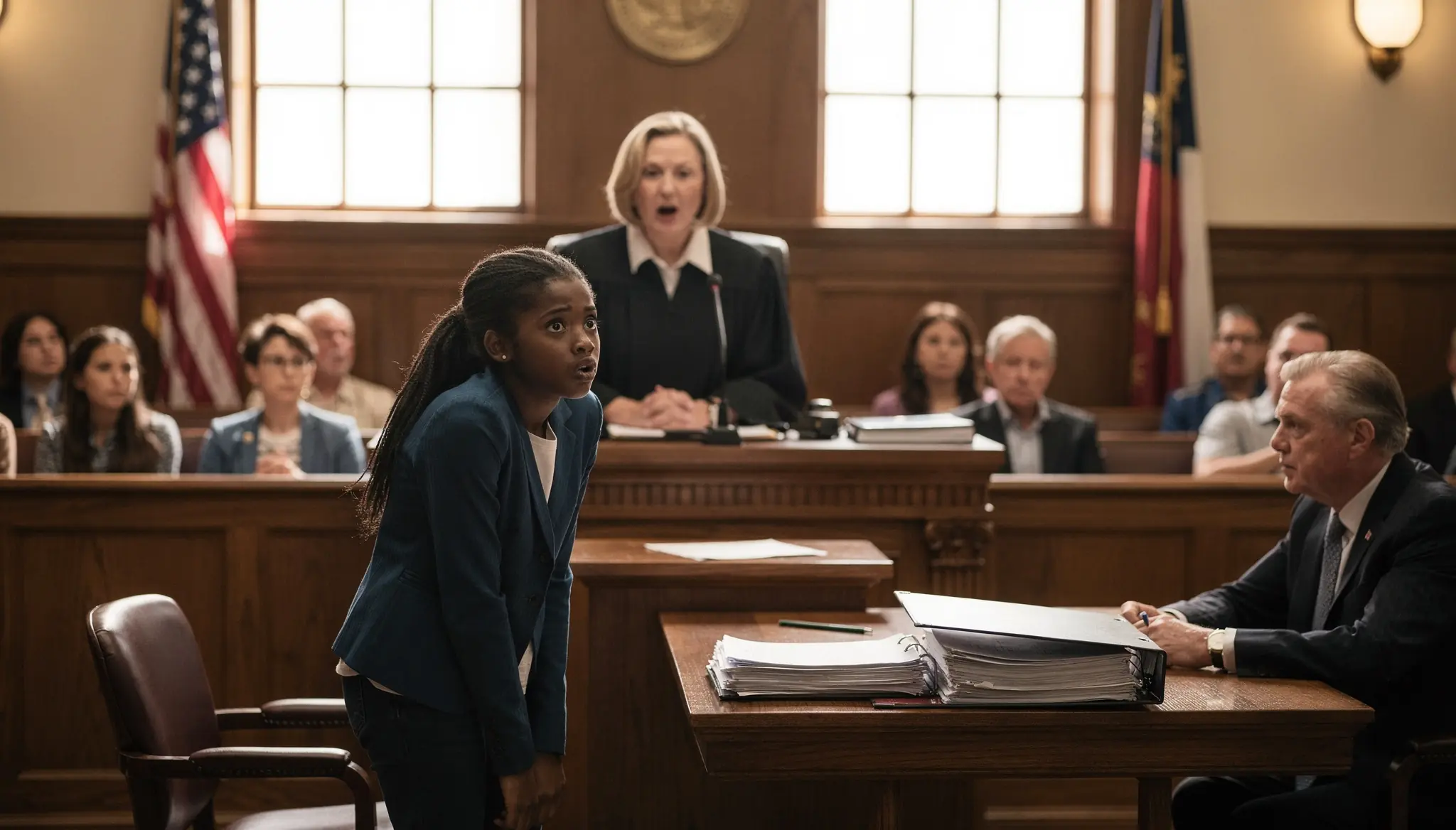
The courtroom was packed, the kind of scene one might expect in a high-profile case rather than a routine hearing. People whispered among themselves, their murmurs blending into a low buzz that filled the room. At the center of it all stood a young Black teenager, maybe seventeen at most. Her sneakers squeaked slightly as she shifted on the cold, polished floor.
She did not look nervous, at least not like someone accused of a serious crime. Her expression was calm and her hands were steady. But the judge was not impressed.
Judge Harold Brenner leaned back in his chair, his robe draped over his bulky frame as though it had been thrown on in a hurry. He peered down at the girl through his glasses, the corner of his mouth curled in visible disdain.
“Miss Freeman,” he said, drawing out her last name as if it left a bad taste in his mouth, “do you even understand what you are being accused of here?”
The room fell silent. Every eye moved between the judge and the girl.
She did not flinch or fumble with her words the way he apparently expected. Instead, she met his gaze calmly and said, “Yes, Your Honor. I do.”
Brenner scoffed and leaned forward, his tone dripping with condescension. “You are sure about that? Because this is not some after-school debate club. You are in a court of law, young lady.”
A few chuckles echoed from the gallery. For the first time, she allowed her gaze to sweep the room. Most of the people watching were older, dressed in suits, their faces hard with judgment. They looked at her as if she were a spectacle rather than a person.
She let them look. There was something in her eyes, something that suggested she knew more than they did.
But the judge was not finished.
“I do not know why anyone thought it was a good idea to let you speak on your own behalf,” he continued with a dismissive wave of his hand. “This is not child’s play. You are not equipped for this.”
Her lips parted slightly as if she might respond, but then she closed them again. A faint, knowing smile crept onto her face.
The gallery shifted, sensing something they could not yet identify. Judge Brenner took her silence as weakness and smirked.
“That is what I thought.”
What he did not realize, what no one in that room realized, was that they were not dealing with a frightened teenager who had become trapped in the system. She was not there by accident. She was there for a reason, and by the end of the hearing, everyone in the courtroom would understand why.
The judge tapped his pen against the desk in a sharp, deliberate rhythm. “Let us get this over with,” he muttered, flipping through the file in front of him. “The prosecution may proceed.”
The district attorney, a tall man with slicked-back hair and a polished demeanor, rose from his chair. He shot a glance at the teenager, his smirk nearly matching the judge’s.
“Your Honor, this is an open-and-shut case. The evidence speaks for itself,” he began, pacing as he delivered what sounded like a well-rehearsed argument, as though the defendant were invisible. “The defendant, a minor, was found at the scene in possession of materials clearly linking her to—”
“Objection.”
Her voice cut through the room like a blade. It was calm, measured, and entirely unexpected.
The district attorney froze mid-sentence and turned toward her. The gallery stirred as whispers began to rise again.
Judge Brenner lifted one eyebrow. “Objection?” he repeated, his voice heavy with sarcasm. “Miss Freeman, do you even know what that means?”
“Yes, Your Honor,” she replied without hesitation. “The prosecutor is making assumptions about my intent without providing context. That is speculative and inadmissible.”
A ripple of shock moved through the room. The district attorney stumbled over his next words, glaring at her as though she had ruined a carefully staged performance.
“Your Honor, this is highly irregular.”
“No,” Harper said, interrupting him. “What is irregular is the lack of actual evidence tying me to criminal activity.”
The judge’s gavel struck the bench with a loud crack.
“That is enough,” Brenner snapped, his face reddening. “Miss Freeman, you are here to defend yourself, not to play lawyer. One more outburst like that, and I will hold you in contempt.”
Her expression remained unchanged. “Understood, Your Honor.”
The district attorney cleared his throat, trying to recover his composure. He turned back toward the judge.
“As I was saying—”
“Permission to approach the bench,” Harper said.
The gallery gasped audibly this time.
Judge Brenner stared at her, his expression caught between irritation and disbelief. “You do not get to make demands in my courtroom,” he barked.
“I am not making a demand, Your Honor. I am exercising my right to present a fair defense,” she replied, her tone steady and unshaken. “But if you are unwilling to hear me, I will file a motion for recusal based on judicial bias.”
Silence filled the courtroom.
The judge leaned back in his chair, his eyes narrowing as though he were trying to identify the game she was playing.
“You think you are clever, do you?” he said after a long pause. “Fine. Approach.”
Harper stepped forward, her sneakers squeaking again on the polished floor. Every eye followed her. The weight of the room’s attention pressed down on her, but she walked as though she did not feel it.
She placed a stack of papers on the bench. Her hands remained steady as she slid them toward the judge.
“This is a preliminary review of the evidence submitted by the prosecution,” she said evenly. “If you look closely, half of it is circumstantial, and the remainder lacks a properly documented chain of custody.”
Judge Brenner glanced at the papers. His frown deepened as he began turning through the pages. The district attorney looked ready to explode.
“Your Honor, this is absurd. She cannot—”
“She can,” the judge muttered, cutting him off.
He flipped through several more pages before looking up at Harper.
“Where did you get this?”
“I prepared it,” she replied.
“And how exactly does a teenager like you know how to do this?”
She hesitated for only a moment. “I read.”
The judge’s eyes narrowed further, but he said nothing. The gallery had gone silent again, everyone leaning forward as if unable to help themselves.
Something about Harper’s confidence was beginning to change the room. People were no longer merely watching her. They were wondering who she really was.
Judge Brenner shuffled the pages again, clearly searching for an error that would allow him to dismiss her work. He found none. Every point was precise. Every argument was supported.
“Miss Freeman,” he said slowly, his skepticism still present, “this review of yours—where did you learn to construct something like this?”
Harper smiled faintly. “Like I said, Your Honor, I read a great deal.”
The district attorney was less composed.
“Your Honor, this is ridiculous. We are wasting time. She is a child. This is not a debate club.”