"Sit down, little girl. This is a courtroom, not a school project."
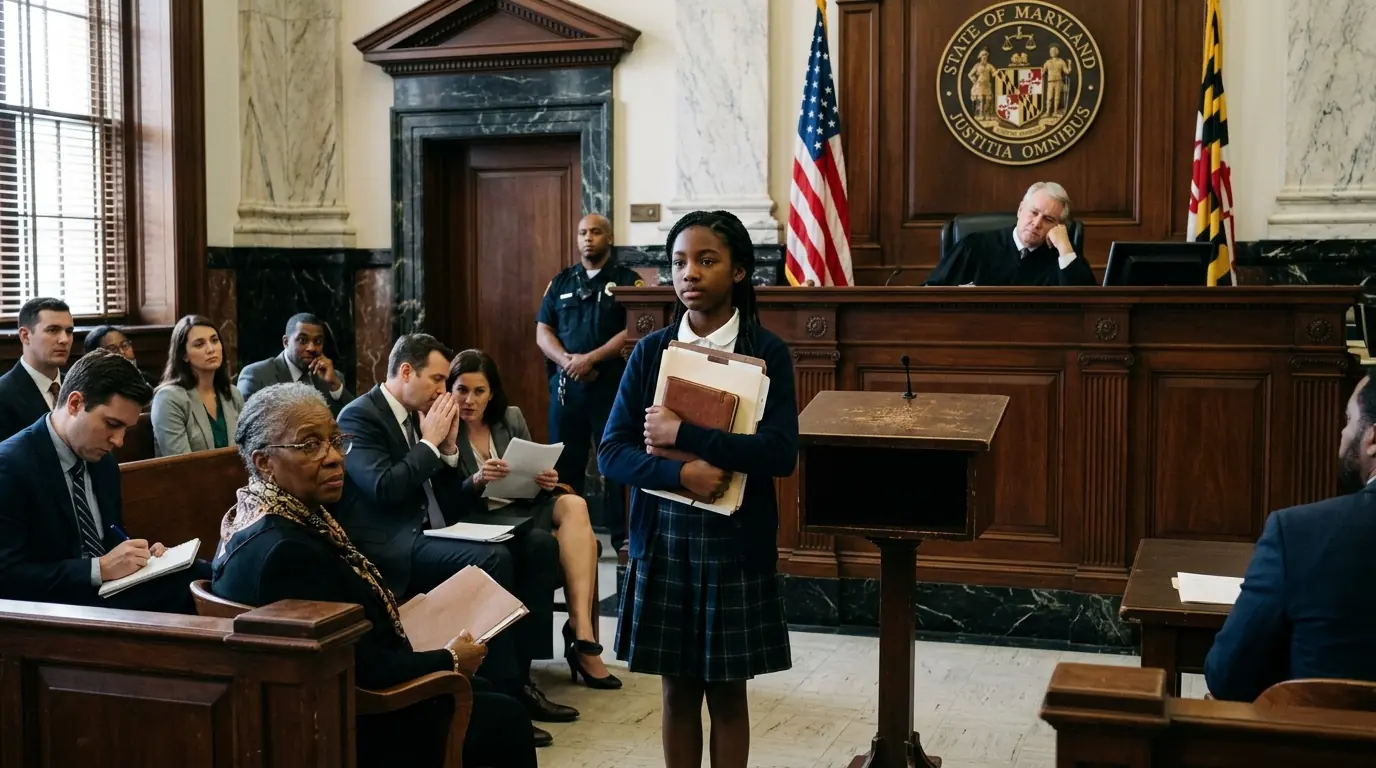
Laughter rippled through the gallery. Somewhere near the back, a city attorney chuckled behind his folder. Judge Harold Whitfield leaned back in his high leather chair, clearly pleased with himself, as if he'd just delivered the wittiest line of the morning.
Twelve-year-old Amara Johnson stood at the small podium meant for citizens addressing the court, her hands folded neatly in front of her, wearing a navy cardigan her grandmother had ironed that morning.
She did not sit down. She did not flinch. She simply waited—the way she had learned to wait, patiently, the way her grandfather used to tell her that patience wasn't weakness. It was strategy.
"I only have one question, Your Honor," she said again, her voice steady despite the laughter still settling around her. "The filing date on page four doesn't match the notice my grandmother received. I just want to know why."
"Sweetheart," Judge Whitfield said, his tone dripping with condescension. "I'm sure it's very impressive that you can read big words in a legal document, but this is an adult matter. Perhaps you should let the grownups handle it."
More laughter.
Somewhere in the front row, Amara's grandmother, Ruth Johnson, sat with her spine straight and her jaw tight, gripping a worn manila folder in her lap like it was the only solid thing left in the room.
Amara didn't sit down. She looked directly at the judge, and for just a moment, something flickered across her face. Not fear, but the quiet, unshaken certainty of someone who already knows they're right and is simply waiting for the room to catch up.
"I'll wait, Your Honor," she said softly. "But the date is still wrong."
The judge waved a dismissive hand, already moving on to the next matter on his docket, already certain this small interruption meant nothing.
They had no idea what that simple question was about to unravel.
---
One week earlier, in a small kitchen on the east side of town, Amara Johnson sat at the table long after her homework was finished. A stack of papers spread out in front of her under the glow of a single overhead light.
Her grandmother, Ruth, had raised her since she was six, after Amara's parents were killed in a car accident that still occasionally visited Amara in dreams she never talked about. Ruth had worked as a school cafeteria manager for thirty years to keep their small house on Maple Street—the same house Amara's grandfather, Theodore Johnson, had bought with his own hands back when the neighborhood was still considered undesirable by the banks that had refused him a loan three separate times before finally relenting.
Theodore had been a civil rights attorney in his younger years, before his hands grew too unsteady to hold a pen and his mind began drifting in his final seasons. He'd passed two years ago, but he'd left behind something Amara treasured more than any toy or trinket: a worn leather notebook filled margin to margin with his careful handwriting. Notes on cases, on courtroom procedure, on the quiet ways that paperwork could be twisted against people who didn't know how to read it closely.
*Read everything twice, Amara bug*, he used to tell her, tapping the notebook with one weathered finger. *The truth is always hiding in the details nobody bothers to check.*
When the city sent a notice claiming Ruth had missed a property tax deadline and moved to seize the house through eminent domain for a new development project, Ruth had been too overwhelmed to fully understand the paperwork. But Amara had taken her grandfather's notebook down from the shelf and night after night she had cross-referenced every date, every stamp, every signature on the city's filing against what little she understood of procedure, determined in her own quiet, twelve-year-old way to save the only home she had ever really known.
She found a mismatch on a Tuesday night. A filing date that didn't match the mail notice by exactly eleven days. Eleven days that—under the law, her grandfather's careful handwriting explained—would have made the entire seizure notice invalid.
That night she showed her grandmother the notebook page, tracing the discrepancy with one careful finger the way her grandfather used to trace case citations for her, explaining slowly what an eleven-day gap could mean under the law.
Ruth had listened, half in disbelief, half in quiet pride, and told her granddaughter that if she believed she was right, she deserved to be heard. Whatever room she had to stand and say it.
She had no idea, closing that notebook and turning off the kitchen light, that in one week she would be standing in a courtroom being laughed at for trying to say exactly that out loud.
---
The Third District Courthouse sat at the center of downtown. An old stone building with tall marble columns and heavy oak doors that had swung open for a hundred years of the city's disputes.
Inside, the main courtroom stretched wide and formal. Dark wood benches polished to a shine, a high judge's bench framed by the state seal, and rows of gallery seating that filled quickly on hearing days like this one.
Community property hearings drew a strange mix of people. City planners in tailored suits reviewing development documents, reporters from the local paper hoping for a quotable moment, attorneys representing the city's redevelopment office, and ordinary residents like Ruth Johnson sitting quietly with folders held together by rubber bands, hoping to be heard.
Judge Harold Whitfield had presided over this courtroom for nineteen years. He was known in local legal circles as efficient, decisive, and—among the attorneys who worked closely with the city's development office—remarkably easy to work with. He moved through his docket quickly, rarely allowing lengthy testimony from self-represented citizens, and had built a reputation for keeping his courtroom orderly. A word that, depending on who you asked, meant either well-run or simply intolerant of interruption.
The gallery that morning was fuller than usual. A new downtown revitalization project had brought a wave of eminent domain hearings. Families being asked to give up long-held properties in exchange for city compensation that rarely matched what the land was actually worth. Most of them sat quietly, resigned, unfamiliar with the legal language stacked against them.
It was into this room, formal and imposing, that a twelve-year-old girl in a navy cardigan had walked beside her grandmother carrying nothing but a manila folder and a decade-old notebook, hoping someone would simply listen.
She had no idea how badly this room needed someone like her to finally speak up.
---
The hearing had begun ordinarily enough. Ruth Johnson's case was fourth on the docket, wedged between two commercial property disputes that the judge moved through with brisk efficiency.
When her name was called, Ruth stood, folder in hand, and began explaining in the careful, respectful voice of someone unaccustomed to courtrooms, that she believed there had been an error in the city's notice.
"Your Honor, the date on the filing doesn't match what we received in the mail," Ruth said. "My granddaughter found—"