"Your Honor," Douglas Harwell said, turning to the bench with a wide smile. He held the single sheet of paper from the defendant's table between two fingers, like something he had found on the bottom of his shoe, and dropped it back down. "I've just been handed a motion filed by opposing counsel." 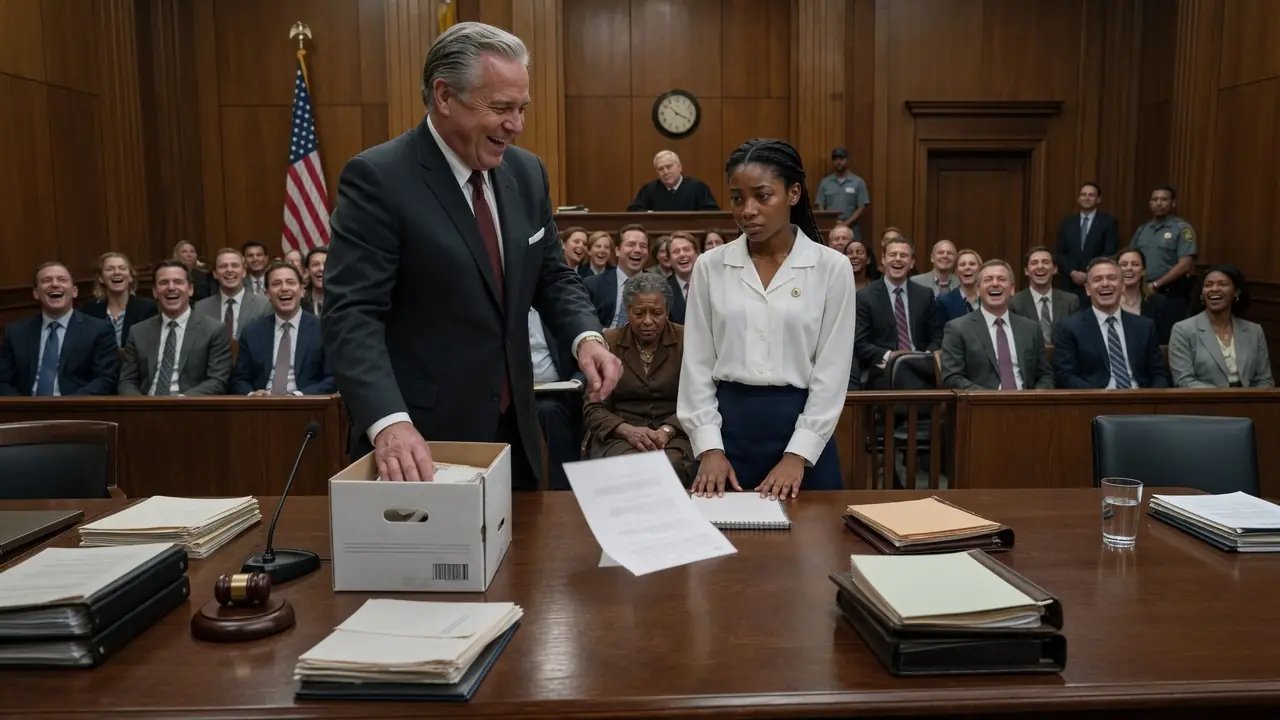
He paused for effect, letting the silence stretch across the entire room. Opposing counsel was a fourteen-year-old Black girl in her grandmother's blouse.
Laughter rippled through his side of the gallery. He wasn't finished. He turned back toward Simone, looked her up and down—the way a man looks at something that doesn't belong in the room—and said loud enough for the front three rows to hear, "Sweetheart, the library is two blocks east. You might be more comfortable there."
More laughter, louder this time, followed. Judge Raymond Stokes leaned back and folded his hands across his chest. He didn't call for order. He looked at Simone Carter the way a man looks at a clock he's about to stop.
"I'll give you two minutes, young lady, and I'm being generous," Stokes said. "The adults in this room have real work to do. Try not to embarrass that old woman sitting behind you any more than you already have."
In the second row, Dorothy Carter—seventy-two years old, thirty-eight years of service at Mercy General, the woman who had built this child from nothing—pressed both hands flat against her knees and stared straight ahead. Her jaw was tight. Her eyes were dry. She had learned a long time ago that some rooms tried to break you with laughter before they ever raised a hand.
The girl at the defendant's table was fourteen years old. She wore a nursing pin on her lapel, and her hands were flat and perfectly still on the table in front of her. Her name was Simone Carter. And in eight minutes, every single person in that courtroom would remember exactly what they had said and exactly what it cost them.
---
To understand what happened in that courtroom on a Tuesday morning in October, you have to go back. Not to the hearing, not to the filing, not even to the night Simone Carter sat down at the kitchen table and decided she was going to fight.
You have to go back to 1957. You have to go back to a man named James Holloway, standing in front of a half-built house on a dirt lot at 317 Holloway Street in Clarkson, Tennessee, with sawdust on his boots, a paid receipt in his chest pocket, and a look on his face like a man who had just planted a flag on the moon.
Two banks had told him no. One of them had laughed when he walked in. The lot had been listed as "undesirable"—an accounting term that in 1957 in Clarkson, Tennessee, meant something very specific about who they expected to buy it and who they didn't. James Holloway had paid $3,200 in cash, every dollar earned from twelve years of carpentry work. He had built the house himself—every nail, every beam, every window frame leveled by his own hand. He had done it because he wanted his family to have something that no one could take. He had done it because he believed that if something was yours—truly, legally, documentably yours—the world would eventually have to respect it. He had been more right than he knew, and more wrong than he could have imagined.
Dorothy Carter was James Holloway's daughter. She had grown up in that house on Holloway Street, learned to read in the front bedroom, eaten breakfast at the kitchen table her father had built from leftover lumber, and watched her mother press the deed into her hands the year James died and say, "This is what he left us. Don't you ever let it go."
Dorothy had become a nurse. For thirty-eight years, she worked the emergency room night shift at Mercy General Hospital in Clarkson—the kind of work that asked everything you had and then asked for a little more. She retired at sixty-eight with a bad left knee, a perfect record, and the same house at 317 Holloway Street where she had always lived.
She had never married. She had one daughter, Patricia, who had been bright and restless and full of laughter until a persistent fatigue that three different doctors dismissed as stress turned out to be something far worse. Patricia Carter died at thirty-one of an undiagnosed autoimmune condition, leaving behind a four-year-old girl with a small backpack, a pair of red sneakers, and a name that felt like a song: Simone. Dorothy brought her home and started over.
Simone Carter had been reading since she was three. Not picture books—real books. Dorothy had a wall of them in the hallway: everything from nursing textbooks to Tennessee history to a complete set of legal encyclopedias she had bought at a church sale for eleven dollars when Simone was six. By eight, Simone had read them all. By nine, she was enrolled in a college prep legal studies accelerator at the Clarkson Community Learning Center, the youngest student they had ever admitted by four years.
At thirteen, on a Wednesday afternoon in the school library, she had taken a voluntary bar readiness examination administered by the program's supervising attorney. She had never told anyone she was going to take it. She had simply sat down, opened the booklet, and finished it forty minutes before the time limit. Her score was in the ninety-first percentile—higher than sixty percent of the graduating law students in the state who had taken the same standardized version that year. The program director, a quiet woman named Ms. Yvette Barlow, had called Dorothy that evening. Dorothy had listened to the entire explanation without interrupting. Then she had said, "I know. She's been like this since she could hold a pencil."
Simone carried a small spiral notebook everywhere she went. She was on her seventh one. On the cover of each, in Dorothy's handwriting—the same careful cursive Dorothy had used to chart patient notes for thirty-eight years—were six words: *What you know, nobody can take.* She had filled every page of the first six. She was halfway through the seventh: the Guardian Ad Litem certification.
Under Tennessee Code Section 34-3-17(b), a minor representing a direct family member in civil property matters under an adult supervision waiver had never been successfully invoked by anyone under the age of eighteen in the history of the state. The certification board had reviewed her application three times before approving it. The third review had lasted four hours. She was the first.
Every morning before school, Simone passed the framed deed to 317 Holloway Street on the way from her bedroom to the kitchen. James Holloway's signature at the bottom was in ink that remained dark after nearly seven decades. The county stamp was pressed into the paper in 1957, like a seal on something permanent. She had stopped in front of it every single morning since she was four years old. She had never once walked past it without looking.
Dorothy made biscuits. Simone read case files at the kitchen table. The coffee pot gurgled. The morning light came through the east window and fell across the old linoleum floor the same way it had fallen across it for sixty-eight years. This was the life they had—quiet, full, and entirely their own.
Then, six months before that courtroom appearance, a man named Preston Whitmore circled 317 Holloway Street on a development map in his downtown office. He used a red marker. He drew the circle slowly, deliberately, the way men draw circles around things they have already decided belong to them. He did not know the name James Holloway. He did not know the name Dorothy Carter. He did not know anything about the girl who read case files at the kitchen table every morning before school. He was about to learn all three.
Preston Whitmore had built his reputation the way most men build reputations in commercial real estate: not by being the best, but by being the most relentless. He had started Whitmore Development LLC seventeen years ago with a single strip mall in East Clarkson and a talent for identifying properties whose owners were either desperate or unaware of what they had. By the time he announced Clarkson Heights, he was worth an estimated $34 million, had his name on four buildings downtown, and had learned that in this city, the right phone call to the right person solved most problems before they became problems.
Clarkson Heights was going to be his masterpiece: forty-two luxury units, a rooftop terrace, a ground-floor restaurant, and a parking structure. The renderings had been published in the *Clarkson Business Journal* with Whitmore standing in front of them in a blue suit, arms crossed, smiling the smile of a man who had already broken ground in his own mind. The project required the full city block bounded by Maple, Third, and Commerce. Every parcel on that block had been acquired—some through negotiated sale, two through what Whitmore's attorneys described as amicable resolution of title disputes, and one through a process that his chief of staff referred to in internal emails only as "the usual approach."
Every parcel except one: 317 Holloway Street.
"Grandma," Simone said carefully, "the assessed value on this property is listed in county records as $487,000."
Dorothy sat down. She looked at her granddaughter for a long moment. "I know, baby. They're offering $61,000."
"I know what it is," Dorothy folded her hands on the table. "And the answer is no."
The second letter arrived three weeks later. The number had not changed, but the language had. Words like *eminent domain proceedings* and *municipal development priority* had appeared in the second paragraph, which was not an accident.
Dorothy called nine law firms over the following two weeks. The first two asked her to hold and never came back. The third quoted her a retainer of $15,000 upfront. The fourth, when she said the name Whitmore Development, went quiet for a moment and then told her they had a conflict of interest. The fifth hung up before she finished the sentence.
The sixth firm was where she found Clare Novak. Clare Novak was thirty-nine, a solo practitioner with a small office on Commerce Street and a reputation for taking cases that larger firms passed on. She had reviewed the file, met with Dorothy twice, and told her clearly that the offer was predatory, the property rights were solid, and she had a strong case. She had taken a reduced retainer of $2,500—all Dorothy could afford—and gone to work.
For six weeks, it had felt like things might be all right. And then, on a Monday morning, Clare Novak called Dorothy and told her, in a voice that was flat, careful, and utterly drained of its earlier confidence, that she was withdrawing from the case. Irreconcilable scheduling conflicts. She was sorry. She truly was.
Dorothy had asked her directly, "Did someone get to you?"
A long silence followed. "I can't discuss the circumstances of my withdrawal, Dorothy. I'm sorry." The call lasted four more seconds, and then the line went dead.
That evening, Dorothy sat at the kitchen table for two hours without speaking. She did not turn on the television. She did not make dinner. She pulled the original deed out of the fireproof box in the hall closet and spread it flat on the table under the kitchen light. James Holloway's signature, 1957. The county stamp was pressed deep into the paper. She traced the signature with the tip of one finger, the way you trace something you are terrified of losing.
From the hallway, Simone watched her. She watched for a long time. Then she went to her room, opened notebook number seven, and began to write. Not about her feelings, not about her fear. She wrote a legal question: *What statute allows a minor to represent a family member in a civil property action in the state of Tennessee?*
She found the answer at 11:47 p.m.: Tennessee Code Section 34-3-17(b). The application required academic credentials, a bar readiness assessment, faculty endorsements, and approval from a three-member certification board. She began drafting the application by hand. The handwritten version took eleven pages. She typed the final version and submitted it digitally at 2:14 a.m. Then she went to the kitchen, found the bowl of instant oatmeal Dorothy had left covered on the counter with a note—*Eat something, baby*—and ate it cold at the table while she reviewed her own filing for errors. She found two. She corrected them and resubmitted at 2:31 a.m.
The certification board reviewed her application three times over the following week. Three separate panels, four hours on the final review alone. On a Thursday afternoon, the approval came through. Second paragraph, third sentence: *This certification represents the first successful invocation of Section 34-3-17(b) by a minor in the history of the state of Tennessee.*
Simone printed it, folded it once, and placed it in notebook number seven between two pages of case notes. She did not celebrate. She made a list of everything she still needed to do. It was a long list.
Judge Raymond Stokes received notice of the certification approval the same afternoon. He read it once, set it on his desk, and picked up his phone. The number he dialed belonged to Douglas Harwell. The call lasted six minutes. Most of what was said has never been recorded, but Harwell's response when he hung up was to lean back in his chair, look at the ceiling of his corner office on the fourteenth floor of the Harwell and Associates building, and smile. "A child," he said to no one in particular. "They're sending a child."
He was not worried. He had thirty years of courtroom wins, a developer client worth $34 million, and a judge who had never once ruled against him in eleven years of cases in this county. He had no reason to be worried.
---
The morning of the hearing, Simone was up at 4:00 a.m. She had slept three hours. She did not feel tired; she felt the way she imagined a surgeon feels before a procedure—focused, narrowed down to a single point. Everything that wasn't the case had temporarily ceased to exist.
She had pressed Dorothy's white blouse the night before. It was still too big. Dorothy had broader shoulders and wider arms from thirty-eight years of lifting patients, but Simone had tucked it carefully into her skirt and pinned it at the back with a single safety pin, so that from the front it looked deliberate, like a choice rather than a hand-me-down. She stood in front of the bathroom mirror for twenty-two minutes. Square the shoulders, lift the chin, hands flat, never clenched, voice from the chest, not the throat. She had practiced this, standing in front of this mirror for four days. She knew her own face when it was ready. It was ready.
Dorothy was already in the kitchen when Simone came out. Two cups of tea were on the table. Biscuits had been made from scratch at 3:00 in the morning because Dorothy needed something to do with her hands, and she had always believed that feeding someone was the most direct form of love available to a person. She looked at Simone in the doorway for a moment—the pressed blouse, the notebook under her arm, the expression of someone who has decided something and is not going back—and she did not say anything about the case. She did not ask if Simone was ready, and she did not offer a last-minute escape route.
She reached into the pocket of her housecoat and held out a small, round pin. It was her Mercy General Nursing Service pin. Gold plating, thirty-eight years of wear rubbed into its edges, the hospital seal on the face barely visible anymore.
"Your great-grandfather built something real," Dorothy said. "I spent thirty-eight years building something real. Now you." She pressed the pin gently into Simone's lapel. "You take this with you."
Simone looked down at the pin, then at her grandmother. "Yes, ma'am."
On the city bus to the courthouse, Dorothy opened her banking app out of habit and looked at the balance: $4,210. She closed the app and put the phone in her purse without a word. She looked out the window at the early morning streets of Clarkson and did not say anything for the rest of the ride. Simone sat beside her, notebook open, reviewing her case notes for the last time. She had read them so many times that doing it now was less about information and more about ritual. The way an athlete runs through a warm-up—not because their muscles need it, but because the rhythm tells the body: *This is real. This is now. It is time.*
The courthouse was a four-story brick building on Third Street that smelled of floor wax, old paper, and the particular institutional silence of a building that had held a great deal of human suffering for a very long time. They arrived at 8:40 a.m. The hearing was at 9:00 a.m.
Courtroom B was wood-paneled, high-ceilinged, and already arranged like a stage set when they walked in. Douglas Harwell's table had four people at it: Harwell himself, two associates in matching dark suits, and a paralegal with a laptop and two banker's boxes of files. The visual impression was intentional—a wall, a machine, a thing that did not lose.
Harwell looked up when Simone walked in. He looked at her the way he had been looking at her since the moment he first saw the certification paperwork: like something that was not quite a real opponent and not quite worth explaining to himself. His eyes moved to Dorothy, then back to Simone, and then away entirely. He turned to his lead associate and said something behind his hand. Both of them smiled.
Simone set notebook number seven on the defendant's table. She set her certified exhibits in order to the right. She placed a single pen parallel to the notebook's edge. Then she sat down, placed both hands flat on the table, and looked straight ahead at the empty bench.
Judge Raymond Stokes entered at 9:03 a.m. He was a large, gray-haired man with the slow and deliberate movements of someone who had spent thirty-one years in rooms where everyone waited for him. He settled into his chair, adjusted his robe, and looked out at the courtroom. His eyes stopped on Simone. He looked at her for a moment in a way that was not judicial—not the neutral assessment of a case, but the private calculation of a man deciding what category to put someone in. Then he looked at his papers.
"Holloway Street property matter," he said. "Carter versus Whitmore Development." He paused. "Is the certified representative of the defendant present?"
"Yes, Your Honor." Simone stood. "Simone Carter appearing on behalf of Dorothy Carter, property owner of record."
Stokes looked at her over the top of his reading glasses. He said her name slowly, dragging it out. "Sir-moan."
"It's Simone, Your Honor. Like the singer."
A few people in the gallery shifted. Stokes's expression did not change. He wrote something on his notepad.
From two rows behind Simone and Dorothy, a man's voice belonging to a retired insurance broker—who was in the gallery for an unrelated matter and had never seen any of these people before—said at a perfectly audible volume, "Is that child actually representing someone? Where are her parents?"
Light laughter followed—not universal, but enough. Stokes did not call for order. Harwell straightened his tie. He did not turn around; he did not need to.
At 9:17 a.m., during a brief administrative recess, Stokes stood and walked to the wooden railing near the front of the gallery, where a colleague, a retired judge named Frank Alderman, was watching from the first row. He spoke at a volume that was not quite private. "Thirty-one years, Frank. I have never had a little Black girl in her grandmother's blouse try to run a property hearing in my courtroom." He shook his head slowly with a mixture of amusement and irritation. "This will be over before lunch. I'd bet my pension on it."
Soft laughter came from Harwell's table. In the second row, Dorothy Carter lowered her head. A single tear tracked down the side of her face. She did not wipe it; she let it fall.
Behind the clerk's desk, Leonard Wise—fifty-eight years old, twenty-two years in this courthouse, a man who had watched more than he had ever been asked about—opened the small brown notebook he kept in the locked drawer beneath the official log. He turned to page ninety-four. He wrote down the time: 9:19 a.m. He wrote down the words exactly as Stokes had spoken them. He wrote down the name of every person within earshot. Page ninety-four was not page one; it was one of many.
Simone heard every word. She did not turn her head. She pressed the nursing pin on her lapel once lightly with two fingers. Then she opened notebook number seven, uncapped her pen, and wrote a single line at the top of a fresh page: *They are not ready.*
---
Douglas Harwell opened the morning session the way he opened every session: like a man walking into a room that already belonged to him. He buttoned his jacket as he rose, smoothed his tie with one hand, and turned to face Judge Stokes with the particular brand of practiced deference that expensive lawyers develop over decades—the performance of respect that is underneath the performance of ownership.
"Your Honor," he said, "in the interest of efficiency, the plaintiff moves to present the foundational document in this matter."
He reached into the manila folder on his table and produced a single stapled document. He walked it to the bench himself—did not hand it to the bailiff, did not send an associate, walked it personally—because the walk itself was part of the argument. The deliberate pace, the clean white pages, the confidence of a man carrying something he knew would win.
"Plaintiff's Exhibit A," he announced, "a purchase and sale agreement executed between Dorothy Anne Carter and Whitmore Development LLC, dated March 14th of two years prior, in the amount of $61,000." He turned to face the gallery as he said the amount, the way a performer turns to the audience for a laugh. "The property in question, 317 Holloway Street, was legally transferred at that time. The matter before this court is, frankly, a formality."
In the second row, Dorothy Carter went very still. Her hands, which had been folded loosely in her lap, pressed flat against her thighs. Her breathing slowed. She stared at the back of Harwell's head with an expression that was not anger—anger was too simple for what moved across her face in that moment. It was something older than anger: the specific devastation of a person watching someone lie about them with complete comfort.
"I never signed that," she said. Her voice was low, controlled, but it carried.
Stokes looked at her over his glasses. "Ma'am, you'll have an opportunity to—"
"I never signed that document." Her voice did not rise; it didn't need to. "I have lived in that house for fifty-one years. My father built that house with his hands. I know every document I have ever signed that has anything to do with that property. I did not sign that."
Stokes set his pen down. "Ma'am, contracts don't forget. People do." He said it the way men say things they have said before—rehearsed, smooth, without friction. "Counselor," he turned to Simone, "your client will have an opportunity to respond at the appropriate time. In the meantime," he gestured for Harwell to continue.
Harwell smiled. He had expected this exact moment. He had prepared for the grandmother's denial the way you prepare for rain—not as a problem, but as weather, something that happens and passes.
What he did next was deliberate. With three minutes remaining before the morning recess, Harwell's lead associate lifted a bound document from the plaintiff's table and walked it to Simone's side with the leisurely pace of a man delivering something he knew she couldn't use. He set it down in front of her without a word. One hundred and ninety pages, tabbed, indexed. It was three months of preparation compressed into a document designed not to be answered, but to overwhelm.
Simone looked at it. She did not touch it immediately. She looked at the cover page, then at the clock on the wall, then back at the document. She stood.
"Your Honor, the defense requests a forty-eight-hour continuance to review the plaintiff's motion submission."
Stokes was already reaching for his gavel. "Denied. You wanted to be a lawyer, young lady, the clock doesn't care how old you are." He brought the gavel down once. "We'll recess for fifteen minutes."
---
The recess was when it happened. Simone was reorganizing her exhibits when Harwell's junior associate—late twenties, side part, the look of a young man who had learned to perform confidence before he had earned any—pushed back from the plaintiff's table and moved toward the side exit. His path took him directly behind Simone's chair. He did not move around her; he moved through.
His elbow caught the edge of her open notebook. Not hard—not hard enough to be undeniable—just hard enough. The notebook flew off the table. It hit the floor spine first and splayed open, its pages spreading wide across the courtroom floor in a white fan. Six weeks of case notes, hand-drawn diagrams, and margins filled with statute numbers in her careful handwriting were scattered.
He looked down at it. "Careful, sweetie," he said. He stepped over it and kept walking.
Harwell, from the plaintiff's table, did not look up, but the left corner of his mouth twitched upward. Nobody from their table moved to help.
Amos Grant had been pushing his cleaning cart along the back wall of Courtroom B when it happened. He was sixty-seven years old, a quiet man with the deliberate movements of someone who had learned long ago that the best way to exist in certain rooms was to take up as little space as possible. He had worked in this courthouse for nineteen years. He had seen a great deal, and he had been asked about almost none of it.
He saw the notebook hit the floor. He left his cart at the wall and walked to where the pages had scattered. He did not hurry, and he did not make a production of it. He knelt down and gathered the pages one by one, tapping their edges straight against his palm the way a person handles something they understand to be important. He stacked them carefully and set the notebook back on Simone's table with both hands. Then he looked at her for exactly one second—not with pity, not with performance, but with the plain, steady look of someone who sees you and wants you to know it. Then he went back to his cart.
In the courthouse restroom, Simone stood at the sink with both hands on the cold porcelain rim and looked at herself in the mirror. She had practiced this, too, in a different way—the moment when the room had done its work on you and you had to decide what you were made of. She had known it would come. She had not known exactly what shape it would take, but she had known it would come because rooms like this one had been doing this to people who looked like her for a very long time. Knowing that did not make it hurt less, but it did mean she was not surprised.
She opened notebook number seven to the inside cover. Dorothy's handwriting, six words: *What you know, nobody can take.*
She closed the notebook. She looked at herself in the mirror for fifteen more seconds. Then she straightened Dorothy's nursing pin on her lapel, tucked the notebook under her arm, and walked back out into the hall. Nobody in that courtroom had any idea what was inside it. They were about to find out.
---
The bus ride home from the courthouse was twenty-three minutes. Dorothy and Simone sat side by side and did not speak for most of it. Outside the window, Clarkson moved past in the late afternoon light—the gas stations, laundromats, elementary schools, and corner stores that made up the ordinary fabric of the city, completely indifferent to what had happened that morning in Courtroom B.
Dorothy looked straight ahead, her hands in her lap. Her jaw was set in the particular way it set when she was holding something in that she did not intend to release in public.
Simone was reading the 190-page motion. She had been reading it since they left the courthouse steps. She had a pen in her hand, and she was moving through the pages at a pace that a person who didn't know her might have found alarming. But Dorothy knew her. Dorothy had watched this child read a Tennessee civil procedure textbook at age nine the way other children read comic books—fast, quiet, retaining everything. At page forty-seven, Simone stopped. She went back three pages. She read something twice. She did not say anything; she turned the page and kept going.
317 Holloway Street in the early evening had a particular quality of light that Simone had never been able to describe precisely. It came through the west-facing kitchen window at an angle that turned the old linoleum floor a color somewhere between gold and amber, making the kitchen look like a painting of itself—like something preserved deliberately rather than simply persisting. Dorothy made tea, not because anyone was thirsty, but because the ritual of making tea was one of the ways she organized herself when the world had been difficult.
They sat on the front porch as the street lamps came on one by one down Holloway Street. Dorothy was quiet for a long time. Then she said, "You know, I never told you the whole story about your great-grandfather."
Simone looked at her.
"Not the deed part, not the part about the bank saying no—the part before that." She set her tea down on the porch railing, folded her hands in her lap, and looked out at the street the way people look at things when they are really looking at the past.
"James Holloway had come to Clarkson from rural Alabama in 1948, twenty-two years old, with a cardboard suitcase and a set of carpenter's tools that had belonged to his own father. He had spent nine years doing every job the city would give a Black man in 1948—loading docks, road crews, night maintenance at the Clarkson textile mill—while teaching himself from library books and borrowed manuals the complete vocabulary of residential construction: foundations, load-bearing walls, electrical rough-in, plumbing, roofing. By 1957, he knew how to build a house better than most men who had been paid to build them their entire careers. What he did not have was a place to build one."
"When the lot on Holloway Street became available, listed at $3,200—a price the seller had set high deliberately because he expected no serious buyers from that part of town—James Holloway had walked into the county assessor's office with an envelope of cash and a typed letter citing three separate Tennessee property statutes that guaranteed his right to purchase. He had researched the statutes himself. He had typed the letter himself on a borrowed typewriter at the colored branch of the Clarkson Public Library two weeks before he walked through that door. The assessor had made him wait for four hours. Then he had taken the money."
"He stood in that office for four hours," Dorothy said quietly. "He didn't sit down. He stood the entire time because he knew that if he sat down, it would look like he was waiting to be told no. And he was not waiting to be told no. He was waiting for them to take his money." She paused. "He got the receipt. He built the house. And when the county tried to reclassify the lot two years later, claimed a surveying error, and tried to pull the deed, he walked into the county records office with a copy of every document he had ever signed, and he made them correct the record line by line. No lawyer. He did it himself because he had read everything they could throw at him, and he knew it better than they did."
She looked at Simone. "You are his great-granddaughter," Dorothy said simply. And then she picked up her tea and didn't say anything else, because she didn't need to.
---
At 6:45 that evening, Simone was sitting on the curb outside Clare Novak's office on Commerce Street. She had been there for three hours.
At 6:45, the lights inside went off. The front door opened and Clare Novak came out with her briefcase and her coat, and stopped dead on the front step when she saw the girl sitting on the curb with a notebook in her lap. A long silence passed between them.
"You shouldn't be here," Clare said finally.
"I know," Simone stood up. "I just need one thing off the record. Did some company get to you?"
Clare looked up and down the empty street. Her face went through several expressions in quick succession: resistance, guilt, calculation, and then something that looked like relief—the specific relief of a person who has been waiting for permission to tell the truth.
"They didn't threaten me directly," she said quietly. "Someone filed a bar complaint against me, anonymous. It was dropped two days later, completely fabricated, no basis. But the message was clear." Her voice was flat. "I have two kids. I have a mortgage. I'm not..." She stopped, pressing her lips together. "I'm sorry, Simone. I am genuinely sorry."
She reached into her briefcase, pulled out a folded piece of paper, and pressed it into Simone's hand. "That name—Arthur Pendleton, seventy-six years old, lives on Marigold Road. He ran the county deed examiner's office for thirty-four years. Retired six years ago. If there is anything wrong with that contract, and I believe there is, he will find it." She paused. "They tried to bury me. Don't let them bury you." She walked to her car without looking back.
That night, Simone did not sleep. She was at the university library until 1:00 a.m. moving through the Tennessee Notary Commission database and deed record archives, fueled by two cups of cold vending machine coffee and the photocopier humming in the dark.
She typed the name of the notary from Exhibit A—Gerald Odum—and leaned forward in her chair, staring at the screen. She wrote down a date very carefully in the tightest handwriting she had. Then she recorded herself delivering a cross-examination on her phone. She played it back, cringing at three things, and recorded it again. Thirty-eight times she recorded it. By the end, her voice had dropped half an octave from where it had started, and she had mastered the pause—the deliberate two-second pause at the start of each question that she had noticed made a room hold its breath when great trial lawyers used it.
At 2:00 a.m., she found something tucked in the back of notebook number three: a drawing she had made at age seven. It showed a stick-figure girl standing at a podium in a courtroom, a gavel the size of her head on the bench beside her. She had written at the bottom in the large, uneven letters of a seven-year-old: *Me someday.* She stared at it for a long time. Then she tucked it carefully back between the pages and closed the book.
At 5:00 in the morning, she got on her bicycle. 44 Marigold Road was forty minutes across town. She rode the whole way without stopping.
---
The house at 44 Marigold Road was a small white craftsman with a covered porch and a front garden that had clearly been tended by someone who understood plants the way archivists understand documents—carefully, specifically, with attention to things other people walked past without noticing. The porch light was already on when Simone arrived, which meant Arthur Pendleton had been awake before dawn, indicating the kind of man he was. She leaned her bicycle against the front gate and walked to the door. She knocked twice.
The door opened almost immediately, as though he had heard the gate. Arthur Pendleton was seventy-six years old, with a gray beard trimmed close, and the eyes of a man who had spent half a century reading fine print in poor light—sharp, patient, and slightly suspicious of everything until proven otherwise. He was wearing a flannel shirt and holding a mug of coffee, and he looked at Simone on his porch the way people look at things that don't fit their expectations.
"You're the child they're trying to bury," he said. It was not a question.
Simone stood straight, her shoulders square, her chin up, exactly as she had practiced in the mirror. "Yes, sir. My name is Simone Carter. I'm fourteen years old, and I hold a Guardian Ad Litem certification from the state of Tennessee—the first minor to receive one. I'm representing my grandmother, Dorothy Carter, in a civil property matter against Whitmore Development LLC." She paused one beat. "Clare Novak said you might be the only honest man in this county who could help me."
Arthur Pendleton looked at her for five full seconds. Then his shoulders dropped half an inch—the specific physical release of a man who has decided to trust something—and he opened the door wider. "Come in," he said, "and bring that notebook."
The walls of Pendleton's front room were covered in the evidence of a life spent with documents: framed county survey maps from the 1960s and '70s, a shadow box containing a set of deed examiner's tools, stamps, measuring instruments, and a loupe arranged with the care of a military decoration. Shelves of bound deed registers went back forty years, their spines labeled in his own handwriting. On his desk was a single framed photograph of two men standing in front of the county records building, arms around each other, both of them young and squinting into the sun. Pendleton was on the left, thirty years younger. On the right was a Black man with a wide smile and the relaxed posture of someone completely at ease with where he was standing.
"Best deed man I ever worked with," Pendleton said quietly, noticing Simone looking at it. "Calvin Webb. He taught me everything I know about reading a forgery. We worked together for twenty-two years." He paused. "He passed in 2019. I owe him more than I can say." He set his coffee down. "Now, show me that contract."
They worked at his kitchen table, which Pendleton cleared with the efficient movements of a man accustomed to spreading documents across flat surfaces and reading them the way other men read maps—not just for information, but for terrain. Simone laid Exhibit A flat between them.
Pendleton put on a pair of reading glasses and leaned forward. He read in silence for four minutes. Simone watched his face. She had learned to read people's faces the way she read documents, looking for the thing beneath the surface, the detail that didn't fit. At the two-minute mark, something shifted in his expression—small, a slight tightening around the eyes, the look of a man who has just found what he was looking for and is making sure he's right before he says anything. At four minutes, he looked up.
"Hand me the notary commission file."
Simone had brought it: a certified printout from the Tennessee Notary Commission database she had printed at the library at 12:47 a.m. She slid it across the table. Pendleton found the entry for Gerald Odum in forty seconds. He ran his finger down the column of dates. He stopped. He went back. He ran it again. Then he set the printout down, removed his glasses, and looked at Simone.
"Gerald Odum's notary commission expired fourteen months before the date on this contract," he said it the way you say something that is not an opinion. "His authority to notarize any document in the state of Tennessee had legally lapsed. The seal is invalid."
Simone wrote the date in notebook number seven—tight, careful, precise. "What else?" she said.
Pendleton stood and walked to his shelf of bound deed registers. He pulled a volume from 2021, set it on the table, and opened it to a tabbed section near the back.
"The parcel identifier appearing in the property description block of Exhibit A," he said, pointing to a number, "this format—the six-digit prefix followed by the hyphenated sub-parcel code—was adopted by the county assessor's office as part of a records modernization project." He opened the register to a specific page and turned it toward Simone. "This format did not exist until eight months *after* the date on this contract."
He looked at her to make sure she had it. She had it; she was already writing. "That's two," she said. "Is there a third?"
He took Exhibit A and turned to the signature page. He pointed to a block of text above the signature line—four lines of formal legal language constituting the witnessing clause.
"This language," he said, "was removed from Tennessee's standard deed and transfer forms in a statutory revision effective January 2019. Any contract legitimately executed after that date would not contain this clause. It simply would not appear. The form templates had been updated statewide." He looked at the date on Exhibit A. "This contract is dated fourteen months after that revision."
He laid the document flat on the table between them. "Three impossibilities," he said. "An expired notary seal, a parcel identifier that didn't exist, and a statutory clause that had been removed from the form." He folded his hands. "This contract could not have been executed on the date it claims. It was fabricated after the fact by someone who knew enough to be dangerous, and not quite enough to be careful."
Simone sat with both hands flat on the table. She looked at the three findings in her notebook. She breathed out slowly. She could file an emergency motion tonight. She could walk into Stokes's chambers tomorrow morning with these three documents and demand an immediate dismissal. She could end the case before the second day's session opened.
She looked at her notebook. She wrote one line underneath the three findings in careful pencil: *Don't file tonight. Let him swear to it first, then show the room what he swore to.*
Pendleton read it over her shoulder. He was quiet for a moment. Then he made a sound, low and genuine, that was not quite a laugh but was something in the same family—the sound of a man who has recognized something.
"Calvin used to say," he said quietly, "never interrupt a man while he's building his own gallows. Let him finish, then walk in." He paused. "I think you two would have understood each other perfectly."
He made four certified copies of every document. He did it slowly and correctly, the way a man does things he knows will matter. At the door, as Simone stepped back into the early morning light, Pendleton put one hand gently on her shoulder. "Dorothy Carter's father," he said, "James Holloway. Was that man your great-grandfather?"
Simone turned. "Yes, sir."
Pendleton nodded slowly, a long memory surfacing in his expression. "I processed the original deed," he said. "1957. I was twenty-three years old, brand new to the county office. I remember because nobody believed it would hold. They said he'd lose the lot within five years, one way or another. Said the county would find a reason." He paused. "That deed has held for sixty-eight years. Make sure it holds one more day."
---
Simone arrived home at 6:15 in the morning. Dorothy was already at the kitchen table. Two cups of tea were still steaming, alongside a plate of biscuits covered with a cloth napkin. She did not ask where Simone had been, and she did not ask what she had found. She looked at her granddaughter's face when she walked through the door—at the set of her jaw, the steadiness in her eyes, the particular quality of calm that settles over a person who has stopped being afraid and started being ready. She slid one of the cups across the table without a word.
Simone sat down and wrapped both hands around the cup. They sat together in the gold morning light that came through the east window—the same light that had come through that window for sixty-eight years—and did not speak for several minutes. Outside, a mockingbird was going through its full repertoire in the oak tree at the edge of the yard. The street was quiet. 317 Holloway Street was quiet in the specific way it was always quiet in the early morning—full rather than empty, the quiet of a house that had held a great deal of life and was holding it still.
"We're going to be all right," Simone said finally.
Dorothy looked at her. She did not ask how she knew. She simply nodded once, the way she had nodded at the bedsides of patients for thirty-eight years when she had done everything that could be done, and the rest was no longer in her hands. "I know, baby," she said. "I know."
Simone dressed carefully: Dorothy's white blouse pressed for the second time and tucked precisely, the nursing pin placed on the lapel at the same angle as the day before. She had noted the exact position in the mirror and replicated it. Notebook number seven was under her arm, and her certified exhibits were in a manila folder, ordered and tabbed. Before she left the bedroom, she opened notebook number seven to the inside front cover and tucked the small, folded drawing between the cover and the first page—the stick-figure girl at the podium. *Me someday.* She smoothed it flat with her thumb. She looked at herself in the bathroom mirror. Square shoulders, lifted chin, hands flat, voice from the chest. She was ready.
On the bus, Dorothy did not open her banking app. There was no point; the number hadn't changed. What had changed was something that did not live in a banking app, and both of them knew it.
They arrived at the courthouse at 8:35 a.m. The morning was cool and bright, the kind of October morning that makes Clarkson look cleaner than it is. Simone held the door for Dorothy. They walked in together through the floor wax and old paper smell of the building and turned left down the corridor toward Courtroom B.
Leonard Wise was already at his desk when they entered. He looked up when Simone walked in. He did not smile; he was too careful a man for expressions that could be read by the wrong people. But something in his posture shifted barely perceptibly, in the way of a person who is quietly rooting for something. He opened his brown notebook beneath the desk, turned to a fresh page—page ninety-five—and wrote the time: 8:41 a.m. He wrote: *Hearing Day 2. Carter present, composed.*
Douglas Harwell arrived at 8:50 a.m. with both associates, the paralegal, the banker's boxes, and the full architecture of a legal team that had never considered the possibility that today would go any differently than yesterday. He did not look at Simone when he sat down. He arranged his papers with the unhurried movements of a man who had already written the ending.
At 9:02 a.m., Judge Raymond Stokes entered. He settled into his chair, adjusted his robe, and looked at the courtroom with the expression of a man who knew what he was about to do and had made his peace with it the previous evening.
"Holloway Street matter," he said. "We'll proceed."
Harwell rose immediately. He buttoned his jacket and turned to the bench with a document held loosely in one hand. It was a motion for summary judgment, forty pages, printed on the same heavy cream stock as everything else he filed.
"Your Honor, in the interest of judicial economy, the plaintiff moves for summary judgment this morning," he said. "The defense has produced nothing substantive in response to Exhibit A. The contract is signed, the transfer is documented, and this proceeding has already consumed more of the court's time than the facts warrant." He gestured toward Simone without turning his head—the gesture of a man pointing at something irrelevant. "This is a child's science project, Your Honor. Sentimental, unsupported, and frankly an embarrassment to these proceedings."
Stokes nodded along with the rhythm of it, the way a man nods to music he has heard before. "The court is inclined to agree." He looked at Simone. "Young lady, before we bring this to its conclusion, do you have anything to add?"
Simone rose. She did not lift onto the balls of her feet, and she did not rush. She stood flat, square, and full at the defendant's table and looked directly at Douglas Harwell.
"Mr. Harwell," she said, her voice level, unhurried, dropped exactly half an octave from where it had started thirty-eight practice sessions ago. "Before the court rules, can you confirm for the record that Plaintiff's Exhibit A is the sole foundational document supporting your client's entire claim to 317 Holloway Street?"
Harwell turned toward her with the expression of a man accepting a question from someone he finds mildly amusing. "That's correct." He glanced at the gallery. "It's a signed contract. This isn't complicated."
"And you personally certify its authenticity without qualification as counsel of record?"
He spread his hands slightly, a performer's gesture. "Without qualification, Your Honor. May we please proceed?"
In the third row of the gallery, Arthur Pendleton, who had entered quietly through the side door four minutes earlier and taken a seat at the end of the row, nodded once—just once. Behind the clerk's desk, Leonard Wise wrote in careful block letters: *Harwell without qualification. 9:09 a.m.*
Simone looked at Judge Stokes. "Your Honor, I have three foundational exhibits and one witness. Eight minutes. If this court remains unmoved after those eight minutes, I will yield without objection."
Stokes leaned back. He looked at her with the expression of a man being patient with something small. "Eight minutes." He glanced toward the gallery with a half-smile. "Don't waste them, sweetheart. Some of us have real cases this afternoon."
In the front row, a young Black woman—a pre-law student from Clarkson County Community College who had come to observe a routine property hearing for a class assignment—slowly set her pen down on her notepad. She did not pick it up again.
Simone turned back to the bench. "Your Honor, permission to call a foundational witness."
Harwell was on his feet immediately. "Objection. Foundational to what? There is nothing here that requires—"
Simone did not look at him. She looked at Judge Stokes, and she spoke quietly, with the deliberate two-second pause before the sentence that she had practiced thirty-eight times in the dark—the pause that made the room lean forward without knowing why. "Foundational, Your Honor, to whether opposing counsel has just committed perjury in front of this court."
The room went still. Not quiet—still. The specific stillness of a space in which something has shifted, and everyone present can feel it, but no one yet understands what it is.
Stokes set down his gavel. He sat back. "Witness is permitted."
---
Douglas Harwell reached for his pen. His hand was not steady. He set the pen down, picked it up again, and leaned toward his lead associate with something whispered behind his palm. The associate listened, turned slightly pale, and began flipping through the briefing binder with the focused urgency of a man looking for a parachute.
Harwell twisted his left wrist—a habit, the gesture of a man checking his Rolex before speaking, something he had done in courtrooms for twenty-eight years without thinking about it. The clasp popped. The watch slid forward on his wrist all the way to his knuckles. He did not push it back.
Arthur Pendleton walked from the third row to the witness stand with the unhurried pace of a man who had been waiting a long time to be useful. He was sworn in by the bailiff. When he stated his credentials—thirty-four years as county deed examiner, retired—he turned his head slightly and looked directly at Judge Raymond Stokes. Stokes looked down at his desk.
Simone stood at the defendant's table, both hands flat on the surface. Notebook number seven was opened to the page where she had written three findings in tight, careful pencil, but she did not look down at her notes. She had not needed to look at them since 2:00 in the morning.
"Mr. Pendleton," she began, "you served as the county deed examiner for thirty-four years. Is that correct?"
"It is."
"In that capacity, were you responsible for maintaining and certifying the accuracy of deed records, notary commission records, and property survey documentation for this county?"
"I was."
"I am placing before you Defense Exhibit One."
She walked the document to the witness stand herself—the same deliberate walk Harwell had used with Exhibit A that morning, the same performance of certainty, because she had watched him do it and understood exactly what it communicated.
"This is a certified printout from the Tennessee Notary Commission database. Can you identify the name on this record?"
Pendleton looked at it. "Gerald Odum, Notary Public, Clarkson County."
"And can you read for the record the commission expiration date listed on that document?"
He read it slowly, the way a careful man reads a number that will matter. The date he read was fourteen months *before* the date stamped on Plaintiff's Exhibit A.
A murmur moved through the gallery. Not loud, more like the sound a room makes when it collectively draws a breath. Renee Okafor, in the press row, drew a hard line through the headline she had written at the top of her notepad and flipped to a fresh page.
"So Gerald Odum's legal authority to notarize any document in the state of Tennessee," Simone said, "had expired fourteen months before the date on the contract this court has been asked to treat as valid."
"That is correct," Pendleton said. "The seal on that contract has no legal standing."
"Defense Exhibit Two." Simone placed the county survey records before him. "Mr. Pendleton, the parcel identifier appearing in the property description block of Plaintiff's Exhibit A. Can you tell the court when this identifier format was first adopted by the county assessor's office?"
Pendleton opened the bound register, found the page, and read the date: eight months *after* the date on the contract. "The format used in Exhibit A," Pendleton said, with the flat precision of someone reading from a record rather than offering an opinion, "did not exist on the date this contract claims to have been executed."
At the plaintiff's table, Harwell's lead associate closed his briefing binder quietly. Then he closed his laptop. He slid his phone under the table and began typing, texting the firm, his thumbs moving fast. Harwell's second associate looked at the first—a single exchange of eyes—then he reached beneath the table and quietly unlatched his briefcase.
"Defense Exhibit Three, the Tennessee statutory revision record." Simone laid the final document on the bench herself. "Mr. Pendleton, directing your attention to the witnessing clause in the signature block of Plaintiff's Exhibit A. Are you familiar with this language?"
Pendleton read it. "I am."
"Can you tell the court the current status of this clause under Tennessee property law?"
"This clause was removed from all standard Tennessee deed and transfer form templates in a statutory revision effective January 2019. After that date, any legitimately executed contract would not contain this language. The forms had been updated statewide." He looked up. "The contract before this court is dated fourteen months after that revision. This clause should not be here."
The murmur in the gallery was louder this time. Stokes had not reached for his gavel since Pendleton took the stand.
"Defense Exhibit Four." Simone laid the final document on the bench herself. "A sworn affidavit signed under penalty of perjury from Clare Novak, Attorney of Record for Dorothy Carter prior to her withdrawal. This affidavit details, with dates and documentation, a coordinated campaign of pressure exerted against Ms. Novak's practice by agents connected to Whitmore Development LLC. It includes authenticated email correspondence referencing the specific document now before this court—Plaintiff's Exhibit A—and its preparation."
She stepped back from the bench. She turned to face Douglas Harwell. She did not raise her voice; she had not raised her voice once in eight minutes. She didn't need to.
"Mr. Harwell, less than thirty minutes ago, you told this court on the record that you certified the authenticity of Exhibit A without qualification." She paused one beat, then two. The entire room leaned in. "Would you like to amend that statement now, or after the State Bar Association reviews this transcript?"
Harwell stood. The first word came out wrong—a broken sound like a hinge that had rusted. He tried again. His lips moved, but no second word came. A single bead of sweat tracked from his right temple down the line of his jaw and disappeared into his collar. His Rolex hung loose at his knuckles, catching the courtroom light one last time.
His two associates had both closed their briefcases now. They sat with the careful stillness of people trying not to be associated with what was happening three feet to their left. Harwell lowered himself back into his chair. His hands were shaking badly enough that when he reached for the edge of his briefing book, he missed it entirely.
Renee Okafor stood up and walked out of the courtroom. She had to call her editor. The story she had been assigned to cover—a routine property hearing with a predictable outcome—no longer existed. In its place was something else entirely.
Simone turned to Judge Raymond Stokes. She stood flat, square, full—the nursing pin on her lapel, the stick-figure drawing in the front of her notebook, representing sixty-eight years of a family's history in a house two miles away.
"Your Honor," her voice was steady, clear, and completely unhurried, "the contract before this court was notarized by a man whose commission had been expired for fourteen months. It uses a county identifier format that did not yet exist. It contains a statutory clause removed from Tennessee law before its claimed execution date, and it was certified before this court under your eye by counsel who vouched for it without qualification not thirty minutes ago." She laid both hands flat on the edge of the lectern. "The defense moves for dismissal with prejudice. The defense further moves that this matter, and Mr. Harwell personally, be referred to the District Attorney for criminal forgery, fraud, and conspiracy."
Eight minutes exactly.
The courtroom was completely silent. Stokes looked at Exhibit One, then Exhibit Two, then Three, then Four. He looked at Harwell, who was staring at the surface of the plaintiff's table and could not seem to look away from it. He looked at Arthur Pendleton on the witness stand. Then, finally, he looked at Simone Carter—fourteen years old, nursing pin on her lapel, both hands flat and perfectly still.
He stood up. The gavel stayed on the bench.
"Motion to dismiss with prejudice granted," his voice had lost something it had carried for thirty-one years. "Exhibit A is found facially fraudulent. This matter is referred immediately to the District Attorney's office. Mr. Harwell is named in that referral personally." He paused. "Counselor Carter."
Simone looked up.
"This court owes you an apology. And this bench," he paused again, long enough that the pause itself meant something, "owes itself a very long, very honest look in the mirror."
In the front row, the pre-law student picked up her pen. She didn't write anything; she just held it. Leonard Wise wrote the final entry on page ninety-five of his brown notebook. He closed it gently—the way you close something you know you won't need to open again.
---
Dorothy Carter walked from the second row to the defendant's table. She moved slowly and steadily, in the way she had moved through thirty-eight years of emergency rooms—with the unhurried purpose of someone who has learned that composure is not the absence of feeling, but its highest expression. She placed her hand against Simone's cheek, her thumb tracing the line of her jaw.
Simone, who had not let her voice break for two full days in that courtroom, let it break now. "Grandma," her voice came out small, real, and completely itself. "We kept the house. Great-grandpa James can rest."
Dorothy did not answer with words. She pressed her lips to the top of Simone's head and held them there.
In the hallway outside Courtroom B, Douglas Harwell was trying to close his briefcase. The clasp missed on the first try, then on the second. On the third attempt, it clicked shut. He stood up, straightened his jacket out of pure muscle memory, and walked toward the main corridor.
The hallway was not empty. There were clerks, attorneys, and a family waiting for a hearing that had nothing to do with any of this. They moved aside as he walked through—not dramatically, and not with intention, but simply the way people move away from something without being able to say exactly why. Nobody said his name, and nobody looked at him directly.
He pushed through the front doors of the courthouse into the October morning, and a photographer from the *Clarkson Courier*—tipped off by Renee Okafor three minutes earlier—raised a camera and took a single photograph. Harwell's hand came up to cover his face. His mouth was half open, his Rolex hanging loose at his knuckles.
The photograph would occupy the top two-thirds of the *Courier*'s front page the following morning. Beneath it, in clean, bold type: **14-Year-Old Dismantles Veteran Lawyer in 8 Minutes. Judge Steps Down. Developer Faces Federal Charges.** Below the headline, smaller, was a photograph of Simone at the lectern—hands flat, chin lifted, Dorothy's nursing pin on her lapel. She was not looking at the camera; she was looking at the bench. She looked like someone who knew exactly where she was and exactly why she was there.
---
What followed over the next six months was not merely a legal outcome; it was an erasure.
Within thirty-six hours of the ruling, Harwell and Associates removed Douglas Harwell's name from the firm website. His photograph disappeared from the partner page, and his name was taken off the etched glass panel in the building lobby. The process, according to a firm spokesperson, was administrative. The spokesperson did not take questions.
Within two weeks, three of Harwell's largest clients—representing collectively more than $4 million in annual billings—had quietly transferred their representation to other firms. Their departures were announced in the business section of the *Courier* in three separate items, each described as a routine change in counsel.
Six weeks after the ruling, the Tennessee State Bar suspended Harwell's license pending investigation. Four months after that, at a formal disciplinary hearing attended by Renee Okafor and two reporters from Nashville, the suspension became permanent disbarment. Harwell sat at the respondent's table alone; his former associates had each retained their own counsel.
The District Attorney filed felony charges—forgery, fraud, conspiracy—within ninety days. Harwell's criminal defense team negotiated a plea agreement. He pled to a reduced charge and received two years of supervised probation, a permanent criminal record, and a restitution order of $180,000 payable to Dorothy Carter for legal costs and damages. His attorney read the plea aloud in a courtroom three blocks from the one where a fourteen-year-old girl had dismantled his career in eight minutes. Harwell did not speak during the proceeding. He stared at the table the same way he had stared at it on the last day anyone took him seriously as a lawyer.
His wife filed for divorce four months after the disbarment. The house—a colonial on Lake Harwell Road that he had named informally after himself—was sold to cover his legal defense costs.
Preston Whitmore did not survive much longer. A federal investigation into Whitmore Development LLC opened within forty-five days of the ruling, prompted by the affidavit evidence and a separate referral from the District Attorney's office. Eighteen months later, a federal grand jury returned an indictment on charges of wire fraud, conspiracy, and obstruction. Whitmore Development LLC was dissolved by court order. The Clarkson Heights development—the luxury project that had required 317 Holloway Street—was canceled. The renderings that had run in the *Clarkson Business Journal* were replaced in a follow-up piece with a photograph of the empty lot and a caption that read: *Site of proposed Clarkson Heights development, now under federal jurisdiction.* Preston Whitmore, at his arraignment, wore a suit slightly less expensive than the ones he had worn to charity galas. He did not smile for the cameras.
Clare Novak's bar complaint was formally expunged from the record within thirty days of the ruling, and her practice reopened. The first case she took on a pro bono basis was for an elderly Black homeowner in Memphis—a widow in her late seventies facing a predatory commercial lease that had been represented to her as a routine maintenance agreement. Clare worked the case for four months and won on summary judgment. She called Dorothy to tell her. Dorothy listened to the whole thing without interrupting, then said, "Good. Now keep going." Clare did.
Leonard Wise carried his brown notebook to the Tennessee Judicial Conduct Commission on the morning of November 3rd. He walked in alone, carrying the notebook in both hands, and placed it on the desk of the commission's chief investigator without a word of preamble. One hundred and forty-three pages, thirty-one years of a judge's courtroom—dates, times, exact words, and the names of every person within earshot. The commission opened its review within sixty days.
Three months later, Judge Raymond Stokes was quietly offered the choice between early retirement and formal prosecution on a documented pattern of racial bias. He retired. He never sat on a bench again. Leonard Wise was promoted to Senior Court Administrator of Clarkson County within two months of delivering the notebook. He accepted the promotion with a handshake and went back to work the same afternoon. He did not give interviews. The small brown notebook was entered into the commission's permanent record. It would be cited in a state judicial ethics training manual revised the following year as an example of institutional witness—the long, patient, undramatic act of writing things down accurately and waiting for the right moment to place them in front of the right people.
---
Three weeks after the verdict, Simone tracked down Amos Grant on his last week of work before retirement. She found him in the corridor outside Courtroom B, pushing his cart with the same unhurried care he had always given it. She walked up to him and held out a sealed envelope. He opened it slowly. Inside was a handwritten note on a page torn from notebook number seven, and a photograph printed from the county records—clear and clean—of the original deed to 317 Holloway Street, bearing James Holloway's signature from 1957.
Amos Grant read the note once. He folded it carefully and placed it in his breast pocket. He looked at the photograph for a long moment, then he looked at Simone. He did not say anything, and neither did she. They stood in the corridor of the courthouse that had held both of their presences for different reasons, in different ways, and for different lengths of time. And they simply looked at each other with the mutual recognition of people who understand, without needing to discuss it, what it costs to keep showing up in rooms that were not built with you in mind. He put the photograph in his breast pocket beside the note, picked up his cart, and pushed it slowly down the corridor, around the corner, and out of sight.
The letters began arriving for Simone within a week of the *Courier* story running: Georgetown, NYU, Vanderbilt's pre-law scholars program, two sitting federal judges who had read the front page over breakfast and written by hand, a state senator, a national civil rights organization, and a documentary filmmaker. Simone read each letter, wrote a polite response to each one, and declined most of them. She was fourteen years old. She had four years of high school ahead of her. She wanted to go to homecoming, she wanted to sleep past 6:00 on Saturdays, and she wanted, for a little while, to be unremarkable. She mostly succeeded.
Three weeks after the verdict, Dorothy hung a new frame on the hallway wall of 317 Holloway Street. Beside the original deed and beside Patricia's portrait, she hung the front page of the *Clarkson Courier*—the photograph of Simone at the lectern, hands flat, nursing pin bright on her lapel. She hung it at the same height as the deed, so that anyone walking down the hallway from the bedrooms to the kitchen passed all three at eye level: three generations, three documents, three moments when someone had said, in one way or another, "You don't belong here," and three generations of proof that they were wrong.
On a Saturday morning six weeks after the verdict, Simone sat on the front steps of 317 Holloway Street with all seven of her notebooks stacked in her lap. The morning light was the particular gold of late autumn in Tennessee—clean and slanted, falling across the porch her great-grandfather had built, the yard he had planted, and the street that still carried his name.
Dorothy brought out coffee and cocoa. They sat together on the steps and did not talk for a while. On the top step beside Simone sat a thick envelope from Georgetown University's pre-law scholars program. It had arrived two days ago; she had not opened it yet. There was no hurry. The morning was new, and the house was theirs.
She opened notebook number seven to the last written page and read the line she had written at Arthur Pendleton's kitchen table: *Don't file tonight. Let him swear to it first, then show the room what he swore to.*
She closed the notebook and leaned back against the porch railing her great-grandfather had built with his own hands in 1957. The wood held.
James Holloway had stood in a county office for four hours in 1957 because he refused to sit down in a room that wanted him to leave. Sixty-eight years later, his great-granddaughter stood in a courtroom for eight minutes and finished what he started. Real legacy is not what you leave behind; it is what you teach the people who carry your name into rooms you never lived to enter.