"Stand up straight when I speak to you, kid." Jamal straightened, handcuffed, his head bowed. "Look at me." He raised his eyes. "What?" The judge leaned forward, his lip curled. "People like you come before me every week with the same lies and the same worthless excuses." He looked Jamal up and down as though he were something discarded on the sidewalk.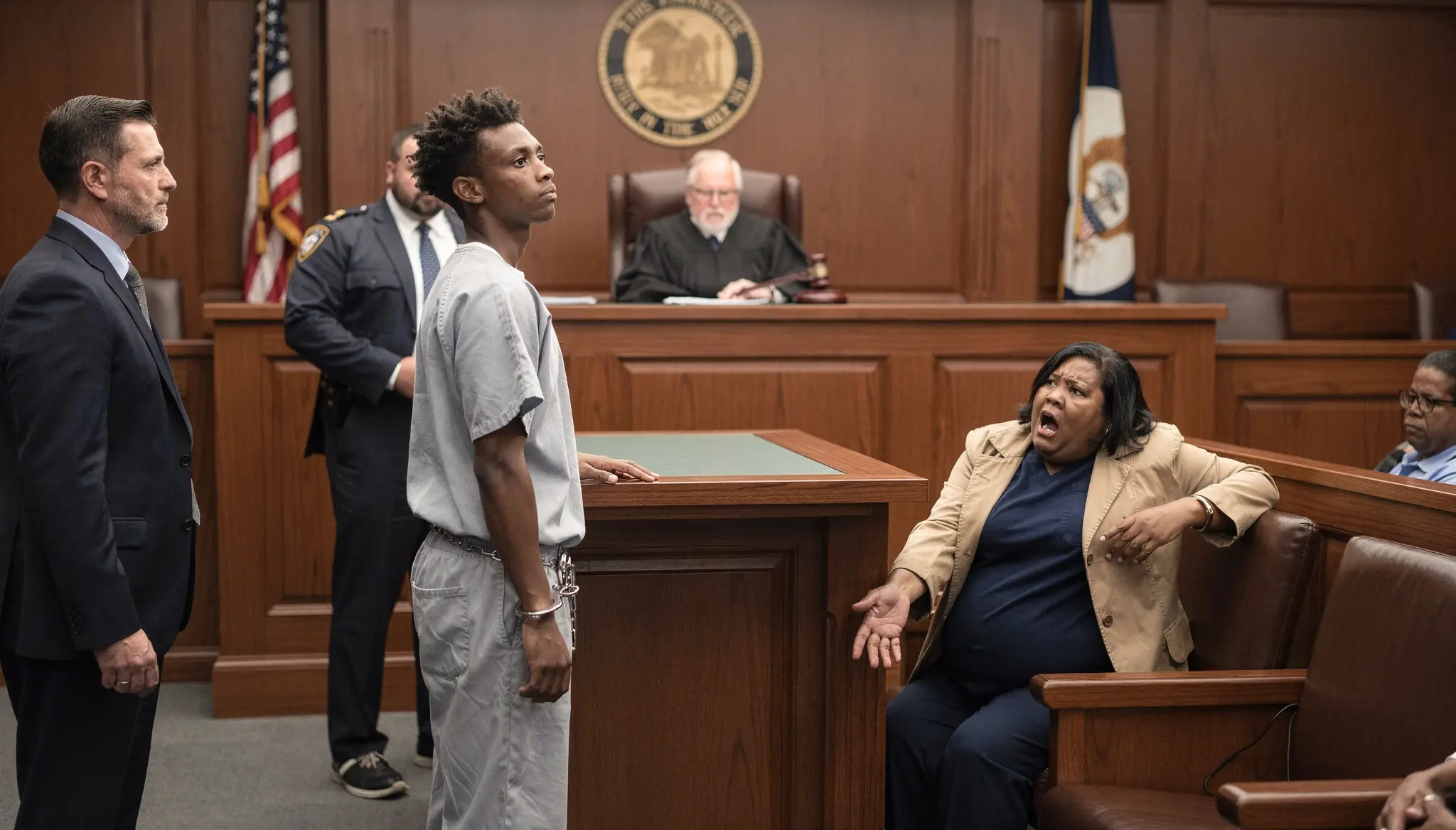
"You are about to spend the rest of your life in a cage." The courtroom fell into a heavy, dead silence. Jamal's voice cracked. "Your Honor, I did not do this." The judge's eyes narrowed. "Life imprisonment without the possibility of parole." The gavel struck like a branch snapping.
Jamal's mother screamed from the front row. The sound echoed from every wall in the courtroom, and the judge did not flinch. But the judge had no idea who the young man's father was. When the courtroom door opened, his face went pale.
Macon County, Georgia, was one of those small towns where everybody knew your name but nobody knew your business. Pine trees lined the back roads. Sunday church bells carried for miles. The kind of place that looked peaceful on the surface and kept its ugliness tucked behind closed doors.
Jamal Hayes lived on Oakfield Drive, a quiet street with modest homes, trimmed lawns, and American flags hanging from a few porches. It was one of the only mixed-race neighborhoods in the county. Black families on one end, white families on the other, and a whole lot of silence in between. The sky was still purple.
Dew sat heavy on the grass. The only sound was a screen door creaking open. Jamal stepped onto the front porch in his running shoes. He was eighteen years old, tall and lean, built like a runner because that was exactly what he was.
Varsity track, two county records, and a shelf full of trophies in his bedroom that he never talked about. He stretched against the porch railing, popped his earbuds in, hit play on a podcast about college admissions essays, then he took off running down the county road. Five miles, the same route every Saturday: past the cotton fields that hadn't been planted in years, past the old Baptist church with the crooked steeple, past Mrs. Henderson's house. She was out watering her roses already, and she waved at him the way she had waved at him since he was a boy.
He waved back without breaking stride. This was Jamal. No trouble, no record, no drama. Just a kid who ran fast, studied hard, and kept his head down.
Back at the house, the kitchen smelled like coffee and butter. Tamara Hayes stood at the stove flipping pancakes. She wore scrubs for her Saturday shift at the community health clinic. The radio on the counter played gospel music low enough to hum along to.
"Jamal, breakfast." He came through the back door sweating, grabbed a glass of water first, then sat down at the table where a plate was already waiting. "Your father is flying in next Thursday," Tamara said, not looking up from the stove. "He wants to see your report card." "Already emailed it to him." "Good, because you know that man will quiz you at the dinner table." Jamal smiled, a real smile, the kind that creased the corners of his eyes. His father, Colonel Desmond Hayes.
The man had been in Washington for months working on something Jamal only half understood. A commission, government meetings, important people in important rooms. All Jamal knew was that his dad called every Sunday night without fail, asked about grades, asked about track times, asked if he was being safe. Always that last question, every single call.
"You being safe out there, son?" "Yes, sir." "You remember what I told you?" "Yes, sir." "Hands on the wheel, engine off." "Yes, sir." "No, sir." Colonel Desmond Hayes had given Jamal the talk when he was a boy. Not the birds-and-bees talk. The other one. The one black fathers give their sons about what to do when you see flashing lights behind you.
How to survive a traffic stop. How to stay alive when someone with a badge decides you look like trouble. Jamal's bedroom told the story of a kid with a future. Track trophies lined the windowsill.
A poster of Jesse Owens hung above his desk. On the corkboard next to his bed, pinned right in the center, was an acceptance letter from Emory University. He had read it so many times the edges were soft. On the dresser, a framed photo.
Jamal at 14 standing next to his father in full military uniform. Both of them smiling. Jamal barely came up to Desmond's shoulder in that picture. Now, here is what you need to understand about Macon County.
It looked like a postcard. It felt like a trap. Black residents made up about thirty percent of the population, yet nearly eighty percent of the faces behind bars in the county jail were Black. The numbers told a story that nobody in power wanted to read.
And sitting at the center of that story was Judge Harlan Whitaker. He had spent years on the bench and had run unopposed in every election. Defense attorneys around the county had a nickname for his courtroom. They called it the pipeline.
If you were Black and you drew Whitaker's name, you did not pray for justice. You prayed for mercy. And mercy was not something Harlan Whitaker kept in stock. The back roads of Macon County had gone pitch black.
Then the blue lights exploded in his rearview mirror, red and blue strobing hard, slicing through the dark like knives. Jamal's stomach dropped straight to the floor. Not because he had done anything wrong, but because his father's voice kicked in before his own thoughts could. Hands on the wheel, engine off, dome light on.
Yes, sir. No, sir. Don't reach for anything. Don't argue, just survive.
He pulled onto the gravel shoulder, cut the engine, clicked the dome light on, placed both hands on the steering wheel at 10:00 and 2:00, and waited. The patrol car just sat behind him. Lights spinning, radio hissing and popping. The crunch of boots on gravel did not come for what felt like an hour.
Then, a flashlight hit him square in the face. Deputy Vance Hargrove, in his mid-thirties, thick neck, buzz cut, one hand gripping the flashlight like a weapon, the other resting on his holster, fingers tapping the leather. There was no greeting, no "good evening," and no "Do you know why I pulled you over?" His first words were five sharp syllables: "Where did you get this car?" Jamal kept his hands perfectly still. "It is my mother's, sir." "Your mother's?" The way Hargrove said it, slow and mocking, made it sound like a joke.
"Yes, sir. Tamara Hayes." "The registration is in the glove box. I can get it--" "Don't move." Jamal stopped breathing. Hargrove dragged the flashlight across the back seat, the passenger seat, then back to Jamal's face.
He held it right in his eyes, close enough to feel the heat until they started watering. "License." Jamal reached slowly with his left hand. Back pocket, wallet, license out. Handed it over with two fingers.
Hargrove looked at it for maybe 3 seconds, did not read it, just looked at the photo, then back at Jamal's face. "Step out." "Sir, may I ask why--" "Step out. Now." Jamal opened the door. His legs felt like water.
He stepped onto the gravel. The night air hit him. Cool, smelling of pine sap and damp red clay. Crickets screamed in the ditch.
A dog barked somewhere far away. Hargrove grabbed him by the bicep hard, spun him around, shoved him face-first against the hood of the Honda. The metal was still warm from the engine. "Hands flat." "Sir, I was not speeding. I did not do anything." "You match a description. Convenience-store robbery an hour ago. The suspect was a young Black male." That was it.
Young black male. That was the entire description. Jamal's pulse hammered in his neck. "I was at my friend's house since four o'clock. Caleb Brooks and his parents were there. You can call them right now." Hargrove did not even acknowledge the words.
He yanked Jamal's wrist behind his back. The handcuffs snapped shut. Cold steel grinding against wrist bones. "Officer safety," Hargrove muttered, the words routine, practiced, and bored.
A second patrol car rolled up behind them. More lights, more gravel dust. A younger white officer in his mid-twenties climbed out, thin and visibly uneasy, looking like he would rather be anywhere else on Earth. He gave Hargrove a short nod, kept his distance.
Hargrove turned to the Honda, opened the driver's door without a word. "Sir, I do not consent to a search." "Shut up." He ransacked the car, tore through the glove box, threw papers on the passenger seat, grabbed Jamal's track bag from the back, and dumped it on the gravel. Running shoes, a towel, a water bottle, an SAT prep book with a cracked spine. Nothing.
Popped the trunk, pulled up the carpet, lifted the spare tire cover, ran his fingers along every seam. Nothing. He slammed the trunk so hard the whole car shook. His jaw clenched.
His neck had gone red from the collar up. He stood there for a moment, breathing hard through his nose, staring at the empty trunk like it had personally insulted him. He looked at the younger officer. The younger officer stared at his own shoes.
Then, Hargrove walked back to the driver side one more time. He leaned into the car slowly. His upper body disappeared inside. His back blocked the entire window.
When he stood up, he was holding a small plastic bag between his thumb and forefinger. "Well, look at that." Jamal's blood turned to ice. "That is not mine." "Found it wedged right under your seat." "That is not mine. I have never seen that in my life." Hargrove held the bag up in the flashlight beam, turned it back and forth, almost admiring it.
"Possession with intent to distribute. That is a felony, kid." "I do not use drugs. I am a runner. I am on the varsity track team. Test me right now, please. That is not mine." Jamal's voice shattered.
His eyes were burning. His entire body was vibrating. Not from cold, not from wind, but from the kind of raw terror that starts behind your ribs and does not stop spreading. The younger officer was 6 ft away.
He saw everything. His right hand trembled at his side. His mouth opened once, then closed. He said nothing.
Hargrove seized Jamal by the back of the neck, marched him to the patrol car, shoved him into the backseat hard enough that his forehead cracked against the plexiglass divider. "Please, just let me call my mom." The door slammed shut. No Miranda warning, no explanation, no phone call-- just the growl of the engine and blue lights still painting the trees. Jamal pressed his cheek against the cold window.
Through the glass, he watched his mother's Honda grow smaller and smaller until the dark swallowed it whole. Eighteen years old, never before in the back of a police car, not once in his entire life. Tamara Hayes's phone buzzed on the kitchen counter. She was wiping down the stove, gospel music still humming from the radio.
She picked up and listened for six seconds. The glass in her other hand hit the tile floor and exploded. She drove to the county jail, hands shaking on the wheel, vision blurred. The desk officer looked up when she came through the door.
"I am here for my son, Jamal Hayes." "Ma'am, he is being processed. You will have to come back in the morning." "No. That is my child. I need to see him now." "Ma'am--" "That is my child." They did not let her in.
She sat in the parking lot for hours, engine off, doors locked, calling Desmond over and over and over. Voicemail every time. Inside, Jamal was in a holding cell, metal bench, cinder block walls. Two older men he had never seen before sleeping on the floor.
The fluorescent tube overhead buzzed and flickered like a dying heartbeat. The air was thick with bleach and stale sweat. He did not sleep. He sat with his back against the wall, knees to his chest, staring at the floor until the light through the window turned gray.
When Tamara was finally allowed in the next morning, she found him in exactly the same position, thinner somehow, eyes swollen red, hands still trembling. He looked up at her and said five words. "Mom, I did not do anything." She knew. Every mother knows.
But knowing did not matter, not here, not in this county. The charge dropped like a hammer. Possession with intent to distribute, a felony. Under Georgia's sentencing guidelines, the maximum penalty was life imprisonment.
Jamal Hayes, honor roll student, varsity track captain, acceptance letter from Emory University pinned to his bedroom wall, now facing life in prison for a bag that was never his. The bail hearing lasted only minutes--minutes to decide whether an 18-year-old with no criminal record, no history of violence, and no prior contact with law enforcement deserved to breathe free air while awaiting trial. Judge Harlan Whitaker sat behind the bench like a man waiting for his lunch reservation, arms folded, jaw set. He did not look at Jamal, not once.
Not when the charges were read aloud, not when the public defender rose to her feet, not when Tamara Hayes pressed a tissue against her mouth in the front row trying not to make a sound. Lena Brooks, Jamal's court-appointed attorney, looked as though she had not slept in days, because she had not. Mid-40s, bags under her eyes dark enough to look like bruises. She had eighty-five active cases stacked on her desk, no investigator, no paralegal, and no budget.
She stood up and did what she could. "Your Honor, my client is eighteen years old with no criminal history whatsoever. He is a high school senior with a verified acceptance to Emory University. He has deep ties to this community. His mother is present in this courtroom. He poses zero flight risk. We respectfully request release on personal recognizance." Whitaker cut her off before the last word left her mouth.
"Bail is set at $500,000." The number landed like a slap. Brooks's lips parted. "Your Honor, that amount is extraordinarily disproportionate for a first-time offender with no--" "Are you telling me how to run my courtroom, Counselor?" "No, Your Honor. I am simply pointing out that--" "Sit down." She sat. $500,000 for a kid whose mother earned $42,000 a year wiping down exam tables at a community health clinic.
They might as well have said $5 billion. Jamal went back to his cell. The metal door clanged shut behind him. That sound, steel against steel, would follow him into his sleep for weeks.
Tamara spent the rest of that day calling Desmond fourteen times. Fourteen calls. His phone was powered off. He was locked inside a classified briefing at the Department of Justice.
No personal devices, no exceptions. She called his office line. She called his assistant's cell. She called two colleagues whose emergency number she kept folded in her wallet.
Nobody answered. She left voicemails that started steady and ended in pieces. "Desmond, it is our son. They took Jamal. Please call me." An hour later, she left another.
"Desmond, they will not let me see him. Something is very wrong." At midnight, her voice finally broke. "Desmond, please. Please. I cannot do this alone." She was alone.
Completely and terrifyingly alone. Pastor Elijah Buford organized a prayer vigil outside the courthouse that Sunday. Forty people came. They held candles.
They sang hymns. They stood in a circle on the courthouse lawn under a sky full of stars. The local news station drove past. They did not stop.
Nobody was coming to rescue Jamal Hayes. Not yet. Then Brooke Langley stepped into the picture. Assistant District Attorney, in her late thirties, blonde hair pulled into a knot so tight it looked painful.
Gray suit, heels that clicked down the courthouse hallway like a metronome. She had a smile that never once touched her eyes. Langley did not care about truth. Langley cared about numbers.
Her conviction rate was ninety-six percent. She kept a framed printout of that statistic on her office wall right next to her law degree. She reviewed Jamal's file in under a day. Her strategy was immediate.
Maximum sentence, no plea negotiation, no second chances. She called Brooks on a Tuesday morning. Her voice was calm and friendly. The way someone sounds right before they twist the knife.
"Let me be honest with you, Lena. Your client is staring down a life sentence. The evidence is solid. The arresting officer's report is clean. Save everyone some time. Tell your boy to take the deal. Fifteen years. That is generous." "The evidence is far from solid, Brooke. That stop had no probable cause. There is no dash-cam footage in the file. The chain of custody on the substance has gaps you could drive a truck through. My client also has a solid alibi. He was at a friend's house all evening with multiple witnesses." Langley paused just long enough to let the silence sting.
"Have you actually contacted those witnesses?" "I am working on it. I have eighty-five other cases." "Fifteen years. The offer expires Friday at five. After that, we go for the maximum." The line went dead.
Langley never contacted the alibi witnesses herself. Never requested the dash-cam footage. Never questioned a single inconsistency in Hargrove's report. She took his paperwork, rubber-stamped it, and built her case on top of it like a house on sand.
Her record against Black defendants under twenty-five in Macon County was unblemished. Not a single acquittal. Not one. Let that number breathe for a second.
Not one. Jamal spent weeks in county jail waiting for trial. Weeks in a general population pod with grown men twice his age and three times his weight. Men with hollow eyes and tattooed knuckles who looked at him like a sheep that had wandered into the wrong pen.
He slept in fifteen-minute fragments, jolting awake at every shout, every door slam, every boot on concrete. He lost twelve pounds. His cheekbones became visible. His track coach called the jail twice asking for updates.
Both times he was told, "No information available." But the worst part was not the fear. It was not the noise or the cold or the food that tasted like wet cardboard. The worst part was the silence inside his own head. Hours and hours of nothing.
Sitting on that metal bench, staring at cinder block walls, replaying the same five seconds on an endless loop. Hargrove leaning into the car, his back filling the entire window, and then standing up with that bag pinched between his fingers, over and over. Every single night, Jamal got one phone call per week. The phone was bolted to the wall in the common area.
A line of men waited behind him. They could hear everything. He tried to sound strong for his mother. He made it about twelve seconds.
"Mom, I am okay." "Baby, talk to me." "I am fine. I promise." A pause followed. Then his whole voice fell apart like wet paper. "Mom, I did not do anything. You know that. Why will no one listen to me?" Tamara pressed the phone against her ear so hard it left a red mark on her skin.
She could not speak. She just breathed slow and steady so he could hear she was still there. Still standing. Still fighting.
The trial was set only weeks after the arrest--unusually fast, suspiciously fast. Brooks filed four pre-trial motions. Suppress the evidence. Dismiss for lack of probable cause.
Compel production of dash-cam footage. Challenge chain of custody. Whitaker denied all four. He spent barely any time on any of them.
He barely flipped through the pages. Just scratched denied in red ink and moved on like he was signing receipts. Jury selection was theater. Langley used peremptory challenges to strike three of the four Black jurors from the pool.
Whitaker did not just allow it. He nodded along after each one. A small knowing nod. The kind two people share when they are playing the same game.
Final jury. Eleven white faces. One Black face. An elderly woman seated in the back row who folded her hands in her lap and stared straight ahead like she already knew exactly how this story was going to end.
The trial lasted two days. Hargrove testified first. Confident. Polished.
Every answer crisp and rehearsed. He never stumbled. Never paused. Never broke eye contact with the jury.
The second officer took the stand next. He corroborated everything Hargrove said. But his voice cracked on the third question. His eyes dropped to the floor.
His right knee bounced under the witness table so hard the microphone picked up the vibration. He was terrified. Anyone paying attention could see it. Nobody on the jury was paying attention.
Langley delivered her closing argument like a surgeon with a scalpel. She never used the word black. She did not need to. She said this element.
She said these neighborhoods. She said, "If we do not send a message now, when do we?" The message was clear. Every person in that courtroom heard it. Brooks gave her closing.
It was thoughtful. It was logical. It was completely ignored. The jury deliberated for a little over an hour.
Guilty. Jamal did not move. He stood there behind the defense table like a man who had been turned to stone. His eyes were open, but they were not seeing anything.
Sentencing came the following Monday. Whitaker looked down from the bench. He adjusted his glasses. He cleared his throat.
"Life imprisonment without the possibility of parole." The courtroom cracked open. Gasps. A woman in the third row covered her mouth with both hands. Even some of the white spectators turned to each other, wide-eyed, shaking their heads.
Brooks launched to her feet. "Your Honor, this sentence is grotesquely disproportionate to--" "One more word, Counselor. One more word and I will hold you in contempt of this court." She stopped. Her hands were trembling against the table.
In the front row, Tamara Hayes collapsed. Her body simply gave out. Pastor Buford caught her a half second before her head hit the bench. The sound that came out of her was not a scream.
It was something deeper, something animal. The sound of a mother watching her child be buried alive. Jamal was led out in chains, wrists, ankles, a metal belt around his waist. At the courtroom door, he turned his head just barely and looked back at his mother one last time.
He had not even graduated high school. A black SUV pulled into the Macon County Courthouse parking lot. The engine was still running when the rear door opened. Colonel Desmond Hayes stepped out.
He did not rush. He did not stumble. He did not look like a man who had just flown hundreds of miles on little sleep after hearing his only son had been sentenced to die in prison. He looked like a man who had come to burn something down.
Quietly, legally, completely. Dark navy suit, tailored white shirt, no tie, leather briefcase in his left hand, thick, heavy, full of weight. Two associates from his Washington firm walked behind him, both young, both sharp, both carrying bankers boxes filled with documents. The courthouse security guard looked up from his desk.
He had worked this entrance for years. He had seen every public defender, every court-appointed lawyer in a wrinkled suit shuffling through with fast food, coffee, and a prayer. He had never seen anything like this. Desmond placed his briefcase on the x-ray belt, walked through the metal detector, collected his bag on the other side.
"Which way is the clerk's office?" "Down the hall, last door on the left." "Thank you." His shoes clicked on the marble. Each step echoed. People in the corridor turned their heads as he passed, not because he was loud, but because he was the quietest thing in the building. And somehow that made him impossible to ignore.
At the clerk's window, Desmond set down a thick filing. The clerk, gray-haired, bifocals, read the cover page, stopped, read it again. Emergency Motion for New Trial and Vacatur of Sentence, filed by Colonel Desmond Hayes, J.D., U.S. Army, Retired; Senior Partner, Townsend, Mercer and Hayes, Washington, D.C. Current member of the Presidential Commission on Criminal Justice Reform. Co-counsel with the NAACP Legal Defense and Educational Fund.
The clerk looked up at Desmond over her glasses, then down at the document, then back at Desmond. "I will need to get this to Judge Whitaker immediately." "Yes," Desmond said. "You will." The filing did not just challenge the verdict, it detonated it. Page 1: a federal civil rights complaint under Section 1983 naming Whitaker, Hargrove, and Langley individually as defendants.
Page 12: dash-cam footage analysis. Hargrove had claimed the dash cam was malfunctioning. Desmond's team recovered the footage from the county's own cloud server. It existed.
It always existed. And it showed everything. Page 23: certified cell-phone records confirming Jamal's device was connected to Caleb Brooks's home Wi-Fi the night of the robbery. At the time of the robbery, Jamal was miles away.
Page 31: forensic analysis of the plastic bag. Zero fingerprints--not Jamal's, not anyone's. A bag supposedly found in a car driven daily and not a single print on it. Page 39: formal notification that the FBI's public corruption unit had opened a preliminary inquiry into civil rights violations in the Macon County justice system.
Page 44: a list of media outlets that had received the dash-cam footage that morning. CNN, The Atlanta Journal-Constitution, The Associated Press, The Washington Post. Every page was a nail. The coffin was already built.
Emergency hearing that afternoon. Whitaker walked in expecting another routine motion he could swat away with a flick of his wrist. He saw Desmond Hayes standing at the defense table. He did not know who Desmond was.
Not yet. Then the clerk handed him the filing. He opened it, read the cover page, his fingers stopped. Page one.
The color left his cheeks. Page 12. His jaw locked. Page 39.
At the FBI notification, his right hand began to tremble. The pages shook visibly. The court reporter saw it. The bailiff saw it.
Everyone in the room saw it. He looked up at Desmond. Desmond looked back. Calm.
Still. Two steady eyes that said everything without a single word. Whitaker asked for a recess. First time in years on the bench, his voice cracked.
"The court will take a brief recess." He was gone for several minutes. When he returned, his face was gray, his hands clasped together to stop the shaking. "The court grants the motion for a new trial. The defendant is ordered released on his own recognizance, effective immediately." He did not look at Desmond when he said it.
He could not. Hours later, Jamal Hayes walked out of the Macon County Jail in the afternoon sun, clothes hanging loose, eyes hollowed out, skin dull from weeks without daylight. Tamara was standing by the car. Desmond was beside her.
Jamal saw his father and stopped walking. Just stopped like his legs forgot how to work. Desmond crossed the distance in four steps, wrapped both arms around his son, and held him so tight Jamal's feet nearly left the ground. Jamal buried his face in his father's shoulder and sobbed.
No words, just sound. The kind of crying that comes from somewhere deeper than the throat, from the belly, from the bones, from a place that had been clenched shut for weeks and finally broke open. Tamara pressed herself against both of them, hands gripping the back of Jamal's shirt, eyes closed, lips moving in a prayer no one else could hear. They stood in that parking lot for a long time.
Three people holding each other up. But Colonel Desmond Hayes had not come to Georgia just to free his son. He had come to make sure this never happened again to anyone. The real fight was just beginning.
The dash-cam footage hit the internet the next morning. Desmond's team did not leak it. They did not have to. The Associated Press ran it first, then CNN picked it up, then every local affiliate in Georgia, then the rest of the country.
Within hours, it had been viewed millions of times. The footage was grainy, nighttime, blue lights strobing in the background. But what it showed was unmistakable. Hargrove approaching Jamal's car.
The first search, tearing through the glove box, the track bag, the trunk, finding nothing. His body language shifting, frustration, tightening his shoulders, stiffening his neck. Then the second approach, driver's side, leaning in, his right hand reaching not into the car, but into his own vest pocket. The dash-cam from the second patrol car caught the angle perfectly.
You could see his fingers close around something small. You could see him tuck it beneath the seat. You could see him pull his hand back out, empty, then reach under the seat again from a different angle, this time for the camera he thought was broken. He came out holding the bag like he had just discovered it.
The crucial sequence lasted only seconds--seconds that ended a man's career, his freedom, and every lie he had ever told under oath. Hargrove was placed on administrative leave by noon. He tried to get ahead of it, stood in front of a single local news camera in his driveway, still in uniform, and said four words, "I followed standard procedure." The clip went viral for all the wrong reasons. People turned it into memes.
They auto-tuned it. They put it on t-shirts. "I followed standard procedure" became the most sarcastic sentence on the internet for an entire week. Then the second officer broke.
His name did not matter. What mattered was what he said in his sworn statement delivered to the FBI hours after the footage dropped. Hargrove had pulled him aside after the arrest that night in the parking lot of the station. No body cameras, no witnesses.
"Keep your mouth shut. The kid will take a plea. Nobody is going to look twice at this." That was the quote. Word for word, under oath.
The second officer said he had not slept a full night since the arrest. He said he saw Jamal's face every time he closed his eyes. He said he knew that night standing on that gravel road that what Hargrove did was wrong. He said nothing then.
He was saying everything now. Too late for courage, just early enough for the truth. Brooke Langley moved fast, but not fast enough. She released a public statement on a Wednesday afternoon, carefully worded, lawyerly, and bloodless.
"My office relied upon the evidence as presented by the arresting officer. At no point was I made aware of any irregularities in the investigation." She was distancing herself from Hargrove like a passenger jumping from a sinking ship. It did not work. Desmond's team filed a formal bar complaint against Langley within hours.
The charges: prosecutorial misconduct, withholding exculpatory evidence. The alibi witnesses were never contacted, encouraging racially biased jury selection, knowingly presenting testimony that contained material falsehoods. Langley was suspended from practice pending a full investigation. Her office fell into chaos.
Two junior prosecutors requested transfers that same week. She stopped answering her phone. Then, the spotlight swung to Whitaker. Journalists from the Atlanta Journal-Constitution pulled years of sentencing data from Macon County public records.
The numbers told a story that should have been told a decade ago. Black defendants in Whitaker's courtroom received sentences three and a half times longer than white defendants for identical charges. His acquittal rate for Black defendants was less than two percent. His bail amounts for Black defendants averaged four times those imposed on white defendants with similar profiles.
Years exposed in a single spreadsheet. Former defendants and their families began coming forward one after another. Stories that had been buried in plea deals and sealed records started surfacing like bones washing up on shore. Coerced guilty pleas, denied motions, witnesses who were never called, evidence that was never examined.
Lives that were quietly destroyed while nobody was watching. The Georgia Judicial Qualifications Commission opened a formal inquiry. Whitaker's attorney issued a one-line statement. "Judge Whitaker is confident he will be fully vindicated." Whitaker himself said nothing.
He drove home from the courthouse that evening, pulled into his garage, and closed the door behind him. The blinds in his house went dark. They stayed dark. Outside the world was just getting started.
Pastor Buford's church held a service that Sunday, standing room only. People drove in from three counties. The congregation was electric. Relief and rage braided together so tightly you could not pull them apart.
Jamal's case was not special. That was the whole point. It was just the first one that got caught. The FBI did not knock politely.
They came. Three black sedans, six agents, body armor under their jackets, a federal warrant folded in a plastic sleeve. Vance Hargrove was eating cereal in his kitchen when the doorbell rang. He opened the door in a t-shirt and boxer shorts.
The bowl was still in his hand. He saw the badges and the bowl hit the floor. "Vance Hargrove, you are under arrest for deprivation of rights under color of law, evidence tampering, and filing a false police report." They cuffed him in his own doorway. The same hands that had snapped cuffs onto Jamal Hayes weeks earlier were now pinned behind his own back.
The metal bit into his wrists the same way. Cold, tight, final. A news helicopter was already circling overhead. Someone had tipped off the press.
The perp walk was broadcast live on three networks before Hargrove's bare feet hit the driveway. The irony wrote itself. A man who had planted evidence on an innocent teenager was now being dragged out of his own home in his underwear on national television. The federal trial was held in Atlanta: neutral ground, no hometown jury, no friendly judge, no rigged courtroom.
Hargrove's defense attorney, a private lawyer paid for by the police union, tried everything. He argued the dash-cam footage was inconclusive. He argued the angle was misleading. He argued that Hargrove's hand movement could have been him reaching for a flashlight, not his vest pocket.
The jury watched the footage three times, slow motion, frame by frame. The prosecutor froze it at the exact second Hargrove's fingers closed around the bag in his own pocket. Inconclusive was not the word anyone in that room would have used. The second officer testified at length.
He described the night in detail. The gravel road, the empty trunk. Hargrove's frustration. The moment he leaned back into the car.
He repeated the parking lot conversation word for word. "Keep your mouth shut. The kid will take a plea. Nobody's going to look twice at this." Hargrove sat at the defense table and stared at the wall.
He did not testify. His attorney advised against it. Smart move. Because there was nothing left to say.
The jury deliberated for several hours. Guilty. All counts. Sentencing came weeks later.
The federal judge, a Black woman in her fifties with many years on the bench, looked at Hargrove for a long time before she spoke. "You were entrusted with the authority to protect. You used that authority to destroy. You planted evidence on a teenager. You lied under oath. You stole months of a young man's life and nearly stole the rest of it. This court does not take that lightly." Fifteen years in federal prison, with no possibility of early parole.
Fifteen years--the exact number Hargrove and Langley had tried to force Jamal to accept in a plea deal. The exact number. The courtroom erupted. Hargrove's wife sobbed in the gallery.
Hargrove himself did not react. He just sat there staring at the table while the marshals came to take him away. He shuffled out in shackles. The same posture.
The same dead-eyed stare. The same man. Only now on the other side of the system he had weaponized.
Brooke Langley's reckoning came quietly.
No cameras. No helicopters. Just a wood-paneled hearing room and a five-member disciplinary panel of the Georgia State Bar. The charges were read in a flat, clinical voice.
Prosecutorial misconduct. Failure to disclose exculpatory evidence. Racially motivated jury selection strategy. Reliance on testimony she had reason to believe was false.
Langley's attorney argued she was a victim of circumstance. She had trusted law enforcement. She had followed protocol. She had no knowledge of Hargrove's actions.
The panel did not buy it. Their finding was unanimous. Langley had engaged in a pattern of willful blindness that prioritized conviction statistics over the constitutional rights of defendants with a demonstrable and disproportionate impact on Black citizens of Macon County. Permanent disbarment, effective immediately.
Langley walked out of the hearing room without speaking to anyone. No public apology, no press conference, no statement of remorse. She packed her office into two cardboard boxes, loaded them into her car, and drove out of Macon County without looking back. She was never heard from again.
Then came Harlan Whitaker. The Georgia Judicial Qualifications Commission spent months building its case. They did not rush. They did not need to.
The evidence was a mountain. Years of sentencing data exposed, analyzed, verified by three independent statisticians. The numbers were not ambiguous. They were not debatable.
They were damning. Whitaker's attorneys fought back hard. They filed six separate motions to dismiss. They claimed the investigation was politically motivated.
They argued that sentencing disparities were a reflection of case differences, not racial bias. The Georgia Supreme Court reviewed the record. All of it. Every motion Whitaker had denied.
Every bail amount he had set. Every Black defendant he had sentenced to the maximum while handing white defendants probation for the same crime. Their ruling was unanimous. Removal from the bench, effective immediately.
He became the first sitting judge removed in the state of Georgia in many years. But Colonel Desmond Hayes was not finished. He filed a federal civil rights lawsuit on behalf of Jamal and a class of former defendants, all Black, all sentenced by Whitaker. All with cases that showed the same pattern of inflated charges, suppressed evidence, and excessive punishment.
The lawsuit resulted in a landmark consent decree. Macon County was required to overhaul its public defender system, implement mandatory body-camera and dash-cam policies, submit to independent oversight of its courts for several years, and establish a review board for all sentences handed down during Whitaker's tenure. Whitaker's pension was revoked. His years of service were erased from the books.
He was last seen leaving the courthouse carrying a single cardboard box. No colleagues walked him out. No one shook his hand. The hallway was empty.
His footsteps echoed off the same marble floors that had once made him feel untouchable. The story went national, then international. Jamal's face appeared on magazine covers. Not his mugshot, but a portrait taken by a volunteer photographer.
He was wearing his track uniform, mid-stride, eyes forward, running toward something instead of away from it. Desmond gave one televised interview, just one. He sat across from the camera in a plain chair, with no notes and no teleprompter. "My son is not a symbol. He is an eighteen-year-old kid who should be worrying about college orientation, not prison. The system did not fail. It worked exactly the way it was designed to work. That is what has to change." The hashtag #JusticeForJamal trended for days.
Jamal Hayes went back to school on a Tuesday morning in April. He walked through the front entrance of Macon County High School. Same hallway, same lockers, same fluorescent lights buzzing overhead, but nothing felt the same. The floor looked different.
The air tasted different. He was different. His track teammates were waiting for him. All of them lined up on both sides of the hallway like an honor guard.
Nobody said a word. They just stood there, some with their arms crossed, some with tears in their eyes, and watched him walk through. Coach Raymond Davis was at the end of the line, gray-haired, weathered face, hands that had trained hundreds of runners over the years. He was holding something.
Jamal's jersey. Number nine, freshly pressed, still had his name stitched across the back. Coach held it out with both hands, did not say a speech, did not need to. "Welcome back, son." Jamal took the jersey, pressed it against his chest, and for the first time since he walked out of that jail, he cried.
Not the broken sobbing from the parking lot, something quieter, something that felt like the beginning of something instead of the end. He finished his senior year, not at the top of his class. The weeks he had lost could not be recovered, but he passed every subject, every exam. He walked across that graduation stage in June with his mother on one side of the auditorium and his father on the other.
Both of them were standing before anyone else rose. That summer, Emory University upgraded Jamal's admission to a full academic scholarship. He moved into his dorm room. He pinned his old acceptance letter, the one with the soft edges from being read too many times, to the corkboard above his new desk.
He declared pre-law. Nobody was surprised. By his second semester, Jamal had started a youth advocacy group that partnered with three Georgia high schools. He visited classrooms.
He visited detention centers. He stood in front of teenagers who looked exactly like him and said the same thing every time. "Know your rights. Record everything, and never let anyone tell you that your life does not matter, because it does." Colonel Desmond Hayes returned to Washington.
The Presidential Commission on Criminal Justice Reform used the Macon County case as the centerpiece of its final report. Desmond pushed for federal legislation requiring independent oversight of rural court systems. The bill was introduced in Congress that fall. Tamara Hayes kept working at the clinic.
She also launched a bail fund for families in Macon County who could not afford to buy their loved ones freedom. In its first year, the fund posted bail for numerous people. Every single one of them showed up for their court date. Every single one.
Macon County held its next judicial election months after Whitaker's removal. For the first time in the county's history, a Black woman was elected circuit court judge. She won by a decisive margin. Her first act on the bench was to order a full review of every felony conviction from the last decade of Whitaker's tenure.
Vance Hargrove sat in a federal prison cell in Alabama. He filed two appeals. Both were denied. He still had many years remaining on his sentence.
Harlan Whitaker applied for a position at a private law firm in Savannah. They turned him down before the interview. He moved out of state. No forwarding address.
Brooke Langley disappeared. No one in Macon County ever saw her again.