"Shut your mouth, boy. Since when does a Black kid from the gutter get to speak in my court?"
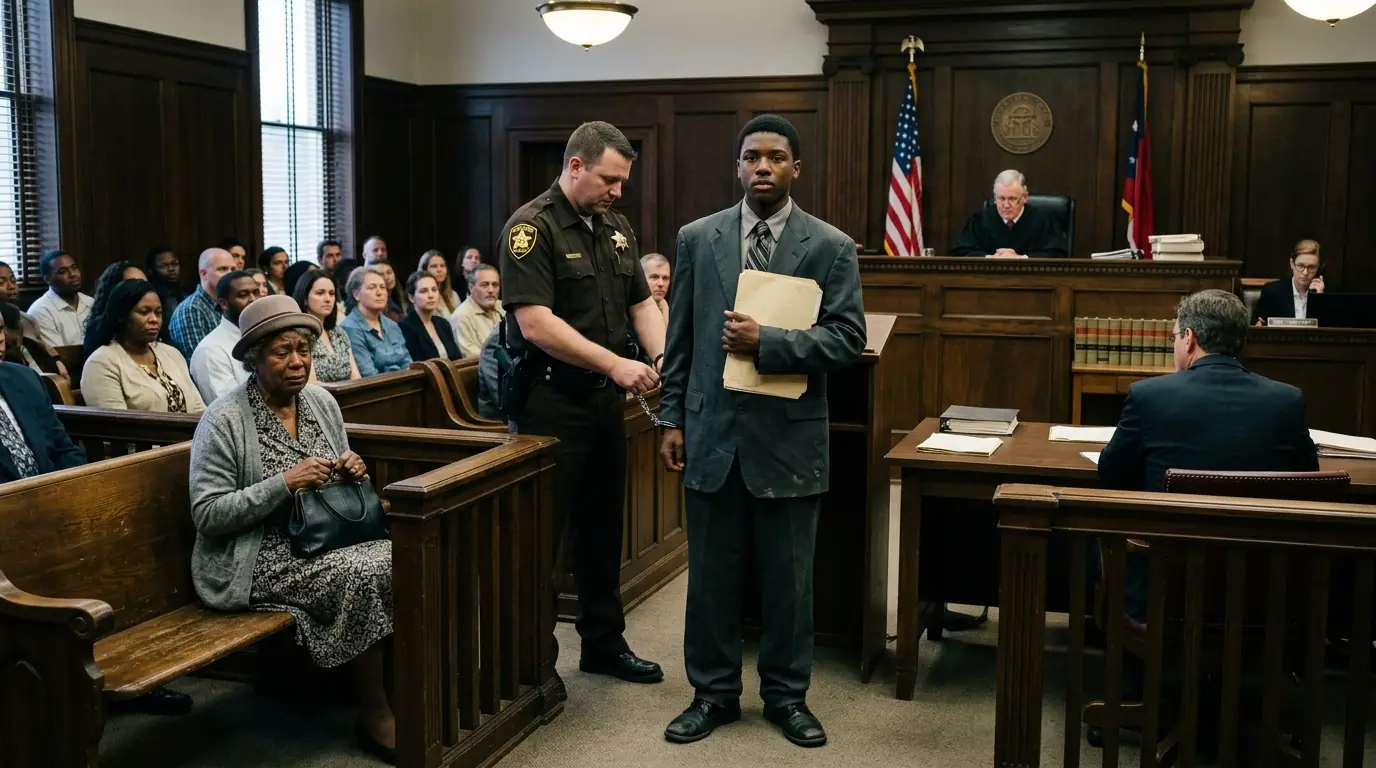
Judge Gerald Thornton didn't even look up when he said it. He just waved his hand like swatting away a fly and nodded to his bailiff.
Darnell Scott, seventeen years old, stood there in a borrowed suit.
"Your Honor, I have the right to—"
"You have no rights here. Deputy, cuff him."
The bailiff grabbed Darnell's wrists. The handcuffs clicked shut.
Forty people watched. Nobody moved.
But here's what the judge missed. The manila folder pressed against Darnell's chest held enough evidence to destroy everything he had built in thirty years.
And by tomorrow morning, the whole country would know it.
---
Cedarville sat in the deep belly of the American South. The kind of town where everybody knew everybody. But not everybody was treated the same.
A single set of railroad tracks cut the town clean in half.
To the west: neat lawns, good schools, and streets that got repaved every spring.
To the east: cracked sidewalks, boarded-up storefronts, and a neighborhood the city council pretended didn't exist.
Darnell Scott grew up on the east side. He lived with his grandmother, Lorraine Scott, in a small house with peeling paint on the outside and not a speck of dust on the inside. Lorraine kept that house spotless the way she kept her dignity—fiercely, quietly, and without asking anyone's permission.
She worked two jobs: morning shift at the hospital laundry, night shift stocking shelves at the grocery store across town. Most days Darnell only saw her for twenty minutes between shifts, standing at the kitchen counter eating cornbread and drinking black coffee before heading back out the door. But those twenty minutes mattered.
"Baby, this world will try to make you small," she told him once, buttoning up her work coat with tired fingers. "Don't you let it. You just be ready when your moment comes."
Darnell never forgot that.
At school, Darnell was the quiet one. Not because he had nothing to say, but because he learned early what happened when a Black boy in Cedarville spoke too loud, too fast, or too smart. Teachers called it "attitude." The principal called it "defiance."
So Darnell learned to keep his mouth shut and his eyes open. But every evening, after homework was done and the house went still, Darnell walked six blocks to the Cedarville Public Library. He sat at the same scratched wooden table under the same flickering lamp, and he read.
Not novels, not comics—law books, court transcripts, constitutional amendments, judicial ethics codes. He filled notebook after notebook with case citations written in small, precise handwriting. The kind of handwriting that comes from someone who knows every word matters.
Nobody knew about the notebooks. Not his teachers, not his friends, not even Lorraine.
That was Darnell's world: small, quiet, invisible.
---
Now, let me tell you about the man who ran the other side of town.
Judge Gerald Thornton had sat on the Cedarville County bench for thirty years. Thirty years of gavels and sentences and absolute, unquestioned power.
The white establishment loved him. The Chamber of Commerce gave him awards. The local paper ran a profile on him every few years with the same headline—*Guardian of Justice*—and the same photograph of him standing in front of the courthouse with an American flag pin on his lapel and a smile that never quite reached his eyes.
But on the east side of those railroad tracks, people didn't call him Guardian of Justice. They called him the Hammer.
Because when a Black defendant walked into Gerald Thornton's courtroom, the outcome was already decided before the first word was spoken.
Thornton never raised his voice. He didn't need to. He had something worse than anger. He had contempt. The quiet, settled kind. The kind that sits behind polished manners and pressed robes and makes a man believe, truly believe, that the people standing before him are less than human.
"These people don't respect the law," Thornton once said to a colleague over lunch at the country club, cutting into a steak without looking up. "They only understand consequences."
*These people.* That's how he said it. Like he was talking about a different species.
And for thirty years, nobody challenged him. Not the prosecutors who watched him hand down maximum sentences to Black teenagers for first offenses. Not the public defenders who advised their clients to plead guilty because fighting Thornton was a war nobody could win. Not the local politicians who needed his endorsement every election cycle.
Nobody.
Until a seventeen-year-old boy from the east side of the tracks decided he'd had enough.
---
It started on a Tuesday afternoon in the Cedarville High School parking lot. The kind of ordinary afternoon that changes everything.
Darnell's best friend, Calvin Moore, got into an argument with a white student over a parking spot. Words were exchanged. Voices got loud. Nothing more. No fists, no threats. Just two teenagers running hot over something stupid.
Then the school resource officer showed up.
He walked right past the white student, didn't even glance at him. He went straight for Calvin, grabbed him by the arm, pushed him against the car. Then he turned to Darnell, who was standing five feet away, holding his backpack, doing absolutely nothing.
"You two. Hands where I can see them."
Darnell didn't run, didn't resist. He just asked a question—the most dangerous thing a Black boy in Cedarville could do.
"Sir, I just want to understand the basis for detaining us when the other student was also—"
"That's enough. Hands behind your back."
The white student walked to his car, drove away, went home to dinner.
Darnell and Calvin were put in the back of a patrol car.
The charge? Disorderly conduct. And for Darnell—because he dared to ask a question—resisting a peace officer.
He was seventeen years old. He had never been in trouble, not once. And now he had a case file with his name on it, heading straight for Judge Gerald Thornton's courtroom.
The gears were already turning, and Darnell didn't know it yet, but he was about to walk into the fight of his life.
---
The juvenile processing center smelled like bleach and bad decisions. Darnell stood under a strip of fluorescent light that buzzed like a dying insect, while a clerk with bored eyes rolled ink across his fingertips one by one, pressing them onto a card like he'd done it a thousand times before.
Because he had.
Fingerprinted, photographed, filed.