"He thought she was an easy target."
"Miss Thompson, perhaps you'd like to explain the legal precedent to the court."
Judge Stanford smirked, expecting to humiliate this simple woman in the blue sweater.
The courtroom tensed as she stood, hands steady, despite the weight of all eyes upon her.
What happened next left the judge speechless and would change the course of her life forever.
Sandra Thompson stared at the stack of legal documents on her kitchen table, a cup of lukewarm coffee forgotten at her elbow.
At 40, her face carried the quiet dignity of someone who had weathered life's storms without losing her compassion.
Her dark hair was pulled back in a practical ponytail.
Her blue sweater worn but neat, much like the small apartment she called home.
"Mom, you sure about this?"
Jaime, her 16-year-old son, leaned against the doorframe, concern etched on his young face.
Sandra looked up, offering a smile that didn't quite reach her eyes.
"Not really, but what choice do I have?"
The letter from Apex Consolidated sat prominently at top the pile, a corporate giant claiming she had breached their service contract and owed them over $15,000 in penalties.
Money she simply didn't have.
"You could just pay what they're asking," Jaime suggested half-heartedly, knowing the impossibility of his words.
Sandra shook her head.
"That would mean emptying my savings for your college. Besides," she pushed back from the table, determination straightening her spine. "They're wrong. I fulfilled every term of that contract."
What Jaime didn't fully understand was how much his mother had sacrificed.
20 years ago, Sandra had been a bright-eyed law student with dreams of becoming an attorney.
Two years into her education, her parents' unexpected deaths and the mounting bills had forced her to drop out.
She'd taken an administrative job, scraping together enough to make ends meet.
But she'd never stopped learning.
The corner of her small living room told that story.
Stacks of law books purchased secondhand.
Legal journals borrowed from the public library.
Online courses completed late at night after Jaime went to bed.
For years, she had absorbed legal knowledge like a sponge, finding comfort in the structure and logic of the law, even as life remained stubbornly chaotic.
"I'll handle this," she said more to herself than to Jaime.
"I have to."
The next morning, Sandra dressed in her most professional outfit, the blue sweater and black slacks she kept for job interviews.
She carefully packed her documents into a worn leather bag that had been a gift from her parents when she first started law school.
As she walked to the bus stop, Sandra mentally rehearsed her arguments.
Apex was claiming she had failed to meet notification requirements when canceling their home security service, but she had records, emails, certified letters, even recorded phone calls.
She was prepared.
What she wasn't prepared for was Judge Robert Stanford.
The Jefferson County Courthouse stood imposing against the morning sky, its stone facade weathered by decades of rain and sun.
Sandra paused at the bottom of the wide steps, taking a deep breath to steady herself.
Inside, her footsteps echoed on the marble floor as she navigated the hallways, following the signs to courtroom 7.
When she pushed open the heavy wooden doors, the scene that greeted her was intimidating in its formality.
Rich mahogany paneling lined the walls, the American flag standing proudly near the judge's bench.
The room was already filling with lawyers in crisp suits, their confidence as apparent as their expensive attire.
Sandra took a seat at the table marked for defendants, feeling painfully out of place.
Across the aisle, two attorneys from Apex Consolidated arranged their documents with practiced efficiency.
Their matching navy suits and leather portfolios screamed corporate power.
"All rise."
The bailiff's voice rang out as a side door opened.
Judge Robert Stanford entered the courtroom with the self-assured stride of a man accustomed to commanding respect.
At 65, he cut an impressive figure, silver hair perfectly styled, his black robe settling around him like armor.
His reputation had preceded him.
28 years on the bench had earned him a nickname among the local legal community, "The Stanford Guillotine," for his swift and often merciless judgments.
As he settled into his chair, the judge's gaze swept across the room, pausing momentarily when he noticed Sandra sitting alone at the defense table.
A slight frown crossed his features before he turned his attention to the docket.
"First case, Apex Consolidated versus Thompson," he announced, his voice carrying the slight southern drawl of a native Virginian.
"Counsel, please identify yourselves for the record."
The Apex attorneys stood in unison.
"Jonathan Mercer and Lisa Chen for the plaintiff, Your Honor."
When the judge turned his attention to Sandra, his eyebrows raised expectantly.
"Sandra Thompson representing myself, Your Honor," she said, proud that her voice remained steady despite the butterflies in her stomach.
Judge Stanford looked at her over his reading glasses, making no attempt to hide his skepticism.
"Pro se, Miss Thompson. Are you certain that's wise?"
"Yes, Your Honor," Sandra replied simply.
The judge sighed, the sound clearly communicating his disapproval.
"Very well. Mr. Mercer, you may present your case."
As the Apex attorney launched into his opening statement, Sandra felt the weight of Judge Stanford's dismissive gaze.
She understood his unspoken message.
This would be quick, and it wouldn't end well for her.
Jonathan Mercer moved with the polished confidence of someone who had never doubted his place in the world.
His voice carried through the courtroom as he laid out Apex's case.
"Your Honor, this is a straightforward breach of contract.
Miss Thompson entered into a binding agreement with our client for home security services.
The terms clearly state that cancellation requires written notice 60 days in advance with confirmation of receipt.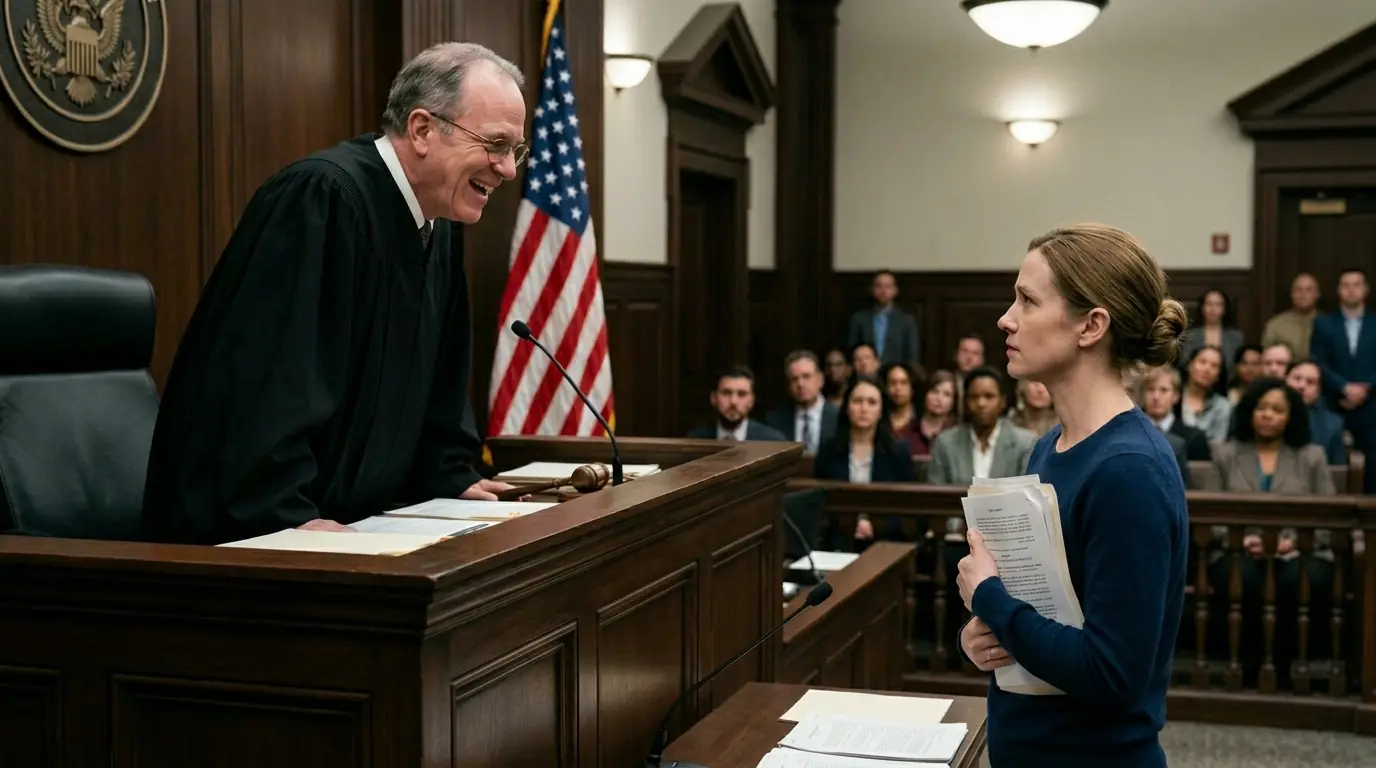
Miss Thompson failed to provide such notice, continued to use our services, and now refuses to pay the accumulated fees and contractually stipulated penalties."
Sandra listened carefully, taking notes on a legal pad.
Her handwriting was neat and precise, each point organized with the methodical attention of someone who had trained herself to think like a lawyer, even if she didn't have the degree to prove it.
When Mercer finished, Judge Stanford turned to her.
"Miss Thompson, your response."
Sandra stood, smoothing her sweater with steady hands.
"Your Honor, I did provide proper notice in accordance with the contract.
I have documentation showing multiple attempts to cancel the service within the required time frame."
She began distributing copies of her evidence—emails, certified mail receipts, and phone records.
Her organization was impeccable, each document labeled and highlighted at relevant passages.
"Furthermore," she continued, "I would direct the court's attention to section 4.3 of the contract, which states that notice is considered delivered upon sending, not upon confirmation of receipt.
The clause Mr. Mercer referenced applies only to disputes regarding service quality, not to cancellations."
A flicker of surprise crossed Judge Stanford's face, quickly masked by a frown.
"Miss Thompson, are you claiming to be familiar with contract law?"
"I'm familiar with this contract, Your Honor," she replied evenly.
"I've studied it carefully."
The judge studied her for a moment before turning to the Apex attorneys.
"Mr. Mercer, your response to Ms. Thompson's interpretation of section 4.3."
Mercer appeared slightly flustered as he shuffled through his documents.
"Your Honor, our position is that section 4.3 must be read in conjunction with Appendix B, which modifies the notice requirements for all communications."
"May I address that point, Your Honor?" Sandra asked.
Judge Stanford gestured for her to proceed, his expression a mixture of curiosity and skepticism.
"Appendix B was added to the contract after the initial signing date," Sandra explained, pointing to timestamps on the documents.
"Under the doctrine of contra proferentem, ambiguities in contracts are interpreted against the drafter, especially when modifications are made unilaterally without clear notification."
The courtroom fell silent as Judge Stanford's eyebrows shot up in genuine surprise.
"Ms. Thompson."
Judge Stanford's voice had a new edge to it.
"Where exactly did you learn about contra proferentem?"
The question hung in the air, a thinly veiled challenge.
Several attorneys seated in the gallery exchanged glances.
The Apex lawyers whispered urgently to each other.
Sandra stood her ground, her posture straight but not defiant.
"I've studied contract law independently, Your Honor.
The principle is well established in cases like Mastrobuono v. Shearson Lehman Hutton."
Judge Stanford leaned forward, his fingertips pressed together.
"Indeed it is. And can you tell the court what the Supreme Court held in that case?"
It was a test, one designed to expose her as an amateur who had memorized a few legal terms without understanding their context.
Sandra could feel the weight of expectation in the room, the collective assumption that she would stumble.
"Yes, Your Honor," she replied calmly.
"The Supreme Court held that when a contract contains both an arbitration clause and a choice of law provision, the ambiguity must be resolved in favor of the party who did not draft the contract.
The Court emphasized that ambiguous terms must be construed against the drafter to protect the party with less bargaining power."
A ripple of murmurs spread through the courtroom.
Judge Stanford's expression remained neutral, but his posture had changed subtly.
He was now truly looking at her, reassessing.
"And you believe that principle applies here?" he asked, his tone less dismissive than before.
"I do, Your Honor," Sandra responded.
"Apex added Appendix B six months after I signed the initial contract.
They sent it as part of a 47-page service update email.
Under Rossman v. Fleet Bank, unilateral modifications to material terms require clear and conspicuous disclosure."
Jonathan Mercer rose quickly.
"Your Honor, Rossman dealt with credit card agreements, not security services.
The case isn't applicable here."
Sandra didn't miss a beat.
"With respect, Mr. Mercer, while Rossman did involve credit cards, the principle has been applied more broadly in consumer contracts, as in Badie v. Bank of America and Sears, Roebuck & Co. v. Avery.
Both cases affirmed that unilateral modifications to essential terms must be clearly communicated, regardless of the specific service being provided."
Judge Stanford's eyes narrowed slightly.
The courtroom had grown so quiet you could hear the old wall clock ticking.
The judge studied Sandra for a long moment before turning to Mercer.
"Mr. Mercer, did Apex specifically highlight the changes to the notice provisions when Appendix B was distributed?"
Mercer shifted uncomfortably.
"The entire document was sent to Miss Thompson, Your Honor.
It was her responsibility to review it."
"That wasn't my question," Judge Stanford replied, his tone sharper.
"Was Miss Thompson specifically informed that the cancellation terms were being modified?"
"I would need to check our records on that point, Your Honor."
Judge Stanford nodded slowly.
"I suggest you do that."
He turned back to Sandra.
"Miss Thompson, you've clearly done your homework on contract law, but I'm curious.
What is your background exactly?"
Sandra felt every eye in the courtroom on her.
"I completed two years of law school at Virginia State, Your Honor, before financial circumstances forced me to withdraw.
I've continued my legal education independently since then."
Something flickered across the judge's face.
Recognition, perhaps, or a reassessment.
He nodded once, then addressed both parties.
"I think we need to examine these documents more carefully.
Mr. Mercer, I want to see all communications regarding Appendix B, including delivery methods and any tracking data.
Miss Thompson, please provide detailed records of your cancellation attempts.
We'll reconvene after lunch."
As the courtroom began to clear, Sandra caught whispers from the gallery.
"Did you hear her cite those cases?"
"Self-taught? No way."
For the first time since entering the courthouse, Sandra allowed herself a small smile.
When court reconvened after lunch, Sandra noticed a subtle shift in the atmosphere.
The Apex attorneys had multiplied.
A third chair had been added to their table.
An older man, whose expensive suit and commanding presence suggested he was a senior partner, brought in for reinforcement.
Judge Stanford's demeanor had changed as well.
He studied her with an intensity that suggested she had become a puzzle he was determined to solve.
"Ms. Thompson," he began without preamble.
"I've reviewed your submissions.
Your understanding of contract notification requirements is noteworthy, but I'd like to address a more fundamental issue."
Sandra straightened in her chair.
"Yes, Your Honor."
"Apex's counsel has raised the matter of arbitration.
Section 11 of your contract specifies that disputes shall be resolved through binding arbitration.
Why are we in my courtroom at all?"
It was a pivotal question, one that could end the proceedings immediately.
The Apex attorneys leaned forward expectantly.
The judge's challenge hung in the air, his expression suggesting he'd found her Achilles' heel.
Sandra didn't hesitate.
"Your Honor, I direct the court's attention to Exhibit C in my filing, the complete communication history with Apex.
On February 17th, I received an email from Apex stating, and I quote, 'Your cancellation request has been escalated to our legal department for resolution in the appropriate venue.'
This constitutes a waiver of the arbitration clause under the principle established in Hooper v. Advance America."
She pulled out the specific document and approached the bench, handing it to the judge with confidence.
"Furthermore," she continued, "the arbitration clause itself is unenforceable under the unconscionability doctrine as outlined in AT&T Mobility LLC v. Concepcion.
The clause requires that arbitration take place exclusively in Phoenix, Arizona, despite Apex doing business in all 50 states and me residing in Virginia.
This creates an unreasonable burden that effectively denies consumers their day in court."
The senior partner from Apex rose to his feet.
"Your Honor, Richard Harmon for the plaintiff.
Ms. Thompson is misapplying Concepcion, which actually upheld the enforceability of arbitration agreements."
Judge Stanford raised a hand.
"I'm familiar with the case, Mr. Harmon. Miss Thompson, your response."
"Concepcion did uphold arbitration clauses generally, Your Honor, but it didn't eliminate unconscionability as a defense.
Subsequent cases like Chavarria v. Ralphs Grocery Co. and Nagrampa v. MailCoups, Inc. have clarified that arbitration clauses can still be invalidated if they are procedurally and substantively unconscionable.
Requiring a Virginia consumer to arbitrate in Arizona at their own expense meets both tests."
Judge Stanford leaned back in his chair, studying Sandra with undisguised interest.
"Miss Thompson, you cite federal circuit decisions with remarkable precision for someone without formal legal training."
It wasn't a question, but Sandra felt compelled to respond.
"I believe in being thorough, Your Honor."
A ghost of a smile touched the judge's lips.
"Indeed. Well, let's test that thoroughness."
He turned to his computer, typed briefly, then looked back at her with a challenging gleam in his eye.
"Miss Thompson, are you familiar with Seldon v. Airbnb, Inc., District of Columbia, 2016?"
The courtroom held its collective breath.
This was no longer about Apex's claim.
This was Judge Stanford deliberately testing the limits of Sandra's legal knowledge with an obscure, recent case.
Sandra took a deep breath.
She recognized the judge's tactic, but the case name wasn't immediately familiar.
Rather than bluff, she chose honesty.
"I'm not familiar with that specific case, Your Honor.
May I ask which aspect of it you find relevant to these proceedings?"
Instead of the triumph she expected to see on the judge's face, she saw something that looked almost like respect.
Judge Stanford's expression remained unreadable as he steepled his fingers.
"Seldon dealt with mandatory arbitration clauses hidden in website terms of service.
Specifically, whether clicking 'agree' on a website constitutes meaningful consent when crucial terms are buried in fine print."
Sandra's mind raced, connecting the dots.
"Similar to Specht v. Netscape and Berkson v. Gogo LLC, establishing that online contracts require clear notice of material terms."
A murmur rippled through the courtroom.
The judge's eyebrows raised fractionally.
"Precisely," he replied, studying her with new intensity.
"Miss Thompson, would you approach the bench, please? Counsel for Apex as well."
As Sandra walked forward, she felt the weight of every eye in the courtroom.
Judge Stanford lowered his voice once both parties stood before him.
"Mrs. Thompson, your knowledge of case law is unusual for a pro se litigant.
I'm curious. Have you considered completing your legal education?"
The question caught her off guard.
"Financial constraints make that difficult, Your Honor."
The judge nodded thoughtfully.
"I see. Well, in the interest of moving this matter forward, I have a proposal.
This seems like a case that could benefit from mediation.
I know a retired judge who handles such matters pro bono for cases I refer.
Would both parties be amenable?"
Richard Harmon frowned.
"Your Honor, given the clear contractual language—"
"Mr. Harmon," the judge interrupted, his tone sharp, "I've heard enough to believe there are legitimate questions about the enforceability of certain provisions.
Unless you'd prefer I rule immediately on the arbitration clause's validity."
The implied threat hung in the air.
After a moment, Harmon nodded stiffly.
"Mediation would be acceptable, Your Honor."
"Miss Thompson?"
"I'd welcome mediation, Your Honor."
Judge Stanford nodded.
"Good. We'll recess while my clerk arranges the details."
He turned to Sandra, his voice lowered further.
"Miss Thompson. A word in chambers after this."
20 minutes later, Sandra found herself in Judge Stanford's wood-paneled office, surrounded by law books and framed certificates.
The judge gestured to a chair across from his desk.
"Please sit."
As she did, he removed his glasses and studied her with frank curiosity.
"Miss Thompson, I must say you've provided me with the most interesting morning I've had in months.
Your command of legal principles and case citations is exceptional.
May I ask where you work currently?"
"I'm an administrative assistant at Brookfield Insurance," she replied, still uncertain where this conversation was heading.
"I see."
He leaned back in his chair.
"And if I may ask, what prevented you from returning to law school after your financial setback?"
Sandra hesitated, unused to discussing her personal circumstances.
"After my parents died, there were debts to settle.
Then my son came along.
Single motherhood and law school didn't seem compatible, especially with tuition costs."
The judge nodded slowly.
"Virginia State, you said. That's my alma mater."
"Yes, Your Honor."
"They have an evening program now, you know.
And several scholarship funds specifically for students with unusual circumstances."
He paused, studying her reaction.
"Including one I established five years ago."
Sandra felt her heart skip a beat as she began to understand what he was suggesting.
"Talent like yours shouldn't be answering phones, Miss Thompson.
It should be in a courtroom, on the right side of the bar."
He reached for a business card and wrote something on the back.
"This is the contact information for the Dean of Admissions.
Tell her I suggested you apply for the Stanford Justice Scholarship."
Sandra's hand trembled slightly as she accepted the card.
"Your Honor, I don't know what to say."
"Say you'll consider it.
The law needs minds like yours, Miss Thompson."
Three days later, Sandra sat across from retired Judge Michael Coleman in a conference room at the courthouse.
The mediation had been proceeding for nearly two hours, with the Apex representatives gradually backing away from their initial demands.
"Let me be clear," Judge Coleman said, addressing the Apex team.
"After reviewing all the documentation Miss Thompson has provided, I believe her position is substantial.
She made multiple good-faith attempts to cancel the service within the contractual timeframe."
Richard Harmon, still representing Apex, glanced at his colleagues before responding.
"While we maintain that proper procedures weren't followed, we're prepared to waive the penalty fees as a gesture of goodwill.
Miss Thompson would only be responsible for the actual service charges up to the date we processed her cancellation."
Sandra calculated quickly.
That would reduce the amount from over $15,000 to approximately $350.
A significant victory.
"I can accept those terms," she said, "provided that Apex also provides written confirmation that my account is fully closed with no remaining obligations, and that this matter won't be reported to credit agencies."
Judge Coleman nodded approvingly.
"Mr. Harmon?"
After a brief conference with his team, Harmon agreed.
"We'll have the settlement agreement drafted by tomorrow."
As the meeting concluded and people gathered their belongings, Lisa Chen, the younger Apex attorney, approached Sandra.
"Miss Thompson," she said quietly.
"That was impressive advocacy.
If you don't mind my asking, are you planning to pursue a legal career?"
Sandra smiled, thinking of Judge Stanford's card, which now occupied a prominent place on her refrigerator.
"As a matter of fact, I'm applying to Virginia State's evening program."
Chen nodded, handing Sandra a business card of her own.
"When you graduate, our firm is always looking for associates who know how to think on their feet, particularly those who understand both sides of consumer law."
As Sandra left the courthouse, she felt lighter than she had in years.
The financial threat that had been hanging over her head was essentially eliminated.
But more importantly, doors she had thought permanently closed were suddenly opening again.
That evening, as she sat at her kitchen table completing the online application for Virginia State Law School, Jaime peered over her shoulder.
"Mom, are you really going back to school?" he asked, his voice a mixture of surprise and pride.
Sandra looked up at her son, smiling.
"It's time, don't you think?
Besides, I have to set a good example for when you start college."
Jaime grinned.
"Stanford Justice Scholarship, huh? Sounds important."
"It is," Sandra replied, thinking of the silver-haired judge whose challenge had changed everything.
"More important than I ever imagined."
One year later, Sandra Thompson sat in the front row of her civil procedure class at Virginia State Law School.
At 41, she was older than most of her classmates, but her life experience and self-education had given her an edge that impressed both students and professors alike.
Her phone vibrated with a message from Jaime.
Good luck on your moot court today. Crush it.
As she gathered her notes, Professor Winters approached her desk.
"Miss Thompson, I hear Judge Stanford will be presiding over your moot court competition this afternoon."
Sandra smiled.
"Yes, I'm looking forward to it."
"He rarely volunteers for these events," the professor remarked.
"I wonder what drew him to this one."
As Sandra headed toward the moot courtroom, her confidence growing with each step, she had a pretty good idea.
Sometimes life's hardest challenges were actually doorways to new beginnings.
You just had to be brave enough to walk through them.
In a world that's quick to judge based on appearances, remember that brilliance often hides in plain sight.
Sandra's story reminds us that persistence and knowledge can overcome even the toughest obstacles.