The ballroom in Chicago glowed like something built for royalty. Chandeliers spilling gold light over marble floors and somewhere near the back, a woman in an emerald gown crossed the room with the calm of someone who owned every inch of it. Outside, the autumn wind pressed cold against the tall windows. But inside, the air was warm with candlelight and champagne, thick with the low hum of powerful people speaking to other powerful people about nothing that mattered. She walked past senators, past bankers, past men who ran companies worth more than small nations and she did not stop for any of them.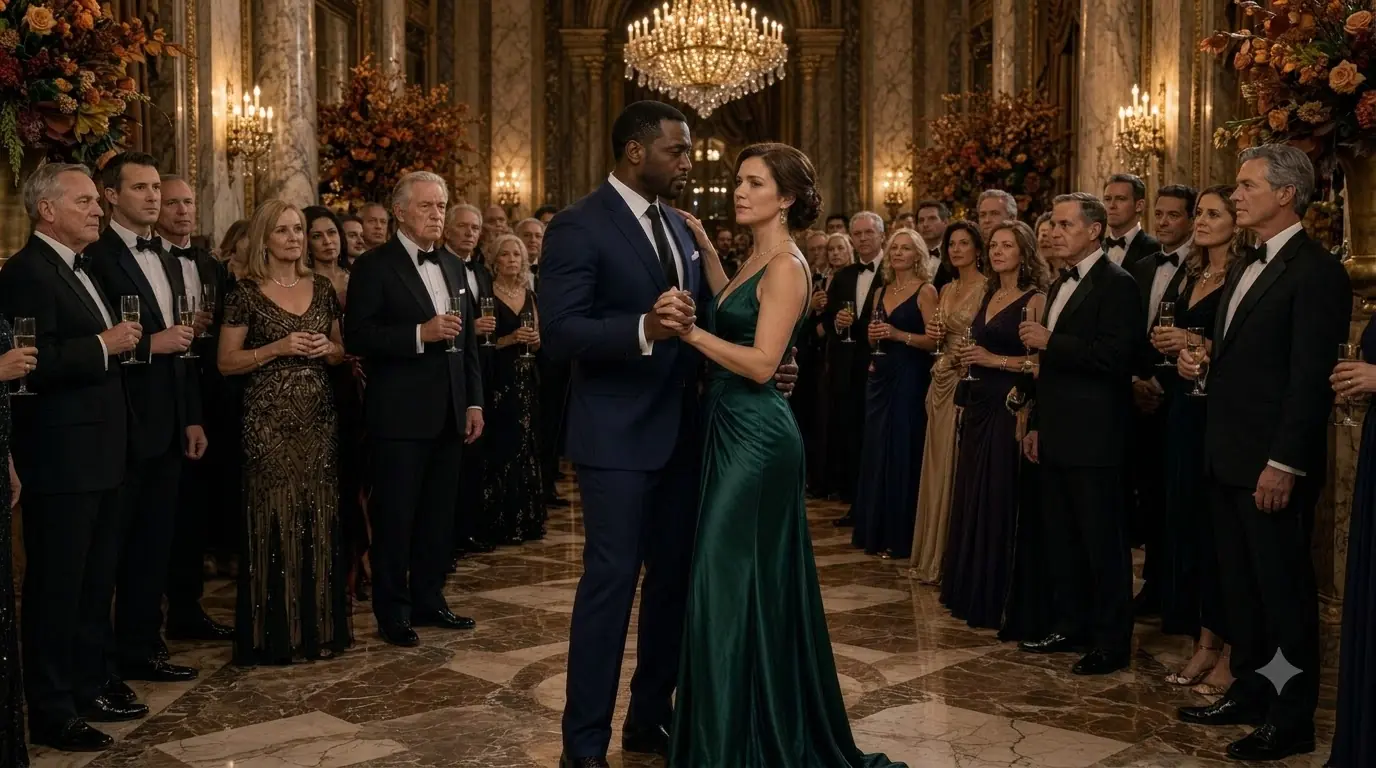
Her eyes had already found the man sitting alone at the last table. A man in a suit that had clearly been worn for years, not bought for the season, a man who had spent the entire evening trying his best not to be seen at all. She smiled the way people smile when they already know the ending of a story no one else has read yet. And when she reached him, she extended her hand and said only four words, "Just one dance." Laughter rippled through the nearest tables, quiet at first, then louder because everyone assumed this was a joke, a billionaire toying with a stranger for entertainment, a small performance of generosity meant to be forgotten by morning.
Nobody in that room understood that within 3 minutes, the laughter would stop completely, that within 10 minutes, the band would refuse to end the song and that within 30 minutes, the entire board of directors would be standing, phones lowered, mouths open, watching a truth surface that had been buried for 15 years, a truth none of them had any reason to expect on an ordinary autumn night in Chicago. Malcolm Rhodes had not wanted to come to Chicago that autumn. The wedding invitation had sat on his workbench for 2 weeks, propped against an old piano frame he was restoring and every time he glanced at it, he considered throwing it away. He owned a small studio on the west side of the city, a narrow brick building where broken pianos went to be reborn, filled with the smell of sawdust and old varnish. The walls lined with instruments in various stages of repair, and he preferred the quiet of that work to the noise of rooms like this one.
His wife had been gone for years now, taken slowly by an illness that left him alone in a house too large for one man. And in the silence that followed, he had learned to build a life out of small, careful things, out of restoring what other people had given up on. Nathan Holloway had been a client years earlier, a young man who had brought in his grandmother's baby grand and left with more than a repaired instrument, leaving instead with a quiet respect for the man who had spent 3 months bringing a dead piano back to life. They had stayed in touch in the loose way men do, a phone call at Christmas, an email when something important happened. And when Nathan called to say he was getting married, Malcolm had not been able to say no.
So, he stood at the edge of a room full of executives and investors holding a glass of water because he did not drink at events like this, wearing the same navy suit he had worn to three funerals, and he let himself become invisible, the way he always did around people who measured worth in numbers on a screen rather than in the quiet, patient work of hands. Nobody in that room knew his name. Waiters moved past him with trays, glancing twice because his posture did not match the folding chair he sat in, straight-backed and still in a way that seemed out of place among men slouched over cocktails. One man, silver-haired and sharp-eyed, actually mistook him for staff, asking without apology where the extra place settings had been stored. Victor Langford, a board member with a reputation for looking through people rather than at them, tapped Malcolm on the shoulder near the bar and asked him to help carry a case of wine to the kitchen.
His tone carrying the easy assumption of a man who had never once been told no. Malcolm looked at him for a long moment, said nothing, and then simply smiled, a small, unreadable smile that gave away nothing before turning back to his water glass. He did not explain who he was. He never did. Explaining had never fixed the way certain rooms looked at him and he had stopped trying decades ago, choosing instead to let his silence answer for him, which it did in ways none of these people yet understood in a patience that had nothing to prove and nowhere left to rush.
Then the doors at the far end of the hall opened and the entire room rose to its feet the way a congregation rises for a bride. Vivian Sterling walked in and for a moment she was simply the guest of honor's closest friend, one of the youngest chief executives in the country, a woman whose hotel empire stretched across four continents and whose name appeared on magazine covers more often than she cared to count. She wore confidence the way other women wore jewelry, effortless and inseparable from her. And every person in that room understood in one glance exactly why the company she ran had grown as fast as it had. Every camera in the room turned toward her.
Her breath catching somewhere between her chest and her throat. And for a heartbeat that felt far longer to her than it looked to anyone watching, Vivian Sterling simply stood still, staring at a stranger in an old suit as though the last 15 years had folded themselves into a single second and deposited themselves, without warning, directly in front of her. The wedding moved forward the way weddings do, with vows and applause and the clinking of champagne glasses. But Vivian's attention kept drifting back toward that last table, toward the man who refused to look up at her again after that first frozen moment. She smiled through toasts she barely heard, danced through pleasantries with men who wanted her investment more than her company, nodding at conversations about quarterly earnings and hotel expansions, while a much older question kept surfacing beneath the surface of her thoughts.
All the while, something old and familiar tightened in her chest, a feeling she had not allowed herself in years, one she had buried beneath boardrooms and airports and the endless demands of running an empire. Celeste, the bride, caught her staring once across the room and asked, laughing, if Vivian had seen a ghost, and Vivian had simply smiled and said that perhaps she had. When the orchestra finally shifted into the opening bars of a waltz, the dance floor stayed empty, the way it often does at the beginning. Guests waiting for someone braver to move first, glasses held loosely, eyes drifting toward the polished floor with quiet anticipation. Vivian set down her glass.
She did not look at Nathan or Celeste for permission, did not glance at the board members watching her every move the way they always did, calculating what her next choice might mean for stock prices and headlines and tomorrow's business pages. She simply walked in a straight unhurried line directly toward the last table, heels striking the marble with a steady, deliberate rhythm. And the entire room turned to watch her go. She stopped in front of Malcolm and held out her hand exactly the way she had done once before in a life that felt impossibly far away now, in a rented studio that no longer existed under fluorescent lights that had long since been replaced. "Just one dance."
She said again, softer this time, meant only for him, even though half the room could hear it, her voice carrying none of the boardroom steel it usually held. Malcolm did not move at first. He looked at her hand, then at her face, searching for something. Perhaps confirmation that this was truly happening and not some trick of memory conjured by too much champagne and too many years of quiet regret. He shook his head, quietly declining, the way a man declines something he wants too badly to trust himself with, afraid of what accepting might unravel.
Vivian did not withdraw her hand. She leaned in slightly and her voice dropped even further, carrying only the weight of certainty. "One last time." She said, and something in those three words cracked through 15 years of silence. Malcolm looked at her for a long moment, his jaw tightening, his eyes searching hers one final time.
And then, slowly, he rose from his chair. Laughter broke out again near the front tables, quieter, but sharper now, edged with disbelief. And Victor Langford, grinning at his neighbor, murmured a bet that the whole thing would be over inside a minute, that whatever this was, it would end in embarrassment for everyone except Vivian, who could afford embarrassment the way other people could afford lunch. Nobody at that table lowered their voice enough to keep Malcolm from hearing every word of it, and still he said nothing, letting his silence carry him toward the floor. The first notes of the waltz rose into the room, and Malcolm placed his hand at Vivian's waist, the way a man remembers an old address he thought he had forgotten.
The first step landed clean, unhurried, precise, his weight shifting with a certainty that seemed almost impossible for a man who supposedly had not danced in over a decade. Vivian felt it immediately, the way his frame did not waver, the way his hand found the small of her back with exact and practiced certainty, and something in her chest loosened for the first time in years, a knot she had carried so long she had nearly forgotten it was there. Conversations around the room began to quiet, first at the tables nearest the floor, then further back, as more and more guests noticed that something extraordinary was unfolding in front of them, something none of them had words for yet. This was not the stiff, careful movement of a stranger being polite, this was the fluid, unmistakable language of someone who had once lived and breathed this exact art form, someone whose body still remembered every count, every turn, every silence between the notes, as though 15 years had simply been a long pause between two halves of the same song. By the second measure, the two of them had fallen into a rhythm so seamless that the space between them seemed to disappear entirely, replaced by something that looked to everyone watching like memory made visible.
Malcolm turned Vivian with a hand that barely seemed to touch her, and she followed as though her body had never forgotten the exact pressure of his palm, the exact timing of his lead, her gown trailing behind her in slow, deliberate arcs across the marble. Nobody in that ballroom could look away now. Phones that had been raised to capture wedding toasts instead turned toward the dance floor, capturing a moment none of them fully understood, but all of them recognized as rare, a spectacle no camera could quite explain in words. The band leader, sensing something larger happening in front of him, extended the piece far beyond its written length, letting the musicians drift into improvisation, watching the couple the way a conductor watches a soloist who has taken flight beyond the page, unwilling to be the one who cut the moment short. Guests who had been seated rose to their feet without deciding to, drawn upward the way people are drawn toward fire or thunder, unable to explain the pull, but unwilling to resist it.
Older couples who had not danced together in years found themselves gripping each other's hands, remembering their own lost rhythms, while younger guests simply stared, transfixed by something they had no name for, but understood instinctively as rare and true. Someone near the entrance had already sent the video out into the world, and within minutes it was circulating among the very phones in that room. Guests watching their own present moment reflected back at them in real time, the strange loop of a memory being made and consumed simultaneously. Helena Brooks, the company's vice president, stood near the bar with her drink forgotten in her hand, watching Vivian move with an ease she had never once seen in a boardroom, an ease that made the powerful woman she worked for look, for the very first time, simply human, simply a woman remembering something she had lost. And still, nobody understood the deeper truth of what they were witnessing.
That this was not two strangers discovering a spark, but two people who had once shared a stage and a dream finding their way back to a language they had never truly forgotten how to speak. Arthur Mason, the owner of the hotel hosting the wedding, watched the entire scene unfold from a discreet position near the entrance to the kitchen, a position he had occupied at hundreds of weddings over the years without ever once feeling the need to step further into the room. He had seen countless first dances, countless toasts, countless moments engineered for photographs that would fade in importance within a year. What he watched that evening felt different, and he found himself lingering long after his usual departure time, unwilling to miss whatever came next. When the waltz finally ended and the applause began to settle, Arthur noticed that neither Malcolm nor Vivian moved to rejoin their separate tables.
Instead, they stood together near the edge of the floor, close enough to speak quietly, far enough from the crowd to avoid being overheard. Two figures caught in a conversation that clearly mattered more to them than anything happening around them. He signaled quietly to a member of his staff to prepare the small, private lounge just off the main ballroom, a room usually reserved for wedding parties who needed a moment away from the noise, sensing without being told that these two people would need exactly that kind of space before the night was over. 15 years earlier, Vivian Sterling had not yet built an empire. She had been a graduate student then, sharp and ambitious but not yet hardened, working long nights on a business degree that promised a future she could not yet fully picture.
And on the weekends, she disappeared into a world entirely separate from lecture halls and internships, a world of sequined gowns and polished floors and competitive ballroom dance. It had been her one true escape, the single place where numbers and spreadsheets fell away and only rhythm mattered. She had entered the regional championships that year with a partner assigned almost by accident, a young man from the South Side with quiet eyes and hands that moved like they had been trained by something older than technique, something closer to instinct. Malcolm Rhodes had been that partner. And together they had become something the judges could not stop watching.
A pairing so natural that other competitors began quietly asking who had choreographed them, refusing to believe that the chemistry on that floor was simply theirs, born from nothing more than two people who understood each other without needing words. They trained for months, hours after his day job and her classes, meeting in a rented studio that smelled of rosin and old wood. The mirrors along one wall cracked in the corner, the radiator clanking through every winter session. And somewhere between the counts and the corrections, something had grown between them that neither had planned for, something neither of them had dared to name out loud. They were close to winning that year, close enough that people had already begun speaking their names together as the pair to watch at Nationals, close enough that a small dance magazine had even asked to photograph them for a feature that never ran.
And then, without warning, Malcolm simply vanished. He did not appear at their final rehearsal before the championship. He did not answer her calls, did not respond to the messages she left at his apartment, did not show up at the studio where they had spent nearly a year building something rare, something Vivian had quietly begun to believe might last far beyond any trophy. She waited outside that studio for three nights in a row, certain each time that he would eventually appear. And each time she had walked home alone through streets that felt colder than they had any right to be in early spring.
Vivian competed with a substitute partner and placed far lower than she should have. But the loss on the scoreboard meant far less to her than the silence that followed it. A silence that stretched into weeks, then months, then years. She never learned why he had disappeared. She built her career instead, channeled the same discipline that had made her a formidable dancer into building a company, climbing from an entry-level analyst position into an office with her name on the door in less time than anyone expected.
And for 15 years, she carried a version of Malcolm frozen in her memory. A question she had never been able to answer, no matter how successful she became. Now, on a dance floor in a hotel ballroom with an entire wedding watching, she finally had the chance to ask it. As the waltz drew to its final measures, Malcolm guided her into one last slow turn. And when the music stopped, neither of them stepped back immediately.
The applause that followed was loud and long, but Vivian barely heard it. Her eyes fixed on his face, searching it for the truth she had been denied for so long. Later, away from the noise in the small private lounge Arthur had quietly prepared for them, the sound of the reception fading into a distant hum beyond the closed doors. Malcolm finally gave her the answer she had waited 15 years to hear. He sat across from her on a low couch, his hands folded loosely in his lap, choosing his words the way he once chose the exact pressure of a hand on a partner's back, careful, deliberate, unwilling to rush what had waited this long to be spoken.
His mother had fallen seriously ill that spring, he told her. A diagnosis that arrived without warning and drained the family savings within months. His father had already been gone by then, and there had been no one else to carry the weight, so Malcolm had carried it alone, taking whatever work he could find, setting aside every dream that did not put food on the table or medicine in his mother's hands. He told her he had walked away from the championship without a word because he had not known how to explain it without sounding as though he were asking for pity, and pity was the one thing he could not afford to accept from anyone, least of all from her. His mother had raised him alone after his father passed, had worked double shifts to pay for the very first pair of dance shoes he ever owned.
And when the illness came, he had known instantly that there was no version of his future that did not begin with taking care of her first. He sold what little he had, took work wherever it appeared, in warehouses, in kitchens, in the back rooms of shops that needed hands more than resumes, and every dollar went toward doctors and medicine and the small, quiet dignities his mother deserved in her final years. He had watched her career rise from a distance over the years, had seen her name in newspapers and business magazines left behind on train seats and in waiting rooms, and every single time he had told himself it was better this way, that a woman building an empire had no room for a man who spent his mother's final years scraping together rent money. He never mentioned the nights he had spent restoring instruments instead of sleeping, teaching himself the trade from library books and second-hand manuals, because it was the only skill he had left that did not require him to leave his mother's bedside for long. He never told her how many times he had almost written to her and stopped himself, the letter half finished and then torn apart, convinced that reappearing would only complicate a life she had clearly built without him, that showing up as a man with nothing would only remind her of everything she had left behind by choosing not to wait.
Vivian listened without interrupting, her hands folded tightly in her lap, and when he finished, she said nothing for a long while, simply looking at him the way a person looks at a photograph they had believed was lost forever. For the first time since the championship they never finished, she finally understood not just the facts of what had happened, but the quiet, aching cost of the choice he had made alone, A cost he had carried in silence for 15 years without once asking anyone to share the weight of it with him. Word of the dance did not stay contained within the wedding for long. By the following morning, Victor Langford had already begun asking questions no one had asked him to ask. Uneasy at the sight of his chief executive so visibly moved by a man from outside their world, a man he had personally mistaken for hired help less than an hour before that waltz began.
He hired someone quietly, the kind of researcher corporations use when they want answers without leaving fingerprints, expecting to find nothing more than a convenient explanation he could dismiss over lunch. Within days, a folder landed on his desk that told a story far different from the one he had assumed. Malcolm Rhodes, it turned out, had once been recruited by some of the most prestigious dance academies in the country, offered scholarships and sponsorships that most young dancers would have surrendered anything to receive. His name listed in old competition archives beside titles Victor did not recognize, but which meant a great deal to the people who still remembered them. There were records of a contract worth well over a million dollars from a national touring company, a contract he had declined without explanation, at the very moment his career could have taken off in front of the world.
Walking away from more money than most executives in that ballroom would see in several years combined. He was, by every account the researcher could find, something close to a legend in circles Victor had never bothered to enter. A man whose name still surfaced in conversations among choreographers who wondered, even now, what might have become of him had circumstances been kinder. The information spread through the company the way information always does, in murmurs near the coffee machine, in messages passed between assistants who were not supposed to know but always did, in the particular hush that falls over an office when everyone suddenly knows something they are pretending not to discuss. Attitudes shifted almost overnight.
People who had dismissed Malcolm as a curiosity at a wedding now found themselves reconsidering everything they thought they understood about status and success, uncomfortable with how quickly they had assumed the worst about a man simply because his suit was old and his manner was quiet. Helena Brooks found herself defending him in a meeting where his name came up unexpectedly, surprised at her own certainty as she reminded her colleagues that greatness rarely announces itself the way they had all been trained to expect, that the quietest man in a room is sometimes the one with the most reason to speak and the least need to prove it. Victor, for his part, said little in the days that followed, unwilling to admit that his research had backfired, that instead of exposing a stranger who did not belong among them, he had only confirmed how badly his own assumptions had failed him, a discomfort he carried privately and never once mentioned aloud. It did not take long for Vivian to decide what she wanted to do next, and it did not take long for Malcolm to make clear that he wanted no part of it. She proposed, gently at first and then with growing conviction, that he step forward publicly, that he allow the story of the dance and the man behind it to become part of her company's next campaign, an image of resilience and quiet brilliance that she believed the world deserved to see, complete with photographers and interviews and a launch event already forming in the back of her mind before she had even finished the sentence.
Malcolm listened to her pitch in the same studio where he restored pianos, surrounded by half-finished instruments and the smell of varnish, his arms crossed loosely as he leaned against a workbench worn smooth by years of use. And when she finished, he simply shook his head. He told her plainly that he had spent his whole life avoiding exactly this, the transformation of his private pain into a marketable story, a narrative other people could package and sell without ever understanding what it had actually cost him to live through it, without ever knowing what it felt like to watch his mother's hands grow thinner by the week while he counted coins for the bus. They argued that afternoon in a way neither of them had argued with anyone in years, voices rising and softening in turns, each of them refusing to fully yield, the studio filling with a tension neither piano nor varnish could soften. Vivian accused him of hiding behind humility, of denying himself recognition he had earned a decade ago and still deserved now, of letting old wounds decide his future the way he had once let them decide his silence.
Malcolm told her that recognition built on other people's terms was not recognition at all, that he had learned the hard way what it meant to be seen only as useful, only as a story that made someone else look generous, a lesson he had absorbed long before he ever met her and had no intention of unlearning now. His voice never rose above a certain register, but the conviction beneath it was unmistakable. The conviction of a man who had rebuilt his entire life around the simple, stubborn insistence that his worth did not require an audience. Somewhere in the middle of that argument, Vivian stopped pushing and simply looked at him. Really looked.
Past the argument and into the man standing in front of her, and understood with sudden clarity that the very quality she was trying to package for public consumption, his refusal to trade dignity for visibility, was the exact quality that had made her fall for him 15 years earlier and never quite let go. No matter how many boardrooms or headlines had tried to fill the space where he used to be. She left the studio that evening without an agreement between them, but with something far more valuable settling quietly into place. A respect that had nothing left to prove. Driving home through streets slick with early rain, Vivian found herself replaying the entire conversation, turning Malcolm's words over the way she once turned over a difficult clause in a contract, searching for the flaw in his logic, and finding instead only the outline of a man who had simply never stopped being exactly who he was.
She thought of the countless campaigns her company had run over the years, the polished stories of resilience packaged for shareholder meetings and investor decks, and for the first time, she wondered how many of those stories had cost the people living them far more than anyone in her boardroom had ever bothered to ask. That night, she did not draft a new proposal. She simply sat by her window with a cup of tea long gone cold, thinking about a rented studio with cracked mirrors and a radiator that never quite worked, and how strange it was that 15 years later the same man was still teaching her something about what mattered and what did not. Weeks later, Vivian organized a charity gala unrelated to any campaign, a modest evening meant to raise funds for arts programs in neighborhoods that rarely saw money like hers, the kind of neighborhoods where a piano teacher's fee could mean the difference between a child finding a gift and never knowing it existed. She invited Malcolm not as a story, but simply as a guest.
No photographers arranged in advance. No press release drafted for the occasion. And this time, when she asked him to dance, there was no laughter anywhere in the room. Word of the wedding had traveled far enough by then that people already understood, in some instinctive way, that they They about to witness something they should not interrupt with commentary, something that deserved silence rather than spectacle. When the orchestra began a slow, aching tango, guests stepped back from the floor almost in unison, clearing space the way a congregation clears space for something sacred.
The low murmur of conversation fading into stillness. Malcolm and Vivian moved together with none of the hesitation that had marked their first dance. Their bodies speaking a language 15 years in the making. Each movement sharper and more deliberate than before, carrying weight that had nothing to do with performance and everything to do with two people finally allowing themselves to be fully seen. This was not a display for cameras or investors.
It was closer to an apology neither of them had been able to voice in words. A conversation carried entirely through the language they had first learned together as young dancers who believed nothing could ever separate them before life had proven otherwise. And then, against every reasonable expectation, brought them back together anyway. Vivian let her head tilt slightly toward his shoulder in one long extended turn. And the room seemed to hold its breath along with her, watching two people move through 15 years of unspoken history in under 4 minutes.
Malcolm's hand pressed firm and certain against the small of her back guiding her through a final dramatic dip that drew a collective gasp from the watching crowd. His eyes never once leaving hers. When the final note faded, there was a pause before the applause came. A brief and total silence as though everyone present understood they had witnessed something too personal to greet with immediate noise. Then the room rose as one, applause swelling and stretching far longer than any performance that evening had earned.
And somewhere near the back, even Victor Langford found himself standing, clapping slowly, unable to explain why his throat felt tight, why a man who had once ordered Malcolm to carry wine crates now found himself unable to look away from him. It was Nathan Holloway who finally revealed the piece neither of them had known to ask about. Sitting with Malcolm over coffee weeks later, in the quiet of the piano studio, surrounded by the same half-restored instruments that had witnessed the argument between Malcolm and Vivian months before, Nathan admitted with a small, guilty smile that the wedding invitation had never been a coincidence. He had learned, quite by accident, at a dinner years earlier, that Vivian occasionally mentioned an old dance partner from her graduate school years, a name she never explained further, no matter how many times someone asked, her voice always trailing off into something wistful, before she changed the subject entirely. Nathan had filed that detail away without quite knowing why, and later, when the piano restoration brought him into Malcolm's orbit, he had put the two pieces together almost without meaning to.
Nathan had done a little digging of his own, found Malcolm's studio through an old business registry, and sent the invitation with far more intention than Malcolm had ever guessed, addressing it personally rather than through the wedding planner, as he had done with every other guest. He told Malcolm plainly that he had wanted to give Vivian something money could not buy her, a chance to close a door that had been left open for 15 years. Whether it ended in reunion or simply in peace, and that watching the two of them dance that night had told him he had made the right choice, regardless of how it unfolded from there. Malcolm sat with that revelation for a long moment before laughter finally broke through, low and surprised. The sound of a man realizing how much of his fate had been quietly engineered by someone else's kindness, a kindness he had never once suspected.
He shook his head slowly, turning a half-finished piano key over in his hand, marveling at how a single decision by a near stranger had rewritten the direction of his entire life. When he told Vivian the truth later that week, over dinner in a quiet restaurant far from any camera, she laughed, too. First in disbelief, and then in something closer to gratitude, understanding at last that the universe had needed a small, deliberate push to do what neither of them had been brave enough to do alone. She reached across the table and took his hand, not in the practiced way she extended it at galas, but simply, quietly, the way one old friend reaches for another. 15 years of unanswered questions, of assumptions built on silence, dissolved in that single conversation, replaced by something simpler and far more durable.
The plain relief of finally knowing the whole truth after carrying half of it for so long. A year passed, and the story that had once traveled through wedding guests and company hallways settled into something quieter and more permanent. Vivian founded a small organization she called the Sterling Arts Foundation, built not for headlines, but for the kind of young talent that circumstance so often crushes before it has the chance to bloom. Dancers and musicians whose families could not afford the doors that had once opened so easily for her. She poured a portion of her own fortune into it before ever asking the board for a dollar, unwilling to let this particular project become a line item debated in committee.
A decision that surprised even Helena Brooks, who had come to expect calculated moves from her chief executive rather than purely personal ones. Malcolm agreed to serve as its artistic director, not because he wanted his name attached to anything larger than himself, but because he understood better than almost anyone alive exactly what it meant to walk away from a gift because life had left no other choice. And he could not bear the thought of another young person facing that same impossible decision without someone in their corner. Together they built a program that offered scholarships instead of charity, mentorship instead of pity, funding auditions and studio time for teenagers who reminded Malcolm more than he ever admitted aloud of the young man he had once been before the world asked too much of him too soon. The foundation grew faster than either of them expected.
Within months, they had placed a dozen young dancers into serious training programs, paid for the shoes and costumes and travel that so often stood quietly between talent and opportunity. The kind of small, unglamorous expenses that rarely made headlines, but decided entire futures. Malcolm spent his mornings at the studio restoring pianos as he always had, and his afternoons at the foundation, walking through rehearsal rooms with the same quiet attentiveness he once brought to a broken instrument, watching for the exact place where a young dancer's technique needed the gentlest correction rather than the harshest one. Vivian, for her part, learned to step back from the spotlight she had spent a lifetime perfecting, content instead to watch from the side of the room as Malcolm worked, understanding that some of her greatest contributions now came not from being seen, but from making space for someone else to be. Victor Langford, in a gesture that surprised everyone who knew him, quietly arranged for the foundation's first major grant without ever taking credit for it, a small correction to a debt he never spoke of, but clearly still felt.
They did not seek publicity for any of it, choosing instead to let the work speak in its own quiet register, the way both of them had always preferred to live. At the foundation's opening gala, held in a smaller, warmer room than the ballroom where this had all begun. String lights strung low across the ceiling instead of chandeliers, the orchestra chose to close the evening with the very waltz that had started everything. Vivian crossed the room the same way she had crossed it a year earlier, unhurried, certain, her gown simpler now, her smile softer, and stopped in front of Malcolm with her hand extended exactly as before. "Just one dance," she asked.
And this time, there was no laughter anywhere in the room, only a warmth that had replaced disbelief entirely, replaced it so completely that some of the younger dancers watching did not even know there had ever been anything to laugh at. Malcolm answered with nothing but a smile, taking her hand the way a man takes hold of something he has finally stopped being afraid to keep. They moved onto the floor together as applause rose around them, sustained and unbroken, filling the room the way it had once filled a ballroom full of strangers who had no idea what they were witnessing. This time, nobody watched them with curiosity or doubt. They watched with something closer to recognition, the particular kind of respect reserved for two people who had lost each other, found their way back through 15 long years of silence, and turned a single dance into the beginning of an entirely new life.
Among the guests that evening stood a handful of the foundation's youngest scholarship recipients, teenagers who had never known a world without struggle, watching a woman who ran hotels across four continents and a man who mended broken pianos move together as though nothing in the world could ever separate them again. For those young dancers, the lesson was not about wealth or fame at all, but about the quiet, stubborn truth that talent delayed is not talent lost, that a life interrupted by hardship can still, against every reasonable expectation, find its way back to the music. Neither Malcolm nor Vivian sat down again that night. Not because the music demanded it, but because for the first time in a very long while, neither of them wanted to. And somewhere in that warm, unassuming room, 15 years of waiting finally, quietly, came to rest.